
The most repeated advice about first party data is to collect as much as you can, unify it into one guest profile, and let marketing sort out the uses later. For a US venue, that advice runs in the wrong direction. The profile isn't the asset. The permission attached to each field is, and a smaller file where every field carries a live, checkable permission will out-earn a large one where half the records can't lawfully be switched on.
Picture a guest who taps your WiFi splash page on a Friday night. She wants the network, nothing else. She types an email address because the page asks for one, leaves every marketing box blank, and connects. Six weeks later an offer arrives for a bottomless brunch she never asked about. Nothing about that send was technically difficult. It was not permitted, and the fact that the address sat in your CRM made it feel permitted to whoever built the list.
That gap between what a venue collects and what it may use is the whole strategy. What follows is the briefing a network lead should give a marketing team: which fields you hold, what each one is allowed to do, and which records get activated this quarter. It ends with a yes or no on your own file, not a slogan about personalization.
What a first party data strategy decides
First party data is information your organization collects directly from people through channels it owns: the website, the app, the loyalty program, the booking engine, the register and guest WiFi. It is not data bought from a broker, and it is not a partner's list passed across under a contract.
The confusion many organizations run into is thinking the job is volume. It isn't. A venue with 40,000 WiFi sessions a year can already hold more data than it can lawfully use. The core work is a set of five decisions, and every field in your estate sits downstream of them.
- Which fields exist at all. Name them. Email, cell phone number, zip code, date of birth, visit history, zone dwell time, survey answers, ad identifiers.
- Which purpose each field serves. Network access, aggregate reporting, identified measurement, personalization, email offers, SMS offers, partner sharing.
- Whether consent is needed for that purpose. Some purposes run on the service itself. Others don't.
- Which channel may use it. Permission for email is not permission for text, and neither is permission for on-site messaging.
- When a record must stay unused. The field exists, the guest is real, and activation is still the wrong move.
Authenticated connectivity is the clearest example of why those decisions matter. When a guest joins your WiFi, the record created is operational identity. It exists so someone can get onto the network, and it belongs to the venue that runs the site. A promotion sits on top of that and needs its own permission, granted separately, at a moment when the guest can refuse.
Get those five decisions written down and the rest of the work is mechanical. Leave them implicit and every campaign becomes a judgment call made by whoever is closest to the send button.
Permission ledger for each guest data field
A larger guest profile is not automatically a more useful one. If a venue cannot show why it holds a field, what the guest was told, and which use the guest agreed to, that extra detail may be impossible to activate lawfully. A permission ledger keeps the record smaller and more dependable: one entry for each data field and purpose, stored where systems can check it before use.
For each entry, record six attributes: the collection timestamp, the notice version the guest saw, the channel scope (email, SMS or on-site messaging), the lawful basis, the source system (such as a splash page, register, booking or survey) and the opt-out status. Together, these details let a campaign manager check whether a particular use is permitted and provide a trail that can be reconstructed later. The same email address can have different permissions for different purposes, so a single “consented” flag is too blunt.
The FTC and state attorneys general guidance on cookies and similar technologies distinguishes technologies that are strictly necessary to provide a service the person requested from other uses. Analytics cookies are not automatically exempt. If a venue records an individual's actions, connects a visitor ID to a conversion, builds a profile from browsing activity or shares conversion data with an advertising partner, consent may be required. Aggregate, non-identifying statistics are different from tracking an individual. That distinction helps keep foot traffic reporting separate from personal data used for targeting.
| Data type | Typical example | Lawful basis | Consent needed | Permitted use |
|---|---|---|---|---|
| Strictly necessary connectivity | Authentication to deliver the WiFi session the guest requested | Contract or legitimate interests for the service | No, if strictly necessary and not used for marketing | Provide network access |
| Aggregate measurement | Non-identifying foot traffic or usage totals | Not personal data if truly aggregate | No, when no individual is identified | Venue reporting |
| Identified analytics | Visitor ID tied to pages, zones or conversions | Consent | Yes, analytics are not automatically exempt | Measurement of individual behavior |
| Email marketing | Email captured for offers | Consent, or soft opt-in where it applies | Yes, unless a valid soft opt-in exists | Email only |
| SMS marketing | Cell phone number for texts | Consent specific to texts | Yes | SMS only |
| Personalization profile | Preferences or visit history used to tailor a journey | Consent when used to profile an individual | Yes | Stated personalization purpose only |
| Ad-partner sharing | Conversion or identity shared with an advertising partner | Consent | Yes | That named sharing purpose |
| Survey response | Post-visit feedback linked to a guest | Consent or another valid basis for that survey | Usually yes if linked to marketing | The survey purpose stated on the form |
Rows venues get wrong
Identified analytics often gets treated as harmless measurement. Yet zone-level dwell time and repeat visits become individual tracking when a visitor ID links them to a person or conversion. The ledger should show the purpose and permission for that link, not just label the activity “analytics.”
Email captured at the door is another common source of confusion. If a splash page uses one checkbox for email, text messages, profiling and partner sharing, it does not clearly record separate choices for those uses. Record each purpose and channel independently, so the permission can be checked against the intended message.
Survey answers attached to a marketing record need the same care. A guest who gives feedback for service improvement has not necessarily agreed to have those answers used to build an offer profile. Record the stated survey purpose and keep marketing use separate unless the guest has agreed to it.
The test worth applying: if a field has no purpose, lawful basis and notice version recorded against it, do not treat it as an activatable lead.
Before a capture project begins, mark fields that fail those checks as not activatable. This prevents a large but poorly documented profile from being mistaken for useful permission. Purple publishes details of its guest WiFi data privacy approach.
How to collect data guests can lawfully give
Collection is a value exchange, and the exchange has to be real. A guest hands over an address because the WiFi is fast and the sign-in is short. That's the trade. Marketing consent is a separate, optional extra that the guest can decline without losing the network.
The the FTC and state attorneys general's direct marketing guidance sets the frame: identify a valid lawful basis before using personal data for direct marketing, with consent and legitimate interests the bases most likely to apply. For a WiFi-authenticated venue, that means storing the basis alongside the record rather than assuming it.
Here is the capture sequence that survives contact with a busy Friday night.
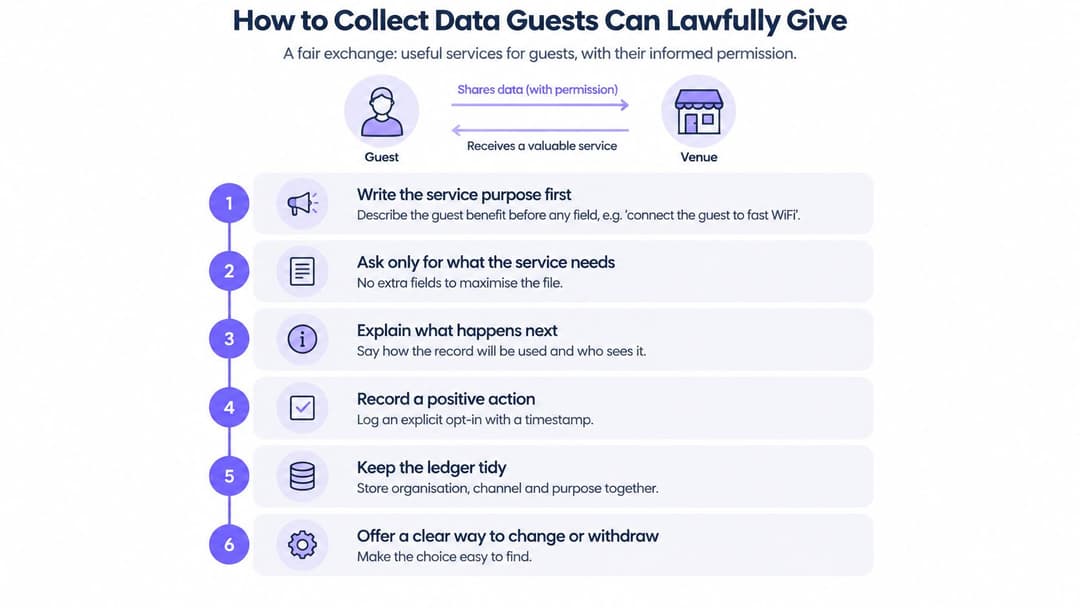
- Write the service purpose first. Connecting a guest to the WiFi is the purpose. List only the fields that session needs, which is usually an email address or a cell phone number for verification and little else.
- Put optional purposes on separate choices. Email offers, SMS offers, personalization and research each get their own line and their own explanation. One box for four purposes is a data-quality problem disguised as a convenience.
- Authenticate before you record an opt-in. Guests consent on the splash page before any marketing opt-in is recorded, and access works whether the marketing boxes are checked or not. Requiring a promotional check to reach the internet is the fastest way to invalidate a freely given consent.
- Record an active opt-in with its context. The positive action, the notice version and the time all get stored. The venue owns the guest data that our platform collects, so the record belongs in your systems under your governance.
- Keep it minimized. Date of birth, household composition and ad identifiers don't belong in a WiFi capture unless a stated purpose needs them. Every extra field is another row to govern and another reason for someone to question the file.
- Set retention and a withdrawal path. Each purpose needs a retention period, and the route to change or withdraw must be as easy as the route in. If someone has to email a manager to be removed, the design is wrong.
Where a later email campaign relies on the soft opt-in, keep it to existing customers, keep it tied to similar products, and put an easy opt-out in every message. The moment that stops being true, the basis is consent.
If access still works when every marketing box is left blank, the capture design is sound. If it doesn't, the collector in the room will check the box for the guest, and the permission is worth nothing.
The same principle holds for every other collection surface you run. If you're handling setting up online event registration for a venue event, the consent wording has to describe that event's purpose rather than fold attendees into the venue's general marketing list. Review how your current guest WiFi capture flow separates those choices before you scale it to another site.
Activate profiles only where permission matches
Activation is a filter, not a sync. A record should reach a channel only when the ledger row for that purpose is complete: organization, channel, positive action, timestamp and current status.
The the TCPA and CAN-SPAM guidance on electronic and telephone marketing sets out the standard this filter has to meet. Electronic mail marketing to individuals generally requires consent unless the soft opt-in applies, and that consent must be specific to both the organization and the communication type, whether email or text. It must also be freely given, involve clear positive action, and be as easy to withdraw as it was to give.
Five operating rules keep the filter honest.
Keep identity and purpose flags inside the CRM. Service authentication stays out of campaign audiences entirely. A guest who joined the network has confirmed nothing about wanting offers.
Build email audiences only from flags that are still true. Marketing automation should query the live flag, not a segment built last quarter. SMS needs its own permission, and a cell phone number captured for verification is not a text marketing opt-in.
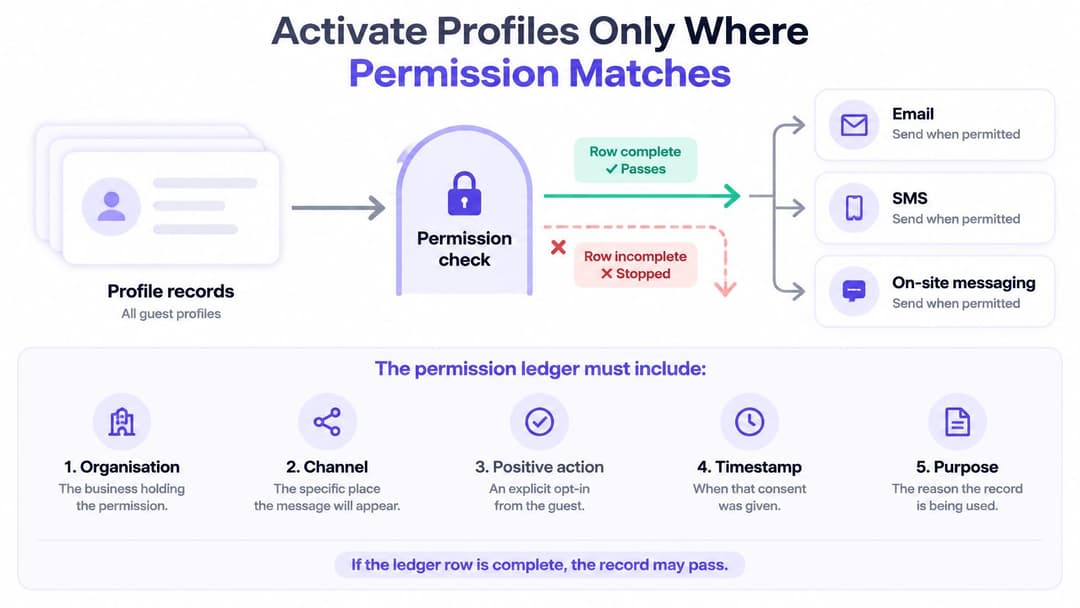
Report identified behavior only where that measurement purpose was consented, and keep aggregate counts on a separate feed so operations still gets its foot-traffic numbers without touching individual records.
Propagate objections everywhere. When someone objects, direct marketing stops or never starts. Copy that objection into every audience, report and export that would otherwise include them, including the ones a regional team built by hand.
Never swap the basis to keep a campaign alive. If consent was withdrawn and consent was the basis, moving to legitimate interests to continue the same marketing isn't a workaround, it's the failure the rules exist to prevent.
A returning guest still gets smooth network access, because that was the service purpose and it's still valid. A lapsed email flag blocks the offer. A group-booking contact's details are not permission for every guest at that table. Healthcare sites and student housing run the same split: operational access stays operational.
Practical rule: the send is allowed only when the channel flag is true at the moment of sending, not when the list was built.
This is also where restraint produces better marketing. The personalization guests notice tends to be small and specific, which is the argument smaller hospitality operators make about creating more personalized travel experiences with a narrow, well-understood guest base rather than a sprawling one.
How venues turn WiFi visits into usable records
Three patterns show how the rules translate into operations, and none of them depends on a bigger profile.
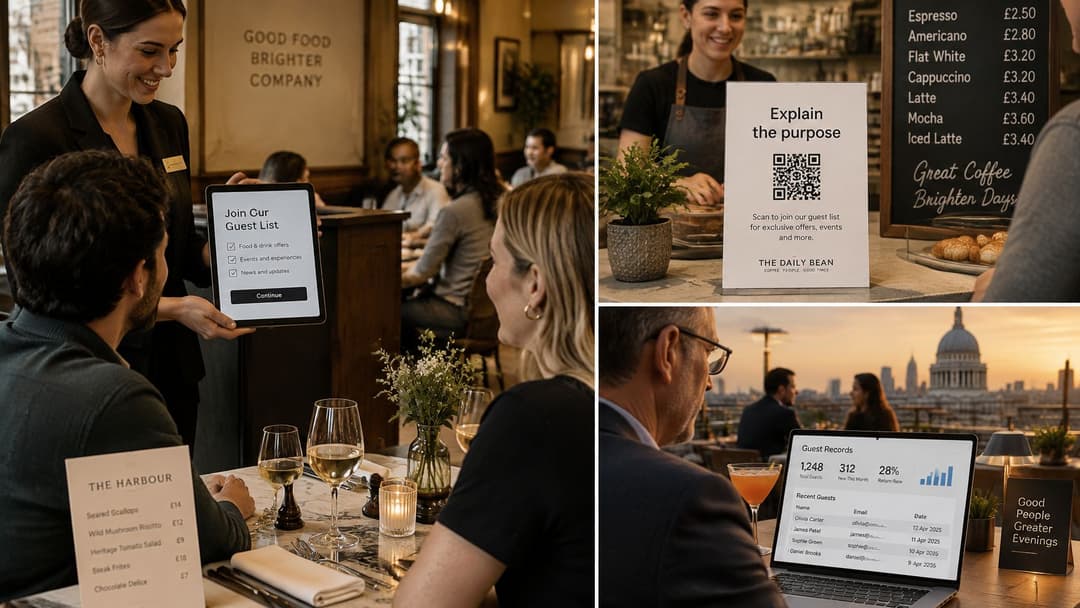
The restaurant group. Scale comes from repeated, permissioned visits rather than one oversized record. Pizza Express has built 2.5 million consented guest records across 8 million restaurant visits, which is a permission rate earned at the point of connection, visit after visit. Each session is a fresh chance to explain the purpose. None of it requires hiding a track or bundling four consents into one check mark.
The shopping mall. The marketing team uses WiFi to see which consented visitors return, then sends a personalized email to people who opted into that mall's offers. Zone-level counts of how many people passed through each level go into the operations report as aggregates, with no individual attached. Two questions, two datasets, one capture system. The mall's center manager never sees a personal record, and the marketer never touches the footfall feed.
The hotel or multi-family operator. A returning guest is recognized for smoother access, with the credential doing the work on the second visit. The spa offer and the resident newsletter each sit on their own flag. A resident who wants the gym WiFi to just work doesn't get enrolled in a wellness campaign, and a guest who joined for one night doesn't start receiving year-round promotions.
The failure mode is identical across all three: one checkbox at the door drafted to cover email, SMS, profiling and partners. It produces a file that looks impressive in a dashboard and cannot be activated with confidence anywhere. Operators describe the value differently. They talk about better profiles and visits driven by relevant communications, not about a bigger export.
A question worth asking of your own sites: which of these three patterns does each venue actually run today, and would the guest recognize the description?
Measure return after you refuse bad sends
More personalization is not automatically better. A campaign can lift conversion this month while growing suppressions, complaints and quiet churn, and the dashboard will report the first number and none of the rest.
The the FTC and state attorneys general guidance on consent or pay models is blunt on the mechanics that create this blind spot. People have an absolute right to object to direct marketing, and organizations must stop, or not start, using their information for that purpose. When consent is withdrawn and consent was the basis, an organization must not switch to another basis to continue the same marketing.
That reframes the measurement question. The number worth reporting is permission-adjusted return: incremental revenue minus the cost of consent management, preference enforcement, data-quality cleanup, and the contacts excluded by valid objections. Read your familiar campaign numbers through that definition.
| Raw metric | What it misses | Adjusted view |
|---|---|---|
| Open or click rate | Contacts who never had permission for that channel | Rate among profiles with a current channel opt-in |
| Conversion uplift | Later objections, complaints and suppressions | Incremental revenue after consent operations and excluded contacts |
| List size | Blanket check marks and outdated notices | Profiles with purpose, notice version and timestamp |
| Email or SMS revenue | Sends that should have been suppressed | Revenue after objected and invalid records are removed |
| Personalization lift | Messages with no matching purpose on the ledger | Lift only where that personalization use is permitted |
The adjusted view changes decisions. An offer that performs well but generates objections loses its shine once the excluded contacts and the admin cost are subtracted. A modest campaign sent only to a clean, current segment starts to look like the better investment, because nothing downstream has to be repaired.
Treat the non-send as a line item with a value. An inappropriate message avoided is a retained relationship, and a guest who never receives the wrong offer is a guest who still opens the right one. Report that beside raw revenue so the restraint is visible to whoever signs off the budget.
Keep authentication and other operational identity out of these marketing totals altogether. They belong to the service, not the campaign, and mixing them inflates both. Set the review on a guest WiFi analytics cadence you already run: if adjusted return falls once objected contacts are removed, shrink the audience rather than buying more data to top it up.
The counterintuitive result: in most venues, a quarter spent deleting unusable records improves reported marketing performance more than a quarter spent acquiring new ones.
Choose which records to activate next
A larger guest profile is not automatically more useful. In the US, extra fields can be unlawful to activate for a marketing purpose if the relevant permission is missing. Keep the file focused: a smaller, purpose-specific set of records with a reliable permission ledger is often the better choice.
Start by assigning each record to an activation status. Guests who authenticate only for network access remain service-only; their connection does not itself grant marketing permission. Records with a named purpose, lawful basis, channel, notice version, timestamp and current opt-in can be considered for that specific use. Quarantine records with a missing notice version, stale blanket check mark, objection or unclear purpose, and exclude them from the audience count.
Then test one purpose on one channel. Apply suppression before sending and compare permission-adjusted return with raw revenue. The point is to learn whether a clearly permitted segment performs, not to find a way to activate every field in the file.
For guest WiFi, check that the branded splash page separates marketing choice from network access. Guests must be able to decline marketing and still connect, and consent must be recorded before a marketing opt-in. Records can then sync through Purple integrations to the venue's CRM or marketing platform, carrying their permission information with them.
Where a review helps
Choosing a Purple plan depends on site count, data needs and existing integrations. Connect, Capture and Engage serve different needs, so choose the level that matches what the venue needs to collect and use. Capture and Engage are best discussed with an expert, who can explore the venue's goals and needs.
Keep the permitted file small enough to manage and specific enough to use. Do not activate a record for a purpose its permission does not cover. Purple's team can help you choose between Connect, Capture and Engage based on your site count, data needs and existing integrations, so start with a quick chat with one of its experts at Purple.