

Multi-Language Captive Portals: Best Practices for International Venues
This authoritative technical reference guide provides senior IT professionals with actionable strategies for designing and deploying multi-language Captive Portals. It covers advanced language detection architecture, RTL layout considerations, and GDPR-compliant legal copy localisation to ensure seamless Guest WiFi access across international venues.
🎧 Listen to this Guide
View Transcript
Executive Summary
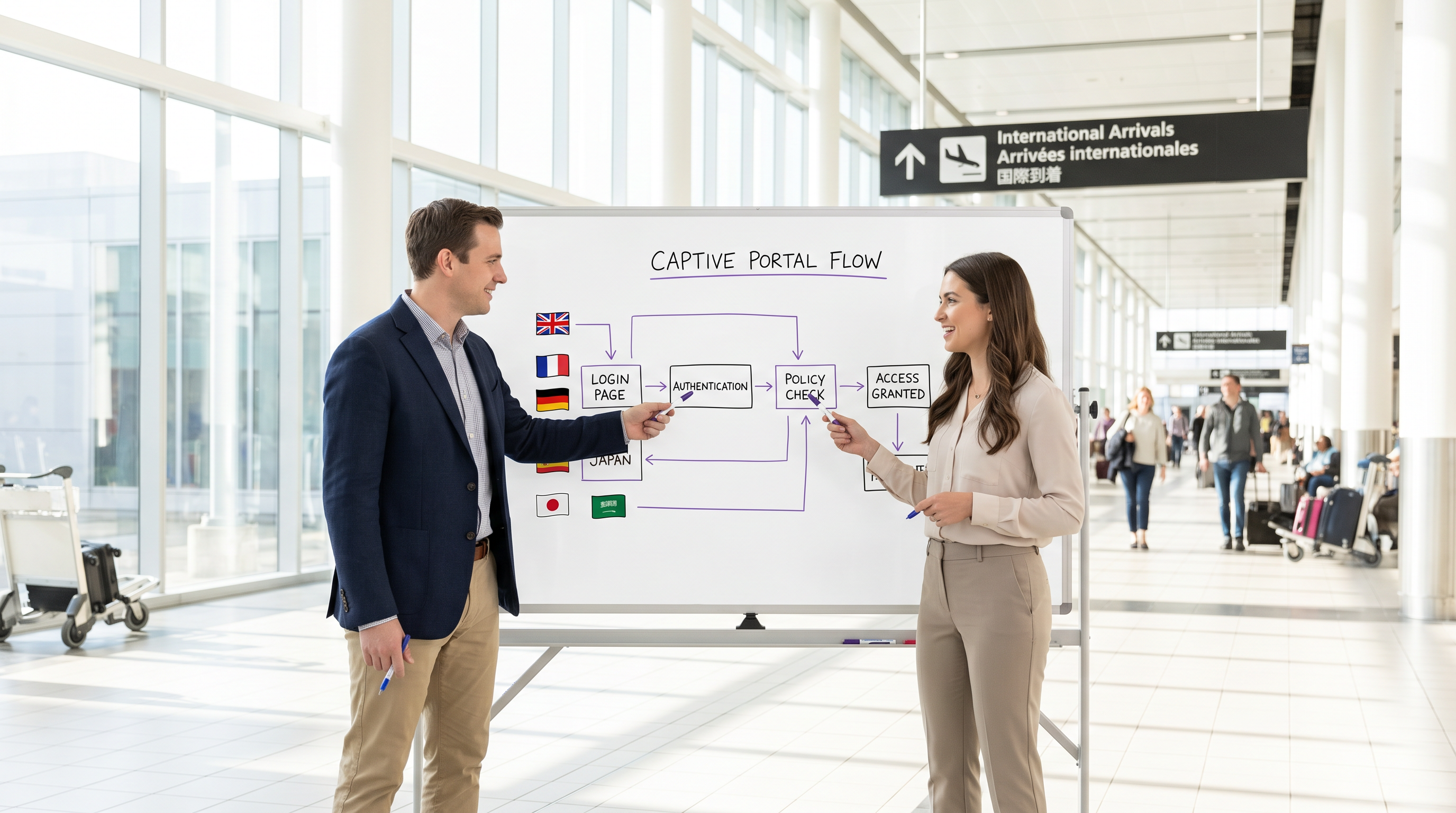
For international venues—whether major airport hubs, global hotel chains, or large-scale retail environments—the Captive Portal is often the first digital touchpoint a visitor experiences. A poorly localised portal not only degrades the guest experience but can also introduce significant compliance risks and reduce the efficacy of your WiFi analytics. This guide provides a comprehensive technical framework for deploying multi-language Captive Portals. We move beyond basic translation to address the underlying architecture of language detection, the complexities of Right-to-Left (RTL) UI rendering, and the stringent requirements for informed consent under GDPR. By implementing the strategies detailed here, IT managers and network architects can ensure their Guest WiFi infrastructure delivers a secure, accessible, and legally compliant authentication experience for visitors worldwide, ultimately supporting broader business objectives like those seen in Retail and Hospitality .
Technical Deep-Dive
The Language Detection Priority Stack
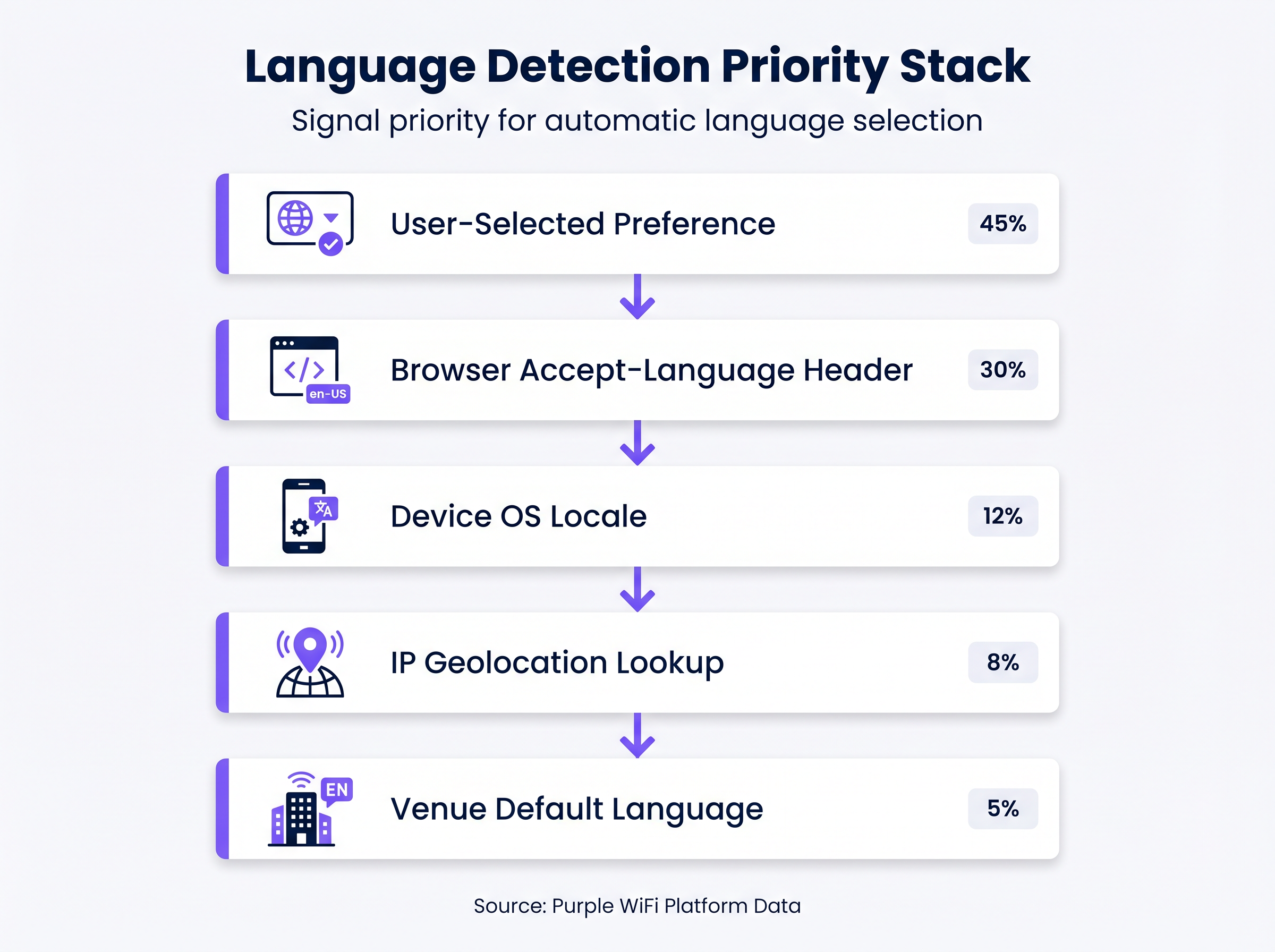
Relying solely on IP geolocation to determine a user's language is a common architectural flaw. In environments like airports or international conferences, users frequently connect via corporate VPNs or roaming data profiles, rendering IP-based geolocation inaccurate in up to 30% of cases. Instead, a robust Captive Portal must implement a multi-tiered priority stack for language detection:
- User-Selected Preference (Highest Priority): If a returning user has previously selected a language, this preference should be stored (e.g., via a persistent cookie or MAC address association in the backend) and applied automatically upon reconnection.
- Browser
Accept-LanguageHeader: This HTTP header provides a highly accurate reflection of the user's explicit device or browser settings (e.g.,en-US,en;q=0.9,fr;q=0.8). It should be the primary automated detection mechanism. - Device OS Locale: Where accessible, querying the underlying operating system locale provides a fallback if the browser header is inconclusive.
- IP Geolocation Lookup: Used only as a secondary fallback, this maps the source IP to a geographical region, though its limitations must be acknowledged.
- Venue Default Language (Lowest Priority): The ultimate fallback, typically the primary language of the country where the venue is located.
Handling Right-to-Left (RTL) Scripts
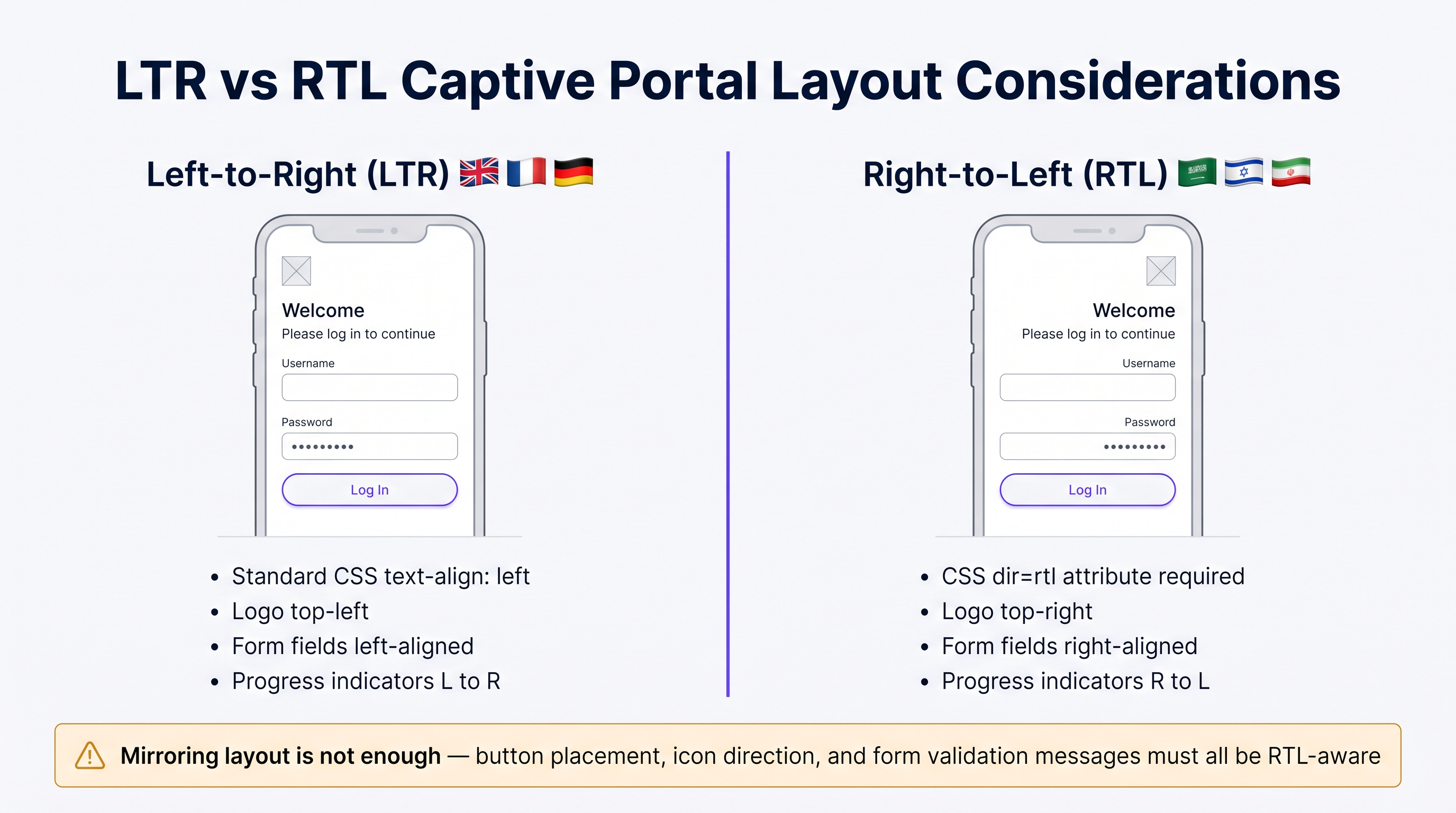
Deploying languages such as Arabic, Hebrew, or Persian requires more than simply translating the text; it demands a fundamental shift in the UI architecture. A portal designed exclusively for Left-to-Right (LTR) languages will break when rendering RTL content, leading to overlapping text, misaligned form fields, and an unusable interface.
Key technical considerations for RTL implementation include:
- Document Directionality: The HTML
dirattribute must be dynamically set tortl(<html dir="rtl">) when serving these languages. This instructs the browser to mirror the document flow. - UI Element Mirroring: All layout elements must be reversed. Logos typically placed in the top-left should move to the top-right. Form labels, input fields, and submit buttons must align to the right.
- CSS Framework Support: Modern CSS frameworks (like Tailwind or Bootstrap) offer RTL variants. Ensure your portal's build pipeline compiles these variants and serves them conditionally based on the detected language.
- Font Selection: Standard Latin fonts often fail to render Arabic ligatures correctly. Utilize robust Unicode fonts (e.g., Google Noto) to ensure proper character shaping and connectivity.
Implementation Guide
Step-by-Step Deployment Strategy
- Data-Driven Language Selection: Do not attempt to launch with 20 languages simultaneously. Analyze your existing WiFi Analytics to identify the top 5–7 languages spoken by your visitors. Focus your initial deployment on this subset to ensure high quality.
- Dynamic Content Delivery: Architect your portal to fetch translated strings dynamically from a Content Delivery Network (CDN) or a dedicated localisation service, rather than hardcoding them into the portal application. This decouples content updates from code deployments.
- Flexible UI Containers: German text can be up to 30% longer than English, while Asian languages may require more vertical height. Design UI containers (buttons, alert boxes, form fields) to be flexible. Avoid fixed widths and implement robust text overflow handling (e.g., CSS
text-overflow: ellipsiscombined with tooltips). - Standardised Date and Time Formatting: Avoid ambiguous date formats (like
04/05/2025). Always use ISO 8601 formatting (YYYY-MM-DD) or explicitly spell out the month in the localised language to prevent confusion regarding session expiry or terms acceptance.
Best Practices
Legal Copy and GDPR Compliance
Translating Terms of Service (ToS) and Privacy Policies is not merely a linguistic exercise; it is a strict legal requirement under regulations like GDPR. As highlighted in discussions around CCPA vs GDPR: Global Privacy Compliance for Guest WiFi Data , presenting complex legal copy in a language the user does not comprehend invalidates informed consent.
- Professiपेशेवर कानूनी अनुवाद: कानूनी दस्तावेज़ों के लिए कभी भी मशीन अनुवाद का उपयोग न करें। योग्य कानूनी अनुवादकों को नियुक्त करें जो विशिष्ट न्यायिक बारीकियों को समझते हों (उदाहरण के लिए, फ्रांसीसी CNIL बनाम जर्मन Datenschutzbehörde की आवश्यकताएं)।
- संस्करण नियंत्रण और ऑडिट ट्रेल: आपके प्रमाणीकरण बैकएंड को न केवल यह लॉग करना चाहिए कि उपयोगकर्ता ने शर्तों को स्वीकार किया, बल्कि शर्तों का कौन सा संस्करण उन्होंने स्वीकार किया, और किस भाषा में। यह ऑडिट ट्रेल नियामक पूछताछ के दौरान अनुपालन प्रदर्शित करने के लिए महत्वपूर्ण है।
समस्या निवारण और जोखिम न्यूनीकरण
"आंशिक स्थानीयकरण जाल"
एक सामान्य विफलता मोड प्राथमिक लॉगिन स्क्रीन का अनुवाद करना है जबकि त्रुटि संदेशों, सत्यापन चेतावनियों, या प्रमाणीकरण के बाद के स्प्लैश पृष्ठों को डिफ़ॉल्ट भाषा में छोड़ देना है। यह एक अप्रिय उपयोगकर्ता अनुभव बनाता है और विश्वास को कमजोर करता है। सुनिश्चित करें कि आपकी स्थानीयकरण मैट्रिक्स सभी विशिष्ट मामलों को कवर करती है, जिनमें शामिल हैं:
- RADIUS प्रमाणीकरण विफलता संदेश।
- फ़ॉर्म सत्यापन त्रुटियाँ (उदाहरण के लिए, "अमान्य ईमेल प्रारूप")।
- सत्र टाइमआउट चेतावनी।
- प्रमाणीकरण के बाद के रीडायरेक्ट और सफलता पृष्ठ।
ROI और व्यावसायिक प्रभाव
एक ठीक से लागू किया गया बहु-भाषा पोर्टल सीधे प्रमुख व्यावसायिक मेट्रिक्स को प्रभावित करता है। प्रमाणीकरण परत पर घर्षण को हटाकर, स्थल उच्च कनेक्शन दरें देखते हैं, जो बदले में उनके मार्केटिंग प्लेटफ़ॉर्म में अधिक मजबूत डेटा फीड करता है। इस मूल्य को मापने के लिए गहन जानकारी हेतु, गेस्ट WiFi पर ROI मापना: CMOs के लिए एक फ्रेमवर्क पर हमारी मार्गदर्शिका देखें। इसके अलावा, कई न्यायालयों में अनुपालन सुनिश्चित करने से पर्याप्त नियामक जुर्माने का जोखिम कम होता है, जिससे संगठन के लाभ की रक्षा होती है।
विशेषज्ञ ऑडियो ब्रीफिंग
इन अवधारणाओं पर गहन चर्चा के लिए हमारी 10 मिनट की तकनीकी ब्रीफिंग सुनें:
Key Terms & Definitions
Accept-Language Header
An HTTP request header sent by the browser indicating the user's preferred languages and locales.
This is the most reliable automated signal for determining which language version of the captive portal to serve.
RTL (Right-to-Left)
Scripts such as Arabic and Hebrew that are read from right to left, requiring specific HTML and CSS handling.
IT teams must ensure their portal frameworks support RTL variants to prevent layout breakage for these users.
Informed Consent
The requirement under GDPR that a user clearly understands what data is being collected and how it will be used before agreeing.
Presenting Terms of Service in a language the user does not understand invalidates informed consent.
Audit Trail
A secure, timestamped record of events.
Captive portals must maintain an audit trail showing exactly which version and language of the ToS a specific user accepted.
IP Geolocation
The process of determining a device's physical location based on its IP address.
Often inaccurate for language detection due to VPNs and roaming, and should only be used as a fallback.
Unicode Font Stack
A set of fonts designed to support a vast array of international characters and scripts.
Essential for ensuring that languages like Japanese or Arabic render correctly without 'tofu' (missing character boxes).
Text Overflow Handling
CSS techniques used to manage text that exceeds the bounds of its container.
Crucial for multi-language portals where translated strings (e.g., in German) may be significantly longer than the original English.
Dynamic Content Delivery
Serving content (like translated strings) from a separate service or CDN rather than hardcoding it.
Allows content teams to update translations without requiring a new code deployment from the network team.
Case Studies
A major international airport in Europe is upgrading its captive portal. Analytics show that 40% of users connect from devices set to English, 20% German, 15% Arabic, 10% Mandarin, and 15% other languages. The current portal uses IP geolocation and defaults to German.
- Implement the priority stack: Browser Accept-Language > OS Locale > Default (English). 2. Deploy English, German, Arabic, and Mandarin translations. 3. For Arabic, implement a dynamic
<html dir="rtl">switch and load a mirrored CSS stylesheet. 4. Ensure all Terms of Service are translated into these four languages by legal professionals and that the backend logs the accepted language version.
A global retail brand is rolling out a unified guest WiFi portal across its stores in the UK, France, and Japan. They want a consistent brand experience but are concerned about UI consistency across different character sets.
- Design the UI with flexible containers rather than fixed widths. 2. Use CSS Flexbox or Grid to allow buttons and text areas to expand dynamically. 3. Select a robust Unicode font stack (e.g., Google Noto) to ensure consistent rendering of Japanese characters alongside Latin scripts. 4. Implement a prominent language selector dropdown on the portal, using native script names (e.g., 'Français', '日本語') rather than just flags.
Scenario Analysis
Q1. Your venue is hosting a major tech conference with attendees primarily from the US, Germany, and Japan. Your current portal uses IP geolocation to set the language. What is the primary risk, and how should you resolve it?
💡 Hint:Consider how international travelers typically connect their devices to foreign networks.
Show Recommended Approach
The primary risk is that international travelers often use corporate VPNs or roaming data profiles, which will mask their true location and cause the IP geolocation to serve the wrong language (likely the venue's default). The solution is to implement a priority stack that relies first on the browser's Accept-Language header, which accurately reflects the user's device settings regardless of their network routing.
Q2. You are expanding your portal to support Arabic. You have translated all the text and applied standard CSS right-alignment to the text blocks. During testing, native speakers report the portal feels 'broken'. What critical step was missed?
💡 Hint:RTL support requires more than just text alignment; consider the entire document structure.
Show Recommended Approach
Simply aligning text to the right is insufficient for RTL languages. The critical missing step is setting the HTML document direction (<html dir="rtl">) and implementing a mirrored CSS layout. This ensures that UI elements like logos, form fields, buttons, and progress indicators are properly reversed to match the RTL reading flow.
Q3. To save costs, your marketing team proposes using an automated AI translation tool to translate the portal's Terms of Service and Privacy Policy into five new languages. As the IT manager, how do you respond?
💡 Hint:Consider the legal implications of inaccurate translations under data protection regulations.
Show Recommended Approach
You must reject this proposal. Under regulations like GDPR, valid informed consent requires that the user fully understands the legal terms. Automated translations often miss critical legal nuances or jurisdictional specificities. Legal copy must be translated and reviewed by qualified legal professionals in the target jurisdictions to avoid severe compliance risks and potential fines.
Key Takeaways
- ✓IP geolocation is unreliable for language detection; prioritize the browser's Accept-Language header.
- ✓Supporting RTL languages requires mirroring the entire UI layout, not just changing text alignment.
- ✓Never use machine translation for Terms of Service or Privacy Policies due to GDPR compliance risks.
- ✓Design UI containers to be flexible to accommodate text expansion (e.g., German translations).
- ✓Maintain a strict audit trail logging which language version of the ToS each user accepted.
- ✓Use robust Unicode fonts to ensure proper rendering of non-Latin characters.
- ✓Avoid the 'partial localisation trap' by ensuring error messages and post-login pages are also translated.




