Interactive network utility
WiFi evolution and protocol impact analyser
Evaluate how historical 802.11 standards, legacy rate beacons, and client contention affect your venue performance.
Current hardware generation deployed across your access point fleet.
Transmitting beacons at 1 Mbps occupies up to 10x more channel airtime than at 12 Mbps.
1 SSID48
1075150
Transient guests, streaming media, smart TVs, and IoT room controls.
Calculated channel impactSevere airtime congestion
Airtime efficiency
40 / 100
60% overhead loss
Beacon airtime tax
6.6%
3 SSIDs broadcasting
Per-client rate
~6.2 Mbps
29 active clients
Peak PHY rate
6.9 Gbps (3.47 Gbps in Wave 2 products)
256-QAM
Pioneer engineering connection
Built on the OFDM foundations of 802.11a/g, adding downlink MU-MIMO so one AP can transmit to several clients at once.
Performance bottleneck: Broadcasting beacons at 1 Mbps forces modern devices to wait for slow CCK frames. Pruning basic rates to 12 Mbps reclaims up to 6% raw airtime.
Need enterprise guest segregation and airtime hygiene?
Useful? Link to this tool
## Executive summary
WiFi was not created by a single inventor. Instead, modern WiFi is the result of decades of collaborative scientific breakthroughs in radio frequency (RF) engineering, spread-spectrum communication, and wireless networking standards.
Key contributors to the invention of WiFi include:
- **Hedy Lamarr and George Antheil (1941):** Patented frequency-hopping spread spectrum (FHSS) technology, which laid the mathematical foundation for interference-resistant wireless communication.
- **Norman Abramson and the ALOHANET team (1971):** Developed the first wireless packet data network at the University of Hawaii, pioneering random access protocols used in modern MAC layers.
- **Dr John O'Sullivan and the CSIRO research team (1992):** Patented a breakthrough method using Fast Fourier Transform (FFT) algorithms to reduce radio signal multipath distortion, enabling high-speed indoor wireless networks.
- **Vic Hayes and the IEEE 802.11 committee (1997):** Known as the "father of WiFi," Vic Hayes chaired the IEEE 802.11 working group that published the original 2 Mbps wireless standard in 1997.
This article details the history of WiFi invention, breaks down key technical milestones from 802.11 legacy speeds to modern WiFi 7, and explains how enterprise venues use advanced WiFi architecture to deliver secure guest connectivity.
## The key inventors behind WiFi technology
Understanding who invented WiFi requires examining four major technological breakthroughs that combined to form modern wireless local area networks (WLANs).
| Milestone Year | Key Inventor / Organisation | Technical Breakthrough | Contribution to Modern WiFi |
| :--- | :--- | :--- | :--- |
| **1941** | Hedy Lamarr & George Antheil | Frequency-Hopping Spread Spectrum (FHSS) | Prevents radio signal jamming and co-channel interference |
| **1971** | Norman Abramson (ALOHANET) | ALOHA protocol for packet radio | Established random medium access control (MAC) packet headers |
| **1992** | Dr John O'Sullivan & CSIRO | Multi-path signal delay reduction patent | Applied FFT algorithms to overcome indoor radio signal echo |
| **1997** | Vic Hayes & IEEE 802.11 Group | IEEE 802.11-1997 standard release | Standardised 2.4 GHz ISM band wireless communication at 2 Mbps |
| **1999** | Wi-Fi Alliance (WECA) | Commercial interoperability certification | Created the consumer brand name "WiFi" and certified 802.11b devices |
### Hedy Lamarr: Foundational frequency hopping
In 1941, Austrian-born actress and inventor Hedy Lamarr, alongside composer George Antheil, patented a radio guidance system for Allied torpedoes (US Patent 2,292,387). Their system used 88 synchronized frequencies - corresponding to the keys on a piano - to hop across radio channels, preventing enemy forces from jamming guidance signals.
Although unused during World War II, Frequency-Hopping Spread Spectrum (FHSS) and Direct-Sequence Spread Spectrum (DSSS) became fundamental components of early IEEE 802.11 specifications and Bluetooth radio architecture.
### ALOHANET: The first wireless data packet network
In 1971, Norman Abramson and his research team at the University of Hawaii built ALOHANET. Designed to connect computer systems across four Hawaiian islands over UHF radio bands, ALOHANET introduced packet-based data transmission over a shared radio medium.
The ALOHA channel access protocol proved that multiple independent devices could transmit data over a single wireless spectrum by detecting collisions and retransmitting data frames. This concept evolved directly into the Carrier Sense Multiple Access with Collision Avoidance (CSMA/CA) protocol used in all WiFi networks today.
### CSIRO: Solving the indoor radio echo problem
The core technological breakthrough that made high-speed indoor WiFi possible came from Australia's Commonwealth Scientific and Industrial Research Organisation (CSIRO) in the early 1990s.
When radio waves travel indoors, signals bounce off walls, floors, and metal obstacles, arriving at the receiver at slightly different times. This phenomenon - known as multipath delay spread - causes severe signal corruption at data rates exceeding a few megabits per second.
In 1992, a team of astronomers and engineers led by Dr John O'Sullivan, Terence Percival, Graham Daniels, Diethelm Ostry, and John Deane filed US Patent 5,487,069. They repurposed mathematical algorithms previously used in radio astronomy to decode faint signals from black holes, applying Fast Fourier Transform (FFT) calculations to split high-speed data across multiple orthogonal subcarrier frequencies. This technique became Orthogonal Frequency Division Multiplexing (OFDM), the core modulation engine of IEEE 802.11a, 802.11g, 802.11n, 802.11ac, and WiFi 6 (802.11ax).
### Vic Hayes: Standardising IEEE 802.11
While CSIRO provided the signal processing mathematics, Vic Hayes provided the engineering consensus. As a senior standards architect at NCR Corporation in the Netherlands, Hayes chaired the IEEE 802.11 Working Group for Wireless LANs from its formation in 1990 until 2000.
Under Hayes' leadership, the committee united competing corporate proposals from Lucent, Harris Semiconductor, Symbol Technologies, and Apple to publish the first official IEEE 802.11 standard in June 1997. For his decade of leadership in establishing global wireless consensus, Vic Hayes is widely recognized in the networking industry as the "father of WiFi."
## How the name "WiFi" was created
The term "WiFi" is not an acronym for "Wireless Fidelity," despite common misconception.
In 1999, leading wireless hardware manufacturers - including Lucent, Intersil, 3Com, and Nokia - formed the Wireless Ethernet Compatibility Alliance (WECA) to ensure interoperability between different brands of 802.11b hardware.
Recognising that the technical specification name "IEEE 802.11b Direct Sequence" was unmarketable to consumers, WECA hired branding firm Interbrand to create a memorable consumer mark. Interbrand proposed the name "Wi-Fi" as a play on the audio term "hi-fi" (high fidelity). WECA adopted the mark and later renamed itself the Wi-Fi Alliance.
Today, Purple adheres strictly to the modern industry naming standard **WiFi** across all technical documentation and enterprise software guides.
## Evolution of WiFi standards: From 1997 to 2026
Since the initial 1997 release, WiFi standards have evolved through seven major generations, increasing theoretical throughput from 2 Mbps to 46 Gbps.
| Generation Name | IEEE Standard | Release Year | Frequency Bands | Max Theoretical Data Rate | Key Modulation & Tech |
| :--- | :--- | :--- | :--- | :--- | :--- |
| Legacy WiFi | 802.11-1997 | 1997 | 2.4 GHz | 2 Mbps | DSSS, FHSS |
| WiFi 1 | 802.11b | 1999 | 2.4 GHz | 11 Mbps | DSSS (CCK) |
| WiFi 2 | 802.11a | 1999 | 5 GHz | 54 Mbps | OFDM (64-QAM) |
| WiFi 3 | 802.11g | 2003 | 2.4 GHz | 54 Mbps | OFDM (64-QAM) |
| WiFi 4 | 802.11n | 2009 | 2.4 GHz, 5 GHz | 600 Mbps | MIMO, 40 MHz Channels |
| WiFi 5 | 802.11ac | 2013 | 5 GHz | 6.9 Gbps | MU-MIMO, 256-QAM |
| WiFi 6 / 6E | 802.11ax | 2019 / 2021 | 2.4, 5, 6 GHz | 9.6 Gbps | OFDMA, 1024-QAM, Target Wake Time |
| WiFi 7 | 802.11be | 2024 | 2.4, 5, 6 GHz | 46.1 Gbps | MLO (Multi-Link Operation), 4096-QAM |
For an in-depth analysis of frequency band performance and channel allocation, read our comprehensive [Guest WiFi Guide](/guest-wifi-guide) and [Enterprise WiFi Security Guide](/enterprise-wifi-security-guide).
## How WiFi evolved into enterprise venue intelligence
While early WiFi focused on replacing physical Ethernet cables for desktop computers, modern WiFi has transformed into an essential operational utility for commercial venues, smart cities, and enterprise environments.
Today's enterprise WiFi networks do far more than transmit data packets; they serve as intelligent sensors for footfall analytics, identity management, and automated customer engagement.
### 1. Seamless guest onboarding and access control
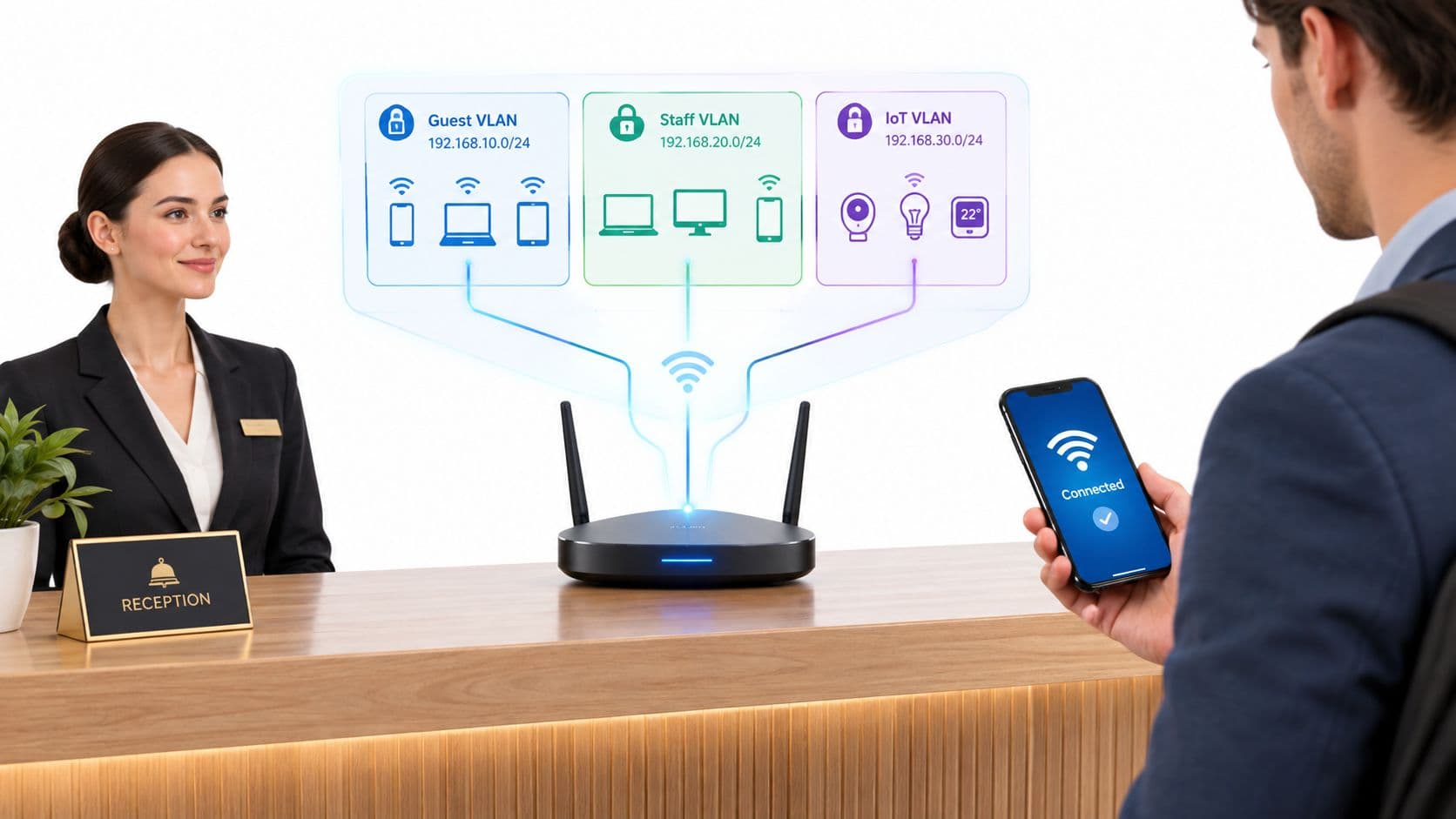
Legacy guest WiFi required visitors to manually ask for preshared keys (PSKs) or navigate cumbersome, slow web forms. Modern venue WiFi utilizes automated captive portals and Passpoint (Hotspot 2.0) standards to connect visitors instantly while enforcing network bandwidth limits and isolated VLAN routing.
Read our [Captive Portal Guide](/captive-portal-guide) to learn how enterprise venues streamline guest connection workflows.
### 2. Location analytics and footfall intelligence
By analysing client RSSI signal strength and probe requests across distributed access point arrays, venue operators track visitor dwell times, repeat visitor rates, and spatial traffic flow. This footfall intelligence helps retail centers, airports, and stadiums optimize staffing levels and lease rates.
Explore our [WiFi Analytics Guide](/wifi-analytics-guide) to see how location data drives venue revenue.
### 3. Identity-first enterprise security
Modern enterprise wireless replaces shared passwords with 802.1X EAP-TLS authentication and cloud RADIUS architecture. Devices receive unique digital certificates or IPSK (Identity-Based Pre-Shared Keys), eliminating credential sharing risks while ensuring total compliance with global data privacy regulations like GDPR.
## Frequently asked questions about who invented WiFi
### Who is officially credited with inventing WiFi?
WiFi was not invented by one person. The foundation was built by Hedy Lamarr (frequency hopping, 1941), Norman Abramson (packet radio, 1971), Dr John O'Sullivan and the Australian CSIRO team (OFDM multipath patent, 1992), and Vic Hayes, who led the IEEE 802.11 standards working group in 1997.
### Why is Dr John O'Sullivan called the inventor of WiFi?
Dr John O'Sullivan led the CSIRO research team in Australia that patented a key signal processing technique in 1992. By applying Fast Fourier Transforms (FFT) to radio waves, his team solved indoor signal reflection and echo, allowing data rates to exceed 10 Mbps over radio spectrum. CSIRO later licensed this patent to major tech manufacturers worldwide.
### Is WiFi an acronym for Wireless Fidelity?
No. "WiFi" is a brand name created in 1999 by branding agency Interbrand for the Wireless Ethernet Compatibility Alliance (now the Wi-Fi Alliance). It was designed as a catchy consumer mark to replace the technical title "IEEE 802.11b Direct Sequence."
### What was the first version of IEEE 802.11?
The first IEEE 802.11 standard was published in June 1997. It operated on the 2.4 GHz radio frequency band and supported maximum data transfer speeds of 2 megabits per second (Mbps).
### How does modern enterprise WiFi differ from early 802.11 networks?
Early 802.11 networks provided basic, unencrypted wireless connectivity at speeds under 11 Mbps. Modern enterprise WiFi networks operate on WiFi 6E and WiFi 7, delivering multi-gigabit speeds, WPA3-Enterprise security, cloud RADIUS authentication, and integrated location analytics.
## Scale your venue wireless infrastructure with Purple
From the early breakthroughs of 802.11 to today's cloud-managed wireless ecosystems, WiFi technology continues to power global enterprise connectivity.
Purple delivers cloud RADIUS authentication, customized captive portal onboarding, and real-time location analytics for thousands of venues worldwide. Transform your venue WiFi into a secure, revenue-generating asset.
- Explore [Purple Guest WiFi Solutions](/guest-wifi)
- Discover [Captive Portal Features](/captive-portal)
- [Speak to a WiFi Specialist](/speak-to-an-expert) to request an enterprise demo.