
Guest WiFi total cost of ownership: licensing, RADIUS infrastructure and support costs compared
You will be able to cost guest WiFi on nine lines, not just the license, and compare an in-house build, a controller splash page and Purple's cloud platform. You can also test how per-AP, per-venue and session-based pricing scale from 10 to 1,000 venues. Finally, you can calculate how many extra visits first-party data must generate to cover the subscription.
By James KeanPublished
📖 14 min read3,151 words3 worked examples12 key definitions
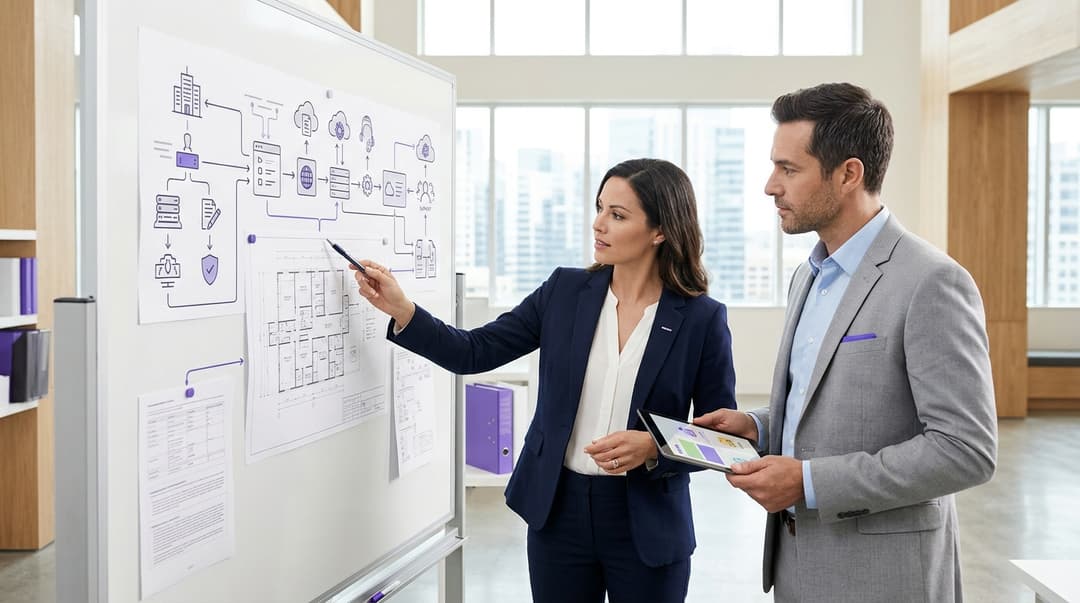
Guest WiFi total cost of ownership is the license plus RADIUS servers, portal engineering, compliance work and support hours. A self-built captive portal looks cheapest until operating system updates break the login flow. Per-venue pricing scales most predictably from 10 to 1,000 sites. First-party data from conscious-choice opt-ins can then offset the subscription.
Which guest WiFi option has the lowest total cost of ownership?
You have three routes to guest access, and the license line hides most of the difference between them:
- Build your own. You build and host your own captive portal and RADIUS stack.
- Use the controller. You switch on the splash page built into your access point controller.
- Run a cloud platform. You run a hardware-agnostic cloud platform, such as Purple Guest WiFi, over the access points you already own.
Two terms carry the cost argument:
- Captive portal. The web page a visitor sees before the network grants internet access.
- RADIUS (Remote Authentication Dial-In User Service, IETF RFC 2865). The protocol your access points (APs) use to ask a server whether to admit a device.
The license is the visible cost. The invisible costs are engineering time, server upkeep, compliance records and support tickets. They grow with venue count, hardware variety and every annual operating system release.
Each route handles those costs differently:
- Controller splash page. It adds little to the invoice but stops at click-through terms and one hardware brand.
- In-house build. It gives you full control and a permanent maintenance bill.
- Cloud platform. It moves the portal and the RADIUS layer into a subscription, so your team stops maintaining both.
Purple runs at 80,000+ live venues in over 90 countries and handles 500 million users and logins a year. It layers on top of Cisco Meraki, HPE Aruba, Ruckus, Juniper Mist, Ubiquiti UniFi, Cambium, Extreme and Fortinet. There is no rip and replace, which keeps the hardware line of your model flat. The reasoning is set out in Why your next WiFi upgrade doesn't need new hardware.
Where do build, controller and platform options genuinely differ?
The license fee is one row of nine. The rest decide your real cost.
| Cost axis | In-house build | Controller splash page | Purple cloud platform |
|---|---|---|---|
| Upfront cost | Design, build and security testing by your team | Configuration time on each controller | Subscription plus controller configuration per venue |
| Portal maintenance across OS updates | Your developers, every iOS and Android release | Hardware vendor, on its own firmware schedule | Purple |
| RADIUS infrastructure | Your servers: high-availability pair, patching, certificates | Your own RADIUS server for anything beyond click-through | Cloud-native RADIUS included |
| Mixed hardware estate | One integration build per hardware brand | One brand only | Cisco Meraki, HPE Aruba, Ruckus, Juniper Mist, Ubiquiti UniFi, Cambium, Extreme, Fortinet |
| Consent records (CCPA/CPRA Article 7) | You design storage, wording versions and audit trail | Outside the controller's scope | Conscious-choice opt-ins captured in the platform |
| CRM and marketing integration | Custom connector per platform, maintained by you | Outside the controller's scope | Integrates with CRM and marketing platforms |
| Reporting across venues | You build it | Per-controller dashboards | WiFi Analytics across the estate |
| Who fixes a broken login flow | Your on-call engineer | Your team, via a vendor ticket | Purple |
| Certifications you inherit | None; you certify your own build | Hardware vendor's | ISO 27001, Cyber Essentials, B Corp; GDPR and CCPA compliant |
What hidden engineering costs sit behind a custom captive portal?
When a cell phone joins an open network, the operating system (OS) probes a known web address. If the network intercepts that probe, the device opens a captive network assistant (CNA). The CNA is a restricted mini browser, separate from Safari or Chrome. Your portal must work inside it, and its behavior shifts with releases you do not control.
Six cost lines rarely appear in a build business case:
- Annual release testing. Apple and Google each ship a major OS release every year, plus point releases. Each can change how the CNA handles redirects, JavaScript, cookies and pop-ups. You need a device lab and a regression test for every login flow.
- Social login breakage. Google's OAuth policy blocks sign-in requests from embedded web views. A Google sign-in button that works in a full browser can fail inside a CNA sheet. Every login method you add is another flow to retest.
- Randomized MAC addresses. iOS 14 and Android 10 switched on private, randomized hardware addresses by default. Portals that recognized returning guests by MAC address had to be re-engineered.
- Standards migration. IETF RFC 8910 lets a network advertise its portal through DHCP, and RFC 8908 defines a captive portal API. Apple's developer guidance encourages networks to adopt both. Supporting them means DHCP changes at every venue and a new API endpoint to host.
- Certificate churn. Your portal is an internet-facing web application that needs public TLS certificates. The CA/Browser Forum has voted to cut maximum certificate lifetimes in stages to 47 days by 2029. Manual renewal stops being viable.
- Consent and data rights. CCPA/CPRA requires you to demonstrate that each guest consented. You need timestamped records, versioned wording, and processes for access requests and erasure. In the US, the TCPA and CAN-SPAM govern the email marketing that follows.
None of these is a one-off. They recur every year. They grow as you add login methods, languages and venue brands.
Standards also point beyond the portal itself. Passpoint (Hotspot 2.0) lets a device join automatically with stored credentials, with no portal page. OpenRoaming, run by the Wireless Broadband Alliance, federates Passpoint networks so returning visitors connect without a login screen. Purple supports OpenRoaming, which removes the CNA from the flow for those devices.
What does RADIUS infrastructure cost when you run it yourself?
Self-hosted guest RADIUS, on FreeRADIUS or Microsoft Network Policy Server for example, needs at least two servers. One server is a single point of failure for every venue's login.
- High availability. You run two servers in separate locations, with load balancing and monitoring.
- Transport security. Classic RADIUS runs over UDP with MD5-based protection. The Blast-RADIUS flaw (CVE-2024-3596), disclosed in 2024, showed how an on-path attacker could forge responses. Mitigation meant patching servers and controllers, and moving untrusted links to RADIUS over TLS (RadSec, RFC 6614).
- Shared secrets. Every controller holds a shared secret. Rotating them across 1,000 venues is a change program, not a task.
- Accounting data. RADIUS accounting (RFC 2866) produces session records. You store, secure and delete them under your retention policy.
- Patching and capacity. You apply OS and RADIUS patches, and you size for peak events.
Purple provides cloud-native RADIUS as part of the platform. You point your controllers at it, following the steps for your hardware vendor in Purple's support documentation.
How do per-AP, per-venue and session-based pricing scale from 10 to 1,000 venues?
Enterprise guest WiFi pricing usually takes one of three shapes. Each bills on a different unit, so each scales differently.
The table models an illustrative estate. It assumes an average of eight APs and 2,500 guest sessions per venue per month. Swap in your own averages before you compare quotes.
| Pricing model | Billed on | Units at 10 venues | Units at 100 venues | Units at 1,000 venues | Main budget risk | Suits |
|---|---|---|---|---|---|---|
| Per-AP | Access points licensed | 80 APs | 800 APs | 8,000 APs | Bill rises with every densification or refresh, even with no new venues | Estates with low, stable AP counts per site |
| Per-venue | Sites live | 10 venues | 100 venues | 1,000 venues | Small and large sites cost the same unless tiered | Chains growing by site count |
| Session-based | Guest sessions | 300,000 a year | 3 million a year | 30 million a year | Bill swings with trading peaks, seasons and events | Pilots and low-traffic sites |
Per-AP pricing
Per-AP pricing ties your bill to radio density, not to business value. A stadium bowl or a large conference hall may need dozens of APs for one venue.
A capacity upgrade that adds APs raises your guest license even if visitor numbers stay flat. If a refresh is on your roadmap, read WiFi 7 (802.11be) Explained: What Changes for Enterprise WiFi. Then check how a denser design changes your license count.
Per-venue pricing
Per-venue pricing matches how operations teams already budget. A new hotel or store adds a known amount, and AP changes do not move the bill.
The weakness is uniformity. Negotiate size tiers so a kiosk and a flagship store do not pay the same.
Session-based pricing
Session-based pricing is cheapest when traffic is low and hardest to forecast. Sessions and devices do not map cleanly to people. Rotating private addresses can make one device look like several under device-based counts.
Worked scenario: an events venue on session-based pricing. A 40,000-capacity stadium hosts 25 event days a year. If half of attendees connect once per event, that is 20,000 sessions per event and 500,000 a year. Those sessions arrive in a few hours on 25 days.
A session-based bill therefore follows the schedule. Every added concert raises spend with no change to the network.
The venue moved to a flat per-venue license before the season began. The outcome: 500,000 sessions covered by one annual figure, known before the first event.
At 1,000 venues, the per-venue admin cost matters as much as the unit price. With a cloud overlay, you repeat one configuration pattern per hardware brand rather than building per venue.
Got questions about your specific setup?
Our team works with venue operators, IT managers, and network engineers across 80,000 venues. Book a 20-minute call and we will show you how others like you solved it.
Where does each guest WiFi option fit?
In-house build
An in-house build fits an organization with a permanent development team, a single hardware brand and no plan to use guest data. You then own every recurring cost line above, indefinitely. The build also concentrates knowledge in a few engineers, so it carries key-person risk.
Controller splash page
A controller splash page covers click-through terms on one hardware brand. It stops fitting when an acquisition brings a second brand into the estate. It also stops fitting once you need consent records, CRM integration or reporting across venues.
Purple cloud platform
Purple fits multi-venue estates, mixed hardware and any team that wants first-party data from its network:
- Hotels. Each guest login can feed your CRM.
- Retail. Shopper visit data shows which stores bring people back.
- Trains. Passengers connect across rolling stock and stations.
- Healthcare. Patients and visitors get access under strict data handling.
Security belongs in the cost model too. Open guest networks need isolation from corporate and payment networks. PCI-DSS uses network segmentation to keep a guest network out of your cardholder data environment's scope. That narrows your audit.
Shared passwords on table cards rotate poorly and leak quickly, as WPA-PSK Explained: What It Is, How It Works, and Its Security Risks sets out. For the guest-side risks, see Is public WiFi safe? What risks and protections to know.
What does guest WiFi cost to run each year?
Build your model on nine lines, not one:
- License or subscription at your venue count, under the pricing unit you will be billed on.
- RADIUS hosting: servers, load balancing, monitoring, and RadSec certificates.
- Portal engineering: OS release testing, device lab, login method maintenance.
- Security: TLS renewals, penetration testing, and remediation.
- Compliance: consent records, access and erasure requests, retention enforcement.
- Integration: CRM and marketing platform connectors, kept current as their APIs change.
- Venue support: front-desk and store staff time spent on "I can't connect".
- Central support: second-line and out-of-hours coverage for login failures.
- Hardware: any replacement forced by the guest WiFi choice rather than by capacity.
Venue support is the line most often missed. Count connection-related tickets and front-desk calls for the month after a major iOS release. That count is your baseline for what a broken CNA flow costs you.
Worked scenario: a 60-hotel group retiring its in-house portal. The group's portal and RADIUS pair were maintained by two internal developers. The inputs below are illustrative, not benchmarks:
- Two major OS releases a year, at five engineer-days each for testing and fixes: 10 days.
- Eight point releases checked, at one day each: 8 days.
- RADIUS patching, monitoring, and shared-secret rotation: 12 days.
- Certificate renewals and penetration-test remediation: 5 days.
- Consent records, access and erasure requests: 10 days.
That totals 45 engineer-days a year. At an assumed loaded day rate of $650, it costs $29,250. That figure excludes hosting, the device lab, and out-of-hours coverage.
The group moved the portal and RADIUS to Purple's cloud platform, venue by venue. The outcome: 45 engineer-days a year came off the network team's plan, and the key-person risk went with them. The board compared a subscription against a fully costed figure, not against zero.
How do CRM capture rates and return-visit campaigns offset the subscription?
The offset follows a chain you can measure at each step:
- Visits multiplied by connection rate gives guest WiFi logins.
- Logins multiplied by opt-in rate gives new marketable contacts.
- Contacts multiplied by campaign return rate gives incremental visits.
- Incremental visits multiplied by margin per visit gives the offset.
The breakeven test is one line. Divide your annual subscription by your gross margin per visit. The answer is the number of extra visits the platform must generate each year.
Consent sits at the top of the chain. CCPA/CPRA guidelines require the consent request to be clearly distinguishable from other matters. Keep the marketing opt-in separate from terms acceptance and leave it unchecked. Purple calls these conscious-choice opt-ins. A contact gathered without one is a liability, not an asset.
Worked scenario: a 120-store retail chain. The inputs below are illustrative assumptions. Replace them with your own.
- Each store sees 5,000 shopper visits a month, and 10% connect to guest WiFi: 500 logins.
- 40% of those shoppers opt in: 200 new contacts per store per month.
- Across 120 stores, that is 288,000 contacts a year before de-duplication.
- An automated return-visit email to lapsed contacts brings back 2% once: 5,760 extra visits.
- At a $30 average basket and 40% gross margin, each visit is worth $12: $69,120 a year.
At $12 margin per visit, every $10,000 of annual subscription needs 834 extra visits to break even. In this model, 5,760 incremental visits cover a subscription of up to $69,120.
Prove the visits are incremental before you claim them. Hold back 10% of contacts from each campaign. Then compare their return rate with the group that received it. Only the difference counts as campaign value.
Repeat connections in WiFi Analytics show you the return visits directly, as first-party data. Purple integrates with CRM and marketing platforms, so the campaign runs in the tools your team already uses. Purple's Connect, Capture and Engage plans match spend to how far you use the data.
How should you decide for your estate?
Start from your situation, not from the price list.
| Your situation | What drives your cost | Recommended route |
|---|---|---|
| Fewer than 10 venues, one hardware brand, terms acceptance only | Configuration time per controller | Purple Guest WiFi on your existing controller, starting on the Connect plan |
| 10 to 100 venues across two or more hardware brands | One integration build per brand | Purple cloud overlay across every brand, priced per venue |
| 100 to 1,000 venues with a CRM and marketing team | Contact volume and campaign return | Purple Capture or Engage, integrated with your CRM |
| Stadium, arena or conference center with event-day peaks | Session spikes on event days | Flat per-venue pricing, not session-based |
| High-density venues planning a WiFi 7 refresh | AP count rising after the refresh | Pricing decoupled from AP count |
| In-house portal maintained by one or two developers | Key-person risk and OS release testing | Migrate venue by venue to Purple and retire self-hosted RADIUS |
| Public sector or healthcare with strict data handling | Audit, consent and access requests | Purple, with ISO 27001, Cyber Essentials and CCPA/CPRA compliance in place |
Put the same five questions to every vendor on your shortlist:
- Who fixes the login flow when a new iOS or Android release breaks it, and how fast?
- Is RADIUS hosted, highly available and patched by you, with RadSec support?
- What is the price at 10, 100 and 1,000 venues, on which billing unit?
- How are consent records stored, versioned and exported for an access request?
- Which hardware brands in our estate are supported today, without replacement?
Score each answer in engineer-days or dollars. The option with the lowest total, not the lowest license, is your answer.
Frequently asked questions
Does Purple work with the access points we already own?
Yes, Purple runs as a cloud overlay on the access points you already own. Supported hardware includes Cisco Meraki, HPE Aruba, Ruckus, Juniper Mist, Ubiquiti UniFi, Cambium, Extreme and Fortinet. You point your controller's captive portal and RADIUS settings at Purple, following the vendor-specific steps in Purple's support documentation. Mixed estates, common after acquisitions, run under one platform with one set of guest data.
Is it cheaper to build our own captive portal than to buy a platform?
Rarely, once you count maintenance. A build carries no license, but every annual iOS and Android release needs regression testing inside the captive network assistant. You also run RADIUS servers, renew certificates, store consent records and answer data rights requests. Model those as engineer-days a year at your own day rate. Then compare that total with a subscription quote at your venue count.
Which guest WiFi pricing model is most predictable at 1,000 venues?
Per-venue pricing is the most predictable, because your bill moves only when you open or close a site. Per-AP pricing rises with every densification or WiFi 7 refresh, even without new venues. Session-based pricing swings with trading peaks and events. At 1,000 venues, ask every vendor for size tiers so a kiosk and a flagship are not charged the same.
Do we still need our own RADIUS servers for guest WiFi?
No, Purple provides cloud-native RADIUS as part of the platform, so you do not host, patch or monitor guest RADIUS servers. That removes the high-availability pair and shared-secret rotation across controllers. It also removes emergency patch cycles such as the 2024 Blast-RADIUS response. Your controllers point at Purple's RADIUS service, using the configuration steps for your hardware vendor.
How do we migrate from our current captive portal?
Migrate venue by venue, starting with a pilot site on each hardware brand you run. Repoint that site's captive portal and RADIUS settings to Purple. Test login flows on current iOS and Android devices, then roll out in waves. Your existing portal keeps serving the venues not yet moved. Export consented contacts with their consent records so marketing permissions carry over intact.
Is guest data captured through Purple CCPA/CPRA compliant?
Yes, Purple is CCPA/CPRA compliant, certified to ISO 27001 and Cyber Essentials, and a certified B Corp. Guests give conscious-choice opt-ins, kept separate from terms acceptance. You still set your lawful basis, privacy notice and retention period. For email marketing in the US, the TCPA and CAN-SPAM regulations apply.
How long does guest WiFi data take to pay back the subscription?
Payback arrives when incremental margin from returning visitors exceeds your annual subscription. Divide the subscription by your margin per visit to find the extra visits you need: at $12 margin, every $10,000 needs 834. Measure real incremental returns with a holdout group excluded from campaigns. Your connection rate, opt-in rate and campaign return rate decide how fast you reach that number.
Key Definitions
Captive portal
The web page a visitor sees before the network grants internet access. IETF RFC 8910 lets a network advertise the portal through DHCP, and RFC 8908 defines a captive portal API that devices can query.
You meet it as the login page at every venue. Building your own means maintaining it across every annual iOS and Android release, which is the largest hidden line in an in-house business case.
Captive network assistant (CNA)
The restricted mini browser an operating system opens when its probe of a known web address is intercepted on an open network. It is separate from Safari or Chrome and handles redirects, JavaScript, cookies and pop-ups differently.
Your portal must work inside it. Its behavior shifts with OS releases you do not control, so each release needs regression testing of every login flow.
RADIUS
Remote Authentication Dial-In User Service, specified in IETF RFC 2865. Access points and controllers use it to ask a server whether to admit a device. Classic RADIUS runs over UDP with MD5-based protection.
Self-hosting it means at least two servers, load balancing, monitoring, patching and shared-secret rotation. Purple includes cloud-native RADIUS in the platform, which removes that line.
RADIUS accounting
Defined in IETF RFC 2866, it produces session records for each connection, sent from the network access device to the RADIUS server.
If you run RADIUS yourself, you store, secure and delete these records under your own retention policy, which adds to the compliance line of your model.
RadSec
RADIUS over TLS, specified in IETF RFC 6614. It wraps RADIUS traffic in TLS to protect it across untrusted links, replacing reliance on UDP with MD5-based protection.
It was the recommended mitigation for untrusted links after Blast-RADIUS. Ask every shortlisted vendor whether their hosted RADIUS supports it.
Blast-RADIUS (CVE-2024-3596)
A flaw disclosed in 2024 showing how an on-path attacker could forge RADIUS responses by exploiting the MD5-based protection in classic RADIUS over UDP.
Mitigation meant patching servers and controllers and moving untrusted links to RadSec. Teams running their own RADIUS absorbed that emergency patch cycle as unplanned engineering time.
Randomized MAC addresses
Private, rotating hardware addresses switched on by default in iOS 14 and Android 10, replacing the device's fixed MAC address on WiFi networks.
Portals that recognized returning guests by MAC address had to be re-engineered. Rotating addresses can also make one device look like several under device-based or session-based pricing.
Passpoint (Hotspot 2.0)
A certification built on IEEE 802.11u that lets a device discover and join a network automatically with stored credentials, with no portal page.
It removes the CNA from the login flow, and with it much of the OS release testing that drives portal maintenance cost.
OpenRoaming
A federation run by the Wireless Broadband Alliance that links Passpoint networks so returning visitors connect without a login screen.
Purple supports OpenRoaming, which takes the CNA out of the flow for those devices and reduces the portal engineering line.
CCPA/CPRA consent requirements
Provisions under US privacy legislation such as the CCPA/CPRA require businesses to provide clear opt-out and opt-in mechanisms and allow consumers to request access and deletion of their data.
It sets the bar for marketing opt-ins at login. Purple captures conscious-choice opt-ins kept separate from terms acceptance; an in-house build must design storage, versioned wording and an audit trail itself.
TCPA and CAN-SPAM regulations
Federal regulations governing unsolicited electronic marketing, email communications, and automated text messaging to consumers.
They apply to the return-visit email and SMS campaigns that offset your subscription, so your opt-in must support them.
PCI DSS network segmentation
The Payment Card Industry Data Security Standard uses network segmentation to keep systems such as a guest network out of the scope of your cardholder data environment.
Isolating guest WiFi from corporate and payment networks narrows your audit, so segmentation belongs in the security line of your cost model.
Worked Examples
A 40,000-capacity stadium hosts 25 event days a year and pays for guest WiFi on session-based pricing. If half of attendees connect once per event, how predictable is the bill?
Half of 40,000 attendees gives 20,000 sessions per event, or 500,000 a year across 25 event days. Those sessions arrive in a few hours on each event day, so a session-based bill follows the schedule. Every added concert raises spend with no change to the network. The venue moved to a flat per-venue license before the season began. The result: 500,000 sessions covered by one annual figure, known before the first event. The same logic applies to any arena or convention center with event-day peaks.
A 60-hotel group runs an in-house captive portal and a RADIUS pair, maintained by two internal developers. What does that really cost each year, using illustrative inputs?
The group counted engineer-days per line. Two major OS releases at five days each gave 10 days. Eight point releases at one day each gave eight. RADIUS patching, monitoring and shared-secret rotation took 12. Certificate renewals and penetration-test remediation took five. Consent records, CCPA/CPRA access and erasure requests took 10. That totals 45 engineer-days, or $22,500 at an assumed $500 loaded day rate, before hosting, the device lab and out-of-hours cover. The group moved portal and RADIUS to Purple's cloud platform venue by venue. It removed 45 engineer-days from the network team's plan, along with the key-person risk. The board then compared a subscription against a fully costed figure, not against zero.
A 120-store retail chain wants to know whether first-party data from guest WiFi can offset its subscription, using illustrative assumptions.
Each store sees 5,000 shopper visits a month and 10% connect, giving 500 logins. At a 40% opt-in rate, that is 200 contacts per store per month, or 288,000 a year across 120 stores before de-duplication. An automated return-visit email bringing back 2% once yields 5,760 extra visits. At a $30 basket and 40% gross margin, each visit is worth $12, so the offset is $69,120 a year. At that margin, every $10,000 of subscription needs 834 extra visits to break even. The chain holds back 10% of contacts from each campaign and counts only the difference in return rate as incremental.
Frequently asked questions
Does Purple work with the access points we already own?
Yes, Purple runs as a cloud overlay on the access points you already own. Supported hardware includes Cisco Meraki, HPE Aruba, Ruckus, Juniper Mist, Ubiquiti UniFi, Cambium, Extreme and Fortinet. You point your controller's captive portal and RADIUS settings at Purple, following the vendor-specific steps in Purple's support documentation. Mixed estates, common after acquisitions, run under one platform with one set of guest data.
Is it cheaper to build our own captive portal than to buy a platform?
Rarely, once you count maintenance. A build carries no license, but every annual iOS and Android release needs regression testing inside the captive network assistant. You also run RADIUS servers, renew certificates, store consent records and answer data rights requests. Model those as engineer-days a year at your own day rate. Then compare that total with a subscription quote at your venue count.
Which guest WiFi pricing model is most predictable at 1,000 venues?
Per-venue pricing is the most predictable, because your bill moves only when you open or close a site. Per-AP pricing rises with every densification or WiFi 7 refresh, even without new venues. Session-based pricing swings with trading peaks and events. At 1,000 venues, ask every vendor for size tiers so a kiosk and a flagship are not charged the same.
Do we still need our own RADIUS servers for guest WiFi?
No, Purple provides cloud-native RADIUS as part of the platform, so you do not host, patch or monitor guest RADIUS servers. That removes the high-availability pair and shared-secret rotation across controllers. It also removes emergency patch cycles such as the 2024 Blast-RADIUS response. Your controllers point at Purple's RADIUS service, using the configuration steps for your hardware vendor.
How do we migrate from our current captive portal?
Migrate venue by venue, starting with a pilot site on each hardware brand you run. Repoint that site's captive portal and RADIUS settings to Purple. Test login flows on current iOS and Android devices, then roll out in waves. Your existing portal keeps serving the venues not yet moved. Export consented contacts with their consent records so marketing permissions carry over intact.
Is guest data captured through Purple CCPA/CPRA compliant?
Yes, Purple is CCPA/CPRA compliant, certified to ISO 27001 and Cyber Essentials, and a certified B Corp. Guests give conscious-choice opt-ins, kept separate from terms acceptance as the CCPA/CPRA requires. You still set your lawful basis, privacy notice and retention period. For email marketing in the US, the TCPA and CAN-SPAM regulations apply on top of the CCPA/CPRA.
How long does guest WiFi data take to pay back the subscription?
Payback arrives when incremental margin from returning visitors exceeds your annual subscription. Divide the subscription by your margin per visit to find the extra visits you need: at $12 margin, every $10,000 needs 834. Measure real incremental returns with a holdout group excluded from campaigns. Your connection rate, opt-in rate and campaign return rate decide how fast you reach that number.
Sources
- IETF RFC 2865: Remote Authentication Dial In User Service (RADIUS)
- IETF RFC 6614: Transport Layer Security (TLS) Encryption for RADIUS
- IETF RFC 8910: Captive-Portal Identification in DHCP and Router Advertisements
- IETF RFC 8908: Captive Portal API
- CVE-2024-3596 (Blast-RADIUS)
- Regulation (EU) 2016/679 (GDPR)
- Privacy and Electronic Communications Regulations 2003, regulation 22
- PCI Security Standards Council
Continue reading in this series
Switching guest WiFi providers: a migration checklist for multi-site venues
You will be able to plan a multi-site guest WiFi provider switch in the right order, from contract dates and consent-backed data export to pilot, wave cutover and report sign-off. You will also know which access point settings fail most often and what to budget, so no site goes dark and no marketing list is lost.
Nightclub and late-night venue WiFi providers: content filtering, peak capacity and staff access
Use this guide to shortlist nightclub WiFi providers against five late-night requirements: first-hour sign-in capacity, license-led content filtering, hard separation for staff and devices, reporting for licensing questions and consented event lists. You can size your portal from your own door data, set a filtering policy and decide which Purple components your venue needs.
Golf club WiFi platforms: members, visitors and clubhouse events on one network
Use this guide to pick one golf club WiFi platform that runs member, visitor, and staff networks on the access points you already own. You will be able to assign each group its route in, take registers off the guest network, size a tournament day, and build a consented email list from visitor sign-ins.
Got questions about your specific setup?
Our team works with venue operators, IT managers, and network engineers across 80,000 venues. Book a 20-minute call and we will show you how others like you solved it.