Modern hospitality WiFi solutions have come a long way from just offering basic internet. These days, they are the very cornerstone of the guest experience, delivering the kind of secure, seamless, and automatic connection that can make or break a person's stay.
Why Your WiFi Is Your Most Important Amenity
Imagine a guest arriving after a long trip, only to fight with a clunky login portal for spotty WiFi. Now, picture that same guest connecting automatically and securely before they even get to the front desk. The gap between those two scenarios shows just how much guest expectations have shifted.
What was once a simple convenience is now the most critical amenity your venue can offer. An outdated WiFi setup isn't just an inconvenience; it's a genuine liability that hits your reviews, guest loyalty, and ultimately, your revenue.
The New Standard of Connectivity
The demand for free, high-speed internet isn't a preference anymore—it's the baseline. In the UK hospitality sector, the trend is impossible to ignore. A 2023 survey found that 92% of hotel guests now expect free, high-speed wireless internet as standard, a huge leap from just 65% back in 2018.
The consequences for falling short are steep. A 2024 report revealed that a staggering 47% of UK travellers admitted they would leave a venue entirely because of poor WiFi. As highlighted on The Drinks Business website, these digital trends are reshaping the entire UK hospitality landscape.
This data paints a very clear picture: your WiFi network is the digital backbone of the modern guest experience. It’s the first impression when a guest connects and one of the last touchpoints when they get a post-stay survey.
The Evolution of Guest WiFi Expectations
To truly grasp this shift, it helps to see how expectations have evolved over time. What was acceptable just a few years ago is now a major point of frustration for today’s connected traveller.
| Feature | Traditional WiFi (The Past) | Modern Hospitality WiFi (The Standard in 2026) |
|---|---|---|
| Connection Process | Manual SSID selection, clunky web portal login, remembering passwords. | Automatic, zero-touch connection via OpenRoaming/Passpoint. |
| Security | Open, unencrypted networks, posing significant security risks. | Enterprise-grade WPA3 encryption, ensuring guest data is always protected. |
| Performance | Slow speeds, frequent dropouts, poor coverage in rooms. | Fast, reliable connectivity capable of streaming 4K video and gaming. |
| Authentication | One-size-fits-all password or room number entry. | Identity-based access (SSO, social logins) for personalised experiences. |
| Purpose | A basic utility, viewed as a cost to be minimised. | A strategic tool for engagement, marketing, and operational efficiency. |
This table isn't just about technology; it's about service. Failing to meet these modern standards is like offering a room without hot water—it's a fundamental failure to meet the basic needs of today's guests.
From Cost Centre to Experience Driver
Thinking of WiFi as just an IT expense is an old-school mindset. Today, strategic, identity-based networking is the essential solution for leading hospitality brands. This approach turns your network from a passive utility into an active driver of satisfaction and operational success.
By focusing on secure and seamless access, venues can deliver a premium experience that builds trust and encourages loyalty from the very first connection. This shift isn't just about better technology; it's about better service.
Modern hospitality WiFi solutions influence everything:
- First Impressions: An automatic, password-free connection using tech like OpenRoaming creates an instant "wow" moment.
- In-Room Comfort: Solid connectivity for streaming, controlling smart devices, and gaming makes a room feel like home.
- Marketing Engagement: The login journey becomes a powerful tool for building guest profiles and driving future bookings.
- Operational Excellence: Secure staff networks and insightful analytics help everything run more smoothly behind the scenes.
By making your WiFi infrastructure a priority, you aren't just upgrading a service. You are investing directly in guest satisfaction, opening up new revenue opportunities, and future-proofing your business. Find out more about how modern WiFi is reshaping the hospitality industry and what it can do for your venue.
Understanding the Tech Behind Seamless Connectivity
To deliver that flawless, secure Wi-Fi modern guests and staff expect, you need more than just a few access points. Hospitality Wi-Fi solutions bring together a collection of powerful technologies that work behind the scenes, moving you far beyond clunky portals and shared passwords to create an experience that’s both effortless and incredibly secure.
Let's unpack the key technologies that make this happen, using a few helpful analogies to clear things up.
This image shows the simple but powerful shift from outdated, problematic Wi-Fi to the modern, secure solutions essential for hospitality today.
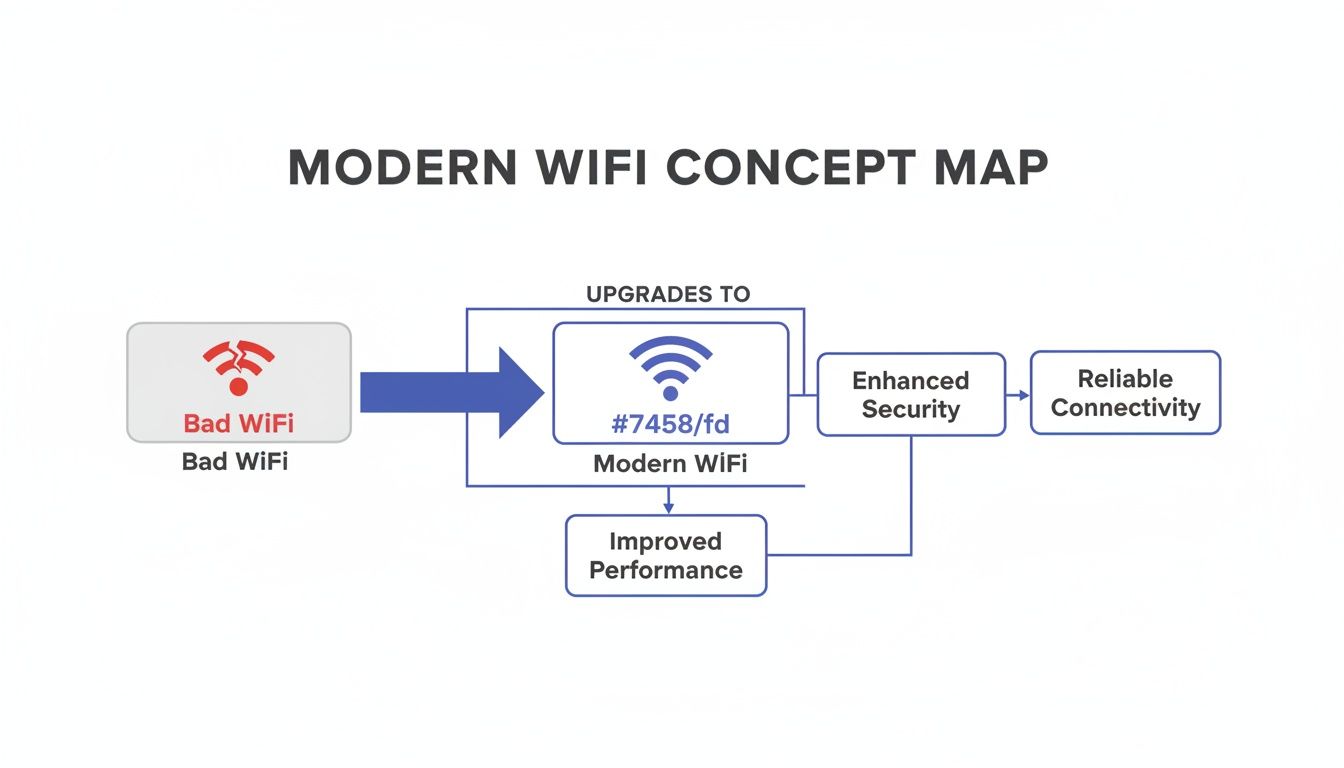
It highlights how upgrading your network fundamentally changes the experience from one of frustration and risk to one of security and seamless performance.
OpenRoaming and Passpoint: The Universal Digital Key
Imagine giving your guests a universal digital key for your Wi-Fi. After a single, one-time setup on their device, they can automatically and securely connect to the network at your hotel, your partner restaurant down the street, and thousands of other participating venues worldwide. That’s the magic of OpenRoaming and Passpoint.
These technologies work together to completely remove the need for guests to hunt for SSIDs and type in passwords. Their device simply recognises a participating network and connects using a secure, pre-approved digital certificate. For the guest, it feels just like their home Wi-Fi—it simply works. This creates an amazing first impression, often connecting guests before they even reach the reception desk.
With OpenRoaming, the connection process disappears entirely for returning guests. It removes the single biggest point of friction in guest Wi-Fi, turning a moment of potential frustration into a seamless, premium experience that builds loyalty.
Identity-Based Networking: The Master Keycard for Staff
For staff, managing network access can be a chaotic mess of shared passwords scribbled on sticky notes. Identity-based networking, paired with Single Sign-On (SSO), replaces this chaos with a secure and efficient "master keycard" system.
Instead of a generic staff password, employees connect using the same credentials they already use for their work accounts, like their Entra ID (formerly Azure AD) or Google Workspace login. The network instantly verifies who they are and grants them access based on their specific role.
This approach brings several huge benefits:
- Automated Access Control: When an employee joins, they get access instantly. When they leave, their access is revoked automatically, closing a major security gap.
- Role-Based Permissions: A front-desk employee can be given access to the PMS, while a maintenance team member gets access to building management systems—all on the same network but with different rules.
- Enhanced Security: It gets rid of the risks tied to shared passwords and gives you a clear audit trail of who is accessing what on your network.
For the best possible control over your network's traffic and performance, especially in a busy hospitality setting, a managed Ethernet switch is a crucial piece of the puzzle. This hardware gives you the fine-grained control needed to prioritise traffic and ensure systems like SSO run without a hitch.
iPSK: The Private Key for Every Device
What about all the other devices in a guest room? Smart TVs, gaming consoles, and personal streaming devices often can't handle the typical hotel Wi-Fi login portals. The usual workaround—a single, shared password for the entire room—creates a massive security hole.
This is where Individual Pre-Shared Key (iPSK) technology comes in. Think of it as giving every single device its own unique, private password. When a guest connects their PlayStation or Amazon Fire Stick, the system automatically generates and assigns a dedicated password just for that device.
This method delivers two critical advantages. First, it provides a simple, home-like connection experience for devices that can't deal with login portals. Second, it isolates each device, meaning if one were somehow compromised, the others in the room—and the wider network—remain completely secure. It brings enterprise-grade security right into the guest room without sacrificing an ounce of convenience.
Building a Zero Trust Security Model for Your Network
With the rise of sophisticated cyber threats, strong network security isn't just a nice-to-have anymore—it's a core requirement for any hospitality business. This is where a Zero Trust security model comes into play for modern hospitality WiFi. Forget the confusing jargon; the philosophy is simple but powerful: ‘never trust, always verify.’
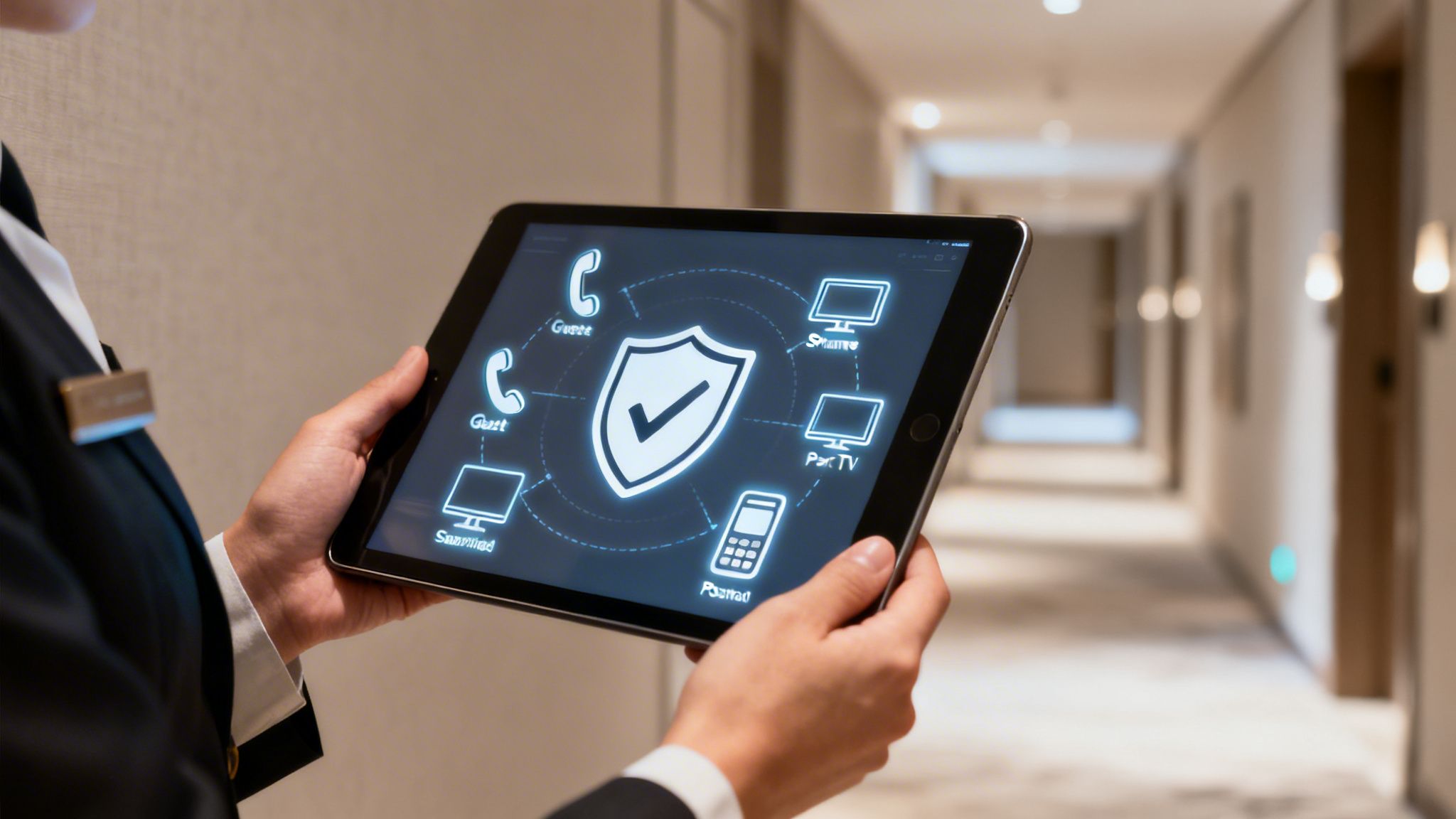
This approach is a world away from the old ‘castle-and-moat’ method, where once a user or device gets inside the network, it’s trusted by default and free to roam. A Zero Trust architecture treats every single connection attempt—whether from a guest's phone, a staff tablet, or an in-room smart TV—as a potential threat until it proves otherwise. It demands strict verification every time, for everyone and everything.
This shift in mindset from assumed trust to explicit verification is critical. As WiFi dependency in UK hospitality grows, so do data security concerns. A recent study found that 51% of operators are deeply worried about data privacy when adding digital tools.
And they have good reason to be. Reports have highlighted that 62% of UK hospitality venues suffered cyber incidents through unsecured WiFi, costing an average of £28,000 per breach. Guests are nervous too, with 41% expressing anxiety over how their data is handled, leading 28% to avoid venues they see as insecure.
The Pillars of Zero Trust in Hospitality
A solid Zero Trust framework isn't built on a single piece of technology. It’s a combination of strategies working together to protect guest data, secure staff operations, and ensure compliance with regulations like UK GDPR.
It’s about moving network security from a technical chore to a cornerstone of guest trust.
A Zero Trust model fundamentally changes the security question from "Is this user on my network?" to "Is this user, on this device, from this location, authorised to access this specific resource right now?" It's continuous, dynamic verification.
Key components include:
- Strong Identity Verification: Every user and device must prove who they are before getting access. This is done with technologies like certificate-based authentication for staff and secure onboarding for guests.
- Least-Privilege Access: Once verified, users and devices only get access to the absolute minimum resources they need. A housekeeper’s tablet, for example, should never be able to touch the same network segments as the front desk’s payment system.
- Network Segmentation: The network is carved up into smaller, isolated zones. This practice, known as micro-segmentation, contains threats by stopping them from moving laterally across the network if a breach ever happens.
Putting Zero Trust into Practice
Implementing this model means making practical, impactful changes. For staff, this means ditching shared passwords for certificate-grade access tied to their corporate identity. When an employee leaves, their network access is instantly and automatically cut off, closing a common security gap.
For guests and their growing collection of devices, technologies like iPSK (Individual Pre-Shared Key) ensure that each device in a room gets its own unique password. This isolates them from one another, preventing a compromised games console from affecting a guest’s work laptop.
Ultimately, building a Zero Trust architecture transforms your WiFi from a simple amenity into a powerful defence. It protects sensitive guest information and critical operational systems, ensuring your network is a secure foundation for an exceptional guest experience. Learn more by exploring our detailed guide on network and wireless security strategies for modern venues.
Turning Your WiFi Network Into a Revenue Engine
For too long, hospitality WiFi has been seen as just another utility bill to pay. It’s a necessary cost, but what if you could flip that thinking on its head? A modern WiFi solution is a powerful business intelligence tool just waiting to be switched on, capable of transforming your network from a cost centre into a real engine for revenue and guest loyalty. It all starts by ethically collecting first-party data during the guest login.
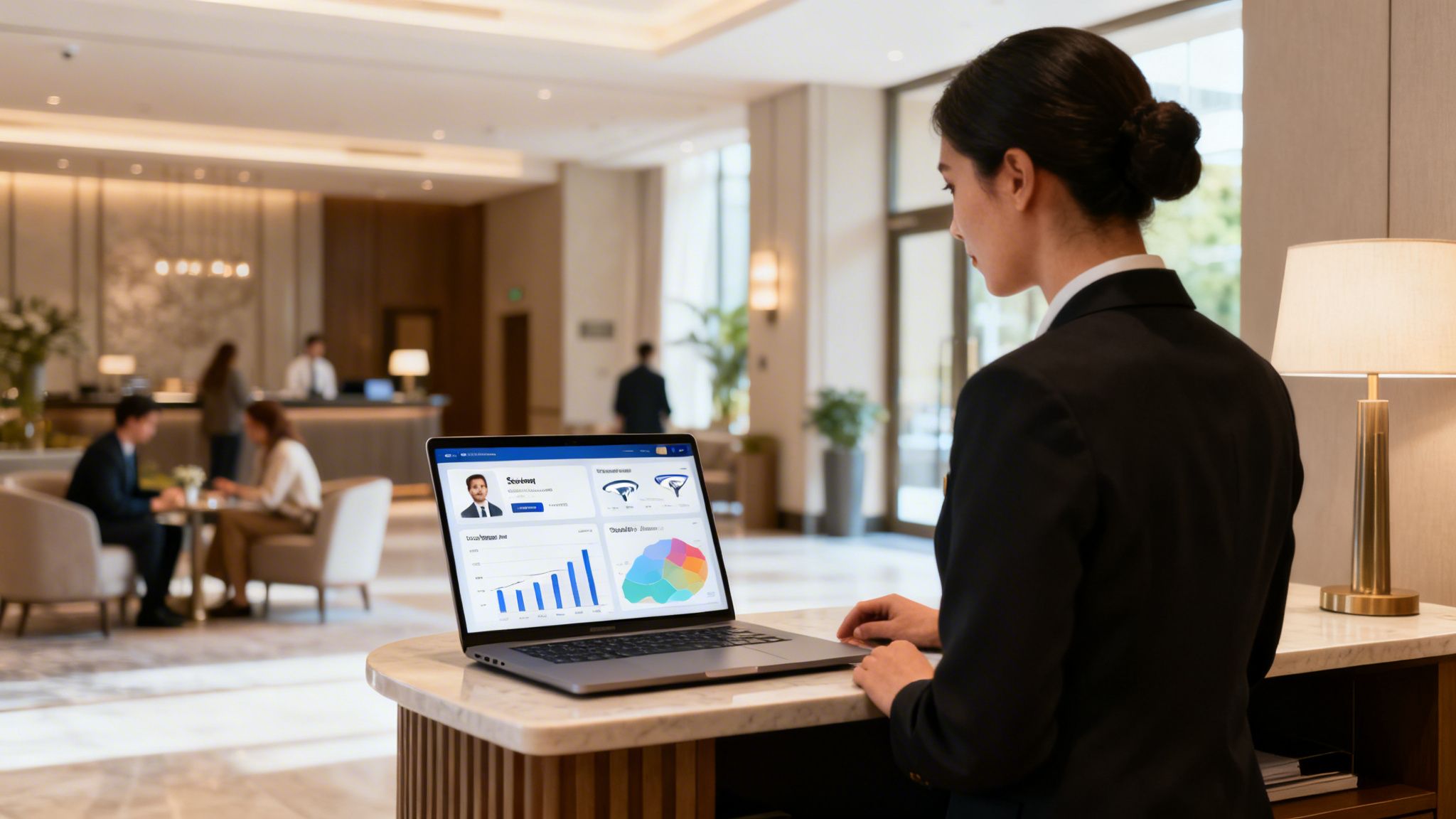
This data, gathered with full consent, becomes the fuel for incredibly effective, personalised marketing strategies that simply weren't possible before. Suddenly, your network isn’t just providing internet access; it’s providing deep insights into what your guests actually do.
From Connection to Conversion
The real magic of advanced hospitality WiFi solutions happens when they connect with your marketing and CRM platforms. This integration creates a feedback loop where guest data automatically triggers actions that drive engagement and spending from the second a guest connects.
Think about it. A first-time guest logs into your WiFi, and the system instantly fires off a welcome email. This isn't just a generic "hello." It could be a personalised offer, like a discount on their first drink at the hotel bar or a special on spa treatments, encouraging them to spend more right away.
The data also shows you how people move through your property. By analysing footfall in different zones, you can unlock invaluable insights.
Understanding foot traffic patterns allows you to optimise staffing levels in your restaurant during peak hours, rearrange a lobby bar layout to improve flow, or identify underused amenities that could benefit from targeted promotion.
This turns your physical space into a source of hard business intelligence. You're no longer guessing where your guests are—you know.
Building Rich Guest Profiles
Every time a guest interacts with your WiFi network, another layer is added to their profile. A modern system can track visit frequency, how long they stay in certain areas, and even which offers they respond to. For your marketing team, this information is gold.
When you integrate your WiFi platform with a CRM, you can:
- Build Comprehensive Profiles: Combine WiFi data (visit dates, frequency) with booking information (room type, total spend) to get a 360-degree view of each guest.
- Personalise Every Interaction: Use this rich data to segment your audience and send them offers that are genuinely relevant to their interests and past behaviour.
- Automate Post-Visit Engagement: Automatically send a thank-you email and a survey a day after check-out. This encourages positive online reviews and gathers crucial feedback while the experience is still fresh in their minds.
These automated, data-driven actions are the key to building lasting relationships and driving that all-important repeat business.
Measuring the Impact on Loyalty and Revenue
This strategic approach has a clear, measurable impact on key business metrics. In the UK, guest expectations for a seamless digital journey are completely reshaping hospitality WiFi demands. A 2025 UK Hoteliers Federation survey found that 88% of guests now rate WiFi speed and reliability as more important than room cleanliness, with 73% being more likely to extend their stays at venues offering passwordless access.
Partners in the UK using platforms with CRM connectors and marketing automation have seen 25% higher visit frequencies by capturing first-party data ethically. Venues with these advanced platforms also report a 15-20% uplift in their Net Promoter Scores, showing a direct link between better WiFi and guest satisfaction. You can read more about tech trends refining the guest journey.
By turning your network into an intelligent marketing tool, you create a powerful cycle of engagement. Great WiFi attracts guests, the login process gathers data, and that data powers campaigns that bring them back, time and time again.
Your Practical Guide to Choosing the Right WiFi Solution
Choosing the right hospitality WiFi solution can feel like a huge undertaking. But if you break it down into a clear, methodical process, it becomes far more manageable. Think of this guide as your practical checklist for vetting vendors and making sure the system you pick doesn't just solve today's problems, but is ready for whatever comes next.
It all boils down to asking the right questions to find a partner that truly gets your operational needs and your vision for the guest experience.
First things first: you need a candid look at your current network infrastructure. You have to know what you’re working with before you can improve it. The good news is that most modern WiFi platforms are hardware-agnostic, built to play nicely with leading network vendors like Meraki, Aruba, and Ruckus.
This compatibility is a massive advantage. It means you can often avoid a costly and disruptive ‘rip and replace’ of your existing access points. Instead, the project is more about reconfiguring your network to push authentication and management through a new, cloud-based platform. This software-first approach is what allows for a rapid rollout, getting a property live in weeks, not months.
Define Your Security and Authentication Needs
Once you have a handle on your infrastructure, the next piece of the puzzle is security and access. In the current climate, a Zero Trust security model isn’t a nice-to-have; it’s non-negotiable.
You need to ask potential vendors how their solution enforces this ‘never trust, always verify’ principle. Does it support certificate-grade access for staff? Can you instantly revoke credentials the moment an employee leaves? And crucially, how does it help you maintain UK GDPR compliance?
At the same time, you need to think about the sign-in process for both guests and staff. For guests, the name of the game is a frictionless experience.
- OpenRoaming/Passpoint: Does the platform support this? It's the gold standard for creating automatic, secure connections for loyal, returning guests.
- Social Logins: Can guests connect using their social media accounts? This simplifies the login and provides valuable, consent-based marketing data.
- Simple Forms: Is there a straightforward email capture form? Sometimes the fastest and easiest option is best.
For staff, the priorities are security and simplicity. Look for solutions offering Single Sign-On (SSO) that integrates with your existing identity provider, like Entra ID or Google Workspace. This gets rid of shared passwords and automates access management — a huge win for both your security posture and your IT team's sanity.
Plan for All Devices and Integrations
Modern hospitality venues are about much more than just phones and laptops. The solution you choose must handle the incredibly diverse array of devices you find in a hotel today. We’re talking about IoT devices like smart TVs and thermostats, plus guest-owned tech like gaming consoles.
A critical feature to look for here is Individual Pre-Shared Key (iPSK) technology. This clever feature gives each device its own unique, secure password, segmenting traffic and bolstering security.
Beyond the devices themselves, you need to consider software integrations. Your WiFi platform can't be an island; it needs to connect seamlessly with your core business systems.
A truly effective hospitality WiFi solution integrates deeply with your Property Management System (PMS) and Customer Relationship Management (CRM) platform. This connection is what transforms your network from a simple utility into a powerful engine for personalised marketing and business intelligence.
Make sure the vendor has proven, ready-to-go connectors for the systems you already rely on. This is what allows you to build rich guest profiles and automate marketing campaigns that drive repeat visits and boost ancillary revenue. For a deeper look at what to ask for, our guest WiFi feature checklist can help you identify these must-have capabilities.
Prioritise Deployment, Analytics and Support
Finally, let's talk about the entire lifecycle of the solution. A smooth deployment is vital to get things started on the right foot. Ask potential vendors about their rollout plan. How much of the work can they do remotely? Do they have a dedicated deployment team to guide you? A cloud-based platform should offer a streamlined setup that causes minimal disruption on-site.
Once you're live, the platform's real value comes from the insights it delivers. Dig into the analytics and reporting capabilities. Can you easily track key metrics like visitor numbers, dwell times, and the ratio of new vs. returning guests? The right data helps you make smarter operational decisions and clearly demonstrates the ROI of your investment.
Ongoing support is the last, but crucial, piece of the puzzle. Make sure the vendor provides comprehensive support to sort out any issues quickly. The goal is to ensure your guests and staff always have the reliable connectivity they've come to expect.
By following this structured approach, you'll be well-equipped to choose a hospitality WiFi solution that not only elevates your guest experience but also strengthens your bottom line for years to come.
To help you through this process, we've put together a checklist to guide your conversations with potential vendors. Use this to compare solutions and ensure you're asking the questions that matter most.
Hospitality WiFi Solution Evaluation Checklist
| Evaluation Category | Key Questions to Ask | Ideal Features to Look For |
|---|---|---|
| Network Compatibility | Is your solution hardware-agnostic? Which network vendors (Meraki, Aruba, etc.) do you integrate with? Can we use our existing access points? | Support for your current hardware. A software-overlay approach that avoids a full "rip and replace". |
| Guest Authentication | What login methods do you support (social, form, voucher)? Do you support OpenRoaming/Passpoint for seamless access? | Multiple, flexible login options. OpenRoaming/Passpoint for loyalty. Customisable splash pages. |
| Staff & Device Security | How do you implement a Zero Trust model? Do you support SSO with our identity provider (e.g., Entra ID)? How do you secure IoT devices and guest consoles? | Zero Trust architecture. SSO integration. iPSK for device-specific keys. Role-based access control. |
| System Integrations | Which PMS and CRM systems do you have existing integrations with? How deep is the integration? Is there an open API for custom connections? | Proven connectors for your existing tech stack (e.g., Oracle, Mews, Lightspeed). Two-way data sync. |
| Analytics & Marketing | What kind of data can we collect? What does the analytics dashboard show? Can we automate marketing campaigns based on WiFi data? | Real-time dashboards. Reports on visitor behaviour (dwell time, new vs. repeat). Automated email/SMS triggers. |
| Deployment & Support | What does the deployment process look like? How much work is done remotely vs. on-site? What are your support hours and SLAs? | A clear, phased rollout plan. A dedicated deployment team. 24/7 global support. |
| Compliance & ROI | How does your solution help us maintain UK GDPR and other data privacy compliance? How do we measure the ROI of the platform? | Built-in consent management tools. Data anonymisation options. Clear reporting on metrics that impact revenue. |
Taking the time to run through these questions will give you a much clearer picture of what each vendor truly offers. It moves the conversation beyond marketing buzzwords and into the practical realities of what will work best for your venue, your staff, and your guests.
Common Questions About Modern Hospitality WiFi
Moving to a modern, identity-based network brings up some important questions for anyone running a hotel, venue, or managing its IT. Let's tackle the most common queries head-on, giving you clear, practical answers to guide your decision-making.
Getting to grips with the reality of an upgrade is the first step. From there, you can start building a far better and more secure experience for everyone.
How Hard Is It to Switch to a Modern Solution?
You might be surprised. The switch from an old-school captive portal to a modern identity platform is much more straightforward than you'd think. The best hospitality WiFi solutions today are designed to be hardware-agnostic. This means they play nicely with the network equipment you already own from vendors like Meraki, Aruba, and UniFi.
This flexibility is a real game-changer. It means you can sidestep a costly and disruptive ‘rip and replace’ hardware project. Instead, the entire process is handled in the cloud, reconfiguring your existing network to authenticate users through the new platform.
The heart of the upgrade is a software-driven change, not a hardware-based one. A specialised deployment team can typically get an entire property live in a matter of weeks, swapping out frustrating login pages for a secure, passwordless experience for guests and staff.
This approach keeps on-site disruption to a minimum and gets you to the good stuff—like a better guest experience—much faster, without getting bogged down in a complex IT project.
How Do You Secure Smart TVs and Gaming Consoles?
This is a classic hospitality headache, and the solution is a clever bit of tech called an Individual Pre-Shared Key (iPSK). In the past, the only option was a single, shared password for all the smart TVs, gaming consoles, and streaming sticks in a room. This was a massive security risk.
With iPSK, that risk is gone. The system automatically creates and hands out a unique, private password for each device. When a guest wants to connect their PlayStation or Amazon Fire Stick, they get a password that works only for that specific device.
This solves two problems at once:
- It gives guests the simple, home-like connectivity they expect for all their personal gadgets.
- It brings enterprise-grade security and device isolation right into the guest room. Even if one device were somehow compromised, the rest of the network remains completely safe.
What Is the True ROI of a Premium Hospitality WiFi Solution?
The return on investment (ROI) for a modern WiFi solution isn't just about providing internet. It's a comprehensive benefit that touches multiple parts of your business.
First and foremost, it’s a direct boost to guest satisfaction and loyalty. Study after study shows that guests value great WiFi above many other amenities. They're far more likely to return and leave positive reviews when the connection is flawless. One recent survey found that 73% of guests would be more likely to extend their stay at a venue that offered seamless, passwordless access.
Second, it becomes a powerful marketing engine. By ethically capturing first-party data when people log in, you can automate personalised marketing campaigns, encourage repeat visits with targeted offers, and grow ancillary revenue by promoting your on-site services.
Third, it massively improves both security and operational efficiency. Things like Single Sign-On (SSO) for staff make their lives easier and cut down on IT support, while a Zero Trust security model drastically lowers the risk of a costly and reputation-damaging data breach. The result is higher occupancy, more revenue, and a stronger, more trusted brand.
How Does an Identity-Based Network Improve Staff Security?
An identity-based network totally changes the game for staff access. It gets rid of those insecure, shared passwords scrawled on a post-it note, like ‘StaffWiFi2026’. Instead, it plugs directly into your corporate identity provider, whether that's Entra ID or Google Workspace.
When a team member connects to the staff network, the system instantly checks their identity against your central company directory. This is what enables a true Zero Trust approach, where network access is tied directly to their role and current status in the business.
This delivers two huge security wins. It automates the whole process of adding and removing users, so when an employee leaves, their network access is revoked the very same moment. It also removes the immense headache of managing complex RADIUS servers, delivering certificate-grade security that guarantees only authorised staff can ever get near sensitive network resources.
Ready to replace outdated portals with a secure, passwordless experience? Purple is a global identity-based networking platform that works with your existing hardware to deliver a world-class WiFi experience for guests and staff. Find out how Purple can transform your venue.