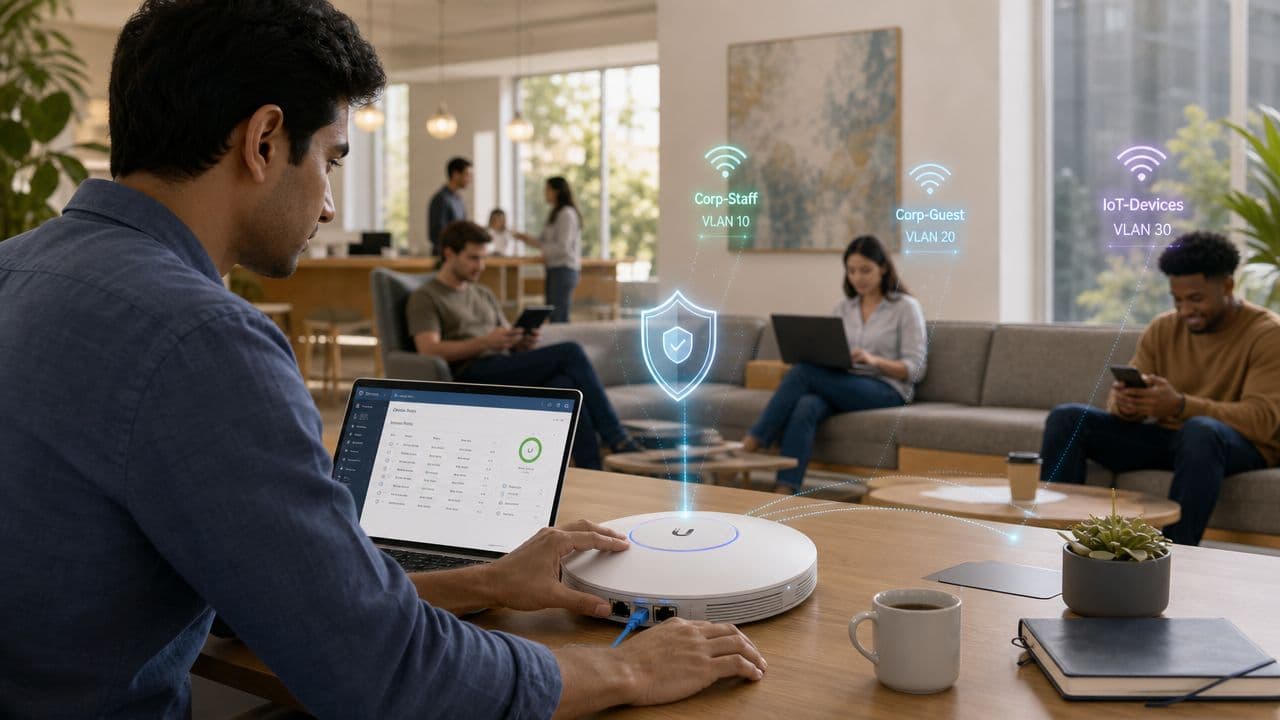
Let's be honest, the term enterprise WiFi solution can sound a bit corporate and intimidating. But at its heart, it’s about moving beyond the basic, password-sharing WiFi you might have at home and adopting a smarter, more secure system built for the demands of a modern business.
It’s a fundamental shift away from simply providing an internet connection. Instead, it focuses on three core pillars: identity, security, and user experience, effectively solving the security risks and management headaches that come with outdated guest networks.
What Are Enterprise WiFi Solutions Really?
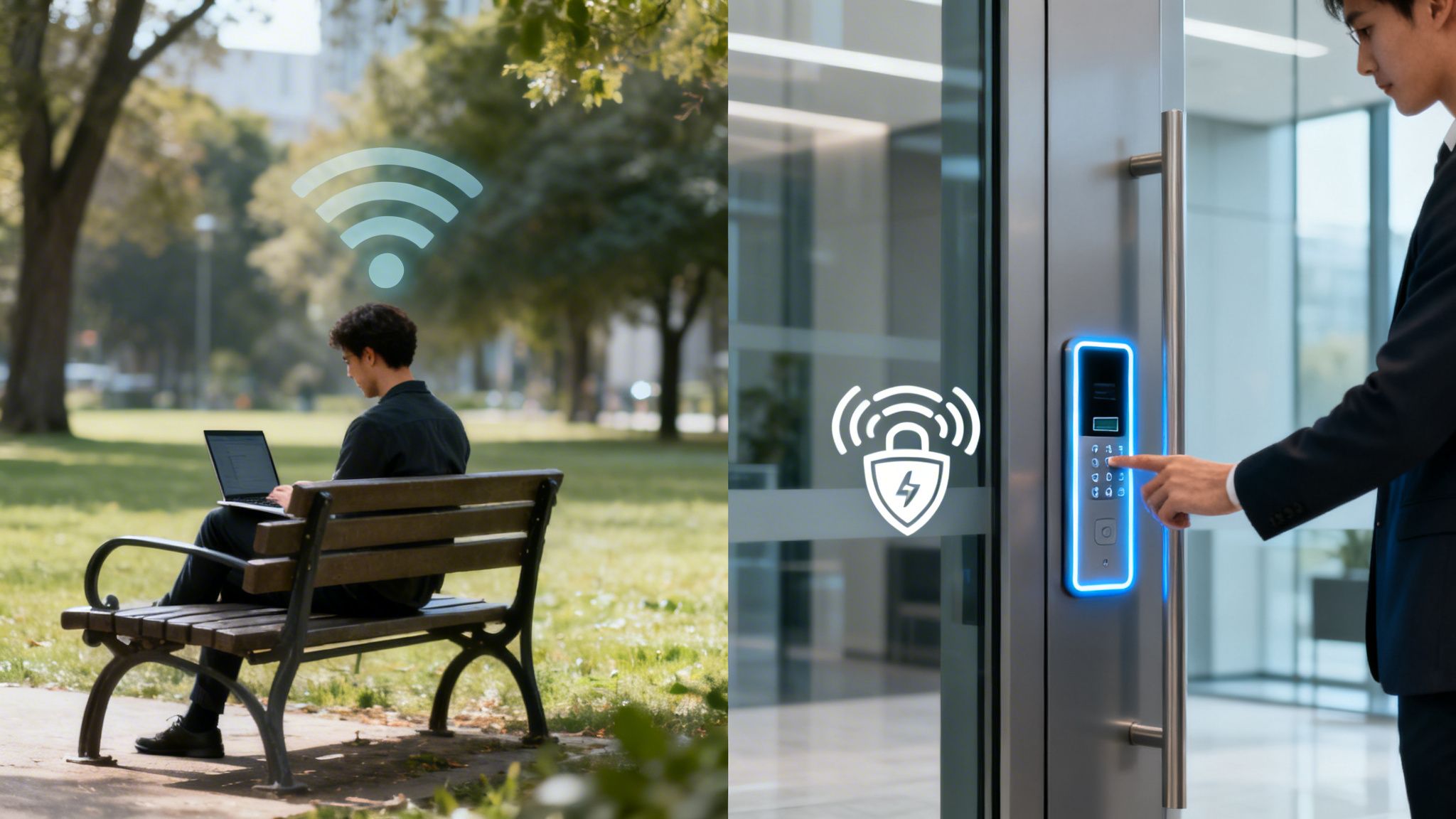
Think of your standard guest WiFi like a public park bench. It’s open for anyone to use, which is convenient, but it offers zero real security, privacy, or control for the owner. Now, contrast that with a modern office building that uses a sophisticated keycard system. Access is granted based on who you are and where you’re allowed to go. That’s the core difference with an enterprise WiFi solution.
These systems aren't just about broadcasting a signal. They are strategic tools designed to securely manage connectivity for a diverse mix of users—employees, guests, and even your growing number of Internet of Things (IoT) devices. The goal is a seamless, automatic connection that is also incredibly secure and simple for IT teams to oversee from one central dashboard.
Beyond the Shared Password
The single biggest leap from basic WiFi to an enterprise platform is ditching the shared password. Having one password for everyone—staff, visitors, and devices—is a huge security flaw. If that password leaks, your entire network is wide open. Enterprise solutions fix this by authenticating each user and device individually.
This modern approach unlocks a few game-changing benefits:
- Enhanced Security: By knowing exactly who is connecting, you can create and enforce specific access rules. This means you can easily keep guest traffic completely separate from your sensitive corporate data.
- Simplified Management: Your IT team can finally say goodbye to the constant cycle of password reset requests or the pain of manually updating credentials on dozens or hundreds of devices.
- Improved User Experience: Employees and regular visitors can connect automatically and securely without the hassle of typing in passwords over and over. It just works, much like their WiFi at home.
An enterprise WiFi solution turns network access from a simple utility into an intelligent security layer. It answers the critical question: "Not just what is connecting, but who is connecting, and what should they be allowed to do?"
Standard Guest WiFi vs Enterprise WiFi Solutions
To really see the difference, it helps to put them side-by-side. While both provide internet access, their methods, security, and capabilities are worlds apart. The table below breaks down how each approach handles common networking needs.
| Feature | Standard Guest WiFi | Enterprise WiFi Solution |
|---|---|---|
| Authentication | Single shared password or open access | Individual identity (e.g., SSO, certificates) |
| Security | Low; high risk of unauthorised access | High; zero-trust principles, network segmentation |
| Management | Manual, device-by-device updates | Centralised, cloud-based dashboard |
| User Experience | Clunky login portals, repeated passwords | Seamless, automatic connection (e.g., Passpoint ) |
| Scalability | Poor; struggles with many devices | High; designed for thousands of users |
Ultimately, making the switch to an enterprise platform is about turning your WiFi from a potential liability into a genuine strategic asset. It delivers the robust, secure, and user-friendly connectivity that any modern business needs to operate safely and grow efficiently.
Why UK Businesses Are Upgrading Their Connectivity
The way we work, shop, and live has completely changed, and UK businesses are finding themselves in a race to keep up. The old, familiar network models simply can’t cut it anymore, creating an urgent need for something smarter, faster, and more secure. This isn't just a fleeting trend; it’s a necessary move to survive in a new commercial reality.
This push is fuelled by a perfect storm of new demands. The explosion of hybrid working means staff need flawless, secure access whether they’re in the office, at home, or grabbing a coffee. At the same time, the Internet of Things (IoT) has gone from a buzzword to a daily reality, with connected devices popping up everywhere—from stock-tracking sensors in shops to vital medical equipment in hospitals—all putting a huge strain on networks that were never built for this kind of traffic.
The New Digital Imperative
These challenges are part of a bigger picture: the UK's nationwide push for digital transformation. Businesses are quickly realising that to stay in the game, they need a network that can handle more people, more devices, and much higher expectations for speed and security. A slow, unreliable, or insecure WiFi network is no longer just a minor annoyance; it's a genuine obstacle to growth.
This is exactly why IT leaders across hospitality, retail, and corporate sectors are looking for more than just a basic connection. They need proper enterprise WiFi solutions built to handle today's complex demands. The aim is to put in place a scalable, cloud-managed platform that works as a strategic asset, not just another line on the expense sheet.
The real test for UK businesses isn't just about providing internet anymore. It's about delivering intelligent, secure, and rock-solid connectivity that underpins every single part of a modern business.
Market Growth and the WLAN Advantage
The money being invested in this space tells you everything you need to know. By 2026, the UK enterprise networking market is forecast to hit a revenue of USD 7,472.1 million, with that figure expected to jump to USD 9,144.0 million by 2030. This kind of growth shows just how serious the region is about building robust wireless infrastructure. For a deeper dive into these market dynamics, you can explore the full research on UK enterprise networking.
Within this booming market, Wireless Local Area Network (WLAN) solutions are the clear front-runners. They're quickly overtaking traditional ethernet switches—which held a commanding 35.51% revenue share in 2026—for a very simple reason: they are far better suited to handling the flood of IoT devices, supporting flexible work, and managing data-hungry applications.
Responding to Real-World Challenges
This shift isn’t happening in a vacuum; it’s a direct answer to real, tangible problems that businesses face every day. Just think about these common scenarios:
- Hospitality: A hotel has to provide great WiFi for hundreds of guests streaming films, secure access for staff using their own phones, and a completely separate, firewalled network for smart room controls and payment systems.
- Retail: A shopping centre wants to track customer footfall to improve store layouts and tenant mix, all while offering a branded guest WiFi login that captures valuable marketing insights.
- Corporate Offices: A company with a hybrid workforce needs to give every employee the same secure, high-speed network experience, whether they're hot-desking, in a meeting room, or at their permanent desk.
In any of these cases, a basic network with a single shared password would be a security and management disaster. The sheer volume and variety of connected devices demand a much smarter way of doing things. As businesses connect more devices than ever before, the need for a robust and secure foundation becomes critical. You can learn more about how many devices are connected to the internet in our detailed guide.
This is precisely why modern enterprise WiFi solutions are no longer a luxury, but a core business requirement. They deliver the centralised control, tight security, and scalability needed to meet these challenges head-on, giving businesses the tools they need to adapt and succeed.
The Core Technologies Driving Modern Enterprise WiFi
To get what makes modern enterprise WiFi so powerful, you have to peek behind the curtain. It's not one single thing, but a handful of clever technologies working in concert to create a network experience that's smooth, secure, and smart. Let's skip the jargon-filled manuals and break down what really matters, using simple analogies to show their value to your business.
These technologies are the engine behind the big shift away from clunky, shared passwords. Instead, they deliver the kind of identity-driven connectivity that today’s UK businesses need to thrive, supporting everything from hybrid work to IoT integration.
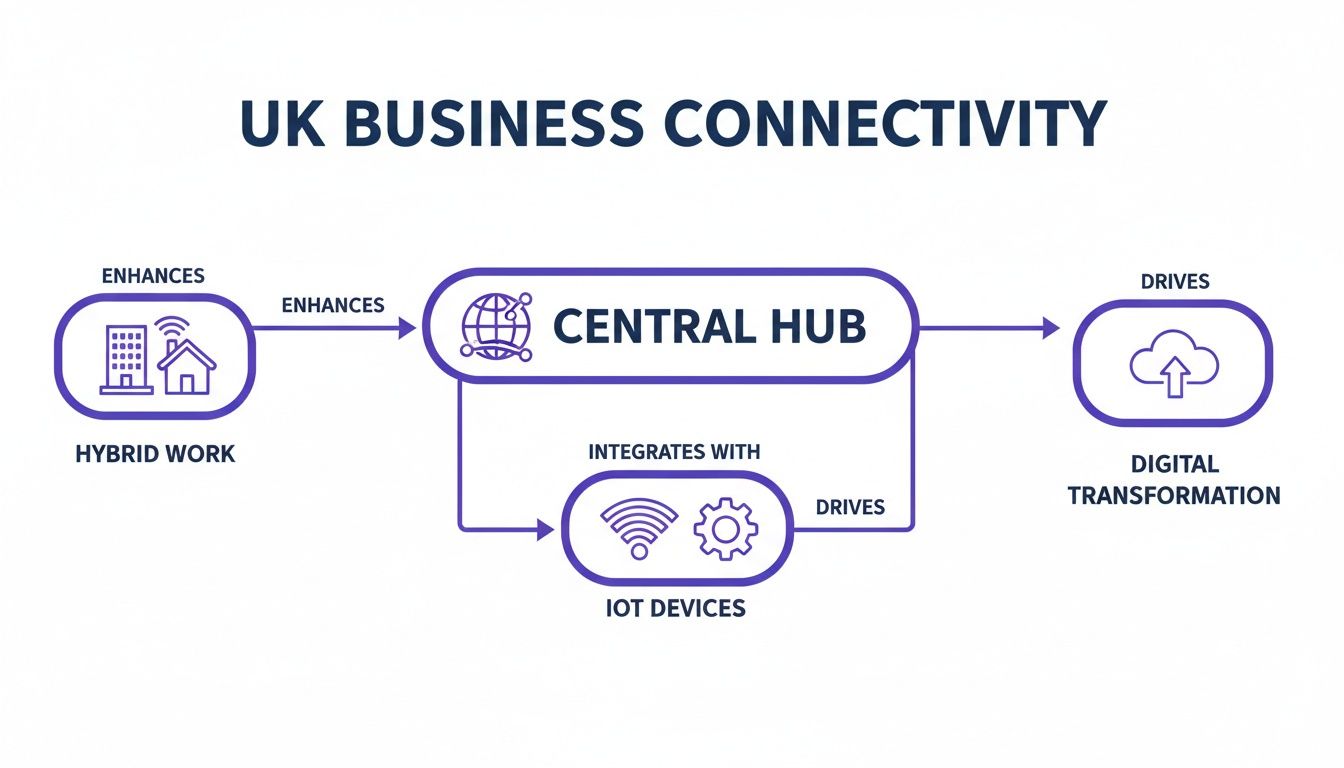
As you can see, having a solid connectivity hub is the key to managing the interconnected demands of a modern business environment.
OpenRoaming and Passpoint: The Universal WiFi Passport
Picture having a digital passport for your devices. Once you get it stamped at the border, you can travel across an entire region without stopping at every checkpoint. That's a perfect way to think about how OpenRoaming and Passpoint work for WiFi.
A user authenticates just one time on a participating network. After that, their phone or laptop automatically and securely connects at any other OpenRoaming-enabled venue—an airport, hotel, coffee shop, or another office branch. No more splash pages, no more hunting for passwords.
This provides two huge wins:
- For Users: It’s a completely frictionless experience. The WiFi simply works, securely and in the background, making connectivity an afterthought.
- For Businesses: You remove the headache of managing guest logins while giving your customers a premium experience. A visitor who enjoys seamless connectivity is far more likely to come back.
Identity-Based Access and SSO: The Master Keycard System
Think of your organisation's digital resources as rooms in a large building. Using a single, shared WiFi password is like leaving the front door key under the mat for anyone to find—a security nightmare waiting to happen. Identity-based access, especially when paired with Single Sign-On (SSO), is like giving everyone their own smart keycard.
This keycard is linked directly to their digital identity, often through platforms like Entra ID or Google Workspace. It only grants access to the "rooms" they're authorised to enter. For example:
- An employee's keycard opens their office, the meeting rooms, and the staff canteen.
- A visitor's keycard only provides access to the guest lounge and reception.
- A contractor's keycard might only work in the server room and automatically expire after 24 hours.
With this approach, network access is tied to a person's role, not a password that can be lost, stolen, or shared. It massively improves security and makes life much simpler for IT teams.
Zero-Trust Security: The Proactive Airport Checkpoint
Traditional network security was built like a castle with a moat. Once you were inside the walls, you were trusted to go anywhere. The glaring problem is that if one bad actor gets in, they suddenly have the keys to the kingdom. Zero-trust security completely flips this model on its head.
A zero-trust framework operates on a simple but powerful principle: "never trust, always verify." It assumes no user or device is safe by default, whether they are inside or outside the network perimeter.
Think of it like a modern airport security checkpoint. Every single time you want to board a flight (access a resource), your identity and boarding pass (credentials and device health) are checked. It doesn't matter if you just came from another gate in the same terminal; you get verified again. This constant verification makes it incredibly difficult for unauthorised users to move around your network, even if they manage to breach an initial defence. For a deeper dive into this model, our guide on network access control solutions is a great place to start.
Individual Pre-Shared Keys (iPSK): The Unique Key for Every Device
So, what about all those "headless" devices that can't use sophisticated keycards? I'm talking about the smart TVs in your meeting rooms, printers, IoT sensors, and other legacy equipment. Historically, these were all connected using that one risky, shared password.
Individual Pre-Shared Keys (iPSKs) solve this problem elegantly. It's like giving a unique, secure house key to every single one of these devices. Each device gets its own distinct password, which you can manage centrally from a single dashboard. If one device is ever compromised, you just revoke its key without affecting anything else. This simple concept closes a massive security hole and makes managing thousands of IoT devices both simple and secure.
How Different Industries Use Enterprise WiFi

This is where the theory hits the tarmac. All the technical capabilities we've talked about—from seamless authentication to zero-trust security—aren't just abstract concepts. They're the engine that drives tangible business outcomes across different sectors.
When you stop seeing WiFi as a simple utility and start treating it as a strategic asset, you unlock a whole new level of operational efficiency, security, and customer engagement. Let’s look at how a few industries are putting these solutions to work in the real world.
Transforming the Guest Experience in Hospitality
For hotels, resorts, and busy event venues, the guest experience is the bottom line. A modern enterprise WiFi platform is central to creating a seamless, personalised journey from the second a guest steps through the door.
Imagine a guest with an OpenRoaming-enabled smartphone walking into a hotel lobby. Their device connects to the secure WiFi instantly and automatically. There's no fumbling with passwords, no clunky login portals. It’s a frictionless first impression that sets a positive tone for the entire stay.
But the experience doesn't stop there:
- In-Room Convenience: The guest can securely stream their favourite films or connect to the room’s smart controls without a single connectivity hiccup.
- Personalised Offers: The WiFi platform notes the guest is near the spa. This can trigger an automated marketing message, offering a timely 20% discount on a last-minute massage.
- Operational Insights: Meanwhile, the hotel manager is analysing anonymised network data to see guest flow, pinpointing popular areas and peak times to better optimise staffing in the bar and restaurant.
In hospitality, the network becomes an invisible concierge. It removes connectivity friction while creating new opportunities to engage guests and drive ancillary revenue—a powerful combination for boosting loyalty and the bottom line.
Driving Sales and Insights in Retail
In the hyper-competitive world of retail, truly understanding your customers is everything. Enterprise WiFi solutions give shopping centres and large stores the tools to analyse foot traffic and engage shoppers in ways that simply weren't possible before.
Think about a large shopping centre with a modern WiFi platform. As shoppers connect to the free guest network, the system starts gathering valuable, anonymised location data. The marketing team can suddenly see which entrances are busiest, the paths people take through the shopping centre, and how long they linger in certain zones.
This insight leads to direct commercial benefits:
- Optimised Store Placement: By identifying "hot spots" and underused areas, management can make data-driven decisions about tenant mix and store placement to maximise footfall for everyone.
- Targeted Promotions: A shopper connecting to the WiFi near a sports shop could be met with a splash page promotion for a sale on running shoes, turning the network into a direct-to-consumer marketing channel.
Suddenly, the WiFi network isn't just a cost centre—it's a core piece of the shopping centre's business intelligence and marketing machine. You can dig deeper into creating these valuable touchpoints by exploring different guest WiFi solutions .
Securing Critical Operations in Healthcare
Hospitals and healthcare facilities have some of the most complex and demanding network needs on the planet. They need to balance open access for visitors, secure connectivity for staff, and an ultra-reliable network for life-critical medical devices, all while navigating a minefield of privacy and security regulations.
An enterprise WiFi solution brings order to this chaos from a single cloud dashboard. It uses network segmentation to create multiple, totally isolated virtual networks that all run on the same physical hardware.
- Secure Guest Access: Visitors connect to a completely firewalled guest network, ensuring their web browsing never comes close to sensitive hospital systems.
- Authenticated Staff Network: Doctors and nurses log in using their existing hospital credentials (SSO), granting them secure, role-based access to patient records and internal applications.
- Dedicated IoT Network: Life-critical equipment like infusion pumps and heart monitors are connected using Individual Pre-Shared Keys (iPSKs). This gives each device its own unique, secure key, quarantining them on a dedicated network to guarantee performance and prevent tampering.
This segmented approach locks down security and ensures reliability across the entire facility, simplifying life for the IT team and, most importantly, protecting patient data.
Delivering Home-Like Simplicity in Residential Properties
In modern build-to-rent (BTR) developments and student accommodation, outstanding connectivity is no longer a perk; it's a key selling point. Residents expect a secure, private, and effortless network experience from day one, without the headache of setting up their own routers.
Enterprise WiFi platforms deliver this through clever features like iPSK . Each tenant is assigned their own private network segment with a unique password. It's like giving every flat its own personal WiFi network, but with the simplicity of central management.
Tenants can easily and securely connect all their devices—laptops, phones, smart speakers, TVs, and lighting—knowing their traffic is completely isolated from their neighbours. It delivers the privacy of a home network with the power and reliability of an enterprise-grade solution.
A Buyer's Checklist For Choosing Your WiFi Platform
Choosing the right enterprise WiFi solution is a major decision. It will directly shape your organisation's security, day-to-day efficiency, and the experience you offer customers and staff for years to come. It’s easy to get bogged down in technical jargon, so it’s far better to frame your search around a handful of critical questions to ask any potential vendor.
This checklist will help you cut through the noise. It’s not about the physical hardware, but the software platform that runs your network. The goal is to find a partner that solves today’s problems while being ready for whatever comes next.
Scalability And Future-Proofing
Your business will grow, and your network absolutely must be able to keep up. A platform that can't scale or adapt to new technology will quickly turn into a costly bottleneck.
Your key questions should be:
- Does it support the latest standards? Your platform needs to be ready for Wi-Fi 6 and Wi-Fi 6E to handle more devices and deliver the speeds users now expect. Critically, ask if it supports OpenRoaming and Passpoint—this is what provides those seamless, automatic connections that people love.
- Is it cloud-native? A true cloud-native platform is what gives you near-infinite scalability, resilience, and the power to manage thousands of locations from a single dashboard, without needing clunky on-premises controllers.
Security And Compliance
Security can't be a feature you bolt on later; it has to be woven into the very fabric of the platform. The days of a single, shared password for everyone are well and truly over, and your new solution must reflect that reality.
The most important question is: does the platform enable a zero-trust security model? This means it verifies every user and every device, every single time, assuming no connection is safe by default.
Further security considerations include:
- Does it integrate with our identity provider? The platform must connect with your existing directory—whether that’s Entra ID, Google Workspace, or Okta—to enable secure identity-based access and Single Sign-On (SSO).
- How does it secure headless devices? Ask about its ability to issue Individual Pre-Shared Keys (iPSKs). This is how you secure all your IoT devices like printers, cameras, and smart sensors without falling back on a single, highly vulnerable password.
Modern vs Traditional WiFi Management Approach
The difference between a legacy system and a modern identity-based platform is stark. The new way simplifies management, tightens security, and dramatically improves the experience for everyone using the network.
This table really highlights the shift in thinking.
| Aspect | The Old Way (Traditional Approach) | The New Way (Modern Platform) |
|---|---|---|
| Access Control | One shared password for everyone (high risk) | Identity-based access (SSO, certificates) |
| Security Model | Castle-and-moat (trust once inside) | Zero-trust (always verify) |
| Infrastructure | On-premises servers, complex hardware | Cloud-native, hardware-agnostic software |
| Management | Manual updates, high IT overhead | Centralised dashboard, automated provisioning |
| User Experience | Clunky login portals, password requests | Seamless, automatic connections |
As you can see, the modern approach is built for today's security threats and user expectations, while the old way feels stuck in the past.
Integration And Deployment
A great platform should work with the infrastructure you already have, not force you into a costly "rip and replace" project. Just as importantly, the deployment process should be fast and efficient, getting you to a return on investment as quickly as possible.
Look for a solution that is hardware-agnostic, meaning it can work with your current access points from leading vendors like Meraki, Ruckus, or Aruba. This approach can save you a significant amount of money and time. The United Kingdom's Enterprise WLAN market is seeing rapid growth, and it's being driven by this need for better, more flexible connectivity. Hospitality operators using modern cloud-native systems, for example, report deployments up to 40% faster than with legacy setups. You can find more data on the UK's evolving WLAN market at 6wresearch.com .
Finally, ask a simple but vital question: how quickly can we be live? A truly cloud-native platform like Purple should be deployable in weeks, not the months-long sagas typical of older, on-premises systems. This speed isn't just a convenience; it's a clear indicator of a modern, efficient architecture.
Your Enterprise WiFi Questions, Answered
Making the move to an identity-based network is a big decision, and it’s completely natural to have questions. You aren't just buying a piece of technology; you're investing in a smarter way to handle security, boost efficiency, and improve the user experience. To help you get a clearer picture, we've gathered the most common questions we hear from business leaders and IT teams considering modern enterprise WiFi solutions.
We’ll give you direct, no-nonsense answers on security, implementation, and the crucial question of return on investment.
How Secure Is An Identity-Based WiFi Solution?
This is almost always the first—and most important—question asked. The short answer is that an identity-based WiFi platform is fundamentally more secure than any system that relies on shared passwords. Its security isn't just a bolt-on feature; it's a multi-layered defence strategy built in from the ground up.
Think about it this way: a shared password is like leaving one key under the doormat for everyone in your building. If a single person loses it or shares it carelessly, your entire premises is at risk. An identity-based approach, on the other hand, gives every single person their own unique, trackable keycard.
This advanced security model rests on several key pillars:
- Zero-Trust Principles: The network runs on a "never trust, always verify" model. It challenges every user and device for their credentials each time they try to access a resource. This dramatically cuts the risk of an intruder moving laterally through your network.
- Certificate-Based Authentication: Forget passwords. The system uses digital certificates—secure, unforgeable digital IDs—to verify users and their devices. This wipes out the risks that come with weak, stolen, or shared passwords.
- End-to-End Encryption: From the moment a device connects, all its data is encrypted. This means that even if traffic was somehow intercepted, it would be scrambled and completely useless to an attacker.
An identity-based solution turns your WiFi from what is often your biggest security headache into one of your strongest lines of defence. It effectively walls off guest traffic from your corporate data and gives you fine-grained control over who can access what.
Is It Difficult To Switch From Our Current System?
The idea of a full network overhaul can be intimidating, conjuring images of long downtimes and complicated hardware swaps. Thankfully, modern enterprise WiFi platforms are designed specifically to make this switch as smooth and fast as possible. The days of year-long IT projects are long gone.
The secret is its cloud-native architecture. Unlike old-school systems that demanded clunky on-site servers and controllers, a modern solution is managed entirely from the cloud. This simplifies the whole process enormously.
Deployment is surprisingly quick. Because these platforms are primarily software-based and hardware-agnostic, they’re built to work with the access points you probably already have from major brands like Meraki, Ruckus, or Aruba. This means you can avoid a costly "rip and replace" project. The migration is focused on software configuration, which can shrink deployment timelines from months down to just a few weeks.
What Kind Of ROI Can We Expect?
The return on investment (ROI) you get from upgrading to a proper enterprise WiFi solution shows up almost immediately and continues to grow over the long term. It comes from direct cost savings, serious risk reduction, and even new ways to generate revenue. This is about more than just faster WiFi; it’s about making your business run better.
First, let's talk about the direct operational savings. A huge chunk of IT helpdesk time is soaked up by password problems—resetting forgotten staff passwords, helping guests get connected, and manually updating credentials on device after device. An identity-based system automates all of this, freeing up your IT team to focus on more important work and causing support tickets to plummet.
Next is the powerful ROI of improved security. A single data breach can be financially ruinous, leading to regulatory fines, lasting damage to your reputation, and operational chaos. By putting a zero-trust network in place, you are making a proactive investment to stop these costly incidents from ever happening. The cost of a modern WiFi platform pales in comparison to the potential cost of a breach.
Finally, the platform itself can become a tool for growing revenue. By using the data your network gathers, you can:
- Understand Customer Behaviour: Analyse footfall and dwell times to optimise your store layouts and staffing schedules.
- Drive Personalised Marketing: Connect your WiFi analytics to your CRM to send targeted offers that boost customer spending and build loyalty.
- Improve Visitor Experience: A seamless, secure connection encourages people to come back and leave positive reviews, which directly helps your bottom line.
When you add all these benefits together, the ROI becomes clear and compelling. Your network stops being a cost centre and transforms into a powerful asset that pays for itself.
Ready to move beyond shared passwords and unlock the true potential of your network? Purple provides secure, identity-based WiFi that integrates seamlessly with your existing hardware and delivers measurable ROI in weeks, not months. Learn more at purple.ai and schedule a demo today.