Enterprise wireless security advisor & risk auditor
Benchmark your wireless authentication, segmentation, IoT controls, and threat monitoring against IEEE 802.1X, WPA3-Enterprise, and Zero Trust standards to calculate your security posture score.
Identified architecture gaps (4)
- Shared passphrase architecture enables offline dictionary attacks and employee credential leakage.
- Static VLANs lack Layer 2 client-to-client isolation, permitting lateral port scanning across devices on the same SSID.
- Headless IoT devices share static credentials without individual revocation or microsegmentation.
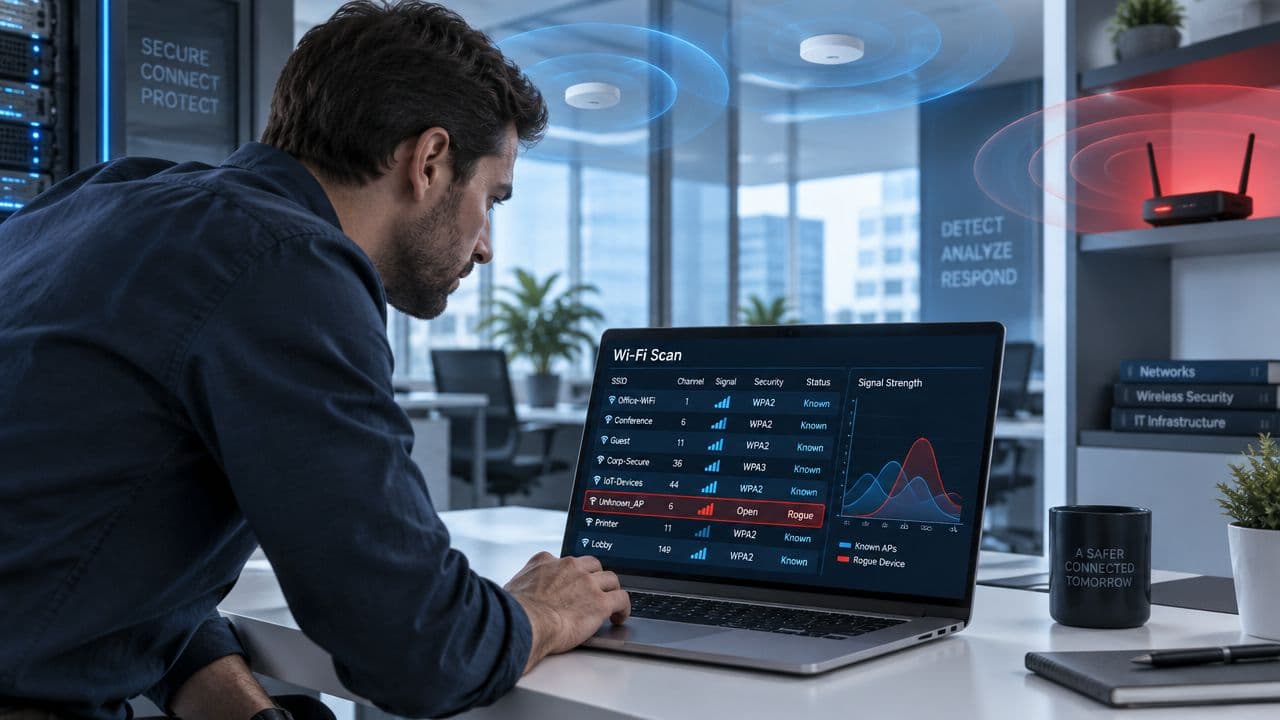
- Periodic audits leave long discovery windows between scans where malicious rogue APs remain undetected.
Zero trust hardening roadmap
- Transition corporate SSIDs to 802.1X with certificate-based EAP-TLS via Cloud RADIUS.
- Enforce client-to-client isolation and dynamic 802.1X VLAN assignment on all access points.
- Deploy Identity PSK (iPSK) with private VLANs to assign unique pre-shared keys per headless IoT device.
- Mandate 802.11w Management Frame Protection (MFP) to neutralize wireless deauthentication and disassociation exploits.
- Deploy enterprise captive portal with SSO and continuous device profiling to isolate guest traffic from internal subnets.
Network and wireless security has evolved from a simple perimeter defence into a critical foundation for modern enterprise operations. As organisations adopt hybrid work models, cloud services, and thousands of connected Internet of Things (IoT) devices, traditional boundary security is no longer sufficient. Wireless networks represent an exposed physical attack surface where radio signals propagate beyond physical walls, making identity-based access control essential.
Establishing comprehensive enterprise wireless security requires replacing static passwords with identity-driven 802.1X authentication, WPA3-Enterprise encryption, network micro-segmentation, and cloud-managed access controls. For an in-depth exploration of overall architecture, consult our master enterprise WiFi security guide.
Why traditional shared passwords fail enterprise networks
Legacy wireless deployments historically relied on a single Pre-Shared Key (PSK) using WPA2-Personal. While simple to deploy, shared passwords introduce severe architectural vulnerabilities in commercial and enterprise environments:
- Zero individual accountability: When dozens or hundreds of employees and contractors share one password, IT administrators cannot attribute network activity or security incidents to a specific user.
- Impossible key management: When an employee leaves the organisation or a password is compromised, revoking access requires reconfiguring the WiFi password on every connected client device across the enterprise.
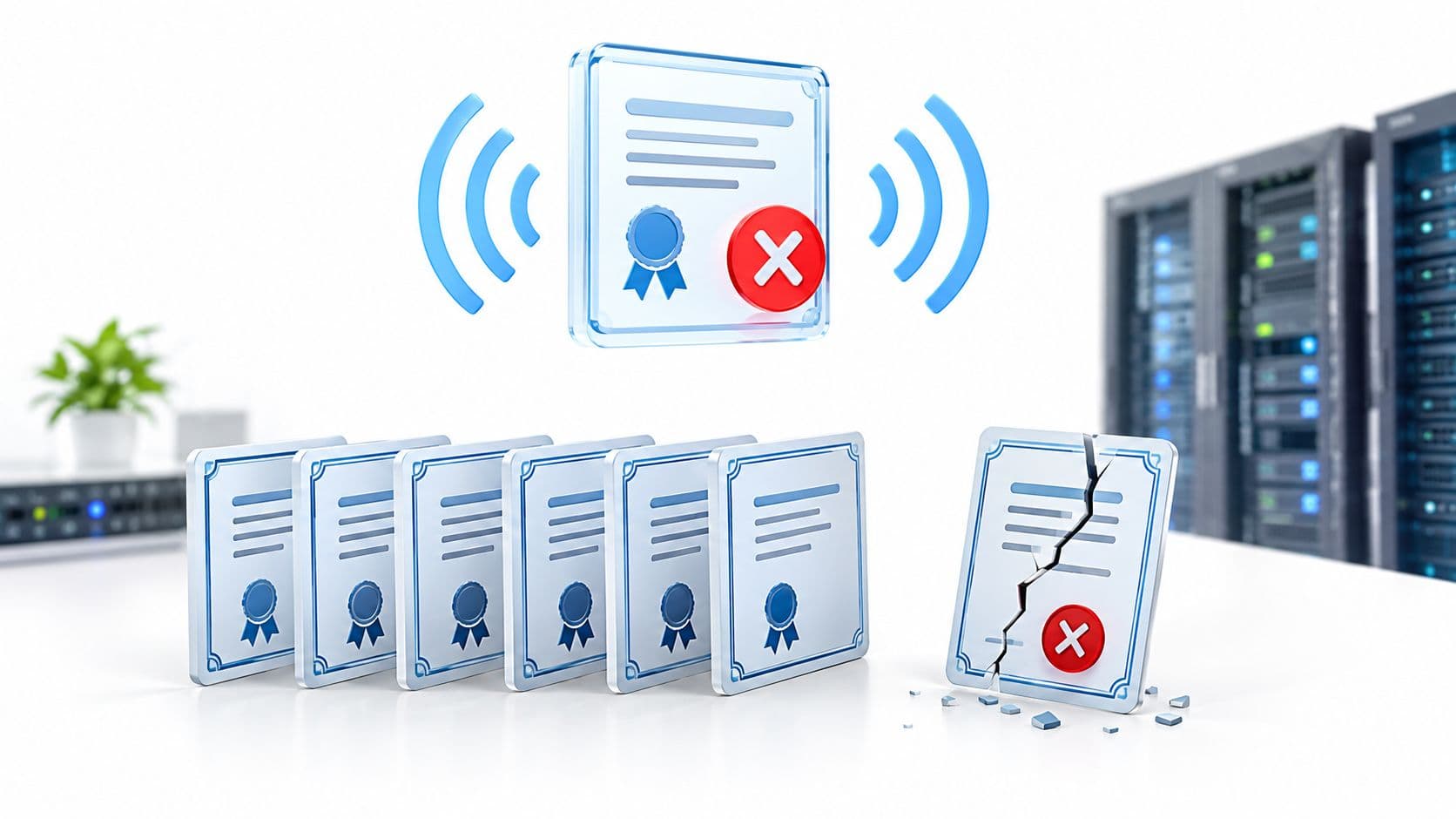
- Susceptibility to offline cracking: WPA2-Personal four-way handshakes can be captured passively over the air and subjected to offline dictionary or brute-force attacks without triggering administrative alerts.
- Lack of session isolation: On open or PSK-secured networks, connected devices can intercept unencrypted local broadcast traffic from other devices sharing the same radio channel.
Traditional PSK vs Zero Trust identity-driven security
Review the comparison table below to understand how modern identity-based access control solves traditional PSK security weaknesses:
| Security dimension | Traditional PSK approach | Zero Trust 802.1X solution |
|---|---|---|
| Authentication factor | Shared static passphrase ("what you know") | Individual user/device digital certificate or Entra ID token |
| Revocation granularity | Global network key rotation required | Instant single-user credential revocation via IdP |
| Encryption & session keys | Shared broadcast encryption key | Unique per-session Pairwise Master Keys (PMK) |
| Network segmentation | Flat single VLAN network structure | Dynamic VLAN assignment based on role and device health |
Understanding common enterprise wireless network threats
To defend wireless infrastructure effectively, enterprise security teams must mitigate five primary wireless threat vectors:
1. Rogue access points & Evil Twin attacks
Attackers set up rogue access points broadcasting legitimate corporate SSIDs near offices or venues. Unsuspecting devices automatically connect to the stronger malicious signal, allowing attackers to perform Man-in-the-Middle (MitM) inspection of corporate credentials and data traffic. Implementing WPA3-Enterprise mutual certificate authentication ensures client devices verify the server identity before transmitting credentials.
2. Deauthentication denial-of-service (DoS)
Attackers transmit forged 802.11 deauthentication frames to force connected clients off legitimate access points. This creates operational disruption for point-of-sale systems, medical monitors, or industrial inventory scanners. Deploying 802.11w Management Frame Protection (MFP) encrypts control frames, preventing deauthentication forging.
3. Session hijacking & packet sniffing
On unencrypted guest or open networks, eavesdroppers use packet analyzer software to capture unencrypted data streams or session cookies. Once captured, attackers hijack active web sessions without needing login credentials. Enforcing HTTPS across all captive portal solutions and deploying Passpoint (Hotspot 2.0) secures guest radio traffic with WPA3 encryption.
4. Protocol vulnerabilities (KRACK & Dragonblood)
Legacy WPA2 implementations suffer from Key Reinstallation Attacks (KRACK), allowing attackers to decrypt traffic by manipulating WPA2 handshake retries. WPA3 eliminates KRACK and brute-force dictionary attacks through Simultaneous Authentication of Equals (SAE) and Protected Management Frames (PMF).
Building a digital fortress with modern security protocols
Modern enterprise wireless defence relies on an integrated stack of security controls working in unison across identity, networking, and analytics layers:
1. 802.1X Enterprise & Cloud RADIUS integration
Integrating wireless access points with Cloud RADIUS services allows direct authentication against enterprise Identity Providers (IdPs) like Microsoft Entra ID, Google Workspace, or Okta. Using Extensible Authentication Protocol (EAP-TLS) with X.509 digital certificates guarantees that only trusted corporate devices can connect, removing password entry entirely.
2. Private PSK (PPSK) for headless IoT devices
Enterprise IoT devices - such as smart screens, printers, thermostats, and surveillance cameras - often lack 802.1X supplicants. Private PSK (PPSK) assigns a unique, dedicated passphrase to each IoT device or vendor group. The access point uses the passphrase to place the device onto an isolated VLAN, restricting lateral network movement.
3. Zero Trust Network Architecture & dynamic VLAN steering
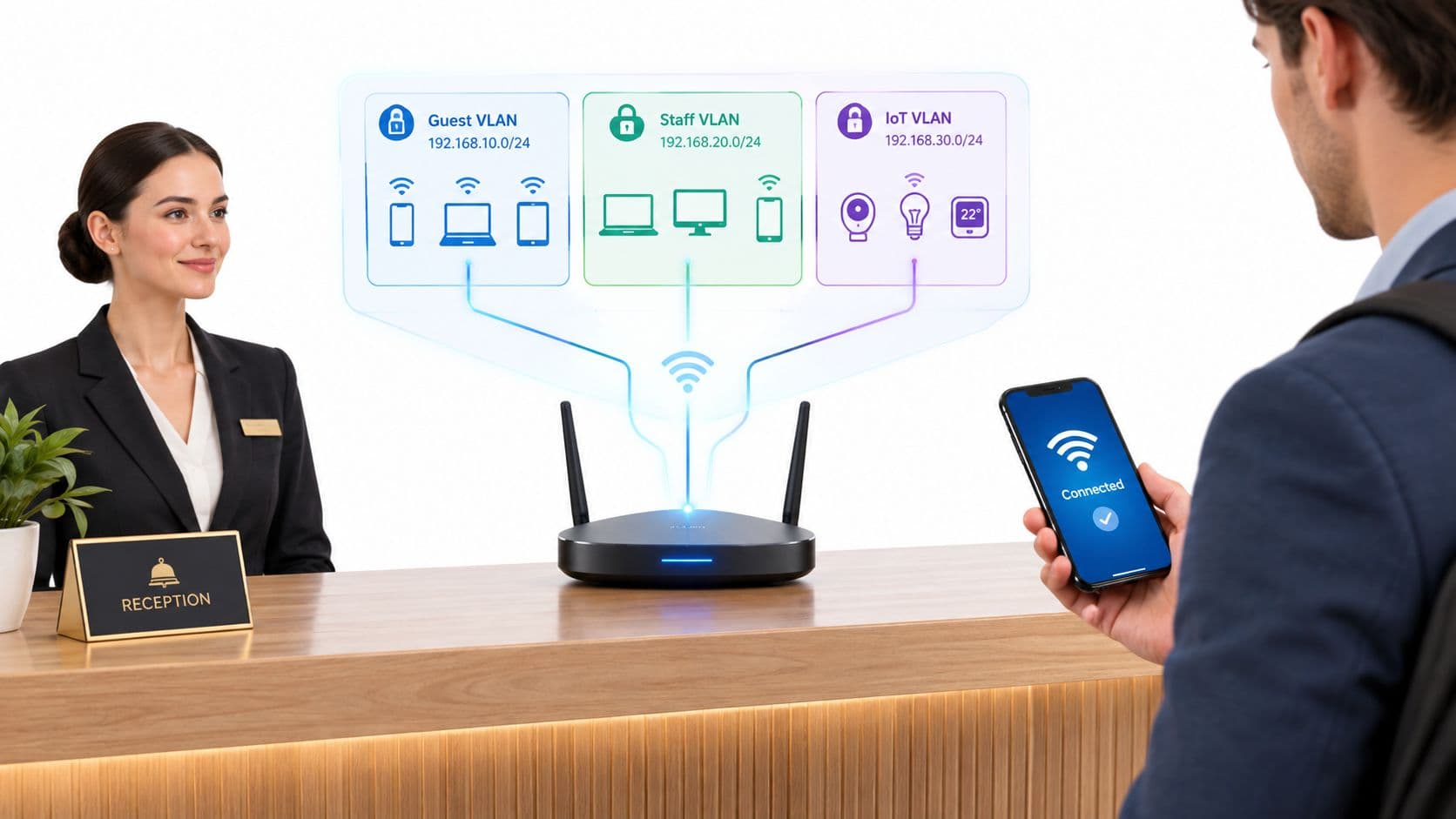
Adopting Zero Trust principles means no device is trusted based on network location alone. Cloud-managed controller platforms dynamically assign VLAN tags and Firewall Access Control Lists (ACLs) based on user group, device posture, and time of day. A guest user, corporate employee, and HVAC contractor authenticating on the same physical access point receive completely isolated network paths.
4. Compliant guest WiFi & Passpoint roaming
Guests and visitors require convenient internet access without posing a risk to internal network assets. Deploying cloud-managed guest WiFi solutions with secure captive portals isolates guest traffic on dedicated internet-only VLANs while capturing verified contact details. Passpoint (WPA3-Enterprise Hotspot 2.0) enables seamless, encrypted automatic connection for mobile subscribers without requiring portal logins.
Regulatory compliance & audit requirements
Enterprise wireless security protocols align directly with major global compliance standards:
- ISO 27001 Annex A.9: Mandates strict user access management, individual network authentication, and segregation of network services.
- PCI-DSS v4.0 Requirement 11.2: Requires quarterly scanning for unauthorized or rogue wireless access points connected to the Cardholder Data Environment (CDE).
- HIPAA Security Rule § 164.312: Demands access control, unique user identification, and transmission security (encryption) for all electronic Protected Health Information (ePHI) traversing wireless channels.
- GDPR Article 32: Requires technical measures to ensure ongoing confidentiality, integrity, and availability of personal data processed over public or guest wireless portals. For details on analytics compliance, read our WiFi analytics guide.
Frequently asked questions
How does 802.1X Enterprise differ from WPA3-Personal?
WPA3-Personal uses Simultaneous Authentication of Equals (SAE) with a shared password, which protects against offline dictionary attacks but does not identify individual users. 802.1X Enterprise authenticates each user or device individually against an Identity Provider (IdP) or RADIUS server using digital certificates or unique credentials.
Can headless IoT devices connect to an enterprise 802.1X network?
Most headless IoT devices (printers, smart TVs, cameras) do not support 802.1X certificate supplicants. Enterprise networks use Private PSK (PPSK) or Identity PSK (iPSK) to issue unique passphrases per IoT device, automatically mapping them to isolated VLANs without complex certificate installation.
What is 802.11w Management Frame Protection?
802.11w Management Frame Protection (MFP) is an IEEE standard that encrypts wireless management frames (such as deauthentication and disassociation packets). This prevents attackers from spoofing management frames to launch denial-of-service (DoS) attacks on connected client devices.
How does Cloud RADIUS simplify multi-site enterprise WiFi security?
Cloud RADIUS eliminates the need to deploy and manage local physical RADIUS servers (such as Microsoft NPS) at every office or venue. Access points authenticate user requests directly via cloud APIs against Azure AD/Entra ID or Okta, streamlining multi-site security administration.