

Jamf आणि RADIUS: Apple डिव्हाइस ताफ्यांसाठी प्रमाणपत्र-आधारित WiFi ऑथेंटिकेशन
हे तांत्रिक संदर्भ मार्गदर्शक IT व्यवस्थापक, नेटवर्क आर्किटेक्ट्स आणि CTOs ना Jamf Pro आणि RADIUS वापरून Apple डिव्हाइस ताफ्यांसाठी प्रमाणपत्र-आधारित 802.1X WiFi ऑथेंटिकेशन तैनात करण्यासाठी कृतीयोग्य पावले प्रदान करते. यामध्ये संपूर्ण SCEP प्रमाणपत्र प्रोव्हिजनिंग वर्कफ्लो, WiFi कॉन्फिगरेशन प्रोफाइल स्ट्रक्चर, RADIUS इंटिग्रेशन आवश्यकता आणि आरोग्य सेवा आणि एंटरप्राइझ वातावरणातील वास्तविक अंमलबजावणीच्या परिस्थितींचा समावेश आहे. पासवर्ड-आधारित WiFi असुरक्षितता दूर करण्यासाठी, हेल्पडेस्क ओव्हरहेड कमी करण्यासाठी आणि PCI DSS आणि GDPR नेटवर्क ॲक्सेस मानकांचे पालन साध्य करण्यासाठी कोणत्याही संस्थेसाठी हे मार्गदर्शक आवश्यक आहे.
🎧 हे मार्गदर्शक ऐका
ट्रान्सक्रिप्ट पहा

कार्यकारी सारांश
एंटरप्राइझ वातावरणात Apple डिव्हाइसेसच्या ताफ्यासाठी सुरक्षित WiFi ॲक्सेस व्यवस्थापित करणे, पारंपारिक पासवर्ड-आधारित ऑथेंटिकेशनवर अवलंबून असताना एक महत्त्वपूर्ण ऑपरेशनल आणि सुरक्षा आव्हान सादर करते. वापरकर्ते त्यांचे Active Directory क्रेडेंशियल्स बदलतात आणि लगेच त्यांचे iPhones, iPads आणि MacBooks नेटवर्कवरून डिस्कनेक्ट होतात — ज्यामुळे हेल्पडेस्क तिकिटे तयार होतात, वर्कफ्लोमध्ये व्यत्यय येतो आणि संस्था क्रेडेंशियल-आधारित हल्ल्यांना बळी पडते.
हॉटेल्स, रिटेल चेन्स, स्टेडियम्स आणि सार्वजनिक क्षेत्रातील संस्थांमधील IT व्यवस्थापक, नेटवर्क आर्किटेक्ट्स आणि CTOs साठी, EAP-TLS वापरून प्रमाणपत्र-आधारित 802.1X ऑथेंटिकेशन हा उपाय आहे. Jamf Pro चा लाभ घेऊन SCEP (Simple Certificate Enrollment Protocol) द्वारे युनिक क्रिप्टोग्राफिक प्रमाणपत्रे वितरित करून आणि RADIUS सर्व्हरशी समाकलित करून, संस्था प्रत्येक व्यवस्थापित Apple डिव्हाइससाठी अखंड, पासवर्डलेस WiFi ॲक्सेस मिळवू शकतात. हे मार्गदर्शक Jamf RADIUS WiFi प्रमाणपत्र ऑथेंटिकेशन तैनात करण्यासाठी एक व्यावहारिक, व्हेंडर-न्यूट्रल दृष्टीकोन प्रदान करते, ज्यामुळे मजबूत सुरक्षा, PCI DSS आणि GDPR सारख्या मानकांचे पालन आणि सपोर्ट ओव्हरहेडमध्ये मोजण्यायोग्य घट सुनिश्चित होते.
तांत्रिक सखोल माहिती
802.1X EAP-TLS आर्किटेक्चर
प्रमाणपत्र-आधारित WiFi ऑथेंटिकेशनचा पाया IEEE 802.1X मानक आणि EAP-TLS (Extensible Authentication Protocol-Transport Layer Security) प्रोटोकॉल आहे. 802.1X मानकाच्या तपशीलवार माहितीसाठी, आमच्या 802.1X ऑथेंटिकेशन: आधुनिक डिव्हाइसेसवर नेटवर्क ॲक्सेस सुरक्षित करणे या मार्गदर्शकाचा संदर्भ घ्या.
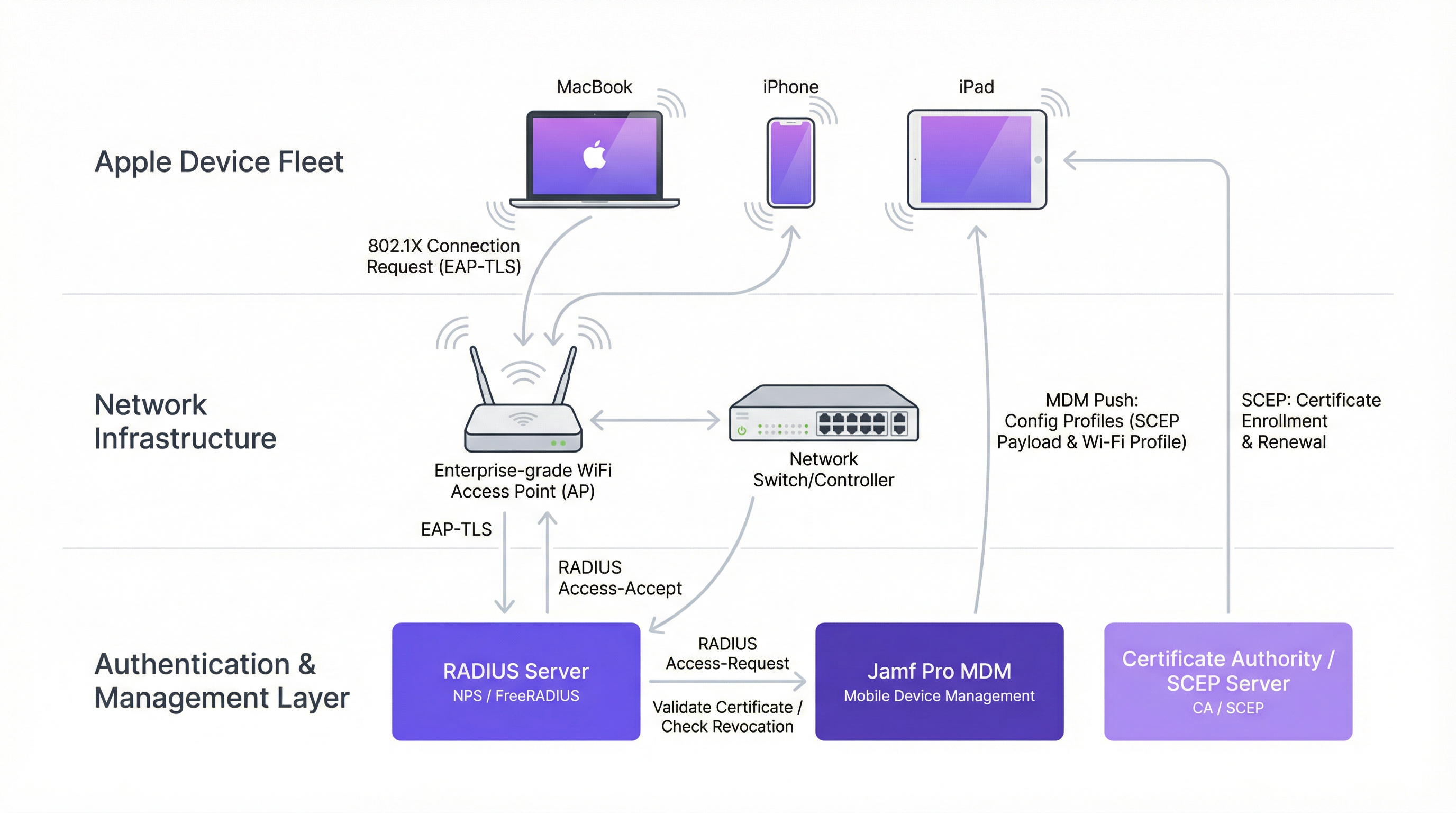
PEAP (Protected EAP) च्या विपरीत, जे युजरनेम आणि पासवर्डवर अवलंबून असते, EAP-TLS ला क्लायंट डिव्हाइस आणि ऑथेंटिकेशन सर्व्हर या दोघांनाही डिजिटल प्रमाणपत्रांचा वापर करून त्यांची ओळख सिद्ध करणे आवश्यक असते. हे परस्पर ऑथेंटिकेशन EAP-TLS ला एंटरप्राइझ उपयोजनांसाठी सुवर्ण मानक बनवते. थ्री-पार्टी मॉडेलमध्ये खालील घटकांचा समावेश असतो.
| घटक | भूमिका | उदाहरणे |
|---|---|---|
| Supplicant | नेटवर्क ॲक्सेसची विनंती करणारे Apple डिव्हाइस | MacBook, iPhone, iPad |
| Authenticator | नेटवर्क एज डिव्हाइस जे ॲक्सेस कंट्रोल लागू करते | WiFi ॲक्सेस पॉइंट, WLC |
| Authentication Server | प्रमाणपत्रे प्रमाणित करते आणि ॲक्सेस अधिकृत करते | FreeRADIUS, Cisco ISE, Microsoft NPS |
ॲक्सेस पॉइंट गेटकीपर म्हणून काम करतो, जोपर्यंत RADIUS सर्व्हर Access-Accept संदेश पाठवत नाही तोपर्यंत सर्व ट्रॅफिक ब्लॉक करतो. हे IEEE 802.1X पोर्ट-आधारित नेटवर्क ॲक्सेस कंट्रोल (PNAC) मॉडेलचे मुख्य केंद्र आहे.
SCEP आणि Jamf Pro: स्केलेबल प्रमाणपत्र वितरण
मोठ्या प्रमाणावर EAP-TLS मधील आव्हान म्हणजे प्रमाणपत्र वितरण. 500 iPads वर मॅन्युअली युनिक प्रमाणपत्र स्थापित करणे हे व्यवहार्य ऑपरेशन नाही. येथेच Jamf Pro आणि SCEP Jamf इंटिग्रेशन महत्त्वपूर्ण ठरते.
SCEP (Simple Certificate Enrollment Protocol) हा एक हलका प्रोटोकॉल आहे जो डिव्हाइसला Certificate Authority (CA) कडून स्वाक्षरी केलेल्या प्रमाणपत्राची स्वयंचलितपणे विनंती करण्यास आणि प्राप्त करण्यास अनुमती देतो. Jamf Pro ऑर्केस्ट्रेटर म्हणून काम करते, प्रत्येक Apple डिव्हाइसवर Configuration Profile पुश करते. या प्रोफाइलमध्ये SCEP पेलोड असतो जो डिव्हाइसला SCEP सर्व्हरशी संपर्क साधण्याची सूचना देतो, डायनॅमिक चॅलेंज पासवर्ड प्रदान करतो आणि आवश्यक प्रमाणपत्र गुणधर्म निर्दिष्ट करतो — जसे की Subject Alternative Name (SAN), जे सहसा डिव्हाइसच्या MAC ॲड्रेस किंवा सिरीयल नंबरवर मॅप केले जाते.
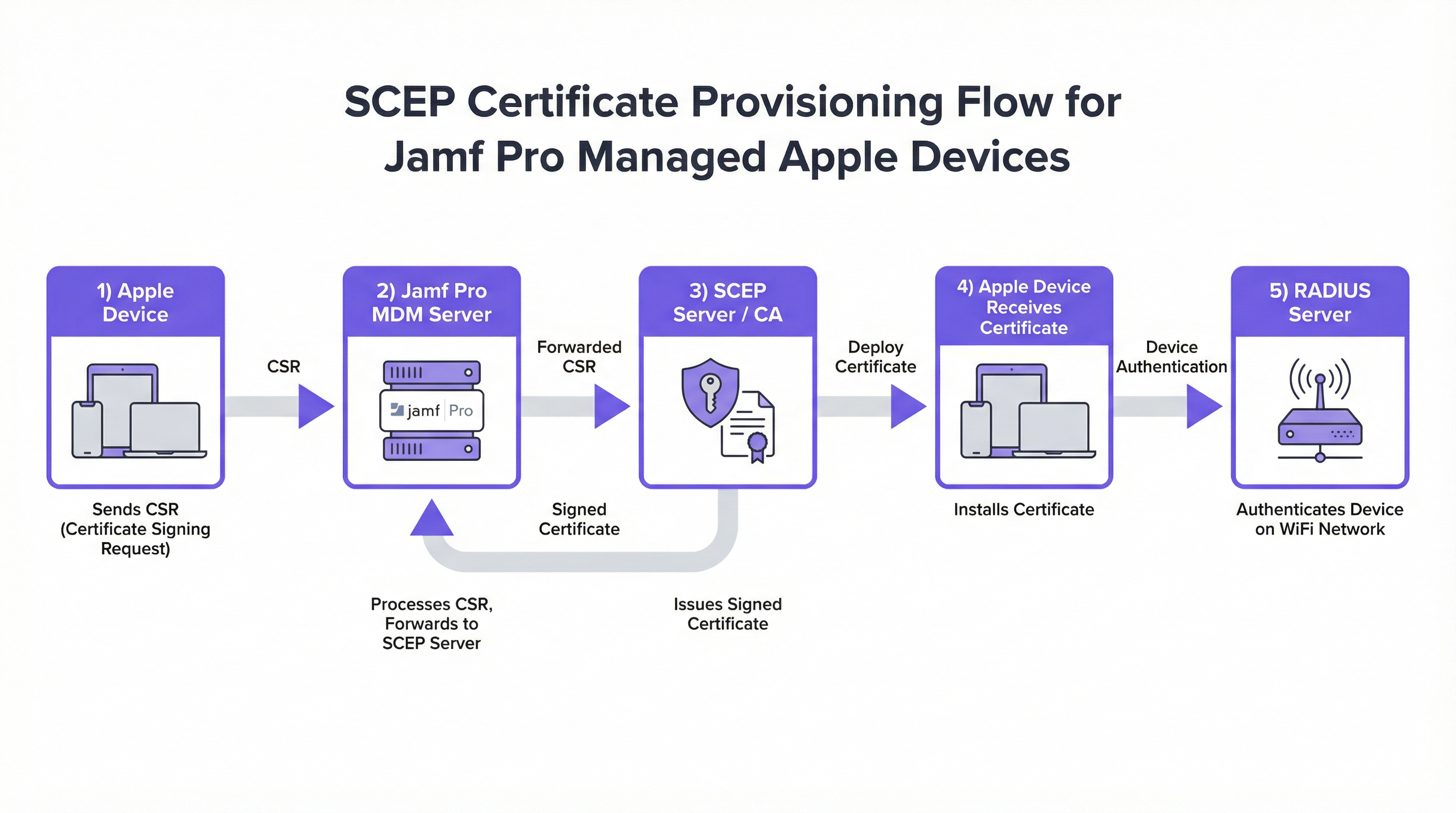
डायनॅमिक चॅलेंज पासवर्ड यंत्रणा विशेषतः महत्त्वाची आहे. Jamf-इंटिग्रेटेड SCEP उपयोजनामध्ये, Jamf प्रत्येक डिव्हाइससाठी एक युनिक, सिंगल-युज चॅलेंज पासवर्ड तयार करते. हे सुनिश्चित करते की केवळ Jamf Pro मध्ये नोंदणी केलेली डिव्हाइसेस — आणि म्हणूनच कॉर्पोरेटली व्यवस्थापित केलेली — CA कडून यशस्वीरित्या प्रमाणपत्र मिळवू शकतात. हे एक महत्त्वपूर्ण सुरक्षा नियंत्रण आहे जे अनधिकृत डिव्हाइसेसना नोंदणी करण्यापासून प्रतिबंधित करते.
Apple डिव्हाइस ऑथेंटिकेशनसाठी RADIUS गुणधर्म
जेव्हा RADIUS सर्व्हरला ॲक्सेस पॉइंटकडून Access-Request प्राप्त होते, तेव्हा तो त्याच्या ऑथरायझेशन निर्णयासाठी अनेक गुणधर्मांचे मूल्यमापन करतो. Apple 802.1X उपयोजनांसाठी, सर्वात संबंधित RADIUS गुणधर्म खालीलप्रमाणे आहेत.
| RADIUS गुणधर्म | वर्णन | Apple सुसंगतता |
|---|---|---|
User-Name (Attr 1) |
सप्लिकंटद्वारे सादर केलेली ओळख | सहसा प्रमाणपत्राचे Subject CN किंवा SAN |
NAS-IP-Address (Attr 4) |
ॲक्सेस पॉइंटचा IP | AP-विशिष्ट धोरणांसाठी वापरला जातो |
Called-Station-Id (Attr 30) |
AP चा BSSID आणि SSID | SSID-आधारित धोरण अंमलबजावणी सक्षम करते |
EAP-Message (Attr 79) |
एन्कॅप्स्युलेटेड EAP पॅकेट | यामध्ये TLS हँडशेक डेटा असतो |
Tunnel-Type (Attr 64) |
VLAN असाइनमेंट प्रकार निर्दिष्ट करते | ऑथेंटिकेशन नंतर डायनॅमिक VLAN असाइनमेंटसाठी वापरले जाते |
Tunnel-Medium-Type (Attr 65) |
टनेलसाठी माध्यम निर्दिष्ट करते | 802.1Q VLAN टॅगिंगसाठी आवश्यक |
Tunnel-Private-Group-Id (Attr 81) |
नियुक्त करण्यासाठी VLAN ID | भूमिका-आधारित नेटवर्क विभागणी सक्षम करते |
Tunnel-Private-Group-Id गुणधर्म एंटरप्राइझ उपयोजनांमध्ये विशेषतः शक्तिशाली आहे. प्रमाणपत्राच्या गुणधर्मांवर (उदा. विभाग, डिव्हाइस प्रकार) आधारित भिन्न VLAN IDs परत करून, RADIUS सर्व्हर स्वतंत्र SSID ची आवश्यकता नसताना नेटवर्कला डायनॅमिकरित्या विभागू शकतो.
अंमलबजावणी मार्गदर्शक
Jamf Pro द्वारे प्रमाणपत्र WiFi Apple ऑथेंटिकेशन तैनात करणे एका संरचित क्रमाचे अनुसरण करते. या क्रमातून विचलित होणे हे अयशस्वी उपयोजनांचे प्राथमिक कारण आहे.
पायरी 1: तुमची Certificate Authority इन्फ्रास्ट्रक्चर स्थापित करा
Jamf ला स्पर्श करण्यापूर्वी, तुमचे CA इन्फ्रास्ट्रक्चर असणे आवश्यक आहेकार्यान्वित आहे. मायक्रोसॉफ्ट वातावरणासाठी, हे सहसा Active Directory Certificate Services (AD CS) असते ज्यामध्ये Network Device Enrollment Service (NDES) भूमिका असते, जी SCEP सर्व्हर म्हणून कार्य करते. नॉन-मायक्रोसॉफ्ट वातावरणासाठी, पर्यायांमध्ये EJBCA, HashiCorp Vault PKI, किंवा AWS Private CA सारख्या क्लाउड-आधारित CAs चा समावेश होतो.
तुमची CA पदानुक्रम स्पष्ट असल्याची खात्री करा: एक Root CA जो ऑफलाइन ठेवला जातो आणि एक किंवा अधिक Issuing CAs जे डिव्हाइस सर्टिफिकेट्सवर स्वाक्षरी करतात. RADIUS सर्व्हरला याच CA पदानुक्रमाद्वारे स्वाक्षरी केलेल्या स्वतःच्या सर्टिफिकेटची आवश्यकता असेल.
पायरी २: Jamf Pro मध्ये SCEP पेलोड कॉन्फिगर करा
Computers (किंवा Mobile Devices) > Configuration Profiles > New वर जा. Certificate पेलोड जोडा आणि सर्टिफिकेट सोर्स म्हणून SCEP निवडा. महत्त्वाचे फील्ड खालीलप्रमाणे आहेत.
- URL: SCEP एंडपॉइंट (उदा.,
http://ndes.yourdomain.com/certsrv/mscep/mscep.dll). - Name: एक वर्णनात्मक नाव जे डिव्हाइसच्या Keychain मध्ये दिसेल.
- Subject: सर्टिफिकेटचे Distinguished Name. कॉम्प्युटरसाठी
CN=$COMPUTERNAMEकिंवा मोबाईल डिव्हाइसेससाठीCN=$JSSIDसारखे Jamf व्हेरिएबल्स वापरा. - Subject Alternative Name (SAN): SAN प्रकार
$MACADDRESS@yourdomain.comमूल्यासहRFC 822 Nameवर किंवा$COMPUTERNAME.yourdomain.comसहDNS Nameवर सेट करा. RADIUS सर्व्हर डिव्हाइस ओळखण्यासाठी हेच वाचेल. - Challenge Type: Jamf चा अंगभूत SCEP प्रॉक्सी वापरण्यासाठी Dynamic निवडा, जो प्रति-डिव्हाइस चॅलेंज पासवर्ड तयार करतो.
- Key Size: किमान 2048-bit RSA. नवीन उपयोजनांसाठी 4096-bit शिफारसीय आहे.
- Key Usage: Signing आणि Encryption दोन्ही सक्षम करा.
पायरी ३: WiFi पेलोड कॉन्फिगर करा
त्याच कॉन्फिगरेशन प्रोफाइलमध्ये, Wi-Fi पेलोड जोडा. Apple 802.1X साठी मुख्य सेटिंग्ज खालीलप्रमाणे आहेत.
- SSID: तुमच्या कॉर्पोरेट सुरक्षित SSID चे अचूक नाव.
- Security Type: WPA2 Enterprise किंवा WPA3 Enterprise (जिथे हार्डवेअर सपोर्ट करते तिथे शिफारसीय).
- Protocols — Accepted EAP Types: फक्त TLS निवडा. केवळ EAP-TLS लागू करण्यासाठी PEAP, TTLS आणि इतर सर्व प्रकारांची निवड रद्द करा.
- Authentication — Identity Certificate: तुम्ही पायरी २ मध्ये तयार केलेला SCEP पेलोड निवडा. सर्टिफिकेट आणि WiFi कनेक्शनमधील हा महत्त्वाचा दुवा आहे.
- Trust — Trusted Server Certificate Names: तुमच्या RADIUS सर्व्हरच्या सर्टिफिकेटचे अचूक Common Name (CN) प्रविष्ट करा (उदा.,
radius.yourdomain.com). ही सर्वात सामान्यपणे सुटणारी कॉन्फिगरेशन बाब आहे. - Trust — Trusted Certificates: RADIUS सर्व्हरच्या सर्टिफिकेटवर स्वाक्षरी केलेले Root CA आणि कोणतेही Intermediate CA सर्टिफिकेट्स अपलोड करा.
पायरी ४: RADIUS सर्व्हर कॉन्फिगर करा
तुमच्या RADIUS सर्व्हरवर, तुम्ही Jamf मध्ये परिभाषित केलेल्या सर्टिफिकेट वैशिष्ट्यांशी जुळणारे नेटवर्क धोरण तयार करा. मायक्रोसॉफ्ट NPS साठी, याचा अर्थ Called-Station-Id वैशिष्ट्याद्वारे SSID शी जुळणारे Connection Request Policy तयार करणे आणि तुमच्या CA विरुद्ध सर्टिफिकेट प्रमाणित करणारे आणि पर्यायाने टनेल वैशिष्ट्यांद्वारे VLAN नियुक्त करणारे Network Policy तयार करणे असा होतो.
FreeRADIUS साठी, tls वापरण्यासाठी eap मॉड्यूल कॉन्फिगर करा आणि तुमच्या CA सर्टिफिकेट, सर्व्हर सर्टिफिकेट आणि खाजगी की कडे निर्देशित करा. users फाइल किंवा SQL बॅकएंड तुमच्या डिव्हाइस इन्व्हेंटरी विरुद्ध सर्टिफिकेटच्या SAN शी जुळण्यासाठी कॉन्फिगर केले जावे.
पायरी ५: प्रोफाइलची व्याप्ती आणि उपयोजन
Jamf Pro मध्ये, कॉन्फिगरेशन प्रोफाइल योग्य डिव्हाइस गटांना नियुक्त करा — उदाहरणार्थ, "Corporate Fleet" स्मार्ट ग्रुपमधील सर्व डिव्हाइसेस. प्रोफाइल MDM द्वारे स्वयंचलितपणे पुश केले जाईल. जे डिव्हाइसेस ऑनलाइन आहेत त्यांना ते काही मिनिटांत प्राप्त होईल; जे डिव्हाइसेस ऑफलाइन आहेत त्यांना ते पुढच्या वेळी चेक-इन केल्यावर प्राप्त होईल.
सर्वोत्तम पद्धती
जिथे शक्य असेल तिथे WPA3 Enterprise लागू करा. 192-बिट मोडसह WPA3 Enterprise GCMP-256 आणि HMAC-SHA-384 वापरून वर्धित क्रिप्टोग्राफिक ताकद प्रदान करते, जे WPA2 Enterprise पेक्षा लक्षणीयरीत्या मजबूत संरक्षण देते. संवेदनशील डेटा हाताळणाऱ्या Hospitality वातावरण आणि Healthcare संस्थांसाठी, हे अपग्रेड केवळ सर्वोत्तम पद्धती नसून वाढती अनुपालन आवश्यकता आहे.
शेअर केलेल्या हार्डवेअरसाठी डिव्हाइस-आधारित सर्टिफिकेट्सचा लाभ घ्या. शेअर केलेल्या डिव्हाइसेससाठी — जसे की रिटेल पॉइंट-ऑफ-सेल iPads, हॉटेल कॉन्शिअर टॅब्लेट्स किंवा क्लिनिकल डिव्हाइसेस — युजर-बाउंड सर्टिफिकेट्सऐवजी डिव्हाइस-बाउंड सर्टिफिकेट्स वापरा. हे सुनिश्चित करते की डिव्हाइस बूट झाल्यावर, कोणताही वापरकर्ता लॉग इन करण्यापूर्वी नेटवर्कशी कनेक्ट होते, ज्यामुळे MDM चेक-इन्स, ॲप अपडेट्स आणि पुश नोटिफिकेशन्स योग्यरित्या कार्य करू शकतात. Retail उपयोजनांसाठी हा एक महत्त्वाचा विचार आहे जिथे डिव्हाइसेस शिफ्टमध्ये शेअर केली जाऊ शकतात.
तुमच्या व्यापक सुरक्षा स्थितीसह नेटवर्क प्रवेश एकत्रित करा. कर्मचारी सुरक्षित अंतर्गत प्रवेशासाठी 802.1X वापरत असताना, रहदारीचे स्पष्ट पृथक्करण राखण्यासाठी तुमचे सार्वजनिक नेटवर्क एका मजबूत Guest WiFi सोल्यूशनद्वारे व्यवस्थापित केले जात असल्याची खात्री करा. सर्टिफिकेट-आधारित कर्मचारी प्रमाणीकरणाला WiFi Analytics सह एकत्रित केल्याने प्रमाणित डिव्हाइस वर्तन आणि अतिथी नेटवर्क क्रियाकलाप या दोन्हीमध्ये पूर्ण दृश्यमानता मिळते.
सर्टिफिकेट नूतनीकरण स्वयंचलित करा. जेव्हा सर्टिफिकेट कालबाह्य होण्याच्या १४ ते ३० दिवसांच्या आत असेल तेव्हा स्वयंचलित नूतनीकरण ट्रिगर करण्यासाठी Jamf मध्ये SCEP पेलोड कॉन्फिगर करा. हे अशा परिस्थितीला प्रतिबंधित करते जिथे सर्टिफिकेट रातोरात कालबाह्य झाल्यामुळे डिव्हाइस शांतपणे नेटवर्क प्रवेश गमावते. Jamf Pro मध्ये, हे SCEP पेलोडमधील Renewal Threshold सेटिंगद्वारे नियंत्रित केले जाते.
सर्टिफिकेट रिव्होकेशन लिस्ट (CRL) किंवा OCSP रिस्पॉन्डर राखा. जेव्हा एखादे डिव्हाइस डिकमिशन केले जाते, चोरीला जाते किंवा Jamf मधून अनएनरोल केले जाते, तेव्हा त्याचे सर्टिफिकेट CA स्तरावर रद्द केले जाणे आवश्यक आहे. प्रत्येक प्रमाणीकरण प्रयत्नावर CRL किंवा OCSP एंडपॉइंट तपासण्यासाठी तुमचा RADIUS सर्व्हर कॉन्फिगर करा. याशिवाय, वैध सर्टिफिकेट असलेले चोरीला गेलेले डिव्हाइस अद्याप नेटवर्कवर प्रमाणीकृत होऊ शकते.
आधुनिक नेटवर्क इन्फ्रास्ट्रक्चर निर्णयांच्या अधिक संदर्भासाठी, The Core SD WAN Benefits for Modern Businesses मार्गदर्शक सर्टिफिकेट-आधारित प्रमाणीकरण SD-WAN ओव्हरले आर्किटेक्चरसह कसे समाकलित होते यावर उपयुक्त संदर्भ प्रदान करते.
Tसमस्या निवारण आणि जोखीम कमी करणे
चिकन-अँड-एग प्रोव्हिजनिंग समस्या. डिव्हाइसेसना SCEP सर्व्हरपर्यंत पोहोचण्यासाठी आणि त्यांचे प्रमाणपत्र डाउनलोड करण्यासाठी नेटवर्क कनेक्शनची आवश्यकता असते, परंतु सुरक्षित WiFi मध्ये सामील होण्यासाठी त्यांना प्रमाणपत्राची आवश्यकता असते. हा सर्वात सामान्य उपयोजन अडथळा आहे. शिफारस केलेली निवारण धोरणे अशी आहेत: USB-C किंवा Lightning ते Ethernet अडॅप्टर वापरून Ethernet द्वारे प्रोव्हिजनिंग करणे; iPhones आणि सेल्युलर-सक्षम iPads वर सेल्युलर डेटा वापरणे; किंवा फायरवॉल नियमांसह एक तात्पुरता, मर्यादित ऑनबोर्डिंग SSID तयार करणे जे केवळ SCEP आणि MDM ट्रॅफिकला अनुमती देते.
macOS वर सायलेंट EAP-TLS बिघाड. जर ट्रस्ट चेन अपूर्ण असेल, तर macOS UI मध्ये कोणताही अर्थपूर्ण एरर न दाखवता कनेक्ट होण्यास सायलेंटली अपयशी ठरू शकते. याचा एकमेव संकेत सिस्टम लॉगमध्ये असतो. रिअल-टाइम ऑथेंटिकेशन इव्हेंट्स कॅप्चर करण्यासाठी log stream --predicate 'subsystem == "com.apple.network"' वापरा. नेहमी पडताळणी करा की Jamf प्रोफाइलमधील Trusted Server Certificate Names ॲरे RADIUS सर्व्हरच्या प्रमाणपत्रातील CN शी तंतोतंत जुळतो.
हाय-लोड इव्हेंट्स दरम्यान RADIUS टाइमआउट. स्टेडियम किंवा कॉन्फरन्स सेंटर्स सारख्या वातावरणात, शेकडो डिव्हाइसेसकडून एकाच वेळी येणाऱ्या ऑथेंटिकेशन विनंत्या RADIUS सर्व्हरवर ताण आणू शकतात. हाय-अॅव्हेलेबिलिटी पेअरमध्ये RADIUS तैनात करून, FreeRADIUS मधील max_requests पॅरामीटर ट्यून करून आणि RADIUS सर्व्हरकडे अपेक्षित समवर्ती ऑथेंटिकेशन लोडसाठी पुरेसे CPU आणि मेमरी असल्याची खात्री करून हे कमी करा. मोठ्या प्रमाणावरील ठिकाणांच्या उपयोजनांसाठी, क्षमता नियोजनाच्या विचारांसाठी Wireless Access Points व्याख्या तुमची अंतिम 2026 मार्गदर्शिका वरील आमचे मार्गदर्शन पहा.
प्रमाणपत्र विशेषता विसंगती. जर डिव्हाइस प्रमाणपत्रातील SAN RADIUS नेटवर्क पॉलिसीच्या अपेक्षेनुसार नसेल, तर ऑथेंटिकेशन अयशस्वी होईल. हे विशेषतः एका CA कडून दुसऱ्या CA कडे स्थलांतरित करताना किंवा जेव्हा Jamf व्हेरिएबल्स अपेक्षेपेक्षा वेगळ्या पद्धतीने रिझॉल्व्ह होतात तेव्हा घडते. संपूर्ण ताफ्यात लागू करण्यापूर्वी नेहमी एका डिव्हाइससह चाचणी करा आणि सादर केली जाणारी नेमकी आयडेंटिटी स्ट्रिंग तपासण्यासाठी RADIUS सर्व्हर लॉग तपासा.
ROI आणि व्यावसायिक प्रभाव
Jamf RADIUS WiFi प्रमाणपत्र ऑथेंटिकेशनवर संक्रमण केल्याने अनेक आयामांमध्ये मोजण्यायोग्य व्यावसायिक मूल्य मिळते.
| मेट्रिक | ठराविक परिणाम |
|---|---|
| हेल्पडेस्क तिकीट कपात | WiFi-संबंधित सपोर्ट विनंत्यांमध्ये 60–85% घट |
| प्रति डिव्हाइस ऑनबोर्डिंग वेळ | 15–30 मिनिटांवरून 2 मिनिटांपेक्षा कमी (झिरो-टच) |
| सुरक्षा घटनेची जोखीम | क्रेडेंशियल-आधारित WiFi हल्ल्यांचे जवळजवळ निर्मूलन |
| अनुपालन स्थिती | PCI DSS Requirement 1.3 आणि GDPR Article 32 नेटवर्क नियंत्रणे पूर्ण करते |
| प्रमाणपत्र जीवनचक्र | स्वयंचलित नूतनीकरण मॅन्युअल प्रमाणपत्र व्यवस्थापन काढून टाकते |
सर्वात महत्त्वाचा ROI ड्रायव्हर म्हणजे पासवर्ड रोटेशनमुळे होणारे व्यत्यय दूर करणे. 500-डिव्हाइसच्या ताफ्यात जिथे पासवर्ड बदलांमुळे दर तिमाहीत 10% डिव्हाइसेस नेटवर्कवरून गळतात आणि प्रत्येक घटना सोडवण्यासाठी IT चा 20 मिनिटांचा वेळ लागतो, तिथे केवळ वार्षिक सपोर्ट खर्चातील बचत पहिल्या वर्षातच अंमलबजावणीच्या गुंतवणुकीचे समर्थन करू शकते.
वाहतूक ऑपरेटर्स आणि मोठ्या ठिकाणांच्या वातावरणासाठी, डायनॅमिक VLAN असाइनमेंट लागू करण्याच्या क्षमतेमुळे बिझनेस केस अधिक मजबूत होते — मॅन्युअल नेटवर्क रिकॉन्फिगरेशनशिवाय ऑपरेशनल डिव्हाइसेस, कर्मचारी डिव्हाइसेस आणि मॅनेजमेंट सिस्टम्स स्वयंचलितपणे विभागल्या गेल्याची खात्री होते.
महत्त्वाच्या संज्ञा आणि व्याख्या
EAP-TLS (Extensible Authentication Protocol-Transport Layer Security)
The most secure 802.1X authentication method, requiring both the client device and the RADIUS server to authenticate each other using digital certificates. No password is exchanged or transmitted.
When IT teams need to eliminate password-based WiFi and enforce strict device compliance, EAP-TLS is the mandatory standard. It is the only EAP type that provides mutual authentication.
SCEP (Simple Certificate Enrollment Protocol)
A protocol that allows devices to securely and automatically request digital certificates from a Certificate Authority using a challenge-response mechanism.
Essential for scaling certificate deployments via Jamf Pro without requiring IT staff to manually install certificates on thousands of devices. Jamf's dynamic SCEP proxy generates per-device challenge passwords.
RADIUS (Remote Authentication Dial-In User Service)
A networking protocol providing centralised Authentication, Authorisation, and Accounting (AAA) management for devices connecting to a network service.
The central decision engine that tells the WiFi Access Point whether a Jamf-managed device is allowed on the network, and optionally which VLAN to assign.
Configuration Profile
An XML file (.mobileconfig) deployed by Jamf Pro that contains one or more payloads to manage settings on Apple devices, including certificates, WiFi, VPN, and restrictions.
This is the vehicle used to push the SCEP settings, WiFi SSID configuration, and certificate trust chain to the iPhone, iPad, or Mac.
CSR (Certificate Signing Request)
A block of encoded text generated by the Apple device containing the public key and identity information, sent to the Certificate Authority to apply for a signed digital certificate.
The first step in the SCEP process. The device generates the CSR locally, ensuring the private key never leaves the device — a fundamental principle of PKI security.
Subject Alternative Name (SAN)
An extension to an X.509 certificate that allows multiple identity values to be associated with the certificate, such as email addresses, DNS names, IP addresses, or MAC addresses.
Crucial for RADIUS authentication. The RADIUS server reads the SAN to identify the device or user. In Jamf deployments, the SAN is typically set to the device's MAC address or the user's UPN.
Root CA (Certificate Authority)
The top-most certificate in a PKI hierarchy, the private key of which is used to sign subordinate CA certificates. The Root CA certificate must be trusted by all parties in the authentication chain.
Must be deployed to Apple devices via Jamf so they trust the certificates presented by the RADIUS server during the EAP-TLS handshake. Without it, the handshake fails.
IEEE 802.1X
An IEEE standard for port-based Network Access Control (PNAC), providing an authentication mechanism to devices wishing to attach to a LAN or WLAN before network access is granted.
The overarching framework that blocks network traffic at the Access Point until the RADIUS server validates the Jamf-provisioned certificate. All enterprise WiFi security is built on this standard.
Dynamic VLAN Assignment
A RADIUS feature that assigns a connecting device to a specific VLAN based on policy attributes returned in the Access-Accept message, using RADIUS Tunnel attributes 64, 65, and 81.
Enables network segmentation without multiple SSIDs. A single corporate SSID can automatically place clinical iPads on VLAN 20, executive MacBooks on VLAN 30, and guest devices on VLAN 100.
केस स्टडीज
A 500-bed hospital needs to deploy 1,200 shared iPads for clinical staff. They currently use PEAP with Active Directory credentials, resulting in hundreds of disconnected devices every 90 days when passwords expire. How should they redesign their authentication architecture?
The hospital should migrate to EAP-TLS using device-based certificates managed through Jamf Pro. The implementation involves four key steps. First, deploy AD CS with the NDES role to act as the SCEP server, issuing certificates from a dedicated 'Clinical Device' certificate template. Second, configure a Jamf Configuration Profile with a SCEP payload using $MACADDRESS as the SAN, and a WiFi payload targeting the clinical SSID with EAP-TLS only, explicitly trusting the RADIUS server certificate. Third, configure Microsoft NPS with a Network Policy that matches the 'Clinical Device' certificate template and assigns devices to the Clinical VLAN (Tunnel-Private-Group-Id = 20). Fourth, set the SCEP renewal threshold to 30 days to ensure automatic certificate renewal without IT intervention. Devices should be provisioned via Ethernet during the initial rollout to resolve the onboarding network challenge.
A creative agency with 300 MacBooks is moving to a new office. They want zero-touch WiFi provisioning — new MacBooks should automatically connect to the secure corporate SSID when unboxed by end-users at their desks, with no IT intervention. How do they achieve this?
The agency must combine Apple Automated Device Enrollment (ADE) with Jamf Pro and a carefully sequenced Configuration Profile. During the macOS Setup Assistant, the MacBook connects to the internet via a temporary open onboarding SSID (restricted by firewall to permit only Apple activation, Jamf MDM, and SCEP traffic). It contacts Apple, recognises it belongs to the agency via ADE, and automatically enrolls in Jamf Pro. Jamf Pro immediately pushes a pre-staged Configuration Profile containing the SCEP payload and the corporate WiFi payload. The SCEP enrollment completes over the onboarding SSID, the certificate is installed in the Keychain, and the WiFi payload activates. The MacBook then automatically transitions to the secure 802.1X corporate SSID. From the user's perspective, they simply complete the Setup Assistant and the laptop is on the corporate network.
परिस्थिती विश्लेषण
Q1. You have deployed a Jamf Configuration Profile with a SCEP payload and a WiFi payload to 50 MacBooks. The SCEP certificates are successfully installed in the Keychain, but the MacBooks are prompting users with a 'Verify Certificate' dialogue when attempting to connect to the corporate SSID. What configuration element is missing or incorrect?
💡 संकेत:Think about what information the Apple device needs to automatically trust the RADIUS server's identity without user interaction.
शिफारस केलेला दृष्टिकोन दाखवा
The WiFi payload in the Jamf Configuration Profile is missing either the 'Trusted Server Certificate Names' entry (which must exactly match the CN in the RADIUS server's certificate), or the Root CA and Intermediate CA certificates that signed the RADIUS server's certificate are not included in the profile's Trust payload. Without explicit trust defined by the MDM, macOS and iOS require the user to manually verify and accept the RADIUS server's certificate during the EAP-TLS handshake. Both fields must be populated: the Trusted Certificates array (containing the CA chain) and the Trusted Server Certificate Names array (containing the RADIUS server's CN).
Q2. A retail chain wants their point-of-sale iPads to connect to the secure corporate WiFi immediately upon boot, before any staff member logs into the POS application. The current deployment uses user certificates tied to individual employee UPNs. Devices frequently fail to connect at the start of a shift. What is the root cause and what is the correct architectural change?
💡 संकेत:Consider when different types of certificates become available to the iOS network stack relative to the user authentication lifecycle.
शिफारस केलेला दृष्टिकोन दाखवा
The root cause is that user certificates (tied to a UPN) are stored in the user's keychain and are only accessible after the user has authenticated to the device. At boot or at the iOS lock screen, the user keychain is locked, so the WiFi stack cannot access the certificate to perform EAP-TLS. The correct architectural change is to switch to device certificates, where the SAN is set to the device's MAC address or serial number. Device certificates are stored in the system keychain, which is accessible at boot time before any user logs in. The RADIUS Network Policy must be updated to match device certificates rather than user certificates, and the Jamf SCEP payload must be updated to use device-level variables such as $MACADDRESS or $SERIALNUMBER as the SAN.
Q3. Your organisation uses Microsoft NPS as the RADIUS server. You are configuring a new Jamf SCEP payload for 200 MacBooks. The NPS Network Policy is configured to require that the certificate's Subject Alternative Name matches a computer account in Active Directory. What SAN value should you configure in the Jamf SCEP payload, and what format does NPS expect?
💡 संकेत:NPS computer certificate authentication requires the SAN to match the computer's identity in Active Directory in a specific format.
शिफारस केलेला दृष्टिकोन दाखवा
For NPS computer certificate authentication, the SAN must be set to the DNS Name type with the value $COMPUTERNAME.yourdomain.com (using the Jamf variable for the computer's hostname). NPS expects the SAN DNS Name to match the computer's fully qualified domain name (FQDN) as it appears in Active Directory. Alternatively, if using the User Principal Name SAN type, the format should be host/$ COMPUTERNAME@YOURDOMAIN.COM . The NPS Network Policy's condition should be set to match the 'Client Certificate SAN' attribute. Ensure the MacBooks are bound to Active Directory, or that the computer names in Jamf match the computer objects in AD, otherwise the NPS lookup will fail even if the certificate is valid.
महत्त्वाचे निष्कर्ष
- ✓EAP-TLS is the gold standard for enterprise WiFi authentication — it eliminates passwords entirely and requires both the device and the RADIUS server to prove their identity using digital certificates.
- ✓Jamf Pro automates certificate distribution to Apple fleets at scale using the SCEP protocol, with dynamic per-device challenge passwords ensuring only managed devices can enrol.
- ✓A successful Jamf WiFi deployment requires two linked payloads in a single Configuration Profile: a SCEP payload to obtain the certificate, and a WiFi payload that references that certificate as the identity.
- ✓The most common deployment failure is an incomplete certificate trust chain — the Jamf WiFi profile must explicitly include the Root CA and specify the RADIUS server's CN in the Trusted Server Certificate Names field.
- ✓Device-based certificates (SAN = MAC address) are essential for shared hardware, ensuring network connectivity at boot before any user logs in.
- ✓Plan the onboarding network carefully — devices need a network path to the SCEP server before they can receive their certificate and join the secure 802.1X SSID.
- ✓Automated certificate renewal (configured at 30 days before expiration) and immediate revocation upon device decommissioning are non-negotiable operational requirements for a secure, resilient deployment.




