

Gäste-WiFi vs. Mitarbeiter-WiFi: Best Practices für die Netzwerksegmentierung
This guide provides an authoritative technical reference for IT managers and network architects on the critical practice of separating guest and staff WiFi through network segmentation. It covers the security risks of running a flat, unsegmented network, the technical architecture of VLAN-based isolation, and vendor-neutral implementation guidance for hospitality, retail, and public-sector venues. The guide demonstrates how proper segmentation simultaneously mitigates data breach risk, satisfies compliance mandates such as PCI DSS and GDPR, and enables guest WiFi to become a revenue-generating business asset.
🎧 Diesen Leitfaden anhören
Transkript anzeigen

Executive Summary
Für jedes Unternehmen, das einen öffentlich zugänglichen Standort betreibt – sei es ein Hotel, eine Einzelhandelskette, ein Stadion oder ein Konferenzzentrum –, ist die Bereitstellung von sowohl Gäste-WiFi als auch Mitarbeiter-WiFi eine grundlegende betriebliche Anforderung. Die Bereitstellung dieser Dienste auf einer einzigen, gemeinsam genutzten Netzwerkarchitektur birgt jedoch erhebliche und oft unterschätzte Risiken. Ein kompromittiertes Gerät eines Gastes kann für einen Angreifer zum Dreh- und Angelpunkt werden, um auf sensible Unternehmensressourcen zuzugreifen, einschließlich Point-of-Sale (POS)-Systemen, internen Servern und Kundendaten. Dies gefährdet nicht nur die Datenintegrität, sondern führt auch dazu, dass das Unternehmen direkt gegen Compliance-Vorgaben wie PCI DSS und GDPR verstößt, was schwere finanzielle Strafen und Reputationsschäden nach sich ziehen kann.
Eine ordnungsgemäße Netzwerksegmentierung ist kein IT-Luxus, sondern eine grundlegende Sicherheitsmaßnahme. Durch die logische Isolierung des Gastverkehrs vom internen Mitarbeiterverkehr mithilfe von Technologien wie VLANs und separaten SSIDs können Unternehmen eine robuste Sicherheitsarchitektur aufbauen. Dieser Leitfaden dient als praktische, herstellerneutrale Referenz für IT-Manager und Netzwerkarchitekten. Er detailliert den Business Case, die technische Architektur und die Implementierungs-Best-Practices für die Bereitstellung einer segmentierten WiFi-Strategie, die Unternehmenswerte schützt und gleichzeitig ein nahtloses Erlebnis für Gäste und Mitarbeiter bietet.
Technischer Deep-Dive
Das Grundprinzip der Trennung von Gäste- und Mitarbeiter-WiFi ist die Netzwerksegmentierung, ein Designansatz, der ein Computernetzwerk in kleinere, isolierte Subnetze unterteilt. Jedes Subnetz oder Segment fungiert als eigenes logisches Netzwerk, wodurch Administratoren den Datenverkehr zwischen ihnen präzise steuern können. Im Kontext von WiFi wird dies am häufigsten durch eine Kombination aus Service Set Identifiers (SSIDs) und Virtual LANs (VLANs) erreicht.
SSID und VLAN: Die Kernkomponenten
Ein Service Set Identifier (SSID) ist der öffentliche Name eines Wireless Local Area Network (WLAN). Ein einzelner Access Point (AP) kann mehrere SSIDs gleichzeitig ausstrahlen, sodass er verschiedene Benutzergruppen über dieselbe physische Hardware bedienen kann. Beispielsweise könnte ein AP in einer Hotellobby sowohl "HotelGuestWiFi" als auch "HotelStaffServices" ausstrahlen. Obwohl dies eine für Endbenutzer sichtbare, oberflächliche Trennung bietet, reicht es allein nicht aus. Ohne weitere Isolierung auf der Netzwerkschicht könnten Geräte, die mit verschiedenen SSIDs auf demselben AP verbunden sind, potenziell immer noch auf Schicht 2 des OSI-Modells miteinander kommunizieren.
Hier bietet die Virtual LAN (VLAN)-Technologie die entscheidende Durchsetzungsebene. Ein VLAN ermöglicht es einem Netzwerkadministrator, logische Gruppierungen von Geräten zu erstellen, unabhängig von ihrem physischen Standort. Der Datenverkehr aus jedem VLAN wird beim Durchqueren des Netzwerk-Backbones mit einer eindeutigen Kennung versehen – ein Prozess, der durch den IEEE 802.1Q-Standard definiert ist. Netzwerk-Switches und Router verwenden diese Tags, um Zugriffskontrollregeln durchzusetzen und sicherzustellen, dass der Datenverkehr aus dem Gäste-VLAN nicht in das Mitarbeiter-VLAN oder ein anderes kritisches internes Netzwerksegment gelangen kann.
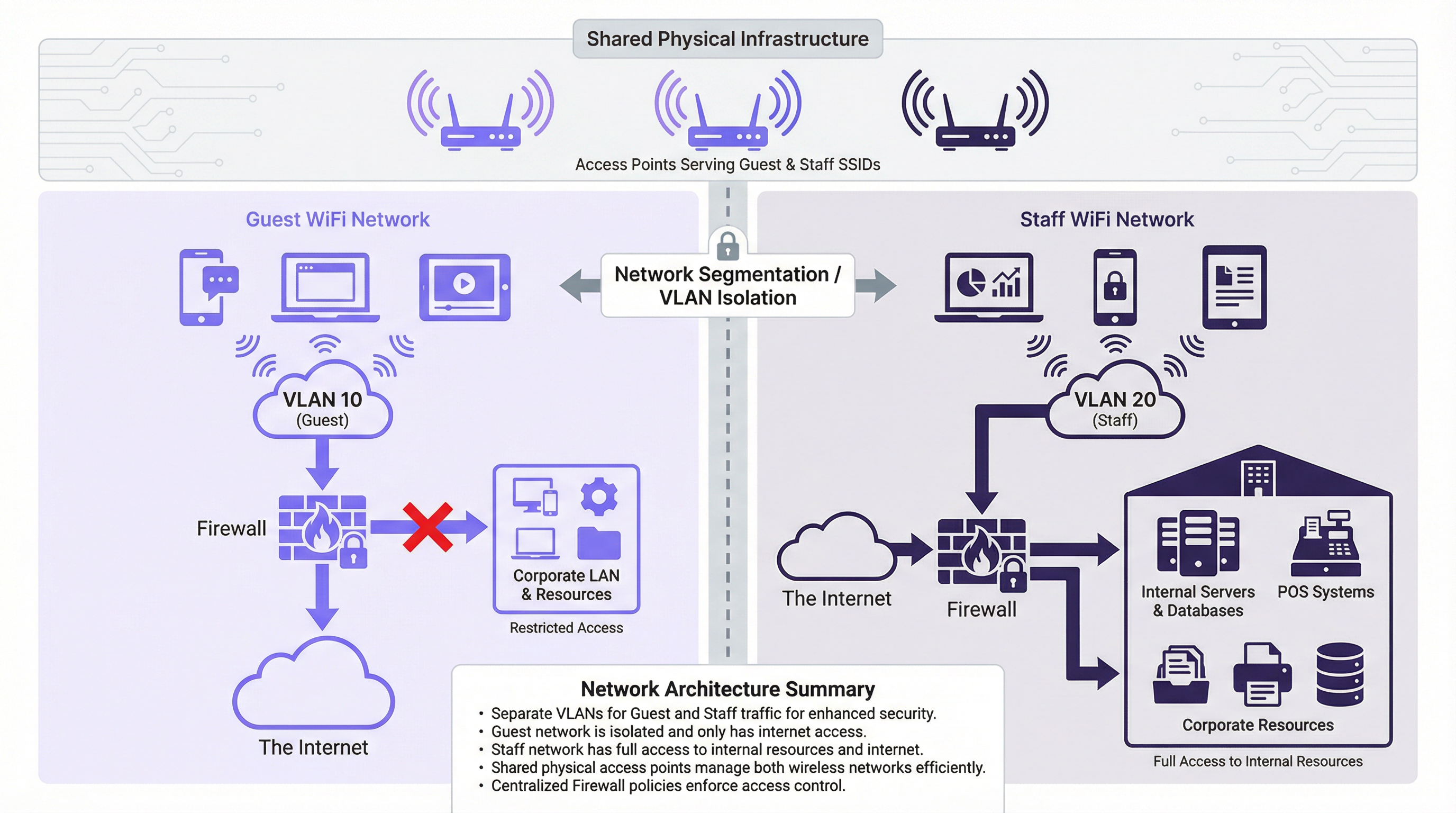
Wie im obigen Architekturdiagramm dargestellt, verbinden sich Gastgeräte mit der "Guest"-SSID, die dem VLAN 10 zugeordnet ist. Dieses VLAN ist an der Firewall so konfiguriert, dass es nur direkten Internetzugang zulässt. Jeglicher Datenverkehr, der für das interne Unternehmens-LAN bestimmt ist – einschließlich Server, Datenbanken und POS-Systeme –, wird explizit verweigert. Umgekehrt verbinden sich Mitarbeitergeräte mit der "Staff"-SSID, die dem VLAN 20 zugeordnet ist. Diesem VLAN wird ein durch eine Firewall geschützter, richtliniengesteuerter Zugriff sowohl auf das Internet als auch auf die spezifischen internen Ressourcen gewährt, die für die jeweilige Mitarbeiterrolle erforderlich sind. Diese Eindämmungsstrategie ist der Grundpfeiler einer sicheren Multi-Netzwerk-Umgebung.
Sicherheitsstandards und Protokolle
Eine effektive Segmentierung beruht auf robusten Sicherheitsprotokollen, um Daten bei der Übertragung zu schützen und Benutzer für ihr jeweiliges Netzwerksegment angemessen zu authentifizieren.
WPA3 (Wi-Fi Protected Access 3) ist der aktuelle Sicherheitsstandard für drahtlose Netzwerke und löst WPA2 ab. Für das Mitarbeiternetzwerk ist der Einsatz von WPA3-Enterprise Best Practice. Es verwendet die IEEE 802.1X-Authentifizierung, die von jedem Benutzer die Vorlage eindeutiger Anmeldeinformationen verlangt – typischerweise verwaltet über einen RADIUS-Server (Remote Authentication Dial-In User Service), der in einen Verzeichnisdienst wie Microsoft Active Directory integriert ist. Dies ermöglicht eine rollenbasierte Zugriffskontrolle und bietet einen klaren, auditierbaren Nachweis darüber, wer sich wann mit dem Netzwerk verbunden hat. Für das Gästenetzwerk bietet WPA3-Personal eine starke Verschlüsselung für die drahtlose Übertragung, aber ein Captive Portal ist der Standardmechanismus für das User Onboarding, die Akzeptanz der Nutzungsbedingungen und die GDPR-konforme Datenerfassung.
Client-Isolierung ist eine kritische Funktion, die auf allen gastseitigen Access Points aktiviert sein muss. Sie verhindert, dass drahtlose Geräte, die mit derselben SSID verbunden sind, auf Schicht 2 direkt miteinander kommunizieren. Ohne diese Kontrolle könnte ein böswilliger Akteur, der in einer Hotellobby sitzt, problemlos die Geräte anderer Gäste im selben Netzwerksegment angreifen.
Implementierungsleitfaden
Die Bereitstellung eines segmentierten WiFi-Netzwerks folgt einem strukturierten Prozess von der Planung bis zur Validierung.
Schritt 1: Netzwerkplanung und -design. Beginnen Sie mit der Erfassung aller internen Ressourcen – Dateiserver, Payment-Gateways, IoT-Geräte, Personalmanagementsysteme – und klassifizieren Sie diese nach Sensibilität. Definieren Sie Benutzerrollen (Gast, Rezeption, Backoffice, IT-Admin) und die spezifischen Netzwerkressourcen, die jede Rolle benötigt. Legen Sie eine VLAN-Nummerierungsstrategie fest. Ein gängiger und skalierbarer Ansatz ist: VLAN 10 (Gäste), VLAN 20 (Unternehmensmitarbeiter), VLAN 30 (POS/Zahlungsgeräte), VLAN 40 (IoT-Geräte), VLAN 99 (Netzwerkmanagement).
Schritt 2: Hardwarekonfiguration. Stellen Sie sicher, dass alle Access Points mehrere SSIDs und IEEE 802.1Q VLAN-Tagging unterstützen. Konfigurieren Sie Switch-Ports, die mit APs verbunden sind, als Trunk-Ports, die den Datenverkehr für mehrere VLANs gleichzeitig übertragen. Ports, die mit Endgeräten für einen einzigen Zweck verbunden sind, sollten als Access-Ports konfiguriert werden, die einem einzelnen VLAN zugewiesen sind. Der Router oder die Firewall ist der zentrale Durchsetzungspunkt. Erstellen Sie explizite Access Control Lists (ACLs) für jedes VLAN: Verweigern Sie standardmäßig jeglichen Datenverkehr von VLAN 10 zum Unternehmens-LAN; erlauben Sie nur den notwendigen Datenverkehr von VLAN 20 zu spezifischen internen Ressourcen auf bestimmten Ports.

Schritt 3: SSID-Konfiguration. Konfigurieren Sie für die Gäste-SSID WPA3-Personal und aktivieren Sie die Client-Isolierung. Stellen Sie ein Captive Portal bereit, um die Nutzungsbedingungen anzuzeigen und die Zustimmung der Benutzer GDPR-konform einzuholen. Konfigurieren Sie für die Mitarbeiter-SSID WPA3-Enterprise und leiten Sie die Authentifizierung an Ihren RADIUS-Server weiter. Erwägen Sie, die Mitarbeiter-SSID nicht auszustrahlen, um ihre Sichtbarkeit für unbefugte Benutzer zu verringern.
Schritt 4: Tests und Validierung. Verbinden Sie ein Testgerät mit dem Gästenetzwerk und bestätigen Sie, dass es das Internet erreichen, aber keine internen IP-Adressbereiche anpingen oder darauf zugreifen kann. Verbinden Sie ein Testgerät mit dem Mitarbeiternetzwerk und überprüfen Sie, ob es auf die zugewiesenen Ressourcen zugreifen kann, aber für Ressourcen außerhalb seiner definierten Richtlinie blockiert ist. Führen Sie Durchsatztests in beiden Netzwerken durch, um zu bestätigen, dass die Bandbreitenzuweisung angemessen ist.
Best Practices
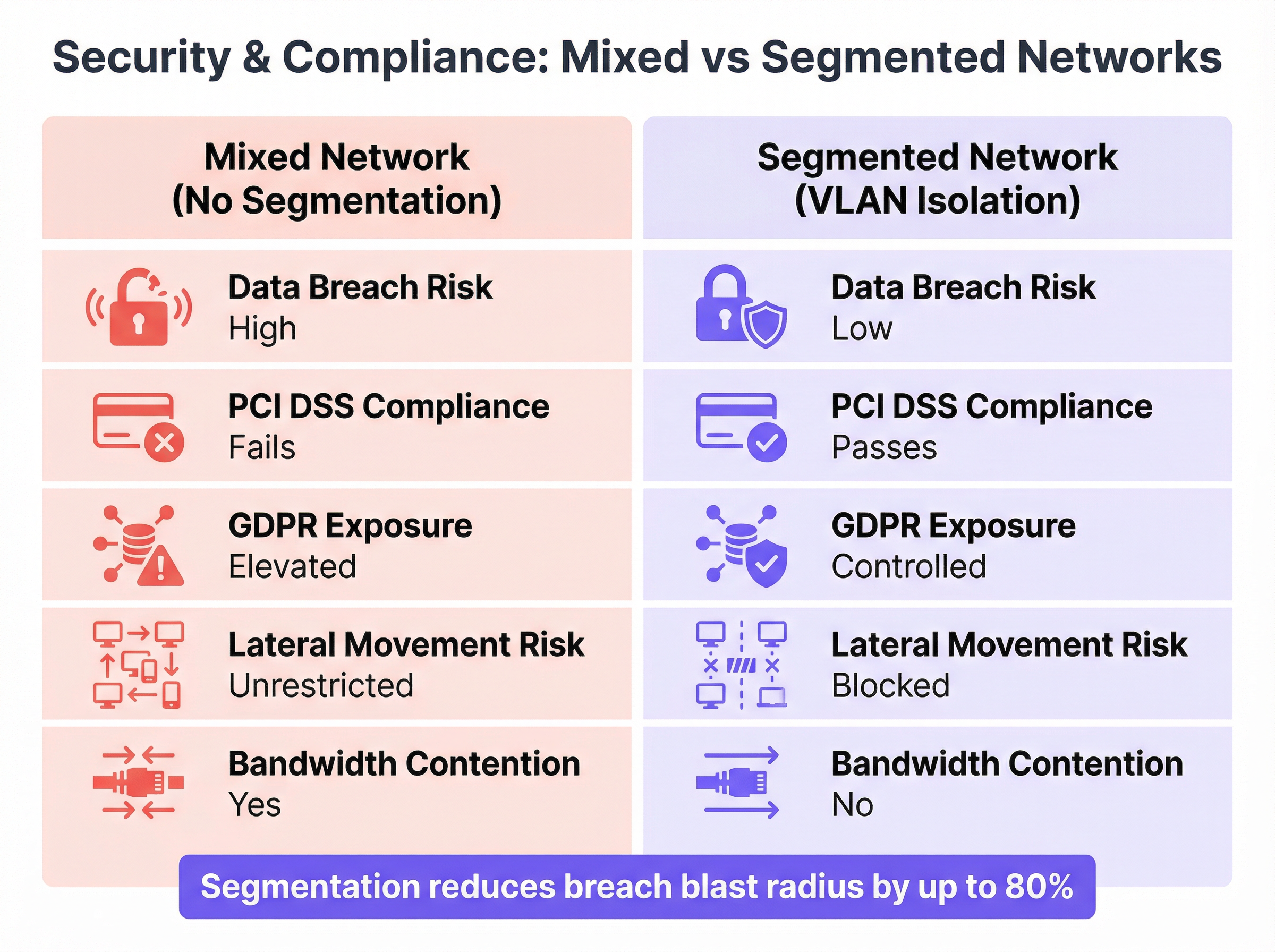
Der obige Vergleich veranschaulicht den deutlichen Unterschied in der Sicherheits- und Compliance-Aufstellung zwischen einem gemischten und einem ordnungsgemäß segmentierten Netzwerk. Die folgenden Prinzipien sollten jede Bereitstellungsentscheidung leiten.
Prinzip der geringsten Rechte (Principle of Least Privilege) ist die Grundregel: Beginnen Sie immer mit der restriktivsten Zugriffsrichtlinie und öffnen Sie nur das, was für die Funktion einer bestimmten Rolle absolut notwendig ist. Jede erteilte Berechtigung ist eine potenzielle Angriffsfläche.
Physische und logische Trennung sollte für hochsensible Umgebungen in Betracht gezogen werden. Während VLANs eine robuste logische Trennung bieten, können Unternehmen, die Zahlungskartendaten verarbeiten, physisch getrennte Hardware (dedizierte APs und Switches) für die Cardholder Data Environment (CDE) verwenden, um den Umfang des PCI DSS-Audits gemäß Anforderung 1.2 zu vereinfachen.
Bandbreitendrosselung im Gästenetzwerk schützt geschäftskritische Mitarbeiterabläufe. Die Anwendung von Download- und Upload-Limits pro Benutzer verhindert, dass eine kleine Anzahl von Gästen die gemeinsam genutzte Internetverbindung auslastet, was POS-Transaktionen oder VoIP-Anrufe verzögern könnte.
Regelmäßige Audits sind eine nicht verhandelbare operative Kontrolle. Firewall-Regeln, VLAN-Konfigurationen und Benutzerzugriffsprotokolle müssen regelmäßig überprüft werden, um sicherzustellen, dass die Segmentierung wirksam bleibt, während sich das Unternehmen weiterentwickelt und neue Bedrohungen auftreten.
Zentralisiertes Management reduziert den operativen Aufwand einer segmentierten Bereitstellung über mehrere Standorte hinweg erheblich. Plattformen wie Purple bieten ein einheitliches Dashboard, um den Gastzugang zu verwalten, Echtzeit-Analysen einzusehen und konsistente Richtlinien über einen verteilten Bestand hinweg durchzusetzen.
Fehlerbehebung & Risikominderung
VLAN-Fehlkonfigurationen sind die häufigste Fehlerquelle bei segmentierten Bereitstellungen. Ein einziger falsch konfigurierter Switch-Port – zum Beispiel ein als Trunk festgelegter Access-Port oder die Zuweisung zum falschen VLAN – kann zu VLAN-Hopping führen, bei dem Datenverkehr zwischen Segmenten durchsickert und die Sicherheitsarchitektur vollständig zunichtemacht. Die Gegenmaßnahme ist rigoros: Verwenden Sie eine konsistente, dokumentierte Konfigurationsvorlage für alle Switch-Ports, implementieren Sie VLAN-Pruning auf Trunk-Verbindungen, um einzuschränken, welche VLANs propagiert werden, und nutzen Sie Netzwerküberwachungstools, um unerwarteten Inter-VLAN-Verkehr zu erkennen.
Fehler bei Firewall-Regeln sind ebenso gefährlich. Eine zu freizügige Regel – wie ALLOW ANY ANY – kann die gesamte Segmentierungsstrategie unbemerkt untergraben. Implementieren Sie einen strengen Change-Control-Prozess für alle Änderungen an Firewall-Regeln. Jede Regel muss eine dokumentierte geschäftliche Rechtfertigung, einen benannten Eigentümer und ein Überprüfungsdatum haben. Verwenden Sie Tools zur Analyse von Firewall-Richtlinien, um überschattete, redundante oder zu weit gefasste Regeln zu identifizieren.
SSID-Bleed kann in dichten Bereitstellungen auftreten, wenn APs nicht korrekt für HF-Leistungspegel konfiguriert sind, was dazu führt, dass sich Geräte mit einem weit entfernten AP in einem unbeabsichtigten Netzwerk verbinden. Eine ordnungsgemäße HF-Planung – einschließlich der Anpassung der AP-Sendeleistung zur Schaffung klar definierter Abdeckungszellen – und die Verwendung von IEEE 802.11k/v/r-Roaming-Unterstützungsfunktionen stellen sicher, dass sich Geräte mit den richtigen APs verbinden und zwischen diesen wechseln.
ROI & Geschäftliche Auswirkungen
Die Implementierung eines ordnungsgemäß segmentierten WiFi-Netzwerks ist keine Kostenstelle; es ist eine messbare Investition in die Risikominderung und betriebliche Effizienz.
Reduzierte Kosten bei Sicherheitsverletzungen sind die wichtigste finanzielle Rechtfertigung. Die durchschnittlichen Kosten einer Datenschutzverletzung gehen in die Millionen, wenn man behördliche Geldstrafen, Rechtskosten, Kundenbenachrichtigungen und Reputationsschäden einkalkuliert. Die Gesamtkosten für die Implementierung der Segmentierung – Hardware, Lizenzen und Entwicklungszeit – sind nur ein Bruchteil dieser potenziellen Haftung. Indem eine Sicherheitsverletzung auf das weniger kritische Gästenetzwerk eingedämmt wird, wird der Explosionsradius drastisch reduziert.
Compliance-Erfüllung wirkt sich direkt auf das Geschäftsergebnis jedes Standorts aus, der Zahlungen verarbeitet. Die PCI DSS-Compliance ist eine Voraussetzung für die Akzeptanz von Kartenzahlungen, und die Netzwerksegmentierung ist eine zentrale technische Kontrolle. Die Nichteinhaltung führt zu Geldstrafen und erhöhten Transaktionsgebühren durch die Kartenorganisationen. Die GDPR-Compliance, die durch ein ordnungsgemäß verwaltetes Gäste-Captive Portal ermöglicht wird, vermeidet behördliche Strafen, die bis zu vier Prozent des weltweiten Jahresumsatzes betragen können.
Verbesserte operative Leistung führt direkt zur Umsatzsicherung. Durch die Gewährleistung der Quality of Service für kritische Mitarbeiteranwendungen – POS-Terminals, Bestandsmanagement, VoIP und Property-Management-Systeme – vermeidet das Unternehmen kostspielige Transaktionsausfälle und betriebliche Verzögerungen während der Spitzenzeiten.
Gästeerlebnis und Datenmonetarisierung stellen den strategischen Vorteil dar. Ein sicheres, zuverlässiges und schnelles Gäste-WiFi-Netzwerk ist ein messbarer Treiber für die Kundenzufriedenheit. Plattformen wie Purple bauen auf diesem Fundament auf und ermöglichen es Standorten, die Onboarding-Journey im Gäste-WiFi für Marketing-Automatisierung, die Integration von Treueprogrammen und Frequenzanalysen zu nutzen – und so eine Sicherheitsnotwendigkeit in einen direkten umsatzgenerierenden Vermögenswert zu verwandeln.
Schlüsselbegriffe & Definitionen
Network Segmentation
The practice of dividing a computer network into smaller, logically isolated subnetworks to control the flow of traffic between them, thereby limiting the potential impact of a security breach.
IT teams implement segmentation as a primary security control to prevent a compromised device on a low-trust network (such as Guest WiFi) from accessing high-trust resources (such as payment systems or corporate file servers). It is a core requirement of PCI DSS and a recommended control under GDPR.
VLAN (Virtual LAN)
A logical grouping of network devices that communicate as if they are on the same physical network segment, regardless of their actual physical location. VLANs are defined by the IEEE 802.1Q standard, which specifies how VLAN tags are added to Ethernet frames.
VLANs are the primary technical mechanism for network segmentation. A network architect assigns separate VLAN IDs to guest and staff traffic, and the network infrastructure (switches and firewalls) uses these IDs to enforce traffic isolation and access control policies.
SSID (Service Set Identifier)
The human-readable name of a wireless network, broadcast by an access point to allow devices to discover and connect to it. A single access point can broadcast multiple SSIDs simultaneously.
The SSID is the user-facing entry point to the network. While broadcasting separate SSIDs for guests and staff creates a logical separation visible to users, the SSID alone provides no security isolation. True security requires each SSID to be mapped to a separate, firewalled VLAN.
Client Isolation
A wireless access point feature that prevents devices connected to the same SSID from communicating directly with each other at Layer 2 of the OSI model.
This is a mandatory configuration for any guest-facing SSID. Without client isolation, a malicious actor connected to the guest network can conduct peer-to-peer attacks against other guests' devices — a common threat in public hotspot environments such as hotels, cafes, and conference centres.
IEEE 802.1X
An IEEE standard for port-based Network Access Control (PNAC) that provides an authentication framework for devices connecting to a LAN or WLAN. It requires each user or device to present valid credentials before network access is granted.
802.1X is the enterprise standard for securing staff WiFi networks. It eliminates the security risk of shared network passwords by requiring individual, revocable credentials for each user. When an employee leaves the organisation, their access is revoked in the directory service (e.g., Active Directory) and immediately takes effect on the network.
RADIUS Server
A centralised server that provides Authentication, Authorisation, and Accounting (AAA) services for network access. In a WiFi context, it validates user credentials presented during 802.1X authentication.
When a staff member connects to the enterprise WiFi using 802.1X, the access point forwards the credentials to the RADIUS server, which checks them against the user directory and returns an access-granted or access-denied response. This centralised model provides a complete audit trail of all network authentication events.
PCI DSS (Payment Card Industry Data Security Standard)
A set of security standards mandated by the major card schemes (Visa, Mastercard, Amex) for all organisations that store, process, or transmit payment card data. Requirement 1.2 specifically mandates network segmentation to isolate the Cardholder Data Environment (CDE).
For any venue that accepts card payments — which includes virtually all hotels, retailers, and stadiums — PCI DSS compliance is a contractual obligation. Failure to properly segment the network that handles card data from other networks (including guest WiFi) results in automatic audit failure, financial penalties, and potential loss of the ability to accept card payments.
Captive Portal
A web page that users of a public-access network are required to interact with before being granted internet access. It is typically used to display terms and conditions, collect user information, and authenticate users.
The captive portal is the primary onboarding mechanism for guest WiFi. Beyond its security function, it is a significant business tool: platforms like Purple use the captive portal to capture GDPR-compliant marketing consent, integrate with loyalty programmes, and generate rich visitor analytics that inform venue operations and marketing strategy.
Fallstudien
A 200-room luxury hotel needs to upgrade its WiFi to provide secure access for guests, corporate staff (front desk, housekeeping, management), and a new fleet of IoT-enabled minibars that report stock levels. The hotel must comply with PCI DSS as its booking system handles credit card data.
The recommended architecture uses four VLANs to achieve strict isolation across all user groups. VLAN 10 is assigned to guests, VLAN 20 to corporate staff, VLAN 30 to the PCI Cardholder Data Environment (CDE) for booking terminals, and VLAN 40 to IoT devices. Three SSIDs are broadcast: 'HotelGuest' mapped to VLAN 10, 'HotelServices' mapped to VLAN 20 using WPA3-Enterprise with 802.1X, and a hidden SSID for IoT devices mapped to VLAN 40 using MAC-based authentication. The PCI VLAN (30) is served via wired connections where possible, with port-level MAC address locking. Firewall policy enforces strict isolation: VLAN 10 receives internet access only; VLAN 20 is permitted access to the Property Management System and internal email server; VLAN 30 is restricted to outbound HTTPS traffic to the payment gateway provider's specific IP addresses on port 443; VLAN 40 is permitted only to communicate with the cloud-based minibar inventory API. All inter-VLAN traffic is denied by default. Guests are onboarded via a Purple-powered captive portal on VLAN 10, providing GDPR-compliant data capture and marketing consent.
A retail chain with 500 stores wants to deploy guest WiFi across its entire estate while ensuring POS systems and inventory scanners remain secure. The deployment must be centrally manageable, scalable, and consistent across all locations.
The solution is built on a template-based deployment model using Zero-Touch Provisioning (ZTP). A single, standardised network configuration template is designed for a reference store: two VLANs (VLAN 100 for Guests, VLAN 200 for Store Operations), two SSIDs ('BrandGuestWiFi' on VLAN 100 with client isolation and 5 Mbps per-user throttling, and a hidden 'StoreOps' SSID on VLAN 200 with WPA3-Enterprise), and a standardised firewall policy (VLAN 100 internet-only; VLAN 200 permitted access to the central POS and inventory servers at the corporate data centre via an IPsec VPN tunnel). This template is uploaded to a cloud-based network management platform supporting ZTP. When new APs and switches are shipped to a store, they are plugged in and automatically download the correct configuration, requiring no on-site engineering expertise. The guest captive portal is managed centrally by Purple, providing the marketing team with unified footfall analytics, campaign management, and customer engagement tools across all 500 locations from a single dashboard.
Szenarioanalyse
Q1. A stadium hosting a major concert expects 50,000 concurrent guest WiFi users. The operations team requires guaranteed, low-latency connectivity for ticketing scanners, security radio over IP, and access control systems — all running on a separate staff network. How would you architect the bandwidth management and QoS strategy to protect operational systems during peak load?
💡 Hinweis:Consider the interaction between per-user bandwidth throttling on the guest network and QoS traffic prioritisation for staff traffic. Think about what happens at the internet gateway when both networks are competing for the same upstream bandwidth.
Empfohlenen Ansatz anzeigen
The solution requires a two-layer approach. First, apply strict per-user bandwidth throttling on the Guest SSID — a limit of 3-5 Mbps per user is typical for a high-density event environment. This prevents any single user from consuming a disproportionate share of the available bandwidth and limits the aggregate impact of 50,000 concurrent users. Second, implement QoS policies at the switch and firewall level. Tag all traffic originating from the Staff VLAN (VLAN 20) with a high-priority DSCP marking (e.g., DSCP EF — Expedited Forwarding for VoIP, or DSCP AF41 for critical data). Tag guest traffic as Best Effort (DSCP BE). Configure the firewall and upstream router to honour these DSCP markings and service high-priority queues first. This ensures that even when the internet link is heavily loaded by guest traffic, the ticketing and security systems receive preferential treatment. Additionally, consider provisioning a dedicated, physically separate internet circuit for the Staff VLAN to provide complete bandwidth isolation for mission-critical operations.
Q2. A small independent cafe has a single business-grade router/AP combination. The owner uses the same network for customer WiFi and their single POS terminal. They have a very limited budget and no dedicated IT support. What is the minimum viable segmentation you would recommend, and what are its limitations?
💡 Hinweis:Most modern business-grade all-in-one routers include a built-in 'Guest Network' feature. Evaluate what this provides and where it falls short of a full enterprise segmentation deployment.
Empfohlenen Ansatz anzeigen
The recommended minimum viable solution is to enable the built-in 'Guest Network' feature on the existing router. When properly activated, this feature creates a second SSID, enables client isolation, and implements basic firewall rules that prevent guest devices from accessing the primary LAN (where the POS terminal resides). This provides a critical layer of separation at zero additional hardware cost. However, the limitations must be clearly understood: the implementation quality varies significantly by vendor and firmware version; it does not provide the granular ACL control of a dedicated firewall; it does not support 802.1X authentication for the staff network; and it may not satisfy a formal PCI DSS audit, which may require the POS to be on a wired, physically isolated connection. For a growing business, this is a temporary measure. The medium-term recommendation is to upgrade to a dedicated business-grade AP and a separate router/firewall appliance that supports full VLAN configuration.
Q3. Your organisation is acquiring a new office building. You discover the previous tenant operated a completely flat network — a single SSID and a single shared password used by all employees, visitors, contractors, and IoT building management devices. What are your first three priority actions regarding the wireless network, and what is your rationale for their ordering?
💡 Hinweis:Think about the sequence of discover, contain, and redesign. Consider the risk of leaving the existing network operational while you plan the replacement.
Empfohlenen Ansatz anzeigen
Priority 1 — Disable the existing SSID immediately. The shared password is a known credential that may have been distributed to an unknown number of former employees, contractors, and visitors. Every minute the network remains operational with this credential is a window of unauthorised access. This is a containment action that accepts a temporary loss of connectivity in exchange for eliminating an unquantifiable security risk. Priority 2 — Conduct a full wireless and network survey. Use a wireless analysis tool to identify all active access points (including any rogue APs installed by the previous tenant), map the physical hardware, and identify all devices that were connected to the flat network — particularly IoT and building management devices, which may have been configured with hardcoded credentials. This discovery phase defines the scope of the redesign. Priority 3 — Design and deploy a new, properly segmented network architecture from scratch. Based on the hardware inventory from Priority 2, design a multi-VLAN architecture (Corporate, Guest, IoT/BMS as a minimum) with appropriate SSIDs, authentication methods, and firewall policies. Do not attempt to patch or 'fix' the existing flat network; a complete redesign is the only way to establish a secure, auditable foundation.
Wichtigste Erkenntnisse
- ✓Running guest and staff WiFi on a single, flat network is a critical security risk that enables lateral movement from a compromised guest device to corporate systems.
- ✓True network segmentation is achieved by mapping separate SSIDs to isolated VLANs, with the firewall as the central enforcement point for inter-VLAN traffic policies.
- ✓Staff networks must use WPA3-Enterprise with IEEE 802.1X authentication for individual, revocable credentials; guest networks require a captive portal with client isolation enabled.
- ✓Network segmentation is a core technical requirement for PCI DSS compliance (Requirement 1.2) and a key control for managing GDPR data exposure risk.
- ✓Bandwidth throttling on the guest network and QoS prioritisation for staff traffic are essential to protect business-critical applications during peak load.
- ✓The most common failure mode is VLAN misconfiguration — a single incorrectly configured switch port can silently bridge network segments and negate the entire security architecture.
- ✓Properly segmented guest WiFi is not merely a cost centre: it is the foundation for a guest analytics and marketing platform that generates measurable business value.




