

Guest WiFi vs Staff WiFi: Best Practice per la Segmentazione di Rete
This guide provides an authoritative technical reference for IT managers and network architects on the critical practice of separating guest and staff WiFi through network segmentation. It covers the security risks of running a flat, unsegmented network, the technical architecture of VLAN-based isolation, and vendor-neutral implementation guidance for hospitality, retail, and public-sector venues. The guide demonstrates how proper segmentation simultaneously mitigates data breach risk, satisfies compliance mandates such as PCI DSS and GDPR, and enables guest WiFi to become a revenue-generating business asset.
🎧 Ascolta questa guida
Visualizza trascrizione

Sintesi Esecutiva
Per qualsiasi azienda che gestisce una struttura aperta al pubblico — che si tratti di un hotel, una catena di negozi, uno stadio o un centro congressi — fornire il WiFi sia per gli ospiti che per il personale è un requisito operativo di base. Tuttavia, l'implementazione di questi servizi su un'unica architettura di rete condivisa introduce rischi significativi e spesso sottovalutati. Un dispositivo ospite compromesso può diventare un punto di snodo per un utente malintenzionato per accedere a risorse aziendali sensibili, inclusi i sistemi Point-of-Sale (POS), i server interni e i dati dei clienti. Questo non solo compromette l'integrità dei dati, ma pone anche l'organizzazione in violazione diretta dei mandati di conformità come PCI DSS e GDPR, portando a gravi sanzioni finanziarie e danni d'immagine.
Una corretta segmentazione di rete non è un lusso IT; è un controllo di sicurezza fondamentale. Isolando logicamente il traffico degli ospiti dal traffico interno del personale utilizzando tecnologie come VLAN e SSID separati, le organizzazioni possono creare una solida postura di sicurezza. Questa guida funge da riferimento pratico e indipendente dal fornitore per i responsabili IT e gli architetti di rete, descrivendo in dettaglio il business case, l'architettura tecnica e le best practice di implementazione per l'adozione di una strategia WiFi segmentata che protegga gli asset aziendali offrendo al contempo un'esperienza fluida sia agli ospiti che ai dipendenti.
Approfondimento Tecnico
Il principio fondamentale della separazione del WiFi per gli ospiti e per il personale è la segmentazione di rete, un approccio di progettazione che divide una rete informatica in sottoreti più piccole e isolate. Ogni sottorete, o segmento, agisce come una propria rete logica, consentendo agli amministratori di controllare con precisione il flusso di traffico tra di esse. Nel contesto del WiFi, questo si ottiene più comunemente attraverso una combinazione di Service Set Identifier (SSID) e Virtual LAN (VLAN).
SSID e VLAN: I Componenti Principali
Un Service Set Identifier (SSID) è il nome pubblico di una Wireless Local Area Network (WLAN). Un singolo access point (AP) può trasmettere più SSID contemporaneamente, consentendogli di servire diversi gruppi di utenti dallo stesso hardware fisico. Ad esempio, un AP nella hall di un hotel potrebbe trasmettere sia "HotelGuestWiFi" che "HotelStaffServices". Sebbene ciò fornisca una separazione a livello superficiale visibile agli utenti finali, da sola è insufficiente. Senza un ulteriore isolamento a livello di rete, i dispositivi connessi a SSID diversi sullo stesso AP potrebbero potenzialmente comunicare tra loro al Livello 2 del modello OSI.
È qui che la tecnologia Virtual LAN (VLAN) fornisce il livello di applicazione critico. Una VLAN consente a un amministratore di rete di creare raggruppamenti logici di dispositivi, indipendentemente dalla loro posizione fisica. Il traffico di ciascuna VLAN viene contrassegnato con un identificatore univoco mentre attraversa la dorsale di rete, un processo definito dallo standard IEEE 802.1Q. Gli switch e i router di rete utilizzano questi tag per applicare le regole di controllo degli accessi, garantendo che il traffico proveniente dalla VLAN degli ospiti non possa raggiungere la VLAN del personale o qualsiasi altro segmento critico della rete interna.
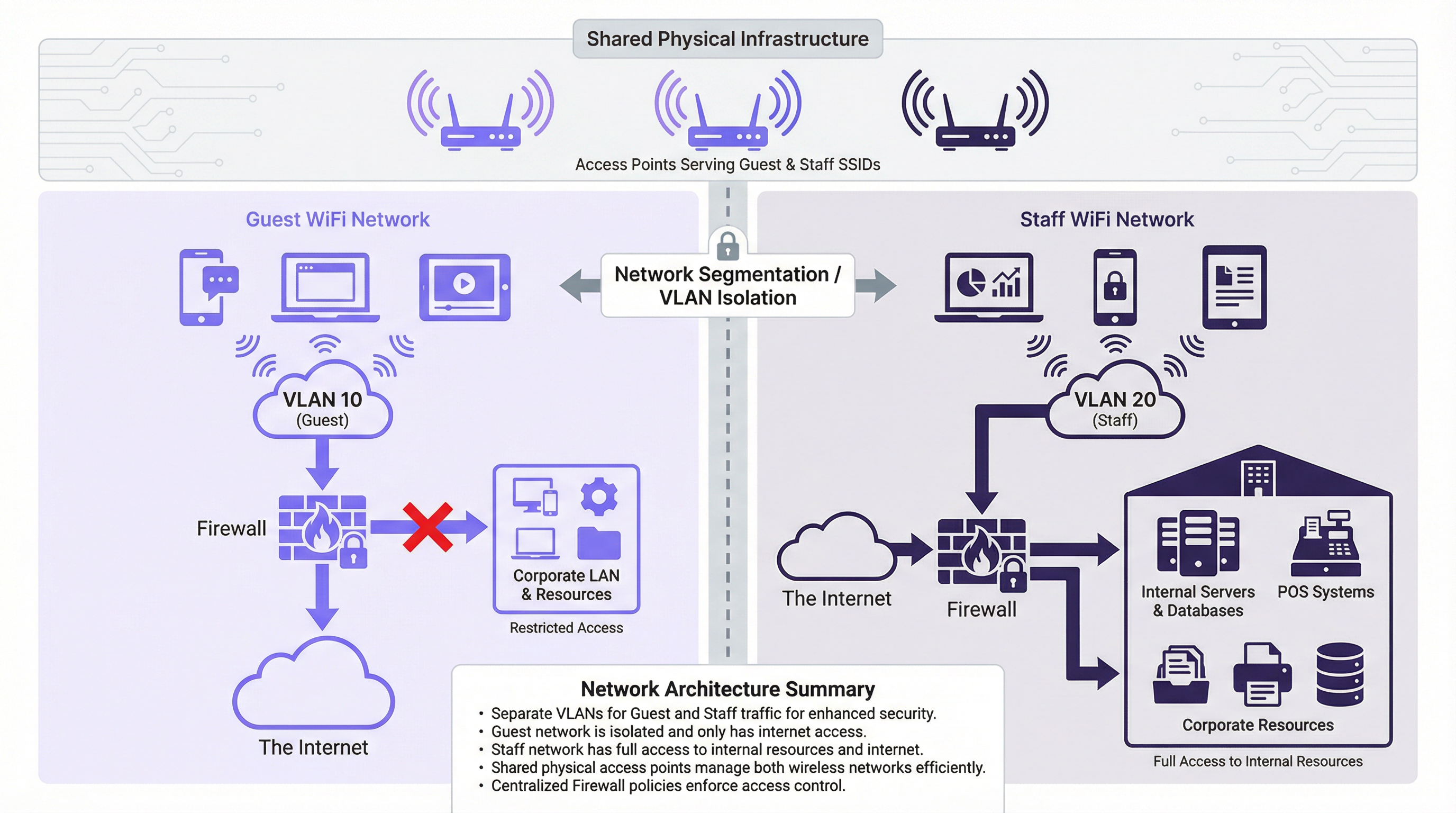
Come illustrato nel diagramma dell'architettura qui sopra, i dispositivi degli ospiti si connettono all'SSID "Guest", che è mappato sulla VLAN 10. Questa VLAN è configurata sul firewall per consentire esclusivamente l'accesso diretto a Internet. Tutto il traffico destinato alla LAN aziendale interna, inclusi server, database e sistemi POS, viene esplicitamente negato. Al contrario, i dispositivi del personale si connettono all'SSID "Staff", mappato sulla VLAN 20. A questa VLAN viene concesso un accesso protetto da firewall e controllato da policy sia a Internet che alle specifiche risorse interne richieste per ciascun ruolo del personale. Questa strategia di contenimento è la pietra angolare di un ambiente multi-rete sicuro.
Standard e Protocolli di Sicurezza
Una segmentazione efficace si basa su solidi protocolli di sicurezza per proteggere i dati in transito e per autenticare gli utenti in modo appropriato per il loro segmento di rete.
WPA3 (Wi-Fi Protected Access 3) è l'attuale standard di sicurezza per le reti wireless, che sostituisce il WPA2. Per la rete del personale, l'implementazione di WPA3-Enterprise rappresenta la best practice. Utilizza l'autenticazione IEEE 802.1X, che richiede a ciascun utente di presentare credenziali univoche, in genere gestite tramite un server RADIUS (Remote Authentication Dial-In User Service) integrato con un servizio di directory come Microsoft Active Directory. Ciò abilita il controllo degli accessi basato sui ruoli e fornisce una traccia chiara e verificabile di chi si è connesso alla rete e quando. Per la rete degli ospiti, WPA3-Personal fornisce una crittografia avanzata per la trasmissione over-the-air, ma un Captive Portal è il meccanismo standard per l'onboarding degli utenti, l'accettazione dei termini e l'acquisizione dei dati conforme al GDPR.
La Client Isolation è una funzionalità critica che deve essere abilitata su tutti gli access point rivolti agli ospiti. Impedisce ai dispositivi wireless connessi allo stesso SSID di comunicare direttamente tra loro al Livello 2. Senza questo controllo, un malintenzionato seduto nella hall di un hotel potrebbe facilmente attaccare i dispositivi di altri ospiti sullo stesso segmento di rete.
Guida all'Implementazione
L'implementazione di una rete WiFi segmentata segue un processo strutturato, dalla pianificazione fino alla convalida.
Fase 1: Pianificazione e Progettazione della Rete. Inizia mappando tutte le risorse interne — file server, gateway di pagamento, dispositivi IoT, sistemi di gestione del personale — e classificandole in base alla sensibilità. Definisci i ruoli degli utenti (Ospite, Reception, Back Office, Amministratore IT) e le specifiche risorse di rete richieste da ciascun ruolo. Stabilisci una strategia di numerazione delle VLAN. Un approccio comune e scalabile è: VLAN 10 (Ospiti), VLAN 20 (Personale Aziendale), VLAN 30 (Dispositivi POS/Pagamento), VLAN 40 (Dispositivi IoT), VLAN 99 (Gestione di Rete).
Fase 2: Configurazione Hardware. Assicurati che tutti gli access point supportino più SSID e il tagging VLAN IEEE 802.1Q. Configura le porte dello switch che si collegano agli AP come porte trunk, che trasportano il traffico per più VLAN contemporaneamente. Le porte che si collegano a dispositivi finali monouso dovrebbero essere configurate come porte di accesso assegnate a una singola VLAN. Il router o il firewall è il punto di applicazione centrale. Crea Access Control List (ACL) esplicite per ciascuna VLAN: nega per impostazione predefinita tutto il traffico dalla VLAN 10 alla LAN aziendale; consenti solo il traffico necessario dalla VLAN 20 a specifiche risorse interne su porte specifiche.

Fase 3: Configurazione SSID. Per l'SSID Guest, configura WPA3-Personal e abilita la Client Isolation. Implementa un Captive Portal per presentare i termini di servizio e acquisire il consenso dell'utente in modo conforme al GDPR. Per l'SSID Staff, configura WPA3-Enterprise e indirizza l'autenticazione al tuo server RADIUS. Valuta di non trasmettere l'SSID del personale per ridurne la visibilità agli utenti non autorizzati.
Fase 4: Test e Convalida. Connetti un dispositivo di test alla rete degli ospiti e conferma che possa raggiungere Internet ma non possa eseguire il ping o accedere ad alcun intervallo di indirizzi IP interni. Connetti un dispositivo di test alla rete del personale e verifica che possa accedere alle risorse designate ma sia bloccato dalle risorse al di fuori della policy definita. Esegui test di throughput su entrambe le reti per confermare che l'allocazione della larghezza di banda sia appropriata.
Best Practice
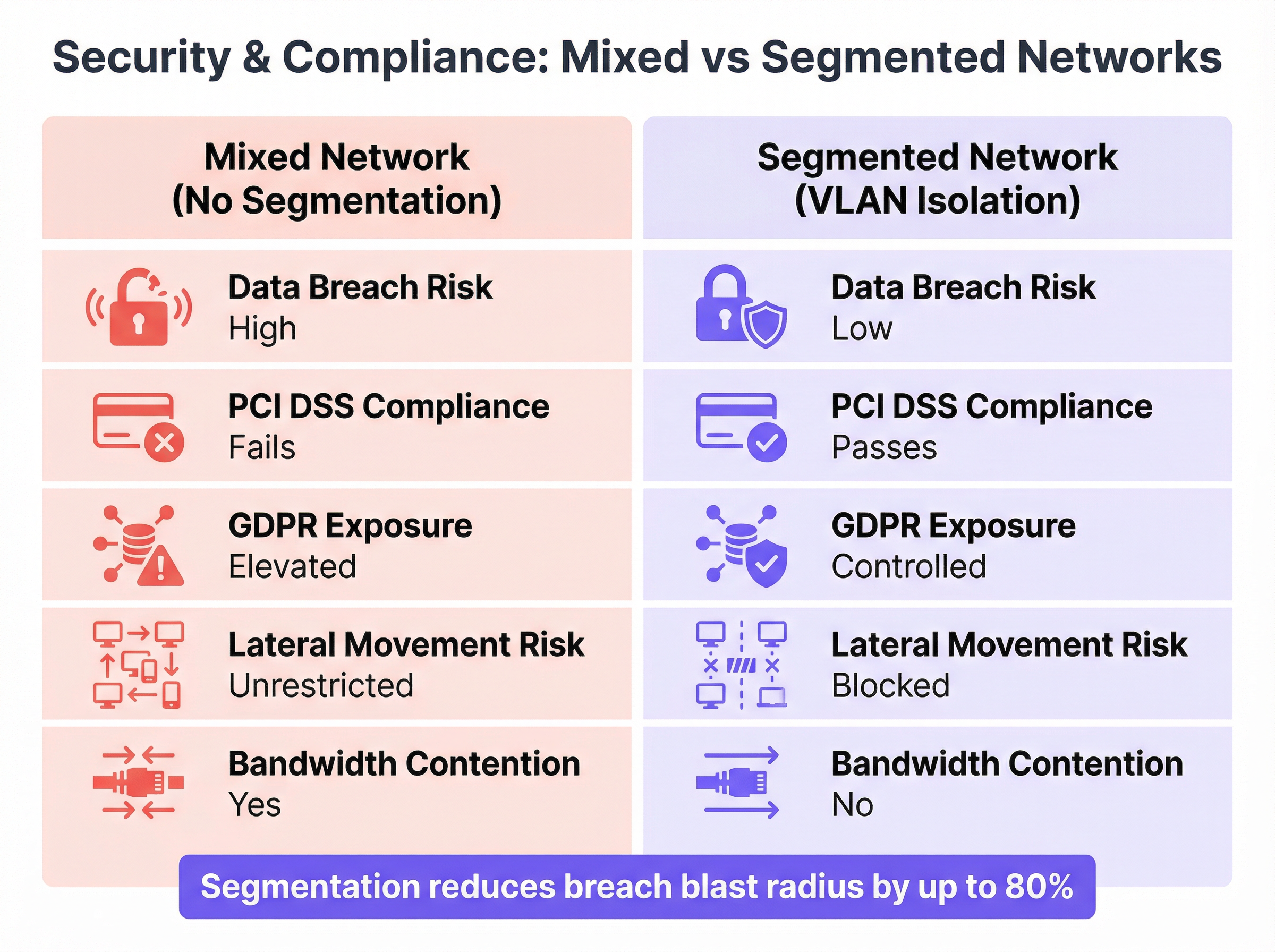
Il confronto precedente illustra la netta differenza nella postura di sicurezza e conformità tra una rete mista e una adeguatamente segmentata. I seguenti principi dovrebbero guidare ogni decisione di implementazione.
Il Principio del Minimo Privilegio è la regola fondamentale: inizia sempre con la policy di accesso più restrittiva e apri solo ciò che è assolutamente necessario per il funzionamento di un determinato ruolo. Ogni autorizzazione concessa è una potenziale superficie di attacco.
La Separazione Fisica e Logica dovrebbe essere presa in considerazione per ambienti altamente sensibili. Sebbene le VLAN forniscano una solida separazione logica, le organizzazioni che elaborano i dati delle carte di pagamento possono scegliere di utilizzare hardware fisicamente separato (AP e switch dedicati) per il Cardholder Data Environment (CDE) al fine di semplificare l'ambito di audit PCI DSS ai sensi del Requisito 1.2.
La Limitazione della Larghezza di Banda sulla rete degli ospiti protegge le operazioni critiche del personale. L'applicazione di limiti di download e upload per utente impedisce a un piccolo numero di ospiti di saturare la connessione Internet condivisa, il che potrebbe ritardare le transazioni POS o le chiamate VoIP.
Gli Audit Regolari sono un controllo operativo non negoziabile. Le regole del firewall, le configurazioni delle VLAN e i log di accesso degli utenti devono essere rivisti periodicamente per garantire che la segmentazione rimanga efficace man mano che l'azienda si evolve ed emergono nuove minacce.
La Gestione Centralizzata riduce significativamente il carico operativo di un'implementazione segmentata multi-sito. Piattaforme come Purple forniscono una dashboard unificata per gestire l'accesso degli ospiti, visualizzare analisi in tempo reale e applicare policy coerenti in un patrimonio distribuito.
Risoluzione dei Problemi e Mitigazione dei Rischi
L'Errata Configurazione delle VLAN è la modalità di guasto più comune nelle implementazioni segmentate. Una singola porta dello switch configurata in modo errato — ad esempio, una porta di accesso impostata come trunk o assegnata alla VLAN sbagliata — può portare al VLAN hopping, in cui il traffico fuoriesce tra i segmenti, annullando completamente l'architettura di sicurezza. La mitigazione è rigorosa: utilizza un modello di configurazione coerente e documentato per tutte le porte dello switch, implementa il VLAN pruning sui collegamenti trunk per limitare quali VLAN vengono propagate e utilizza strumenti di monitoraggio della rete per rilevare traffico inter-VLAN imprevisto.
Gli Errori nelle Regole del Firewall sono altrettanto pericolosi. Una regola eccessivamente permissiva — come ALLOW ANY ANY — può silenziosamente compromettere l'intera strategia di segmentazione. Implementa un rigoroso processo di controllo delle modifiche per tutte le variazioni alle regole del firewall. Ogni regola deve avere una giustificazione aziendale documentata, un proprietario designato e una data di revisione. Utilizza strumenti di analisi delle policy del firewall per identificare regole oscurate, ridondanti o eccessivamente ampie.
L'SSID Bleed può verificarsi in implementazioni ad alta densità in cui gli AP non sono configurati correttamente per i livelli di potenza RF, causando l'associazione dei dispositivi a un AP distante su una rete non prevista. Una corretta pianificazione RF — inclusa la regolazione della potenza di trasmissione dell'AP per creare celle di copertura ben definite — e l'uso delle funzionalità di assistenza al roaming IEEE 802.11k/v/r garantiranno che i dispositivi si connettano e si spostino tra gli AP corretti.
ROI e Impatto Aziendale
L'implementazione di una rete WiFi adeguatamente segmentata non è un centro di costo; è un investimento misurabile nella mitigazione del rischio e nell'efficienza operativa.
La Riduzione del Costo di una Violazione è la giustificazione finanziaria più significativa. Il costo medio di una violazione dei dati ammonta a milioni di dollari se si considerano le sanzioni normative, le spese legali, le notifiche ai clienti e i danni d'immagine. Il costo totale dell'implementazione della segmentazione — hardware, licenze e tempo di ingegnerizzazione — è una frazione di questa potenziale responsabilità. Contenendo una violazione alla rete degli ospiti a basso impatto, il raggio d'azione viene drasticamente ridotto.
Il Raggiungimento della Conformità ha un impatto diretto sui profitti di qualsiasi struttura che elabora pagamenti. La conformità PCI DSS è un prerequisito per accettare pagamenti con carta e la segmentazione di rete è un controllo tecnico fondamentale. La mancata conformità comporta sanzioni e commissioni di elaborazione delle transazioni più elevate da parte dei circuiti di carte. La conformità al GDPR, abilitata da un Captive Portal per gli ospiti gestito correttamente, evita sanzioni normative che possono raggiungere il quattro percento del fatturato annuo globale.
Il Miglioramento delle Prestazioni Operative si traduce direttamente nella protezione dei ricavi. Garantendo la Quality of Service per le applicazioni critiche del personale — terminali POS, gestione dell'inventario, VoIP e sistemi di gestione della proprietà — l'azienda evita costosi fallimenti delle transazioni e rallentamenti operativi durante i periodi di punta.
L'Esperienza degli Ospiti e la Monetizzazione dei Dati rappresentano il vantaggio strategico. Una rete WiFi per gli ospiti sicura, affidabile e veloce è un fattore misurabile dei punteggi di soddisfazione dei clienti. Piattaforme come Purple si basano su queste fondamenta, consentendo alle strutture di sfruttare il percorso di onboarding del WiFi per gli ospiti per la marketing automation, l'integrazione di programmi fedeltà e l'analisi dell'affluenza, trasformando una necessità di sicurezza in un asset che genera ricavi diretti.
Termini chiave e definizioni
Network Segmentation
The practice of dividing a computer network into smaller, logically isolated subnetworks to control the flow of traffic between them, thereby limiting the potential impact of a security breach.
IT teams implement segmentation as a primary security control to prevent a compromised device on a low-trust network (such as Guest WiFi) from accessing high-trust resources (such as payment systems or corporate file servers). It is a core requirement of PCI DSS and a recommended control under GDPR.
VLAN (Virtual LAN)
A logical grouping of network devices that communicate as if they are on the same physical network segment, regardless of their actual physical location. VLANs are defined by the IEEE 802.1Q standard, which specifies how VLAN tags are added to Ethernet frames.
VLANs are the primary technical mechanism for network segmentation. A network architect assigns separate VLAN IDs to guest and staff traffic, and the network infrastructure (switches and firewalls) uses these IDs to enforce traffic isolation and access control policies.
SSID (Service Set Identifier)
The human-readable name of a wireless network, broadcast by an access point to allow devices to discover and connect to it. A single access point can broadcast multiple SSIDs simultaneously.
The SSID is the user-facing entry point to the network. While broadcasting separate SSIDs for guests and staff creates a logical separation visible to users, the SSID alone provides no security isolation. True security requires each SSID to be mapped to a separate, firewalled VLAN.
Client Isolation
A wireless access point feature that prevents devices connected to the same SSID from communicating directly with each other at Layer 2 of the OSI model.
This is a mandatory configuration for any guest-facing SSID. Without client isolation, a malicious actor connected to the guest network can conduct peer-to-peer attacks against other guests' devices — a common threat in public hotspot environments such as hotels, cafes, and conference centres.
IEEE 802.1X
An IEEE standard for port-based Network Access Control (PNAC) that provides an authentication framework for devices connecting to a LAN or WLAN. It requires each user or device to present valid credentials before network access is granted.
802.1X is the enterprise standard for securing staff WiFi networks. It eliminates the security risk of shared network passwords by requiring individual, revocable credentials for each user. When an employee leaves the organisation, their access is revoked in the directory service (e.g., Active Directory) and immediately takes effect on the network.
RADIUS Server
A centralised server that provides Authentication, Authorisation, and Accounting (AAA) services for network access. In a WiFi context, it validates user credentials presented during 802.1X authentication.
When a staff member connects to the enterprise WiFi using 802.1X, the access point forwards the credentials to the RADIUS server, which checks them against the user directory and returns an access-granted or access-denied response. This centralised model provides a complete audit trail of all network authentication events.
PCI DSS (Payment Card Industry Data Security Standard)
A set of security standards mandated by the major card schemes (Visa, Mastercard, Amex) for all organisations that store, process, or transmit payment card data. Requirement 1.2 specifically mandates network segmentation to isolate the Cardholder Data Environment (CDE).
For any venue that accepts card payments — which includes virtually all hotels, retailers, and stadiums — PCI DSS compliance is a contractual obligation. Failure to properly segment the network that handles card data from other networks (including guest WiFi) results in automatic audit failure, financial penalties, and potential loss of the ability to accept card payments.
Captive Portal
A web page that users of a public-access network are required to interact with before being granted internet access. It is typically used to display terms and conditions, collect user information, and authenticate users.
The captive portal is the primary onboarding mechanism for guest WiFi. Beyond its security function, it is a significant business tool: platforms like Purple use the captive portal to capture GDPR-compliant marketing consent, integrate with loyalty programmes, and generate rich visitor analytics that inform venue operations and marketing strategy.
Casi di studio
A 200-room luxury hotel needs to upgrade its WiFi to provide secure access for guests, corporate staff (front desk, housekeeping, management), and a new fleet of IoT-enabled minibars that report stock levels. The hotel must comply with PCI DSS as its booking system handles credit card data.
The recommended architecture uses four VLANs to achieve strict isolation across all user groups. VLAN 10 is assigned to guests, VLAN 20 to corporate staff, VLAN 30 to the PCI Cardholder Data Environment (CDE) for booking terminals, and VLAN 40 to IoT devices. Three SSIDs are broadcast: 'HotelGuest' mapped to VLAN 10, 'HotelServices' mapped to VLAN 20 using WPA3-Enterprise with 802.1X, and a hidden SSID for IoT devices mapped to VLAN 40 using MAC-based authentication. The PCI VLAN (30) is served via wired connections where possible, with port-level MAC address locking. Firewall policy enforces strict isolation: VLAN 10 receives internet access only; VLAN 20 is permitted access to the Property Management System and internal email server; VLAN 30 is restricted to outbound HTTPS traffic to the payment gateway provider's specific IP addresses on port 443; VLAN 40 is permitted only to communicate with the cloud-based minibar inventory API. All inter-VLAN traffic is denied by default. Guests are onboarded via a Purple-powered captive portal on VLAN 10, providing GDPR-compliant data capture and marketing consent.
A retail chain with 500 stores wants to deploy guest WiFi across its entire estate while ensuring POS systems and inventory scanners remain secure. The deployment must be centrally manageable, scalable, and consistent across all locations.
The solution is built on a template-based deployment model using Zero-Touch Provisioning (ZTP). A single, standardised network configuration template is designed for a reference store: two VLANs (VLAN 100 for Guests, VLAN 200 for Store Operations), two SSIDs ('BrandGuestWiFi' on VLAN 100 with client isolation and 5 Mbps per-user throttling, and a hidden 'StoreOps' SSID on VLAN 200 with WPA3-Enterprise), and a standardised firewall policy (VLAN 100 internet-only; VLAN 200 permitted access to the central POS and inventory servers at the corporate data centre via an IPsec VPN tunnel). This template is uploaded to a cloud-based network management platform supporting ZTP. When new APs and switches are shipped to a store, they are plugged in and automatically download the correct configuration, requiring no on-site engineering expertise. The guest captive portal is managed centrally by Purple, providing the marketing team with unified footfall analytics, campaign management, and customer engagement tools across all 500 locations from a single dashboard.
Analisi degli scenari
Q1. A stadium hosting a major concert expects 50,000 concurrent guest WiFi users. The operations team requires guaranteed, low-latency connectivity for ticketing scanners, security radio over IP, and access control systems — all running on a separate staff network. How would you architect the bandwidth management and QoS strategy to protect operational systems during peak load?
💡 Suggerimento:Consider the interaction between per-user bandwidth throttling on the guest network and QoS traffic prioritisation for staff traffic. Think about what happens at the internet gateway when both networks are competing for the same upstream bandwidth.
Mostra l'approccio consigliato
The solution requires a two-layer approach. First, apply strict per-user bandwidth throttling on the Guest SSID — a limit of 3-5 Mbps per user is typical for a high-density event environment. This prevents any single user from consuming a disproportionate share of the available bandwidth and limits the aggregate impact of 50,000 concurrent users. Second, implement QoS policies at the switch and firewall level. Tag all traffic originating from the Staff VLAN (VLAN 20) with a high-priority DSCP marking (e.g., DSCP EF — Expedited Forwarding for VoIP, or DSCP AF41 for critical data). Tag guest traffic as Best Effort (DSCP BE). Configure the firewall and upstream router to honour these DSCP markings and service high-priority queues first. This ensures that even when the internet link is heavily loaded by guest traffic, the ticketing and security systems receive preferential treatment. Additionally, consider provisioning a dedicated, physically separate internet circuit for the Staff VLAN to provide complete bandwidth isolation for mission-critical operations.
Q2. A small independent cafe has a single business-grade router/AP combination. The owner uses the same network for customer WiFi and their single POS terminal. They have a very limited budget and no dedicated IT support. What is the minimum viable segmentation you would recommend, and what are its limitations?
💡 Suggerimento:Most modern business-grade all-in-one routers include a built-in 'Guest Network' feature. Evaluate what this provides and where it falls short of a full enterprise segmentation deployment.
Mostra l'approccio consigliato
The recommended minimum viable solution is to enable the built-in 'Guest Network' feature on the existing router. When properly activated, this feature creates a second SSID, enables client isolation, and implements basic firewall rules that prevent guest devices from accessing the primary LAN (where the POS terminal resides). This provides a critical layer of separation at zero additional hardware cost. However, the limitations must be clearly understood: the implementation quality varies significantly by vendor and firmware version; it does not provide the granular ACL control of a dedicated firewall; it does not support 802.1X authentication for the staff network; and it may not satisfy a formal PCI DSS audit, which may require the POS to be on a wired, physically isolated connection. For a growing business, this is a temporary measure. The medium-term recommendation is to upgrade to a dedicated business-grade AP and a separate router/firewall appliance that supports full VLAN configuration.
Q3. Your organisation is acquiring a new office building. You discover the previous tenant operated a completely flat network — a single SSID and a single shared password used by all employees, visitors, contractors, and IoT building management devices. What are your first three priority actions regarding the wireless network, and what is your rationale for their ordering?
💡 Suggerimento:Think about the sequence of discover, contain, and redesign. Consider the risk of leaving the existing network operational while you plan the replacement.
Mostra l'approccio consigliato
Priority 1 — Disable the existing SSID immediately. The shared password is a known credential that may have been distributed to an unknown number of former employees, contractors, and visitors. Every minute the network remains operational with this credential is a window of unauthorised access. This is a containment action that accepts a temporary loss of connectivity in exchange for eliminating an unquantifiable security risk. Priority 2 — Conduct a full wireless and network survey. Use a wireless analysis tool to identify all active access points (including any rogue APs installed by the previous tenant), map the physical hardware, and identify all devices that were connected to the flat network — particularly IoT and building management devices, which may have been configured with hardcoded credentials. This discovery phase defines the scope of the redesign. Priority 3 — Design and deploy a new, properly segmented network architecture from scratch. Based on the hardware inventory from Priority 2, design a multi-VLAN architecture (Corporate, Guest, IoT/BMS as a minimum) with appropriate SSIDs, authentication methods, and firewall policies. Do not attempt to patch or 'fix' the existing flat network; a complete redesign is the only way to establish a secure, auditable foundation.
Punti chiave
- ✓Running guest and staff WiFi on a single, flat network is a critical security risk that enables lateral movement from a compromised guest device to corporate systems.
- ✓True network segmentation is achieved by mapping separate SSIDs to isolated VLANs, with the firewall as the central enforcement point for inter-VLAN traffic policies.
- ✓Staff networks must use WPA3-Enterprise with IEEE 802.1X authentication for individual, revocable credentials; guest networks require a captive portal with client isolation enabled.
- ✓Network segmentation is a core technical requirement for PCI DSS compliance (Requirement 1.2) and a key control for managing GDPR data exposure risk.
- ✓Bandwidth throttling on the guest network and QoS prioritisation for staff traffic are essential to protect business-critical applications during peak load.
- ✓The most common failure mode is VLAN misconfiguration — a single incorrectly configured switch port can silently bridge network segments and negate the entire security architecture.
- ✓Properly segmented guest WiFi is not merely a cost centre: it is the foundation for a guest analytics and marketing platform that generates measurable business value.




