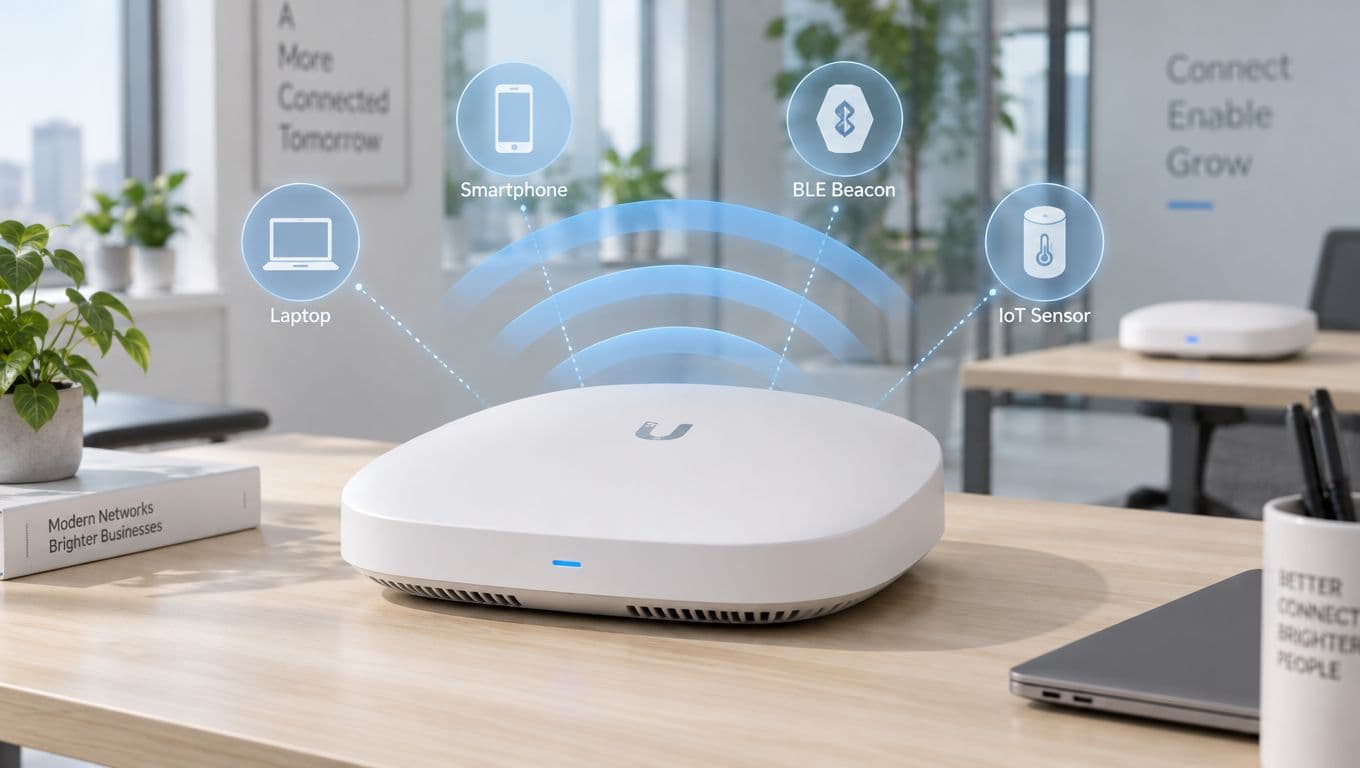
You're not choosing a SIM tariff. You're choosing who controls the radio layer underneath your guest journey, your failover design and your identity platform. Get MNO vs MVNO wrong and you'll discover the mistake at peak check-in, not in procurement.
A Hotel Chain Faces the Connectivity Question
A hospitality group with 40 properties is renewing its estate connectivity. One bid comes direct from a mobile network operator for cellular backhaul and failover. The other comes from a virtual operator offering branded SIMs, bundled roaming and a faster rollout across every site.
On price per SIM, the second bid wins. On paper, the first bid looks safer because the operator owns the network. Neither answer is sufficient, because neither bid yet explains what happens to a guest trying to get online in a basement bar, a rural annexe or a packed conference floor.
The Guest Experience Test
Guests don't judge your wholesale contract. They judge whether onboarding is instant, whether video calls hold, and whether they can stay in touch while travelling, a habit well covered in guides to social travel apps for hostel stays that show how central messaging and social apps now are to a stay. If your cellular layer can't support Passpoint, OpenRoaming and passwordless return visits, your WiFi strategy starts with a handicap.
That's why the framework in this guest WiFi guide for venue operators matters before you sign anything mobile. It forces the right order. Define the identity journey first, then test whether the mobile partner can support it across sites with different radio conditions.
- Direct MNO route: deeper control, slower commercial movement, stronger influence on coverage remedies
- MVNO route: faster launch, branded journeys, possible multi-network reach, but total dependence on wholesale terms
- Hybrid route: MNO for primary backhaul, MVNO for failover, IoT and mobile staff
My advice is blunt. Don't award this on tariff. Award it on host-network disclosure, 5G priority, SLA remedies and integration with your identity platform. If a bidder won't put those four items in writing, remove them from the shortlist.
What MNO and MVNO Actually Mean in the UK Market
An MNO, or mobile network operator, owns licences for spectrum, builds radio sites and runs the core network. It sells to retail customers under its own brand and wholesales capacity to other providers. It controls investment, coverage priorities and network policy.
An MVNO, or mobile virtual network operator, buys wholesale access from an MNO and sells services under its own brand. It doesn't own nationwide radio infrastructure. It competes on price, segment focus, distribution, customer service and bundled propositions.
The UK Structure You Are Buying Into
The UK market has four principal MNOs, EE, Vodafone, O2 and Three, sitting underneath a much larger virtual operator ecosystem. Ofcom reported approximately 28 MVNOs in October 2015, with MVNOs and resellers collectively holding 15% of UK retail mobile subscriptions at the end of 2015. Recognisable names from that period included Tesco Mobile, Virgin Mobile, Lycamobile and Lebara.
The four-MNO structure dates from 2010, when T-Mobile and Orange combined to form EE. Since then, MNOs have played a dual role. They compete for your retail and enterprise spend while deciding what capacity, features and priority their wholesale customers receive.
An MVNO brand is a commercial wrapper. The host MNO is the network your guests and devices will actually experience.
Not All MVNOs Are Built the Same
A light MVNO relies heavily on the host for core functions and has limited control over routing and policy. A full MVNO runs more of its own core, giving it greater control over SIM profiles, authentication and traffic steering. A branded reseller may do little beyond billing and marketing.
A multi-host MVNO adds another dimension. It can, where contracts and devices allow, select between networks. That design can improve availability across a dispersed estate, but only if switching behaviour, authentication and policy are engineered properly.
For venue buyers, the label matters less than the architecture. Ask who owns the core elements, who controls the APN, and who can change priority or routing without asking the host for permission. Those answers predict operational flexibility far better than a sales deck.
Side-by-Side Comparison on the Criteria That Matter
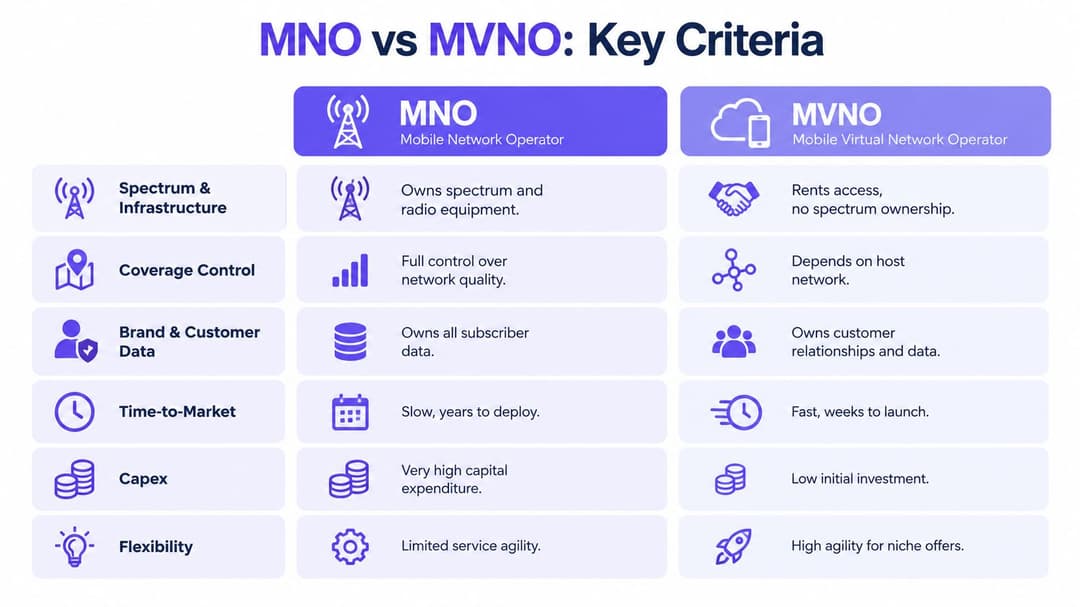
Most comparison tables waste your time on obvious points. You already know an MNO owns masts and an MVNO doesn't. The useful comparison is about control, data, speed of change and exit cost.
| Criterion | MNO direct relationship | MVNO partnership |
|---|---|---|
| Spectrum and infrastructure | Owns spectrum, radio sites and core | Rents access, no spectrum ownership |
| Coverage control | Direct influence over investment and remediation | Inherits host coverage and performance |
| Brand and customer data | Operator owns subscriber relationship and network data | MVNO owns customer relationship, host retains network-level data |
| Time to market | Slower contracting and customisation | Faster launch for standard propositions |
| Capex profile | Network capex absorbed by operator, reflected in pricing | Low infrastructure capex, more spend on platform and marketing |
| Flexibility | Strong on bespoke radio and capacity, weaker on niche journeys | Strong on segment offers and bundled services |
| Switching cost | High where bespoke integration or in-building systems exist | Lower for standard SIM estates, higher where core integration is deep |
The Three Criteria That Change Buyer Behaviour
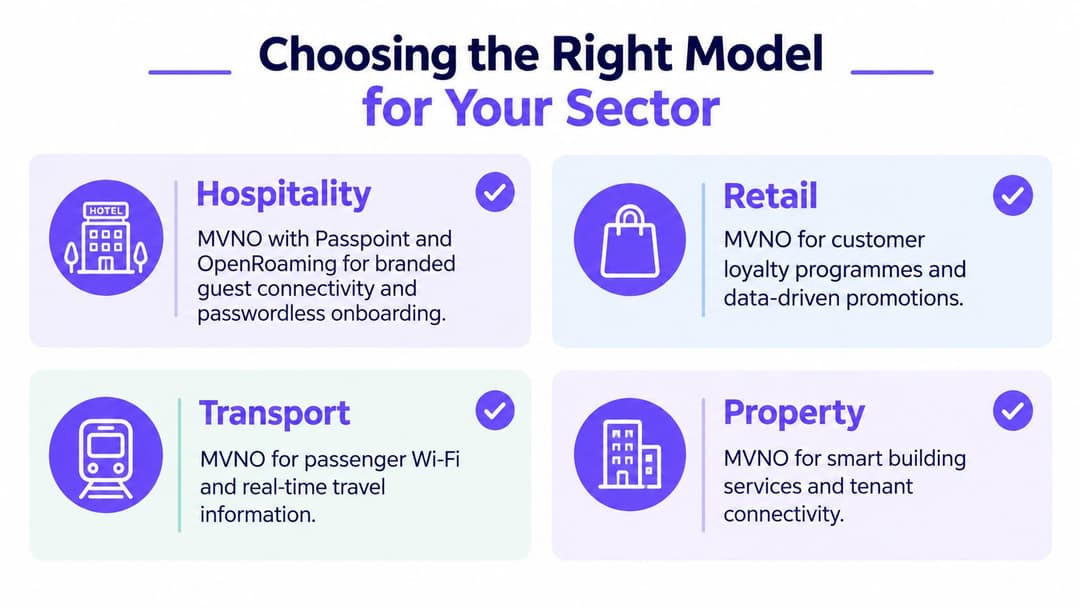
Spectrum ownership matters when you need dedicated capacity, in-building small cells or custom radio features at a flagship site. An MVNO can't promise a new macro site or a spectrum refarm. It can only escalate through its host.
Customer data is more nuanced than vendors admit. An MVNO may own billing, CRM and the branded relationship, but the host still sees network events and controls core telemetry. If your strategy depends on first-party identity data, contract explicitly for what data you receive, in what format and with what latency.
Switching agility cuts both ways. A standard MVNO SIM estate can move quickly if eSIM profiles and number ranges are portable. A highly integrated full MVNO with private APNs, static addressing and custom authentication can be just as sticky as an MNO deal.
Don't score these criteria equally. Weight them by site criticality. A flagship conference hotel and a small franchised property shouldn't automatically share the same model or the same SLA.
Wholesale Terms, Roaming and 5G Access
MVNO deals succeed or fail right here. A virtual operator generally inherits coverage and air-interface capability from its host, but the contract decides whether it inherits the host's best experience or a restricted version of it.
Restrictions can apply to 5G access, traffic priority during congestion, roaming partners, VoLTE and WiFi calling features, and network slicing or quality-of-service profiles. Two MVNOs on the same host can deliver noticeably different results at the same postcode.
Host Choice Is a Measurable Decision
Ofcom's 2025 measurements found 28.3% of UK connection attempts used 5G overall, with EE at 31.9% and Vodafone at 23.8%. That's not a branding difference. It's a difference in the radio experience your SIMs are likely to encounter, before wholesale priority is even considered.
Ofcom also reported average UK response times below 25 ms on both 4G and 5G in that dataset. A strong host can therefore support most enterprise, hospitality, retail and IoT workloads on latency. Your risk isn't usually headline latency. It's indoor signal, uplink quality and throughput when the cell is busy.
Headline coverage needs equal care. Ofcom's coverage data puts 4G at approximately 88% of UK geographic landmass at the regulator's good threshold and 99% or more of outdoor premises at the variable threshold. A rural venue can sit inside strong premises statistics and still have a dead zone in the room where your router lives.
Questions to Put in Writing
- Host disclosure: Which MNO carries traffic at each site, and can the host change without notice?
- 5G and priority: Is 5G included, and is traffic deprioritised during congestion?
- Private APN and addressing: Do you get a private APN, IPv4 and IPv6 support and static addressing where needed?
- Roaming policy: Which partners, steering rules and fair-use limits apply for travelling staff and guests?
- SLA remedies: What credits, escalation paths and termination rights follow a missed target?
Then test the exact host profile at the target site. Measure indoor signal, 5G availability, uplink, latency, congestion-period throughput and failover behaviour. A postcode-level score based on connection attempts achieving usable download speed tells you more than a theoretical maximum.
Cost Structure and Operational Implications
Per-SIM pricing is the smallest part of this decision. The MNO absorbs spectrum and network investment and recovers it through retail and wholesale pricing. The MVNO avoids that capex, then spends on platform, distribution, support and margin. You pay either way, just through different line items.

Integration is where budgets expand. Your mobile estate has to work with identity platforms, RADIUS policy, firewalls, SD-WAN failover logic and device provisioning. If an MVNO can't support your authentication model cleanly, your team will pay in manual workarounds and support tickets.
Operational Costs Buyers Underestimate
Multi-tenant venues add a sharper test. Residential, student and mixed-use buildings need isolation between tenants, per-unit credentials and support for legacy devices. The principles in this multi-tenant WiFi guide for property operators apply directly when cellular failover sits behind the same access layer. If isolation breaks during failover, your design fails regardless of SIM price.
Purple is one example of an identity platform that provides passwordless guest and staff access using Passpoint and OpenRoaming, alongside multi-tenant isolation features such as iPSK. Whatever platform you use, price the integration work with that vendor before you sign the mobile contract, not after.
Budget rule: The cheapest SIM is rarely the cheapest network once you count SLA credits, escalations, reprovisioning and missed guest-experience targets.
Support escalation deserves its own line in your business case. With an MNO, you escalate to the network owner. With an MVNO, you escalate to an intermediary that may then escalate to the host. That second hop is acceptable only if response times, named contacts and host escalation rights are contractual.
Finally, price your exit on day one. Include SIM and eSIM reprovisioning, router reconfiguration, static address changes, number portability and parallel running. A low headline tariff with a painful exit is a lock-in strategy, not a saving.
Matching the Model to Hospitality, Retail, Transport and Property
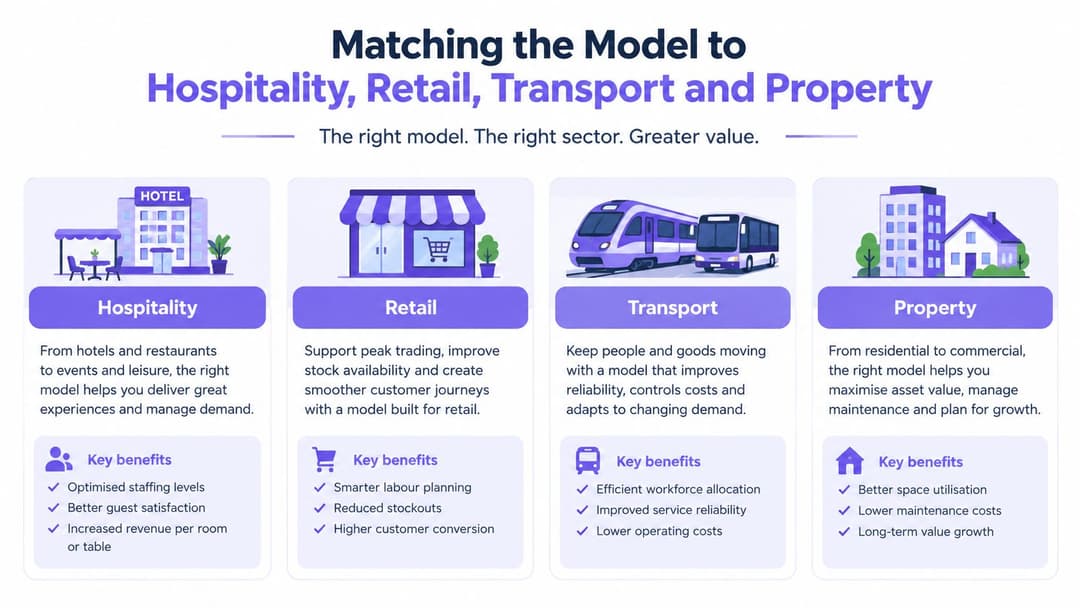
Sector matters because the cost of a failed connection differs. A dropped guest onboarding flow, a stalled point-of-sale terminal and a failed departure board don't carry the same operational risk, so they shouldn't drive the same partnership model.
Buyer appetite for virtual models is clearly growing. The UK Government's 2026 Mobile Market Review call for evidence, citing Enders Analysis, put MVNOs at 19% of the UK mobile market at the end of 2024 and described them as the fastest-growing segment in recent years. Treat that as evidence of momentum, not as a reason to copy everyone else.
Hospitality and Retail
For hotel groups, an MVNO supporting Passpoint and OpenRoaming usually wins on time to value. You get branded, passwordless onboarding across properties without negotiating radio customisation site by site. Reserve direct MNO deals for flagships needing dedicated capacity or in-building coverage remediation.
Retail follows a similar pattern. MVNOs with CRM integration and multi-network reach help marketing teams activate loyalty journeys quickly across stores. Choose an MNO direct route when you need spectrum-level control, such as a bespoke small-cell design inside a major mall.
Transport and Property
Transport hubs should be conservative. Passenger information, operations and safety-adjacent systems need deep SLAs and direct escalation to the network owner. The operational discipline visible in the Manchester Airport Group connectivity case study is the standard to aim for, where guest access and operational resilience are designed together.
Property managers in build-to-rent and student housing usually favour MVNO partnerships bundled with a managed access platform. Multi-tenant isolation, per-resident identity and rapid move-in provisioning matter more than direct spectrum control. Your residents care that their devices work in their flat, not who owns the nearest macro site.
Which Partnership Model Should You Choose
Use a default, then justify exceptions. That approach stops every site manager renegotiating strategy locally and gives procurement a defensible position in the vendor meeting.
Choose an MNO Direct Relationship When
- Site value is concentrated: A small number of flagship venues justify bespoke radio design and dedicated capacity.
- Coverage remedies matter: You need contractual pull over the organisation that owns sites and spectrum.
- Custom features are required: Your design depends on specific core policy, quality-of-service treatment or in-building systems.
- Escalation must be direct: Operational risk doesn't tolerate an intermediary during a major incident.
Choose an MVNO Partnership When
- Rollout speed matters: You need many sites live quickly under one branded customer journey.
- Identity integration leads: Passpoint, OpenRoaming and CRM-driven onboarding are central to the proposition.
- Multi-network reach helps: A dispersed estate benefits from selecting between hosts where the design supports it.
- Commercial flexibility wins: Shorter commitments and segment-specific bundles outweigh bespoke radio control.
For most multi-site hospitality, retail and property estates, my default recommendation is an MVNO partnership with full host disclosure, tested at site level and integrated with your identity platform. For transport hubs and flagship venues with known coverage problems, my default is MNO direct. Don't reverse those defaults without site survey evidence.
Consider a hybrid where resilience justifies it. Use an MNO for primary backhaul at critical sites and a multi-network MVNO for failover, IoT and mobile staff. That combination costs more to govern, but it removes a single point of commercial and technical failure.
Score venue scale, guest strategy, SLA depth, brand data needs and time to market before you meet vendors. If you walk in without weightings, the vendor with the best presentation will set them for you.
Vendor Questions and Common Mistakes to Avoid
Ask these questions of every bidder, MNO or MVNO, and require written answers. Verbal assurances won't help you during an outage review.
- Host network: Who carries traffic at each site?
- 5G priority: Is access restricted or deprioritised?
- Private APN: Is one provided, and who controls it?
- Addressing: Are IPv6 and static IPs supported?
- Roaming: Which partners and steering rules apply?
- SLA remedies: What credits and termination rights apply?
- Data ownership: What telemetry and identity data do we receive?
- Switching costs: What does exit cost, in full?
Three mistakes cost operators most. First, trusting the MVNO brand instead of testing the host network at the actual site. Second, ignoring wholesale priority terms that only bite during congestion. Third, underestimating integration with identity, RADIUS and analytics platforms until after signature.
Choose the model that protects the guest journey under load. Everything else is procurement detail.
Purple helps venues turn whichever mobile model you choose into secure, passwordless guest and staff connectivity with Passpoint, OpenRoaming, identity-based access and multi-tenant isolation across your estate. If you're weighing MNO vs MVNO bids right now, map the wholesale terms against the guest journey you need to deliver, then visit Purple to see how the identity layer should be designed before you sign.