

WPA3 Enterprise vs iPSK: Cómo elegir el modelo de seguridad adecuado
Esta guía ofrece una comparación técnica definitiva entre WPA3 Enterprise e Identity Pre-Shared Key (iPSK) para redes WiFi empresariales. Permite a los líderes de TI elegir el modelo de seguridad óptimo para sus instalaciones, equilibrando una autenticación 802.1X robusta con la flexibilidad necesaria para dispositivos IoT y heredados.
🎧 Escucha esta guía
Ver transcripción
Resumen ejecutivo
Para los gerentes de TI y arquitectos de red que operan recintos complejos abiertos al público —desde cadenas de retail hasta extensos centros de convenciones— asegurar el borde inalámbrico es un desafío constante. La proliferación de dispositivos IoT, junto con mandatos de cumplimiento estrictos como PCI DSS y GDPR, exige un control de acceso robusto. Históricamente, la elección era binaria: el complejo 802.1X (WPA2/WPA3 Enterprise) o las claves precompartidas (PSK) inseguras y fáciles de comprometer.
Hoy en día, la decisión suele centrarse en WPA3 Enterprise frente a Identity PSK (iPSK). WPA3 Enterprise representa el estándar de oro para la autenticación de usuarios, aprovechando mejoras criptográficas y la protección obligatoria de tramas de gestión para asegurar los dispositivos operados por humanos. Por el contrario, iPSK proporciona un enfoque escalable y segmentado para el creciente volumen de dispositivos IoT sin interfaz (headless) que no pueden soportar suplicantes 802.1X. Esta guía desglosa ambas arquitecturas, ofreciendo estrategias de despliegue accionables para ayudarle a implementar el modelo de seguridad adecuado —o un enfoque híbrido— para sus requisitos operativos específicos. Ya sea que esté actualizando el WiFi para invitados de un hospital o asegurando Sensores en un estadio inteligente, comprender estos modelos es fundamental para mantener una red segura y de alto rendimiento.

Análisis técnico profundo
WPA3 Enterprise: La evolución de 802.1X
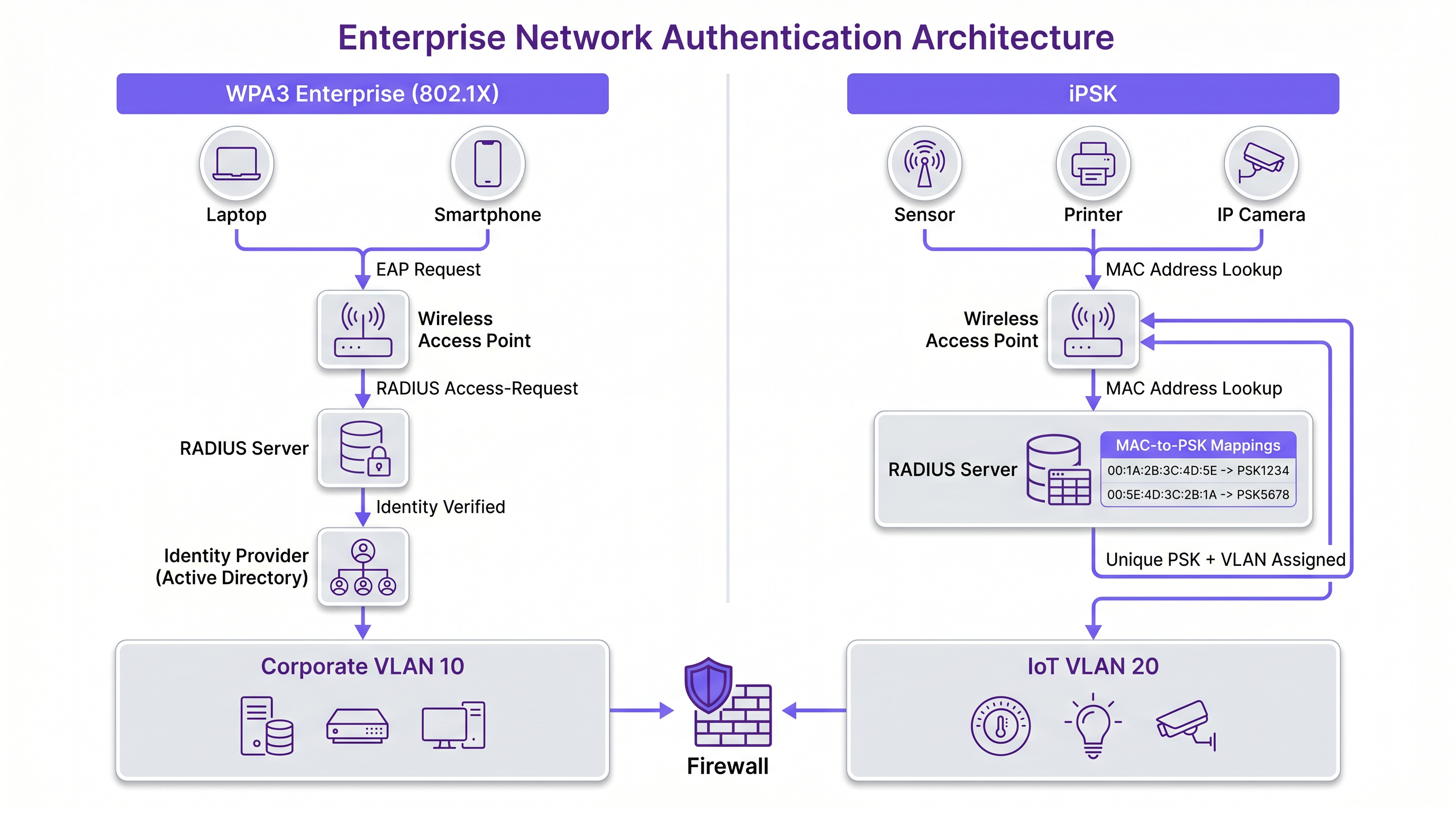
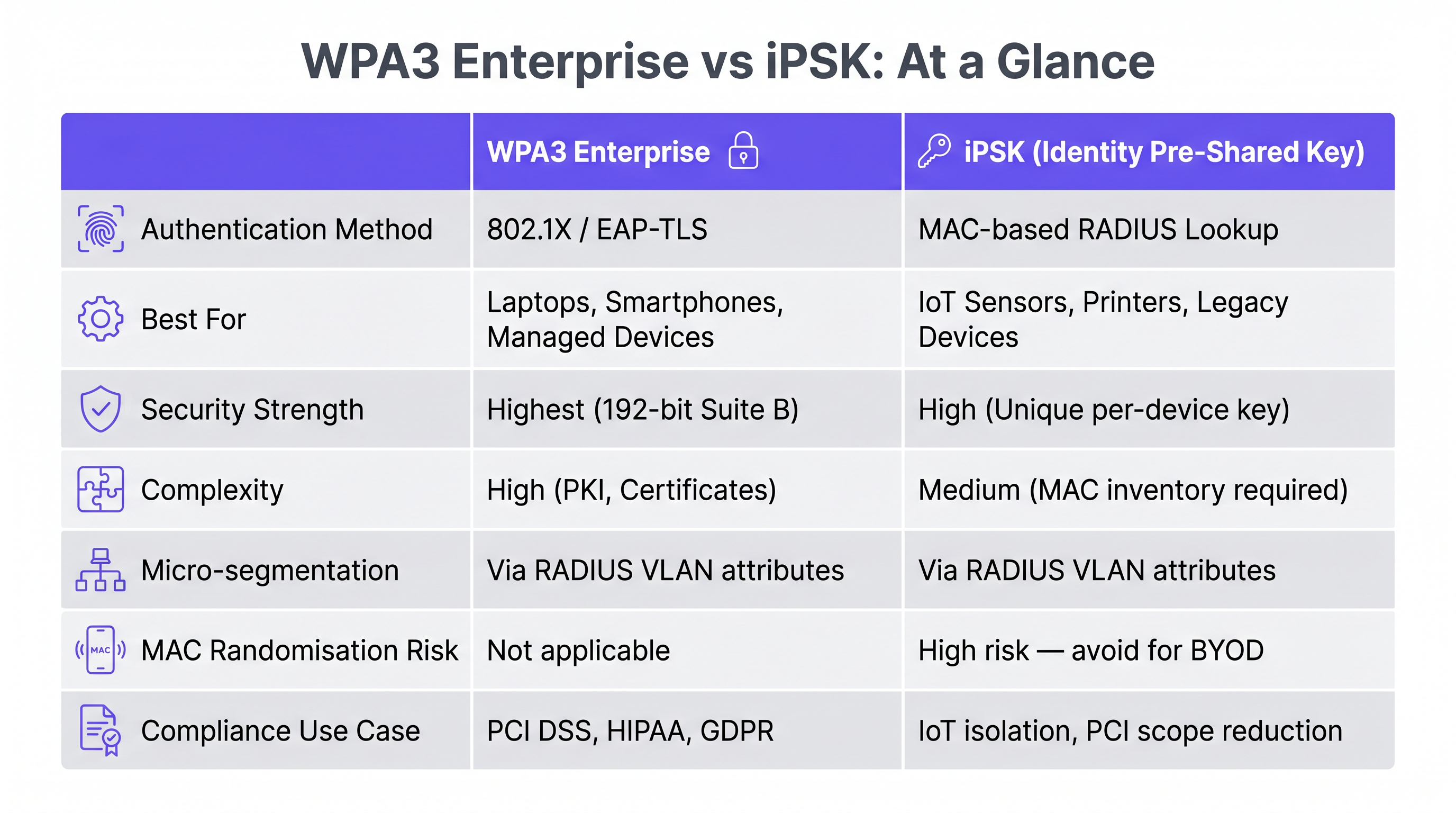
WPA3 Enterprise se basa en la base de la autenticación 802.1X/EAP, reemplazando los protocolos criptográficos heredados con una suite de seguridad obligatoria de 192 bits (a menudo denominada criptografía Suite B). Este modelo requiere un servidor RADIUS para autenticar a cada usuario individualmente, normalmente contra un proveedor de identidad (IdP) como Active Directory o Azure AD.
La principal ventaja técnica de WPA3 Enterprise es su robusta protección contra ataques de diccionario fuera de línea y su aplicación de Tramas de gestión protegidas (PMF). Las PMF (802.11w) mitigan los ataques de desautenticación y desasociación, que son vectores comunes para interrumpir las operaciones de un recinto o forzar a los clientes a conectarse a puntos de acceso no autorizados. Para entornos que manejan datos sensibles, como instalaciones del Sector salud u oficinas corporativas, WPA3 Enterprise proporciona el no repudio y la responsabilidad individual requeridos por los auditores.
Sin embargo, la complejidad del despliegue de 802.1X no debe subestimarse. Requiere una gestión cuidadosa de certificados, un tema cubierto ampliamente en nuestra guía sobre OCSP y revocación de certificados para la autenticación WiFi . Además, la carga de autenticación puede afectar el rendimiento del roaming si la Transición rápida de BSS (802.11r) no está configurada de manera óptima.
Identity PSK (iPSK): Simplicidad segmentada
iPSK (también conocido como Multiple PSK, Dynamic PSK o PPSK según el fabricante) altera fundamentalmente el paradigma tradicional de contraseña compartida. En lugar de una única frase de contraseña para todo un SSID, iPSK permite que el servidor RADIUS asigne dinámicamente una clave precompartida única a dispositivos individuales o grupos de dispositivos basándose en su dirección MAC.
Cuando un dispositivo se asocia, el punto de acceso consulta al servidor RADIUS utilizando la dirección MAC del dispositivo como identidad. El servidor responde con la PSK específica para ese dispositivo y, fundamentalmente, con atributos RADIUS estándar como asignaciones de VLAN, políticas de QoS y ACL. Esta arquitectura proporciona microsegmentación sin la carga de los suplicantes 802.1X.
Para entornos de Retail que despliegan terminales de punto de venta, señalización digital y escáneres de códigos de barras, iPSK es transformador. Estos dispositivos sin interfaz rara vez soportan 802.1X, y colocarlos en una red abierta o en una red PSK monolítica tradicional presenta riesgos inaceptables. iPSK garantiza que, si una pantalla de señalización digital se ve comprometida, su clave única pueda ser revocada sin obligar a un cambio de contraseña en todo el recinto.
Guía de implementación
Paso 1: Perfilado y categorización de dispositivos
Antes de seleccionar un modelo de seguridad, realice una auditoría exhaustiva de todos los tipos de puntos finales que se esperan en la red. Categorice los dispositivos en dos grupos principales:
- Dispositivos compatibles con suplicantes: Laptops corporativas, smartphones modernos y tablets. Estos deben ser el objetivo de WPA3 Enterprise.
- Dispositivos sin interfaz/heredados: Sensores IoT, impresoras, cámaras IP y escáneres heredados. Estos son candidatos para iPSK.
Para un perfilado avanzado, considere implementar una Evaluación de la postura del dispositivo para el control de acceso a la red para asegurar que los dispositivos cumplan con los niveles de seguridad mínimos antes de ser admitidos en la red.
Paso 2: Diseño de la arquitectura SSID
Un despliegue de mejores prácticas a menudo implica una estrategia de doble SSID para equilibrar la seguridad y la compatibilidad:
- SSID corporativo (WPA3 Enterprise): Dedicado a los dispositivos del personal. Utiliza EAP-TLS para la autenticación basada en certificados o PEAP-MSCHAPv2 donde los certificados no sean viables. Esto garantiza el más alto nivel de cifrado y responsabilidad del usuario.
- SSID de IoT/dispositivos (WPA2/WPA3 iPSK): Dedicado a dispositivos sin interfaz. El servidor RADIUS asigna VLANs según el tipo de dispositivo (por ejemplo, VLAN 10 para impresoras, VLAN 20 para sensores de HVAC), asegurando que el movimiento lateral esté restringido incluso si un dispositivo se ve comprometido.
Paso 3: Configuración de RADIUS y políticas
Configure su infraestructura RADIUS (por ejemplo, Cisco ISE, Aruba ClearPass o un NAC nativo de la nube) para manejar ambos tipos de autenticación. Para iPSK, asegúrese de que el motor de políticas esté configurado para mapear direcciones MAC a claves específicas y atributos de VLAN. Implemente un perfilado estricto de direcciones MAC para detectar intentos de suplantación (spoofing).
Mejores prácticas
- Aplicar autenticación basada en certificados: Para WPA3 Enterprise, priorice EAP-TLS sobre los métodos EAP basados en credenciales. Los certificados eliminan el riesgo de robo de contraseñas y proporcionan una autenticación fluida y sin intervención (zero-touch) para los dispositivos gestionados.
- Implementar microsegmentación con iPSK: No utilice iPSK simplemente para proporcionar contraseñas únicas; aproveche los atributos RADIUS para asignar dispositivos a VLAN aisladas con ACL estrictas. Una cámara IoT comprometida nunca debería poder dirigir tráfico a una terminal de punto de venta.
- Automatizar la gestión del ciclo de vida de las llaves: Para iPSK, integre el proceso de generación y revocación de llaves con su plataforma de gestión de servicios de TI (ITSM). Las llaves deben rotarse o revocarse automáticamente cuando un dispositivo sea retirado del servicio.
- Monitorear la suplantación de MAC: Debido a que iPSK depende de las direcciones MAC para la identificación, es susceptible a la suplantación de MAC. Implemente el perfilado de puntos finales y el análisis de comportamiento para detectar anomalías, como una "cámara IP" que intenta acceder a la base de datos de RR. HH.
Solución de problemas y mitigación de riesgos
Desafíos de WPA3 Enterprise
- Expiración de certificados: La causa más común de interrupciones en WPA3 Enterprise son los certificados de servidor RADIUS o los certificados de cliente expirados. Implemente un monitoreo robusto y flujos de renovación automatizados.
- Mala configuración del suplicante: Los clientes pueden fallar al autenticarse si no están configurados para validar el certificado del servidor RADIUS, lo que conduce a posibles ataques de intermediario (MitM). Aplique la configuración del suplicante a través de perfiles de MDM.
Desafíos de iPSK
- Aleatorización de direcciones MAC: Los smartphones modernos utilizan direcciones MAC aleatorias para mejorar la privacidad. Esto rompe iPSK, que depende de direcciones MAC estáticas para la asignación de políticas. iPSK debe reservarse estrictamente para IoT y dispositivos propiedad de la empresa con MAC estáticas.
- Carga administrativa: Gestionar manualmente miles de entradas de iPSK es insostenible. Asegúrese de que su solución NAC admita el aprovisionamiento masivo impulsado por API y se integre con sus sistemas de inventario de activos.
ROI e impacto empresarial
La implementación del modelo de seguridad correcto impacta directamente en la rentabilidad al reducir la fricción operativa y mitigar los costos relacionados con brechas de seguridad.
- Reducción de tickets de soporte: Alejarse del complejo 802.1X para dispositivos incompatibles reduce drásticamente el volumen de tickets relacionados con problemas de conectividad. iPSK proporciona una experiencia "plug-and-play" para los despliegues de IoT.
- Despliegues de IoT acelerados: Los recintos que despliegan balizas de Wayfinding o sensores ambientales pueden aprovisionar dispositivos rápidamente utilizando flujos de trabajo de iPSK automatizados, acelerando el tiempo de obtención de valor para las nuevas iniciativas tecnológicas.
- Cumplimiento y reducción de riesgos: WPA3 Enterprise proporciona los registros de auditoría necesarios para el cumplimiento de PCI DSS, mientras que la segmentación de iPSK contiene posibles brechas, limitando el radio de impacto y protegiendo la reputación de la marca.
Como se discutió en nuestro análisis más amplio sobre Los beneficios principales de SD WAN para las empresas modernas , asegurar el borde es un requisito fundamental para la arquitectura de red moderna. Al aplicar cuidadosamente WPA3 Enterprise e iPSK, los líderes de TI pueden construir redes resilientes y conformes que soporten las diversas demandas del recinto moderno.
Términos clave y definiciones
WPA3 Enterprise
The highest tier of Wi-Fi security, requiring individual user authentication via an 802.1X RADIUS server and enforcing 192-bit cryptographic strength.
Mandatory for securing corporate data and achieving compliance in enterprise environments.
iPSK (Identity Pre-Shared Key)
A security model where a RADIUS server dynamically assigns a unique passphrase to a device based on its MAC address, along with network policies like VLANs.
The standard solution for securing IoT and legacy devices that cannot support 802.1X supplicants.
802.1X
An IEEE standard for port-based network access control, providing an authentication mechanism to devices wishing to attach to a LAN or WLAN.
The underlying framework that powers WPA3 Enterprise authentication.
Supplicant
The software client on an endpoint device (like a laptop or smartphone) that communicates with the RADIUS server to negotiate 802.1X authentication.
IoT devices typically lack supplicants, necessitating the use of iPSK.
RADIUS
Remote Authentication Dial-In User Service; a networking protocol that provides centralized Authentication, Authorization, and Accounting (AAA) management.
The central server that processes authentication requests for both WPA3 Enterprise and iPSK.
Micro-segmentation
The security practice of dividing a network into isolated segments to reduce the attack surface and prevent lateral movement.
Achieved in wireless networks by using iPSK to dynamically assign different IoT devices to isolated VLANs.
EAP-TLS
Extensible Authentication Protocol-Transport Layer Security; an 802.1X method that uses digital certificates for both client and server authentication.
The most secure implementation of WPA3 Enterprise, eliminating the reliance on vulnerable passwords.
Protected Management Frames (PMF)
An IEEE standard (802.11w) that encrypts wireless management frames, preventing attackers from forging deauthentication packets.
Mandatory in WPA3, PMF protects venue networks from disruption and rogue AP attacks.
Casos de éxito
A 500-room luxury hotel is upgrading its infrastructure. They need to secure staff corporate laptops, thousands of in-room smart TVs, and staff handheld point-of-sale (POS) terminals. How should they architect the wireless security model?
The optimal approach is a dual-SSID strategy.
- Staff SSID (WPA3 Enterprise): Deployed for corporate laptops and managed staff smartphones. Configured with EAP-TLS using certificates pushed via the hotel's MDM. This ensures robust encryption for sensitive back-office communications.
- Operations SSID (iPSK): Deployed for the smart TVs and POS terminals. The NAC is configured to assign unique PSKs based on MAC addresses. Crucially, the RADIUS server assigns the TVs to an isolated 'Guest Entertainment VLAN' with internet-only access, while the POS terminals are assigned to a strictly controlled 'PCI VLAN' that only routes to the payment gateway.
A large retail chain is deploying new wireless barcode scanners across 50 locations. The scanners support WPA2-PSK but not 802.1X. The CISO mandates that a compromised scanner must not require a global password change across all stores.
The chain must implement iPSK for the barcode scanners.
- The IT team generates a unique PSK for each scanner's MAC address and provisions this via their NAC platform's API.
- The scanners connect to a hidden 'Retail-Ops' SSID.
- If a scanner is lost or stolen, the IT team simply revokes that specific MAC/PSK pairing in the NAC. The device is immediately denied network access, while the thousands of other scanners remain connected and operational.
Análisis de escenarios
Q1. A stadium IT director wants to deploy 500 wireless environmental sensors to monitor temperature and humidity across the concourse. The sensors only support basic WPA2-Personal (PSK). How should they secure these devices while preventing lateral movement if a sensor is physically tampered with?
💡 Sugerencia:Consider how to provide unique credentials to devices that don't support 802.1X while enforcing network isolation.
Mostrar enfoque recomendado
The director should deploy iPSK. Each sensor's MAC address is registered in the NAC, generating a unique PSK. Crucially, the RADIUS server must be configured to assign these MAC addresses to a dedicated, highly restricted 'IoT-Sensor VLAN'. This VLAN should have strict ACLs applied, allowing outbound traffic only to the specific cloud monitoring dashboard, completely blocking lateral movement to the stadium's corporate or POS networks.
Q2. A corporate office is migrating from WPA2 Enterprise (PEAP-MSCHAPv2) to WPA3 Enterprise. During testing, several older laptops fail to connect to the new WPA3 SSID, while modern smartphones connect without issue. What is the most likely cause?
💡 Sugerencia:WPA3 mandates certain security features that were optional in WPA2.
Mostrar enfoque recomendado
The most likely cause is a lack of support for Protected Management Frames (PMF/802.11w) on the older laptops' wireless network interface cards (NICs) or drivers. WPA3 makes PMF mandatory. If the client driver cannot negotiate PMF, the association will fail. The IT team must update the wireless drivers on the legacy laptops or, if the hardware is incompatible, replace the NICs/devices.
Q3. A hospital IT team is designing a new wireless network. They need to support medical staff tablets (which handle patient data) and legacy wireless infusion pumps. What is the recommended SSID and security design?
💡 Sugerencia:Different device capabilities require different authentication methods.
Mostrar enfoque recomendado
A dual-SSID design is required. The staff tablets, which handle sensitive Protected Health Information (PHI), should connect to a 'Clinical-Secure' SSID using WPA3 Enterprise (ideally EAP-TLS with certificates) to ensure maximum encryption and compliance. The legacy infusion pumps, which likely lack 802.1X supplicants, should connect to a separate 'Medical-Device' SSID using iPSK, with RADIUS dynamically assigning them to an isolated VLAN restricted to communicating only with the medical device management server.
Conclusiones clave
- ✓WPA3 Enterprise is the gold standard for human-operated devices, offering 192-bit encryption and robust 802.1X authentication.
- ✓iPSK provides a scalable, secure solution for headless IoT devices that cannot support complex 802.1X supplicants.
- ✓iPSK allows dynamic assignment of unique passwords and VLANs based on device MAC addresses, enabling critical micro-segmentation.
- ✓A dual-SSID strategy (one for WPA3 Enterprise, one for iPSK) is the best practice for modern venues to balance security and compatibility.
- ✓WPA3 mandates Protected Management Frames (PMF), which prevents disruptive deauthentication attacks but may require client driver updates.
- ✓Never use iPSK for BYOD or guest networks, as modern MAC address randomisation breaks the MAC-to-policy mapping.
- ✓Automated key lifecycle management is essential for iPSK deployments to avoid unsustainable administrative overhead.




