

WPA3 Enterprise बनाम iPSK: सही सुरक्षा मॉडल चुनना
यह गाइड एंटरप्राइज WiFi नेटवर्क के लिए WPA3 Enterprise और Identity Pre-Shared Key (iPSK) के बीच एक निश्चित तकनीकी तुलना प्रदान करती है। यह IT लीडर्स को उनके वेन्यू के लिए इष्टतम सुरक्षा मॉडल चुनने में सक्षम बनाती है, जो IoT और लेगेसी डिवाइस के लिए आवश्यक लचीलेपन के साथ मजबूत 802.1X ऑथेंटिकेशन को संतुलित करती है।
🎧 इस गाइड को सुनें
ट्रांसक्रिप्ट देखें
कार्यकारी सारांश
रिटेल चेन से लेकर विशाल कॉन्फ्रेंस सेंटरों तक—जटिल सार्वजनिक वेन्यू संचालित करने वाले IT मैनेजरों और नेटवर्क आर्किटेक्ट्स के लिए—वायरलेस एज को सुरक्षित करना एक निरंतर चुनौती है। IoT डिवाइसों के प्रसार के साथ-साथ PCI DSS और GDPR जैसे कड़े अनुपालन जनादेश, मजबूत एक्सेस कंट्रोल की मांग करते हैं। ऐतिहासिक रूप से, चुनाव बाइनरी था: जटिल 802.1X (WPA2/WPA3 Enterprise) या असुरक्षित, आसानी से समझौता किए जाने वाले Pre-Shared Keys (PSK)।
आज, निर्णय आमतौर पर WPA3 Enterprise बनाम Identity PSK (iPSK) पर केंद्रित होता है। WPA3 Enterprise यूजर ऑथेंटिकेशन के लिए गोल्ड स्टैंडर्ड का प्रतिनिधित्व करता है, जो मानव-संचालित डिवाइसों को सुरक्षित करने के लिए क्रिप्टोग्राफिक एन्हांसमेंट और अनिवार्य मैनेजमेंट फ्रेम प्रोटेक्शन का लाभ उठाता है। इसके विपरीत, iPSK उन हेडलेस IoT डिवाइसों की बढ़ती संख्या के लिए एक स्केलेबल, सेगमेंटेड दृष्टिकोण प्रदान करता है जो 802.1X सप्लीकेंट्स का समर्थन नहीं कर सकते हैं। यह गाइड दोनों आर्किटेक्चर का विश्लेषण करती है, जो आपकी विशिष्ट परिचालन आवश्यकताओं के लिए सही सुरक्षा मॉडल—या हाइब्रिड दृष्टिकोण—को लागू करने में आपकी सहायता करने के लिए व्यावहारिक परिनियोजन रणनीतियां प्रदान करती है। चाहे आप किसी अस्पताल के Guest WiFi को अपग्रेड कर रहे हों या स्मार्ट स्टेडियम में Sensors को सुरक्षित कर रहे हों, सुरक्षित और प्रदर्शन करने वाले नेटवर्क को बनाए रखने के लिए इन मॉडलों को समझना महत्वपूर्ण है।

तकनीकी डीप-डाइव
WPA3 Enterprise: 802.1X का विकास
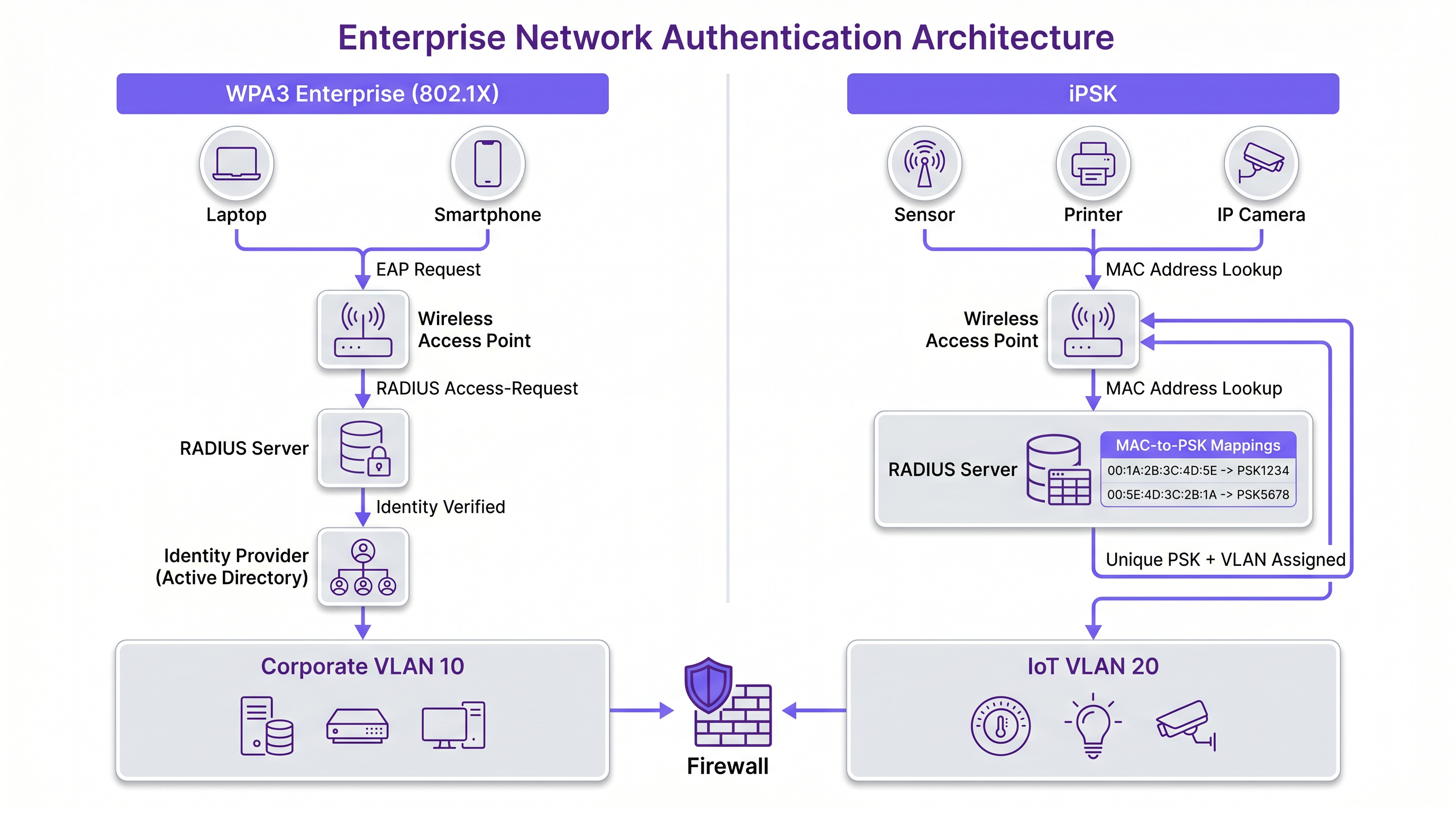
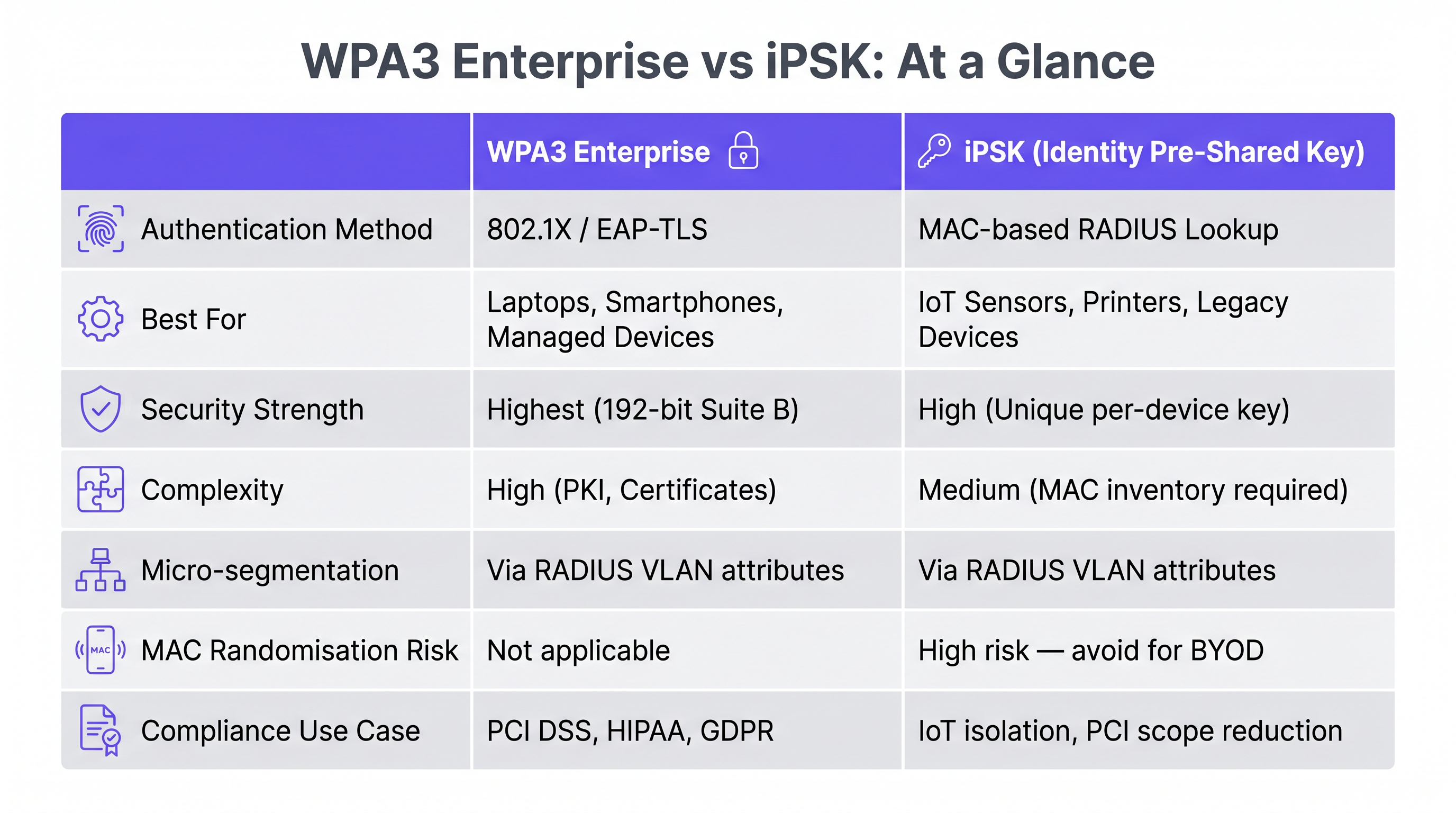
WPA3 Enterprise 802.1X/EAP ऑथेंटिकेशन की नींव पर बना है, जो लेगेसी क्रिप्टोग्राफिक प्रोटोकॉल को अनिवार्य 192-बिट सुरक्षा सूट (जिसे अक्सर Suite B क्रिप्टोग्राफी कहा जाता है) से बदल देता है। इस मॉडल को प्रत्येक यूजर को व्यक्तिगत रूप से ऑथेंटिकेट करने के लिए एक RADIUS सर्वर की आवश्यकता होती है, जो आमतौर पर Active Directory या Azure AD जैसे आइडेंटिटी प्रोवाइडर (IdP) के विरुद्ध होता है।
WPA3 Enterprise का प्राथमिक तकनीकी लाभ ऑफलाइन डिक्शनरी हमलों के खिलाफ इसकी मजबूत सुरक्षा और प्रोटेक्टेड मैनेजमेंट फ्रेम्स (PMF) का प्रवर्तन है। PMF (802.11w) डी-ऑथेंटिकेशन और डिस-एसोसिएशन हमलों को कम करता है, जो वेन्यू संचालन को बाधित करने या क्लाइंट्स को नकली एक्सेस पॉइंट्स पर मजबूर करने के सामान्य तरीके हैं। संवेदनशील डेटा को संभालने वाले वातावरणों के लिए, जैसे कि Healthcare सुविधाएं या कॉर्पोरेट कार्यालय, WPA3 Enterprise ऑडिटर्स द्वारा आवश्यक नॉन-रेपुडिएशन और व्यक्तिगत जवाबदेही प्रदान करता है।
हालांकि, 802.1X परिनियोजन की जटिलता को कम करके नहीं आंका जा सकता है। इसके लिए सावधानीपूर्वक सर्टिफिकेट मैनेजमेंट की आवश्यकता होती है—एक विषय जिसे OCSP and Certificate Revocation for WiFi Authentication पर हमारी गाइड में विस्तार से कवर किया गया है। इसके अलावा, यदि Fast BSS Transition (802.11r) को बेहतर ढंग से कॉन्फ़िगर नहीं किया गया है, तो ऑथेंटिकेशन ओवरहेड रोमिंग प्रदर्शन को प्रभावित कर सकता है।
Identity PSK (iPSK): सेगमेंटेड सरलता
iPSK (वेंडर के आधार पर Multiple PSK, Dynamic PSK, या PPSK के रूप में भी जाना जाता है) मौलिक रूप से पारंपरिक साझा-पासवर्ड प्रतिमान को बदल देता है। पूरे SSID के लिए एक सिंगल पासफ़्रेज़ के बजाय, iPSK RADIUS सर्वर को उनके MAC एड्रेस के आधार पर व्यक्तिगत डिवाइसों या डिवाइसों के समूहों को गतिशील रूप से एक अद्वितीय प्री-शेयर्ड की (key) असाइन करने की अनुमति देता है।
जब कोई डिवाइस जुड़ता है, तो एक्सेस पॉइंट डिवाइस के MAC एड्रेस को पहचान के रूप में उपयोग करके RADIUS सर्वर से क्वेरी करता है। सर्वर उस डिवाइस के लिए विशिष्ट PSK के साथ प्रतिक्रिया देता है और, महत्वपूर्ण रूप से, मानक RADIUS एट्रिब्यूट्स जैसे VLAN असाइनमेंट, QoS नीतियां और ACLs प्रदान करता है। यह आर्किटेक्चर 802.1X सप्लीकेंट्स के ओवरहेड के बिना माइक्रो-सेगमेंटेशन प्रदान करता है।
पॉइंट-ऑफ-सेल टर्मिनल, डिजिटल साइनेज और बारकोड स्कैनर तैनात करने वाले Retail वातावरणों के लिए, iPSK परिवर्तनकारी है। ये हेडलेस डिवाइस शायद ही कभी 802.1X का समर्थन करते हैं, और उन्हें एक ओपन नेटवर्क या पारंपरिक मोनोलिथिक PSK नेटवर्क पर रखना अस्वीकार्य जोखिम प्रस्तुत करता है। iPSK यह सुनिश्चित करता है कि यदि डिजिटल साइनेज स्क्रीन से समझौता किया जाता है, तो पूरे वेन्यू के लिए पासवर्ड बदलने के लिए मजबूर किए बिना इसकी विशिष्ट की (key) को रद्द किया जा सकता है।
कार्यान्वयन गाइड
स्टेप 1: डिवाइस प्रोफाइलिंग और वर्गीकरण
सुरक्षा मॉडल चुनने से पहले, नेटवर्क पर अपेक्षित सभी एंडपॉइंट प्रकारों का व्यापक ऑडिट करें। डिवाइसों को दो प्राथमिक श्रेणियों में वर्गीकृत करें:
- सप्लीकेंट-सक्षम डिवाइस: कॉर्पोरेट लैपटॉप, आधुनिक स्मार्टफोन और टैबलेट। इन्हें WPA3 Enterprise के लिए लक्षित किया जाना चाहिए।
- हेडलेस/लेगेसी डिवाइस: IoT सेंसर, प्रिंटर, IP कैमरे और लेगेसी स्कैनर। ये iPSK के लिए उम्मीदवार हैं।
उन्नत प्रोफाइलिंग के लिए, यह सुनिश्चित करने के लिए कि डिवाइस नेटवर्क प्रवेश से पहले न्यूनतम सुरक्षा बेसलाइन को पूरा करते हैं, Device Posture Assessment for Network Access Control को लागू करने पर विचार करें।
स्टेप 2: SSID आर्किटेक्चर डिजाइन करना
एक सर्वोत्तम-अभ्यास परिनियोजन में अक्सर सुरक्षा और अनुकूलता को संतुलित करने के लिए डुअल-SSID रणनीति शामिल होती है:
- कॉर्पोरेट SSID (WPA3 Enterprise): स्टाफ डिवाइसों के लिए समर्पित। सर्टिफिकेट-आधारित ऑथेंटिकेशन के लिए EAP-TLS या जहां सर्टिफिकेट संभव नहीं हैं वहां PEAP-MSCHAPv2 का उपयोग करता है। यह एन्क्रिप्शन और यूजर जवाबदेही के उच्चतम स्तर को सुनिश्चित करता है।
- IoT/डिवाइस SSID (WPA2/WPA3 iPSK): हेडलेस डिवाइसों के लिए समर्पित। RADIUS सर्वर डिवाइस प्रकार के आधार पर VLAN असाइन करता है (जैसे, प्रिंटर के लिए VLAN 10, HVAC सेंसर के लिए VLAN 20), यह सुनिश्चित करता है कि डिवाइस से समझौता होने पर भी लेटरल मूवमेंट प्रतिबंधित रहे।
स्टेप 3: RADIUS और पॉलिसी कॉन्फ़िगरेशन
दोनों ऑथेंटिकेशन प्रकारों को संभालने के लिए अपने RADIUS इंफ्रास्ट्रक्चर (जैसे, Cisco ISE, Aruba ClearPass, या क्लाउड-नेटिव NAC) को कॉन्फ़िगर करें। iPSK के लिए, सुनिश्चित करें कि पॉलिसी इंजन को MAC एड्रेस को विशिष्ट की (keys) और VLAN एट्रिब्यूट्स से मैप करने के लिए कॉन्फ़िगर किया गया है। स्पूफिंग प्रयासों का पता लगाने के लिए सख्त MAC एड्रेस प्रोफाइलिंग लागू करें।
सर्वोत्तम अभ्यास
- सर्टिफिकेट-आधारित A लागू करेंप्रमाणीकरण**: WPA3 Enterprise के लिए, क्रेडेंशियल-आधारित EAP विधियों की तुलना में EAP-TLS को प्राथमिकता दें। सर्टिफिकेट पासवर्ड चोरी के जोखिम को खत्म करते हैं और प्रबंधित डिवाइसों के लिए निर्बाध, जीरो-टच प्रमाणीकरण प्रदान करते हैं।
- iPSK के साथ माइक्रो-सेगमेंटेशन लागू करें: केवल यूनिक पासवर्ड प्रदान करने के लिए iPSK का उपयोग न करें; डिवाइसों को सख्त ACLs के साथ आइसोलेटेड VLANs में असाइन करने के लिए RADIUS एट्रिब्यूट्स का लाभ उठाएं। एक समझौता किया गया IoT कैमरा कभी भी पॉइंट-ऑफ-सेल टर्मिनल पर ट्रैफ़िक रूट करने में सक्षम नहीं होना चाहिए।
- की (Key) लाइफसाइकिल मैनेजमेंट को ऑटोमेट करें: iPSK के लिए, की जनरेशन और रिवोकेशन प्रक्रिया को अपने IT सर्विस मैनेजमेंट (ITSM) प्लेटफॉर्म के साथ इंटीग्रेट करें। जब कोई डिवाइस सेवा से बाहर हो जाए, तो कीज़ को ऑटोमैटिक रूप से रोटेट या रिवोक किया जाना चाहिए।
- MAC स्पूफिंग की निगरानी करें: क्योंकि iPSK पहचान के लिए MAC एड्रेस पर निर्भर करता है, यह MAC स्पूफिंग के प्रति संवेदनशील है। विसंगतियों का पता लगाने के लिए एंडपॉइंट प्रोफाइलिंग और व्यवहार विश्लेषण लागू करें, जैसे कि एक "IP कैमरा" HR डेटाबेस तक पहुँचने का प्रयास कर रहा हो।
समस्या निवारण और जोखिम शमन
WPA3 Enterprise चुनौतियाँ
- सर्टिफिकेट की समाप्ति: WPA3 Enterprise आउटेज का सबसे आम कारण समाप्त हो चुके RADIUS सर्वर सर्टिफिकेट या क्लाइंट सर्टिफिकेट हैं। मजबूत निगरानी और ऑटोमेटेड रिन्यूअल पाइपलाइन लागू करें।
- सप्लीकेंट मिसकॉन्फ़िगरेशन: यदि क्लाइंट RADIUS सर्वर के सर्टिफिकेट को वैलिडेट करने के लिए कॉन्फ़िगर नहीं किए गए हैं, तो वे प्रमाणित होने में विफल हो सकते हैं, जिससे संभावित मैन-इन-द-मिडल (MitM) हमले हो सकते हैं। MDM प्रोफाइल के माध्यम से सप्लीकेंट कॉन्फ़िगरेशन लागू करें।
iPSK चुनौतियाँ
- MAC एड्रेस रैंडमाइजेशन: आधुनिक स्मार्टफोन प्राइवेसी बढ़ाने के लिए रैंडमाइज्ड MAC एड्रेस का उपयोग करते हैं। यह iPSK को बाधित करता है, जो पॉलिसी असाइनमेंट के लिए स्टैटिक MAC एड्रेस पर निर्भर करता है। iPSK को सख्ती से IoT और स्टैटिक MAC वाले कॉर्पोरेट-स्वामित्व वाले डिवाइसों के लिए आरक्षित किया जाना चाहिए।
- प्रशासनिक ओवरहेड: हजारों iPSK प्रविष्टियों को मैन्युअल रूप से प्रबंधित करना टिकाऊ नहीं है। सुनिश्चित करें कि आपका NAC समाधान API-संचालित बल्क प्रोविजनिंग का समर्थन करता है और आपके एसेट इन्वेंट्री सिस्टम के साथ इंटीग्रेट होता है।
ROI और व्यावसायिक प्रभाव
सही सुरक्षा मॉडल को लागू करना परिचालन घर्षण को कम करके और उल्लंघन से संबंधित लागतों को कम करके सीधे तौर पर मुनाफे को प्रभावित करता है।
- हेल्पडेस्क टिकटों में कमी: असंगत डिवाइसों के लिए जटिल 802.1X से दूर जाने से कनेक्टिविटी समस्याओं से संबंधित हेल्पडेस्क वॉल्यूम काफी कम हो जाता है। iPSK IoT डिप्लॉयमेंट के लिए "प्लग-एंड-प्ले" अनुभव प्रदान करता है।
- त्वरित IoT रोलआउट: Wayfinding बीकन या पर्यावरणीय सेंसर तैनात करने वाले स्थान ऑटोमेटेड iPSK वर्कफ़्लो का उपयोग करके डिवाइसों को तेजी से प्रोविज़न कर सकते हैं, जिससे नई तकनीक की पहल के लिए टाइम-टू-वैल्यू में तेजी आती है।
- अनुपालन और जोखिम में कमी: WPA3 Enterprise PCI DSS अनुपालन के लिए आवश्यक ऑडिट ट्रेल प्रदान करता है, जबकि iPSK सेगमेंटेशन संभावित उल्लंघनों को रोकता है, ब्लास्ट रेडियस को सीमित करता है और ब्रांड की प्रतिष्ठा की रक्षा करता है।
जैसा कि The Core SD WAN Benefits for Modern Businesses के हमारे व्यापक विश्लेषण में चर्चा की गई है, आधुनिक नेटवर्क आर्किटेक्चर के लिए एज को सुरक्षित करना एक बुनियादी आवश्यकता है। WPA3 Enterprise और iPSK को सोच-समझकर लागू करके, IT लीडर लचीले, अनुपालन करने वाले नेटवर्क बना सकते हैं जो आधुनिक वेन्यू की विविध मांगों का समर्थन करते हैं।
मुख्य शब्द और परिभाषाएं
WPA3 Enterprise
The highest tier of Wi-Fi security, requiring individual user authentication via an 802.1X RADIUS server and enforcing 192-bit cryptographic strength.
Mandatory for securing corporate data and achieving compliance in enterprise environments.
iPSK (Identity Pre-Shared Key)
A security model where a RADIUS server dynamically assigns a unique passphrase to a device based on its MAC address, along with network policies like VLANs.
The standard solution for securing IoT and legacy devices that cannot support 802.1X supplicants.
802.1X
An IEEE standard for port-based network access control, providing an authentication mechanism to devices wishing to attach to a LAN or WLAN.
The underlying framework that powers WPA3 Enterprise authentication.
Supplicant
The software client on an endpoint device (like a laptop or smartphone) that communicates with the RADIUS server to negotiate 802.1X authentication.
IoT devices typically lack supplicants, necessitating the use of iPSK.
RADIUS
Remote Authentication Dial-In User Service; a networking protocol that provides centralized Authentication, Authorization, and Accounting (AAA) management.
The central server that processes authentication requests for both WPA3 Enterprise and iPSK.
Micro-segmentation
The security practice of dividing a network into isolated segments to reduce the attack surface and prevent lateral movement.
Achieved in wireless networks by using iPSK to dynamically assign different IoT devices to isolated VLANs.
EAP-TLS
Extensible Authentication Protocol-Transport Layer Security; an 802.1X method that uses digital certificates for both client and server authentication.
The most secure implementation of WPA3 Enterprise, eliminating the reliance on vulnerable passwords.
Protected Management Frames (PMF)
An IEEE standard (802.11w) that encrypts wireless management frames, preventing attackers from forging deauthentication packets.
Mandatory in WPA3, PMF protects venue networks from disruption and rogue AP attacks.
केस स्टडीज
A 500-room luxury hotel is upgrading its infrastructure. They need to secure staff corporate laptops, thousands of in-room smart TVs, and staff handheld point-of-sale (POS) terminals. How should they architect the wireless security model?
The optimal approach is a dual-SSID strategy.
- Staff SSID (WPA3 Enterprise): Deployed for corporate laptops and managed staff smartphones. Configured with EAP-TLS using certificates pushed via the hotel's MDM. This ensures robust encryption for sensitive back-office communications.
- Operations SSID (iPSK): Deployed for the smart TVs and POS terminals. The NAC is configured to assign unique PSKs based on MAC addresses. Crucially, the RADIUS server assigns the TVs to an isolated 'Guest Entertainment VLAN' with internet-only access, while the POS terminals are assigned to a strictly controlled 'PCI VLAN' that only routes to the payment gateway.
A large retail chain is deploying new wireless barcode scanners across 50 locations. The scanners support WPA2-PSK but not 802.1X. The CISO mandates that a compromised scanner must not require a global password change across all stores.
The chain must implement iPSK for the barcode scanners.
- The IT team generates a unique PSK for each scanner's MAC address and provisions this via their NAC platform's API.
- The scanners connect to a hidden 'Retail-Ops' SSID.
- If a scanner is lost or stolen, the IT team simply revokes that specific MAC/PSK pairing in the NAC. The device is immediately denied network access, while the thousands of other scanners remain connected and operational.
परिदृश्य विश्लेषण
Q1. A stadium IT director wants to deploy 500 wireless environmental sensors to monitor temperature and humidity across the concourse. The sensors only support basic WPA2-Personal (PSK). How should they secure these devices while preventing lateral movement if a sensor is physically tampered with?
💡 संकेत:Consider how to provide unique credentials to devices that don't support 802.1X while enforcing network isolation.
अनुशंसित दृष्टिकोण दिखाएं
The director should deploy iPSK. Each sensor's MAC address is registered in the NAC, generating a unique PSK. Crucially, the RADIUS server must be configured to assign these MAC addresses to a dedicated, highly restricted 'IoT-Sensor VLAN'. This VLAN should have strict ACLs applied, allowing outbound traffic only to the specific cloud monitoring dashboard, completely blocking lateral movement to the stadium's corporate or POS networks.
Q2. A corporate office is migrating from WPA2 Enterprise (PEAP-MSCHAPv2) to WPA3 Enterprise. During testing, several older laptops fail to connect to the new WPA3 SSID, while modern smartphones connect without issue. What is the most likely cause?
💡 संकेत:WPA3 mandates certain security features that were optional in WPA2.
अनुशंसित दृष्टिकोण दिखाएं
The most likely cause is a lack of support for Protected Management Frames (PMF/802.11w) on the older laptops' wireless network interface cards (NICs) or drivers. WPA3 makes PMF mandatory. If the client driver cannot negotiate PMF, the association will fail. The IT team must update the wireless drivers on the legacy laptops or, if the hardware is incompatible, replace the NICs/devices.
Q3. A hospital IT team is designing a new wireless network. They need to support medical staff tablets (which handle patient data) and legacy wireless infusion pumps. What is the recommended SSID and security design?
💡 संकेत:Different device capabilities require different authentication methods.
अनुशंसित दृष्टिकोण दिखाएं
A dual-SSID design is required. The staff tablets, which handle sensitive Protected Health Information (PHI), should connect to a 'Clinical-Secure' SSID using WPA3 Enterprise (ideally EAP-TLS with certificates) to ensure maximum encryption and compliance. The legacy infusion pumps, which likely lack 802.1X supplicants, should connect to a separate 'Medical-Device' SSID using iPSK, with RADIUS dynamically assigning them to an isolated VLAN restricted to communicating only with the medical device management server.
मुख्य निष्कर्ष
- ✓WPA3 Enterprise is the gold standard for human-operated devices, offering 192-bit encryption and robust 802.1X authentication.
- ✓iPSK provides a scalable, secure solution for headless IoT devices that cannot support complex 802.1X supplicants.
- ✓iPSK allows dynamic assignment of unique passwords and VLANs based on device MAC addresses, enabling critical micro-segmentation.
- ✓A dual-SSID strategy (one for WPA3 Enterprise, one for iPSK) is the best practice for modern venues to balance security and compatibility.
- ✓WPA3 mandates Protected Management Frames (PMF), which prevents disruptive deauthentication attacks but may require client driver updates.
- ✓Never use iPSK for BYOD or guest networks, as modern MAC address randomisation breaks the MAC-to-policy mapping.
- ✓Automated key lifecycle management is essential for iPSK deployments to avoid unsustainable administrative overhead.




