

WPA3 Enterprise vs iPSK: Scegliere il Modello di Sicurezza Corretto
Questa guida fornisce un confronto tecnico definitivo tra WPA3 Enterprise e Identity Pre-Shared Key (iPSK) per le reti WiFi aziendali. Consente ai responsabili IT di scegliere il modello di sicurezza ottimale per le proprie strutture, bilanciando una robusta autenticazione 802.1X con la flessibilità richiesta dai dispositivi IoT e legacy.
🎧 Ascolta questa guida
Visualizza trascrizione
Sintesi Operativa
Per i responsabili IT e gli architetti di rete che gestiscono complessi spazi aperti al pubblico — dalle catene di vendita al dettaglio ai vasti centri congressi — proteggere il perimetro wireless è una sfida costante. La proliferazione dei dispositivi IoT, unita a stringenti requisiti di conformità come PCI DSS e GDPR, richiede un controllo degli accessi robusto. Storicamente, la scelta era binaria: il complesso 802.1X (WPA2/WPA3 Enterprise) o le chiavi pre-condivise (PSK) insicure e facilmente compromettibili.
Oggi, la decisione si concentra tipicamente su WPA3 Enterprise rispetto a Identity PSK (iPSK). WPA3 Enterprise rappresenta il gold standard per l'autenticazione degli utenti, sfruttando potenziamenti crittografici e la protezione obbligatoria dei frame di gestione per proteggere i dispositivi gestiti da persone. Al contrario, iPSK offre un approccio scalabile e segmentato per il volume esplosivo di dispositivi IoT headless che non possono supportare i supplicant 802.1X. Questa guida analizza entrambe le architetture, offrendo strategie di implementazione pratiche per aiutarti a implementare il modello di sicurezza corretto — o un approccio ibrido — per i tuoi specifici requisiti operativi. Sia che tu stia aggiornando il Guest WiFi di un ospedale o proteggendo i Sensors in uno stadio intelligente, la comprensione di questi modelli è fondamentale per mantenere una rete sicura e performante.

Approfondimento Tecnico
WPA3 Enterprise: L'Evoluzione dell'802.1X
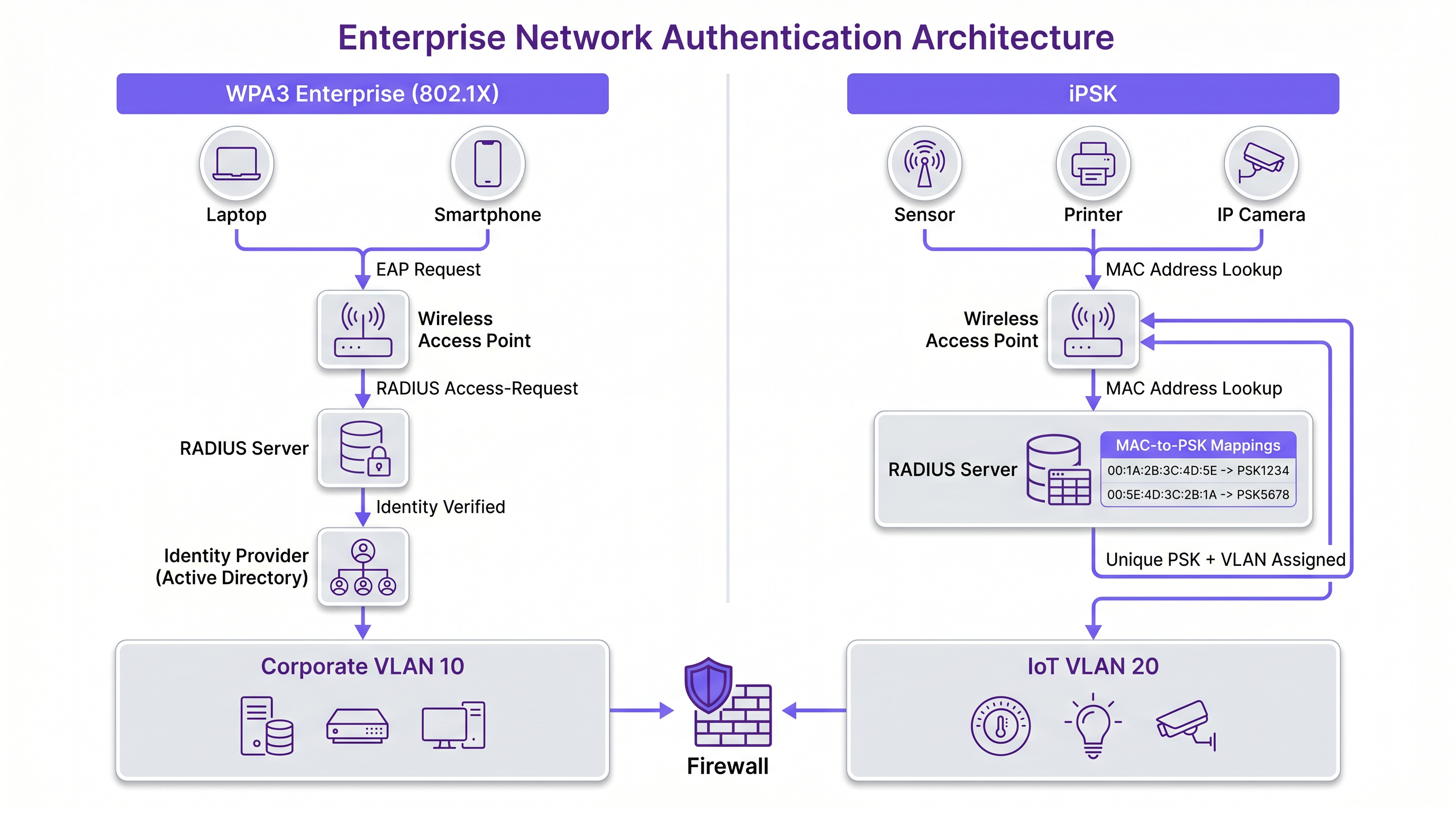
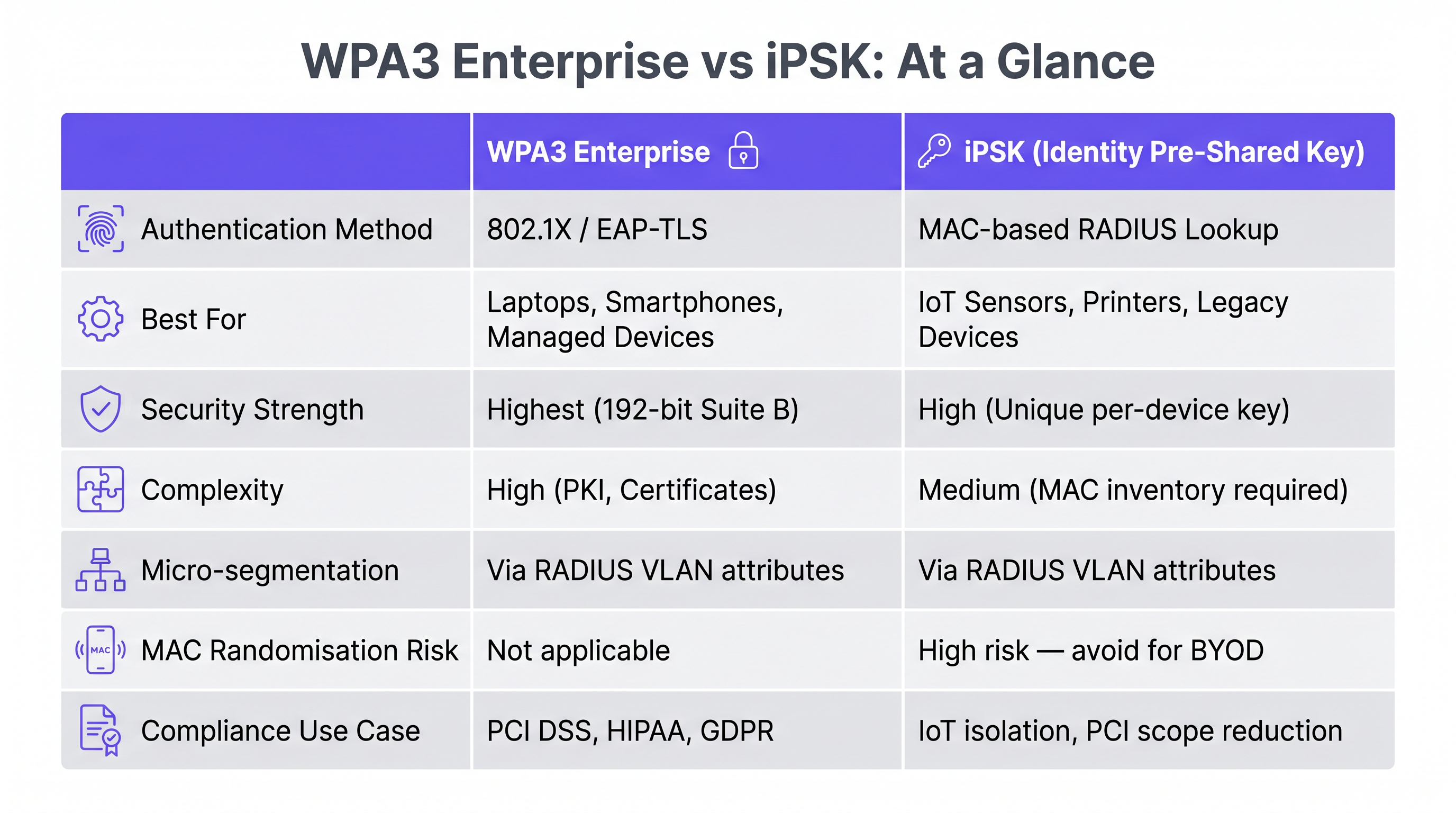
WPA3 Enterprise si basa sulle fondamenta dell'autenticazione 802.1X/EAP, sostituendo i protocolli crittografici legacy con una suite di sicurezza obbligatoria a 192 bit (spesso definita crittografia Suite B). Questo modello richiede un server RADIUS per autenticare ogni utente individualmente, tipicamente rispetto a un identity provider (IdP) come Active Directory o Azure AD.
Il principale vantaggio tecnico di WPA3 Enterprise è la sua robusta protezione contro gli attacchi a dizionario offline e l'applicazione dei Protected Management Frames (PMF). Il PMF (802.11w) mitiga gli attacchi di deautenticazione e disassociazione, che sono vettori comuni per interrompere le operazioni della struttura o forzare i client su access point non autorizzati. Per gli ambienti che gestiscono dati sensibili, come le strutture Healthcare o gli uffici aziendali, WPA3 Enterprise fornisce il non ripudio e la responsabilità individuale richiesti dai revisori.
Tuttavia, la complessità dell'implementazione dell'802.1X non può essere sottovalutata. Richiede un'attenta gestione dei certificati — un argomento trattato ampiamente nella nostra guida su OCSP e la revoca dei certificati per l'autenticazione WiFi . Inoltre, l'overhead di autenticazione può influire sulle prestazioni di roaming se il Fast BSS Transition (802.11r) non è configurato in modo ottimale.
Identity PSK (iPSK): Semplicità Segmentata
iPSK (noto anche come Multiple PSK, Dynamic PSK o PPSK a seconda del fornitore) altera fondamentalmente il paradigma tradizionale della password condivisa. Invece di una singola passphrase per un intero SSID, iPSK consente al server RADIUS di assegnare dinamicamente una chiave pre-condivisa univoca a singoli dispositivi o gruppi di dispositivi in base al loro indirizzo MAC.
Quando un dispositivo si associa, l'access point interroga il server RADIUS utilizzando l'indirizzo MAC del dispositivo come identità. Il server risponde con la PSK specifica per quel dispositivo e, cosa fondamentale, con gli attributi RADIUS standard come le assegnazioni VLAN, le policy QoS e le ACL. Questa architettura fornisce micro-segmentazione senza l'overhead dei supplicant 802.1X.
Per gli ambienti Retail che implementano terminali punto vendita, segnaletica digitale e scanner di codici a barre, iPSK è trasformativo. Questi dispositivi headless raramente supportano l'802.1X e posizionarli su una rete aperta o su una tradizionale rete PSK monolitica presenta rischi inaccettabili. iPSK garantisce che se uno schermo di segnaletica digitale viene compromesso, la sua chiave univoca può essere revocata senza forzare un cambio di password per l'intera struttura.
Guida all'Implementazione
Passaggio 1: Profilazione e Categorizzazione dei Dispositivi
Prima di selezionare un modello di sicurezza, esegui un audit completo di tutti i tipi di endpoint previsti sulla rete. Categorizza i dispositivi in due gruppi principali:
- Dispositivi compatibili con Supplicant: Laptop aziendali, smartphone moderni e tablet. Questi dovrebbero essere destinati a WPA3 Enterprise.
- Dispositivi Headless/Legacy: Sensori IoT, stampanti, telecamere IP e scanner legacy. Questi sono candidati per iPSK.
Per una profilazione avanzata, considera l'implementazione di un Device Posture Assessment per il Network Access Control per garantire che i dispositivi soddisfino i requisiti minimi di sicurezza prima dell'ammissione alla rete.
Passaggio 2: Progettazione dell'Architettura SSID
Un'implementazione basata sulle best practice spesso prevede una strategia a doppio SSID per bilanciare sicurezza e compatibilità:
- SSID Aziendale (WPA3 Enterprise): Dedicato ai dispositivi del personale. Utilizza EAP-TLS per l'autenticazione basata su certificati o PEAP-MSCHAPv2 dove i certificati non sono fattibili. Ciò garantisce il massimo livello di crittografia e responsabilità dell'utente.
- SSID IoT/Dispositivi (WPA2/WPA3 iPSK): Dedicato ai dispositivi headless. Il server RADIUS assegna le VLAN in base al tipo di dispositivo (ad esempio, VLAN 10 per le stampanti, VLAN 20 per i sensori HVAC), garantendo che il movimento laterale sia limitato anche se un dispositivo viene compromesso.
Passaggio 3: Configurazione RADIUS e Policy
Configura la tua infrastruttura RADIUS (ad esempio, Cisco ISE, Aruba ClearPass o un NAC cloud-native) per gestire entrambi i tipi di autenticazione. Per iPSK, assicurati che il motore delle policy sia configurato per mappare gli indirizzi MAC a chiavi specifiche e attributi VLAN. Implementa una profilazione rigorosa degli indirizzi MAC per rilevare tentativi di spoofing.
Best Practice
- Imponi l'Autenticazione**: Per WPA3 Enterprise, dai la priorità a EAP-TLS rispetto ai metodi EAP basati su credenziali. I certificati eliminano il rischio di furto di password e forniscono un'autenticazione fluida e zero-touch per i dispositivi gestiti.
- Implementa la micro-segmentazione con iPSK: Non limitarti a usare iPSK per fornire password univoche; sfrutta gli attributi RADIUS per assegnare i dispositivi a VLAN isolate con ACL rigorose. Una telecamera IoT compromessa non dovrebbe mai essere in grado di instradare il traffico verso un terminale point-of-sale.
- Automatizza la gestione del ciclo di vita delle chiavi: Per iPSK, integra il processo di generazione e revoca delle chiavi con la tua piattaforma di IT service management (ITSM). Le chiavi dovrebbero essere ruotate o revocate automaticamente quando un dispositivo viene dismesso.
- Monitora il MAC Spoofing: Poiché iPSK si affida agli indirizzi MAC per l'identificazione, è suscettibile al MAC spoofing. Implementa la profilazione degli endpoint e l'analisi comportamentale per rilevare anomalie, come una "telecamera IP" che tenta di accedere al database delle risorse umane.
Risoluzione dei problemi e mitigazione dei rischi
Sfide di WPA3 Enterprise
- Scadenza dei certificati: La causa più comune di interruzioni di WPA3 Enterprise è la scadenza dei certificati del server RADIUS o dei certificati client. Implementa un monitoraggio robusto e pipeline di rinnovo automatizzate.
- Configurazione errata del supplicant: I client potrebbero non riuscire ad autenticarsi se non sono configurati per convalidare il certificato del server RADIUS, portando a potenziali attacchi Man-in-the-Middle (MitM). Imponi la configurazione del supplicant tramite profili MDM.
Sfide di iPSK
- Randomizzazione degli indirizzi MAC: Gli smartphone moderni utilizzano indirizzi MAC randomizzati per migliorare la privacy. Questo interrompe il funzionamento di iPSK, che si affida a indirizzi MAC statici per l'assegnazione delle policy. iPSK dovrebbe essere rigorosamente riservato ai dispositivi IoT e aziendali con MAC statici.
- Sovraccarico amministrativo: Gestire manualmente migliaia di voci iPSK è insostenibile. Assicurati che la tua soluzione NAC supporti il provisioning massivo basato su API e si integri con i tuoi sistemi di inventario degli asset.
ROI e impatto aziendale
L'implementazione del corretto modello di sicurezza influisce direttamente sui profitti riducendo l'attrito operativo e mitigando i costi legati alle violazioni.
- Riduzione dei ticket all'helpdesk: L'abbandono del complesso protocollo 802.1X per i dispositivi incompatibili riduce drasticamente il volume di richieste all'helpdesk relative a problemi di connettività. iPSK offre un'esperienza "plug-and-play" per le implementazioni IoT.
- Rollout IoT accelerati: Le location che implementano beacon per il Wayfinding o sensori ambientali possono configurare i dispositivi rapidamente utilizzando flussi di lavoro iPSK automatizzati, accelerando il time-to-value per le nuove iniziative tecnologiche.
- Conformità e riduzione del rischio: WPA3 Enterprise fornisce i percorsi di audit necessari per la conformità PCI DSS, mentre la segmentazione iPSK contiene le potenziali violazioni, limitando il raggio d'azione e proteggendo la reputazione del brand.
Come discusso nella nostra analisi più ampia su I principali vantaggi di SD WAN per le aziende moderne , proteggere l'edge è un requisito fondamentale per la moderna architettura di rete. Applicando con attenzione WPA3 Enterprise e iPSK, i leader IT possono costruire reti resilienti e conformi che supportano le diverse esigenze delle location moderne.
Termini chiave e definizioni
WPA3 Enterprise
The highest tier of Wi-Fi security, requiring individual user authentication via an 802.1X RADIUS server and enforcing 192-bit cryptographic strength.
Mandatory for securing corporate data and achieving compliance in enterprise environments.
iPSK (Identity Pre-Shared Key)
A security model where a RADIUS server dynamically assigns a unique passphrase to a device based on its MAC address, along with network policies like VLANs.
The standard solution for securing IoT and legacy devices that cannot support 802.1X supplicants.
802.1X
An IEEE standard for port-based network access control, providing an authentication mechanism to devices wishing to attach to a LAN or WLAN.
The underlying framework that powers WPA3 Enterprise authentication.
Supplicant
The software client on an endpoint device (like a laptop or smartphone) that communicates with the RADIUS server to negotiate 802.1X authentication.
IoT devices typically lack supplicants, necessitating the use of iPSK.
RADIUS
Remote Authentication Dial-In User Service; a networking protocol that provides centralized Authentication, Authorization, and Accounting (AAA) management.
The central server that processes authentication requests for both WPA3 Enterprise and iPSK.
Micro-segmentation
The security practice of dividing a network into isolated segments to reduce the attack surface and prevent lateral movement.
Achieved in wireless networks by using iPSK to dynamically assign different IoT devices to isolated VLANs.
EAP-TLS
Extensible Authentication Protocol-Transport Layer Security; an 802.1X method that uses digital certificates for both client and server authentication.
The most secure implementation of WPA3 Enterprise, eliminating the reliance on vulnerable passwords.
Protected Management Frames (PMF)
An IEEE standard (802.11w) that encrypts wireless management frames, preventing attackers from forging deauthentication packets.
Mandatory in WPA3, PMF protects venue networks from disruption and rogue AP attacks.
Casi di studio
A 500-room luxury hotel is upgrading its infrastructure. They need to secure staff corporate laptops, thousands of in-room smart TVs, and staff handheld point-of-sale (POS) terminals. How should they architect the wireless security model?
The optimal approach is a dual-SSID strategy.
- Staff SSID (WPA3 Enterprise): Deployed for corporate laptops and managed staff smartphones. Configured with EAP-TLS using certificates pushed via the hotel's MDM. This ensures robust encryption for sensitive back-office communications.
- Operations SSID (iPSK): Deployed for the smart TVs and POS terminals. The NAC is configured to assign unique PSKs based on MAC addresses. Crucially, the RADIUS server assigns the TVs to an isolated 'Guest Entertainment VLAN' with internet-only access, while the POS terminals are assigned to a strictly controlled 'PCI VLAN' that only routes to the payment gateway.
A large retail chain is deploying new wireless barcode scanners across 50 locations. The scanners support WPA2-PSK but not 802.1X. The CISO mandates that a compromised scanner must not require a global password change across all stores.
The chain must implement iPSK for the barcode scanners.
- The IT team generates a unique PSK for each scanner's MAC address and provisions this via their NAC platform's API.
- The scanners connect to a hidden 'Retail-Ops' SSID.
- If a scanner is lost or stolen, the IT team simply revokes that specific MAC/PSK pairing in the NAC. The device is immediately denied network access, while the thousands of other scanners remain connected and operational.
Analisi degli scenari
Q1. A stadium IT director wants to deploy 500 wireless environmental sensors to monitor temperature and humidity across the concourse. The sensors only support basic WPA2-Personal (PSK). How should they secure these devices while preventing lateral movement if a sensor is physically tampered with?
💡 Suggerimento:Consider how to provide unique credentials to devices that don't support 802.1X while enforcing network isolation.
Mostra l'approccio consigliato
The director should deploy iPSK. Each sensor's MAC address is registered in the NAC, generating a unique PSK. Crucially, the RADIUS server must be configured to assign these MAC addresses to a dedicated, highly restricted 'IoT-Sensor VLAN'. This VLAN should have strict ACLs applied, allowing outbound traffic only to the specific cloud monitoring dashboard, completely blocking lateral movement to the stadium's corporate or POS networks.
Q2. A corporate office is migrating from WPA2 Enterprise (PEAP-MSCHAPv2) to WPA3 Enterprise. During testing, several older laptops fail to connect to the new WPA3 SSID, while modern smartphones connect without issue. What is the most likely cause?
💡 Suggerimento:WPA3 mandates certain security features that were optional in WPA2.
Mostra l'approccio consigliato
The most likely cause is a lack of support for Protected Management Frames (PMF/802.11w) on the older laptops' wireless network interface cards (NICs) or drivers. WPA3 makes PMF mandatory. If the client driver cannot negotiate PMF, the association will fail. The IT team must update the wireless drivers on the legacy laptops or, if the hardware is incompatible, replace the NICs/devices.
Q3. A hospital IT team is designing a new wireless network. They need to support medical staff tablets (which handle patient data) and legacy wireless infusion pumps. What is the recommended SSID and security design?
💡 Suggerimento:Different device capabilities require different authentication methods.
Mostra l'approccio consigliato
A dual-SSID design is required. The staff tablets, which handle sensitive Protected Health Information (PHI), should connect to a 'Clinical-Secure' SSID using WPA3 Enterprise (ideally EAP-TLS with certificates) to ensure maximum encryption and compliance. The legacy infusion pumps, which likely lack 802.1X supplicants, should connect to a separate 'Medical-Device' SSID using iPSK, with RADIUS dynamically assigning them to an isolated VLAN restricted to communicating only with the medical device management server.
Punti chiave
- ✓WPA3 Enterprise is the gold standard for human-operated devices, offering 192-bit encryption and robust 802.1X authentication.
- ✓iPSK provides a scalable, secure solution for headless IoT devices that cannot support complex 802.1X supplicants.
- ✓iPSK allows dynamic assignment of unique passwords and VLANs based on device MAC addresses, enabling critical micro-segmentation.
- ✓A dual-SSID strategy (one for WPA3 Enterprise, one for iPSK) is the best practice for modern venues to balance security and compatibility.
- ✓WPA3 mandates Protected Management Frames (PMF), which prevents disruptive deauthentication attacks but may require client driver updates.
- ✓Never use iPSK for BYOD or guest networks, as modern MAC address randomisation breaks the MAC-to-policy mapping.
- ✓Automated key lifecycle management is essential for iPSK deployments to avoid unsustainable administrative overhead.




