
When you hear people talking about the core SD‑WAN benefits, they’re usually focused on three big wins: dramatic cost savings, superior application performance, and enhanced network security. It pulls this off by smartly managing network traffic across multiple connections, breaking free from the rigid and costly world of traditional networking.
Why SD‑WAN Is Essential for Business Networks

For decades, the Wide Area Network (WAN) was the invisible engine connecting a company’s main office to its various branches. These traditional networks almost always relied on expensive, private circuits known as Multiprotocol Label Switching (MPLS).
Think of MPLS links as private, single-lane toll roads. They were reliable and secure, but incredibly expensive and inflexible.
This old model was fine back when most of your important applications were sitting in a central data centre. All traffic, whether it was going to another branch or out to the public internet, had to travel back to this central hub first. This "traffic trombone" effect was clunky, but manageable in a pre-cloud world.
The Problem with Traditional WANs
Fast forward to today. Your business probably runs on a whole host of cloud applications like Microsoft 365, cloud-based POS systems, and countless collaboration tools. Suddenly, that old hub-and-spoke model doesn't just look dated—it's a major bottleneck.
Sending your cloud-bound traffic on a long detour through the main data centre creates a huge amount of latency. For your users, this means frustrating lag and a poor experience.
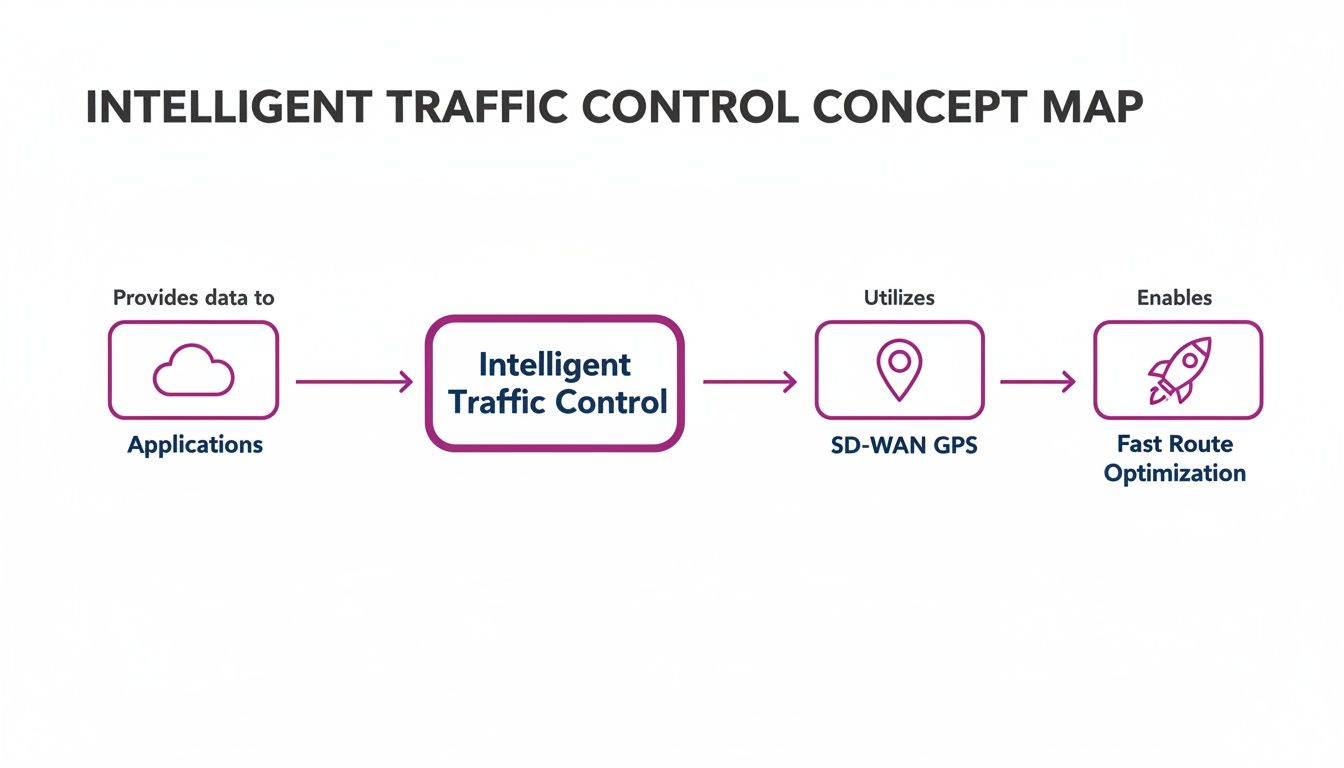
SD-WAN acts like a smart GPS for your network traffic, always finding the fastest and least congested route for your critical applications. It turns your network from a set of rigid, pre-defined roads into a dynamic superhighway system.
The rigid nature of these MPLS-only networks causes several real-world headaches:
- High Costs: MPLS contracts are notoriously expensive and can eat up a massive chunk of an IT budget.
- Poor Cloud Performance: Backhauling cloud traffic leads to frustrating lag for users at branch locations, killing productivity.
- Lack of Agility: Need to open a new site? Deploying a new MPLS circuit can take weeks, if not months, slowing down business growth.
- Complex Management: Each site often requires manual, on-site configuration, which increases operational overhead and the risk of human error.
To understand the fundamental shift from rigid, expensive networks to flexible, intelligent ones, here’s a quick comparison at a glance.
Traditional WAN vs SD‑WAN: A Quick Comparison
| Feature | Traditional WAN (MPLS) | Modern SD‑WAN |
|---|---|---|
| Primary Connection | Expensive, private MPLS circuits | Any mix: broadband, 4G/5G, MPLS |
| Traffic Path | Backhauled through a central data centre | Direct, optimised path to the cloud |
| Agility & Speed | Slow; new circuits take weeks/months | Fast; new sites online in minutes/hours |
| Cost | Very high operational and circuit costs | Lower costs using affordable internet |
| Management | Complex, manual, site-by-site setup | Centralised, software-defined control |
| Performance | Reliable, but high latency for cloud apps | Application-aware, low latency |
This table makes it clear why sticking with an old WAN architecture is like trying to navigate a modern city using a map from the 1990s. It just wasn't built for the world we live in now.
A New Approach for a Cloud-First World
This is where Software-Defined WAN (SD-WAN) completely changes the game. It’s a software-first approach that makes your network more intelligent, flexible, and secure.
Instead of being locked into a single, expensive MPLS connection, SD-WAN can use any combination of transport links you have—including affordable broadband, LTE, and 5G. It then bonds these together to create a single, unified, and high-performing network fabric.
This is what introduces the key SD‑WAN benefits we’ll explore in detail. It’s a necessary upgrade for any modern business that wants to be more efficient, agile, and ready for growth.
How SD-WAN Delivers Real Cost Savings

While better performance and security are great, let's talk about what really gets the attention of any business leader: the direct, measurable impact on the bottom line. SD-WAN isn't just about abstract technical gains; it delivers concrete financial wins that make both IT leaders and financial controllers happy.
The secret sauce behind this is a principle called transport independence.
In simple terms, this means you are no longer locked into a single, eye-wateringly expensive network provider. For years, businesses had little choice but to rely on costly private MPLS circuits to connect their sites reliably. SD-WAN shatters that old model, giving you the freedom to mix and match different network connections based on what makes the most sense for your budget and performance needs.
You can now use a cocktail of affordable, high-bandwidth connections—like business broadband, fibre, LTE, and even 5G—to either boost or completely replace your old MPLS links. This strategic freedom is the bedrock of SD-WAN’s financial appeal.
Lowering Direct Network Spending
The first and most obvious win comes from slashing your direct network transport costs. By bringing low-cost internet connections into the mix, you can dramatically cut your monthly operational spending (OpEx).
Think about a business with 50 retail stores, each paying for a £1,000-per-month MPLS circuit. That’s a staggering £50,000 every single month. Now, imagine replacing or shrinking that MPLS link at each store with a solid £100-per-month business broadband connection. The savings quickly become massive.
This approach gives you two major financial boosts:
- Reduced Circuit Costs: You get to directly attack one of the biggest line items in any IT budget by cutting back on expensive MPLS contracts.
- Increased Bandwidth for Less: Commodity internet gives you so much more bang for your buck. You can often get a 1 Gbps broadband line for a fraction of what you’d pay for a 100 Mbps MPLS circuit.
By leveraging cost-effective broadband, businesses can reduce their connectivity costs by up to 75% compared to a purely MPLS-based network. This frees up capital that can be poured back into other strategic IT projects.
This doesn't mean you have to ditch MPLS completely. A popular and very effective strategy is to go hybrid. You can keep a smaller, reliable MPLS link for your most critical, real-time traffic like VoIP calls or payment transactions, while shunting the bulk of your traffic—cloud app updates, guest WiFi, and general web browsing—onto the cheaper broadband links. It’s all about "right-sizing" your network so you only pay premium prices for the traffic that truly demands it.
Driving Operational Efficiency
Beyond just cutting circuit costs, SD-WAN delivers huge indirect savings by automating and simplifying how you manage your network. This is where operational ease turns directly into financial advantage.
Traditional WANs are notoriously clunky and complex. They often demand skilled engineers to manually configure routers at every single site—a process that's slow, expensive, and a magnet for human error. SD-WAN flips this on its head by centralising the entire management process.
One of its most powerful features is zero-touch provisioning (ZTP). With ZTP, you can ship an unconfigured SD-WAN appliance to a new branch office or pop-up store. An on-site employee—with zero technical training—simply plugs it into power and an internet connection.
The device then automatically phones home to the central SD-WAN controller, downloads its unique configuration and security policies, and becomes fully operational in minutes. This completely removes the need for expensive, time-consuming site visits from specialist network engineers. For a business opening new locations, the savings on travel and labour alone can be immense, shrinking deployment timelines from months down to days.
Boosting Performance with Intelligent Traffic Control
Think of your network as a busy city during rush hour. With a traditional WAN, it's a bit like a city with no traffic police. Every car, lorry, and bicycle is squeezed onto the same roads, causing inevitable gridlock. An ambulance carrying a critical patient gets stuck behind a slow-moving parade. This is exactly what happens when your vital video conferencing traffic gets trapped behind a large, non-urgent software update.
SD-WAN changes all of that. It’s like installing a modern, intelligent traffic management system across the entire city. This system doesn't just see vehicles; it identifies them, understands where they need to go, and guides them onto the best possible route in real-time. This is the heart of one of the most powerful SD‑WAN benefits: intelligent traffic control.
At its core, this intelligence stems from a feature called application-aware routing. An SD-WAN solution doesn't just see a stream of anonymous data packets; it can identify the applications they belong to. It knows the difference between a high-priority VoIP call, a critical transaction from a cloud point-of-sale system, and a far less important social media update.
Dynamic Path Selection in Action
Once SD-WAN has identified the application, it uses dynamic path selection to steer that traffic over the most appropriate connection. It constantly monitors the health of all available network paths—your primary broadband, a backup 5G connection, maybe even a legacy MPLS line—and grades them on key performance indicators.
These crucial metrics include:
- Latency: The time it takes for a data packet to get from A to B. High latency is what causes that frustrating lag on video calls.
- Jitter: The variation in latency. High jitter is what makes voice calls sound choppy and robotic.
- Packet Loss: The percentage of data packets that simply get lost in transit, leading to dropped video frames or garbled audio.
Let's say the SD-WAN detects that your primary broadband link is suddenly suffering from high jitter. It won't just let your CEO’s important Teams call fall apart. It will instantly and automatically shift that voice traffic over to a more stable connection, like the 5G backup, without anyone on the call ever noticing a disruption. This sub-second failover ensures a flawless, high-quality experience for the applications that truly matter.
This intelligent steering is what really separates SD-WAN from simple network failover. It's not just about reacting when a link goes down entirely; it's about proactively managing performance to stop a poor experience from ever happening in the first place.
This means that while a large file transfer might be sent over a high-bandwidth but less stable connection, your sensitive, real-time traffic is always protected on the best-performing path. It’s a level of sophisticated traffic management that was previously almost impossible to achieve without huge expense and complexity. For a deeper dive into controlling network traffic, you can learn more about effective bandwidth management strategies in our related guide.
Guaranteeing a Flawless User Experience
Ultimately, this intelligent control has a direct and tangible impact on the business. By actively heading off issues like packet loss and jitter, SD-WAN guarantees a consistent and reliable quality of service (QoS) for your most essential applications.
Think about these real-world scenarios:
- For a Retail Store: A customer is at the checkout, and the POS system needs to connect to the cloud to process their payment. SD-WAN gives this transaction top priority, ensuring it goes through instantly, preventing queues and keeping customers happy.
- For a Hotel: A guest is streaming a movie in their room while the front desk staff are using the cloud-based booking system. SD-WAN intelligently allocates bandwidth to ensure both have a great experience, preventing guest complaints and keeping operations running smoothly.
- For a Corporate Office: The entire executive team is on a video conference with a major client. SD-WAN dedicates the cleanest, most stable path to this video stream, ensuring a professional, glitch-free meeting that reflects well on the business.
In every case, the result is the same: happier customers, more productive staff, and a network that actively helps the business achieve its goals, rather than getting in the way. This is the performance promise of SD-WAN, delivered.
Strengthening Security with Zero Trust and SASE
While better performance and cost savings are great, the real game-changer with SD-WAN is how it completely overhauls network security. The old way of doing things—hauling all your traffic back to a central, heavily fortified data centre for inspection—just doesn't work anymore. It's slow, inefficient, and frankly, insecure in a world of remote work and cloud applications.
SD-WAN turns that entire model inside out. Instead of a single security chokepoint, it pushes security functions right out to the edge of the network, where your users and apps actually are. This is the core idea behind a modern framework called Secure Access Service Edge (SASE), which blends networking and security into a unified, cloud-based service.
Think of it this way: SASE can't work without SD-WAN. The SD-WAN provides the intelligent, agile network pathways, and SASE layers the critical security services on top. Together, they create a powerful, cohesive defence that protects every user, on any device, no matter where they are.
Building a Foundation for Zero Trust
One of the biggest security wins with SD-WAN is that it lays the perfect groundwork for a Zero Trust security model. The old IT philosophy of "trust, but verify" is dead. In its place is a much simpler, far more effective principle: never trust, always verify.
This means no user or device gets a free pass, even if they're already "inside" the corporate network. Before anyone gets access to an application or piece of data, their identity and the security health of their device must be rigorously checked. It's a world away from traditional security, which often acted like a castle-and-moat, granting broad access once you were past the outer wall.
SD-WAN makes this practical with two key capabilities:
- Network-wide Visibility: You can't secure what you can't see. SD-WAN's centralised controller gives you a complete, real-time map of all users, devices, and traffic flowing across your entire network.
- Micro-segmentation: This is where Zero Trust gets put into practice. SD-WAN lets you carve your network up into tiny, isolated zones or "segments." You can create one segment just for your payment systems, another for your guest WiFi, and a separate one for your IoT devices.
With micro-segmentation, you can ensure that even if a threat actor manages to compromise one segment—say, a vulnerable IoT security camera—they are completely boxed in. They can't move laterally across the network to access more critical systems, like your customer database.
This fine-grained control is something legacy networks have always struggled with. By making segmentation simple to set up and manage, SD-WAN dramatically shrinks the network's attack surface and contains the blast radius of any potential breach.
This is a core principle for delivering a Zero Trust experience—identifying applications and steering them onto the fastest, most secure path, much like a GPS for your network traffic.
Integrated Security and Streamlined Management
Beyond just enabling these modern security frameworks, today’s SD-WAN solutions often come with a full security toolkit baked right in. This is sometimes called a unified threat management (UTM) stack, and it typically includes:
- Next-Generation Firewall (NGFW): Provides advanced threat prevention that sees far beyond simple port and IP address blocking.
- Intrusion Prevention System (IPS): Actively scans network traffic for malicious patterns and blocks known exploits in real-time.
- Secure Web Gateway: Filters all web traffic, blocking access to malicious websites and stopping malware downloads before they start.
Having these features integrated directly into the SD-WAN appliance at each branch office makes your security architecture vastly simpler. It gets rid of the need to deploy and manage a patchwork of different security boxes from multiple vendors at every single site. This doesn't just cut down on complexity and cost; it guarantees that a consistent security policy is enforced everywhere, across the entire organisation. You can learn more about protecting modern networks in our guide to network and wireless security.
The market is clearly moving in this direction. A recent report found that a staggering 63% of UK businesses are now actively looking into or deploying SD-WAN, driven largely by this very need for reliable, always-on, secure connectivity.
Simplifying Cloud Connectivity for a Better User Experience
For any business that depends on cloud services—which, in 2026, is almost everyone—one of the most noticeable SD‑WAN benefits is the dramatic improvement in user experience. Older network designs simply weren't created for a world where your most important applications live outside your own data centre.
In a traditional network, all traffic from a branch office had to travel back to a central headquarters first. This was true even if that traffic was just going to a cloud service like Microsoft 365. This detour, often called "traffic tromboning," adds a crippling amount of delay.
It’s like forcing someone driving from Manchester to London to first go all the way up to Glasgow just to get on the M1. The result? Frustratingly slow applications and unhappy, less productive staff. SD-WAN fixes this by creating secure, direct paths to the cloud from every single location.
Creating a Fast Lane to the Cloud
The secret behind this leap in performance is a feature known as cloud on-ramps. Instead of sending traffic on a long detour, SD‑WAN is smart enough to identify when traffic is headed for a trusted cloud application. It then lets that traffic break out directly to the internet right from the branch office.
This creates a much shorter, more direct path to major cloud providers like Amazon Web Services (AWS), Microsoft Azure, and Google Cloud Platform (GCP).
By getting rid of that pointless trip back to the main data centre, SD‑WAN slashes latency and frees up your core network. For your team, this means a faster, more responsive experience when using essential cloud software.
The positive impact on productivity is immediate:
- Faster File Access: Staff accessing documents on SharePoint or Google Drive will see much shorter loading times.
- Smoother Collaboration: Video conferencing on tools like Teams and Zoom runs smoothly, without the lag and jitter caused by a congested network.
- Responsive Applications: Business-critical tools, from your CRM to finance software, feel snappier and far more reliable.
This direct internet breakout isn't just a nice-to-have; it's fundamental to getting the performance you expect from your cloud investments. It makes sure your employees can do their jobs without fighting a slow, outdated network.
This shift is a key reason for the technology's rapid growth. In the UK, SD-WAN now commands a massive 30.9% share of the European market, making it the dominant force in the region's networking scene as of 2024. This growth is being driven by the surge in cloud use and a sharp focus on cybersecurity, with everyone from finance to retail enjoying the benefits. You can see the full findings in the European SD-WAN market report on marketdataforecast.com.
Optimising for Specific SaaS Applications
Modern SD‑WAN solutions take this even further. They now offer deep integration and optimisation for the most popular Software-as-a-Service (SaaS) applications. Many vendors work directly with companies like Microsoft to make sure their SD‑WAN can identify and prioritise specific types of application traffic.
For instance, a good SD‑WAN can tell the difference between a high-priority Teams video call and a routine OneDrive file sync happening in the background. It can then apply specific Quality of Service (QoS) policies to each, automatically sending the video call over the most stable, lowest-latency connection available at that very moment.
This fine-grained control ensures that the experience for critical applications is always protected, even when the network is busy. It means fewer dropped calls, quicker application response times, and ultimately, a more productive and less frustrated workforce. This focus on a seamless user journey is a core advantage that underpins the entire business case for SD‑WAN.
The Strategic Imperative of SD-WAN in 2026
As we move through 2026, the conversation about SD-WAN has changed. It’s no longer a question of if a business should adopt it, but a much more urgent discussion about when and how. All the benefits we've covered, from real cost savings to making your applications run smoother, all point to one clear conclusion.
Trying to run a modern business on a traditional WAN is like attempting to manage a global logistics network using a paper map and a landline phone. It’s slow, expensive, and completely out of step with how cloud-based, digital businesses actually work today. SD-WAN is the upgrade that makes everything else run properly.
The Foundation for Future Growth
Here’s the bottom line. SD-WAN delivers the smart, secure, and flexible network backbone that almost every major IT project needs to succeed. It's the groundwork you have to lay to get your operations running at their peak.
SD-WAN is not just another box you plug into the network; it's a business enablement platform. It's the critical first step for any organisation serious about delivering a flawless user experience, adopting advanced security like SASE, and future-proofing its infrastructure against whatever comes next.
This technology hits the biggest challenges facing businesses head-on. It cuts through complexity, tightens up security, and delivers the raw performance needed to keep your staff productive and your customers happy.
Think about a retail chain rolling out new interactive in-store displays, or a hotel group adding smart room tech. Both projects live or die on the quality of their network. They need something that’s reliable, fast, and can be managed from one central point—which is exactly what a well-designed SD-WAN provides. Planning this foundation is vital; our guide on how to design a network that scales digs deeper into this process.
In the end, this is about more than just a piece of technology. It's a choice between being held back by an outdated model or building on an architecture that’s made for growth, new ideas, and resilience. For any business that wants to do more than just survive in 2026, SD-WAN isn't really an option anymore; it’s a necessity.
Your SD-WAN Questions, Answered
Even when the high-level advantages are clear, it's natural to have questions about how SD-WAN benefits play out in the real world. Let's tackle some of the most common queries we hear from IT leaders and network managers when they're weighing up an upgrade.
Can SD-WAN Completely Replace My Existing MPLS Network?
Not necessarily, and that’s actually one of its biggest strengths. SD-WAN truly shines in a hybrid model, letting you supplement your reliable (but costly) MPLS circuits with low-cost broadband or 5G connections.
You can set up policies that steer critical, real-time traffic like VoIP calls over your rock-solid MPLS. At the same time, less sensitive, high-bandwidth traffic like cloud backups or guest WiFi can be routed over your standard internet links.
This hybrid approach allows you to "right-size" your MPLS contracts, unlocking significant cost savings without giving up an ounce of reliability. Over time, as your confidence in the performance of your internet links grows, you have a flexible path to phase out MPLS entirely if you choose.
How Does SD-WAN Improve Security for Guest WiFi?
This is a critical area and one where the benefits of SD-WAN are immediately obvious. It brings several layers of security perfectly suited for guest WiFi, moving well beyond a simple password.
- Network Segmentation: First, SD-WAN enables micro-segmentation. This effectively builds a digital wall, completely isolating guest traffic from your critical corporate systems, like payment processors or staff networks. A threat on a guest's device simply can't move laterally into your core infrastructure.
- Integrated Threat Management: Second, many SD-WAN solutions come with built-in security tools, such as a next-generation firewall (NGFW) and content filtering. This blocks malicious websites and potential threats right at the branch, before they ever get a chance to cause harm.
By creating these digital walls, SD-WAN not only secures the network pipe but ensures all user traffic is properly managed and contained. It treats guest access as untrusted by default—a core principle of modern zero-trust security.
This combination of total isolation and active threat defence creates a powerful security posture. You can provide a safer online experience for your guests while protecting your own business-critical assets from any potential cross-contamination.
Is Deploying SD-WAN a Complex Process for Many Locations?
It is far less complex than a traditional WAN rollout, thanks to a feature called zero-touch provisioning (ZTP). This capability completely changes the game for bringing new sites online, making it a key operational win for any business with distributed locations.
Here’s how it works. You can ship an unconfigured SD-WAN appliance directly to a new branch. An on-site employee just needs to plug it into a power source and an internet connection. The device then automatically calls home to the central controller, downloads its specific configuration and security policies, and becomes fully operational in minutes.
This automated process removes the need for a specialised IT technician to travel to every single site. ZTP dramatically shrinks deployment timelines from weeks or months down to just days, massively cutting rollout costs and business disruption.
At Purple, we believe secure, identity-based networking is the future. Our platform harnesses the power of intelligent networks like SD-WAN to deliver passwordless, zero-trust access for guests and staff, turning your WiFi into a tool for growth and security. Learn more at https://www.purple.ai.