

Cloud RADIUS बनाम On-Premise RADIUS: IT टीमों के लिए निर्णय मार्गदर्शिका
यह मार्गदर्शिका IT निदेशकों, नेटवर्क आर्किटेक्ट्स और वेन्यू ऑपरेशंस टीमों को क्लाउड-होस्टेड RADIUS सेवाओं और पारंपरिक on-premise RADIUS सर्वरों के बीच चयन करने के लिए एक निश्चित ढांचा प्रदान करती है। इसमें मल्टी-साइट हॉस्पिटैलिटी, रिटेल और सार्वजनिक क्षेत्र के परिनियोजन के लिए तकनीकी आर्किटेक्चर, लेटेंसी और विश्वसनीयता के बीच संतुलन, स्वामित्व की कुल लागत और अनुपालन संबंधी विचार शामिल हैं। अंत तक, पाठकों के पास उनके विशिष्ट बुनियादी ढांचे की बाधाओं और संगठनात्मक जोखिम क्षमता के अनुरूप एक स्पष्ट निर्णय मॉडल होगा।
🎧 इस गाइड को सुनें
ट्रांसक्रिप्ट देखें
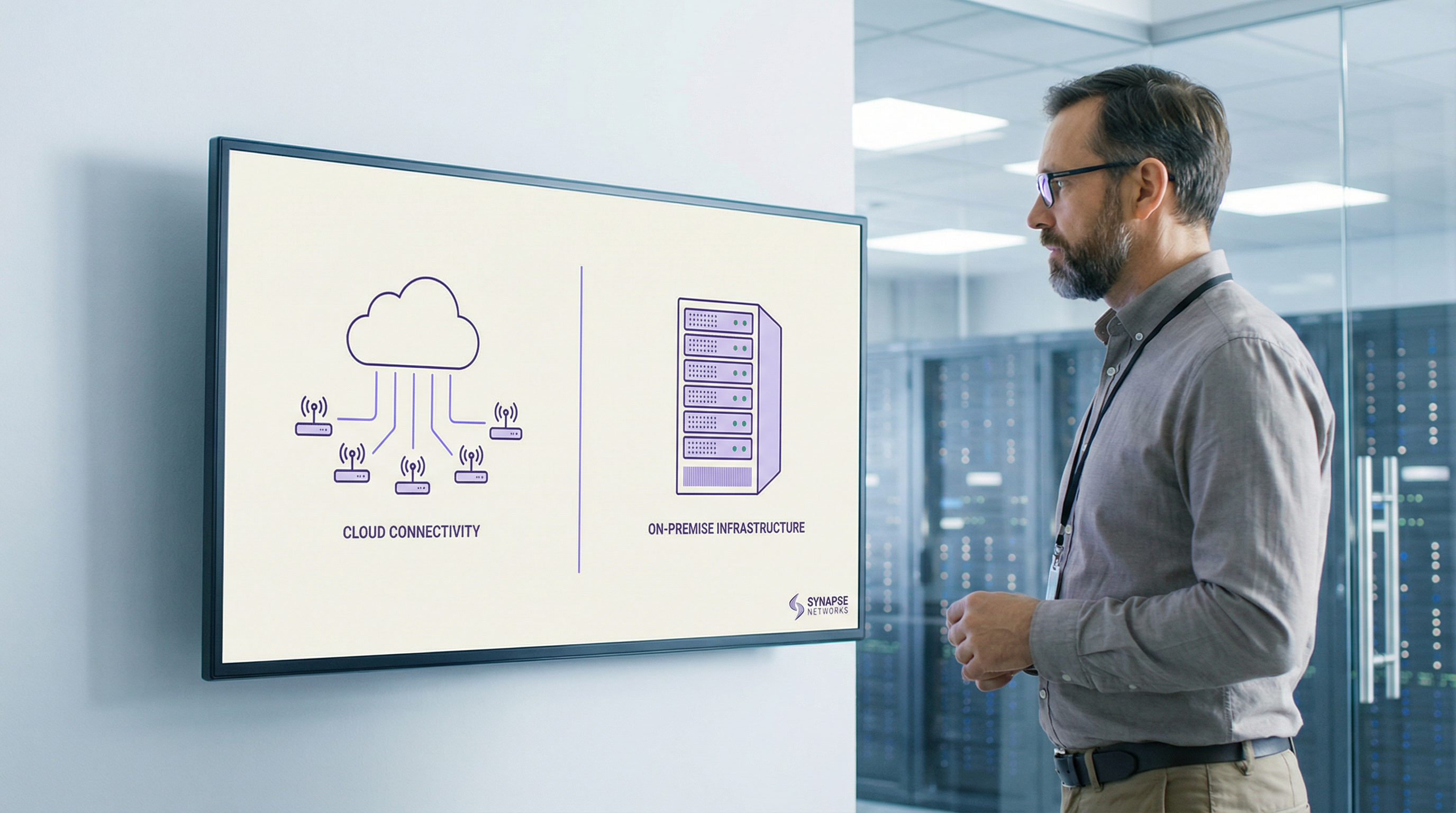
कार्यकारी सारांश
RADIUS प्रमाणीकरण हर एंटरप्राइज WiFi परिनियोजन के केंद्र में होता है। चाहे आप IEEE 802.1X के माध्यम से कर्मचारी पहुंच को सुरक्षित कर रहे हों या मल्टी-साइट वेन्यू एस्टेट में गेस्ट ऑनबोर्डिंग का प्रबंधन कर रहे हों, आपके RADIUS बुनियादी ढांचे को कहां होस्ट करना है, इसका निर्णय अपटाइम, परिचालन ओवरहेड और स्वामित्व की कुल लागत पर सीधा प्रभाव डालता है।
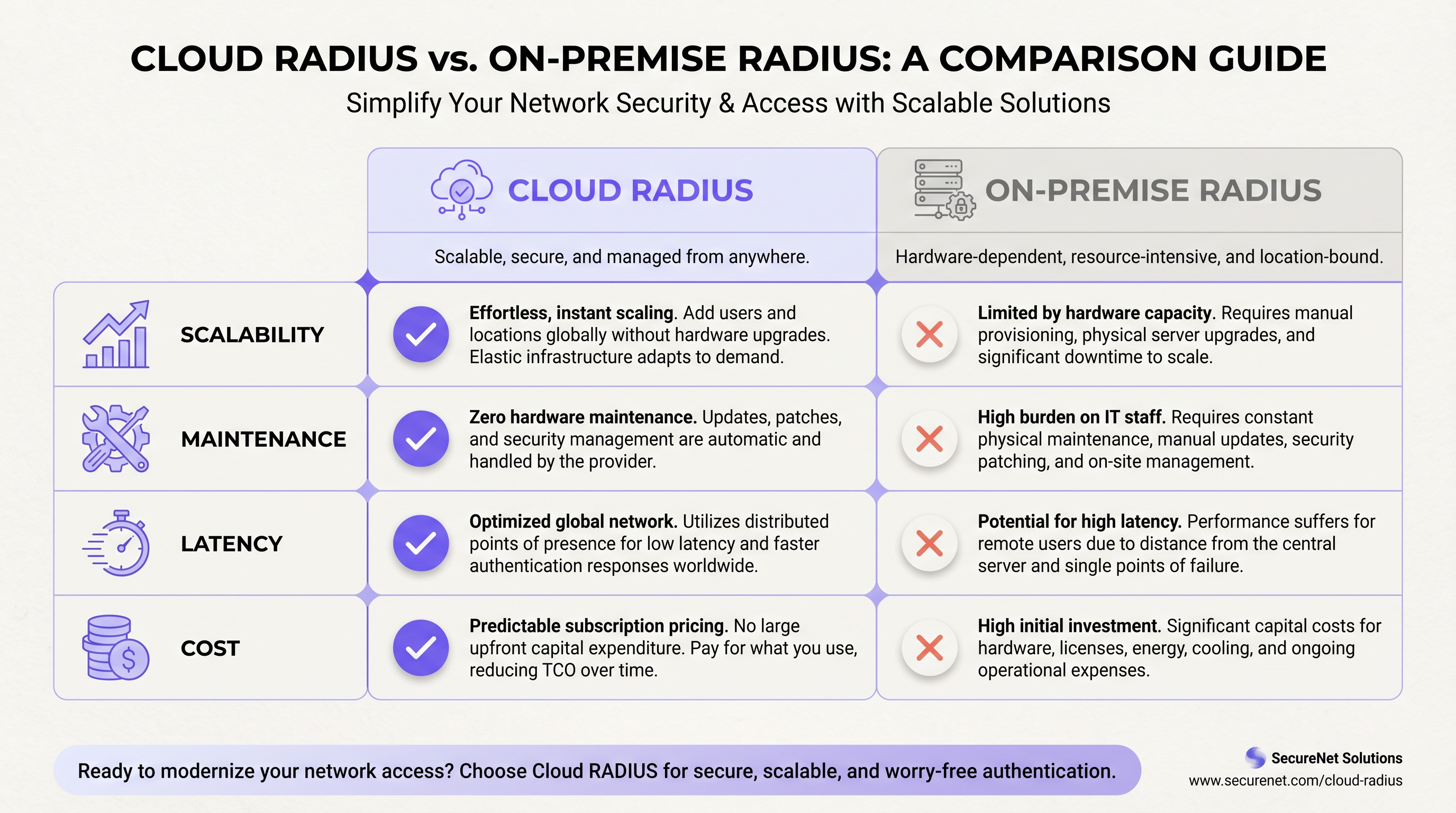
Cloud RADIUS सेवाएं अंतर्निहित उच्च उपलब्धता, स्वचालित प्रमाणपत्र रोटेशन और इलास्टिक स्केलेबिलिटी के साथ प्रबंधित, विश्व स्तर पर वितरित प्रमाणीकरण बुनियादी ढांचा प्रदान करती हैं — जो वितरित on-premise परिनियोजन को प्रभावित करने वाले प्रति-साइट रखरखाव के बोझ को समाप्त करती हैं। On-premise RADIUS, चाहे FreeRADIUS या Microsoft NPS चला रहा हो, सब-मिलीसेकंड स्थानीय प्रमाणीकरण, पूर्ण डेटा संप्रभुता और WAN कनेक्टिविटी से स्वतंत्रता प्रदान करता है — ये लाभ विशिष्ट उच्च-घनत्व या विनियमित वातावरण में निर्णायक बने रहते हैं।
अधिकांश मल्टी-साइट ऑपरेटरों — होटल समूहों, रिटेल श्रृंखलाओं, सम्मेलन केंद्रों — के लिए Cloud RADIUS कम पांच-वर्षीय कुल स्वामित्व लागत पर बेहतर परिचालन परिणाम प्रदान करता है। इसके अपवाद स्पष्ट रूप से परिभाषित हैं: एयर-गैप्ड वातावरण, सख्त डेटा रेजिडेंसी जनादेश, और बहुत बड़े सिंगल-साइट परिनियोजन जहां स्थानीय LAN प्रदर्शन सर्वोपरि है। यह मार्गदर्शिका आपको यह निर्धारित करने के लिए ढांचा देती है कि आपका परिनियोजन किस श्रेणी में आता है, और उस निर्णय पर कैसे कार्य करना है।
तकनीकी गहन विश्लेषण
RADIUS प्रोटोकॉल और 802.1X बुनियादी ढांचे में इसकी भूमिका
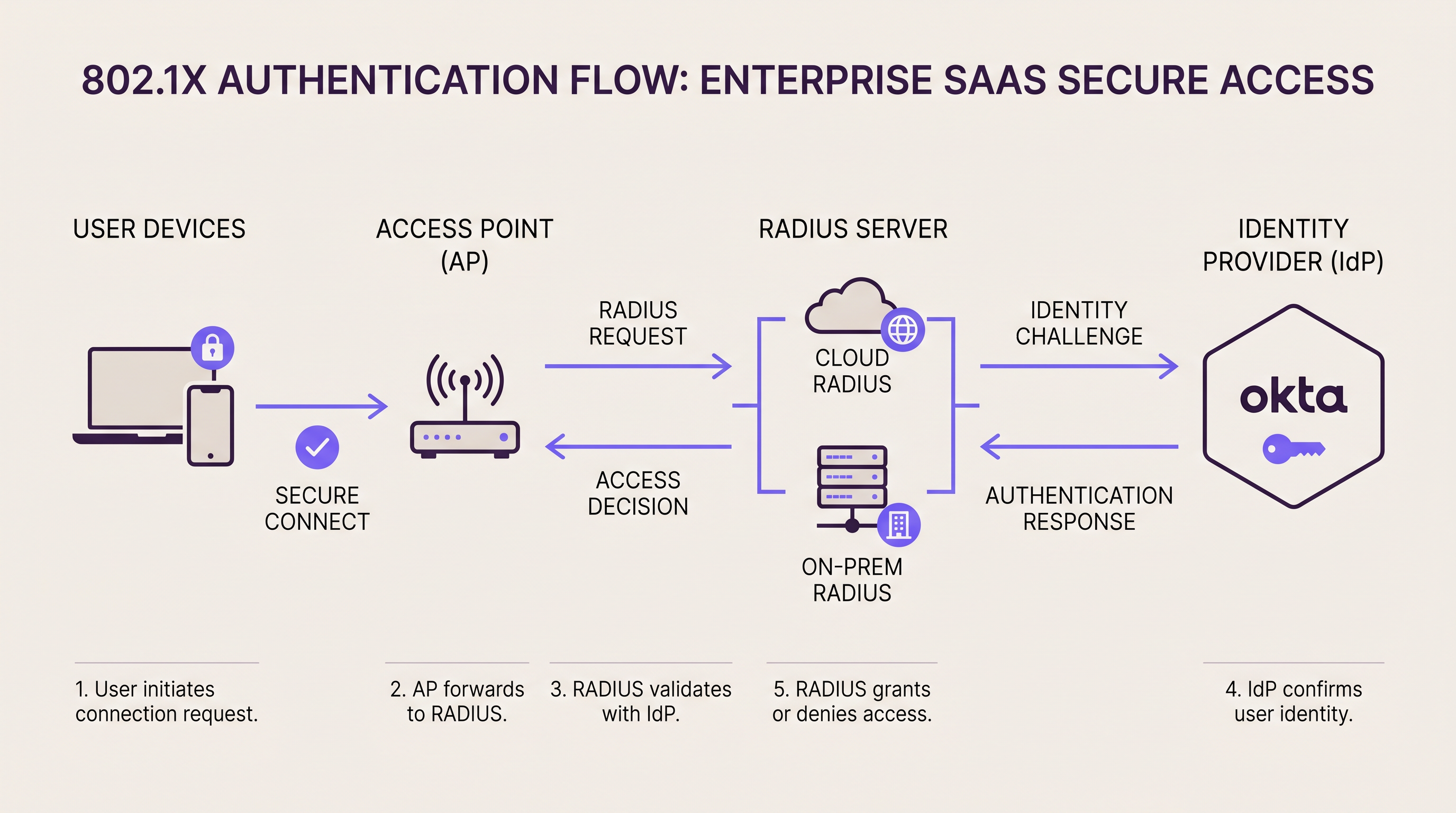
RADIUS (Remote Authentication Dial-In User Service, RFC 2865) आपके नेटवर्क एक्सेस लेयर और आपकी पहचान निर्देशिका के बीच प्रमाणीकरण ब्रोकर के रूप में कार्य करता है। एक 802.1X परिनियोजन में, एक्सेस पॉइंट या स्विच नेटवर्क एक्सेस सर्वर (NAS) के रूप में कार्य करता है, जो UDP (प्रमाणीकरण के लिए पोर्ट 1812, अकाउंटिंग के लिए पोर्ट 1813) पर RADIUS सर्वर को EAP प्रमाणीकरण फ्रेम अग्रेषित करता है। RADIUS सर्वर बैकएंड निर्देशिका — Active Directory, LDAP, या क्लाउड पहचान प्रदाता — के विरुद्ध क्रेडेंशियल्स को मान्य करता है और Access-Accept या Access-Reject प्रतिक्रिया देता है, जिसमें वैकल्पिक रूप से VLAN असाइनमेंट विशेषताएं शामिल होती हैं।
यह आर्किटेक्चर मौलिक रूप से वही है चाहे आपका RADIUS सर्वर आपके सर्वर रूम में रैक-माउंटेड उपकरण हो या विश्व स्तर पर वितरित क्लाउड सेवा। अंतर इस बात में है कि वह सर्वर कहां रहता है, उसका रखरखाव कौन करता है, और वह कैसे स्केल करता है।
On-Premise RADIUS: आर्किटेक्चर और ट्रेड-ऑफ
दो प्रमुख on-premise RADIUS प्लेटफॉर्म FreeRADIUS और Microsoft Network Policy Server (NPS) हैं। FreeRADIUS दुनिया का सबसे व्यापक रूप से तैनात RADIUS सर्वर है, जो EAP-TLS, PEAP-MSCHAPv2, EAP-TTLS और EAP-PWD सहित EAP विधियों की एक विस्तृत श्रृंखला का समर्थन करता है। यह LDAP, SQL, या REST के माध्यम से वस्तुतः किसी भी बैकएंड निर्देशिका के साथ एकीकृत होता है, और बिना किसी लाइसेंसिंग लागत के उपलब्ध है। हालांकि, यह कुशल प्रशासन की मांग करता है: कॉन्फ़िगरेशन फ़ाइल-आधारित है, डिबगिंग के लिए लॉग विश्लेषण विशेषज्ञता की आवश्यकता होती है, और दर्जनों साइटों पर स्केलिंग के लिए सावधानीपूर्वक प्रतिकृति और फेलओवर योजना की आवश्यकता होती है।
Microsoft NPS मूल रूप से Active Directory के साथ एकीकृत होता है और Windows-केंद्रित वातावरण के लिए डिफ़ॉल्ट विकल्प है। यह आउट-ऑफ-द-बॉक्स PEAP-MSCHAPv2 और EAP-TLS का समर्थन करता है और परिचित Windows Server इंटरफ़ेस के माध्यम से प्रबंधित किया जाता है। इसका ट्रेड-ऑफ Windows Server लाइसेंसिंग के साथ कड़ा जुड़ाव और FreeRADIUS की तुलना में अधिक सीमित EAP विधि सेट है।
उच्च-उपलब्धता वाले on-premise परिनियोजन के लिए, संगठन आमतौर पर सक्रिय-सक्रिय या सक्रिय-निष्क्रिय RADIUS क्लस्टर तैनात करते हैं। एक्सेस पॉइंट्स को प्राथमिक और माध्यमिक RADIUS सर्वर पते के साथ कॉन्फ़िगर किया जाता है; यदि प्राथमिक कॉन्फ़िगर किए गए टाइमआउट (आमतौर पर 3-5 सेकंड) के भीतर प्रतिक्रिया देने में विफल रहता है, तो NAS माध्यमिक पर फेलओवर हो जाता है। इस आर्किटेक्चर के लिए या तो भौगोलिक रूप से बिखरे हुए सर्वरों की आवश्यकता होती है — जो अपनी जटिलता पेश करता है — या एक ही सुविधा में सर्वरों की एक जोड़ी, जो साइट-स्तर के आउटेज से रक्षा नहीं करती है।
लेटेंसी प्रोफाइल: On-premise RADIUS स्थानीय LAN पर 1 मिलीसेकंड से कम के प्रमाणीकरण राउंड-ट्रिप प्रदान करता है। हजारों समवर्ती प्रमाणीकरणों को संसाधित करने वाले उच्च-घनत्व वाले वातावरण के लिए — उदाहरण के लिए, एक हाउसफुल इवेंट के दौरान 68,000 सीटों वाला स्टेडियम — यह स्थानीय प्रसंस्करण क्षमता एक वास्तविक परिचालन लाभ है।
Cloud RADIUS: आर्किटेक्चर और ट्रेड-ऑफ
Cloud RADIUS प्लेटफॉर्म कई भौगोलिक रूप से वितरित उपलब्धता क्षेत्रों में RADIUS बुनियादी ढांचे की मेजबानी करते हैं। जब कोई एक्सेस पॉइंट प्रमाणीकरण अनुरोध भेजता है, तो उसे निकटतम क्लाउड एज नोड पर रूट किया जाता है, जो आमतौर पर साइट से प्रदाता की उपस्थिति की निकटता के आधार पर 5-50 मिलीसेकंड की राउंड-ट्रिप लेटेंसी जोड़ता है। प्रमाणीकरण के अधिकांश उपयोग के मामलों के लिए, यह लेटेंसी अंतिम उपयोगकर्ताओं के लिए अगोचर है।
उच्च-उपलब्धता मॉडल on-premise से मौलिक रूप से भिन्न है। प्राथमिक/माध्यमिक जोड़ी को कॉन्फ़िगर करने के बजाय, क्लाउड प्लेटफॉर्म का लोड बैलेंसर स्वचालित रूप से विफल नोड्स से दूर अनुरोधों को रूट करता है। एंटरप्राइज Cloud RADIUS प्रदाता आमतौर पर मल्टी-रीजन रिडंडेंसी द्वारा समर्थित 99.99% अपटाइम के SLA प्रकाशित करते हैं। On-premise पर समान रिडंडेंसी प्राप्त करने के लिए कई भौगोलिक रूप से बिखरे हुए डेटा केंद्रों में सक्रिय-सक्रिय क्लस्टर तैनात करने की आवश्यकता होती है — जो एक महत्वपूर्ण इंजीनियरिंग और पूंजी निवेश है।
Cloud RADIUS प्लेटफॉर्म मूल रूप से क्लाउड पहचान प्रदाताओं के साथ एकीकृत होते हैं। यदि आपका संगठन Okta, Azure Active Directory, या Google Workspace का उपयोग करता है, तो एक Cloud RADIUS सेवा SAML, LDAP-over-TLS, या मालिकाना API कनेक्टर्स के माध्यम से जुड़ती है। विशेष रूप से Okta एकीकरण के विस्तृत विवरण के लिए, हमारी मार्गदर्शिका देखें: Okta और RADIUS: अपने पहचान प्रदाता को WiFi प्रमाणीकरण तक विस्तारित करना ।
प्रमाणपत्र प्रबंधन Cloud RADIUS के लिए सबसे सम्मोहक परिचालन तर्कों में से एक है। EAP-TLS और PEAP दोनों सर्वर-साइड डिजिटल प्रमाणपत्रों पर निर्भर करते हैं। On-premise में, प्रमाणपत्र की समाप्ति प्रमाणीकरण आउटेज का एक प्रमुख कारण है — FreeRADIUS सर्वर पर समाप्त होने वाला प्रमाणपत्र हर कनेक्टेड क्लाइंट को सर्वर की पहचान को अस्वीकार करने का कारण बनता है, जिसके परिणामस्वरूप प्रमाणपत्र के नवीनीकरण और तैनात होने तक पूर्ण WiFi आउटेज होता है। Cloud RADIUS प्रदाता प्रमाणपत्र रोटेशन को पूरी तरह से स्वचालित करते हैं, जिससे यह विफलता मोड समाप्त हो जाता है।
WPA3-Enterprise और प्रोटोकॉल विचार
WiFi एलायंस का WPA3-Enterprise विनिर्देश 192-बिट सुरक्षा मोड पेश करता है जो Suite B क्रिप्टोग्राफी (ECDHE, ECDSA, AES-256-GCM) के साथ EAP-TLS को अनिवार्य करता है। यह स्वास्थ्य सेवा, वित्त और सरकारी परिनियोजन के लिए तेजी से प्रासंगिक हो रहा है। अधिकांश आधुनिक Cloud RADIUS प्लेटफॉर्म मूल रूप से WPA3-Enterprise का समर्थन करते हैं। पुराने FreeRADIUS संस्करणों (3.0.x से पहले) या लीगेसी NPS कॉन्फ़िगरेशन चलाने वाले on-premise परिनियोजन को WPA3-Enterprise तैनात करने से पहले अपग्रेड की आवश्यकता हो सकती है। यदि WPA3-Enterprise आपके रोडमैप पर है, तो बुनियादी ढांचे के पथ पर प्रतिबद्ध होने से पहले अपने RADIUS प्लेटफॉर्म के समर्थन को मान्य करें।
उन संगठनों के लिए जो SD-WAN लेयर पर विचार कर रहे हैं जो मल्टी-साइट क्लाउड RADIUS परिनियोजन को रेखांकित करती है, आधुनिक व्यवसायों के लिए मुख्य SD-WAN लाभ पर हमारी मार्गदर्शिका WAN लचीलापन आर्किटेक्चर पर पूरक संदर्भ प्रदान करती है।
कार्यान्वयन मार्गदर्शिका
चरण 1: अपनी वर्तमान प्रमाणीकरण निर्भरताओं का ऑडिट करें
परिनियोजन मॉडल चुनने से पहले, प्रत्येक SSID, VLAN, EAP विधि और बैकएंड निर्देशिका का दस्तावेजीकरण करें जिसे आपका वर्तमान प्रमाणीकरण बुनियादी ढांचा स्पर्श करता है। हेडलेस उपकरणों — प्रिंटर, IoT सेंसर, पॉइंट-ऑफ-सेल टर्मिनल — के लिए MAC Authentication Bypass (MAB) नीतियों को शामिल करें, क्योंकि माइग्रेशन के दौरान इन्हें अक्सर अनदेखा कर दिया जाता है और ये कटओवर के बाद महत्वपूर्ण घटनाओं का कारण बन सकते हैं।
चरण 2: पहचान प्रदाता तत्परता का मूल्यांकन करें
यदि आपकी उपयोगकर्ता निर्देशिका on-premise Active Directory है और इसे क्लाउड IdP के साथ सिंक्रनाइज़ नहीं किया जा सकता है, तो आपके Cloud RADIUS विकल्प उन प्लेटफार्मों तक सीमित हैं जो on-premise निर्देशिकाओं के लिए LDAP प्रॉक्सीइंग का समर्थन करते हैं। यदि आप Azure AD Connect या इसी तरह का सिंक्रनाइज़ेशन टूल तैनात कर सकते हैं, तो Cloud RADIUS प्लेटफार्मों की पूरी श्रृंखला उपलब्ध हो जाती है। यह एकल निर्णय — क्लाउड IdP बनाम on-premise निर्देशिका — अक्सर क्लाउड बनाम on-premise RADIUS चुनाव में निर्णायक कारक होता है।
चरण 3: प्रत्येक साइट पर WAN लचीलेपन का आकलन करें
Cloud RADIUS केवल उतना ही विश्वसनीय है जितना कि प्रत्येक साइट पर इंटरनेट कनेक्शन। माइग्रेट करने से पहले, हर स्थान पर WAN कनेक्टिविटी का ऑडिट करें। एकल ISP कनेक्शन और बिना फेलओवर वाली साइटें एक महत्वपूर्ण जोखिम हैं। Cloud RADIUS को अपने प्राथमिक प्रमाणीकरण बुनियादी ढांचे के रूप में तैनात करने से पहले डुअल-ISP कनेक्टिविटी या SD-WAN फेलओवर लागू करें। रिटेल वातावरण के लिए जहां पॉइंट-ऑफ-सेल सिस्टम नेटवर्क प्रमाणीकरण पर निर्भर करते हैं, WAN लचीलापन गैर-परक्राम्य है।
चरण 4: प्रमाणपत्र माइग्रेशन की योजना बनाएं (On-Premise परिनियोजन)
यदि EAP-TLS के साथ on-premise RADIUS तैनात या बनाए रख रहे हैं, तो प्रमाणपत्र जीवनचक्र प्रबंधन प्रक्रिया स्थापित करें। प्रमाणपत्र समाप्ति से 90, 60 और 30 दिन पहले निगरानी अलर्ट लागू करें। प्रमाणपत्र जारी करने और नवीनीकरण को स्वचालित करने के लिए आंतरिक PKI (जैसे Microsoft ADCS या HashiCorp Vault) तैनात करने पर विचार करें। प्रोडक्शन वातावरण में प्रमाणपत्र प्रबंधन के लिए कभी भी केवल कैलेंडर रिमाइंडर पर निर्भर न रहें।
चरण 5: उत्तरजीविता नीतियों को कॉन्फ़िगर करें
Cloud RADIUS परिनियोजन के लिए, अपने वायरलेस कंट्रोलर या एक्सेस पॉइंट्स पर स्थानीय उत्तरजीविता नीति (local survivability policy) कॉन्फ़िगर करें। विकल्पों में शामिल हैं: एक कॉन्फ़िगर करने योग्य अवधि के लिए अंतिम-ज्ञात प्रमाणीकरण स्थिति को कैश करना, पूर्व-अनुमोदित डिवाइस सूचियों के लिए MAC Authentication Bypass पर वापस जाना, या माध्यमिक प्रमाणीकरण पथ के माध्यम से महत्वपूर्ण स्टाफ SSID को रूट करना। हॉस्पिटैलिटी ऑपरेटरों के लिए, सुनिश्चित करें कि Purple के Guest WiFi जैसे प्लेटफार्मों के माध्यम से गेस्ट WiFi ऑनबोर्डिंग में RADIUS अनुपलब्धता के दौरान एक परिभाषित फॉलबैक व्यवहार हो।
चरण 6: समानांतर परिनियोजन चलाएं
मौजूदा बुनियादी ढांचे के साथ समानांतर में नया RADIUS प्लेटफॉर्म तैनात करें। नए RADIUS सर्वर पर मैप किया गया एक समर्पित परीक्षण SSID बनाएं और प्रोडक्शन SSID को माइग्रेट करने से पहले सभी EAP विधियों, VLAN असाइनमेंट और नीति प्रवर्तन को मान्य करें। यह समानांतर-रन अवधि सिंगल-साइट परिनियोजन के लिए न्यूनतम दो सप्ताह और मल्टी-साइट माइग्रेशन के लिए चार से छह सप्ताह होनी चाहिए।
चरण 7: चरणबद्ध साइट-दर-साइट माइग्रेशन निष्पादित करें
मल्टी-साइट परिनियोजन के लिए, साइटों को एक साथ के बजाय क्रमिक रूप से माइग्रेट करें। कम जोखिम वाली साइटों — कम ट्रैफिक और अधिक सहनशील उपयोगकर्ताओं वाले छोटे स्थानों — से शुरुआत करें, इसके बाद फ्लैगशिप स्टोर या सम्मेलन-भारी होटल संपत्तियों जैसी उच्च-प्राथमिकता वाली साइटों को माइग्रेट करें। कटओवर शुरू करने से पहले प्रत्येक साइट के लिए रोलबैक प्रक्रिया का दस्तावेजीकरण करें।
सर्वोत्तम प्रथाएं
साझा गुप्त स्वच्छता (Shared secret hygiene): एक्सेस पॉइंट्स और RADIUS सर्वर के बीच RADIUS साझा रहस्य न्यूनतम 32 वर्णों के, बेतरतीब ढंग से उत्पन्न और प्रति NAS डिवाइस अद्वितीय होने चाहिए। सभी एक्सेस पॉइंट्स पर साझा रहस्यों का पुन: उपयोग करने का अर्थ है कि एक डिवाइस से समझौता करने से पूरे प्रमाणीकरण बुनियादी ढांचे का खुलासा हो जाता है। साझा रहस्यों को सालाना या किसी भी संदिग्ध समझौते के बाद रोटेट करें।
VLAN सेगमेंटेशन: उपयोगकर्ता भूमिका के आधार पर ट्रैफ़िक को गतिशील रूप से विभाजित करने के लिए RADIUS-असाइन किए गए VLAN (Tunnel-Type, Tunnel-Medium-Type, और Tunnel-Private-Group-ID विशेषताओं के माध्यम से) का उपयोग करें। गेस्ट डिवाइस केवल इंटरनेट एक्सेस के साथ एक अलग VLAN पर होने चाहिए; कॉर्पोरेट डिवाइस प्रोडक्शन VLAN पर; IoT डिवाइस एक समर्पित प्रतिबंधित VLAN पर। यह सेगमेंटेशन कार्डधारक डेटा को संभालने वाले किसी भी नेटवर्क के लिए PCI DSS की आवश्यकता है।
अकाउंटिंग और ऑडिट लॉगिंग: RADIUS अकाउंटिंग (पोर्ट 1813) सक्षम करें और अकाउंटिंग लॉग को न्यूनतम 12 महीनों तक सुरक्षित रखें। ये लॉग सत्र शुरू/समाप्त होने का समय, डेटा वॉल्यूम और असाइन किए गए IP पते रिकॉर्ड करते हैं — जो सुरक्षा घटना जांच और GDPR अनुपालन के लिए आवश्यक हैं। Cloud RADIUS प्लेटफॉर्म आमतौर पर syslog या API के माध्यम से SIEM सिस्टम में अकाउंटिंग डेटा निर्यात करते हैं; on-premise परिनियोजन को अकाउंटिंग डेटा को केंद्रीकृत लॉग प्रबंधन प्लेटफॉर्म पर रूट करना चाहिए।
EAP विधि चयन: कॉर्पोरेट कर्मचारी नेटवर्क के लिए, EAP-TLS (प्रमाणपत्र-आधारित) सबसे मजबूत सुरक्षा स्थिति प्रदान करता है और PCI DSS और स्वास्थ्य सेवा वातावरण के लिए अनुशंसित है। PEAP-MSCHAPv2 कम जोखिम वाले वातावरण के लिए स्वीकार्य है लेकिन क्रेडेंशियल हार्वेस्टिंग हमलों के प्रति संवेदनशील है यदि सर्वर प्रमाणपत्र को सप्लीकेंट्स द्वारा ठीक से मान्य नहीं किया जाता है। EAP-MD5 से पूरी तरह बचें — यह अप्रचलित है और कोई पारस्परिक प्रमाणीकरण प्रदान नहीं करता है।
RadSec (RADIUS over TLS): पारंपरिक RADIUS प्रोटोकॉल केवल एन्क्रिप्टेड User-Password विशेषता के साथ UDP पर डेटा प्रसारित करता है। RadSec (RFC 6614) RADIUS को TLS में लपेटता है, जो NAS और RADIUS सर्वर के बीच पूर्ण परिवहन एन्क्रिप्शन और पारस्परिक प्रमाणीकरण प्रदान करता है। अधिकांश आधुनिक Cloud RADIUS प्लेटफॉर्म RadSec का समर्थन करते हैं। नए परिनियोजन के लिए, RadSec डिफ़ॉल्ट परिवहन विकल्प होना चाहिए।
स्वास्थ्य सेवा और परिवहन क्षेत्र के परिनियोजन के लिए, जहां GDPR और क्षेत्र-विशिष्ट नियमों के तहत डेटा हैंडलिंग दायित्व विशेष रूप से कड़े हैं, सुनिश्चित करें कि आपका RADIUS प्लेटफॉर्म डेटा प्रोसेसिंग एग्रीमेंट प्रदान करता है और क्षेत्रीय डेटा रेजिडेंसी का समर्थन करता है।
समस्या निवारण और जोखिम न्यूनीकरण
सामान्य विफलता मोड 1: प्रमाणपत्र समाप्ति (On-Premise)
लक्षण: सभी क्लाइंट अचानक प्रमाणित होने में विफल हो जाते हैं; RADIUS लॉग TLS हैंडशेक विफलता दिखाते हैं।
मूल कारण: RADIUS सर्वर पर सर्वर-साइड प्रमाणपत्र समाप्त हो गया है। क्लाइंट सप्लीकेंट्स सर्वर की पहचान को अस्वीकार कर देते हैं।
निवारण: 90/60/30 दिनों पर अलर्ट के साथ स्वचालित प्रमाणपत्र निगरानी लागू करें। स्वचालित नवीनीकरण के साथ आंतरिक CA का उपयोग करें। Cloud RADIUS स्वचालित प्रमाणपत्र रोटेशन के माध्यम से इस विफलता मोड को पूरी तरह से समाप्त कर देता है।
सामान्य विफलता मोड 2: WAN आउटेज Cloud RADIUS को ब्लॉक कर रहा है
लक्षण: एक विशिष्ट साइट पर प्रमाणीकरण विफल हो जाता है; अन्य साइटें अप्रभावित रहती हैं। स्थानीय नेटवर्क चालू है।
मूल कारण: साइट का इंटरनेट कनेक्शन विफल हो गया है, जिससे एक्सेस पॉइंट्स Cloud RADIUS सेवा तक नहीं पहुंच पा रहे हैं।
निवारण: डुअल-ISP कनेक्टिविटी या स्वचालित फेलओवर के साथ SD-WAN तैनात करें। क्रेडेंशियल्स को कैश करने या महत्वपूर्ण उपकरणों के लिए MAB पर वापस जाने के लिए एक्सेस पॉइंट उत्तरजीविता नीतियां कॉन्फ़िगर करें।
सामान्य विफलता मोड 3: साझा गुप्त बेमेल (Shared Secret Mismatch)
लक्षण: प्रमाणीकरण अनुरोध चुपचाप छोड़ दिए जाते हैं; RADIUS लॉग "invalid authenticator" या "message authenticator" त्रुटियां दिखाते हैं।
मूल कारण: एक्सेस पॉइंट पर कॉन्फ़िगर किया गया साझा रहस्य RADIUS सर्वर पर कॉन्फ़िगर किए गए रहस्य से मेल नहीं खाता है।
निवारण: निरंतरता सुनिश्चित करने के लिए केंद्रीकृत गुप्त प्रबंधन प्रणाली (HashiCorp Vault, AWS Secrets Manager) का उपयोग करें। किसी भी NAS या RADIUS सर्वर कॉन्फ़िगरेशन परिवर्तन के बाद साझा रहस्यों को मान्य करें।
सामान्य विफलता मोड 4: सप्लीकेंट गलत कॉन्फ़िगरेशन
लक्षण: व्यक्तिगत डिवाइस प्रमाणित होने में विफल रहते हैं जबकि उसी SSID पर अन्य सफल होते हैं।
मूल कारण: विफल डिवाइस पर 802.1X सप्लीकेंट RADIUS सर्वर के प्रमाणपत्र पर भरोसा करने के लिए कॉन्फ़िगर नहीं है, या असंगत EAP विधि के लिए कॉन्फ़िगर किया गया है।
निवारण: निरंतरता सुनिश्चित करने के लिए MDM या समूह नीति के माध्यम से सप्लीकेंट कॉन्फ़िगरेशन तैनात करें। BYOD वातावरण के लिए, एक स्पष्ट ऑनबोर्डिंग मार्गदर्शिका प्रदान करें। Purple का WiFi Analytics प्लेटफॉर्म आपके डिवाइस एस्टेट में प्रमाणीकरण विफलता पैटर्न की पहचान करने में मदद कर सकता है।
सामान्य विफलता मोड 5: लोड के तहत RADIUS टाइमआउट
लक्षण: पीक अवधि (इवेंट शुरू होना, शिफ्ट बदलना) के दौरान प्रमाणीकरण में देरी या विफलता।
मूल कारण: RADIUS सर्वर समवर्ती प्रमाणीकरण अनुरोधों से अभिभूत है; प्रतिक्रिया प्राप्त होने से पहले NAS टाइमआउट पार हो गया है।
निवारण: On-premise: ज्ञात पीक इवेंट्स से पहले RADIUS सर्वर क्षमता बढ़ाएं; एक्सेस पॉइंट्स पर कनेक्शन दर सीमित करना लागू करें। Cloud RADIUS: सत्यापित करें कि आपका सब्सक्रिप्शन टियर आपके पीक प्रमाणीकरण थ्रूपुट का समर्थन करता है; अधिकांश एंटरप्राइज क्लाउड प्लेटफॉर्म स्वचालित रूप से स्केल करते हैं।
ROI और व्यावसायिक प्रभाव
स्वामित्व की कुल लागत: पांच-वर्षीय तुलना
निम्नलिखित विश्लेषण एक प्रतिनिधि 20-साइट रिटेल श्रृंखला पर आधारित है जिसमें प्रति साइट लगभग 50 एक्सेस पॉइंट और पीक पर प्रति साइट 200 समवर्ती प्रमाणित डिवाइस हैं।
| लागत घटक | On-Premise RADIUS (20 साइटें) | Cloud RADIUS (20 साइटें) |
|---|---|---|
| हार्डवेयर (सर्वर, HA जोड़े) | £80,000–£120,000 | £0 |
| OS और सॉफ्टवेयर लाइसेंसिंग | £10,000–£30,000 | £0 |
| वार्षिक सदस्यता | £0 | £18,000–£40,000/वर्ष |
| बिजली और कूलिंग (5 वर्ष) | £15,000–£25,000 | £0 |
| इंजीनियरिंग समय (5 वर्ष) | £60,000–£100,000 | £10,000–£20,000 |
| 5-वर्षीय कुल | £165,000–£275,000 | £100,000–£220,000 |
इंजीनियरिंग समय का अंतर सबसे महत्वपूर्ण कारक है। 20 साइटों पर on-premise RADIUS के लिए निरंतर पैचिंग, प्रमाणपत्र प्रबंधन, निगरानी और घटना प्रतिक्रिया की आवश्यकता होती है। Cloud RADIUS इसे नीति प्रबंधन और एकीकरण रखरखाव तक कम कर देता है — जो प्रयास का एक अंश मात्र है।
सफलता को मापना
आपके RADIUS परिनियोजन के लिए मुख्य प्रदर्शन संकेतकों में शामिल होना चाहिए: प्रमाणीकरण सफलता दर (लक्ष्य: प्रोडक्शन वातावरण के लिए >99.5%), औसत प्रमाणीकरण लेटेंसी (लक्ष्य: क्लाउड के लिए <100ms, on-premise LAN के लिए <5ms), प्रमाणीकरण आउटेज से रिकवरी का औसत समय (लक्ष्य: <15 मिनट), और प्रमाणपत्र समाप्ति की घटनाएं (लक्ष्य: शून्य, उचित स्वचालन के साथ प्राप्त करने योग्य)।
Purple के Guest WiFi प्लेटफॉर्म का उपयोग करने वाले हॉस्पिटैलिटी ऑपरेटरों के लिए, प्रमाणीकरण बुनियादी ढांचे की विश्वसनीयता सीधे अतिथि संतुष्टि स्कोर को प्रभावित करती है। पीक चेक-इन अवधि के दौरान 2-सेकंड की प्रमाणीकरण देरी अतिथि प्रतिक्रिया में मापने योग्य होती है। उचित रूप से कॉन्फ़िगर की गई उत्तरजीविता नीतियों के साथ Cloud RADIUS इस मीट्रिक पर तदर्थ on-premise परिनियोजन से लगातार बेहतर प्रदर्शन करता है।
वितरित on-premise FreeRADIUS परिनियोजन से Cloud RADIUS पर माइग्रेट करने वाले संगठन लगातार प्रमाणीकरण-संबंधित IT घटनाओं में 30-50% की कमी और RADIUS रखरखाव के लिए आवंटित इंजीनियरिंग घंटों में महत्वपूर्ण कमी की रिपोर्ट करते हैं — वे घंटे जो रणनीतिक नेटवर्क सुधार परियोजनाओं के लिए पुन: आवंटित किए जाते हैं। Purple का प्लेटफॉर्म, जो दोनों परिनियोजन मॉडल के साथ एकीकृत होता है, माइग्रेशन से पहले कैप्चर किए गए बेसलाइन मेट्रिक्स के खिलाफ इन सुधारों को मापने के लिए WiFi Analytics और Sensors डेटा प्रदान करता है।
व्यापक नेटवर्क आधुनिकीकरण संदर्भ पर विचार करने वाले वेन्यू ऑपरेशंस के लिए, Purple की Wayfinding क्षमताएं और फुटफॉल एनालिटिक्स के साथ प्रमाणीकरण डेटा का एकीकरण मूल्य की अगली परत का प्रतिनिधित्व करता है जिसे एक अच्छी तरह से तैयार किया गया RADIUS बुनियादी ढांचा सक्षम बनाता है। प्रमाणीकरण घटनाएं, अपने मूल में, उपस्थिति डेटा हैं — और जब Purple की एनालिटिक्स लेयर के माध्यम से सामने आती हैं, तो वे आपके एस्टेट में आगंतुक व्यवहार, ड्वेल टाइम और रिटर्न विजिट दरों को समझने के लिए एक शक्तिशाली उपकरण बन जाती हैं।
मुख्य शब्द और परिभाषाएं
RADIUS (Remote Authentication Dial-In User Service)
A networking protocol (RFC 2865) that provides centralised authentication, authorisation, and accounting (AAA) for users connecting to a network. RADIUS operates over UDP and acts as the broker between network access equipment (access points, switches) and the identity directory (Active Directory, LDAP, cloud IdP).
IT teams encounter RADIUS whenever deploying 802.1X authentication for WiFi or wired networks. It is the foundational protocol for enterprise network access control and is required for WPA2-Enterprise and WPA3-Enterprise deployments.
802.1X
An IEEE standard for port-based network access control that defines the framework for EAP-based authentication. In a WiFi context, 802.1X requires three components: the supplicant (client device), the authenticator (access point), and the authentication server (RADIUS). The access point blocks all traffic from the client until RADIUS returns an Access-Accept.
802.1X is the authentication mechanism for WPA2-Enterprise and WPA3-Enterprise networks. IT teams use it to ensure that only authorised devices and users can connect to the corporate WiFi, with dynamic VLAN assignment based on user identity.
EAP (Extensible Authentication Protocol)
A flexible authentication framework used within 802.1X that supports multiple authentication methods. Common EAP methods include EAP-TLS (certificate-based, strongest security), PEAP-MSCHAPv2 (password-based with server certificate validation), and EAP-TTLS (tunnelled password authentication).
The choice of EAP method directly impacts security posture and deployment complexity. EAP-TLS requires client certificates on every device, making it more complex to deploy but significantly more resistant to credential theft attacks. IT teams in regulated industries (healthcare, finance) should default to EAP-TLS.
FreeRADIUS
The world's most widely deployed open-source RADIUS server, powering authentication for hundreds of millions of users globally. FreeRADIUS supports an extensive range of EAP methods and backend integrations, is available at no licensing cost, and runs on Linux. It requires skilled administration and file-based configuration.
FreeRADIUS is the default choice for on-premise RADIUS deployments in non-Microsoft environments. IT teams evaluating the cloud versus on-premise decision should assess whether they have the in-house expertise to operate FreeRADIUS effectively, as misconfiguration is a leading cause of authentication incidents.
NPS (Network Policy Server)
Microsoft's built-in RADIUS server, included with Windows Server. NPS integrates natively with Active Directory and supports PEAP-MSCHAPv2 and EAP-TLS. It is managed through the Windows Server GUI and is the default RADIUS choice for Microsoft-centric environments.
IT teams running Windows Server infrastructure typically deploy NPS as their on-premise RADIUS server. NPS is tightly coupled to Windows Server licensing and Active Directory, which simplifies deployment in Microsoft environments but limits flexibility in heterogeneous or cloud-native environments.
MAC Authentication Bypass (MAB)
An authentication method that uses a device's MAC address as its credential, allowing headless devices (printers, IoT sensors, point-of-sale terminals) that cannot run an 802.1X supplicant to authenticate to the network. The MAC address is checked against an allow-list on the RADIUS server.
MAB is essential for any network with IoT devices or legacy equipment. IT teams must maintain accurate MAC address inventories and implement processes for adding new devices. Cloud RADIUS platforms typically provide a centralised dashboard for MAB list management across all sites, which is significantly more efficient than per-site configuration file management on FreeRADIUS.
RadSec (RADIUS over TLS)
An extension of the RADIUS protocol (RFC 6614) that transports RADIUS packets over TLS rather than UDP. RadSec provides full transport encryption and mutual authentication between the NAS and RADIUS server, addressing several well-documented security vulnerabilities in the traditional UDP-based RADIUS protocol.
Traditional RADIUS encrypts only the User-Password attribute; all other attributes, including usernames and session data, are transmitted in plaintext. RadSec is the modern, secure transport mechanism for RADIUS and is supported by most enterprise Cloud RADIUS platforms and modern access point vendors. IT teams deploying new RADIUS infrastructure should evaluate RadSec as the default transport.
VLAN Assignment (RADIUS-assigned VLAN)
A RADIUS capability that dynamically assigns a connecting device to a specific VLAN based on authentication outcome. The RADIUS server returns Tunnel-Type (13=VLAN), Tunnel-Medium-Type (6=802), and Tunnel-Private-Group-ID (VLAN ID) attributes in the Access-Accept response, and the access point places the device in the specified VLAN.
Dynamic VLAN assignment is the mechanism by which IT teams implement network segmentation based on user identity. A single SSID can serve multiple user types — guests, employees, contractors, IoT devices — with each type automatically placed in the appropriate VLAN based on their RADIUS authentication result. This is a PCI DSS requirement for networks that handle cardholder data.
High Availability (HA) RADIUS
A RADIUS deployment architecture that ensures authentication services remain available despite individual server failures. Common HA patterns include active-active clustering (both servers handle traffic simultaneously, with load balancing), active-passive failover (secondary server takes over when primary fails), and geographically distributed redundancy (servers in separate physical locations).
HA is a critical design consideration for any production RADIUS deployment. IT teams must define their Recovery Time Objective (RTO) — how quickly authentication must be restored after a failure — and design their HA architecture accordingly. Cloud RADIUS providers deliver HA as a built-in service; on-premise HA requires explicit architectural design and ongoing maintenance.
केस स्टडीज
A European hotel group operates 45 properties across six countries. Each property has 150–400 guest rooms plus conference facilities. The central IT team consists of three network engineers. They currently run FreeRADIUS on virtual machines at each property — 45 separate instances. A certificate expiry at one property caused a complete guest WiFi outage during a major conference. The CTO wants to eliminate this class of incident and reduce maintenance overhead. What is the recommended architecture?
Recommended Architecture: Cloud RADIUS with Purple Guest WiFi Integration
Select a Cloud RADIUS provider with European data residency (to satisfy GDPR obligations) and native integration with your existing IdP. If the hotel group uses Azure AD for staff identity, select a platform with Azure AD LDAP connector support.
Migrate guest WiFi SSIDs first. Guest authentication is the highest-volume, lowest-risk migration target. Configure Purple's captive portal to handle guest onboarding (data capture, consent, branded splash page) and pass authenticated sessions to the Cloud RADIUS backend. This immediately eliminates per-property FreeRADIUS maintenance for the guest network.
Migrate staff SSIDs property by property, beginning with smaller properties. For each property, run a two-week parallel deployment with a test SSID before cutting over production traffic.
Configure WAN survivability at each property. Implement SD-WAN or dual-ISP connectivity. Configure the wireless controller to cache staff credentials locally for up to 8 hours, ensuring hotel operations staff can authenticate even during brief internet outages.
Decommission FreeRADIUS VMs at each property post-migration. Retain VM snapshots for 30 days as a rollback safety net.
Centralise policy management through the Cloud RADIUS dashboard. Define VLAN assignment policies once and apply them across all 45 properties — a task that previously required per-property configuration file edits.
Expected outcomes: Elimination of certificate expiry incidents (automated rotation), reduction of RADIUS-related engineering time by approximately 40%, and improved authentication latency at properties in countries where the cloud provider has local edge nodes.
A national sports stadium with 68,000 seats hosts 30 major events per year. Peak concurrent WiFi users exceed 25,000 during sold-out matches. The stadium has a dedicated 10Gbps internet connection, but the IT security team has a hard requirement: all authentication logs must remain on UK soil and must not traverse the public internet. The stadium also operates a PCI DSS-compliant point-of-sale network for concessions. What RADIUS architecture is appropriate?
Recommended Architecture: On-Premise RADIUS with Active-Active Cluster and Co-Location DR
Deploy a primary active-active RADIUS cluster within the stadium's on-site data room. Use two physical servers running FreeRADIUS in active-active configuration, load-balanced via the wireless controller's RADIUS server list. Each server should be capable of handling the full authentication load independently — size for 3,000+ authentications per minute at peak event ingress.
Deploy a secondary cluster at a UK co-location facility within 30 miles of the stadium, connected via a dedicated private WAN link (not the public internet). This provides site-level disaster recovery without violating the data sovereignty requirement.
Segment the PCI DSS environment with a dedicated RADIUS policy for the point-of-sale SSID. Assign POS devices to a dedicated VLAN via RADIUS attributes. Ensure RADIUS accounting logs for POS authentication are retained for 12 months minimum, stored on-premise in compliance with PCI DSS Requirement 10.
Implement EAP-TLS for all staff and POS device authentication. Deploy an internal Certificate Authority (Microsoft ADCS or equivalent) to issue and manage client certificates. Configure automated certificate renewal with 90-day advance alerts.
Deploy RadSec (RADIUS over TLS) between access points and the on-premise RADIUS cluster to encrypt authentication traffic on the internal network — particularly important given the high-density public environment.
Pre-provision capacity before major events. Work with the stadium's event operations team to receive confirmed attendance figures 72 hours in advance, and validate RADIUS server capacity against expected peak authentication rates.
Expected outcomes: Sub-millisecond authentication latency during peak event ingress, full data sovereignty compliance, PCI DSS-compliant authentication logging, and 99.99%+ availability via the active-active cluster architecture.
परिदृश्य विश्लेषण
Q1. A national pharmacy chain operates 320 stores across the UK. Each store has a single internet connection from a major ISP with no failover. The chain uses Microsoft 365 and Azure Active Directory for all staff identity. The IT team of 8 engineers currently manages FreeRADIUS instances on a virtual machine at each store. The CISO has flagged that 23% of stores have RADIUS certificates that will expire within 90 days. The CTO wants to resolve this and reduce ongoing maintenance overhead. What RADIUS architecture do you recommend, and what is the single most critical infrastructure change required before migration?
💡 संकेत:Consider the WAN resilience requirement carefully — what happens to in-store operations if the internet connection fails after Cloud RADIUS is deployed?
अनुशंसित दृष्टिकोण दिखाएं
Recommended architecture: Cloud RADIUS integrated with Azure Active Directory, replacing the 320 FreeRADIUS instances. The Azure AD integration is straightforward given the existing Microsoft 365 deployment, and Cloud RADIUS eliminates the certificate management crisis immediately through automated rotation.
Critical infrastructure change before migration: WAN resilience. Each store currently has a single ISP connection with no failover. Cloud RADIUS is entirely dependent on internet connectivity. Before migrating any store, implement SD-WAN with dual-ISP failover, or at minimum configure the wireless controller to cache staff credentials locally for 8–12 hours. Without this, a store that loses internet connectivity cannot authenticate staff to the corporate network — potentially blocking access to point-of-sale systems, inventory management, and other network-dependent operations.
Migration sequence: (1) Deploy SD-WAN or credential caching at all 320 stores. (2) Migrate the 23% of stores with imminent certificate expiry first — this addresses the immediate risk. (3) Migrate remaining stores in batches of 20–30 per week. (4) Decommission FreeRADIUS VMs post-migration. Expected outcome: zero certificate expiry incidents, 60–70% reduction in RADIUS-related engineering time, centralised policy management across all 320 stores.
Q2. A conference centre operator runs a single flagship venue with a capacity of 5,000 delegates. The venue hosts 200 events per year, ranging from small board meetings to large international conferences. Peak concurrent WiFi users reach 4,500 during major events. The venue has a 1Gbps dedicated internet connection with 99.9% SLA. The IT team consists of two network engineers. There are no specific data sovereignty requirements. The current on-premise FreeRADIUS server is approaching end-of-life. Should they replace it with a new on-premise deployment or migrate to Cloud RADIUS?
💡 संकेत:Consider both the peak load profile and the team size. Is 4,500 concurrent users at a single site a strong argument for on-premise, or does the team size and management overhead tip the balance?
अनुशंसित दृष्टिकोण दिखाएं
Recommended architecture: Cloud RADIUS. Despite the single-site, high-density profile, the combination of a small IT team (2 engineers), no data sovereignty requirements, and a reliable dedicated internet connection makes Cloud RADIUS the stronger choice.
Reasoning: The peak load of 4,500 concurrent users is well within the throughput capacity of enterprise Cloud RADIUS platforms, which are designed for far higher volumes. The 5–20ms additional latency from cloud routing is imperceptible in a conference environment. The 1Gbps dedicated internet connection with a 99.9% SLA provides sufficient WAN reliability for Cloud RADIUS dependence.
The decisive factor is team size. Two engineers managing an on-premise FreeRADIUS replacement — including hardware procurement, OS hardening, certificate management, EAP configuration, and ongoing maintenance — represents a significant ongoing overhead for a small team. Cloud RADIUS reduces this to policy management, freeing both engineers for the venue's broader network infrastructure needs.
Implementation note: Configure credential caching on the wireless controller for the venue operations staff SSID, providing survivability during any brief internet disruption. Ensure the Cloud RADIUS provider has a UK or European edge node to minimise authentication latency for the high-density event scenario.
Q3. A regional NHS trust operates 12 hospital sites across a county. Authentication requirements include: (1) staff access to the clinical network via 802.1X with EAP-TLS, (2) guest/patient WiFi via captive portal, and (3) medical device authentication via MAC Authentication Bypass. The trust's information governance team has mandated that all patient-related data, including authentication logs, must remain within NHS-approved data centres in England. The trust uses on-premise Active Directory with no current plans to migrate to Azure AD. What architecture do you recommend?
💡 संकेत:This scenario has multiple hard constraints. Identify each one and determine whether it eliminates cloud RADIUS entirely or only partially.
अनुशंसित दृष्टिकोण दिखाएं
Recommended architecture: Hybrid — On-Premise RADIUS for clinical staff and medical device authentication; Cloud RADIUS (NHS-compliant) or on-premise for guest/patient WiFi.
Analysis of constraints:
- Data sovereignty (NHS-approved English data centres): This eliminates most commercial Cloud RADIUS providers unless they offer NHS-compliant data residency. Some providers offer NHS-specific deployments; these should be evaluated. If no compliant cloud option exists, on-premise is required for all authentication.
- On-premise Active Directory with no cloud sync: This is a hard constraint for Cloud RADIUS integration. Without Azure AD Connect or equivalent, Cloud RADIUS cannot query the trust's staff directory. On-premise RADIUS is required for staff authentication.
- EAP-TLS for clinical staff: Supported by both on-premise FreeRADIUS and NPS. Requires an internal PKI (Microsoft ADCS recommended for an AD-integrated environment).
Recommended deployment: Deploy on-premise RADIUS (NPS or FreeRADIUS) at each of the 12 hospital sites in active-passive pairs, integrated with the trust's on-premise Active Directory. Use RADIUS-assigned VLANs to segment clinical, administrative, and medical device traffic. For guest/patient WiFi, deploy Purple's captive portal for GDPR-compliant data capture and consent management — this does not require RADIUS for guest authentication and sidesteps the data sovereignty constraint for the guest network entirely. Medical device MAB policies are managed on the on-premise RADIUS server with MAC address lists maintained centrally via a configuration management tool.
Key risk to mitigate: Certificate management for EAP-TLS across 12 sites. Deploy Microsoft ADCS with automated certificate enrolment via Group Policy to ensure all clinical devices receive and renew certificates automatically.
मुख्य निष्कर्ष
- ✓Cloud RADIUS delivers built-in high availability, automatic certificate rotation, and elastic scalability — making it operationally superior for multi-site deployments with distributed footprints and small central IT teams.
- ✓On-premise RADIUS remains the correct choice for air-gapped environments, deployments with hard data sovereignty requirements that no cloud provider can satisfy, and very large single-site venues where sub-millisecond local LAN authentication is operationally critical.
- ✓The 10-Site Rule: organisations with more than 10 sites and fewer than 5 network engineers almost always achieve a positive ROI from Cloud RADIUS within 18 months, driven primarily by the elimination of per-site maintenance overhead.
- ✓WAN resilience is the non-negotiable prerequisite for Cloud RADIUS deployment. Implement dual-ISP connectivity or SD-WAN failover, and configure credential caching on wireless controllers before migrating any production authentication traffic to the cloud.
- ✓Certificate expiry is the leading cause of on-premise RADIUS outages and is entirely preventable — either through Cloud RADIUS (automated rotation) or through a properly implemented certificate lifecycle management process with proactive monitoring at 90/60/30-day intervals.
- ✓The hybrid model — Cloud RADIUS for guest and IoT networks, on-premise RADIUS for corporate employee networks — is a common and pragmatic architecture that applies the right tool to each use case without forcing a binary choice.
- ✓Purple's platform integrates with both cloud and on-premise RADIUS backends, and authentication event data surfaced through Purple's analytics layer transforms RADIUS accounting records into actionable footfall intelligence for venue operators.




