

OFDMA की व्याख्या: WiFi 6 घने वातावरण को कैसे संभालता है
यह गाइड OFDMA (Orthogonal Frequency Division Multiple Access) का एक उन्नत तकनीकी विश्लेषण प्रदान करती है, जो IEEE 802.11ax (WiFi 6) मानक की आधारभूत मल्टी-यूज़र तकनीक है। यह बताता है कि OFDMA पुराने OFDM से कैसे अलग है, यह उच्च-घनत्व वाले स्थानों के परिनियोजन के लिए क्यों महत्वपूर्ण है, और नेटवर्क आर्किटेक्ट्स और IT निदेशकों के लिए व्यावहारिक कार्यान्वयन मार्गदर्शन प्रदान करता है। हॉस्पिटैलिटी, रिटेल, हेल्थकेयर और इवेंट्स के वेन्यू ऑपरेटरों को WiFi 6 इंफ्रास्ट्रक्चर रिफ्रेश को सही ठहराने और निष्पादित करने के लिए ठोस परिनियोजन रणनीतियाँ, क्लाइंट-साइड आवश्यकताएं और ROI फ्रेमवर्क मिलेंगे।
🎧 इस गाइड को सुनें
ट्रांसक्रिप्ट देखें
कार्यकारी सारांश
एंटरप्राइज वेन्यू के लिए — चाहे वह 50,000 सीटों वाला स्टेडियम हो, एक विशाल अस्पताल परिसर हो, या एक घना रिटेल वातावरण हो — वायरलेस नेटवर्क के लिए प्राथमिक चुनौती अब केवल गति नहीं, बल्कि स्पेक्ट्रल दक्षता है। Orthogonal Frequency Division Multiple Access (OFDMA) IEEE 802.11ax (WiFi 6) मानक की आधारभूत तकनीक है जो इसी समस्या का समाधान करती है। एक ही ट्रांसमिशन को एक साथ कई क्लाइंट्स के साथ संवाद करने की अनुमति देकर, OFDMA लेटेंसी को नाटकीय रूप से कम करता है, कंटेंशन ओवरहेड को न्यूनतम करता है, और उच्च-घनत्व वाले परिनियोजन में समग्र नेटवर्क क्षमता को बढ़ाता है।
यह गाइड OFDMA के तकनीकी तंत्र की खोज करती है, यह पुराने OFDM से कैसे अलग है, और अपने अगली पीढ़ी के Guest WiFi इंफ्रास्ट्रक्चर की योजना बनाने वाले IT निदेशकों और नेटवर्क आर्किटेक्ट्स के लिए व्यावहारिक मार्गदर्शन प्रदान करती है। चाहे आप एक सम्मेलन केंद्र, एक रिटेल एस्टेट, या एक सार्वजनिक क्षेत्र के परिसर का प्रबंधन कर रहे हों, OFDMA को समझना किसी भी विश्वसनीय WiFi 6 परिनियोजन रणनीति के लिए पूर्व शर्त है।
तकनीकी गहन विश्लेषण: OFDM से OFDMA तक
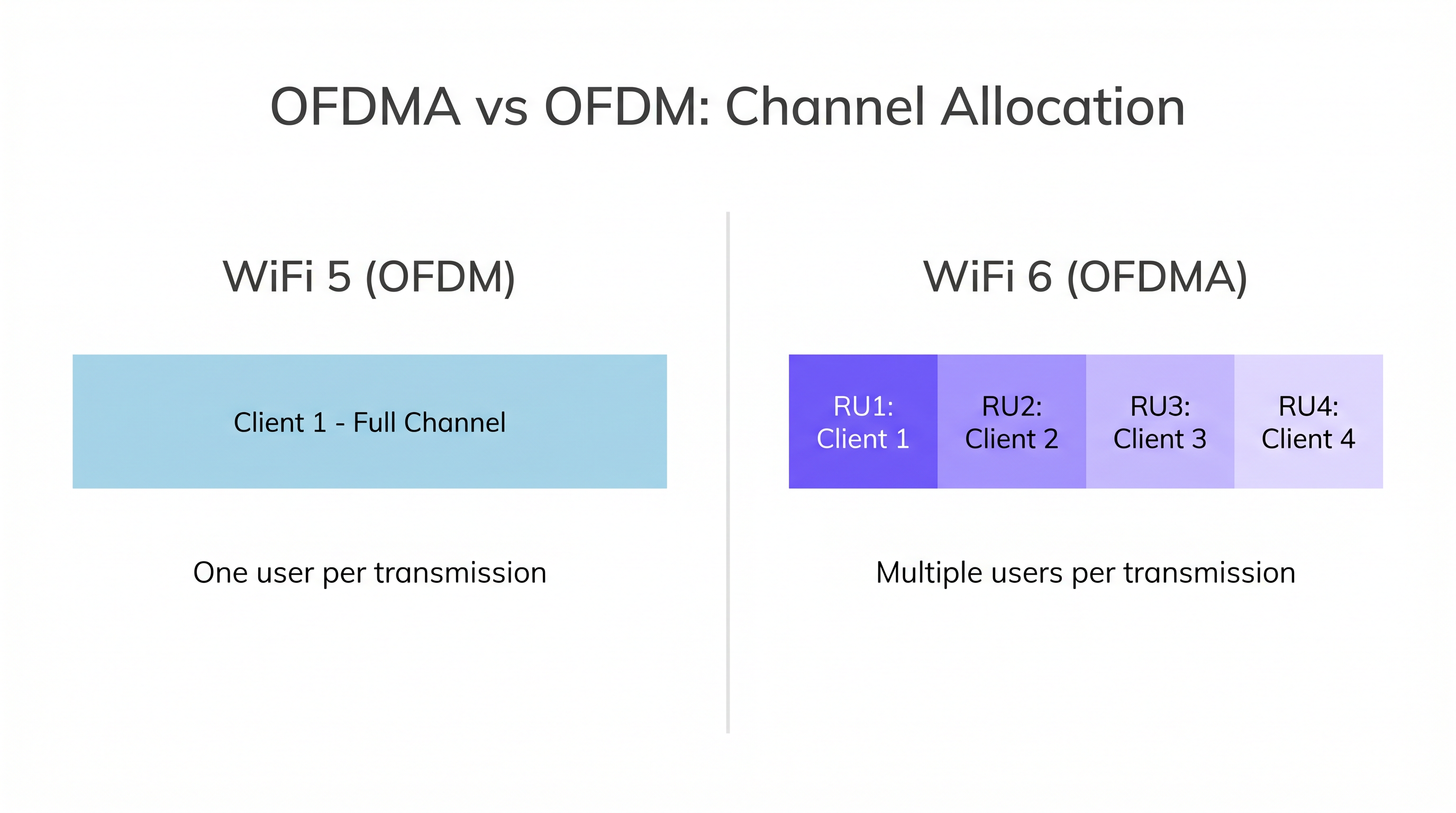
OFDMA को समझने के लिए, हमें पहले इसके पूर्ववर्ती की सीमाओं की जांच करनी चाहिए। WiFi 5 (802.11ac) और पुराने मानकों में, नेटवर्क Orthogonal Frequency Division Multiplexing (OFDM) का उपयोग करते थे। OFDM एक विशिष्ट ट्रांसमिशन के लिए एक एकल क्लाइंट को संपूर्ण चैनल बैंडविड्थ — चाहे वह 20MHz, 40MHz, या 80MHz हो — आवंटित करता है। भले ही क्लाइंट को केवल एक छोटा पेलोड ट्रांसमिट करने की आवश्यकता हो, जैसे कि DNS अनुरोध, TCP पावती, या IoT सेंसर पिंग, वह उस अवधि के लिए पूरे चैनल पर एकाधिकार कर लेता है।
Retail या Hospitality जैसे घने वातावरण में, यह एक बड़ा बॉटलनेक पैदा करता है। छोटे पैकेट ट्रांसमिट करने के लिए कतार में लगे सैकड़ों उपकरणों के परिणामस्वरूप महत्वपूर्ण कंटेंशन ओवरहेड और लेटेंसी स्पाइक्स होते हैं। समस्या अपर्याप्त बैंडविड्थ नहीं है — बल्कि यह है कि प्रोटोकॉल मौलिक रूप से सिंगल-यूज़र है।
OFDMA समाधान: रिसोर्स यूनिट्स (RUs)
OFDMA चैनल को रिसोर्स यूनिट्स (RUs) के रूप में जाने जाने वाले छोटे सब-चैनलों में विभाजित करके इस प्रतिमान को मौलिक रूप से बदल देता है। एक उपयोगकर्ता को 20MHz चैनल समर्पित करने के बजाय, एक WiFi 6 एक्सेस पॉइंट (AP) उस 20MHz चैनल को नौ अलग-अलग RUs (26-टोन RUs का उपयोग करके) तक उप-विभाजित कर सकता है। यह AP को एक ही ट्रांसमिशन अवसर (TXOP) में एक साथ नौ क्लाइंट्स तक संवाद करने की अनुमति देता है।
| चैनल की चौड़ाई | अधिकतम RUs (26-टोन) | अधिकतम एक साथ क्लाइंट्स |
|---|---|---|
| 20 MHz | 9 | 9 |
| 40 MHz | 18 | 18 |
| 80 MHz | 37 | 37 |
| 160 MHz | 74 | 74 |
AP ट्रैफिक कंट्रोलर के रूप में कार्य करता है, जो सभी अपलिंक OFDMA ट्रांसमिशन को व्यवस्थित करने के लिए ट्रिगर फ्रेम्स — 802.11ax में पेश किया गया एक नया मैनेजमेंट फ्रेम प्रकार — का उपयोग करता है। ट्रिगर फ्रेम विशिष्ट क्लाइंट्स को विशिष्ट RUs आवंटित करता है, ट्रांसमिशन पावर निर्धारित करता है, और अपलिंक को सिंक्रोनाइज़ करता है ताकि सभी क्लाइंट सिग्नल एक साथ AP पर पहुंचें। कंटेंशन-आधारित मॉडल (CSMA/CA) से शेड्यूल्ड, ऑर्केस्ट्रेटेड मॉडल में यह बदलाव मुख्य कारण है कि OFDMA लोड के तहत लेटेंसी में इतना नाटकीय सुधार करता है।
सबकैरियर आर्किटेक्चर
WiFi 6 सबकैरियर स्पेसिंग को 312.5 kHz (WiFi 5) से घटाकर 78.125 kHz कर देता है — जो कि चार गुना कमी है। यह सख्त स्पेसिंग लंबे सिंबल ड्यूरेशन (12.8μs बनाम 3.2μs) को सक्षम बनाती है, जो मल्टीपाथ फेडिंग के खिलाफ मजबूती में सुधार करती है। गोदामों, Transport हब, या बड़े ओपन-प्लान रिटेल फ्लोर जैसे वातावरण में जहां सिग्नल धातु की अलमारियों और कंक्रीट संरचनाओं से टकराकर वापस आते हैं, यह लिंक विश्वसनीयता में एक सार्थक सुधार है।
BSS कलरिंग
हालांकि यह सख्ती से OFDMA का हिस्सा नहीं है, BSS कलरिंग इसके साथ मिलकर काम करता है। यह PHY हेडर में 6-बिट आइडेंटिफायर जोड़ता है, जिससे रेडियो अपने स्वयं के नेटवर्क (इंट्रा-BSS) और पड़ोसी नेटवर्क (इंटर-BSS) के बीच ट्रांसमिशन में अंतर कर सकते हैं। यह स्थानिक पुन: उपयोग (spatial reuse) तंत्र घने परिनियोजन में को-चैनल इंटरफेरेंस को काफी कम करता है जहां कई APs आस-पास के क्षेत्रों में एक ही चैनल पर काम करते हैं।
कार्यान्वयन गाइड
OFDMA-सक्षम नेटवर्क को तैनात करने के लिए डिजाइन दर्शन में बदलाव की आवश्यकता होती है। लीगेसी नेटवर्क कवरेज के लिए डिज़ाइन किए गए थे; आधुनिक उच्च-घनत्व वाले नेटवर्क क्षमता के लिए डिज़ाइन किए जाने चाहिए।
1. क्लाइंट इकोसिस्टम की तैयारी
WiFi 6 परिनियोजन में सबसे आम गलती क्लाइंट मिक्स पर विचार किए बिना तत्काल प्रदर्शन लाभ मान लेना है। OFDMA के लिए दोनों सिरों पर 802.11ax हार्डवेयर की आवश्यकता होती है। यदि किसी वेन्यू में 70% लीगेसी क्लाइंट बेस (WiFi 4/5) है, तो AP को उनकी सेवा के लिए बार-बार मानक OFDM पर वापस जाना होगा, जिससे OFDMA के लाभ समाप्त हो जाएंगे।
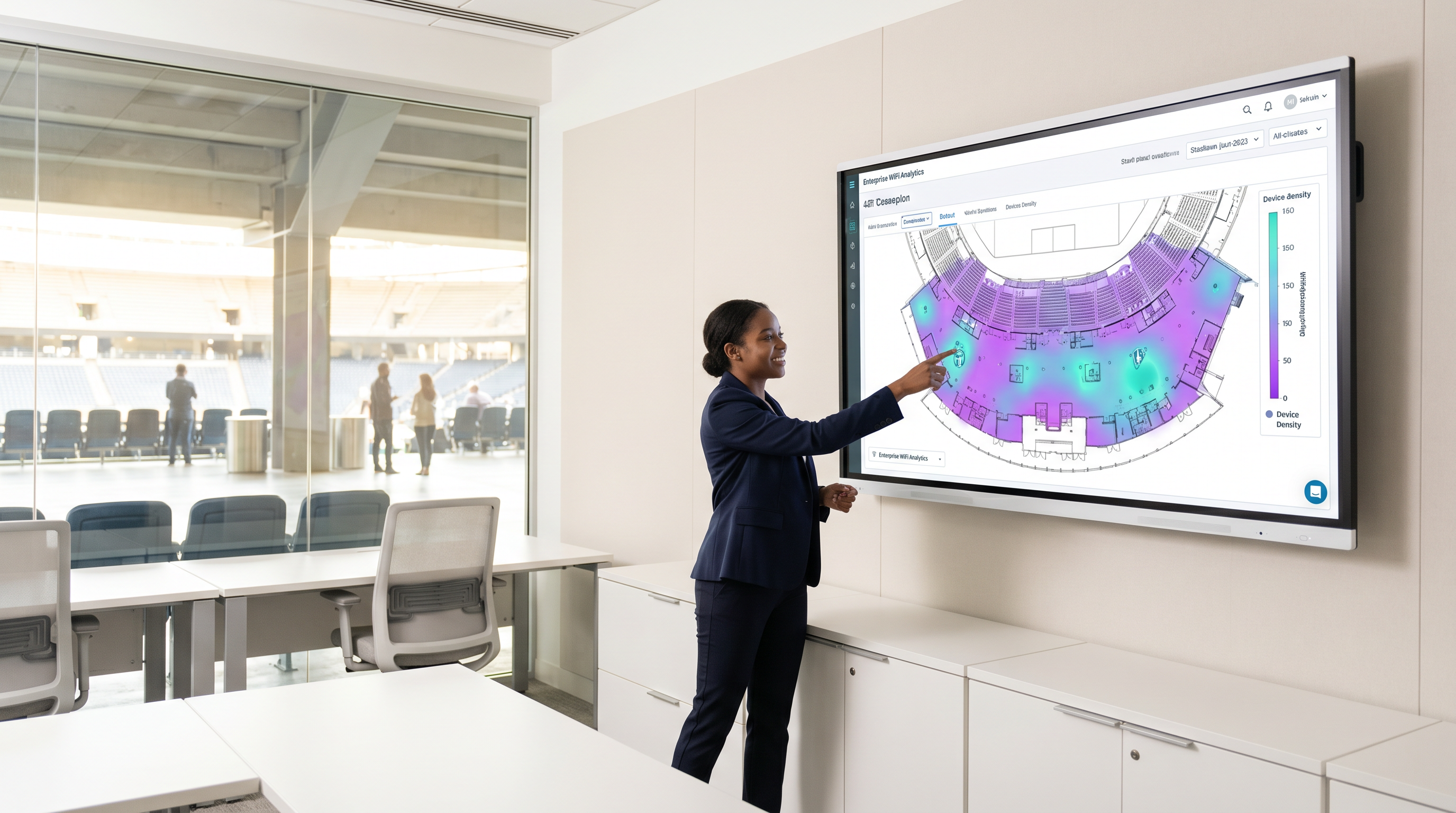
आर्किटेक्चर रिफ्रेश करने से पहले क्लाइंट इकोसिस्टम को प्रोफाइल करने के लिए WiFi Analytics का उपयोग करें। Sensors या IoT उपकरणों पर निर्भर वातावरण के लिए, सुनिश्चित करें कि नई खरीद में WiFi 6 अनुपालन अनिवार्य हो। सक्षम उपकरणों को 5GHz या 6GHz बैंड पर धकेलने के लिए आक्रामक बैंड स्टीयरिंग और क्लाइंट आइसोलेशन लागू करें।
2. चैनल विड्थ रणनीति
घने वातावरण में, व्यापक चैनल (80MHz या 160MHz) आम तौर पर हानिकारक होते हैं। वे उपलब्ध नॉन-ओवरलैपिंग चैनलों की संख्या को कम करते हैं, जिससे को-चैनल इंटरफेरेंस बढ़ जाता है।
सिफारिश: अति-घने परिनियोजन (स्टेडियम, ऑडिटोरियम, कॉन्फ्रेंस हॉल) के लिए 20MHz चैनलों पर मानकीकरण करें। यह चैनल के पुन: उपयोग को अधिकतम करता है और BSS कलरिंग को बेहतर ढंग से कार्य करने की अनुमति देता है। OFDMA का उपयोग करने वाला 20MHz चैनल अक्सर कंटेंशन से जूझ रहे 80MHz चैनल की तुलना में 50 समवर्ती उपयोगकर्ताओं के लिए बेहतर कुल थ्रूपुट और कम लेटेंसी प्रदान करेगा।
3. पावर और PoE संबंधी विचार
WiFi 6 APs में परिष्कृत रेडियो होते हैं जिन्हें अधिक पावर की आवश्यकता होती है। कई एंटरप्राइज APs को सभी स्पेशियल स्ट्रीम संचालित करने के लिए 802.3at (PoE+) या 802.3bt (PoE++) की आवश्यकता होती है।सिस्टम और फीचर्स का पूरी तरह से उपयोग करें।
सुझाव: परिनियोजन (deployment) से पहले अपने स्विचिंग इंफ्रास्ट्रक्चर का ऑडिट करें। हाई-एंड WiFi 6 APs को पुराने 802.3af स्विच से जोड़ने से APs की क्षमताएं कम हो जाएंगी — आमतौर पर स्पेशियल स्ट्रीम्स (spatial streams) अक्षम हो जाती हैं या ट्रांसमिट पावर कम हो जाती है — जिससे आपके हार्डवेयर निवेश पर मिलने वाला रिटर्न गंभीर रूप से सीमित हो जाता है।
सर्वोत्तम प्रथाएं
1. मिशन-क्रिटिकल एप्लिकेशन्स के लिए 6GHz (WiFi 6E) को प्राथमिकता दें। WiFi 6E, OFDMA के सभी लाभों को स्पष्ट 6GHz स्पेक्ट्रम में लाता है, जो पुराने WiFi 4/5 क्लाइंट्स से पूरी तरह मुक्त है। यह Healthcare में मिशन-क्रिटिकल एप्लिकेशन्स के लिए विशेष रूप से मूल्यवान है, जहां 2.4GHz और 5GHz पर पुराने मेडिकल डिवाइस क्लिनिकल संचार में हस्तक्षेप नहीं करने चाहिए।
2. सभी नए परिनियोजन में WPA3 अनिवार्य करें। WiFi 6 सर्टिफिकेशन के लिए WPA3 अनिवार्य है और यह Simultaneous Authentication of Equals (SAE) के माध्यम से क्रिप्टोग्राफिक मजबूती में महत्वपूर्ण सुधार प्रदान करता है। यह PCI DSS और GDPR आवश्यकताओं के अनुरूप है और किसी भी नए परिनियोजन में एक गैर-परक्राम्य मानक होना चाहिए। नेटवर्क ऑनबोर्डिंग के सुरक्षित प्रमाणीकरण के संदर्भ में मार्गदर्शन के लिए, Network Onboarding UX: एक निर्बाध WiFi सेटअप अनुभव डिजाइन करना देखें।
3. वायरलेस और WAN रणनीति को एकीकृत करें। एक हाई-परफॉर्मेंस वायरलेस एज के लिए एक मजबूत WAN एज की आवश्यकता होती है। सुनिश्चित करें कि आपका बैकहॉल उस बढ़े हुए कुल थ्रूपुट (aggregate throughput) को संभाल सकता है जो एक ठीक से काम करने वाला OFDMA नेटवर्क उत्पन्न करेगा। एकीकरण रणनीतियों के लिए आधुनिक व्यवसायों के लिए मुख्य SD WAN लाभ की समीक्षा करें जो आपके वायरलेस और WAN निवेशों को संरेखित करती हैं।
4. उसी इंफ्रास्ट्रक्चर पर Wayfinding तैनात करें। OFDMA की लो-लेटेंसी विशेषताएं WiFi 6 को रीयल-टाइम लोकेशन सेवाओं और वेफाइंडिंग के लिए एक उत्कृष्ट आधार बनाती हैं। वही इंफ्रास्ट्रक्चर निवेश जो अतिथि कनेक्टिविटी में सुधार करता है, साथ ही इनडोर नेविगेशन को भी शक्ति प्रदान कर सकता है, जिससे स्वामित्व की कुल लागत (TCO) कम हो जाती है।
समस्या निवारण और जोखिम न्यूनीकरण
लक्षण: WiFi 6 APs तैनात होने के बावजूद हाई लेटेंसी।
सबसे संभावित मूल कारण पुराने क्लाइंट्स का उच्च प्रतिशत है जो AP को पुराने OFDM मोड में मजबूर करते हैं, या आस-पास के APs के बीच अत्यधिक चैनल ओवरलैप है। अपने नेटवर्क प्रबंधन प्लेटफॉर्म का उपयोग करके क्लाइंट मिक्स का ऑडिट करके शुरुआत करें। यदि पुराने क्लाइंट समस्या हैं, तो बैंड स्टीयरिंग (band steering) लागू करें और एंडपॉइंट रिफ्रेश साइकिल को तेज करने पर विचार करें। यदि चैनल ओवरलैप समस्या है, तो चैनल विड्थ को 20MHz तक कम करें और BSS Coloring सक्षम करें।
लक्षण: APs का रीबूट होना, रेडियो का अक्षम होना, या प्रदर्शन विनिर्देश (specification) से बहुत नीचे होना।
यह लगभग हमेशा PoE पावर की कमी की समस्या होती है। LLDP नेगोशिएशन लॉग के माध्यम से स्विच पोर्ट पावर आवंटन को सत्यापित करें। जांचें कि क्या AP कम-पावर मोड में काम कर रहा है। समाधान के लिए PoE+ या PoE++ स्विच में अपग्रेड करना, या अंतरिम उपाय के रूप में मिड-स्पैन PoE इंजेक्टर तैनात करना आवश्यक है।
लक्षण: प्रबंधन डैशबोर्ड में OFDMA उपयोग मेट्रिक्स शून्य के करीब उपयोग दिखा रहे हैं।
यह इंगित करता है कि AP को OFDMA ट्रांसमिशन शेड्यूल करने के लिए पर्याप्त WiFi 6 क्लाइंट नहीं मिल रहे हैं। क्लाइंट एसोसिएशन टेबल की समीक्षा करें। यदि अधिकांश संबद्ध क्लाइंट पुराने डिवाइस हैं, तो OFDMA निष्क्रिय रहेगा। यह क्लाइंट इकोसिस्टम की समस्या है, न कि AP कॉन्फ़िगरेशन की समस्या।
ROI और व्यावसायिक प्रभाव
CTOs और वेन्यू ऑपरेटरों के लिए, OFDMA के ROI को उपयोगकर्ता अनुभव, परिचालन दक्षता और इंफ्रास्ट्रक्चर लाइफसाइकिल विस्तार में मापा जाता है।
Retail वातावरण में, कम लेटेंसी का अर्थ है तेज़ पॉइंट-ऑफ-सेल लेनदेन, विश्वसनीय इन्वेंट्री स्कैनिंग और रिस्पॉन्सिव Wayfinding एप्लिकेशन जो ग्राहक यात्रा में सुधार करते हैं। Hospitality सेटिंग में, OFDMA यह सुनिश्चित करता है कि 4K वीडियो स्ट्रीम करने वाले मेहमान होटल कर्मचारियों द्वारा की जाने वाली VoIP कॉल की लेटेंसी को प्रभावित न करें — जो पुराने WiFi 5 परिनियोजन में एक आम शिकायत है। हॉस्पिटैलिटी-विशिष्ट परिनियोजन रणनीतियों पर विस्तृत मार्गदर्शन के लिए, आधुनिक Hospitality WiFi समाधान जिसके आपके मेहमान हकदार हैं देखें।
RF स्पेक्ट्रम की क्षमता बढ़ाकर, OFDMA वायरलेस इंफ्रास्ट्रक्चर के लाइफसाइकिल को बढ़ाता है, भविष्य के बड़े स्तर के (forklift) अपग्रेड की आवश्यकता में देरी करता है और IoT विस्तार के लिए एक मजबूत आधार प्रदान करता है। एक नेटवर्क जो आज 200 एक साथ जुड़े क्लाइंट्स को कुशलतापूर्वक सेवा दे सकता है, वह कल 400 को समायोजित कर सकता है — अधिक APs जोड़कर नहीं, बल्कि स्पेक्ट्रम का अधिक बुद्धिमानी से उपयोग करके।
हार्डवेयर चयन मार्गदर्शन के लिए, हमारे Wireless Access Points की परिभाषा: आपकी अंतिम 2026 गाइड से परामर्श लें। WiFi 6 आपकी ऑनबोर्डिंग और उपयोगकर्ता अनुभव रणनीति के साथ कैसे एकीकृत होता है, इसकी व्यापक समझ के लिए, Network Onboarding UX: एक निर्बाध WiFi सेटअप अनुभव डिजाइन करना गाइड बहुभाषी परिनियोजन संदर्भ प्रदान करती है।
मुख्य शब्द और परिभाषाएं
OFDMA (Orthogonal Frequency Division Multiple Access)
A multi-user technology introduced in IEEE 802.11ax (WiFi 6) that subdivides a WiFi channel into smaller frequency allocations called Resource Units (RUs), allowing an AP to communicate with multiple clients simultaneously within a single transmission opportunity.
The core feature of WiFi 6 that reduces latency and increases spectral efficiency in dense deployments. IT teams should understand OFDMA as the primary justification for WiFi 6 upgrades in high-density venues.
Resource Unit (RU)
A specific subset of subcarriers within an OFDMA channel allocated to a single client for a given transmission. RU sizes range from 26 tones (smallest, for IoT/small packets) to 996 tones (full channel, for high-throughput clients).
IT teams must understand RUs to grasp how bandwidth is dynamically allocated to clients based on their traffic needs. A client sending a DNS query gets a small RU; a client streaming 4K video gets a larger RU.
Trigger Frame
A management frame sent by the AP to orchestrate uplink OFDMA transmissions. It allocates specific RUs to specific clients, specifies transmission power levels, and synchronises client timing so all uplink signals arrive at the AP simultaneously.
Crucial for understanding how the AP acts as the traffic controller in a WiFi 6 network. Without Trigger Frames, uplink OFDMA cannot function — the AP must actively schedule clients rather than waiting for them to contend for airtime.
BSS Coloring
A spatial reuse technique in IEEE 802.11ax that adds a 6-bit colour identifier to PHY headers, allowing radios to distinguish between transmissions from their own network (intra-BSS) and neighbouring networks on the same channel (inter-BSS).
Essential for mitigating co-channel interference in ultra-dense environments like stadiums, retail malls, or multi-floor office buildings. Works in concert with OFDMA to improve overall spectral efficiency.
Subcarrier
A narrow frequency band within a larger WiFi channel used to carry data. WiFi 6 uses subcarrier spacing of 78.125 kHz, compared to 312.5 kHz in WiFi 5, quadrupling the number of subcarriers and enabling finer-grained frequency allocation.
The tighter subcarrier spacing in WiFi 6 is what makes OFDMA's fine-grained RU allocation possible, and also improves multipath resilience in complex RF environments.
TXOP (Transmission Opportunity)
A bounded time interval during which a device has the right to initiate frame exchanges on the wireless medium. In WiFi 6, OFDMA maximises the efficiency of each TXOP by packing data for multiple users into a single transmission.
Understanding TXOPs helps IT teams appreciate why OFDMA reduces overhead: instead of each client requiring its own TXOP (with associated contention and backoff delays), multiple clients share a single TXOP.
Spatial Streams (MIMO)
Independent data signals transmitted simultaneously using Multiple-Input Multiple-Output (MIMO) antenna technology. WiFi 6 APs support up to 8 spatial streams (8x8 MIMO), which work in conjunction with OFDMA to increase overall capacity.
High-density deployments require APs with sufficient spatial stream support. However, spatial streams require adequate PoE power — a key infrastructure consideration when specifying hardware.
WPA3
The latest WiFi security certification, featuring Simultaneous Authentication of Equals (SAE) to protect against offline dictionary attacks, and Forward Secrecy to protect past sessions if a key is later compromised. Mandatory for all WiFi 6 certified devices.
Mandatory for WiFi 6 certification. For organisations subject to PCI DSS (payment card environments) or GDPR (personal data processing), WPA3 is a compliance requirement, not merely a best practice.
PoE+ (802.3at) and PoE++ (802.3bt)
IEEE standards for Power over Ethernet that define the maximum power delivered per port. 802.3at delivers up to 30W; 802.3bt delivers up to 90W. Both exceed the legacy 802.3af standard (15.4W) required by modern WiFi 6 APs.
A critical infrastructure consideration for any WiFi 6 deployment. Failing to provision adequate PoE power is the most common cause of underperforming WiFi 6 installations.
केस स्टडीज
A 500-room resort hotel is experiencing severe guest complaints regarding WiFi performance during the evening 'Netflix hour' (8 PM to 11 PM). They currently use 802.11ac (WiFi 5) APs configured with 80MHz channels on the 5GHz band. The network team has already deployed a high AP density — one AP per floor section — but performance remains poor. How should the network architect redesign the RF environment using WiFi 6 and OFDMA?
Step 1 — Client Ecosystem Audit: Before any hardware change, use WiFi Analytics to profile the client mix. Identify what percentage of connected devices are WiFi 6 capable. In a typical hotel, this will range from 40% to 70% depending on guest demographics. Step 2 — Channel Width Reduction: Immediately reduce 5GHz channel widths from 80MHz to 20MHz on the existing APs. This alone will reduce co-channel interference and improve aggregate performance, even before the WiFi 6 upgrade. Step 3 — WiFi 6 AP Deployment: Replace existing APs with WiFi 6 (802.11ax) models. Ensure the switching infrastructure supports PoE+ (802.3at). Configure OFDMA and BSS Coloring on all APs. Step 4 — Band Steering and QoS: Implement aggressive band steering to push 5GHz-capable clients off the 2.4GHz band. Configure QoS policies to prioritise latency-sensitive traffic (VoIP, interactive applications) over bulk streaming traffic. Step 5 — Monitoring: Deploy real-time monitoring to track OFDMA utilisation, client distribution per AP, and per-client throughput. Adjust AP placement if any single AP is serving more than 40 concurrent active clients.
A stadium IT director needs to deploy connectivity for a dense concourse area where up to 8,000 fans congregate during halftime. They plan to deploy high-density WiFi 6 APs rated for 8x8 MIMO but are constrained by legacy PoE (802.3af) switches in the intermediate distribution frames (IDFs). The project budget does not currently include switch replacement. What is the critical risk, and how should it be mitigated within the existing budget constraint?
The critical risk is power starvation. High-density WiFi 6 APs with 8x8 MIMO typically require 802.3at (PoE+, up to 30W) or 802.3bt (PoE++, up to 90W) to fully power their radios, dedicated scanning radios, and onboard processors. If connected to 802.3af switches (maximum 15.4W), the APs will enter a power-saving mode. Typical degradation includes: dropping from 8x8 to 4x4 or 2x2 MIMO, disabling the dedicated scanning radio (which handles security monitoring and analytics), and reducing transmit power. Mitigation within budget: Deploy mid-span PoE injectors between the 802.3af switch and each AP. A mid-span injector takes the existing PoE feed and supplements it to deliver PoE+ or PoE++ levels. This is significantly cheaper than replacing the switches and can be deployed without any changes to the IDF. Budget the injector cost into the AP deployment line item. Document this as a temporary measure and include switch replacement in the next capital expenditure cycle.
परिदृश्य विश्लेषण
Q1. You are designing a high-density WiFi network for a university lecture hall seating 300 students. The primary use case is concurrent online examination, where all students must maintain a stable, low-latency connection simultaneously. The hall has a dropped ceiling with regular grid tiles. Which channel width configuration is most appropriate for the 5GHz band, and why?
💡 संकेत:Consider the impact of co-channel interference and the number of non-overlapping 5GHz channels available in a confined space. Also consider what happens to OFDMA efficiency as channel width increases.
अनुशंसित दृष्टिकोण दिखाएं
20MHz channels are the most appropriate configuration. While 80MHz channels offer higher peak speeds for individual users, they reduce the number of non-overlapping 5GHz channels from approximately 24 (at 20MHz) to just 6 (at 80MHz) in the UNII-1 through UNII-3 bands. In a lecture hall requiring multiple APs, this leads to severe co-channel interference. 20MHz channels maximise channel reuse, allowing more APs to operate cleanly in adjacent areas. Within those 20MHz channels, OFDMA efficiently handles the concurrent client load by allocating Resource Units to each student's device simultaneously, delivering low latency and high aggregate throughput — exactly what an online examination environment requires.
Q2. A retail chain is upgrading 50 stores to WiFi 6 to support new IoT shelf sensors, mobile POS terminals, and a customer-facing Guest WiFi service. The project budget covers new WiFi 6 APs but does not include switch replacement. The existing switches are all 802.3af (PoE). The IT director insists the project can proceed without switch upgrades. What is the likely outcome, and what is your recommendation?
💡 संकेत:Review the power requirements for modern 802.11ax radios compared to legacy 802.3af limits. Consider what features are typically disabled when an AP enters power-saving mode.
अनुशंसित दृष्टिकोण दिखाएं
The likely outcome is that the new WiFi 6 APs will operate in a degraded power-saving mode. To remain within the 15.4W limit of 802.3af, the APs will typically disable spatial streams (dropping from 4x4 to 2x2), reduce transmit power, and disable auxiliary radios such as dedicated BLE scanning radios. This severely limits the expected performance gains and may render the IoT sensor integration unreliable if it depends on the BLE radio. The recommendation is to either include mid-span PoE injectors in the project budget (a cost-effective interim solution) or to phase the switch upgrade alongside the AP deployment, prioritising the highest-density stores first.
Q3. During a post-deployment review of a newly installed WiFi 6 network in a 1,200-bed hospital, the network team observes that OFDMA utilisation metrics in the management dashboard are consistently below 10%, and average client latency has not improved significantly compared to the previous WiFi 5 deployment. The APs are correctly configured and receiving full PoE+ power. What is the most likely root cause, and what remediation steps would you recommend?
💡 संकेत:Consider the requirements for OFDMA to activate, the typical composition of device types in a hospital environment, and what the management dashboard's client association table would reveal.
अनुशंसित दृष्टिकोण दिखाएं
The most likely root cause is a high percentage of legacy (WiFi 4/WiFi 5) clients on the network. Hospitals typically have a large installed base of legacy medical devices — infusion pumps, patient monitoring systems, nurse call systems, and older clinical workstations — many of which are on long replacement cycles and are not WiFi 6 capable. OFDMA requires 802.11ax hardware on both the AP and the client. If the majority of associated clients are legacy, the AP operates predominantly in OFDM mode, and OFDMA remains dormant. Remediation steps: (1) Use WiFi Analytics to generate a full client device report, segmented by WiFi generation. (2) Identify which device categories represent the largest legacy population. (3) Work with clinical engineering to accelerate the refresh cycle for high-volume legacy devices. (4) In the interim, implement band steering to segregate legacy devices onto dedicated 2.4GHz SSIDs, freeing the 5GHz band for WiFi 6 clients where OFDMA can operate effectively. (5) For new clinical device procurement, mandate WiFi 6 compliance as a purchasing requirement.
मुख्य निष्कर्ष
- ✓OFDMA is the core technology of WiFi 6 that shifts the focus from peak single-user throughput to multi-user spectral efficiency, allowing an AP to serve multiple clients simultaneously within a single channel.
- ✓Unlike legacy OFDM, OFDMA divides channels into Resource Units (RUs), enabling up to nine concurrent transmissions within a single 20MHz channel — dramatically reducing latency and contention overhead.
- ✓Maximum OFDMA benefits require a high percentage of WiFi 6-capable clients; legacy devices force the network back into less efficient OFDM mode, making a client ecosystem audit essential before deployment.
- ✓High-density designs should standardise on 20MHz channels to maximise frequency reuse and minimise co-channel interference — wider channels reduce available non-overlapping channels and increase contention.
- ✓Upgrading to WiFi 6 APs almost always necessitates upgrading switching infrastructure to support PoE+ (802.3at) or PoE++ (802.3bt); power starvation is the most common cause of underperforming WiFi 6 deployments.
- ✓BSS Coloring works in concert with OFDMA to mitigate co-channel interference in dense venues by allowing radios to distinguish and deprioritise transmissions from neighbouring networks.
- ✓The ROI of OFDMA is measured in user experience, operational efficiency, and infrastructure lifecycle extension — not just headline throughput figures.




