

WiFi प्रशासकों के लिए PKI के मूल सिद्धांत: प्रमाणपत्र, CAs, और ट्रस्ट चेन
यह तकनीकी संदर्भ मार्गदर्शिका एंटरप्राइज़ WiFi प्रशासकों के लिए पब्लिक की इन्फ्रास्ट्रक्चर (PKI) की मूलभूत अवधारणाओं की व्याख्या करती है, जिसमें प्रमाणपत्र प्राधिकरण (certificate authorities), ट्रस्ट चेन और X.509 प्रमाणपत्र शामिल हैं। यह विस्तार से बताता है कि कैसे PKI, EAP-TLS पारस्परिक प्रमाणीकरण (mutual authentication) का आधार बनता है और हॉस्पिटैलिटी, रिटेल और सार्वजनिक क्षेत्र के वातावरण में IT टीमों के लिए कार्रवाई योग्य परिनियोजन मार्गदर्शन प्रदान करता है। Purple के साथ प्रमाणपत्र-आधारित स्टाफ WiFi प्रमाणीकरण को तैनात करने के लिए PKI को समझना एक अनिवार्य शर्त है।
🎧 इस गाइड को सुनें
ट्रांसक्रिप्ट देखें

कार्यकारी सारांश
IT प्रबंधकों, नेटवर्क आर्किटेक्ट्स और वेन्यू ऑपरेशंस निदेशकों के लिए, कॉर्पोरेट और स्टाफ WiFi नेटवर्क को सुरक्षित करना एक महत्वपूर्ण अनुपालन और परिचालन आवश्यकता है। प्री-शेयर्ड कीज़ (PSKs) या MAC एड्रेस फ़िल्टरिंग जैसे पुराने प्रमाणीकरण तरीके आधुनिक एंटरप्राइज़ वातावरण के लिए अपर्याप्त हैं, जिससे नेटवर्क क्रेडेंशियल चोरी और डिवाइस स्पूफिंग के प्रति संवेदनशील हो जाते हैं। मजबूत, ऑडिट योग्य सुरक्षा प्राप्त करने के लिए, संगठनों को प्रमाणपत्र-आधारित प्रमाणीकरण — विशेष रूप से EAP-TLS (एक्सटेंसिबल ऑथेंटिकेशन प्रोटोकॉल-ट्रांसपोर्ट लेयर सिक्योरिटी) पर स्विच करना चाहिए।
EAP-TLS को तैनात करने के लिए पब्लिक की इन्फ्रास्ट्रक्चर (PKI) की ठोस समझ की आवश्यकता होती है। यह मार्गदर्शिका WiFi प्रशासकों के लिए PKI को सरल बनाती है, प्रमाणपत्र प्राधिकरणों (CAs) की भूमिकाओं, ट्रस्ट चेन की कार्यप्रणाली और सर्वर और क्लाइंट प्रमाणपत्रों के बीच व्यावहारिक अंतर को समझाती है। इन मूल सिद्धांतों में महारत हासिल करके, IT टीमें हॉस्पिटैलिटी , रिटेल , और सार्वजनिक क्षेत्र के वेन्यू में सुरक्षित, स्केलेबल नेटवर्क एक्सेस समाधानों को आत्मविश्वास के साथ डिजाइन और कार्यान्वित कर सकती हैं, जिससे PCI DSS और GDPR जैसे मानकों का अनुपालन सुनिश्चित होता है और प्रबंधित उपकरणों के लिए निर्बाध, पासवर्ड-मुक्त कनेक्टिविटी प्रदान की जाती है। Purple के साथ प्रमाणपत्र-आधारित स्टाफ WiFi प्रमाणीकरण को तैनात करने के लिए PKI को समझना भी मूलभूत आवश्यकता है।
तकनीकी गहन विश्लेषण
ट्रस्ट का आर्किटेक्चर: पब्लिक की इन्फ्रास्ट्रक्चर क्या है?
पब्लिक की इन्फ्रास्ट्रक्चर (PKI) एक क्रिप्टोग्राफिक फ्रेमवर्क है जो एक असुरक्षित नेटवर्क पर सुरक्षित संचार और पारस्परिक प्रमाणीकरण को सक्षम बनाता है। एंटरप्राइज़ WiFi के संदर्भ में, PKI एक डिजिटल पासपोर्ट सिस्टम के रूप में कार्य करता है, जो किसी भी डेटा के आदान-प्रदान से पहले क्लाइंट डिवाइस (सप्लीकेंट) और नेटवर्क ऑथेंटिकेशन सर्वर (RADIUS सर्वर) दोनों की पहचान की पुष्टि करता है।
यह सिस्टम X.509 प्रमाणपत्रों पर निर्भर करता है, जो एक सार्वजनिक कुंजी (public key) को एक सत्यापित पहचान — जैसे सर्वर होस्टनाम या उपयोगकर्ता के ईमेल पते — से जोड़ते हैं और प्रमाणपत्र प्राधिकरण (CA) के रूप में जाने जाने वाले एक विश्वसनीय तीसरे पक्ष द्वारा डिजिटल रूप से हस्ताक्षरित होते हैं। CA का हस्ताक्षर क्रिप्टोग्राफिक गारंटी है कि पहचान का दावा वैध है।
प्रमाणपत्र पदानुक्रम और ट्रस्ट चेन
PKI की ताकत इसके पदानुक्रमित ढांचे में निहित है, जिसे ट्रस्ट चेन के रूप में जाना जाता है। यह पदानुक्रम सुनिश्चित करता है कि किसी डिवाइस या सर्वर द्वारा प्रस्तुत किसी भी प्रमाणपत्र को क्रिप्टोग्राफिक रूप से सार्वभौमिक रूप से विश्वसनीय स्रोत तक ट्रैक किया जा सकता है। इसके तीन स्तर इस प्रकार हैं।
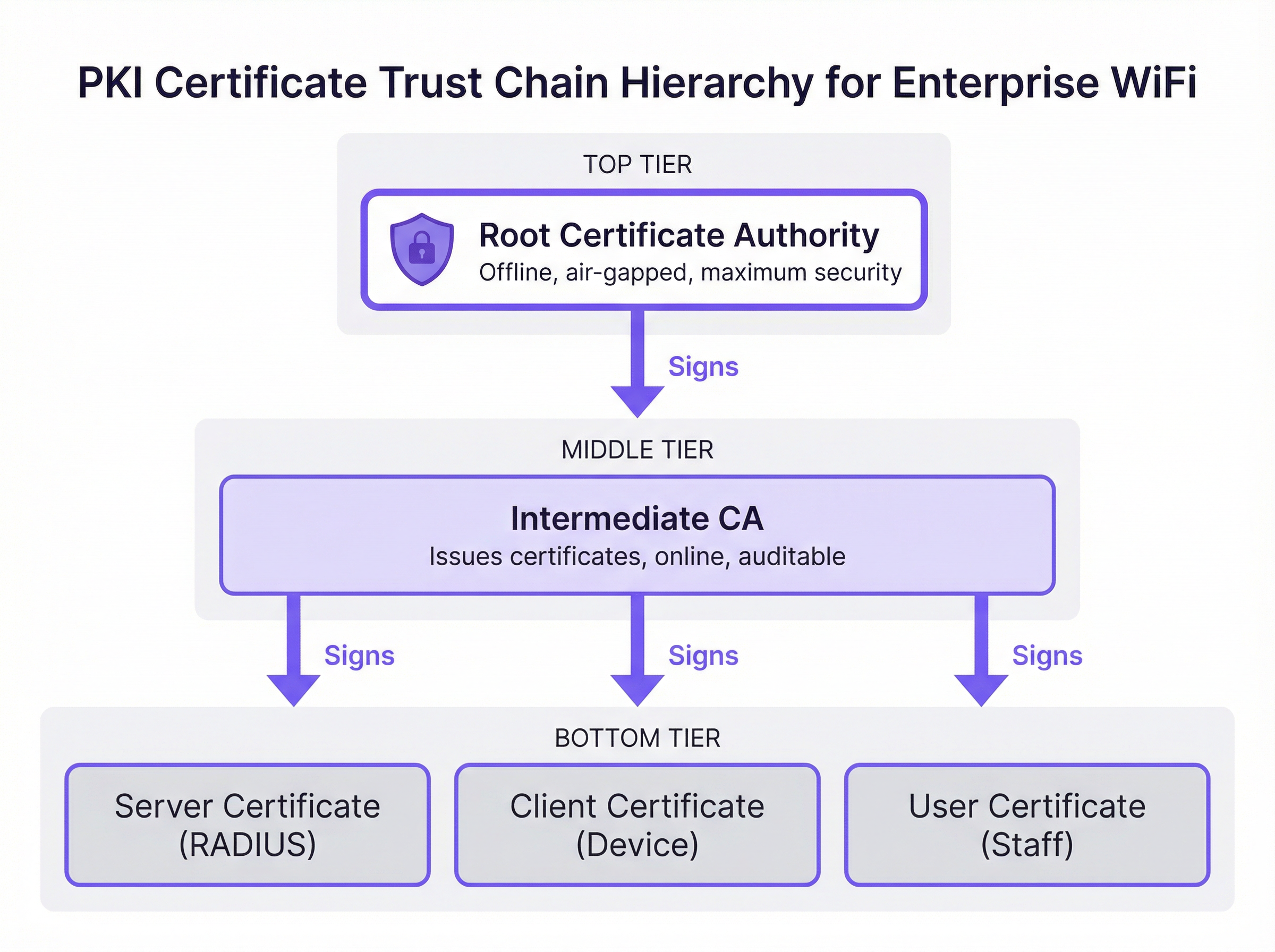
रूट प्रमाणपत्र प्राधिकरण (Root CA): Root CA पूरे PKI इकोसिस्टम का क्रिप्टोग्राफिक एंकर है। यह एक स्व-हस्ताक्षरित प्रमाणपत्र जारी करता है और क्लाइंट डिवाइस और सर्वर द्वारा स्वाभाविक रूप से विश्वसनीय होता है। एक सुरक्षित एंटरप्राइज़ परिनियोजन में, Root CA को इसकी निजी कुंजी (private key) को नेटवर्क-आधारित खतरों से बचाने के लिए ऑफलाइन और एयर-गैप्ड रखा जाता है। इसका एकमात्र परिचालन उद्देश्य इंटरमीडिएट CAs के प्रमाणपत्रों पर हस्ताक्षर करना है।
इंटरमीडिएट प्रमाणपत्र प्राधिकरण (Intermediate CA): Intermediate CA अत्यधिक सुरक्षित Root CA और परिचालन वातावरण के बीच एक बफर के रूप में कार्य करता है। यह ऑनलाइन होता है और लीफ प्रमाणपत्रों के दैनिक जारी करने और निरस्तीकरण (revocation) को संभालता है। यह अलगाव एक महत्वपूर्ण जोखिम शमन रणनीति है: यदि एक Intermediate CA के साथ समझौता किया जाता है, तो इसे पूरे PKI इन्फ्रास्ट्रक्चर को अमान्य किए बिना या प्रत्येक क्लाइंट डिवाइस को पुन: कॉन्फ़िगर किए बिना Root CA द्वारा रद्द किया जा सकता है।
लीफ प्रमाणपत्र (एंड-एंटीटी सर्टिफिकेट): ये व्यक्तिगत सर्वर और क्लाइंट डिवाइस पर इंस्टॉल किए गए प्रमाणपत्र हैं। ये ट्रस्ट चेन के सबसे नीचे होते हैं और स्वयं अन्य प्रमाणपत्रों पर हस्ताक्षर नहीं कर सकते। WiFi परिनियोजन से संबंधित दो प्राथमिक प्रकार हैं। सर्वर प्रमाणपत्र RADIUS सर्वर पर इंस्टॉल किया जाता है, जिससे क्लाइंट डिवाइस यह सत्यापित कर सकते हैं कि वे वैध कॉर्पोरेट नेटवर्क से जुड़ रहे हैं। क्लाइंट प्रमाणपत्र स्टाफ लैपटॉप, मोबाइल डिवाइस या पॉइंट-ऑफ-सेल टर्मिनलों पर इंस्टॉल किया जाता है, जिससे RADIUS सर्वर प्रत्येक विशिष्ट डिवाइस या उपयोगकर्ता की पहचान सत्यापित कर सकता है।
PKI कैसे EAP-TLS प्रमाणीकरण का आधार बनता है
EAP-TLS सुरक्षित WiFi प्रमाणीकरण के लिए स्वर्ण मानक है क्योंकि यह पारस्परिक प्रमाणपत्र-आधारित प्रमाणीकरण को अनिवार्य बनाता है। इसका मतलब है कि क्लाइंट डिवाइस और RADIUS सर्वर दोनों को PKI ट्रस्ट चेन के विरुद्ध मान्य प्रमाणपत्रों का उपयोग करके एक-दूसरे को अपनी पहचान साबित करनी होगी — जिससे पासवर्ड-आधारित दृष्टिकोणों में निहित जोखिम समाप्त हो जाते हैं।
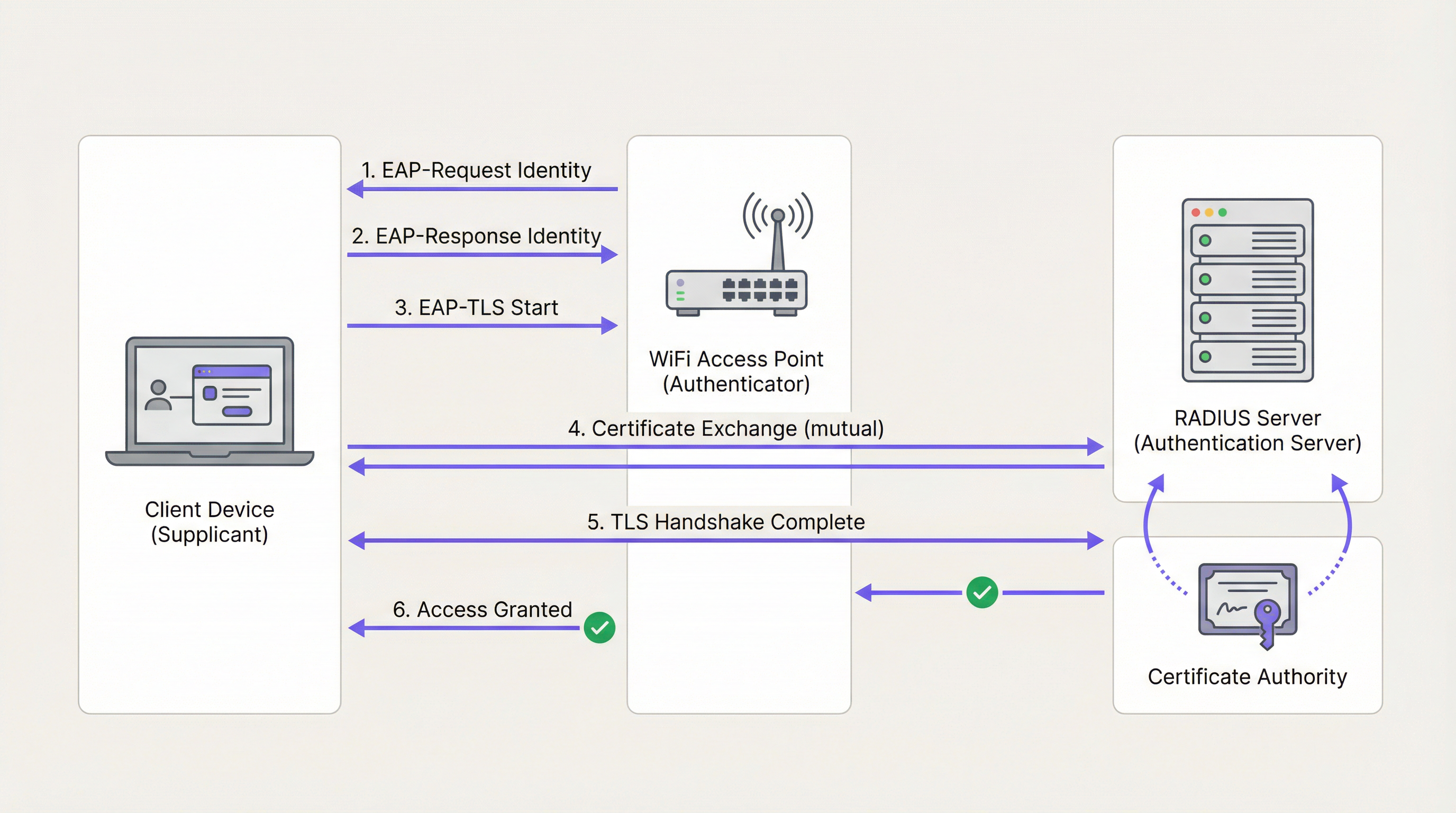
EAP-TLS हैंडशेक के दौरान, जो IEEE 802.1X फ्रेमवर्क के भीतर काम करता है, RADIUS सर्वर पहले क्लाइंट डिवाइस को अपना सर्वर प्रमाणपत्र प्रस्तुत करता है। डिवाइस अपने विश्वसनीय Root CA स्टोर के विरुद्ध प्रमाणपत्र के हस्ताक्षर को मान्य करता है। यदि मान्य है, तो डिवाइस के पास क्रिप्टोग्राफिक प्रमाण होता है कि वह वैध कॉर्पोरेट नेटवर्क से जुड़ रहा है — न कि किसी दुष्ट एक्सेस पॉइंट या ईविल ट्विन से। क्लाइंट डिवाइस फिर RADIUS सर्वर को अपना क्लाइंट प्रमाणपत्र प्रस्तुत करता है, जो इसे CA के विरुद्ध मान्य करता है। एक बार जब दोनों पक्ष प्रमाणित हो जाते हैं, तो एक सुरक्षित TLS टनल स्थापित हो जाती है और नेटवर्क एक्सेस प्रदान किया जाता है। कोई पासवर्ड प्रसारित नहीं किया जाता है, और चोरी होने के लिए कोई साझा रहस्य (shared secrets) मौजूद नहीं होता है।
यह आर्किटेक्चर WPA3-Enterprise की नींव भी है, जो 192-बिट सुरक्षा मोड को अनिवार्य बनाता है और उसी PKI और 802.1X आधारों पर निर्भर करता है। उच्च-सुरक्षा वातावरण में वायरलेस एक्सेस पॉइंट्स तैनात करने वाले संगठनों के लिए, EAP-TLS के साथ WPA3-Enterprise वर्तमान सर्वोत्तम अभ्यास का प्रतिनिधित्व करता है।
पब्लिक CA बनाम प्राइवेट CA: परिनियोजन का निर्णय
एकPKI डिप्लॉयमेंट में सबसे महत्वपूर्ण आर्किटेक्चरल निर्णयों में से एक Public CA और Private CA के बीच चुनाव करना है। नीचे दी गई तालिका इसके लाभों और सीमाओं का सारांश प्रस्तुत करती है।
| मानदंड | Public CA | Private CA |
|---|---|---|
| लागत | प्रति-सर्टिफिकेट शुल्क (कम संख्या में सर्वर के लिए व्यवहार्य) | बुनियादी ढांचे की लागत, लेकिन बड़े पैमाने पर कोई प्रति-सर्टिफिकेट शुल्क नहीं |
| डिवाइस ट्रस्ट | अधिकांश OS और डिवाइस पर डिफ़ॉल्ट रूप से विश्वसनीय | MDM के माध्यम से सभी डिवाइस पर Root CA भेजने की आवश्यकता होती है |
| नियंत्रण | सीमित; CA जारी करने की नीतियों को नियंत्रित करता है | जारी करने, निरस्त करने और लाइफसाइकिल पर पूर्ण नियंत्रण |
| सबसे अच्छा उपयोग | RADIUS सर्वर सर्टिफिकेट | प्रबंधित कॉर्पोरेट डिवाइस के लिए क्लाइंट सर्टिफिकेट |
| अनुपालन | सार्वजनिक CT लॉग के माध्यम से ऑडिट योग्य | आंतरिक ऑडिट प्रक्रियाओं की आवश्यकता होती है |
अधिकांश एंटरप्राइज WiFi डिप्लॉयमेंट के लिए अनुशंसित दृष्टिकोण एक हाइब्रिड मॉडल है: व्यापक अनुकूलता सुनिश्चित करने के लिए RADIUS सर्वर सर्टिफिकेट के लिए Public CA का उपयोग करें, और बड़े पैमाने पर प्रबंधित डिवाइस को क्लाइंट सर्टिफिकेट जारी करने के लिए Private CA (जैसे Microsoft Active Directory Certificate Services या क्लाउड-आधारित PKI प्रदाता) तैनात करें।
कार्यान्वयन गाइड
चरण 1: CA आर्किटेक्चर डिज़ाइन करें
अपनी सर्टिफिकेट आवश्यकताओं का मानचित्रण करके शुरुआत करें। प्रबंधित डिवाइस की संख्या, उपयोग में आने वाले ऑपरेटिंग सिस्टम और उपलब्ध MDM प्लेटफॉर्म की पहचान करें। यह निर्धारित करें कि आपके संगठन के पैमाने और जोखिम प्रोफाइल के लिए टू-टियर (Root CA + Intermediate CA) या थ्री-टियर पदानुक्रम उपयुक्त है या नहीं।
चरण 2: Root और Intermediate CA तैनात और सुरक्षित करें
एक समर्पित, एयर-गैप्ड मशीन पर ऑफलाइन Root CA स्थापित करें। Intermediate CA सर्टिफिकेट पर हस्ताक्षर करने के लिए Root CA का उपयोग करें। सुनिश्चित करें कि Intermediate CA आपके डेटा सेंटर या क्लाउड वातावरण में सुरक्षित रूप से तैनात है और आपके आइडेंटिटी प्रोवाइडर (IdP) या MDM समाधान के साथ एकीकृत है। बजट अनुमति देने पर Root CA प्राइवेट की (private key) को हार्डवेयर सिक्योरिटी मॉड्यूल (HSM) में स्टोर करें।
चरण 3: RADIUS सर्वर कॉन्फ़िगर करें
अपने RADIUS सर्वर पर सर्वर सर्टिफिकेट इंस्टॉल करें। सुरक्षित कॉर्पोरेट SSID के लिए EAP-TLS की आवश्यकता के लिए सर्वर को कॉन्फ़िगर करें। सुनिश्चित करें कि RADIUS सर्वर उस Intermediate CA पर भरोसा करता है जिसने क्लाइंट सर्टिफिकेट जारी किए हैं, और इसे OCSP के माध्यम से निरस्तीकरण (revocation) जाँच करने के लिए कॉन्फ़िगर करें।
चरण 4: MDM के माध्यम से सर्टिफिकेट वितरित करें
बड़े पैमाने पर मैन्युअल सर्टिफिकेट इंस्टॉलेशन का प्रयास कभी न करें। स्वचालित पॉलिसी के माध्यम से सभी प्रबंधित डिवाइस पर Root CA सर्टिफिकेट, Intermediate CA सर्टिफिकेट और अद्वितीय क्लाइंट सर्टिफिकेट भेजने के लिए Microsoft Intune या Jamf जैसे MDM प्लेटफॉर्म का उपयोग करें। यह सुसंगत डिप्लॉयमेंट सुनिश्चित करता है और स्वचालित रिन्यूअल को सक्षम बनाता है।
चरण 5: निरस्तीकरण तंत्र लागू करें और परीक्षण करें
सर्टिफिकेट निरस्तीकरण सूची (CRLs) या ऑनलाइन सर्टिफिकेट स्टेटस प्रोटोकॉल (OCSP) कॉन्फ़िगर करें। एक टेस्ट सर्टिफिकेट को निरस्त करके और यह पुष्टि करके कि RADIUS सर्वर अपेक्षित समय सीमा के भीतर एक्सेस से इनकार करता है, निरस्तीकरण वर्कफ़्लो का शुरू से अंत तक परीक्षण करें। उन वातावरणों के लिए जिन्हें लगभग तत्काल निरस्तीकरण की आवश्यकता होती है — जैसे Retail POS नेटवर्क — OCSP अनिवार्य है।
चरण 6: लाइफसाइकिल प्रबंधन की निगरानी और ऑटोमेशन करें
पदानुक्रम के सभी स्तरों पर सर्टिफिकेट की समाप्ति के लिए स्वचालित निगरानी लागू करें। समाप्ति से 90, 60 और 30 दिन पहले अलर्ट कॉन्फ़िगर करें। 60 दिनों पर रिन्यूअल को स्वचालित करें। नेटवर्क आउटेज को रोकने के लिए यह सबसे प्रभावशाली परिचालन कदम है।
सर्वोत्तम प्रथाएं
बिना किसी अपवाद के म्यूचुअल ऑथेंटिकेशन लागू करें: सुनिश्चित करें कि क्लाइंट डिवाइस RADIUS सर्वर के सर्टिफिकेट को सख्ती से मान्य करने के लिए कॉन्फ़िगर किए गए हैं। सर्वर सर्टिफिकेट वैलिडेशन को अक्षम करना — जो शुरुआती डिप्लॉयमेंट के दौरान एक सामान्य शॉर्टकट है — डिवाइस को मैन-इन-द-मिडल हमलों और क्रेडेंशियल हार्वेस्टिंग के प्रति संवेदनशील बनाता है, और PCI DSS आवश्यकताओं का उल्लंघन करता है।
ऑथेंटिकेशन विधि द्वारा नेटवर्क को अलग करें: समर्पित SSID पर कॉर्पोरेट और स्टाफ डिवाइस के लिए EAP-TLS का उपयोग करें। सार्वजनिक विज़िटर एक्सेस के लिए, पूरी तरह से अलग नेटवर्क पर Guest WiFi जैसा एक मजबूत Captive Portal समाधान तैनात करें। अप्रबंधित गेस्ट डिवाइस पर PKI तैनात करने का प्रयास न करें।
नियमित रूप से PKI इंफ्रास्ट्रक्चर का ऑडिट करें: CA एक्सेस कंट्रोल, निरस्तीकरण सूची और सर्टिफिकेट जारी करने के लॉग का त्रैमासिक ऑडिट करें। Healthcare और Retail वातावरण में, यह क्रमशः HIPAA और PCI DSS के तहत एक अनुपालन आवश्यकता है।
नेटवर्क एनालिटिक्स के साथ एकीकृत करें: एक बार सुरक्षित ऑथेंटिकेशन हो जाने के बाद, डिवाइस के व्यवहार, कनेक्शन पैटर्न और संभावित विसंगतियों की दृश्यता प्राप्त करने के लिए WiFi Analytics की लेयर जोड़ें। एक सुरक्षित नेटवर्क विश्वसनीय डेटा की नींव है।
SD-WAN एकीकरण पर विचार करें: होटल चेन या रिटेल एस्टेट में मल्टी-साइट डिप्लॉयमेंट के लिए, PKI स्वाभाविक रूप से SD-WAN आर्किटेक्चर के साथ एकीकृत होता है। ये तकनीकें एक-दूसरे की पूरक कैसे हैं, इस संदर्भ के लिए The Core SD-WAN Benefits for Modern Businesses देखें।
समस्या निवारण और जोखिम न्यूनीकरण
नीचे दी गई तालिका सामान्य विफलता मोड को उनके मूल कारणों और अनुशंसित समाधानों के साथ दर्शाती है।
| लक्षण | मूल कारण | समाधान |
|---|---|---|
| डिवाइस कनेक्ट नहीं हो सकते; RADIUS लॉग 'Unknown CA' दिखाते हैं | क्लाइंट डिवाइस उस CA पर भरोसा नहीं करता जिसने RADIUS सर्वर सर्टिफिकेट जारी किया है | MDM के माध्यम से सभी डिवाइस पर Root CA भेजें |
| सभी कॉर्पोरेट डिवाइस के लिए अचानक नेटवर्क-व्यापी आउटेज | RADIUS सर्वर सर्टिफिकेट या Intermediate CA सर्टिफिकेट समाप्त हो गया है | स्वचालित निगरानी और रिन्यूअल लागू करें; 90/60/30 दिनों पर अलर्ट सेट करें |
| चोरी हुआ लैपटॉप अभी भी नेटवर्क तक पहुंच सकता है | CRL पुराना है या OCSP कॉन्फ़िगर नहीं है | रीयल-टाइम निरस्तीकरण जाँच के लिए OCSP पर स्विच करें |
| MDM नामांकन के बाद नए डिवाइस कनेक्ट नहीं हो सकते | MDM पॉलिसी द्वारा क्लाइंट सर्टिफिकेट अभी तक नहीं भेजा गया है | MDM पॉलिसी असाइनमेंट सत्यापित करें और डिवाइस सिंक के लिए बाध्य करें |
| रुक-रुक कर ऑथेंटिकेशन विफलताएं | क्लाइंट और RADIUS सर्वर के बीच क्लॉक स्क्यू (समय का अंतर) | सुनिश्चित करें कि सभी डिवाइस NTP समय सिंक्रोनाइज़ेशन का उपयोग करते हैं |
802.1X कॉन्फ़िगरेशन और समस्या निवारण की गहरी समझ के लिए, गाइड 802.1X Authentication: Securing Network Access on Modern Devices विस्तृत वेंडर-न्यूट्रल कॉन्फ़िगरेशन मार्गदर्शन प्रदान करता है।
ROI और व्यावसायिक प्रभाव
PKI-समर्थित EAP-TLS आर्किटेक्चर पर ट्रांज़िशन करना वेन्यू ऑपरेटरों के लिए कई आयामों में मापने योग्य व्यावसायिक मूल्य प्रदान करता है।
जोखिम शमन और अनुपालन: पासवर्ड-आधारित ऑथेंटिकेशन को समाप्त करना नेटवर्क समझौते के लिए सबसे सामान्य हमले के वेक्टर को हटा देता है। यह सीधे तौर पर महंगे डेटा उल्लंघन की संभावना को कम करता है और PCI DSS (पेमेंट प्रोसेसिंग के लिए आवश्यक), GDPR (डेटा सुरक्षा के लिए), और क्षेत्र-विशिष्ट नियमों के अनुपालन को सरल बनाता है। IoT Sensors या स्थान-आधारित Wayfinding सिस्टम तैनात करने वाले वेन्यू के लिए, विश्वसनीय डेटा अखंडता के लिए क्रिप्टोग्राफ़िक रूप से सुरक्षित नेटवर्क एक पूर्व शर्त है।
परिचालन दक्षता: MDM के माध्यम से सर्टिफिकेट परिनियोजन को स्वचालित करना पासवर्ड प्रबंधन के परिचालन ओवरहेड को समाप्त करता है, जिससे WiFi कनेक्टिविटी से संबंधित IT हेल्पडेस्क टिकट कम हो जाते हैं। होटल और रिटेल जैसे उच्च-टर्नओवर वाले वातावरण में, जहाँ स्टाफ की ऑनबोर्डिंग और ऑफबोर्डिंग बार-बार होती है, स्वचालित सर्टिफिकेट जारी करना और निरस्त करना साझा क्रेडेंशियल प्रबंधित करने की तुलना में महत्वपूर्ण समय की बचत प्रदान करता है।
उन्नत सेवाओं के लिए आधार: एक सुरक्षित, प्रमाणित कॉर्पोरेट नेटवर्क वह विश्वसनीय आधार है जिस पर उन्नत परिचालन सेवाएं बनाई जाती हैं। चाहे फुटफॉल इंटेलिजेंस के लिए WiFi Analytics तैनात करना हो, रीयल-टाइम ऑक्यूपेंसी डेटा के लिए Sensors , या बड़े वेन्यू के लिए Wayfinding , इनमें से प्रत्येक क्षमता PKI द्वारा प्रदान की जाने वाली अखंडता गारंटी से लाभान्वित होती है।
विशेष रूप से Hospitality ऑपरेटरों के लिए, एक सुरक्षित स्टाफ नेटवर्क और एक अच्छी तरह से डिज़ाइन किए गए गेस्ट पोर्टल का संयोजन — जैसा कि Modern Hospitality WiFi Solutions Your Guests Deserve में बताया गया है — संपूर्ण एंटरप्राइज WiFi आर्किटेक्चर का प्रतिनिधित्व करता है। Transport हब और बड़े सार्वजनिक वेन्यू के लिए, यही सिद्धांत बड़े पैमाने पर लागू होते हैं।
मुख्य शब्द और परिभाषाएं
Public Key Infrastructure (PKI)
A framework of roles, policies, hardware, software, and procedures needed to create, manage, distribute, use, store, and revoke digital certificates and manage public-key encryption.
The foundational architecture that must be in place before an IT team can deploy secure, certificate-based WiFi authentication using EAP-TLS.
Certificate Authority (CA)
A trusted entity that issues digital certificates, verifying the identity of the certificate subject and binding that identity to a public key with a cryptographic signature.
The central authority in your network that acts as the source of truth for all device and server identities. Without a trusted CA, no certificate-based authentication is possible.
X.509 Certificate
The standard format for public key certificates, defined in RFC 5280. Contains the subject identity, public key, issuer identity, validity period, and the CA's digital signature.
The actual digital passport installed on a laptop or server that proves its identity during the EAP-TLS handshake.
EAP-TLS (Extensible Authentication Protocol-Transport Layer Security)
An 802.1X authentication method that requires mutual certificate-based authentication between the client device (supplicant) and the authentication server (RADIUS). Defined in RFC 5216.
The most secure method for authenticating corporate devices to a WiFi network. Eliminates the need for passwords and provides cryptographic proof of identity for both parties.
Trust Chain
A hierarchical sequence of certificates used to authenticate an entity, starting from the leaf certificate and tracing upward through the Intermediate CA to the Root CA.
The mechanism by which a laptop verifies that a RADIUS server's certificate is legitimate. Each link in the chain is validated until a trusted Root CA is reached.
Certificate Revocation List (CRL)
A periodically published list of digital certificates that have been revoked by the issuing CA before their scheduled expiration date and should no longer be trusted.
A mechanism for blocking access from lost or stolen devices. CRLs are cached and updated on a schedule, meaning revocation may not be immediate — a limitation addressed by OCSP.
Online Certificate Status Protocol (OCSP)
An internet protocol (RFC 6960) used for obtaining the real-time revocation status of an X.509 digital certificate by querying the CA's OCSP responder.
The preferred revocation mechanism for high-security environments. Enables the RADIUS server to check certificate validity in real-time during each authentication attempt, providing near-instant revocation enforcement.
RADIUS (Remote Authentication Dial-In User Service)
A networking protocol that provides centralised Authentication, Authorisation, and Accounting (AAA) management for users and devices connecting to a network.
The central server in an enterprise WiFi deployment that validates certificates and makes the final access control decision. The RADIUS server is the operational core of an EAP-TLS deployment.
IEEE 802.1X
An IEEE standard for port-based Network Access Control (PNAC) that provides an authentication mechanism for devices wishing to attach to a LAN or WLAN.
The overarching framework within which EAP-TLS operates. Understanding 802.1X is essential for configuring access points and switches to enforce certificate-based authentication.
Mobile Device Management (MDM)
A software platform used by IT administrators to remotely manage, configure, and secure mobile devices and laptops across an organisation.
The essential operational tool for deploying certificates at scale. MDM platforms such as Microsoft Intune and Jamf automate the distribution of Root CA certificates, Intermediate CA certificates, and Client Certificates to all managed devices.
केस स्टडीज
A 500-room luxury hotel in London needs to secure its staff WiFi network for housekeeping tablets and point-of-sale (POS) terminals. Currently, they use a single Pre-Shared Key (PSK) that has not been rotated in three years and is known to all permanent and agency staff. The IT Director has been tasked with transitioning to a certificate-based architecture before the next PCI DSS audit. How should this be approached?
Phase 1 — Architecture Design: Deploy a cloud-based Private PKI (e.g., Microsoft NDES via Intune, or a dedicated cloud PKI provider) integrated with the hotel's MDM platform. Obtain a RADIUS Server Certificate from a Public CA such as DigiCert.
Phase 2 — Infrastructure Deployment: Configure the RADIUS server with the new Server Certificate and enable EAP-TLS on a new hidden SSID designated for staff devices. Configure OCSP for real-time revocation checking.
Phase 3 — Device Enrolment: Use the MDM platform to push the Private Root CA, the Intermediate CA, and unique Client Certificates to all housekeeping tablets and POS terminals. Verify successful certificate installation on a pilot group of 20 devices before full rollout.
Phase 4 — Migration and Decommission: Migrate all devices to the new EAP-TLS SSID via MDM policy. Confirm connectivity across all device types. After a two-week parallel running period, decommission the legacy PSK network.
Phase 5 — Operational Handover: Document the certificate lifecycle, revocation procedures, and MDM policies. Configure automated expiry alerts and schedule quarterly PKI audits.
A national retail chain is deploying EAP-TLS across 200 stores. During pilot testing across five stores, the IT team discovers that when a store manager's laptop is reported stolen and the certificate is revoked in the PKI system, the device can still successfully authenticate to the corporate WiFi for up to 18 hours after revocation. The security team considers this an unacceptable risk given that the device may have access to inventory management systems. How should this be resolved?
The 18-hour delay is caused by the RADIUS server relying on a cached, infrequently downloaded Certificate Revocation List (CRL). CRLs are typically published on a schedule (e.g., every 24 hours) and cached by the RADIUS server, meaning revocation is not reflected in real-time.
The resolution is to reconfigure the RADIUS server to use the Online Certificate Status Protocol (OCSP) as the primary revocation checking mechanism. OCSP allows the RADIUS server to query the CA's OCSP responder in real-time during each EAP-TLS handshake, receiving an immediate 'good', 'revoked', or 'unknown' response for the specific certificate being presented.
Configuration steps: (1) Ensure the Private CA is configured with an OCSP responder endpoint. (2) Update the RADIUS server configuration to query the OCSP endpoint for every authentication attempt. (3) Configure OCSP stapling where supported to reduce latency. (4) Test by revoking a certificate and confirming the RADIUS server denies access within 60 seconds.
परिदृश्य विश्लेषण
Q1. Your organisation is migrating from PEAP-MSCHAPv2 (username and password) to EAP-TLS for the corporate WiFi. The network team proposes using the existing Active Directory Certificate Services (AD CS) infrastructure to issue certificates to both the RADIUS servers and all corporate laptops. A member of the team points out that the organisation also has 50 contractor laptops that are not domain-joined. What is the primary compatibility risk, and how should it be addressed?
💡 संकेत:Consider how non-domain joined devices will validate the RADIUS server's identity when it presents a certificate signed by your Private AD CS Root CA.
अनुशंसित दृष्टिकोण दिखाएं
The primary risk is that the 50 non-domain joined contractor laptops will not have the private AD CS Root CA in their trusted certificate store. When the RADIUS server presents its Server Certificate during the EAP-TLS handshake, these devices will receive an 'Untrusted Certificate' error and fail to connect. The recommended resolution is to obtain the RADIUS Server Certificate from a Public CA (such as DigiCert or Sectigo) rather than the private AD CS. Public CA roots are pre-installed in the trust stores of all major operating systems, ensuring compatibility with both domain-joined and non-domain joined devices. The private AD CS should be retained solely for issuing Client Certificates to managed, domain-joined devices.
Q2. During a compliance audit for a large NHS hospital trust, the auditor notes that the Root CA is running as a virtual machine in the primary data centre and is permanently connected to the hospital's internal network. The auditor flags this as a critical finding. What architectural change must be implemented, and why is the current configuration a significant risk?
💡 संकेत:Consider what would happen to every certificate in the organisation if the Root CA's private key were compromised by a ransomware attack or insider threat.
अनुशंसित दृष्टिकोण दिखाएं
The Root CA must be immediately taken offline and air-gapped. The current configuration is a critical risk because the Root CA's private key is exposed to network-based attacks, including ransomware, lateral movement from a compromised domain account, or insider threats. If the Root CA's private key is stolen or used to sign malicious certificates, the entire PKI infrastructure — and therefore every certificate-authenticated system in the trust — is compromised. Recovery would require revoking the Root CA and re-issuing every certificate in the organisation, a catastrophic operational event. The correct architecture requires the Root CA to be powered on only when signing or revoking an Intermediate CA certificate, with all day-to-day issuance handled by an online Intermediate CA. The Root CA's private key should be stored in a Hardware Security Module (HSM).
Q3. A large conference centre operator wants to implement certificate-based authentication for both their permanent IT staff and the thousands of exhibitors and visitors who attend events. They ask you to design a single PKI infrastructure to serve both groups. What is your recommendation, and why?
💡 संकेत:Consider the operational feasibility of distributing certificates to thousands of unmanaged, temporary visitors who may attend an event for a single day.
अनुशंसित दृष्टिकोण दिखाएं
You should strongly advise against using PKI and EAP-TLS for public visitors and exhibitors. Certificate-based authentication requires installing a Client Certificate and often a Root CA profile on the end-user device, which is operationally impossible for unmanaged, temporary devices and creates an extremely poor user experience. EAP-TLS should be strictly reserved for permanent IT staff using managed corporate devices enrolled in the organisation's MDM platform. For exhibitors and visitors, a captive portal solution should be deployed on a completely separate, segregated SSID. This two-network architecture — secure EAP-TLS for staff, captive portal for guests — is the industry standard for venue operators and is the model supported by Purple's platform.
Q4. An IT manager at a retail chain has successfully deployed EAP-TLS across all 150 stores. Six months later, the RADIUS server at 12 stores simultaneously stops accepting client connections. Investigation reveals no certificate revocations have occurred. What is the most likely cause, and what process failure allowed this to happen?
💡 संकेत:Consider what all 12 affected stores might have in common from a certificate perspective, and what event could cause simultaneous failures.
अनुशंसित दृष्टिकोण दिखाएं
The most likely cause is that the Intermediate CA certificate — or the RADIUS Server Certificate — has expired. If all 12 stores were configured using the same Intermediate CA or the same batch of RADIUS Server Certificates issued at the same time, they would all expire simultaneously. This is a lifecycle management failure: the organisation did not implement automated certificate expiry monitoring and alerting. The resolution requires renewing the expired certificate(s) and immediately implementing automated monitoring with alerts at 90, 60, and 30 days before expiry for all certificates in the hierarchy, including the Intermediate CA, the RADIUS Server Certificate, and the Root CA.
मुख्य निष्कर्ष
- ✓PKI is the cryptographic trust framework that must be in place before deploying EAP-TLS or WPA3-Enterprise certificate-based WiFi authentication.
- ✓The trust chain has three tiers: an offline Root CA (the trust anchor), an online Intermediate CA (the operational issuer), and Leaf Certificates installed on servers and client devices.
- ✓EAP-TLS provides mutual authentication — the client verifies the network and the network verifies the client — eliminating the password-based attack surface entirely.
- ✓Use a Public CA for your RADIUS Server Certificate (for broad device compatibility) and a Private CA for Client Certificates (for cost control and lifecycle management at scale).
- ✓Always keep the Root CA offline and air-gapped; if it is compromised, the entire PKI infrastructure must be rebuilt from scratch.
- ✓Implement OCSP for real-time certificate revocation checking — CRL-based revocation introduces unacceptable delays in high-security environments.
- ✓Automate certificate lifecycle management via MDM and monitoring tools; expired certificates are the leading cause of EAP-TLS network outages.




