

गेस्ट WiFi साठी स्प्लॅश पेज डिझाइनच्या सर्वोत्तम पद्धती
This guide provides IT managers, network architects, and venue operations directors with a definitive technical reference for designing and deploying high-performance guest WiFi splash pages. It covers the four core pillars of effective captive portal design — brand identity, user experience, data capture, and legal compliance — and translates them into actionable deployment guidance. By following these best practices, organisations can expect measurable improvements in guest connection rates, marketing database growth, and demonstrable ROI from their guest WiFi infrastructure.
🎧 हे मार्गदर्शक ऐका
ट्रान्सक्रिप्ट पहा
कार्यकारी सारांश
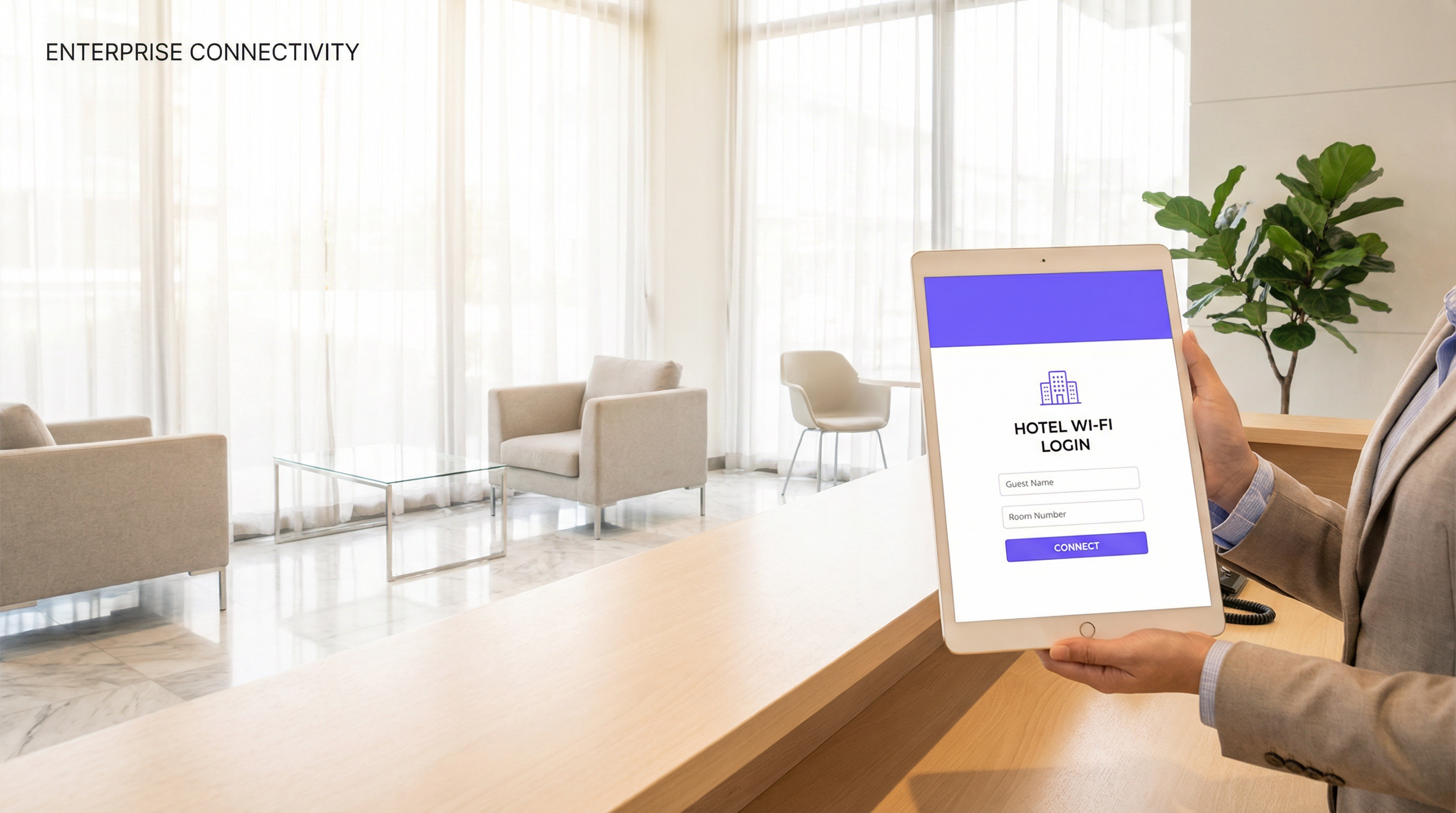
गेस्ट WiFi स्प्लॅश पेज — किंवा Captive Portal — हा कोणत्याही ठिकाणच्या वायरलेस डिप्लॉयमेंटमधील सर्वात महत्त्वाचा टचपॉइंट आहे. हा अतिथीचा तुमच्या नेटवर्कसोबतचा पहिला संवाद असतो आणि ते कनेक्ट होतील की नाही हे यावरच ठरते. तरीही, एंटरप्राइझ WiFi इन्फ्रास्ट्रक्चरमधील हा सातत्याने सर्वात कमी तांत्रिक लक्ष दिलेला घटक राहिला आहे. खराब डिझाइन केलेले स्प्लॅश पेज केवळ वापरकर्त्यांना निराश करत नाही; तर ते लाखो पाउंड्सच्या नेटवर्क गुंतवणुकीचे व्यावसायिक मूल्य सक्रियपणे नष्ट करते.
हे मार्गदर्शक वरिष्ठ IT आणि ऑपरेशन्स प्रोफेशनल्ससाठी तयार केले आहे ज्यांना आता अंमलबजावणीचे निर्णय घेणे आवश्यक आहे. यामध्ये Captive Portal ऑथेंटिकेशनचे तांत्रिक आर्किटेक्चर, कन्व्हर्जन वाढवणारी UX तत्त्वे, GDPR आणि संबंधित फ्रेमवर्क्स अंतर्गत कायदेशीर आणि अनुपालन बंधने, आणि लॉगिन स्क्रीनला महसूल-निर्मितीच्या मालमत्तेत रूपांतरित करणाऱ्या ब्रँडिंग आवश्यकतांचा समावेश आहे. प्रत्येक शिफारसीला ऑपरेशनल वास्तवाशी जोडण्यासाठी हॉस्पिटॅलिटी, रिटेल आणि इव्हेंट्स क्षेत्रांमधील वास्तविक डिप्लॉयमेंट परिस्थितींचा समावेश केला आहे. मुख्य मुद्दा सरळ आहे: तुमचे स्प्लॅश पेज केवळ एक सिक्युरिटी चेकबॉक्स नाही. हे एक धोरणात्मक व्यावसायिक साधन आहे आणि त्यानुसारच ते डिझाइन केले जावे.
तांत्रिक सखोल माहिती
Captive Portal ऑथेंटिकेशन कसे काम करते
Captive Portal नेटवर्क ॲक्सेस लेयरवर काम करते, अनऑथेंटिकेटेड क्लायंट डिव्हाइसवरून येणारा सर्व HTTP आणि HTTPS ट्रॅफिक इंटरसेप्ट करते आणि त्याला स्प्लॅश पेज URL वर रिडायरेक्ट करते. याची मूळ यंत्रणा DNS हायजॅकिंग आणि HTTP 302 रिडायरेक्ट्सवर अवलंबून असते. जेव्हा एखादे डिव्हाइस गेस्ट SSID शी जोडले जाते, तेव्हा ॲक्सेस पॉइंट किंवा वायरलेस कंट्रोलर त्याला एक प्रतिबंधित IP ॲड्रेस देतो आणि सर्व आउटबाउंड ट्रॅफिक पोर्टल सर्व्हरकडे वळवतो. जोपर्यंत वापरकर्ता स्प्लॅश पेजवर ऑथेंटिकेशन फ्लो पूर्ण करत नाही, तोपर्यंत डिव्हाइसला क्वारंटाइन VLAN मध्ये ठेवले जाते, ज्याचा ॲक्सेस फक्त पोर्टलच्या IP ॲड्रेस आणि कोणत्याही पूर्व-अधिकृत वॉल्ड-गार्डन डोमेन्सपुरता (जसे की सोशल लॉगिन प्रोव्हायडर्स) मर्यादित असतो.
यशस्वी ऑथेंटिकेशननंतर — मग ते ईमेल सबमिशन, सोशल लॉगिन, SMS OTP किंवा व्हाउचर कोडद्वारे असो — कंट्रोलर किंवा RADIUS सर्व्हर क्लायंटची ऑथरायझेशन स्थिती अपडेट करतो, त्याला योग्य ॲक्सेस VLAN मध्ये हलवतो आणि इंटरनेट कनेक्टिव्हिटी प्रदान करतो. हा संपूर्ण फ्लो पारदर्शक आणि वेगवान असणे आवश्यक आहे. पोर्टल रिडायरेक्ट किंवा ऑथेंटिकेशन रिस्पॉन्समध्ये कोणताही विलंब झाल्यास वापरकर्त्याला WiFi खराब असल्याचे वाटेल.
मानकांच्या दृष्टिकोनातून, Captive Portal आर्किटेक्चर व्हेंडर-न्यूट्रल आहे आणि ते मूळ वायरलेस सिक्युरिटी प्रोटोकॉलपासून स्वतंत्रपणे काम करते. तथापि, IEEE 802.11ax (Wi-Fi 6) स्पेसिफिकेशननुसार, जिथे डिव्हाइस सुसंगतता अनुमती देते तिथे SSID स्वतः WPA3-Personal किंवा WPA3-Enterprise सह कॉन्फिगर केले जावे. Captive Portal लेयर आयडेंटिटी आणि ॲक्सेस मॅनेजमेंट हाताळते, तर मूळ वायरलेस प्रोटोकॉल ट्रान्समिशन सिक्युरिटी हाताळतो. ही भिन्न कार्ये आहेत आणि ती स्वतंत्रपणे आर्किटेक्ट केली जावीत.
ऑथेंटिकेशन पद्धती: एक तुलनात्मक विश्लेषण
कोणत्याही स्प्लॅश पेज डिप्लॉयमेंटसाठी ऑथेंटिकेशन पद्धतीची निवड हा सर्वात महत्त्वाचा डिझाइन निर्णय असतो. प्रत्येक पद्धतीचे युझर फ्रिक्शन, डेटा रिचनेस, कंप्लायन्स ओव्हरहेड आणि सिक्युरिटी पोश्चरवर वेगवेगळे परिणाम होतात.
| ऑथेंटिकेशन पद्धत | फ्रिक्शन लेव्हल | डेटा क्वालिटी | GDPR गुंतागुंत | सर्वोत्तम-योग्य ठिकाण प्रकार |
|---|---|---|---|---|
| क्लिक-थ्रू (फक्त T&Cs) | खूप कमी | किमान | कमी | विमानतळ, सार्वजनिक वाहतूक, ग्रंथालये |
| ईमेल सबमिशन | कमी | उच्च (ईमेल, भेटीची वारंवारता) | मध्यम | हॉटेल्स, रिटेल, रेस्टॉरंट्स |
| सोशल लॉगिन (Facebook/Google) | कमी-मध्यम | खूप उच्च (डेमोग्राफिक्स) | उच्च | बार्स, मनोरंजन स्थळे, रिटेल |
| SMS / OTP | मध्यम | उच्च (व्हेरिफाईड मोबाईल नंबर) | मध्यम | प्रीमियम हॉस्पिटॅलिटी, हेल्थकेअर |
| व्हाउचर / PIN कोड | कमी | काहीही नाही (निनावी) | खूप कमी | कॉन्फरन्स सेंटर्स, को-वर्किंग स्पेसेस |
| RADIUS / Active Directory | खूप कमी (SSO) | एंटरप्राइझ-ग्रेड | कमी (अंतर्गत वापरकर्ते) | कॉर्पोरेट कॅम्पस, शिक्षण |
बहुतेक व्यावसायिक डिप्लॉयमेंट्ससाठी, ईमेल सबमिशन इष्टतम संतुलन दर्शवते. हे कमीत कमी फ्रिक्शनसह एक टिकाऊ, मार्केटेबल आयडेंटिफायर कॅप्चर करते आणि GDPR च्या कायदेशीर आधार आवश्यकतांनुसार व्यवस्थापित करणे सोपे आहे. डेटा रिचनेससाठी सोशल लॉगिन आकर्षक आहे परंतु यासाठी अधिक गुंतागुंतीच्या संमती फ्रेमवर्कची आवश्यकता असते आणि थर्ड-पार्टी OAuth प्रोव्हायडर्सवर अवलंबित्व निर्माण होते — एंटरप्राइझ संदर्भात काळजीपूर्वक मूल्यांकन करण्यासारखा हा एक धोका आहे.
वॉल्ड गार्डन कॉन्फिगरेशन
वॉल्ड गार्डन हा डोमेन्स आणि IP ॲड्रेसचा असा संच आहे ज्याचा ॲक्सेस अनऑथेंटिकेटेड क्लायंटला स्प्लॅश पेज फ्लो पूर्ण करण्यापूर्वी दिला जातो. हा एक अत्यंत महत्त्वाचा कॉन्फिगरेशन घटक आहे. किमानपक्षी, वॉल्ड गार्डनमध्ये पोर्टल सर्व्हर स्वतः, पोर्टल ॲसेट्स सर्व्ह करणारे कोणतेही CDN एंडपॉइंट्स आणि वापरात असलेल्या कोणत्याही सोशल लॉगिन प्रोव्हायडर्सचे OAuth एंडपॉइंट्स समाविष्ट असणे आवश्यक आहे. वॉल्ड गार्डन योग्यरित्या कॉन्फिगर करण्यात अपयश हे सोशल लॉगिन अयशस्वी होण्याचे सर्वात सामान्य कारण आहे आणि नवीन डिप्लॉयमेंट्समध्ये सपोर्ट तिकिटांचा हा एक वारंवार उद्भवणारा स्रोत आहे.
HTTPS आणि सर्टिफिकेट मॅनेजमेंट
सर्व स्प्लॅश पेजेस HTTPS वर सर्व्ह केली जावीत. iOS 14+ आणि Android 11+ सह आधुनिक मोबाईल ऑपरेटिंग सिस्टीम्स, HTTP Captive Portal ला सिक्युरिटी वॉर्निंग्ज दाखवतील किंवा कनेक्शन्स ब्लॉक करतील. तुमच्या पोर्टल सर्व्हरने विश्वसनीय सर्टिफिकेट ऑथॉरिटीकडून वैध TLS सर्टिफिकेट सादर करणे आवश्यक आहे. प्रॉडक्शन डिप्लॉयमेंट्समध्ये सेल्फ-साईन्ड सर्टिफिकेट्स स्वीकार्य नाहीत. सर्टिफिकेटची मुदत संपणे हा एक सामान्य ऑपरेशनल फेल्युअर मोड आहे; Let's Encrypt किंवा तुमच्या प्लॅटफॉर्म प्रोव्हायडरच्या मॅनेज्ड सर्टिफिकेट सर्व्हिसद्वारे स्वयंचलित नूतनीकरण ही एक मानक पद्धत असावी.
अंमलबजावणी मार्गदर्शक
टप्पा 1: आवश्यकता निश्चिती
डिझाइन टूल उघडण्यापूर्वी, प्रोजेक्ट टीमने चार पॅरामीटर्सवर एकमत होणे आवश्यक आहे: ऑथेंटिकेशन पद्धत (वरील तुलनात्मक विश्लेषणावर आधारित), कॅप्चर करायचे डेटा फील्ड्स (डेटा मिनिमायझेशनचे तत्त्व लागू करा — जे तुम्ही सक्रियपणे वापराल तेवढेच गोळा करा), मार्केटिंग कन्सेंट मॉडेल (ऑप्ट-इन विरुद्ध ऑप्ट-आउट, GDPR अनुपालनासाठी ऑप्ट-इनची जोरदार शिफारस केली जाते), आणि समाविष्ट करायचे ब्रँड ॲसेट्स (SVG फॉरमॅटमधील लोगो फाइल्स, हेक्स कलर कोड्स, मंजूर टायपफेसेस).
टप्पा 2: स्प्लॅश पेज डिझाइन
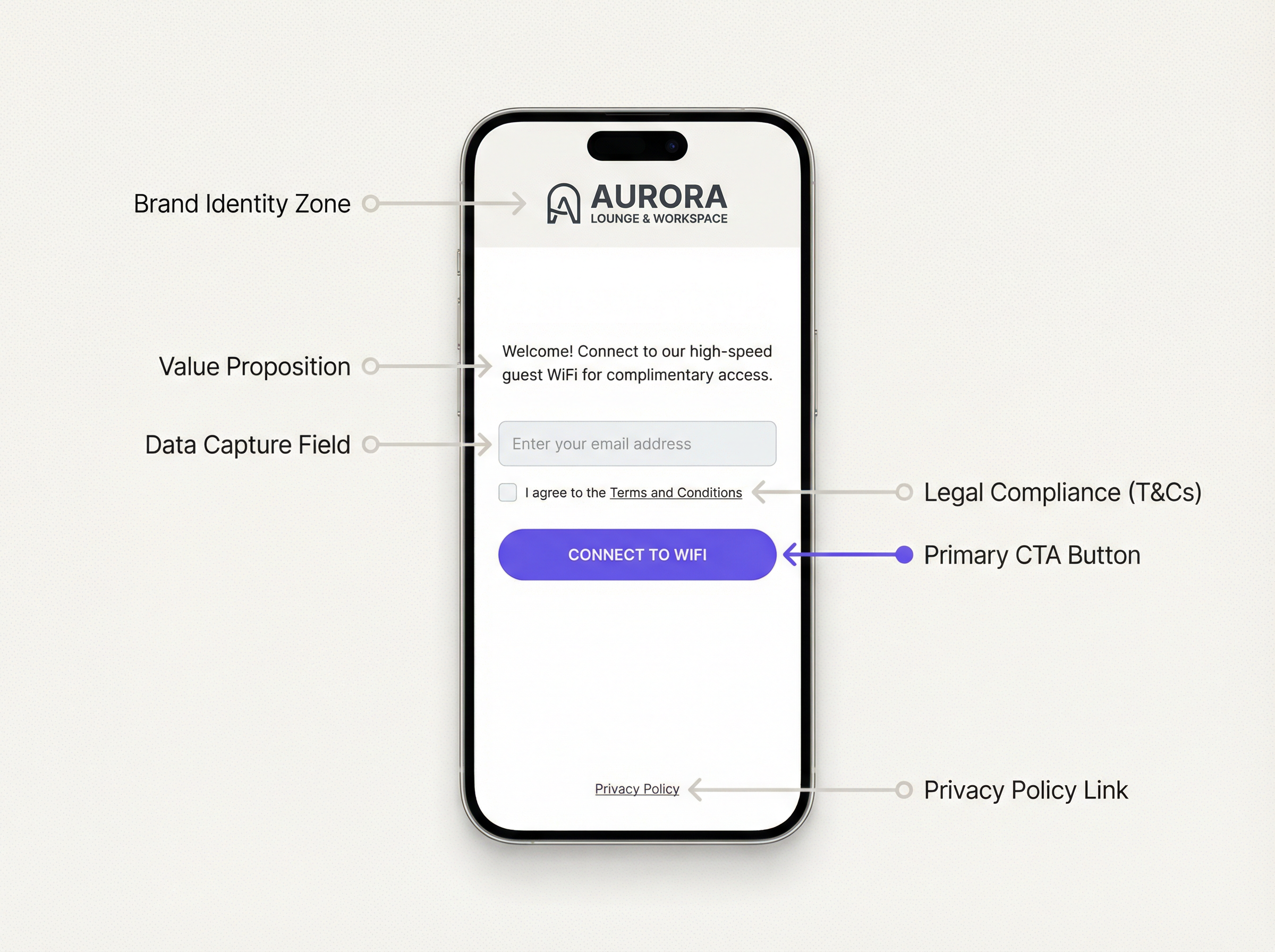
प्रभावी WiFi स्प्लॅश पेज डिझाइन स्पष्ट व्हिज्युअल हायरार्कीचे (दृश्य पदानुक्रम) अनुसरण करते. ब्रँड आयडेंटिटी झोन पेजच्या शीर्षस्थानी असतो आणि तो सर्वात आधी लोड झाला पाहिजे. त्यानंतर लगेचच एक संक्षिप्त व्हॅल्यू प्रपोझिशन — एका वाक्यापेक्षा जास्त नसावे — येते. ऑथेंटिकेशन फॉर्म हा मध्यवर्ती घटक आहे आणि तो सर्वात दृश्यमानपणे ठळक इंटरॅक्टिव्ह घटक असला पाहिजे. कायदेशीर अनुपालन घटक (T&Cs चेकबॉक्स, प्रायव्हसी पॉलिसी लिंक) फॉर्मच्या खाली असतात. कॉल-टू-ॲक्शन बटण हा अंतिम घटक आहे आणि तो मोठा, हाय-कॉन्ट्रास्ट आणि स्पष्ट असला पाहिजे.
पेज वेट हा एक अत्यंत महत्त्वाचा परफॉर्मन्स व्हेरिएबल आहे. सर्व स्प्लॅश पेज ॲसेट्सचा — HTML, CSS, JavaScript, इमेजेस — एकूण अनकंप्रेस्ड आकार 200KB पेक्षा जास्त नसावा. बॅकग्राउंड इमेजेस वापरल्यास, त्या कंप्रेस केल्या पाहिजेत आणि आधुनिक फॉरमॅट्समध्ये (WebP ला प्राधान्य) सर्व्ह केल्या पाहिजेत. 4G कनेक्शनवर लोड होण्यासाठी तीन सेकंदांपेक्षा जास्त वेळ घेणाऱ्या पेजच्या ॲबँडनमेंट रेट्समध्ये (सोडून जाण्याचे प्रमाण) लक्षणीय वाढ दिसून येईल. Google PageSpeed Insights सारख्या टूल्सचा वापर करून परफॉर्मन्सची चाचणी करा आणि 2.5 सेकंदांपेक्षा कमी Largest Contentful Paint (LCP) चे लक्ष्य ठेवा.
रिस्पॉन्सिव्ह डिझाइन अनिवार्य आहे. बहुतांश गेस्ट WiFi कनेक्शन्स स्मार्टफोन्सवरून येतात. स्प्लॅश पेज 320px ते 1440px पर्यंतच्या व्ह्यूपोर्ट रुंदीवर योग्यरित्या रेंडर झाले पाहिजे. CSS मीडिया क्वेरीज आणि मोबाईल-फर्स्ट डिझाइन दृष्टिकोन वापरा. फिक्स्ड-विड्थ लेआउट्स टाळा.
टप्पा 3: प्लॅटफॉर्म कॉन्फिगरेशन
तुमच्या गेस्ट WiFi मॅनेजमेंट प्लॅटफॉर्मद्वारे स्प्लॅश पेज डिप्लॉय करा. Purple सारखा प्रॉडक्शन-ग्रेड प्लॅटफॉर्म एक टेम्पलेट-आधारित एडिटर प्रदान करतो जो मार्केटिंग टीम्सना इंजिनिअरिंग हस्तक्षेपाशिवाय ब्रँड अपडेट्स व्यवस्थापित करण्याची अनुमती देतो. पोर्टल URL वर रिडायरेक्ट करण्यासाठी SSID कॉन्फिगर करा, सेशन टाइमआउट आणि बँडविड्थ पॉलिसीज सेट करा आणि वॉल्ड गार्डन डोमेन्स परिभाषित करा. लाइव्ह होण्यापूर्वी किमान तीन डिव्हाइस प्रकारांवर (iOS, Android, Windows लॅपटॉप) एंड-टू-एंड टेस्टिंग करा.
टप्पा 4: ॲनालिटिक्स आणि ऑप्टिमायझेशन
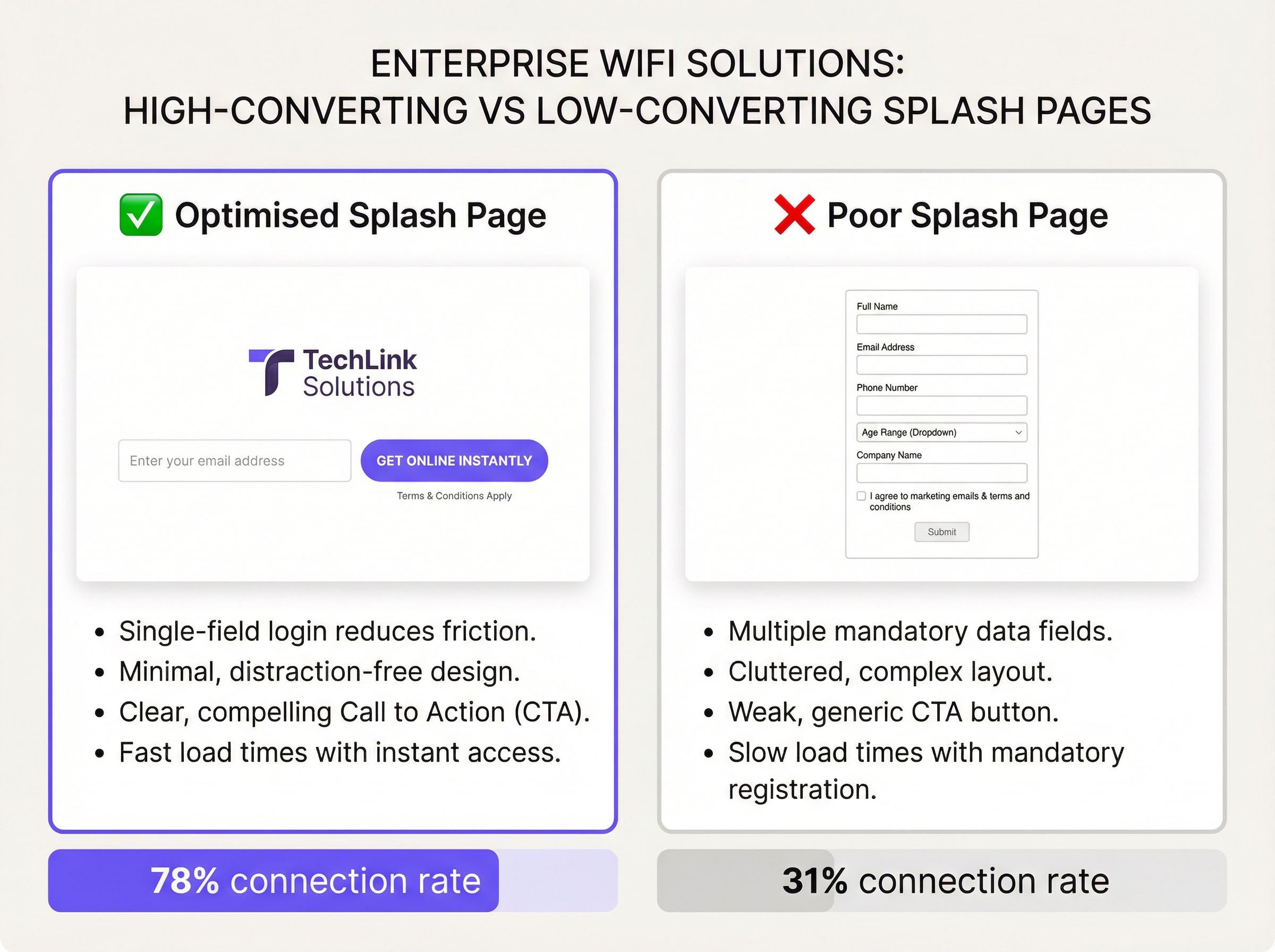
डिप्लॉयमेंटनंतर, स्प्लॅश पेजवर कन्व्हर्जन ट्रॅकिंग इन्स्ट्रुमेंट करा. मुख्य मेट्रिक्स आहेत: इम्प्रेशन रेट (ज्या डिव्हाइसेसनी SSID शोधला), पोर्टल व्ह्यू रेट (ज्या डिव्हाइसेसनी स्प्लॅश पेज लोड केले), कम्प्लिशन रेट (ज्या डिव्हाइसेसनी यशस्वीरित्या ऑथेंटिकेट केले), आणि ड्रॉप-ऑफ रेट (व्ह्यूज आणि कम्प्लिशन मधील फरक). ईमेल-कॅप्चर फ्लोसाठी चांगला कम्प्लिशन रेट 65% च्या वर असतो. 50% पेक्षा कमी रेट UX किंवा परफॉर्मन्स समस्येचे संकेत देतो ज्याची चौकशी करणे आवश्यक आहे.
सर्वोत्तम पद्धती
खालील शिफारसी हॉस्पिटॅलिटी, रिटेल आणि सार्वजनिक-क्षेत्रातील वातावरणातील एंटरप्राइझ डिप्लॉयमेंट्समधून मिळवलेले परिष्कृत मार्गदर्शन दर्शवतात.
फॉर्म फील्ड्स कमीत कमी ठेवा. प्रत्येक अतिरिक्त फील्ड कम्प्लिशन रेट्स कमी करते. मोठ्या प्रमाणावरील डिप्लॉयमेंट्समधील असंख्य A/B चाचण्या सातत्याने दर्शवतात की दोन-फील्ड फॉर्म (नाव + ईमेल) वरून सिंगल-फील्ड फॉर्म (फक्त ईमेल) वर गेल्याने कम्प्लिशन रेट्स 15-25 टक्क्यांनी वाढतात. जोपर्यंत एखादे विशिष्ट बिझनेस कारण अतिरिक्त डेटा संकलनाचे समर्थन करत नाही, तोपर्यंत सिंगल ईमेल फील्ड हा योग्य डिफॉल्ट आहे.
व्हॅल्यू प्रपोझिशन स्पष्ट करा. बदल्यात काय मिळते हे समजल्याशिवाय वापरकर्ते फॉर्म पूर्ण करणार नाहीत. फॉर्म फील्डच्या अगदी वर "मोफत, हाय-स्पीड WiFi शी कनेक्ट करा" किंवा "सेकंदांत ऑनलाइन व्हा" यासारखी हेडलाइन कन्व्हर्जनमध्ये लक्षणीय सुधारणा करते. अस्पष्ट किंवा अनुपस्थित व्हॅल्यू प्रपोझिशन्स हे उच्च ड्रॉप-ऑफ रेट्सचे प्रमुख कारण आहेत.
डिझाइनद्वारे GDPR चे अनुपालन करा. स्प्लॅश पेजने मार्केटिंग कम्युनिकेशन्ससाठी एक स्पष्ट, अनबंडल्ड संमती यंत्रणा सादर केली पाहिजे, जी नेटवर्क ॲक्सेससाठी आवश्यक असलेल्या T&Cs स्वीकृतीपासून वेगळी असावी. प्री-टिक्ड मार्केटिंग कन्सेंट चेकबॉक्सेस GDPR कलम 7 अंतर्गत नॉन-कंप्लायंट आहेत. प्रायव्हसी पॉलिसी स्पष्टपणे लेबल केलेल्या लिंकद्वारे ॲक्सेसिबल असली पाहिजे आणि WiFi-मधून मिळवलेला डेटा कसा प्रोसेस, स्टोअर आणि शेअर केला जातो याचे अचूक वर्णन केले पाहिजे.
सेशन मॅनेजमेंट योग्यरित्या लागू करा. योग्य सेशन टाइमआउट आणि री-ऑथेंटिकेशन इंटरव्हल्स परिभाषित करा. हॉटेलच्या अतिथींसाठी 24-तासांचे सेशन मानक आहे. कॉफी शॉपसाठी 2-तासांचे सेशन योग्य आहे. ज्या ठिकाणी अतिथी तासन्तास थांबतात तिथे दर 30 मिनिटांनी री-ऑथेंटिकेशन सक्तीचे करणे हे एक मोठे UX अपयश आहे आणि हॉस्पिटॅलिटी वातावरणातील एक सामान्य तक्रार आहे.
ऑपरेटिंग सिस्टीम्सवर चाचणी करा. iOS Captive Network Assistant (CNA) आणि Android ची Captive Portal शोध यंत्रणा वेगळ्या प्रकारे वागतात. iOS पोर्टल प्रदर्शित करण्यासाठी एक मिनी-ब्राउझर विंडो (CNA) उघडते, ज्यामध्ये जुन्या आवृत्त्यांमध्ये JavaScript सपोर्ट नसणे आणि प्रतिबंधित कुकी हँडलिंग यासारख्या मर्यादा आहेत. तुमचे पोर्टल CNA वातावरणात ग्रेसफुली डिग्रेड होत असल्याची खात्री करा. iOS आणि Android दोन्हीच्या वर्तमान आणि N-1 आवृत्त्यांवर चाचणी करा.
गेस्ट ट्रॅफिक आयसोलेट करा. गेस्ट VLAN सर्व अंतर्गत कॉर्पोरेट नेटवर्क्स, मॅनेजमेंट इंटरफेसेस आणि POS सिस्टीम्सपासून फायरवॉल्ड असणे आवश्यक आहे. ही एक मूलभूत नेटवर्क सिक्युरिटी आवश्यकता आहे आणि कार्ड पेमेंट्स प्रोसेस करणाऱ्या कोणत्याही ठिकाणासाठी PCI DSS आवश्यकता 1.3 अंतर्गत अनिवार्य आहे. गेस्ट ट्रॅफिक सेगमेंट करण्यात अपयश ही एक गंभीर सिक्युरिटी व्हल्नरेबिलिटी आहे.
ट्रबलशूटिंग आणि रिस्क मिटिगेशन
सामान्य फेल्युअर मोड्स
खालील तक्ता Captive Portal डिप्लॉयमेंट्समध्ये वारंवार येणाऱ्या समस्या आणि त्यांच्या मूळ कारणांची यादी देतो.
| लक्षण | मूळ कारण | उपाय |
|---|---|---|
| पोर्टल पेज दिसत नाही | DNS हायजॅकिंग कॉन्फिगर केलेले नाही; क्लायंट DoH/DoT वापरत आहे | कंट्रोलर DNS इंटरसेप्ट करत असल्याची खात्री करा; फायरवॉलवर DNS-over-HTTPS ब्लॉक करा |
| सोशल लॉगिन अयशस्वी | OAuth प्रोव्हायडर वॉल्ड गार्डनमध्ये नाही | सर्व OAuth एंडपॉइंट्स आणि CDN डोमेन्स वॉल्ड गार्डनमध्ये जोडा |
| पोर्टलवर HTTPS वॉर्निंग | मुदत संपलेले किंवा सेल्फ-साईन्ड TLS सर्टिफिकेट | वैध सर्टिफिकेट डिप्लॉय करा; स्वयंचलित नूतनीकरण लागू करा |
| iOS CNA कोरे पेज दाखवते | पोर्टलमध्ये JavaScript अवलंबित्व; CNA JS निर्बंध | CNA सुसंगततेसाठी पोर्टलचे ऑडिट करा; सर्व्हर-साइड रेंडरिंग वापरा |
| उच्च ड्रॉप-ऑफ रेट | खूप जास्त फॉर्म फील्ड्स; स्लो पेज लोड; अस्पष्ट CTA | फील्ड्स कमी करा; ॲसेट्स ऑप्टिमाइझ करा; CTA कॉपीची A/B चाचणी करा |
| सेशन संपल्यानंतर वापरकर्ते पुन्हा कनेक्ट करू शकत नाहीत | सेशन टोकन क्लिअर केलेले नाही; MAC ॲड्रेसचे पुन्हा मूल्यांकन केलेले नाही | कंट्रोलरमधील सेशन मॅनेजमेंट कॉन्फिगरेशनचे पुनरावलोकन करा |
| GDPR ऑडिट निष्कर्ष | प्री-टिक्ड कन्सेंट बॉक्सेस; प्रायव्हसी पॉलिसी लिंक गहाळ | कन्सेंट UX सुधारा; कंप्लायंट प्रायव्हसी पॉलिसी लिंक जोडा |
रिस्क मिटिगेशन: कंप्लायन्स ऑडिट चेकलिस्ट
कोणतेही गेस्ट WiFi डिप्लॉयमेंट लाइव्ह होण्यापूर्वी, खालील कंप्लायन्स बाबींची पडताळणी करणे आवश्यक आहे: प्रायव्हसी पॉलिसी अद्ययावत आहे आणि डेटा प्रोसेसिंग ॲक्टिव्हिटीज अचूकपणे प्रतिबिंबित करते; मार्केटिंग कन्सेंट ऑप्ट-इन आहे आणि T&Cs पासून अनबंडल्ड आहे; डेटा रिटेन्शन कालावधी परिभाषित आणि लागू केले आहेत; WiFi-मधून मिळवलेल्या डेटासाठी सब्जेक्ट ॲक्सेस रिक्वेस्ट्स (SARs) हाताळण्यासाठी एक प्रक्रिया अस्तित्वात आहे; आणि गेस्ट ट्रॅफिक अंतर्गत नेटवर्क्स आणि PCI-स्कोप केलेल्या सिस्टीम्सपासून पूर्णपणे आयसोलेटेड आहे.
ROI आणि व्यावसायिक प्रभाव
चांगल्या डिझाइन केलेल्या स्प्लॅश पेजमध्ये गुंतवणूक करण्याचे व्यावसायिक कारण सरळ आहे. गेस्ट WiFi डेटा — प्रामुख्याने ईमेल ॲड्रेसेस आणि भेटीच्या वारंवारतेचा डेटा — हा संस्था गोळा करू शकणाऱ्या सर्वात मौल्यवान फर्स्ट-पार्टी डेटापैकी एक आहे. प्रमुख ब्राउझर्सवर थर्ड-पार्टी कुकीज बंद झाल्यामुळे आणि मोबाईल ॲडव्हर्टायझिंग आयडेंटिफायर्सवर वाढत्या निर्बंधांमुळे, WiFi लॉगिन पॉईंटवर कॅप्चर केलेला ईमेल ॲड्रेस हा एक टिकाऊ, संमती-आधारित, मालकीचा मार्केटिंग ॲसेट आहे.
200-लोकेशन असलेल्या रिटेल चेनच्या अर्थशास्त्राचा विचार करा. जर प्रत्येक लोकेशन दररोज 300 युनिक गेस्ट WiFi वापरकर्त्यांना सेवा देत असेल आणि सध्याचा कम्प्लिशन रेट 35% असेल, तर ती चेन दररोज अंदाजे 21,000 ईमेल ॲड्रेसेस कॅप्चर करते. 70% कम्प्लिशन रेट साध्य करण्यासाठी स्प्लॅश पेज ऑप्टिमाइझ केल्यास — या मार्गदर्शकामध्ये वर्णन केलेल्या पद्धतींसह हे एक वास्तववादी लक्ष्य आहे — तो आकडा दुप्पट होऊन दररोज 42,000 होतो. एका वर्षात, हे मार्केटिंग डेटाबेसमध्ये प्रवेश करणारे अतिरिक्त 7.6 दशलक्ष ऑप्ट-इन कॉन्टॅक्ट्स दर्शवते. प्रति कॉन्टॅक्ट प्रति वर्ष £0.10 च्या पुराणमतवादी ईमेल मार्केटिंग महसूल ॲट्रिब्युशनवर, हे ऑप्टिमायझेशन £760,000 च्या वाढीव वार्षिक महसुलाचे मूल्य देते — अशा डिझाइन बदलातून ज्याची अंमलबजावणी करण्यासाठी त्यापैकी अगदी थोडाच खर्च येतो.
थेट मार्केटिंग मूल्याच्या पलीकडे, स्प्लॅश पेज हा एका व्यापक गेस्ट इंटेलिजन्स प्लॅटफॉर्मचा एंट्री पॉईंट आहे. ड्वेल टाइम ॲनालिटिक्स, रिपीट व्हिजिट फ्रिक्वेन्सी, पीक फुटफॉल मॅपिंग आणि कस्टमर जर्नी ॲनालिसिस या सर्वांचा उगम ऑथेंटिकेशन इव्हेंटमधून होतो. हा डेटा ऑपरेशनल निर्णयांची माहिती देतो — स्टाफिंग लेव्हल्स, स्टोअर लेआउट, प्रमोशनल टायमिंग — ज्यांचा ऑपरेशनल कार्यक्षमता आणि प्रति चौरस फूट महसुलावर मोजता येण्याजोगा प्रभाव पडतो.
त्यामुळे स्प्लॅश पेज ऑप्टिमायझेशनसाठी ROI कॅल्क्युलेशन हा मार्केटिंगचा व्यायाम नाही. ही चक्रवाढ परतावा देणारी डेटा इन्फ्रास्ट्रक्चर गुंतवणूक आहे.
महत्त्वाच्या संज्ञा आणि व्याख्या
Captive Portal
A network access control mechanism that intercepts all HTTP/HTTPS traffic from an unauthenticated client and redirects it to an authentication web page before granting internet access. Operates at the access layer via DNS hijacking and HTTP 302 redirects.
IT teams encounter this term when configuring wireless controllers, access points, and network management platforms. It is the technical term for what marketing teams call a 'splash page' or 'WiFi login page'. Understanding the distinction between the portal mechanism and the page design is essential for effective troubleshooting.
Splash Page
The web page presented to a guest WiFi user via the captive portal mechanism. It is the user-facing interface for authentication and is the primary point of brand expression, data capture, and legal consent in a guest WiFi deployment.
The term is used interchangeably with 'captive portal' in commercial contexts, though strictly speaking the splash page is the front-end design layer and the captive portal is the underlying network mechanism. IT managers should be precise about this distinction when briefing design agencies or platform vendors.
Walled Garden
A defined set of IP addresses, domains, and URLs that an unauthenticated client device is permitted to access before completing the splash page authentication flow. Configured at the wireless controller or firewall level.
Encountered during initial deployment configuration and whenever the splash page design changes. An incorrectly configured walled garden is the most common cause of social login failures and broken portal page rendering. Must be reviewed and updated whenever new authentication methods or third-party scripts are added to the splash page.
GDPR (General Data Protection Regulation)
EU Regulation 2016/679, applicable in the UK as the UK GDPR post-Brexit. Governs the collection, processing, storage, and transfer of personal data. Requires a lawful basis for processing, explicit and unbundled consent for marketing communications, and the right for individuals to access, rectify, and erase their data.
Directly applicable to any splash page that collects personal data (email addresses, names, device identifiers). IT and marketing teams must ensure the splash page's consent mechanism, privacy policy, and data retention practices are compliant. Non-compliance carries fines of up to 4% of global annual turnover under Article 83.
WPA3 (Wi-Fi Protected Access 3)
The current generation wireless security protocol defined by the Wi-Fi Alliance, superseding WPA2. Introduces Simultaneous Authentication of Equals (SAE) for stronger password-based authentication, enhanced protection against offline dictionary attacks, and mandatory use of Protected Management Frames (PMF).
Relevant when specifying SSID security configuration for guest networks. WPA3-Personal is recommended for guest SSIDs where device compatibility allows. Note that WPA3 governs transmission security and is distinct from the captive portal authentication layer, which operates at the application layer.
RADIUS (Remote Authentication Dial-In User Service)
A networking protocol providing centralised Authentication, Authorisation, and Accounting (AAA) management for users connecting to a network. Defined in RFC 2865. Used in enterprise WiFi deployments to validate credentials against a central directory (e.g., Active Directory, LDAP) and enforce access policies.
Encountered in enterprise and education deployments where guest WiFi must integrate with existing identity infrastructure. For pure guest WiFi with email capture, RADIUS is typically not required. It becomes relevant when deploying 802.1X-authenticated SSIDs for staff or when integrating with a centralised policy management platform.
PCI DSS (Payment Card Industry Data Security Standard)
A set of security standards defined by the PCI Security Standards Council, mandating controls for any organisation that stores, processes, or transmits cardholder data. Requirement 1.3 mandates network segmentation to isolate cardholder data environments from all other networks, including guest WiFi.
Directly applicable to hotels, retailers, and any venue that processes card payments on the same physical network infrastructure as the guest WiFi. IT teams must ensure the guest VLAN is fully isolated from POS systems, payment terminals, and any system in scope for PCI DSS. Failure to segment is a critical finding in PCI audits.
Progressive Profiling
A data collection strategy in which additional user attributes are requested incrementally across multiple sessions, rather than all at once during the initial authentication. Each subsequent interaction presents a short, optional prompt to enrich the user's profile.
Highly relevant for retail and hospitality deployments where richer demographic data is commercially valuable but front-loading a long form would suppress connection rates. Implemented at the platform level, with conditional logic that detects returning devices and presents appropriate prompts. Must be clearly disclosed in the privacy policy.
Conversion Rate (WiFi Context)
The percentage of devices that load the splash page and successfully complete the authentication flow, expressed as: (Authenticated Sessions / Portal Page Views) x 100. A key performance indicator for splash page effectiveness.
The primary metric for evaluating splash page performance. IT and marketing teams should establish a baseline conversion rate at deployment and track it continuously. A rate below 50% for an email-capture flow indicates a significant UX or performance issue. Rates above 70% are achievable with optimised single-field designs and clear value propositions.
केस स्टडीज
A 350-room business hotel in central London is deploying a new guest WiFi infrastructure across its property. The hotel's marketing team wants to capture guest email addresses for post-stay communications, while the IT team is concerned about GDPR compliance and network security. The hotel also hosts corporate events and needs to support conference delegates who expect seamless, fast connectivity. How should the splash page be designed and configured to meet all of these requirements?
The deployment should use a tiered SSID architecture: a primary guest SSID with an email-capture splash page for hotel residents and general guests, and a separate event SSID with voucher-code authentication for conference delegates. This separation allows the marketing team to collect opted-in email addresses from hotel guests without forcing conference delegates — who may be attending a third-party event — through a data-capture flow that could create GDPR complications for the event organiser.
For the primary guest splash page, the design should feature the hotel's logo and brand colours prominently, a single email input field, a clearly labelled opt-in checkbox for marketing communications (unchecked by default), a mandatory T&Cs acceptance checkbox, and a high-contrast 'Connect' CTA button. The page should load in under 2 seconds and be fully responsive. The session timeout should be set to 24 hours, with automatic re-authentication suppressed for returning devices within a 30-day window to reduce friction for repeat guests.
For the event SSID, the hotel's IT team should pre-generate a batch of single-use or time-limited voucher codes that the events coordinator distributes to delegates. This provides controlled access without data capture obligations. The event VLAN should be firewalled from the hotel's PMS (Property Management System) and POS infrastructure in compliance with PCI DSS Requirement 1.3.
All guest traffic must traverse a dedicated guest VLAN, isolated from the hotel's operational network. The splash page must be served over HTTPS with a valid certificate. The privacy policy linked from the splash page must explicitly reference WiFi data collection, retention periods (recommend 24 months), and the right to unsubscribe from marketing communications.
A national retail chain with 180 stores wants to use its guest WiFi network to build a first-party marketing database and gain footfall analytics. The current splash page — provided by the ISP — is unbranded, asks for name, email, date of birth, and postcode, and has a connection rate of 28%. The marketing director has set a target of 65% connection rate and 500,000 new email opt-ins within 12 months. What changes should be made to the splash page, and what supporting infrastructure is required?
The immediate priority is to replace the ISP-provided portal with a branded, platform-managed solution. The form must be reduced to a single email field. Removing name, date of birth, and postcode will be the single most impactful change. These fields add friction without providing data that is immediately actionable in a retail context; email address alone is sufficient to trigger a welcome journey, attribute future purchases, and measure visit frequency.
The new splash page design should incorporate the retailer's brand identity — logo, primary brand colour, approved typeface — and include a value proposition headline such as 'Free WiFi. Connect in seconds.' The T&Cs and privacy policy links must be present and compliant. The marketing opt-in checkbox should be unchecked by default with clear copy such as 'Yes, I'd like to receive exclusive offers by email.'
To achieve the 500,000 opt-in target, the chain should also implement a progressive profiling strategy: on a user's second or third visit, the splash page can present an optional prompt to complete their profile (e.g., add a name or confirm their postcode for localised offers). This approach collects richer data without compromising the initial connection rate.
The supporting infrastructure requires a centralised guest WiFi management platform with multi-site management capabilities, a CRM integration to push captured emails and consent flags directly into the marketing automation platform, and a real-time analytics dashboard to monitor per-store connection rates and identify underperforming locations. A/B testing capability at the platform level is highly desirable to allow ongoing optimisation of CTA copy and page layout.
Projected outcome: based on comparable deployments, moving from a five-field form to a single-field form with a branded design typically increases completion rates from 28% to 65-75%. At 180 stores averaging 250 unique daily visitors, a 65% completion rate generates approximately 29,000 new email opt-ins per day, reaching the 500,000 target in approximately 17 days of operation — well within the 12-month window.
परिस्थिती विश्लेषण
Q1. You are the IT Manager for a 500-seat stadium that hosts 40 events per year, ranging from football matches (general public) to corporate hospitality events (premium guests). The commercial team wants to use guest WiFi to build a marketing database, while the security team insists on minimal data exposure. The stadium's existing network uses a flat guest VLAN with no segmentation. How do you design the splash page strategy and supporting network architecture to satisfy both teams?
💡 संकेत:Consider whether a single splash page design can serve both use cases, and think carefully about what network segmentation changes are required before any splash page optimisation is meaningful.
शिफारस केलेला दृष्टिकोन दाखवा
The correct approach is a dual-SSID architecture: a public SSID for general admission guests with an email-capture splash page, and a separate corporate SSID for hospitality guests with a voucher-code or pre-shared key authentication. This satisfies the commercial team's data capture requirement for the general public cohort while giving the security team a controlled, low-data-exposure path for corporate guests. Before any splash page work begins, the flat guest VLAN must be segmented: general guest traffic, corporate guest traffic, and operational/POS traffic must each occupy separate VLANs with appropriate firewall rules between them. This is a prerequisite, not an optional enhancement. The email-capture splash page should use a single field (email), an unchecked marketing opt-in checkbox, and a clear T&Cs link. The privacy policy must reference the stadium operator as data controller and describe the marketing use of captured data. Post-event, the captured emails should be exported to the CRM platform within 24 hours to enable timely follow-up communications.
Q2. A regional library authority is deploying free public WiFi across 22 branches. The authority's legal team has flagged that collecting email addresses from library users may conflict with the authority's obligations under the Public Sector Equality Duty and data minimisation principles. The IT team is under pressure to deploy quickly. What authentication method should be used, and what are the key splash page design requirements for this public-sector context?
💡 संकेत:Consider the principle of data minimisation under UK GDPR and the specific obligations of a public-sector body. Is email capture necessary to achieve the authority's objectives?
शिफारस केलेला दृष्टिकोन दाखवा
For a public library context, a click-through authentication — requiring only T&Cs acceptance with no data capture — is the most appropriate and legally defensible approach. The authority's primary obligation is to provide equitable access to information; data collection is not a core objective and introduces compliance risk without commensurate benefit. The splash page should be simple and accessible: the authority's branding, a brief welcome message, a T&Cs acceptance checkbox, and a 'Connect' button. The T&Cs must include an acceptable use policy that prohibits illegal activity, in compliance with the authority's obligations under the Computer Misuse Act 1990. If the authority wishes to collect usage analytics, this should be done at the network level (aggregate throughput, peak usage times) rather than at the individual user level. If email capture is later deemed necessary for a specific programme (e.g., a digital skills initiative), it must be implemented as a separate, clearly optional flow with a documented lawful basis under UK GDPR Article 6(1)(e) (public task) or Article 6(1)(a) (consent).
Q3. Your organisation's guest WiFi splash page has a completion rate of 42% against a target of 65%. Analytics show that 85% of users load the splash page, but 43% abandon before clicking 'Connect'. The page currently asks for first name, last name, email address, and date of birth, and includes a 400KB background image. The marketing team does not want to remove the date of birth field as it is used for age verification for an alcohol-related promotion. How do you diagnose and resolve the drop-off issue?
💡 संकेत:Separate the performance problem from the UX problem. Address them in sequence. Consider whether the age verification requirement can be met by a different mechanism that does not require a form field.
शिफारस केलेला दृष्टिकोन दाखवा
The diagnosis identifies two distinct problems: a performance problem (the 400KB background image is likely causing slow load times, contributing to early abandonment) and a UX problem (four form fields is significantly above the optimal one-field design). Address the performance problem first: compress the background image to under 50KB using WebP format, or replace it with a CSS gradient that loads instantly. This alone may recover 5-10 percentage points of completion rate. For the UX problem, negotiate with the marketing team to remove first name, last name, and date of birth from the standard flow. The age verification requirement for the alcohol promotion can be met more effectively by a separate age-gate mechanism (a simple 'I confirm I am 18 or over' checkbox) rather than a date-of-birth field, which is disproportionate data collection for this purpose and creates a GDPR data minimisation issue. Implement progressive profiling to request additional data on subsequent visits if richer profiling is genuinely required. After these changes, re-measure the completion rate over a 30-day period. If it remains below 65%, conduct user testing to identify any remaining friction points in the authentication flow.
महत्त्वाचे निष्कर्ष
- ✓A guest WiFi splash page is a strategic business asset, not a technical formality — its design directly determines the ROI of your entire guest WiFi investment through connection rates and first-party data capture.
- ✓Apply the One-Field Rule as your default: a single email field consistently outperforms multi-field forms, often doubling completion rates from below 35% to above 70% in comparable deployments.
- ✓Legal compliance is non-negotiable and must be designed in from the start — GDPR requires unbundled, opt-in marketing consent, an accurate privacy policy, and a documented lawful basis for all data processing activities.
- ✓Network segmentation is a prerequisite, not an optional enhancement — guest traffic must be isolated from corporate and POS systems in compliance with PCI DSS Requirement 1.3 before any splash page optimisation work begins.
- ✓Page performance is as important as visual design — a splash page that takes more than three seconds to load will see measurable abandonment; target a total asset weight under 200KB and an LCP under 2.5 seconds.
- ✓Choose your authentication method based on venue type and business objective — email capture is optimal for most commercial venues, while click-through is appropriate for public-sector and high-throughput environments where data collection is not a primary objective.
- ✓Instrument your splash page with conversion analytics from day one — without baseline data on impression rate, portal view rate, and completion rate, you cannot measure the impact of optimisation changes or identify underperforming locations in a multi-site deployment.




