

Integração do Cisco Meraki com o Purple WiFi
This guide provides a definitive technical reference for deploying Purple WiFi on Cisco Meraki infrastructure, covering the dual-layer integration architecture — Dashboard API provisioning and Captive Portal API authentication — alongside step-by-step RADIUS and splash page configuration. It is designed for network engineers and IT managers who need to move from a functional guest WiFi deployment to a strategic guest intelligence platform, with measurable ROI outcomes drawn from live enterprise deployments including McDonald's Belgium, Harrods, and AGS Airports.
🎧 Ouça este Guia
Ver Transcrição

Resumo Executivo
O Cisco Meraki é a infraestrutura de base preferida por milhares de locais corporativos — hotéis, redes de varejo, estádios e instalações do setor público. Sua arquitetura gerenciada na nuvem oferece simplicidade operacional em escala, mas seus recursos nativos de WiFi para visitantes ficam muito aquém do que um operador de local moderno exige: captura de dados primários (first-party data), gerenciamento de consentimento em conformidade com a GDPR, análises de fluxo de pessoas em tempo real e integração de automação de marketing. O Purple WiFi preenche essa lacuna de forma decisiva.
A integração entre o Purple e o Meraki opera em duas camadas técnicas. A Meraki Dashboard API permite o provisionamento automatizado em massa — importando centenas de pontos de acesso de uma organização Meraki para o Portal Purple em uma única operação. A Meraki Captive Portal API, combinada com a autenticação RADIUS, oferece a experiência voltada para o visitante: uma splash page totalmente personalizada com a marca, opções flexíveis de autenticação e contabilização de sessões que alimenta o mecanismo de análise do Purple. Para visitantes recorrentes, o SSID PurpleConnex (SecurePass) aproveita o Hotspot 2.0 (Passpoint, IEEE 802.11u) para uma reconexão automática perfeita, eliminando o atrito de autenticações repetidas.
As implantações dessa integração estão ativas em escala: McDonald's Bélgica, Walmart Canadá, Harrods (57x de ROI em 600.000 logins) e AGS Airports (842% de ROI). Para qualquer equipe de TI que gerencie um parque Meraki e busque demonstrar valor de negócios mensurável a partir do WiFi para visitantes, essa integração é o caminho operacionalmente mais eficiente para esse resultado.
Aprofundamento Técnico
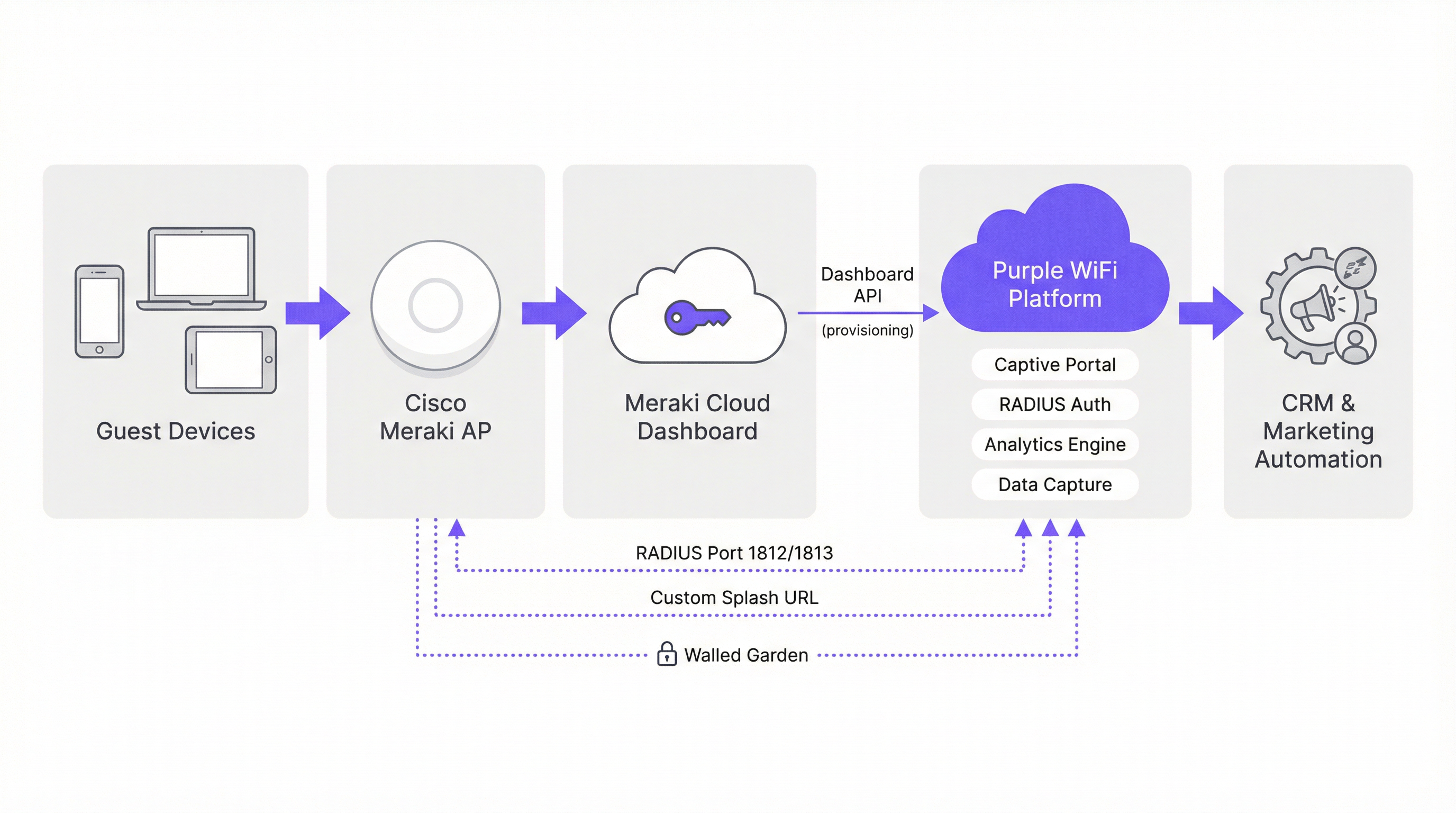
Arquitetura de Integração
A integração entre o Purple e o Meraki é melhor compreendida como dois relacionamentos de API paralelos operando em diferentes camadas da pilha de rede. A primeira é uma integração no plano de gerenciamento por meio da Meraki Dashboard REST API, usada exclusivamente para provisionamento e configuração. A segunda é uma integração no plano de dados por meio da Meraki Captive Portal API e do protocolo RADIUS, que rege o fluxo de autenticação de visitantes em tempo real.
Plano de Gerenciamento: Provisionamento da Dashboard API
O Meraki expõe uma REST API abrangente em api.meraki.com/api/v1. O Assistente de Importação de Hardware do Purple autentica-se nessa API usando uma chave de API com escopo de organização e, em seguida, enumera todas as redes, SSIDs e pontos de acesso dentro da organização Meraki. Isso permite que um engenheiro de rede importe um parque de mais de 300 pontos de acesso em 50 locais em uma única operação em lote — um processo que, de outra forma, exigiria a entrada manual para cada dispositivo. A capacidade de integração bidirecional do Purple também permite que a plataforma envie as configurações de Captive Portal, walled garden e RADIUS de volta ao Meraki, reduzindo ainda mais a sobrecarga de configuração manual.
Para gerar a chave de API necessária, navegue até Organização > API & Webhooks > Chaves de API no painel do Meraki e selecione Gerar Chave de API. Essa chave deve ser tratada como uma credencial privilegiada — armazene-a em um sistema de gerenciamento de segredos e faça a rotação de acordo com o ciclo de vida de credenciais padrão da sua organização.
Plano de Dados: Captive Portal API e RADIUS
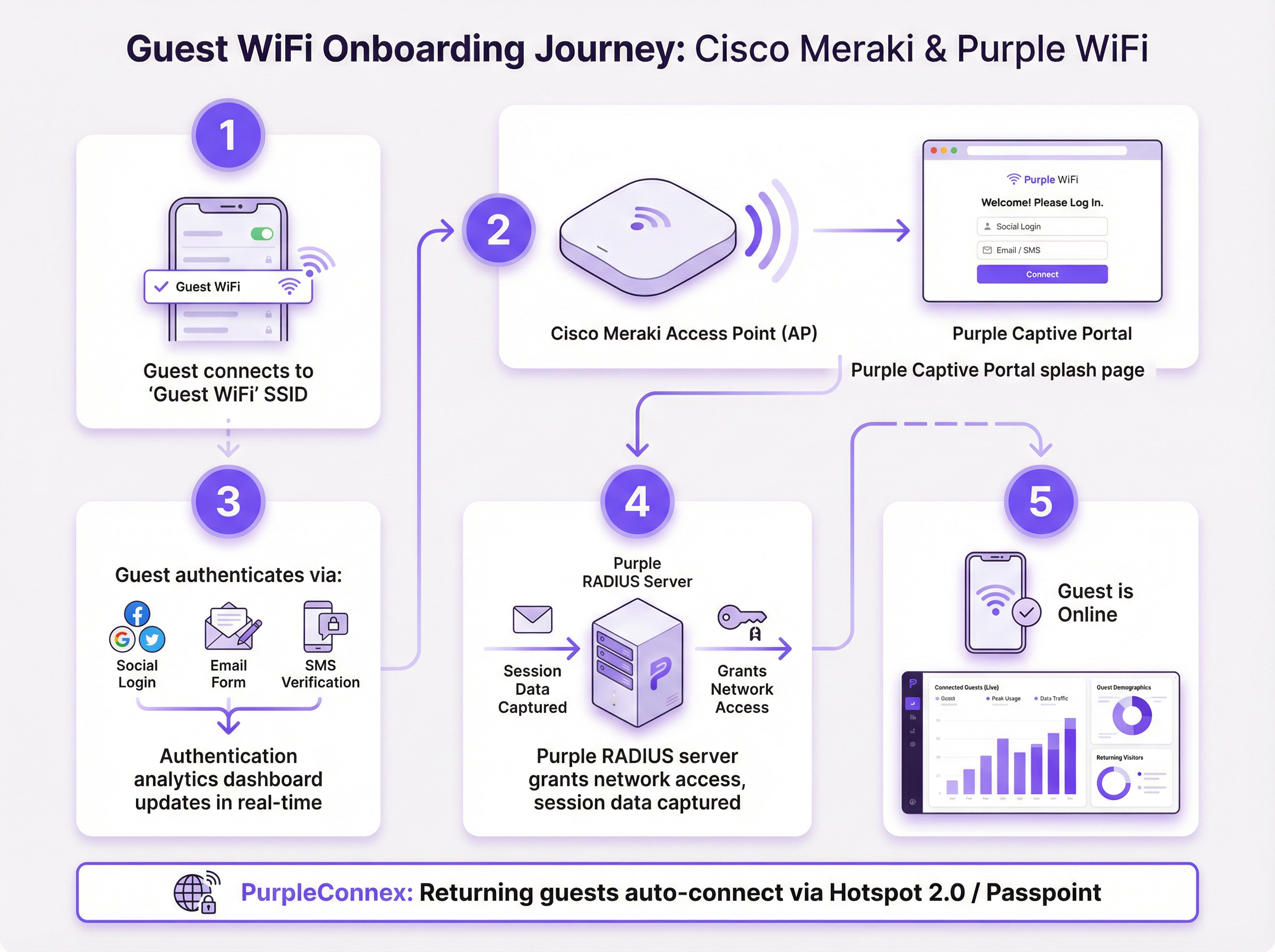
O fluxo de autenticação de visitantes usa a Captive Portal API do Meraki no modo Sign-on. Quando um visitante se associa ao SSID de visitantes, o mecanismo de controle de acesso do Meraki intercepta a primeira solicitação HTTP e emite um redirecionamento 302 para a URL da splash page hospedada pelo Purple. A splash page é fornecida a partir da infraestrutura de CDN do Purple; a configuração de walled garden garante que os domínios do Purple fiquem acessíveis antes da conclusão da autenticação.
Assim que o visitante conclui a autenticação na splash page, a plataforma do Purple emite uma mensagem RADIUS Access-Accept para o AP Meraki na porta 1812. O Meraki então concede ao dispositivo acesso total à rede. As mensagens de contabilização RADIUS na porta 1813 fornecem eventos de início de sessão, atualização provisória (a cada 4 minutos) e término de sessão para o mecanismo de análise do Purple, permitindo cálculos precisos de tempo de permanência, duração da sessão e visitas repetidas.
Métodos de Autenticação
O Captive Portal do Purple suporta vários mecanismos de autenticação, cada um com diferentes implicações de captura de dados:
| Método | Dados Capturados | Consentimento GDPR | Caso de Uso Recomendado |
|---|---|---|---|
| Login Social (Facebook, Google) | Nome, e-mail, dados de perfil | Caixa de seleção de consentimento inline | Hospitalidade, fidelidade no varejo |
| Formulário de E-mail | E-mail, campos personalizados | Caixa de seleção de consentimento inline | Qualquer local, controle máximo de dados |
| Verificação por SMS | Número de celular | Caixa de seleção de consentimento inline | Locais de alta segurança ou com restrição de idade |
| Click-through (Apenas Termos de Serviço) | MAC do dispositivo, dados da sessão | Aceitação dos termos | Acesso público de baixo atrito |
PurpleConnex: SecurePass e Hotspot 2.0
O PurpleConnex é um segundo SSID implantado junto com o SSID principal de visitantes. Ele é configurado como uma rede WPA2 Enterprise, com os servidores RadSec RADIUS do Purple (rad1-secure.purple.ai e rad2-secure.purple.ai) na porta 2083 com transporte TLS. O Hotspot 2.0 (Passpoint) é habilitado neste SSID, anunciando o domínio securewifi.purple.ai e os OIs do Purple Roaming Consortium. Quando o dispositivo de um visitante recorrente já baixou um perfil Purple Passpoint anteriormente, ele se associará automaticamente ao PurpleConnex e se autenticará silenciosamente — sem splash page, sem login manual. Isso é particularmente impactante em ambientes hoteleiros, onde um hóspede que faz check-in para uma estadia de várias noites não deve ser obrigado a se reautenticar a cada reconexão do dispositivo.
A configuração do Hotspot 2.0 também resolve o desafio de randomização de endereços MAC introduzido pelo iOS 14 e Android 10+. Como a autenticação do PurpleConnex é baseada em credenciais em vez de baseada em MAC, o Purple pode manter um registro consistente de identidade do visitante, mesmo quando o dispositivo apresenta um endereço MAC randomizado diferente a cada tentativa de conexão.
Guia de Implementação
Checklist de Pré-implantação
Antes de iniciar a configuração, confirme se os seguintes pré-requisitos estão em vigor. Sua organização Meraki deve ter o acesso à API habilitado — esta é uma configuração no nível da organização em Organização > Configurações > Acesso à Dashboard API. Você precisará de uma conta no Portal Purple com seu(s) local(is) criado(s) e seu(s) SSID(s) configurado(s). Obtenha os seguintes valores do Portal Purple antes de mexer no painel do Meraki: os hostnames do servidor RADIUS e o segredo compartilhado (shared secret), a URL personalizada da splash page, a URL de redirecionamento pós-autenticação e a lista de permissões (whitelist) atual de domínios do walled garden.
Passo 1: Gerar a Chave de API do Meraki e Importar Pontos de Acesso
No painel do Meraki, navegue até Organização > API & Webhooks > Chaves de API e gere uma nova chave de API. Copie esta chave imediatamente — ela é exibida apenas uma vez. No Portal Purple, navegue até Gerenciamento de Locais > Importar Hardware > API de Terceiros, selecione Cisco Meraki e cole sua chave de API. O Purple enumerará todo o seu parque de pontos de acesso. Selecione os pontos de acesso que deseja associar a cada local do Purple e confirme a importação.
Passo 2: Configurar o SSID de Visitantes — Controle de Acesso
No painel do Meraki, navegue até Wireless > Controle de Acesso. Selecione seu SSID de visitantes no menu suspenso e aplique as seguintes configurações:
| Parâmetro | Valor |
|---|---|
| Status do SSID | Habilitado |
| Segurança | Aberta |
| Splash Page | Sign-on com meu servidor RADIUS |
| Força do Captive Portal | Bloquear todo o acesso até que o sign-on seja concluído |
| Walled Garden | Habilitado (adicione todas as entradas de domínio do Purple) |
| Logins Simultâneos | Permitir |
| Comportamento de Desconexão da Controladora | Padrão |
| IP do Cliente e VLAN | Meraki DHCP (modo NAT) |
| Detecção de Portadora de Dados | Desabilitado |
Em Servidores RADIUS, adicione dois servidores de autenticação (primário e secundário) na porta 1812 com o segredo compartilhado do seu Portal Purple. Adicione os servidores de contabilização correspondentes na porta 1813. Defina o intervalo provisório de contabilização para 4 minutos, o tempo limite do servidor para 5 segundos e a contagem de novas tentativas para 3.
Em Configurações Avançadas de RADIUS, defina tanto o Called-Station-ID quanto o NAS-ID para Endereço MAC do AP. Remova quaisquer outros valores desses campos.
Passo 3: Configurar a Splash Page
Navegue até Wireless > Splash Page. Insira a URL Personalizada da Splash Page do seu Portal Purple. Defina o destino de redirecionamento pós-splash para a URL de sua escolha — normalmente o site do seu local ou uma landing page promocional específica. Salve as alterações.
Passo 4: Configurar o PurpleConnex (SSID SecurePass)
Crie um novo SSID chamado PurpleConnex. Defina a segurança como WPA2 Enterprise. Desabilite a Wi-Fi Personal Network (WPN). Em servidores RADIUS, adicione rad1-secure.purple.ai e rad2-secure.purple.ai na porta 2083 com RadSec (RADIUS sobre TLS) habilitado e o segredo compartilhado radsec. Defina o tempo limite de inatividade do TLS RadSec para 15 minutos. Desabilite o suporte a RADIUS CoA. Habilite o proxy RADIUS.
Navegue até Wireless > Hotspot 2.0. Selecione o SSID PurpleConnex e configure da seguinte forma:
| Parâmetro | Valor |
|---|---|
| Hotspot 2.0 | Habilitado |
| Nome do Operador | PURPLE:GB |
| Tipo de Rede | Rede pública gratuita |
| Lista de Domínios | securewifi.purple.ai |
| OIs do Roaming Consortium | 5A03BA0000, 004096 |
| NAI Realm | securewifi.purple.ai (EAP-TTLS / PAP) |
Passo 5: Validar e Testar
Antes de declarar a implantação concluída, teste a jornada completa do visitante a partir de um dispositivo de consumidor em um segmento de rede separado. Verifique se a splash page carrega corretamente, se todos os métodos de autenticação funcionam, se o acesso à rede pós-autenticação é concedido dentro de 3 a 5 segundos e se os dados da sessão aparecem no painel de análise do Purple em até 5 minutos. Teste o fluxo de reconexão automática do PurpleConnex baixando o perfil Passpoint e confirmando a reconexão perfeita em uma segunda visita.
Melhores Práticas
Segmentação de Rede e Conformidade com PCI DSS. O tráfego de WiFi para visitantes deve ser isolado em uma VLAN dedicada, com regras de firewall impedindo o movimento lateral para segmentos de rede corporativa. Se o seu local processa dados de cartão de pagamento na mesma infraestrutura de rede física, é necessário um exercício formal de definição de escopo do PCI DSS. O modo NAT do Meraki fornece isolamento de cliente no nível do AP, mas a segmentação de VLAN na camada de comutação (switching) é o controle apropriado para o gerenciamento de escopo PCI.
Governança de Dados GDPR e CCPA. O Captive Portal do Purple apresenta um mecanismo de consentimento no ponto de autenticação, capturando o opt-in explícito para comunicações de marketing. Certifique-se de que as configurações de retenção de dados do seu Portal Purple estejam alinhadas com a política de governança de dados da sua organização. A plataforma do Purple suporta nativamente solicitações de acesso de titulares de dados e fluxos de trabalho de direito ao esquecimento (right-to-erasure), o que é uma vantagem material de conformidade sobre soluções de Captive Portal sob medida.
Manutenção do Walled Garden. A lista de domínios do walled garden é um item de configuração vivo. A CDN e a infraestrutura da plataforma do Purple podem mudar com o tempo, e um walled garden desatualizado resultará em uma experiência de splash page quebrada. Inscreva-se nas notas de lançamento do Purple e revise a lista do walled garden como parte do seu processo padrão de gerenciamento de mudanças.
Redundância e Failover. O Purple fornece dois endpoints de servidor RADIUS tanto para o SSID de visitantes quanto para o PurpleConnex. Ambos devem estar sempre configurados. No caso de uma interrupção da plataforma Purple, configure o comportamento de desconexão da controladora do Meraki para Padrão — isso permite que as sessões autenticadas anteriormente continuem enquanto as novas autenticações entram na fila para nova tentativa.
Wi-Fi 6 e Otimização de Throughput. Para locais de alta densidade, como estádios e centros de conferências, os pontos de acesso Wi-Fi 6 (802.11ax) do Meraki fornecem a margem de throughput necessária para sessões simultâneas de visitantes. A integração do Purple é agnóstica em relação à geração de hardware — a configuração do RADIUS e do Captive Portal é idêntica em todas as gerações de produtos AP do Meraki.
Solução de Problemas e Mitigação de Riscos

A tabela a seguir resume os modos de falha mais comuns encontrados em implantações do Meraki e do Purple, suas causas raízes e a remediação recomendada.
| Sintoma | Causa Raiz | Remediação |
|---|---|---|
| A splash page não carrega (em branco ou quebrada) | Walled garden incompleto | Adicione todas as entradas de domínio do Purple à whitelist do walled garden |
| A autenticação é bem-sucedida, mas o acesso à rede não é concedido | Tempo limite do RADIUS muito baixo | Defina o tempo limite do servidor para 5s, contagem de novas tentativas para 3 |
| O Analytics não mostra dados por AP | NAS-ID / Called-Station-ID configurados incorretamente | Defina ambos os campos para o endereço MAC do AP nas Configurações Avançadas de RADIUS |
| Falhas intermitentes de autenticação no pico de carga | Apenas um servidor RADIUS configurado | Adicione os endpoints RADIUS primário e secundário do Purple |
| PurpleConnex não conecta automaticamente | Hotspot 2.0 configurado incorretamente | Verifique as configurações de OIs do Roaming Consortium e NAI Realm |
| Visitantes recorrentes são solicitados a se reautenticar | SSID PurpleConnex não implantado | Implante o SSID PurpleConnex com a configuração Passpoint |
| Consentimento GDPR não capturado | Campos de consentimento da splash page desabilitados | Habilite os campos de opt-in de marketing no editor de splash do Portal Purple |
Randomização de Endereço MAC. Dispositivos iOS e Android modernos apresentam endereços MAC randomizados por padrão. Isso afeta a capacidade do Purple de identificar visitantes recorrentes no SSID de visitantes. A solução PurpleConnex / SecurePass resolve isso usando autenticação baseada em credenciais em vez de identificação baseada em MAC. Para locais onde a implantação do PurpleConnex não é viável, a plataforma do Purple aplica correspondência probabilística usando metadados de sessão para mitigar parcialmente o impacto.
Compatibilidade de Firmware do Meraki. Certifique-se de que seus APs Meraki estejam executando uma versão de firmware que suporte os recursos Hotspot 2.0 e RadSec necessários para o PurpleConnex. O canal de firmware estável do Meraki é recomendado para implantações de produção; firmwares beta não devem ser usados em ambientes de WiFi para visitantes em tempo real.
ROI e Impacto nos Negócios
O business case para a implantação do Purple em um parque Meraki é bem evidenciado por implantações ativas em vários setores verticais. Os resultados a seguir foram extraídos de estudos de caso publicados pelo Purple.
| Organização | Setor | Resultado |
|---|---|---|
| Harrods | Varejo de Luxo | 57x de ROI em 600.000 logins de WiFi |
| AGS Airports | Viagens e Transporte | 842% de ROI via receita de largura de banda em níveis |
| McDonald's Bélgica | Restaurante de Serviço Rápido | Implantação ativa do Purple + Cisco Meraki + Socialspot |
| Walmart Canadá | Varejo de Grande Superfície | WiFi para visitantes em escala corporativa com Purple e Cisco |
| Miami HEAT (Kaseya Center) | Esportes e Entretenimento | 290.000 conexões, média de 28.000 por mês |
| c2c Rail | Transporte | 81.601 usuários de WiFi → 151% de ROI |
O mecanismo de ROI é direto. O Purple converte eventos de autenticação de WiFi de visitantes em perfis de dados primários (first-party data) — endereços de e-mail, informações demográficas, frequência de visitas, tempo de permanência e padrões comportamentais. Esses dados alimentam diretamente as plataformas de CRM e automação de marketing por meio dos conectores de API do Purple, permitindo campanhas direcionadas que comprovadamente superam os dados de audiência de terceiros tanto na taxa de conversão quanto no custo por aquisição.
Para um hotel de 200 quartos operando com 70% de ocupação e uma média de 1,8 hóspedes por quarto, uma implantação do Purple em um parque Meraki normalmente capturará de 250 a 300 novos perfis de dados primários por dia. Com uma taxa de conversão de e-mail marketing padrão do setor de 3 a 5% e um valor médio de reserva incremental de £ 150, a atribuição de receita anual apenas do reengajamento por e-mail normalmente excede o custo total da licença da plataforma Purple no primeiro ano de operação.
Os ganhos de eficiência operacional do provisionamento automatizado do Meraki são um benefício secundário, mas significativo. Para um operador de vários locais gerenciando 50 localidades, a redução no tempo de configuração manual — de cerca de 3 a 4 horas por local para menos de 30 minutos — representa uma economia material nos custos de recursos de engenharia.
Termos-Chave e Definições
Captive Portal
A web-based authentication gateway that intercepts a guest device's initial HTTP request and redirects it to a login or terms-acceptance page before granting network access. In the Meraki-Purple integration, the captive portal is hosted by Purple and delivered via a custom splash URL configured in the Meraki dashboard.
IT teams encounter this when configuring the Splash Page settings in the Meraki dashboard. The choice between Click-through (terms acceptance only) and Sign-on (RADIUS authentication) determines the level of data capture and security the deployment provides.
RADIUS (Remote Authentication Dial-In User Service)
A networking protocol (RFC 2865) that provides centralised authentication, authorisation, and accounting (AAA) for network access. In the Meraki-Purple integration, Purple operates RADIUS servers that receive authentication requests from Meraki APs on port 1812 and return Access-Accept or Access-Reject responses. Accounting data is sent to port 1813.
RADIUS is the backbone of the guest authentication flow. Network engineers need to configure the RADIUS server IP addresses, shared secret, and port numbers in the Meraki Access Control settings. Incorrect RADIUS configuration is the most common cause of guest authentication failure.
Walled Garden
A list of network destinations (IP addresses, domain names, or CIDR blocks) that a guest device is permitted to reach before completing captive portal authentication. In the Meraki-Purple integration, the walled garden must include all domains required by Purple's splash page — CDN assets, authentication provider endpoints, and the Purple platform itself.
IT teams must maintain this list as a living configuration item. An incomplete walled garden results in a broken splash page experience for guests. Purple publishes and maintains a current whitelist of required domains in their support documentation.
RadSec (RADIUS over TLS)
An extension to the RADIUS protocol (RFC 6614) that transports RADIUS messages over a TLS-encrypted TCP connection, providing confidentiality and integrity for authentication traffic. Purple's PurpleConnex SSID uses RadSec on port 2083, replacing the standard UDP transport used by the guest SSID RADIUS configuration.
RadSec is required for the PurpleConnex SecurePass SSID. Network engineers must enable the RadSec toggle in Meraki's RADIUS server configuration and use port 2083 rather than the standard 1812/1813. Failure to enable RadSec will prevent PurpleConnex authentication from functioning.
Hotspot 2.0 / Passpoint (IEEE 802.11u)
A Wi-Fi Alliance certification programme based on the IEEE 802.11u standard that enables automatic, secure network discovery and association. A device with a Passpoint profile will automatically connect to a compatible network without user intervention, using EAP-based authentication rather than a captive portal.
In the Meraki-Purple integration, Hotspot 2.0 is configured on the PurpleConnex SSID to enable seamless auto-reconnection for returning guests. This is particularly valuable in hospitality and retail environments where repeat authentication friction reduces guest satisfaction.
NAS-ID (Network Access Server Identifier)
A RADIUS attribute (Attribute 32) that identifies the network access server — in this context, the Meraki access point — that is sending the authentication request. Purple uses the NAS-ID to attribute guest sessions to specific physical access points, enabling floor-level location analytics.
This is one of the most commonly misconfigured parameters in Meraki-Purple deployments. It must be set to AP MAC address in the Meraki Advanced RADIUS Settings. Any other value (such as SSID name or a static string) will prevent Purple from generating per-AP analytics.
Meraki Dashboard API
A RESTful API provided by Cisco Meraki that allows programmatic access to the Meraki cloud management platform. It supports read and write operations across organisations, networks, devices, and configuration objects. Purple uses this API to import access point data and push SSID/RADIUS configuration during the provisioning phase.
IT teams need to generate an API key from the Meraki dashboard (Organisation > API & Webhooks) and provide it to the Purple Portal's Hardware Import Wizard. This key should be treated as a privileged credential and stored securely.
GDPR (General Data Protection Regulation)
EU Regulation 2016/679, which governs the collection, processing, and storage of personal data of EU residents. In the context of guest WiFi, GDPR requires that venues obtain explicit, informed consent before collecting personal data (such as email addresses) through a captive portal, and provide mechanisms for data subjects to access, correct, or delete their data.
Purple was among the first WiFi providers to achieve GDPR compliance. The Purple captive portal presents a consent mechanism at the point of authentication, and the platform supports data subject access requests and right-to-erasure workflows natively. IT teams should ensure that the Purple Portal's data retention settings align with their organisation's data governance policy.
PurpleConnex (SecurePass)
Purple's seamless reconnection solution, implemented as a second SSID configured with WPA2 Enterprise security, RadSec RADIUS transport, and Hotspot 2.0 (Passpoint) advertisement. Returning guests whose devices have downloaded a Purple Passpoint profile will automatically associate with PurpleConnex without seeing a captive portal.
PurpleConnex is deployed alongside the primary guest SSID and is invisible to first-time visitors. It resolves two key challenges: repeat authentication friction for returning guests, and MAC address randomisation (iOS 14+, Android 10+) which breaks MAC-based guest identification on the primary SSID.
Called-Station-ID (RADIUS Attribute 30)
A RADIUS attribute that identifies the access point or network access server that the client connected to, typically expressed as the AP's MAC address. Purple uses this attribute in conjunction with NAS-ID to map guest sessions to specific physical access points for location analytics.
Must be set to AP MAC address in Meraki's Advanced RADIUS Settings. This attribute works in tandem with NAS-ID — both must be correctly configured for Purple's floor-level analytics to function accurately.
Estudos de Caso
A 250-room four-star hotel group with 12 properties across the UK has a fully deployed Cisco Meraki estate (MR46 and MR57 APs, MX68 security appliances). They currently offer open guest WiFi with no captive portal. The IT Director wants to implement Purple WiFi to capture guest email addresses for the hotel's CRM, comply with GDPR, and generate analytics on peak-hour network usage. The deployment must be completed with minimal disruption to existing guests and must not require on-site engineer visits to any of the 12 properties. How should this deployment be structured?
The deployment should proceed in three phases, leveraging the Meraki Dashboard API for remote, zero-touch provisioning across all 12 properties.
Phase 1: Provisioning (Day 1, remote) Generate a Meraki API key scoped to the hotel group's Meraki organisation. In the Purple Portal, use the Hardware Import Wizard with the Third Party API option to import all access points across all 12 networks in a single batch. Assign each network to the corresponding Purple venue. This operation typically completes in under 20 minutes for an estate of this size.
Phase 2: SSID and RADIUS Configuration (Days 1–2, remote via Meraki dashboard) For each of the 12 Meraki networks, configure the existing guest SSID with the Sign-on with my RADIUS server splash page type. Add Purple's primary and secondary RADIUS servers on ports 1812 and 1813 with the shared secret from the Purple Portal. Set captive portal strength to Block all access, enable the walled garden with Purple's domain whitelist, and configure the custom splash URL. Set NAS-ID and Called-Station-ID to AP MAC address. Because Meraki's dashboard supports configuration templates, a single template can be applied across all 12 networks simultaneously, reducing per-site configuration time to near zero.
Phase 3: PurpleConnex Deployment (Days 2–3, remote) Create the PurpleConnex SSID on each network with WPA2 Enterprise and RadSec RADIUS configuration. Enable Hotspot 2.0 with the Purple operator name and domain settings. This SSID is invisible to guests who have not previously authenticated — it will auto-connect returning guests silently on subsequent visits.
Validation: Test the full guest journey remotely using a 4G-connected mobile device at one property before rolling the configuration live across all 12. Monitor the Purple analytics dashboard for session data ingestion within the first 24 hours of go-live.
The entire deployment is achievable in 2–3 days of engineering time with zero on-site visits, leveraging Meraki's cloud management and Purple's API provisioning.
A 60,000-capacity football stadium uses Cisco Meraki MR45 access points throughout the concourse, seating bowl, and hospitality suites. They want to deploy Purple WiFi to capture fan data, run in-venue surveys during matches, and integrate with their existing Salesforce CRM. The primary concern is scale: on match days, up to 35,000 concurrent WiFi sessions are expected. The stadium's IT team is concerned about RADIUS authentication performance under peak load. How should the RADIUS configuration be optimised for high-concurrency environments?
For a high-concurrency stadium deployment, the RADIUS configuration requires specific attention to redundancy, timeout parameters, and session management.
RADIUS Server Configuration for Scale: Configure both Purple RADIUS endpoints (primary and secondary) on every Meraki AP and MX in the estate. This is non-negotiable for a stadium deployment — a single RADIUS server configuration will create a single point of failure that will manifest as authentication failures precisely at kick-off, when concurrent connection attempts peak.
Set the RADIUS server timeout to 5 seconds and retry count to 3. This gives each authentication attempt up to 15 seconds before failing over to the secondary server, which is sufficient for a cloud-hosted RADIUS service under normal conditions. Do not reduce the timeout below 5 seconds in a stadium environment — the additional latency from concurrent load means that aggressive timeout values will cause false failures.
Set the accounting interim interval to 4 minutes. This generates a RADIUS Accounting-Interim-Update message every 4 minutes per active session, which Purple uses to calculate dwell time. In a stadium with 35,000 concurrent sessions, this generates approximately 145 accounting messages per second — well within Purple's platform capacity.
SSID and Network Segmentation: Deploy the guest SSID on a dedicated VLAN with a sufficiently large DHCP scope. A /16 subnet (65,534 addresses) is recommended for a 60,000-capacity venue. Ensure the DHCP lease time is set to match the expected session duration — for a 2-hour match, a 3-hour lease is appropriate. Short lease times will cause unnecessary DHCP churn and add load to the authentication infrastructure.
Salesforce CRM Integration: Purple's platform supports native Salesforce connector integration. Configure the CRM connector in the Purple Portal to push new guest profiles and session events to Salesforce in real time. Map Purple's data fields (email, visit count, dwell time, authentication method) to the corresponding Salesforce Contact and Campaign Member objects. This enables the stadium's marketing team to trigger automated post-match email campaigns within minutes of the final whistle.
In-Venue Surveys: Purple's MicroSurvey feature can be triggered post-authentication, presenting a 1–3 question survey on the splash page redirect. For a stadium deployment, configure the survey to trigger for a random 20% sample of authenticated guests to avoid survey fatigue while maintaining statistical significance.
Análise de Cenário
Q1. A retail chain with 80 stores has deployed Cisco Meraki MR33 access points throughout their estate. They want to implement Purple WiFi but their security team has raised concerns about deploying an Open SSID for guest access. The security team argues that all SSIDs should use WPA2 encryption at minimum. How do you address this concern, and what is the correct security architecture for the guest WiFi deployment?
💡 Dica:Consider the difference between link-layer encryption (WPA2) and application-layer authentication (captive portal + RADIUS). Also consider what the PurpleConnex SSID provides.
Mostrar Abordagem Recomendada
The security team's concern is valid in principle but reflects a conflation of two different security objectives. WPA2 encryption protects the radio link between the client device and the access point — it prevents eavesdropping on the wireless medium. However, for a public guest network, WPA2 Personal (PSK) provides minimal practical security because the pre-shared key is, by definition, publicly known to all guests. Any guest who knows the PSK can decrypt other guests' traffic using a passive capture attack.
The correct architecture is: deploy the guest SSID as Open (no WPA2) with a captive portal for authentication. This is the industry-standard approach for public guest WiFi because it allows the captive portal to function without requiring guests to know a password before they can reach the splash page. The security model relies on application-layer controls (HTTPS on the splash page, RADIUS authentication, VLAN isolation) rather than link-layer encryption.
For guests who require encrypted transport, the PurpleConnex SSID provides WPA2 Enterprise security with RadSec RADIUS — this is genuinely secure because each client receives a unique encryption key derived from their EAP credentials. Returning guests who have the PurpleConnex Passpoint profile will automatically connect to this encrypted SSID.
The complete security architecture is therefore: Open SSID for first-time guest onboarding (captive portal + RADIUS authentication + VLAN isolation) + WPA2 Enterprise PurpleConnex SSID for returning guests (RadSec + Passpoint). This satisfies both the guest experience requirement and the security team's encryption requirement for repeat visitors.
Q2. A conference centre is deploying Purple WiFi on their Meraki estate for the first time. Three weeks after go-live, the marketing team reports that the Purple analytics dashboard shows total session counts but no per-room or per-zone data — all sessions appear to be attributed to a single location. The network engineer who performed the configuration has left the organisation. What is the most likely cause, and how do you diagnose and resolve it?
💡 Dica:Think about which RADIUS attribute Purple uses to map sessions to physical locations, and what the default Meraki configuration for that attribute is.
Mostrar Abordagem Recomendada
The most likely cause is that the NAS-ID and/or Called-Station-ID RADIUS attributes are not configured to use AP MAC address. When these fields are set to a static string, SSID name, or left at default, every access point in the estate sends the same identifier in its RADIUS messages. Purple's analytics engine receives identical location identifiers from all APs and cannot distinguish between them, resulting in all sessions being attributed to a single (or unknown) location.
Diagnosis: In the Meraki dashboard, navigate to Wireless > Access Control for the guest SSID. Scroll to Advanced RADIUS Settings. Check the values for Called-Station-ID and NAS-ID. If either field shows anything other than AP MAC address — such as SSID name, a static string, or multiple values — this is the root cause.
Resolution: Set both Called-Station-ID and NAS-ID to AP MAC address only. Remove any other values from these fields. Save the configuration. Note that this change takes effect for new sessions — existing active sessions will not be retroactively re-attributed. Within 5–10 minutes of the configuration change, new session data in the Purple analytics dashboard should begin showing per-AP attribution.
If the issue persists after correcting the RADIUS attribute configuration, verify that the Purple Portal has the correct AP MAC addresses imported and associated with the correct floor plan zones. If APs were imported before floor plans were configured, the MAC-to-zone mapping may need to be updated in the Purple Portal's venue management settings.
Q3. A 500-bed NHS hospital trust wants to deploy Purple WiFi on their existing Cisco Meraki infrastructure to provide patient and visitor WiFi. Key requirements are: GDPR compliance for data collection, content filtering to block inappropriate content on the patient network, seamless connectivity for long-stay patients (multi-day admissions), and integration with their existing patient engagement platform via API. What Purple features and Meraki configuration elements address each requirement?
💡 Dica:Consider Purple's compliance features, Purple Shield DNS filtering, PurpleConnex for long-stay patients, and Purple's API/connector capabilities for the patient engagement platform integration.
Mostrar Abordagem Recomendada
Each requirement maps to a specific combination of Purple features and Meraki configuration:
GDPR Compliance: Purple's captive portal presents a consent mechanism at authentication, capturing explicit opt-in for data processing. The Purple Portal's data governance settings allow configuration of data retention periods aligned with NHS data governance policies. Purple supports data subject access requests and right-to-erasure natively. The splash page should be configured to present clear, plain-language consent language — not buried in terms and conditions — to meet the GDPR requirement for informed, unambiguous consent.
Content Filtering: Purple Shield is Purple's cloud-native DNS filtering service. It operates at the infrastructure level, filtering DNS queries before they resolve, and can be configured with category-based blocking (adult content, gambling, malware, etc.) appropriate for a patient environment. This is configured within the Purple Portal and applies to all authenticated sessions on the guest SSID without requiring additional hardware.
Seamless Connectivity for Long-Stay Patients: Deploy PurpleConnex with Hotspot 2.0 (Passpoint) configuration. Once a patient has authenticated once and downloaded the Passpoint profile, their device will auto-connect on subsequent associations — including after the device wakes from sleep, moves between wards, or reconnects after a brief disconnection. This eliminates the daily re-authentication friction that is a common complaint in hospital WiFi deployments.
Patient Engagement Platform Integration: Purple's platform exposes a REST API and supports pre-built connectors for major CRM and engagement platforms. Configure the Purple Portal's API connector to push authenticated session events (patient ID if captured at login, session start/end, ward-level location data) to the patient engagement platform in real time. If the engagement platform is not in Purple's pre-built connector library, the REST API allows custom integration development.
Principais Conclusões
- ✓The Purple and Meraki integration operates across two distinct layers: the Meraki Dashboard REST API for automated bulk provisioning of access points, and the Captive Portal API with RADIUS authentication (ports 1812/1813) for the live guest experience — understanding this separation is essential for both deployment planning and troubleshooting.
- ✓The three most critical configuration parameters are: NAS-ID and Called-Station-ID set to AP MAC address (required for per-zone analytics), RADIUS server timeout of 5 seconds with retry count of 3 (required for reliability under load), and a complete walled garden domain whitelist (required for the splash page to load correctly).
- ✓PurpleConnex (SecurePass) deploys a second WPA2 Enterprise SSID with RadSec RADIUS and Hotspot 2.0 (Passpoint/IEEE 802.11u), enabling returning guests to auto-reconnect without a captive portal — this also resolves the MAC address randomisation challenge introduced by iOS 14+ and Android 10+.
- ✓GDPR and CCPA compliance is built into Purple's captive portal by design, with explicit consent capture at authentication, data subject access request workflows, and configurable data retention — making Purple a materially lower compliance risk than bespoke captive portal solutions.
- ✓The business case is well-evidenced: Harrods achieved 57× ROI on 600,000 WiFi logins, AGS Airports achieved 842% ROI, and McDonald's Belgium, Walmart Canada, and the Miami HEAT are all live Cisco Meraki and Purple deployments at enterprise scale.
- ✓For multi-site deployments, the Meraki Dashboard API enables batch import of entire access point estates into the Purple Portal in a single operation, reducing a multi-day manual configuration exercise to under an hour — the operational efficiency gain is a significant secondary benefit beyond the guest intelligence value.
- ✓Network segmentation is a non-negotiable prerequisite: guest WiFi traffic must be isolated on a dedicated VLAN with firewall rules preventing lateral movement to corporate segments, and any PCI DSS scoping implications of shared physical infrastructure must be formally assessed before go-live.




