

Integrazione di Cisco Meraki con Purple WiFi
This guide provides a definitive technical reference for deploying Purple WiFi on Cisco Meraki infrastructure, covering the dual-layer integration architecture — Dashboard API provisioning and Captive Portal API authentication — alongside step-by-step RADIUS and splash page configuration. It is designed for network engineers and IT managers who need to move from a functional guest WiFi deployment to a strategic guest intelligence platform, with measurable ROI outcomes drawn from live enterprise deployments including McDonald's Belgium, Harrods, and AGS Airports.
🎧 Ascolta questa guida
Visualizza trascrizione

Sintesi esecutiva
Cisco Meraki è la dorsale infrastrutturale d'elezione per migliaia di sedi aziendali: hotel, catene di vendita al dettaglio, stadi e strutture del settore pubblico. La sua architettura gestita in cloud offre semplicità operativa su larga scala, ma le sue funzionalità WiFi native per gli ospiti sono ben lontane da ciò che richiede un moderno operatore di strutture: acquisizione di dati di prima parte, gestione del consenso conforme al GDPR, analisi dell'affluenza in tempo reale e integrazione con la marketing automation. Purple WiFi colma questa lacuna in modo decisivo.
L'integrazione tra Purple e Meraki opera su due livelli tecnici. La Meraki Dashboard API consente il provisioning automatizzato in blocco, importando centinaia di access point da un'organizzazione Meraki nel portale Purple in un'unica operazione. La Meraki Captive Portal API, combinata con l'autenticazione RADIUS, offre l'esperienza rivolta agli ospiti: una splash page completamente personalizzata con il brand, opzioni di autenticazione flessibili e la contabilità delle sessioni che alimenta il motore di analisi di Purple. Per gli ospiti di ritorno, l'SSID PurpleConnex (SecurePass) sfrutta Hotspot 2.0 (Passpoint, IEEE 802.11u) per una riconnessione automatica senza interruzioni, eliminando l'attrito delle autenticazioni ripetute.
Le implementazioni di questa integrazione sono attive su larga scala: McDonald's Belgio, Walmart Canada, Harrods (ROI di 57x su 600.000 accessi) e AGS Airports (ROI dell'842%). Per qualsiasi team IT che gestisce un parco dispositivi Meraki e cerca di dimostrare un valore di business misurabile dal WiFi per gli ospiti, questa integrazione rappresenta il percorso operativamente più efficiente per raggiungere tale risultato.
Approfondimento tecnico
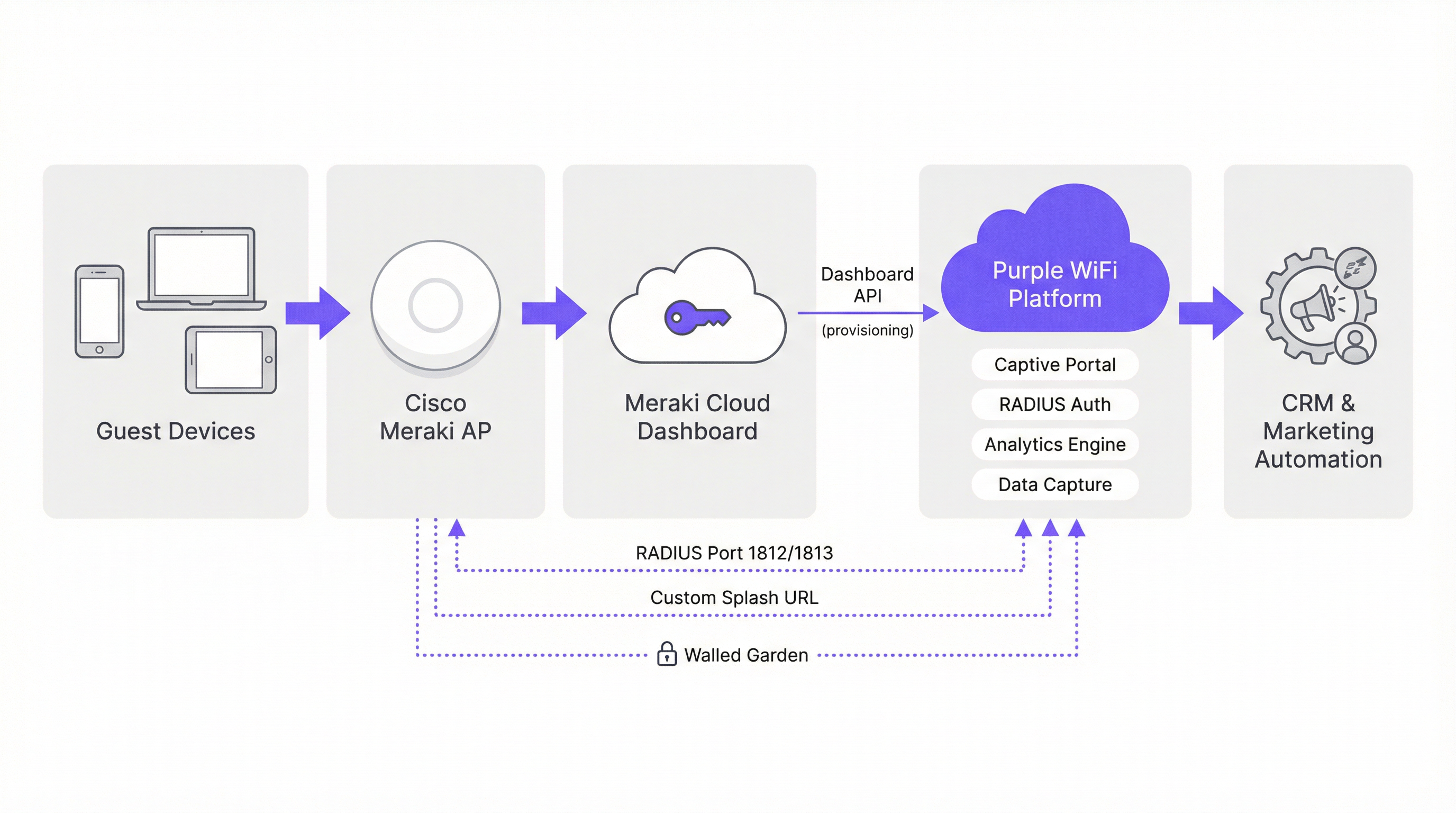
Architettura di integrazione
L'integrazione tra Purple e Meraki è meglio compresa come due relazioni API parallele che operano a diversi livelli dello stack di rete. La prima è un'integrazione del piano di gestione tramite la Meraki Dashboard REST API, utilizzata esclusivamente per il provisioning e la configurazione. La seconda è un'integrazione del piano dati tramite la Meraki Captive Portal API e il protocollo RADIUS, che governa il flusso di autenticazione degli ospiti in tempo reale.
Piano di gestione: Provisioning tramite Dashboard API
Meraki espone una REST API completa all'indirizzo api.meraki.com/api/v1. L'Hardware Import Wizard di Purple si autentica su questa API utilizzando una chiave API a livello di organizzazione, quindi enumera tutte le reti, gli SSID e gli access point all'interno dell'organizzazione Meraki. Ciò consente a un ingegnere di rete di importare un parco di oltre 300 access point distribuiti su 50 siti in un'unica operazione batch, un processo che altrimenti richiederebbe l'inserimento manuale per ogni dispositivo. La capacità di integrazione bidirezionale di Purple consente inoltre alla piattaforma di inviare a Meraki la configurazione del Captive Portal, del walled garden e del RADIUS, riducendo ulteriormente il carico della configurazione manuale.
Per generare la chiave API richiesta, accedere a Organisation > API & Webhooks > API Keys nella dashboard di Meraki e selezionare Generate API Key. Questa chiave deve essere trattata come una credenziale privilegiata: conservarla in un sistema di gestione dei segreti e ruotarla in base al ciclo di vita standard delle credenziali dell'organizzazione.
Piano dati: Captive Portal API e RADIUS
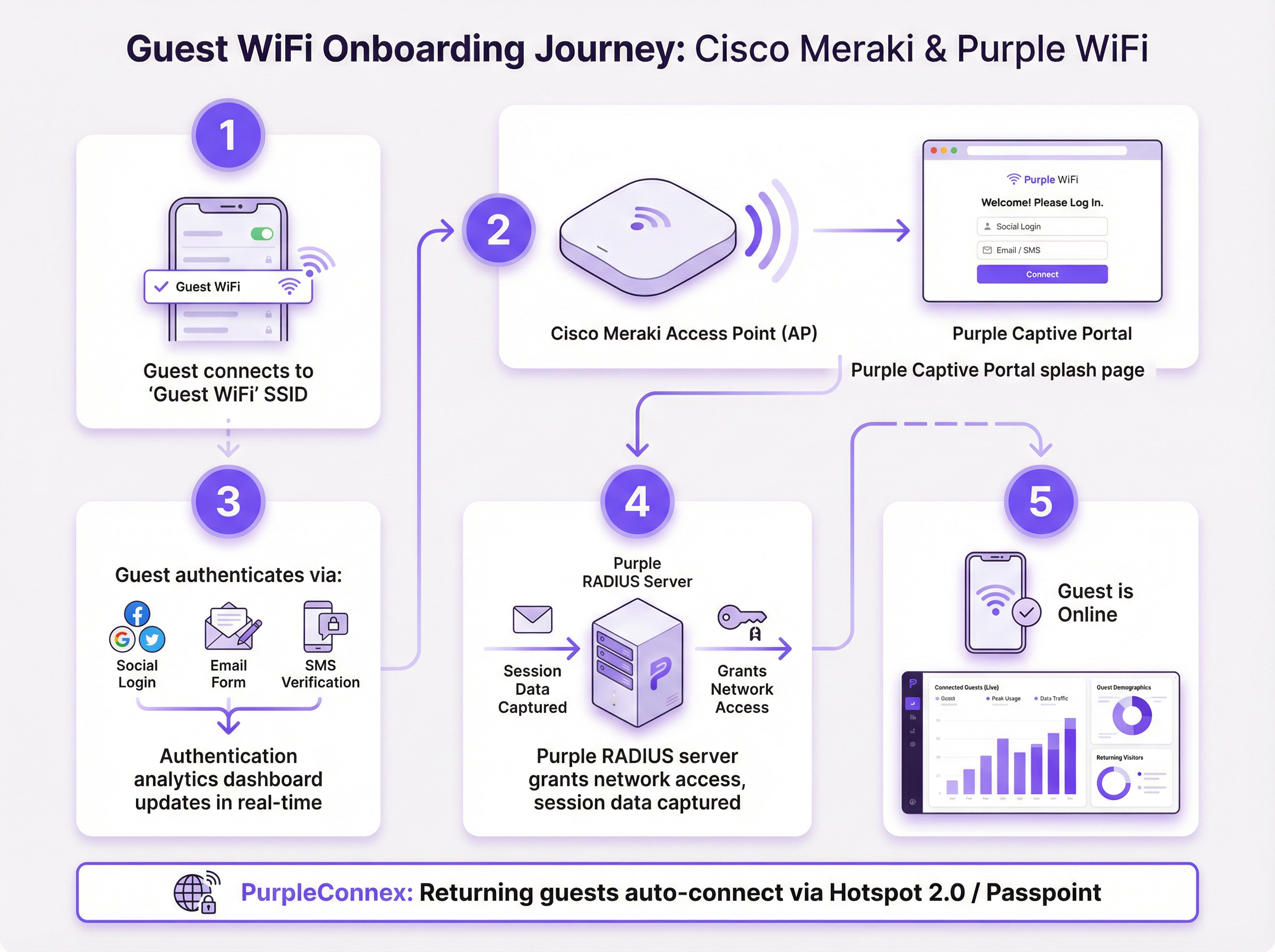
Il flusso di autenticazione degli ospiti utilizza la Captive Portal API di Meraki in modalità Sign-on. Quando un ospite si associa all'SSID per gli ospiti, il motore di controllo degli accessi di Meraki intercetta la prima richiesta HTTP ed emette un reindirizzamento 302 all'URL della splash page ospitata da Purple. La splash page viene fornita dall'infrastruttura CDN di Purple; la configurazione del walled garden garantisce che i domini di Purple siano raggiungibili prima del completamento dell'autenticazione.
Una volta che l'ospite completa l'autenticazione sulla splash page, la piattaforma di Purple invia un messaggio RADIUS Access-Accept all'AP Meraki sulla porta 1812. Meraki concede quindi al dispositivo l'accesso completo alla rete. I messaggi di accounting RADIUS sulla porta 1813 forniscono eventi di inizio sessione, aggiornamento intermedio (ogni 4 minuti) e fine sessione al motore di analisi di Purple, consentendo calcoli accurati del tempo di permanenza, della durata della sessione e delle visite ripetute.
Metodi di autenticazione
Il Captive Portal di Purple supporta molteplici meccanismi di autenticazione, ciascuno con diverse implicazioni per l'acquisizione dei dati:
| Metodo | Dati acquisiti | Consenso GDPR | Caso d'uso consigliato |
|---|---|---|---|
| Social Login (Facebook, Google) | Nome, email, dati del profilo | Casella di spunta per il consenso in linea | Ospitalità, fidelizzazione nel retail |
| Modulo email | Email, campi personalizzati | Casella di spunta per il consenso in linea | Qualsiasi struttura, massimo controllo dei dati |
| Verifica via SMS | Numero di cellulare | Casella di spunta per il consenso in linea | Strutture ad alta sicurezza o con limiti di età |
| Click-through (solo ToS) | MAC del dispositivo, dati di sessione | Accettazione dei termini | Accesso pubblico a basso attrito |
PurpleConnex: SecurePass e Hotspot 2.0
PurpleConnex è un secondo SSID implementato insieme all'SSID principale per gli ospiti. È configurato come rete WPA2 Enterprise, con i server RADIUS RadSec di Purple (rad1-secure.purple.ai e rad2-secure.purple.ai) sulla porta 2083 con trasporto TLS. Hotspot 2.0 (Passpoint) è abilitato su questo SSID, annunciando il dominio securewifi.purple.ai e gli OI del Purple Roaming Consortium. Quando il dispositivo di un ospite di ritorno ha precedentemente scaricato un profilo Purple Passpoint, si assocerà automaticamente a PurpleConnex e si autenticherà in modo silenzioso: nessuna splash page, nessun login manuale. Ciò ha un impatto particolare negli ambienti alberghieri, dove a un ospite che effettua il check-in per un soggiorno di più notti non dovrebbe essere richiesto di riautenticarsi a ogni riconnessione del dispositivo.
La configurazione Hotspot 2.0 risolve anche la sfida della randomizzazione degli indirizzi MAC introdotta da iOS 14 e Android 10+. Poiché l'autenticazione PurpleConnex è basata su credenziali anziché su MAC, Purple può mantenere un record di identità dell'ospite coerente anche se il dispositivo presenta un indirizzo MAC randomizzato diverso a ogni tentativo di connessione.
Guida all'implementazione
Checklist pre-implementazione
Prima di iniziare la configurazione, confermare che i seguenti prerequisiti siano soddisfatti. L'organizzazione Meraki deve avere l'accesso API abilitato: si tratta di un'impostazione a livello di organizzazione in Organisation > Settings > Dashboard API Access. Sarà necessario un account sul portale Purple con le strutture create e gli SSID configurati. Ottenere i seguenti valori dal portale Purple prima di intervenire sulla dashboard di Meraki: gli hostname del server RADIUS e il segreto condiviso, l'URL personalizzato della splash page, l'URL di reindirizzamento post-autenticazione e l'attuale whitelist dei domini del walled garden.
Passaggio 1: Generare la chiave API Meraki e importare gli access point
Nella dashboard di Meraki, accedere a Organisation > API & Webhooks > API Keys e generare una nuova chiave API. Copiare immediatamente questa chiave: viene visualizzata una sola volta. Nel portale Purple, accedere a Venue Management > Import Hardware > Third Party API, selezionare Cisco Meraki e incollare la chiave API. Purple enumererà l'intero parco di access point. Selezionare gli access point che si desidera associare a ciascuna struttura Purple e confermare l'importazione.
Passaggio 2: Configurare l'SSID per gli ospiti — Controllo degli accessi
Nella dashboard di Meraki, accedere a Wireless > Access Control. Selezionare l'SSID per gli ospiti dal menu a discesa e applicare le seguenti impostazioni:
| Parametro | Valore |
|---|---|
| Stato SSID | Abilitato |
| Sicurezza | Aperta |
| Splash Page | Sign-on con il mio server RADIUS |
| Forza del Captive Portal | Blocca tutti gli accessi fino al completamento del sign-on |
| Walled Garden | Abilitato (aggiungere tutte le voci di dominio Purple) |
| Accessi simultanei | Consenti |
| Comportamento disconnessione controller | Predefinito |
| IP client e VLAN | Meraki DHCP (modalità NAT) |
| Data-Carrier Detect | Disabilitato |
In RADIUS Servers, aggiungere due server di autenticazione (primario e secondario) sulla porta 1812 con il segreto condiviso dal portale Purple. Aggiungere i server di accounting corrispondenti sulla porta 1813. Impostare l'intervallo intermedio di accounting a 4 minuti, il timeout del server a 5 secondi e il numero di tentativi a 3.
In Advanced RADIUS Settings, impostare sia Called-Station-ID che NAS-ID su AP MAC address. Rimuovere qualsiasi altro valore da questi campi.
Passaggio 3: Configurare la Splash Page
Accedere a Wireless > Splash Page. Inserire il Custom Splash URL dal portale Purple. Impostare la destinazione di reindirizzamento post-splash sull'URL desiderato, in genere il sito web della struttura o una specifica landing page promozionale. Salvare le modifiche.
Passaggio 4: Configurare PurpleConnex (SSID SecurePass)
Creare un nuovo SSID denominato PurpleConnex. Impostare la sicurezza su WPA2 Enterprise. Disabilitare Wi-Fi Personal Network (WPN). In server RADIUS, aggiungere rad1-secure.purple.ai e rad2-secure.purple.ai sulla porta 2083 con RadSec (RADIUS over TLS) abilitato e il segreto condiviso radsec. Impostare il timeout di inattività TLS RADSec a 15 minuti. Disabilitare il supporto RADIUS CoA. Abilitare il proxy RADIUS.
Accedere a Wireless > Hotspot 2.0. Selezionare l'SSID PurpleConnex e configurare come segue:
| Parametro | Valore |
|---|---|
| Hotspot 2.0 | Abilitato |
| Nome operatore | PURPLE:GB |
| Tipo di rete | Rete pubblica gratuita |
| Elenco domini | securewifi.purple.ai |
| Roaming Consortium OIs | 5A03BA0000, 004096 |
| NAI Realm | securewifi.purple.ai (EAP-TTLS / PAP) |
Passaggio 5: Convalida e test
Prima di dichiarare completata l'implementazione, testare l'intero percorso dell'ospite da un dispositivo consumer su un segmento di rete separato. Verificare che la splash page si carichi correttamente, che tutti i metodi di autenticazione funzionino, che l'accesso alla rete post-autenticazione venga concesso entro 3-5 secondi e che i dati di sessione appaiano nella dashboard di analisi di Purple entro 5 minuti. Testare il flusso di riconnessione automatica di PurpleConnex scaricando il profilo Passpoint e confermando la riconnessione senza interruzioni in una seconda visita.
Best Practice
Segmentazione della rete e conformità PCI DSS. Il traffico WiFi degli ospiti deve essere isolato su una VLAN dedicata, con regole firewall che impediscano il movimento laterale verso i segmenti di rete aziendali. Se la struttura elabora i dati delle carte di pagamento sulla stessa infrastruttura di rete fisica, è necessario un esercizio formale di scoping PCI DSS. La modalità NAT di Meraki fornisce l'isolamento dei client a livello di AP, ma la segmentazione VLAN a livello di switching è il controllo appropriato per la gestione dell'ambito PCI.
Governance dei dati GDPR e CCPA. Il Captive Portal di Purple presenta un meccanismo di consenso al momento dell'autenticazione, acquisendo l'opt-in esplicito per le comunicazioni di marketing. Assicurarsi che le impostazioni di conservazione dei dati del portale Purple siano in linea con la politica di governance dei dati dell'organizzazione. La piattaforma di Purple supporta nativamente le richieste di accesso degli interessati e i flussi di lavoro per il diritto all'oblio, il che rappresenta un vantaggio sostanziale in termini di conformità rispetto alle soluzioni Captive Portal su misura.
Manutenzione del Walled Garden. L'elenco dei domini del walled garden è un elemento di configurazione dinamico. La CDN e l'infrastruttura della piattaforma di Purple possono cambiare nel tempo e un walled garden obsoleto comporterà un'esperienza della splash page interrotta. Iscriversi alle note di rilascio di Purple e rivedere l'elenco del walled garden come parte del processo standard di gestione delle modifiche.
Ridondanza e failover. Purple fornisce due endpoint server RADIUS sia per l'SSID degli ospiti che per PurpleConnex. Entrambi dovrebbero essere sempre configurati. In caso di interruzione della piattaforma Purple, configurare il comportamento di disconnessione del controller di Meraki su Predefinito (Default): ciò consente alle sessioni precedentemente autenticate di continuare mentre le nuove autenticazioni si accodano per un nuovo tentativo.
Wi-Fi 6 e ottimizzazione del throughput. Per strutture ad alta densità come stadi e centri congressi, gli access point Wi-Fi 6 (802.11ax) di Meraki forniscono il margine di throughput necessario per le sessioni simultanee degli ospiti. L'integrazione di Purple è indipendente dalla generazione dell'hardware: la configurazione del RADIUS e del Captive Portal è identica in tutte le generazioni di prodotti AP di Meraki.
Risoluzione dei problemi e mitigazione dei rischi

La seguente tabella riassume le modalità di errore più comuni riscontrate nelle implementazioni Meraki e Purple, le relative cause principali e le soluzioni consigliate.
| Sintomo | Causa principale | Soluzione |
|---|---|---|
| La splash page non si carica (vuota o interrotta) | Walled garden incompleto | Aggiungere tutte le voci di dominio Purple alla whitelist del walled garden |
| L'autenticazione ha esito positivo ma l'accesso alla rete non viene concesso | Timeout RADIUS troppo basso | Impostare il timeout del server a 5s, il numero di tentativi a 3 |
| Le analisi non mostrano dati per AP | NAS-ID / Called-Station-ID configurati in modo errato | Impostare entrambi i campi su AP MAC address in Advanced RADIUS Settings |
| Errori di autenticazione intermittenti al picco di carico | Singolo server RADIUS configurato | Aggiungere entrambi gli endpoint RADIUS Purple primario e secondario |
| PurpleConnex non si connette automaticamente | Hotspot 2.0 configurato in modo errato | Verificare le impostazioni Roaming Consortium OIs e NAI Realm |
| Agli ospiti di ritorno viene richiesto di riautenticarsi | SSID PurpleConnex non implementato | Implementare l'SSID PurpleConnex con la configurazione Passpoint |
| Consenso GDPR non acquisito | Campi di consenso della splash page disabilitati | Abilitare i campi di opt-in per il marketing nell'editor della splash page del portale Purple |
Randomizzazione dell'indirizzo MAC. I moderni dispositivi iOS e Android presentano indirizzi MAC randomizzati per impostazione predefinita. Ciò influisce sulla capacità di Purple di identificare i visitatori di ritorno sull'SSID degli ospiti. La soluzione PurpleConnex / SecurePass risolve questo problema utilizzando l'autenticazione basata su credenziali anziché l'identificazione basata su MAC. Per le strutture in cui l'implementazione di PurpleConnex non è fattibile, la piattaforma di Purple applica una corrispondenza probabilistica utilizzando i metadati di sessione per mitigare parzialmente l'impatto.
Compatibilità del firmware Meraki. Assicurarsi che gli AP Meraki eseguano una versione del firmware che supporti le funzionalità Hotspot 2.0 e RadSec richieste per PurpleConnex. Il canale firmware stabile di Meraki è consigliato per le implementazioni in produzione; il firmware beta non deve essere utilizzato in ambienti WiFi per gli ospiti attivi.
ROI e impatto sul business
Il business case per l'implementazione di Purple su un parco dispositivi Meraki è ben documentato da implementazioni attive in molteplici settori verticali. I seguenti risultati sono tratti da casi di studio pubblicati da Purple.
| Organizzazione | Settore | Risultato |
|---|---|---|
| Harrods | Retail di lusso | ROI di 57x su 600.000 accessi WiFi |
| AGS Airports | Viaggi e trasporti | ROI dell'842% tramite entrate da larghezza di banda a livelli |
| McDonald's Belgio | Ristorazione rapida | Implementazione attiva di Purple + Cisco Meraki + Socialspot |
| Walmart Canada | Grande distribuzione | WiFi per gli ospiti su scala enterprise con Purple e Cisco |
| Miami HEAT (Kaseya Center) | Sport e intrattenimento | 290.000 connessioni, media di 28.000 al mese |
| c2c Rail | Trasporti | 81.601 utenti WiFi → ROI del 151% |
Il meccanismo del ROI è semplice. Purple converte gli eventi di autenticazione WiFi degli ospiti in profili di dati di prima parte: indirizzi email, informazioni demografiche, frequenza delle visite, tempo di permanenza e modelli comportamentali. Questi dati confluiscono direttamente nelle piattaforme CRM e di marketing automation tramite i connettori API di Purple, consentendo campagne mirate che superano in modo dimostrabile i dati di audience di terze parti sia in termini di tasso di conversione che di costo per acquisizione.
Per un hotel di 200 camere con un'occupazione del 70% e una media di 1,8 ospiti per camera, un'implementazione Purple su un parco dispositivi Meraki acquisirà in genere 250-300 nuovi profili di prima parte al giorno. Con un tasso di conversione dell'email marketing standard del settore del 3-5% e un valore medio di prenotazione incrementale di 150 £, l'attribuzione dei ricavi annuali derivante dal solo re-engagement via email supera in genere il costo totale della licenza della piattaforma Purple entro il primo anno operativo.
I guadagni in termini di efficienza operativa derivanti dal provisioning automatizzato di Meraki rappresentano un vantaggio secondario ma significativo. Per un operatore multi-sito che gestisce 50 sedi, la riduzione dei tempi di configurazione manuale, da una stima di 3-4 ore per sito a meno di 30 minuti, rappresenta un risparmio sostanziale sui costi delle risorse ingegneristiche.
Termini chiave e definizioni
Captive Portal
A web-based authentication gateway that intercepts a guest device's initial HTTP request and redirects it to a login or terms-acceptance page before granting network access. In the Meraki-Purple integration, the captive portal is hosted by Purple and delivered via a custom splash URL configured in the Meraki dashboard.
IT teams encounter this when configuring the Splash Page settings in the Meraki dashboard. The choice between Click-through (terms acceptance only) and Sign-on (RADIUS authentication) determines the level of data capture and security the deployment provides.
RADIUS (Remote Authentication Dial-In User Service)
A networking protocol (RFC 2865) that provides centralised authentication, authorisation, and accounting (AAA) for network access. In the Meraki-Purple integration, Purple operates RADIUS servers that receive authentication requests from Meraki APs on port 1812 and return Access-Accept or Access-Reject responses. Accounting data is sent to port 1813.
RADIUS is the backbone of the guest authentication flow. Network engineers need to configure the RADIUS server IP addresses, shared secret, and port numbers in the Meraki Access Control settings. Incorrect RADIUS configuration is the most common cause of guest authentication failure.
Walled Garden
A list of network destinations (IP addresses, domain names, or CIDR blocks) that a guest device is permitted to reach before completing captive portal authentication. In the Meraki-Purple integration, the walled garden must include all domains required by Purple's splash page — CDN assets, authentication provider endpoints, and the Purple platform itself.
IT teams must maintain this list as a living configuration item. An incomplete walled garden results in a broken splash page experience for guests. Purple publishes and maintains a current whitelist of required domains in their support documentation.
RadSec (RADIUS over TLS)
An extension to the RADIUS protocol (RFC 6614) that transports RADIUS messages over a TLS-encrypted TCP connection, providing confidentiality and integrity for authentication traffic. Purple's PurpleConnex SSID uses RadSec on port 2083, replacing the standard UDP transport used by the guest SSID RADIUS configuration.
RadSec is required for the PurpleConnex SecurePass SSID. Network engineers must enable the RadSec toggle in Meraki's RADIUS server configuration and use port 2083 rather than the standard 1812/1813. Failure to enable RadSec will prevent PurpleConnex authentication from functioning.
Hotspot 2.0 / Passpoint (IEEE 802.11u)
A Wi-Fi Alliance certification programme based on the IEEE 802.11u standard that enables automatic, secure network discovery and association. A device with a Passpoint profile will automatically connect to a compatible network without user intervention, using EAP-based authentication rather than a captive portal.
In the Meraki-Purple integration, Hotspot 2.0 is configured on the PurpleConnex SSID to enable seamless auto-reconnection for returning guests. This is particularly valuable in hospitality and retail environments where repeat authentication friction reduces guest satisfaction.
NAS-ID (Network Access Server Identifier)
A RADIUS attribute (Attribute 32) that identifies the network access server — in this context, the Meraki access point — that is sending the authentication request. Purple uses the NAS-ID to attribute guest sessions to specific physical access points, enabling floor-level location analytics.
This is one of the most commonly misconfigured parameters in Meraki-Purple deployments. It must be set to AP MAC address in the Meraki Advanced RADIUS Settings. Any other value (such as SSID name or a static string) will prevent Purple from generating per-AP analytics.
Meraki Dashboard API
A RESTful API provided by Cisco Meraki that allows programmatic access to the Meraki cloud management platform. It supports read and write operations across organisations, networks, devices, and configuration objects. Purple uses this API to import access point data and push SSID/RADIUS configuration during the provisioning phase.
IT teams need to generate an API key from the Meraki dashboard (Organisation > API & Webhooks) and provide it to the Purple Portal's Hardware Import Wizard. This key should be treated as a privileged credential and stored securely.
GDPR (General Data Protection Regulation)
EU Regulation 2016/679, which governs the collection, processing, and storage of personal data of EU residents. In the context of guest WiFi, GDPR requires that venues obtain explicit, informed consent before collecting personal data (such as email addresses) through a captive portal, and provide mechanisms for data subjects to access, correct, or delete their data.
Purple was among the first WiFi providers to achieve GDPR compliance. The Purple captive portal presents a consent mechanism at the point of authentication, and the platform supports data subject access requests and right-to-erasure workflows natively. IT teams should ensure that the Purple Portal's data retention settings align with their organisation's data governance policy.
PurpleConnex (SecurePass)
Purple's seamless reconnection solution, implemented as a second SSID configured with WPA2 Enterprise security, RadSec RADIUS transport, and Hotspot 2.0 (Passpoint) advertisement. Returning guests whose devices have downloaded a Purple Passpoint profile will automatically associate with PurpleConnex without seeing a captive portal.
PurpleConnex is deployed alongside the primary guest SSID and is invisible to first-time visitors. It resolves two key challenges: repeat authentication friction for returning guests, and MAC address randomisation (iOS 14+, Android 10+) which breaks MAC-based guest identification on the primary SSID.
Called-Station-ID (RADIUS Attribute 30)
A RADIUS attribute that identifies the access point or network access server that the client connected to, typically expressed as the AP's MAC address. Purple uses this attribute in conjunction with NAS-ID to map guest sessions to specific physical access points for location analytics.
Must be set to AP MAC address in Meraki's Advanced RADIUS Settings. This attribute works in tandem with NAS-ID — both must be correctly configured for Purple's floor-level analytics to function accurately.
Casi di studio
A 250-room four-star hotel group with 12 properties across the UK has a fully deployed Cisco Meraki estate (MR46 and MR57 APs, MX68 security appliances). They currently offer open guest WiFi with no captive portal. The IT Director wants to implement Purple WiFi to capture guest email addresses for the hotel's CRM, comply with GDPR, and generate analytics on peak-hour network usage. The deployment must be completed with minimal disruption to existing guests and must not require on-site engineer visits to any of the 12 properties. How should this deployment be structured?
The deployment should proceed in three phases, leveraging the Meraki Dashboard API for remote, zero-touch provisioning across all 12 properties.
Phase 1: Provisioning (Day 1, remote) Generate a Meraki API key scoped to the hotel group's Meraki organisation. In the Purple Portal, use the Hardware Import Wizard with the Third Party API option to import all access points across all 12 networks in a single batch. Assign each network to the corresponding Purple venue. This operation typically completes in under 20 minutes for an estate of this size.
Phase 2: SSID and RADIUS Configuration (Days 1–2, remote via Meraki dashboard) For each of the 12 Meraki networks, configure the existing guest SSID with the Sign-on with my RADIUS server splash page type. Add Purple's primary and secondary RADIUS servers on ports 1812 and 1813 with the shared secret from the Purple Portal. Set captive portal strength to Block all access, enable the walled garden with Purple's domain whitelist, and configure the custom splash URL. Set NAS-ID and Called-Station-ID to AP MAC address. Because Meraki's dashboard supports configuration templates, a single template can be applied across all 12 networks simultaneously, reducing per-site configuration time to near zero.
Phase 3: PurpleConnex Deployment (Days 2–3, remote) Create the PurpleConnex SSID on each network with WPA2 Enterprise and RadSec RADIUS configuration. Enable Hotspot 2.0 with the Purple operator name and domain settings. This SSID is invisible to guests who have not previously authenticated — it will auto-connect returning guests silently on subsequent visits.
Validation: Test the full guest journey remotely using a 4G-connected mobile device at one property before rolling the configuration live across all 12. Monitor the Purple analytics dashboard for session data ingestion within the first 24 hours of go-live.
The entire deployment is achievable in 2–3 days of engineering time with zero on-site visits, leveraging Meraki's cloud management and Purple's API provisioning.
A 60,000-capacity football stadium uses Cisco Meraki MR45 access points throughout the concourse, seating bowl, and hospitality suites. They want to deploy Purple WiFi to capture fan data, run in-venue surveys during matches, and integrate with their existing Salesforce CRM. The primary concern is scale: on match days, up to 35,000 concurrent WiFi sessions are expected. The stadium's IT team is concerned about RADIUS authentication performance under peak load. How should the RADIUS configuration be optimised for high-concurrency environments?
For a high-concurrency stadium deployment, the RADIUS configuration requires specific attention to redundancy, timeout parameters, and session management.
RADIUS Server Configuration for Scale: Configure both Purple RADIUS endpoints (primary and secondary) on every Meraki AP and MX in the estate. This is non-negotiable for a stadium deployment — a single RADIUS server configuration will create a single point of failure that will manifest as authentication failures precisely at kick-off, when concurrent connection attempts peak.
Set the RADIUS server timeout to 5 seconds and retry count to 3. This gives each authentication attempt up to 15 seconds before failing over to the secondary server, which is sufficient for a cloud-hosted RADIUS service under normal conditions. Do not reduce the timeout below 5 seconds in a stadium environment — the additional latency from concurrent load means that aggressive timeout values will cause false failures.
Set the accounting interim interval to 4 minutes. This generates a RADIUS Accounting-Interim-Update message every 4 minutes per active session, which Purple uses to calculate dwell time. In a stadium with 35,000 concurrent sessions, this generates approximately 145 accounting messages per second — well within Purple's platform capacity.
SSID and Network Segmentation: Deploy the guest SSID on a dedicated VLAN with a sufficiently large DHCP scope. A /16 subnet (65,534 addresses) is recommended for a 60,000-capacity venue. Ensure the DHCP lease time is set to match the expected session duration — for a 2-hour match, a 3-hour lease is appropriate. Short lease times will cause unnecessary DHCP churn and add load to the authentication infrastructure.
Salesforce CRM Integration: Purple's platform supports native Salesforce connector integration. Configure the CRM connector in the Purple Portal to push new guest profiles and session events to Salesforce in real time. Map Purple's data fields (email, visit count, dwell time, authentication method) to the corresponding Salesforce Contact and Campaign Member objects. This enables the stadium's marketing team to trigger automated post-match email campaigns within minutes of the final whistle.
In-Venue Surveys: Purple's MicroSurvey feature can be triggered post-authentication, presenting a 1–3 question survey on the splash page redirect. For a stadium deployment, configure the survey to trigger for a random 20% sample of authenticated guests to avoid survey fatigue while maintaining statistical significance.
Analisi degli scenari
Q1. A retail chain with 80 stores has deployed Cisco Meraki MR33 access points throughout their estate. They want to implement Purple WiFi but their security team has raised concerns about deploying an Open SSID for guest access. The security team argues that all SSIDs should use WPA2 encryption at minimum. How do you address this concern, and what is the correct security architecture for the guest WiFi deployment?
💡 Suggerimento:Consider the difference between link-layer encryption (WPA2) and application-layer authentication (captive portal + RADIUS). Also consider what the PurpleConnex SSID provides.
Mostra l'approccio consigliato
The security team's concern is valid in principle but reflects a conflation of two different security objectives. WPA2 encryption protects the radio link between the client device and the access point — it prevents eavesdropping on the wireless medium. However, for a public guest network, WPA2 Personal (PSK) provides minimal practical security because the pre-shared key is, by definition, publicly known to all guests. Any guest who knows the PSK can decrypt other guests' traffic using a passive capture attack.
The correct architecture is: deploy the guest SSID as Open (no WPA2) with a captive portal for authentication. This is the industry-standard approach for public guest WiFi because it allows the captive portal to function without requiring guests to know a password before they can reach the splash page. The security model relies on application-layer controls (HTTPS on the splash page, RADIUS authentication, VLAN isolation) rather than link-layer encryption.
For guests who require encrypted transport, the PurpleConnex SSID provides WPA2 Enterprise security with RadSec RADIUS — this is genuinely secure because each client receives a unique encryption key derived from their EAP credentials. Returning guests who have the PurpleConnex Passpoint profile will automatically connect to this encrypted SSID.
The complete security architecture is therefore: Open SSID for first-time guest onboarding (captive portal + RADIUS authentication + VLAN isolation) + WPA2 Enterprise PurpleConnex SSID for returning guests (RadSec + Passpoint). This satisfies both the guest experience requirement and the security team's encryption requirement for repeat visitors.
Q2. A conference centre is deploying Purple WiFi on their Meraki estate for the first time. Three weeks after go-live, the marketing team reports that the Purple analytics dashboard shows total session counts but no per-room or per-zone data — all sessions appear to be attributed to a single location. The network engineer who performed the configuration has left the organisation. What is the most likely cause, and how do you diagnose and resolve it?
💡 Suggerimento:Think about which RADIUS attribute Purple uses to map sessions to physical locations, and what the default Meraki configuration for that attribute is.
Mostra l'approccio consigliato
The most likely cause is that the NAS-ID and/or Called-Station-ID RADIUS attributes are not configured to use AP MAC address. When these fields are set to a static string, SSID name, or left at default, every access point in the estate sends the same identifier in its RADIUS messages. Purple's analytics engine receives identical location identifiers from all APs and cannot distinguish between them, resulting in all sessions being attributed to a single (or unknown) location.
Diagnosis: In the Meraki dashboard, navigate to Wireless > Access Control for the guest SSID. Scroll to Advanced RADIUS Settings. Check the values for Called-Station-ID and NAS-ID. If either field shows anything other than AP MAC address — such as SSID name, a static string, or multiple values — this is the root cause.
Resolution: Set both Called-Station-ID and NAS-ID to AP MAC address only. Remove any other values from these fields. Save the configuration. Note that this change takes effect for new sessions — existing active sessions will not be retroactively re-attributed. Within 5–10 minutes of the configuration change, new session data in the Purple analytics dashboard should begin showing per-AP attribution.
If the issue persists after correcting the RADIUS attribute configuration, verify that the Purple Portal has the correct AP MAC addresses imported and associated with the correct floor plan zones. If APs were imported before floor plans were configured, the MAC-to-zone mapping may need to be updated in the Purple Portal's venue management settings.
Q3. A 500-bed NHS hospital trust wants to deploy Purple WiFi on their existing Cisco Meraki infrastructure to provide patient and visitor WiFi. Key requirements are: GDPR compliance for data collection, content filtering to block inappropriate content on the patient network, seamless connectivity for long-stay patients (multi-day admissions), and integration with their existing patient engagement platform via API. What Purple features and Meraki configuration elements address each requirement?
💡 Suggerimento:Consider Purple's compliance features, Purple Shield DNS filtering, PurpleConnex for long-stay patients, and Purple's API/connector capabilities for the patient engagement platform integration.
Mostra l'approccio consigliato
Each requirement maps to a specific combination of Purple features and Meraki configuration:
GDPR Compliance: Purple's captive portal presents a consent mechanism at authentication, capturing explicit opt-in for data processing. The Purple Portal's data governance settings allow configuration of data retention periods aligned with NHS data governance policies. Purple supports data subject access requests and right-to-erasure natively. The splash page should be configured to present clear, plain-language consent language — not buried in terms and conditions — to meet the GDPR requirement for informed, unambiguous consent.
Content Filtering: Purple Shield is Purple's cloud-native DNS filtering service. It operates at the infrastructure level, filtering DNS queries before they resolve, and can be configured with category-based blocking (adult content, gambling, malware, etc.) appropriate for a patient environment. This is configured within the Purple Portal and applies to all authenticated sessions on the guest SSID without requiring additional hardware.
Seamless Connectivity for Long-Stay Patients: Deploy PurpleConnex with Hotspot 2.0 (Passpoint) configuration. Once a patient has authenticated once and downloaded the Passpoint profile, their device will auto-connect on subsequent associations — including after the device wakes from sleep, moves between wards, or reconnects after a brief disconnection. This eliminates the daily re-authentication friction that is a common complaint in hospital WiFi deployments.
Patient Engagement Platform Integration: Purple's platform exposes a REST API and supports pre-built connectors for major CRM and engagement platforms. Configure the Purple Portal's API connector to push authenticated session events (patient ID if captured at login, session start/end, ward-level location data) to the patient engagement platform in real time. If the engagement platform is not in Purple's pre-built connector library, the REST API allows custom integration development.
Punti chiave
- ✓The Purple and Meraki integration operates across two distinct layers: the Meraki Dashboard REST API for automated bulk provisioning of access points, and the Captive Portal API with RADIUS authentication (ports 1812/1813) for the live guest experience — understanding this separation is essential for both deployment planning and troubleshooting.
- ✓The three most critical configuration parameters are: NAS-ID and Called-Station-ID set to AP MAC address (required for per-zone analytics), RADIUS server timeout of 5 seconds with retry count of 3 (required for reliability under load), and a complete walled garden domain whitelist (required for the splash page to load correctly).
- ✓PurpleConnex (SecurePass) deploys a second WPA2 Enterprise SSID with RadSec RADIUS and Hotspot 2.0 (Passpoint/IEEE 802.11u), enabling returning guests to auto-reconnect without a captive portal — this also resolves the MAC address randomisation challenge introduced by iOS 14+ and Android 10+.
- ✓GDPR and CCPA compliance is built into Purple's captive portal by design, with explicit consent capture at authentication, data subject access request workflows, and configurable data retention — making Purple a materially lower compliance risk than bespoke captive portal solutions.
- ✓The business case is well-evidenced: Harrods achieved 57× ROI on 600,000 WiFi logins, AGS Airports achieved 842% ROI, and McDonald's Belgium, Walmart Canada, and the Miami HEAT are all live Cisco Meraki and Purple deployments at enterprise scale.
- ✓For multi-site deployments, the Meraki Dashboard API enables batch import of entire access point estates into the Purple Portal in a single operation, reducing a multi-day manual configuration exercise to under an hour — the operational efficiency gain is a significant secondary benefit beyond the guest intelligence value.
- ✓Network segmentation is a non-negotiable prerequisite: guest WiFi traffic must be isolated on a dedicated VLAN with firewall rules preventing lateral movement to corporate segments, and any PCI DSS scoping implications of shared physical infrastructure must be formally assessed before go-live.




