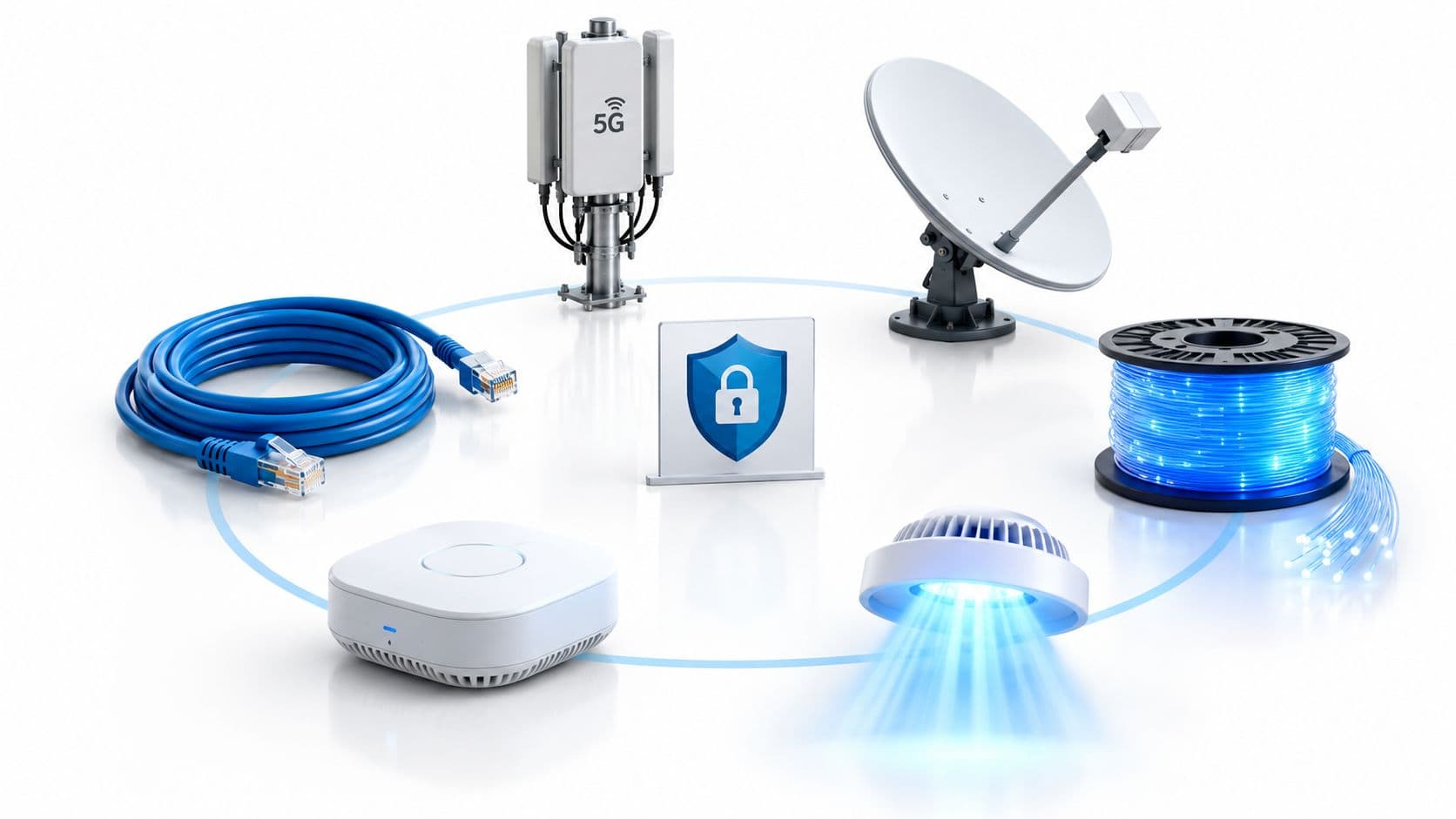
Is WiFi really the problem, or are you trying to solve a backhaul, mobility, coverage or identity problem with the wrong layer? The best alternatives for WiFi depend on what needs to change. Fixed Ethernet and leased fibre provide predictable access for stationary devices and dependable backhaul. Public 4G and 5G fixed wireless access bring sites online quickly, while private cellular and neutral-host systems handle controlled mobility, difficult radio environments and dense venues. Satellite reaches locations beyond reliable terrestrial networks, and LiFi creates tightly confined connectivity where radio is undesirable.
The useful comparison is not just about speed. Assess coverage, latency, capacity, deployment time, security, authentication and resilience. A satellite terminal may solve the internet connection but still need wired distribution and WiFi for guests. A private 5G network may carry operational devices while conventional WiFi serves visitors. Purple can sit on that WiFi layer, replacing shared passwords with identity-based access for guests, staff and tenants, while supporting analytics and return visits. For a useful comparison of wireless and cellular approaches in security-sensitive environments, see this WiFi versus LTE gate security comparison.
1. Three Business 5G Business Broadband Fixed Wireless Access
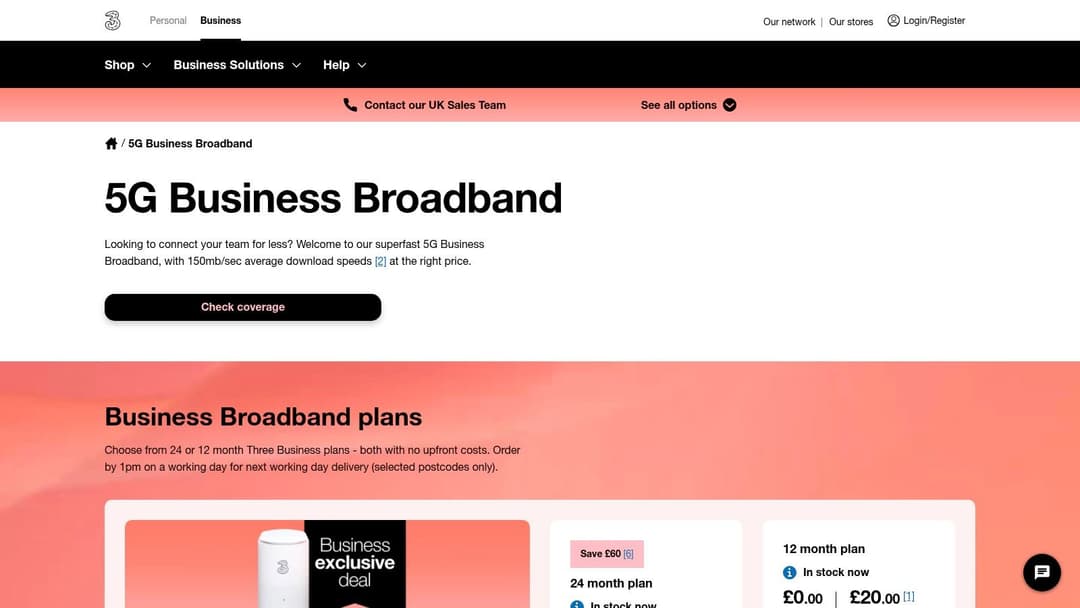
Three Business 5G Business Broadband is best understood as an internet handoff, not a complete venue network. Its mains-powered 5G hub connects to the public Three UK mobile network and can provide primary connectivity or failover without waiting for a fixed-line installation. That suits pop-ups, temporary venues, small hospitality sites and offices awaiting fibre.
The practical deployment is straightforward. Place the hub where signal quality is strongest, connect it to a firewall or managed router, and distribute traffic through the site's existing Ethernet and WiFi infrastructure. Don't leave the hub as an unmanaged shared network if it carries payment systems, staff devices, IPTV or building operations. Create separate policies for guest, staff and operational traffic, then monitor the cellular uplink rather than assuming the strongest signal will remain the fastest.
The provider advertises Three Business 5G Business Broadband with self-installation, UK data plans including unlimited options, and use as a primary or backup connection. Published tariffs can make budgeting easier for smaller sites, but a fixed monthly plan doesn't make performance fixed.
Where the hub works well
A 5G hub is a strong choice when deployment speed matters more than deterministic performance. It can connect a temporary event, seasonal venue or small branch without civil works, and its Ethernet handoff can support wired desks, point-of-sale systems and local network equipment. It also gives an IT team a practical fallback when a fibre circuit fails, provided the firewall supports automatic WAN failover.
Test at the actual installation point during busy and quiet periods. Mobile performance changes with signal quality, building materials and cell loading. A site that performs well during a survey can behave differently during an event when nearby users consume capacity.
Operational rule: Treat public 5G as a variable WAN circuit. Use health checks, bandwidth policies and failover testing instead of promising a fixed experience to every device.
CGNAT and other mobile-network policies may prevent inbound connections or complicate VPNs, remote management and hosted services. Confirm those requirements before purchase. Purple can still provide passwordless guest authentication and first-party analytics on the local WiFi layer, even when Three supplies the internet path.
2. EE Business Mobile Broadband 5G and 4G FWA
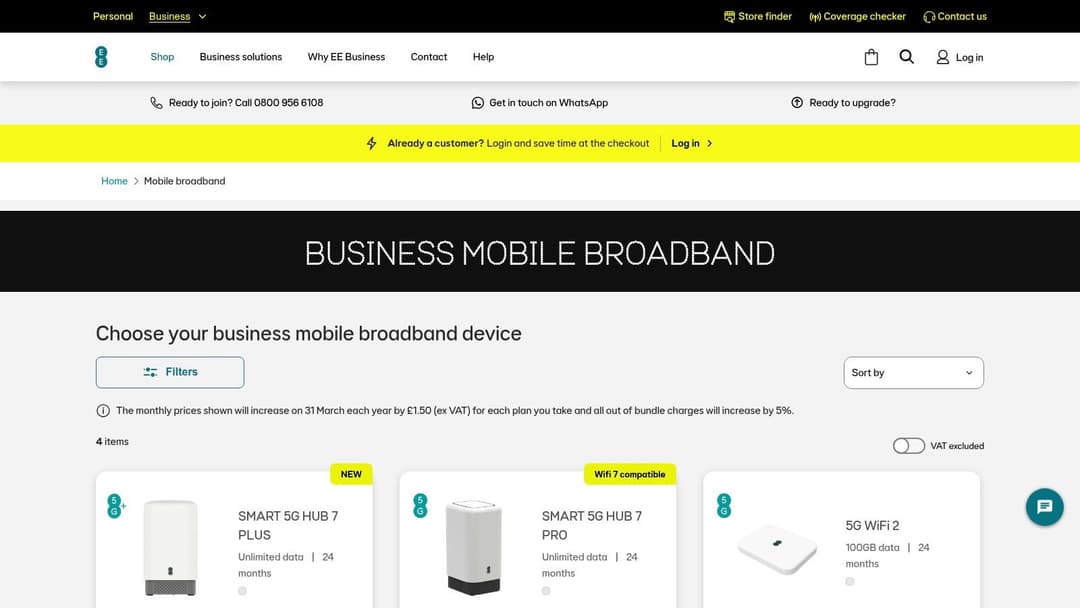
EE Business Mobile Broadband targets a similar problem, but its positioning is useful for temporary offices, retail units, events and sites waiting for fibre. A 5G or 4G hub supplies the WAN connection, while the on-site network still needs deliberate design. The hub's built-in WiFi shouldn't automatically become the long-term access layer for staff, guests and operational equipment.
The EE Business Mobile Broadband service includes Smart 5G Hub 7 series hardware described as WiFi 7 capable, 4G and 5G data plans including unlimited options, and business support features such as warranty and stay-connected data. Those features can simplify turn-up, particularly where a small team needs to install connectivity without an engineer.
The important distinction is between internet access and user access. Document where the hub sits, which devices connect by Ethernet, how local WiFi is secured, and who can change the configuration. If the hub feeds an existing firewall, the business can apply VLANs, content controls and application priorities consistently across wired and wireless links. If users connect directly to the hub, the organisation may lose that control.
What to validate before deployment
Start with a site survey and a short operational test. Check signal quality inside the building, place the hub away from obstructions, and test throughput under realistic load. A broad mobile footprint doesn't guarantee consistent indoor performance, especially in reinforced or heavily glazed buildings.
Use the service as a primary link when the site can tolerate variable capacity and the applications are cloud-based. Use it as failover when the primary circuit is fibre and the business needs continuity for payments, communications or essential cloud tools. Mobile-network policies such as CGNAT can restrict inbound services, so verify remote access, VPN and monitoring requirements.
A temporary venue may also need frictionless guest onboarding, staff identity integration and measurable engagement. A shared hub password solves none of those problems. Purple can run on the venue's existing WiFi infrastructure, allowing guest access and staff connectivity to remain separate from the EE WAN service.
A mobile broadband hub gets the site online quickly. It doesn't decide which users should access which systems.
That separation makes EE useful in a hybrid stack. Keep POS and building systems behind the firewall, give staff a controlled network, and expose guest WiFi through an identity-based flow rather than a universal password.
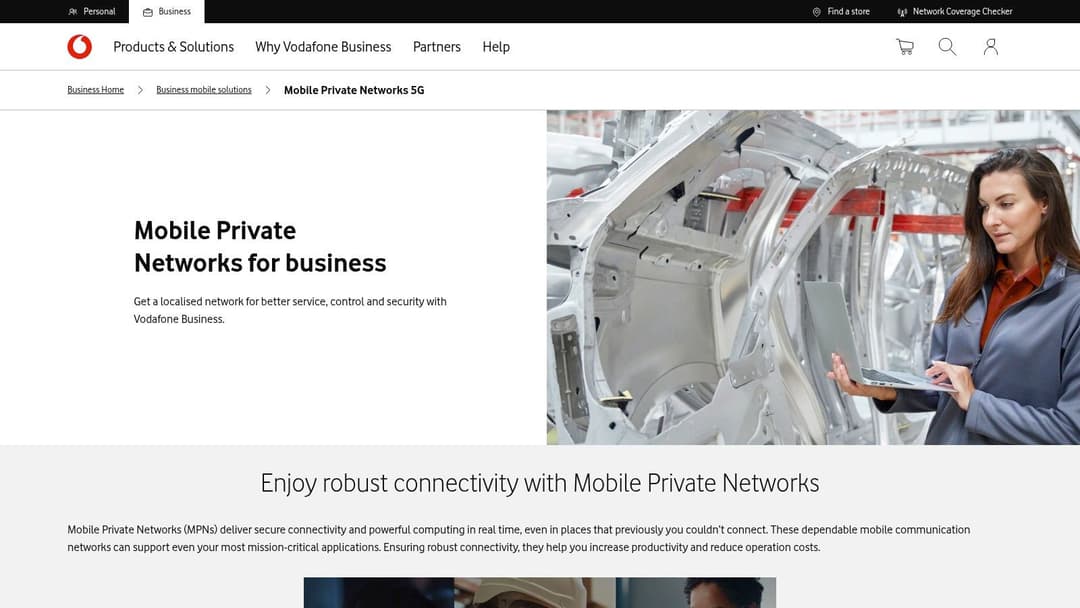
3. Vodafone Business Mobile Private Networks
Public mobile broadband is a fast WAN option. A private 4G or 5G network is a controlled access system for devices and applications that need predictable mobility across a defined site. Vodafone Business Mobile Private Networks are aimed at environments such as factories, hospitals, ports, campuses and large venues where moving equipment, outdoor coverage and operational continuity can expose WiFi's limits.
The design process should begin with an inventory, not a radio purchase. List devices, applications, locations and business consequences of interruption. Then map indoor and outdoor coverage, define latency and availability requirements, decide whether devices use SIM or eSIM, and specify how onboarding and revocation will work. A private network is only as controlled as its device lifecycle.
Vodafone describes options including a dedicated radio and core, 5G Standalone mobile private networks and network slicing through its Business Mobile Private Networks service. These capabilities can support stronger separation and more deterministic behaviour than a best-effort public WLAN, but they require site-specific scoping, integration and spectrum planning.
When private cellular earns its complexity
Private cellular makes sense when users or machines move through large areas and the network must maintain reliable handoff. Autonomous equipment, scanners, clinical devices, security systems and industrial sensors may benefit from SIM-based identity and broad coverage. WiFi remains effective for many fixed or low-risk devices, but dense roaming environments can demand careful channel planning and access-point placement.
The trade-off is operational maturity. Expect more planning, specialised endpoints and a higher implementation burden than a standard WiFi deployment. Device compatibility must be checked early. A private network won't help if the application hardware can't use the selected cellular bands or if the organisation lacks a process for SIM and eSIM management.
Design for two identities: use SIM or eSIM identity for operational devices, then use Purple's private area network capabilities where staff, guests or tenants still need secure WiFi access.
This avoids forcing one technology to carry every traffic type. Private cellular can handle mobility-critical operations, while WiFi provides the user-facing experience in reception areas, offices, meeting rooms and guest spaces. Purple can provide passwordless onboarding and identity-aware access on that retained WiFi layer without turning the private cellular core into a guest portal.
4. Boldyn Networks Neutral Host DAS and Private Indoor Cellular
Some venues don't need to replace WiFi. They need visitors to receive reliable mobile service indoors, using the plans and devices they already carry. Boldyn Networks addresses that requirement through neutral-host distributed antenna systems, small cells and private or indoor cellular networks for arenas, stadiums, shopping centres, airports and mixed-use properties.
A neutral-host design brings multiple operators into shared indoor infrastructure. That changes the venue-owner decision. Instead of asking only how many access points are required, assess which operators need participation, how building materials affect propagation, where peak density occurs, and who will own the system through its lifecycle. A venue may need coverage throughout public areas, staff zones, loading areas and transport links, each with different requirements.
Boldyn's venue and property-owner solutions include multi-operator 4G and 5G DAS, neutral-host engagement and design, build and managed-service options. The strength is scale. Visitors can use cellular connectivity without joining the venue WiFi, and the system can support high-density event conditions where ordinary indoor coverage is weak.
The experience trade-off
Cellular coverage gives the visitor a familiar connection, but the venue doesn't control the full journey. Users authenticate with their own operator, consume their own mobile data and may not provide an identity the venue can use for consented engagement. WiFi offers more control over onboarding, service messaging and first-party analytics, but it requires a well-designed access layer.
That makes neutral-host cellular a complement rather than a universal WiFi replacement. Use it for carrier-grade coverage, emergency resilience and mobile service in areas where guests don't need venue-specific services. Retain WiFi for applications such as venue discovery, guest messaging, tenant access, staff systems and analytics.
Venue-owner question: Do you need people to have signal, or do you need a relationship with the people using the venue? Neutral-host cellular solves the first problem. Identity-based WiFi can help solve the second.
Purple can provide encrypted, passwordless authentication on retained WiFi segments, while network teams isolate staff, tenant and guest traffic. The right choice may be both systems, with neutral-host infrastructure carrying general mobile demand and WiFi supporting controlled digital experiences.
5. Starlink Business Satellite Internet
Satellite is an access or backhaul option, not automatically a replacement for every wireless network. Starlink Business is relevant to rural hospitality, construction compounds, temporary events and transport locations where fibre is unavailable or mobile coverage is unreliable. Its low-Earth-orbit service can supply the upstream connection, which then feeds a firewall, Ethernet switches, local WiFi or a failover appliance.
The deployment environment determines whether it works. Before ordering, check sky visibility, mounting, power, weather exposure and cable routes. A dish behind trees, beside a tall structure or in a poorly planned temporary location can undermine the service. The local distribution network matters too. A satellite terminal connected to an unmanaged access point still creates the same segmentation and authentication risks as any other internet connection.
Starlink Business offers fixed and in-motion service profiles, self-install kits and portable options for temporary or seasonal sites. Those characteristics suit organisations that need to bring a location online quickly or move the connection between sites. The trade-offs include clear-sky requirements, weather and obstruction sensitivity, power planning and higher equipment or service costs than an urban fixed line.
Build the local network separately
Use the satellite terminal as the WAN source, then place routing, firewalling and policy enforcement behind it. Prioritise payment systems, voice and operational applications, and apply fair-use controls to guest traffic. If the terminal becomes the primary path, add a second technology such as cellular where the site can access it. Satellite and mobile links fail for different physical reasons, so combining them can improve resilience.
Measure the resulting guest experience from the venue, not just the dish. A practical internet speed test for WiFi environments can help identify whether a complaint originates in the satellite backhaul, the local access points, client density or indoor coverage.
Purple complements Starlink when a rural venue still needs a branded guest network, passwordless authentication and measurable engagement. The satellite link provides the route to the internet. Purple manages the identity and experience on the local WiFi network.
Satellite reaches the site. It doesn't remove the need for switching, segmentation, access control or guest identity.
6. BTnet Leased Line Dedicated Internet Access over Fibre
A leased line solves a different problem from a WiFi upgrade. BTnet Leased Line provides a dedicated, uncontended fibre circuit with business SLAs, making it suitable for mission-critical internet access, cloud applications, voice, video and dependable site backhaul. It serves the WAN edge. It doesn't connect every end user by itself.
That distinction prevents a common design error. A site can have excellent fibre and still suffer poor wireless coverage, overloaded access points or weak authentication. Conversely, a wired-only environment may have strong connectivity for servers and desks but no practical mobility for guests, handheld devices or tenants.
BTnet Leased Line supports scalable speeds and resilience options, with a pre-sales survey and service design. Start by confirming the building entry point, handoff type, firewall requirements and physical route. Then plan resilient routing, traffic priorities and separate operational networks. If the business needs continuity during a fibre outage, specify the secondary path and test automatic failover before users depend on it.
Fibre is the dependable foundation
Leased fibre is strongest where predictable performance matters more than installation speed. It supports a stable upstream for Ethernet, private LANs, managed guest connectivity and wired backhaul. Ofcom reported that 20.7 million UK homes, or 69%, could access full-fibre broadband in 2024, up from 57%, or 17.1 million homes, in September 2023, and later reported 22.5 million homes, or 74%, could access full-fibre by spring 2025. The same reporting recorded 9.0 million full-fibre connections by spring 2025, compared with 4.6 million connected homes noted earlier, showing that availability has moved ahead of adoption in Ofcom's full-fibre reporting.
Those figures describe availability, not a guaranteed service for a particular building, so a site survey still matters. Installation can involve lead time and construction charges, and the final connection to desks, cameras or access points still needs structured cabling.
Purple can operate above that wired foundation. Its network multi-tool can support the diagnostic side of a retained WiFi deployment, while identity-based access separates guest, staff and tenant experiences from the leased-line service itself.
7. Signify Trulifi LiFi
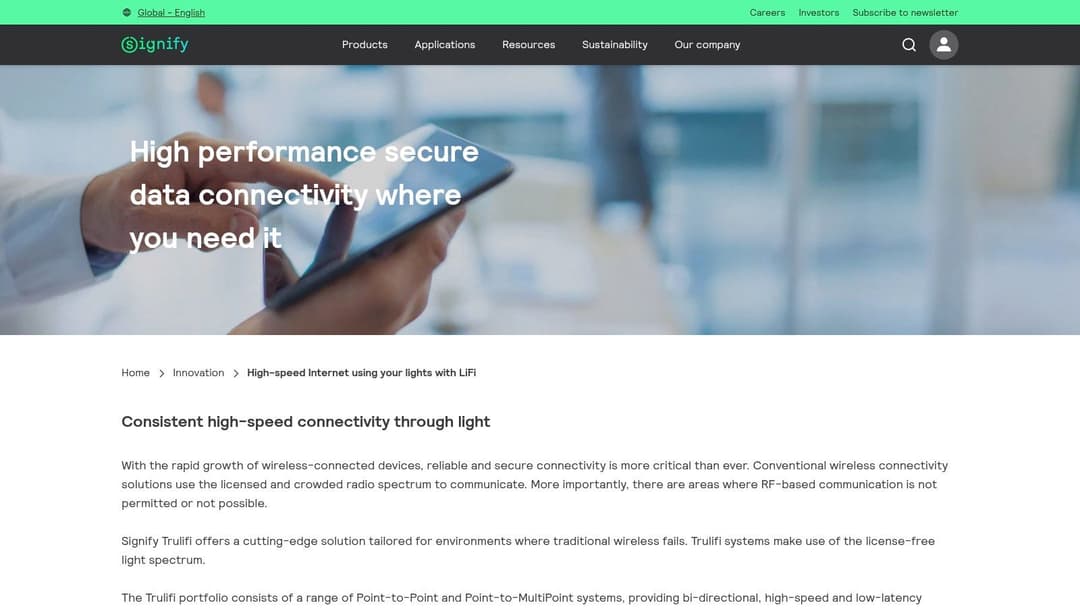
LiFi is one of the few alternatives for WiFi that changes the physical transmission medium at the user edge. Signify Trulifi uses light through luminaires and transceivers rather than conventional radio, with infrared operation possible when visible lights are dimmed or off. That makes it relevant to RF-sensitive spaces, secure offices, healthcare environments and classrooms where tightly confined coverage is useful.
The planning model is room by room. Identify areas where radio reduction matters, map luminaire placement, check line-of-sight and reflected-light conditions, and confirm whether client devices need USB access keys or another specialised receiver. Point-to-multipoint and point-to-point configurations support different layouts, but neither removes the need to consider movement outside the LiFi zone.
Signify Trulifi describes two-way LiFi, localised coverage and security benefits associated with physical confinement and validated cryptographic profiles. The benefit is reduced RF interference and a smaller physical coverage footprint. The constraint is equally clear. Walls, furniture, blocked light paths and room transitions can interrupt access, and general-purpose laptops or phones may require additional hardware.
Use LiFi selectively
LiFi works best as a targeted complement, not as a building-wide replacement for WiFi. A clinical room, examination area, secure workspace or classroom may use LiFi for selected endpoints, while corridors, communal areas and mobile users rely on WiFi or cellular. Design handoff deliberately. Users should know what happens when they leave the light coverage, and IT teams should monitor both access technologies through the same policy framework.
Government-backed 5G RuralFirst testing reported that LiFi on Orkney demonstrated reliable communication in harsh weather and hard-to-reach rural areas, while fixed wireless access could provide superfast broadband in difficult locations, as described in the 5G RuralFirst case study. That evidence supports LiFi as a practical specialist technology, not proof that it suits every indoor user.
LiFi narrows the coverage boundary. That can improve control, but it also makes mobility and endpoint compatibility your responsibility.
Purple can handle secure guest or staff access on adjacent WiFi segments in a hybrid design. The LiFi network can serve controlled rooms, while identity-based WiFi maintains a consistent experience elsewhere.
7 Alternatives to Wi‑Fi: Quick Comparison
| Solution | Implementation 🔄 | Resources ⚡ | Expected outcomes 📊⭐ | Ideal use cases 💡 | Key advantages ⭐ |
|---|---|---|---|---|---|
| Three Business 5G Business Broadband (Fixed Wireless Access) | Low, self‑install 5G hub; test signal/congestion; firewall handoff & VLANs | 5G hub, SIM/data plan, power, minimal cabling | Rapid turn‑up; variable throughput by signal/cell load; good primary/backup; ⭐⭐⭐ | Pop‑ups, temporary sites, small venues, POS, IPTV, wired desks | Fast deployment; published tariffs & unlimited plans |
| EE Business Mobile Broadband (5G/4G FWA) | Low, self‑install Wi‑Fi7 hub; document hub placement & failover tests | Wi‑Fi7 hub, SIM/data plan, IT for local Wi‑Fi security | Quick turn‑up; broad 4G/5G footprint; throughput varies; ⭐⭐⭐ | Offices awaiting fibre, retail pop‑ups, temporary events | Latest hub tech (Wi‑Fi7); business support & warranty |
| Vodafone Business Mobile Private Networks (Private 4G/5G) | High, device/app inventory, coverage mapping, SIM/eSIM ops, bespoke deployment | Dedicated radios/core, spectrum strategy or slicing, integration team | Deterministic latency/QoS; predictable mobility and coverage; ⭐⭐⭐⭐ | Factories, hospitals, ports, campuses, critical ops | Predictable performance, strong control & security |
| Boldyn Networks (Neutral‑Host DAS & Indoor Cellular) | High, in‑building RF design, operator coordination, capex/opex planning | DAS hardware, multi‑operator agreements, construction & managed services | Carrier‑grade indoor coverage; scales to very high density; ⭐⭐⭐⭐ | Arenas, stadiums, malls, airports, mixed‑use venues | Multi‑operator coverage; reliable high‑density service |
| Starlink Business (Satellite Internet) | Low–Medium, self‑install dish; sky‑visibility survey; mounting & routing | Dish kit, subscription, clear sky view, power, local distribution gear | High throughput where terrestrial missing; weather/obstruction sensitive; ⭐⭐⭐ | Remote hospitality, construction camps, temporary events, transport | Works where terrestrial nets unavailable; portable & fast deploy |
| BTnet Leased Line (Dedicated Fibre) | Medium–High, pre‑sales survey, possible civil works, resilient routing & SLAs | Fibre circuit, CPE, SLA, potential construction costs, firewall handoff | Symmetrical uncontended bandwidth; SLA-backed reliability; ⭐⭐⭐⭐ | Mission‑critical sites, HQs, data centres, high‑reliability needs | Predictable performance; supports cloud, voice & video reliably |
| Signify Trulifi (LiFi – light‑based wireless) | Medium, room‑by‑room luminaire planning; line‑of‑sight and receiver checks | LiFi luminaires/transceivers, client dongles/receivers, lighting integration | RF‑free localized links; secure confinement; limited mobility; ⭐⭐ | RF‑sensitive healthcare, secure offices, classrooms | Minimal RF interference; physical‑layer security through confined coverage |
Build the Right Hybrid Connectivity Stack
The strongest design usually combines technologies instead of searching for one universal WiFi replacement. Start with the endpoint. Fixed desks, access points, cameras, servers and building controllers benefit from wired Ethernet and predictable fibre backhaul. A leased line is appropriate when the business needs dedicated capacity, service levels and stable performance for cloud applications, voice or operational systems.
Choose public fixed wireless when speed of deployment matters. Three Business 5G Business Broadband and EE Business Mobile Broadband can connect temporary sites, pop-ups and small branches without waiting for fixed-line construction. They can also provide failover behind a firewall. Test signal, congestion and application behaviour at the actual site, and treat CGNAT as a design constraint rather than a footnote.
Choose private cellular when devices move through complex indoor and outdoor areas and the organisation needs controlled identities, coverage and mobility. Choose neutral-host infrastructure when the venue's priority is reliable multi-operator mobile service for visitors and staff. These options require more planning than ordinary WiFi, but they address different problems. Private cellular controls an operational network. Neutral-host cellular improves general mobile coverage without requiring every visitor to join venue WiFi.
Satellite belongs where terrestrial options don't provide a dependable path. It can serve rural hospitality, compounds and temporary locations, but the design must account for sky visibility, weather, power and local distribution. LiFi belongs in selected rooms or zones where RF reduction, physical confinement or specialised security requirements justify client hardware and room-by-room planning.
The UK market also supports a more nuanced view of fixed wireless. Ofcom reported fixed wireless access availability to 96% of premises in England and 93% in Wales, while 1% of UK premises lacked decent broadband in July 2024. Ofcom also noted that coverage estimates are predictive and local conditions can prevent service at a specific property, so buyers should compare performance, contention, indoor signal quality and resilience rather than rely on headline availability in the Connected Nations England report. The same report indicated that about 58,000 premises had no access to decent broadband at the end of 2024, with around 48,000 expected after public-funded buildouts, reinforcing the shift from basic availability to estate-level decision-making.
Use this implementation sequence:
- Map coverage: Include indoor rooms, outdoor zones, loading areas, guest spaces and handoff boundaries.
- Model capacity: Separate average demand from event peaks, and distinguish WAN capacity from local radio capacity.
- Set latency requirements: Identify applications that need predictable response times, not merely high throughput.
- Define identity: Assign identity to SIMs, certificates, directory users, tenants and guests where appropriate.
- Check devices: Confirm WiFi, cellular, LiFi receiver, Ethernet and roaming compatibility before procurement.
- Segment traffic: Isolate guests, staff, tenants, POS, cameras, clinical devices and building systems.
- Test resilience: Simulate fibre failure, cellular congestion, satellite obstruction and access-layer outages.
- Protect the experience: Make onboarding, return visits, support and consent consistent across retained WiFi zones.
Purple complements these choices wherever WiFi remains part of the stack. It can replace shared passwords and clumsy captive portals with identity-based access for guests, staff and tenants, while supporting encrypted connectivity, analytics and return-visit engagement. The result is a layered network in which each technology does the job it handles best, instead of forcing one access method to carry every user, device and failure mode.
Purple provides passwordless guest WiFi authentication, staff access and multi-tenant identity networking on existing infrastructure, so your hybrid connectivity design can remain secure and measurable. Visit Purple to see how identity-based access and analytics can complement fibre, 5G, private cellular, satellite and LiFi deployments.