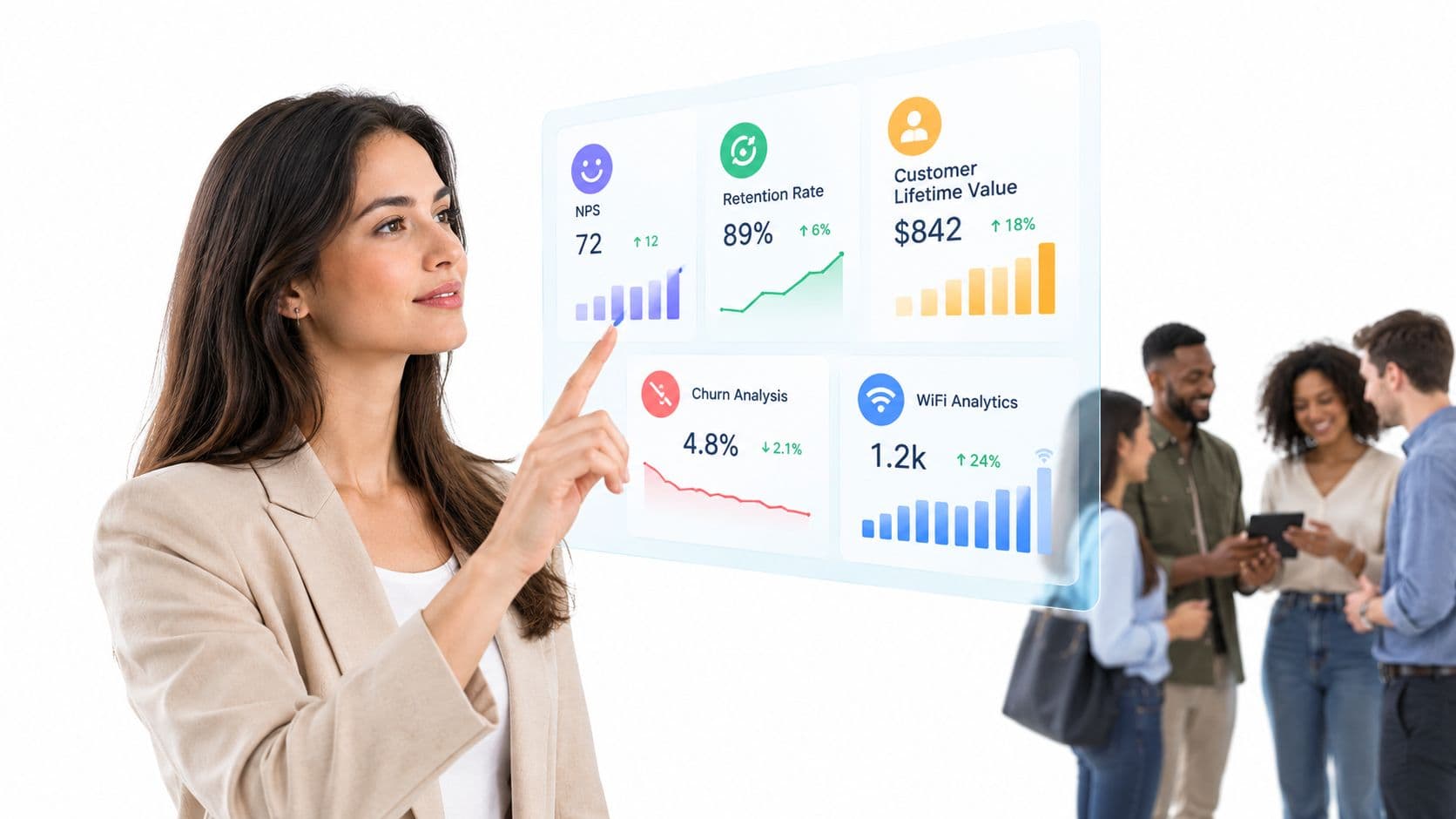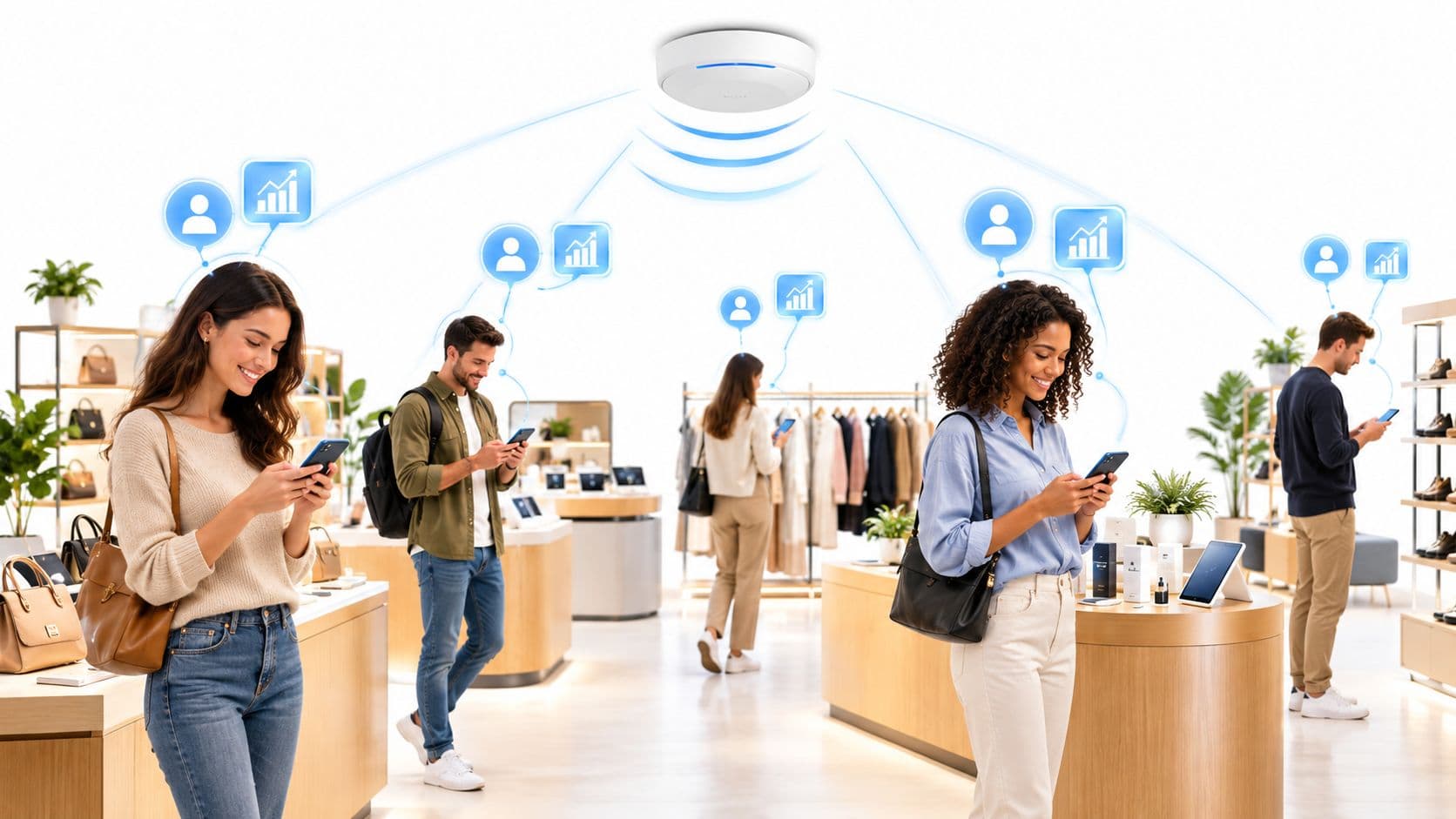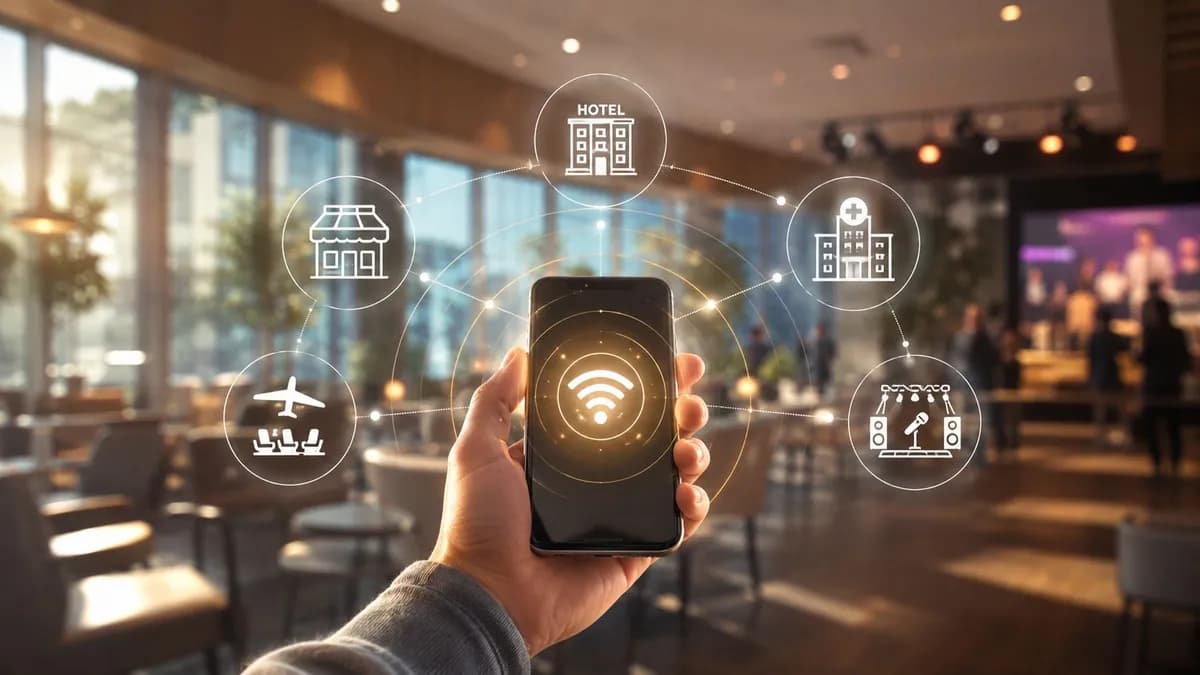
Proximity Marketing Campaign & ROI Advisor
Model campaign conversion rates, technology reach, and revenue uplift across BLE beacons, WiFi presence, and geofencing. Plan GDPR-compliant trigger rules for your physical venue.
Audience Conversion Funnel
Deploy Enterprise Proximity Marketing with Purple
Purple integrates seamlessly with Cisco Meraki, Aruba, Ruckus, and Juniper Mist to transform standard WiFi and BLE infrastructure into an intelligent, GDPR-compliant visitor engagement engine.
A guest arrives at a hotel after a long journey. Her room key is already on her phone, and her handset reconnects to the guest WiFi as she enters the lobby. Before she reaches reception, a welcome message offers directions to the spa and a late-checkout option. That message feels useful because it arrives in the right place, at the right moment, with enough context to avoid a generic promotion.
That is the practical promise of proximity marketing. It connects a physical venue with a digital relationship, using signals such as WiFi authentication, Bluetooth, NFC, GPS, or device presence to deliver a service message, offer, prompt, or measurement event. The difficult part isn't detecting that someone is nearby. It's knowing who the visitor is, what they've agreed to receive, and whether the message helps them.
For venue operators and IT teams, that distinction matters. A beacon can detect a compatible device, but an authenticated WiFi session can connect a visit to a consented profile, a room number, a ticket, or a customer record. If you're comparing approaches or looking for ideas from other operators, you can browse independent brands to see how physical experiences and digital engagement are being combined.
What Proximity Marketing Actually Means
Proximity marketing is a venue-level communication and analytics discipline. It reaches a known or anonymous person when they're inside, approaching, or moving through a defined physical environment, using signals about where they are, how they arrived, or what they've just connected to.
That makes it narrower than broad location-based marketing. A geofence around an entire shopping district can support a wide-area campaign. Proximity marketing focuses on the hotel lobby, the fitting-room corridor, the clinic waiting area, or the airport lounge. The operator defines a useful moment, chooses a permission-aware trigger, and connects it to an action.
Consider the hotel example. The venue might use:
- A location signal, such as association with a guest access point.
- An identity signal, such as an authenticated loyalty profile or room record.
- A context rule, such as “returning guest arriving before check-in”.
- A delivery channel, such as an in-app message, email, or SMS.
- A measurable action, such as a spa booking or late-checkout request.
The signal alone has limited value. A device near reception doesn't tell the hotel whether its owner wants a spa treatment. Identity and consent make the trigger meaningful, while the visitor's context determines whether the message feels helpful or intrusive.
Detection is not the same as relationship
Many deployments become confused. Presence data can show that a device was near an access point or beacon. It doesn't automatically identify the person, establish marketing permission, or prove that a later purchase resulted from a message.
An authenticated guest WiFi journey provides a stronger foundation because the visitor actively completes an access flow. The venue can then connect the session to an approved identifier, subject to its privacy notice, lawful basis, retention policy, and stated purpose. That record can support service communications first, followed by optional marketing where the visitor has agreed.
A sensible operator therefore treats proximity marketing as a layer between the physical environment and the digital relationship. The physical space supplies context. The identity layer supplies continuity. The campaign system supplies content and automation. Analytics then tests whether the experience produced a useful outcome.
The technologies differ in precision, friction, cost, and privacy implications. The right choice depends on the venue, the visitor journey, and the degree of identity the operator requires.
The Technologies That Make It Work
No single proximity technology solves every venue problem. A hotel may need authenticated WiFi for returning guests, BLE for room-level navigation, and NFC for a deliberate tap at a treatment menu. A stadium may prioritise network presence and seat-section context over app-based push messaging.
| Technology | Typical Range | App Required? | Opt-in Model | Hardware Cost | Maintenance | Best-Fit Venue |
|---|---|---|---|---|---|---|
| BLE beacons | Room or zone level | Usually, for push | Bluetooth, location, app permissions | Low per device | Battery checks and zone mapping | Retail aisles, museums, clinics |
| Eddystone or similar beacon formats | Room or zone level | Usually, for push | App and handset permissions | Low per device | Battery and configuration management | Multi-zone visitor journeys |
| NFC | Tap distance | No dedicated app for web flows | Deliberate user action | Low | Tags and destination content | VIP, staff, product, and service flows |
| GPS geofencing | Broad outdoor area | Usually, for app triggers | Location services and channel permission | Low venue hardware cost | Rule and consent management | Outdoor campuses, approach zones |
| WiFi presence detection | Access-point coverage | No, for passive analytics | Device and privacy controls vary | Existing network may help | Network calibration and governance | Footfall, dwell, and movement analysis |
| Identity-based WiFi | Access-point coverage | No, browser or Passpoint flow | Authentication plus separate marketing choice | Network and platform integration | Profile, portal, and connector management | Hotels, retail, events, residential venues |
BLE beacons broadcast an identifier that a compatible handset or app can interpret. They're useful when the operator needs a specific zone, such as a fitting-room entrance or museum exhibit, but they depend on handset settings, app adoption, and suitable radio conditions. The operator must also map each device to a location and maintain the hardware.
NFC has less reach but stronger intent. A visitor tapping a phone on a spa menu, product label, or staff-only sign is actively asking for information. That makes NFC well suited to moments where the user should initiate the interaction rather than receive an unsolicited prompt.
Geofencing works across broad outdoor areas, such as the approach to an airport or an event campus. GPS is less dependable for fine-grained indoor positioning, so it shouldn't be the only layer in a dense venue.
WiFi presence detection can support passive analytics, including movement and dwell analysis, but passive detection raises governance questions because the venue may see devices without a clear customer relationship. Identity-based WiFi shifts the emphasis from raw detection to authentication. A captive portal or passwordless flow becomes the point at which the visitor can receive connectivity and choose optional communications.
Real-world delivery is bounded by consent and radio conditions. In a UK pilot at Hinckley Centre, 925 Bluetooth messages were successfully transmitted from 5,140 detected devices, an 18% contact success rate, as reported in the MMA Global Bluetooth proximity marketing report. That result is a reminder that detection isn't delivery.
Venue operators planning transforming hybrid events with tech should also consider how connectivity supports registration, engagement, and follow-up, not just one-off notifications. Hardware integration matters too, particularly where access points, gateways, and sensors need to work together. Purple documents examples of WiFi hardware integrations for network environments that need this kind of coordination.
The strongest stacks usually blend two or three technologies. WiFi can provide identity, BLE can add zone precision, and NFC can reserve high-intent actions for visitors who actively tap.
Where Proximity Marketing Earns Its Keep
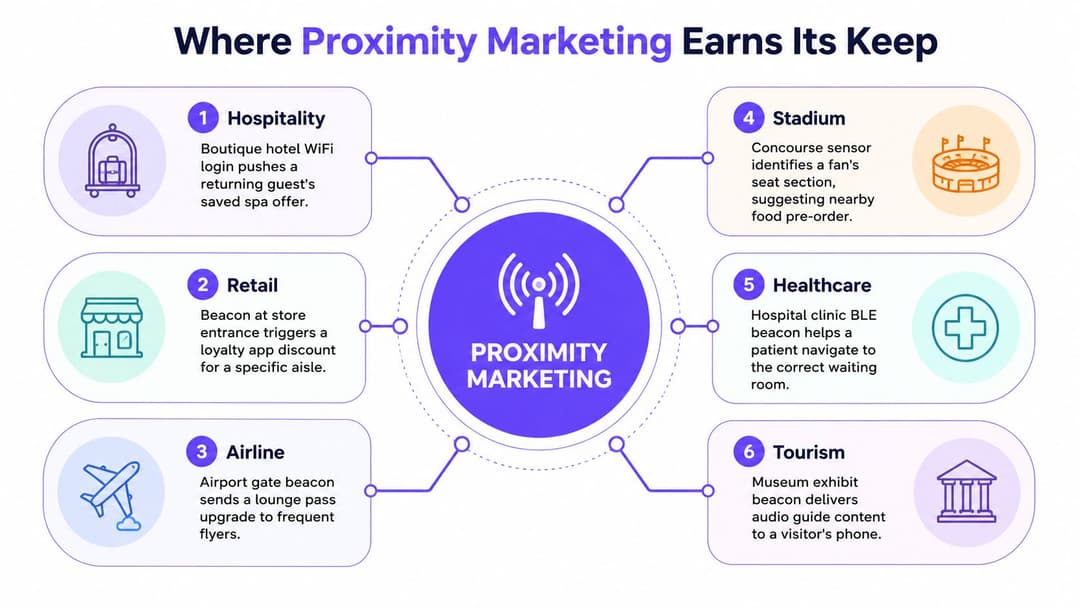
Proximity marketing earns its place when a venue can connect identity, trigger, context, and action. The same architecture changes shape across sectors because the visitor's need changes.
Hospitality
A boutique hotel can recognise a returning guest when her phone authenticates to guest WiFi on a later night of the stay. If she has opted into relevant marketing, the hotel might surface a saved spa offer after check-in rather than sending the same welcome message to every arrival. The operator can link the prompt to a booking system and distinguish an actual treatment reservation from a notification view.
The service benefit comes first. Directions, room information, breakfast times, and booking access are often more useful than a discount. Promotional content should support the stay rather than interrupt it.
Retail
A fashion store could use a zone signal near a rail or fitting-room entrance to trigger a reminder for an opted-in loyalty shopper. The message might point to matching items, stock information, or a fitting-room service. A POS connection then lets the team compare the message exposure with the purchase record, while suppression rules prevent a second offer after conversion.
Retail teams should avoid treating dwell as proof of intent. A shopper may linger because they're comparing products, waiting for someone, or looking for assistance.
Healthcare
A clinic can use authenticated WiFi or device association as part of an arrival workflow. When a patient connects, the service might confirm check-in or present directions to the correct waiting room. The system should minimise sensitive information in promotional channels and keep clinical communications separate from optional marketing.
Transport
At an airport, a broad geofence may support approach messaging, while WiFi presence helps identify passengers already inside the terminal. A venue could direct a connecting passenger towards a lounge or quieter gate area, provided the message is timely, consented, and operationally accurate.
Events
A conference attendee might opt in during registration and later receive session reminders, sponsor content, or a seat-upgrade offer. The event organiser can use room or zone triggers to avoid sending a session reminder after the attendee has left the area. Post-event follow-up can then reference attendance rather than treating every registrant as equally engaged.
Residential
A build-to-rent operator can use amenity WiFi to present gym-booking information or community updates to residents who have opted into those messages. The operator should keep essential building communications distinct from commercial promotions and ensure that residents can withdraw optional permissions without losing ordinary network access.
For teams designing an identity-led approach, this WiFi marketing guide provides useful context on how connectivity, authentication, and engagement can sit together. The underlying pattern remains consistent: identify the visitor appropriately, detect a relevant moment, deliver a useful message, and connect the response to an operational or commercial outcome.
Building a Proximity Marketing Stack
A practical deployment starts with architecture, not campaign copy. The venue should know where signals originate, where identities are created, how consent is stored, and how outcomes reach the reporting systems before anyone installs hardware.
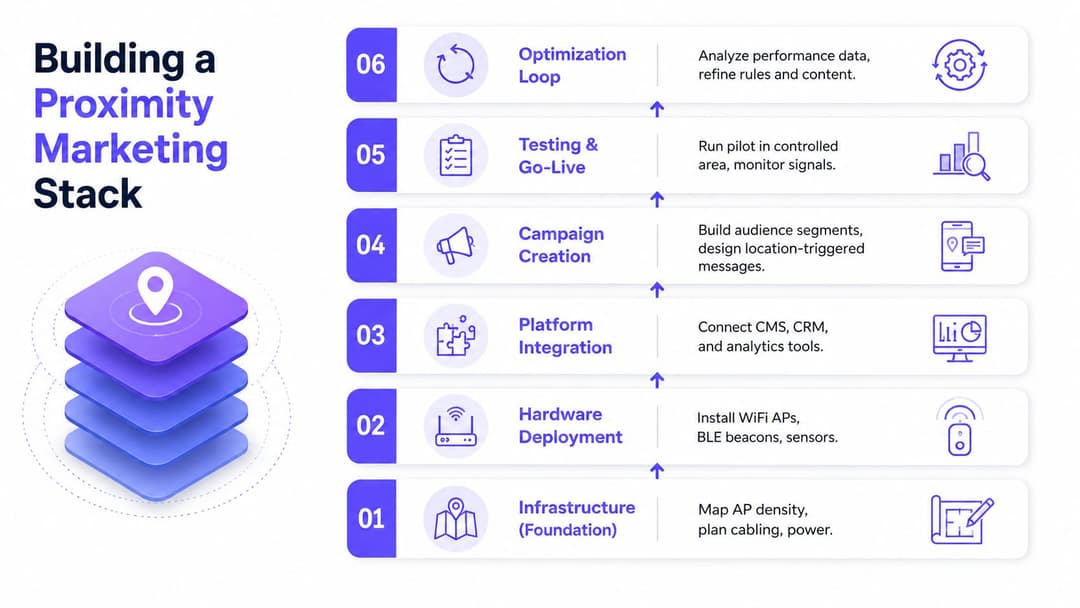
Start with the network foundation
Map access-point coverage, cabling, power, controller dependencies, and likely congestion. Decide where BLE gateways or sensors will connect to existing switches, and record the physical location of each device. An attractive campaign can't compensate for a network that doesn't cover the lobby, fitting rooms, clinic corridors, or event rooms where the trigger must occur.
Create an identity layer
Guest WiFi authentication can create a visitor record tied to an email address, room number, ticket, membership record, or CRM identifier. The operator must define what identifier is necessary for the use case and what should remain anonymous.
This record becomes the substrate for segmentation and measurement. Without it, the team may know that a device appeared but not whether it belongs to a returning guest, a registered attendee, or a member who has already redeemed an offer.
Capture consent at the access point
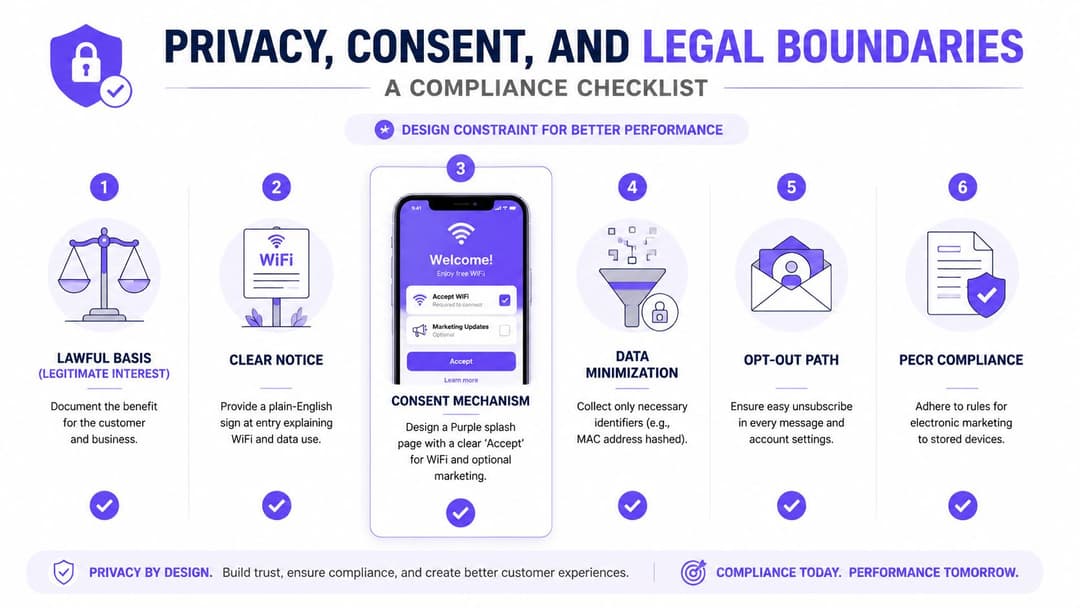
The splash page should separate network access from optional marketing. Present the purpose in plain language, use granular choices for channels or categories, and record the wording and timestamp associated with the decision. Withdrawal should be as straightforward as acceptance.
Prepare content for the actual channel
A push notification, SMS, email, and in-app message have different limits and different expectations. Create the content before finalising activation rules, then add frequency caps, quiet periods, language preferences, and conversion suppression.
Link triggers to audiences
A rule might say: “When an opted-in returning hotel guest authenticates in the lobby after arrival, show the spa information relevant to that stay.” A retail rule might use a store zone, loyalty segment, and product availability. Every rule needs an exit condition, or the venue risks repeating a message after the visitor has acted.
Add measurement hooks
Define events such as authentication, zone entry, message delivery, click, booking, redemption, and purchase. Send those events through webhooks or connectors to the CRM, customer data platform, booking system, or POS. Set an attribution window before launch and preserve a control group where practical.
The architecture is easiest to understand as three layers:
- Hardware below, including access points, beacons, gateways, and sensors.
- Identity and WiFi authentication in the middle, where access, consent, profiles, and presence signals meet.
- Marketing and analytics above, including content systems, CRM tools, automation, dashboards, and revenue records.
Purple can occupy that middle layer by handling WiFi authentication and identity records, then connecting those records to marketing and analytics systems. That is a platform role, not a substitute for network planning, legal review, or campaign strategy.
Measuring ROI and Proving Value
Finance teams rarely approve a proximity programme because it produced a large number of detections. They want to know whether the venue generated useful revenue, protected margin, reduced avoidable workload, or improved a service outcome.
Start by defining the measurement vocabulary:
- Dwell time measures how long a visitor remains in a zone. It can inform layout or service planning, but it isn't revenue by itself.
- Visit frequency shows whether identified visitors return. It becomes commercially useful when connected to membership, bookings, or repeat purchases.
- Opt-in rate shows how many eligible visitors accepted a specific communication purpose. A high figure with weak engagement may indicate poor targeting.
- Reach and delivery show whether a message was eligible and delivered. Bluetooth detection alone shouldn't be treated as delivery.
- Click-through and redemption connect an interaction to a response.
- Attributable revenue links a response to a booking, purchase, or upgrade through a defined join.
- Incremental margin asks whether the campaign generated more profit than the cost of the offer, media, software, staff time, and operational support.
Two practical measurement scenarios
A hotel can send an opted-in lobby prompt to a returning guest segment and track the sequence from authentication to spa booking. The dashboard should show eligible visitors, delivered messages, clicks, bookings, booking value, treatment cost, and margin. It should also show visitors who met the same conditions but didn't receive the message, if operationally possible.
A retail venue can compare loyalty shoppers who received a fitting-room prompt with a similar holdout group that did not. The retailer then joins both groups to POS records and compares purchase behaviour, average basket value, returns, and margin. That design is stronger than claiming every purchase after a message was caused by the message.
Attribution rule: Proximity data is observational until you connect it to transaction records or compare it with a credible holdout.
A scorecard for the first pilot
| Metric | What It Measures | Commercial Outcome |
|---|---|---|
| Authenticated visits | Known visitor sessions | Reachable audience and repeat-visit insight |
| Consent by purpose | Permission for each channel or use | Addressable marketing audience |
| Delivered messages | Actual channel delivery | Usable campaign reach |
| Clicks or bookings | Immediate response | Demand for the promoted action |
| Redemptions or purchases | Completed behaviour | Revenue or service utilisation |
| Incremental margin | Value beyond the comparison group | Finance-ready return |
| Opt-outs and complaints | Trust and friction signals | Risk control and experience quality |
The scorecard should include campaign cost, offer cost, staff effort, and any technology expense. A pilot is valuable when it shows not only whether visitors respond, but whether the venue can repeat the process without weakening trust or creating manual work.
Privacy, Consent, and Legal Boundaries
Privacy isn't a final approval box. It shapes the data model, the access journey, the message design, and the quality of the audience. UK evidence shows why: 73% of users allow apps to access location, but 64% are less inclined to share when privacy is a concern, 60% want secure storage, and 59% want the option to switch location off at any time, according to UK reporting on location sharing preferences.
Trust also depends on relationship. The same reporting found that 27% of smartphone users were comfortable with brands using location data, while 43% found location-based communications helpful from a store they had already used, compared with 24% where no prior relationship existed. The lesson is practical: a useful service for an existing guest may be unacceptable as an unsolicited message to an unknown passer-by.
Under UK GDPR and PECR, the venue needs to identify the lawful basis for processing, explain the purpose, and distinguish necessary service communications from optional promotional messages. A WiFi login shouldn't bundle marketing consent into network access. SMS, email, and push permissions need their own clear treatment, with a withdrawal route that works in practice.
Design the consent journey
Use a short, plain-language splash page. Explain what the network needs, what optional marketing would do, which channels are involved, and how long relevant data will be retained. Avoid pre-ticked boxes, vague “partners” language, and indefinite retention of device identifiers.
A sound flow usually includes:
- Separate choices, so connectivity isn't conditional on promotional consent where it needn't be.
- Specific purposes, such as stay information, member offers, or venue updates.
- An easy withdrawal route, available in every relevant message and account setting.
- Data minimisation, including pseudonymisation where a raw identifier isn't required.
- Access controls, so staff only see the information their role needs.
- A retention schedule, with deletion or anonymisation when the purpose ends.
The privacy design should also reflect technical reality. A UK Bluetooth pilot reported 18% contact success from detected devices, which shows why a large detected audience doesn't necessarily equal a large delivered audience. Consent, discoverability, signal conditions, and message frequency all need to be tested rather than assumed.
Before launch, use the Purple guest WiFi data privacy guidance alongside your own legal and security review.
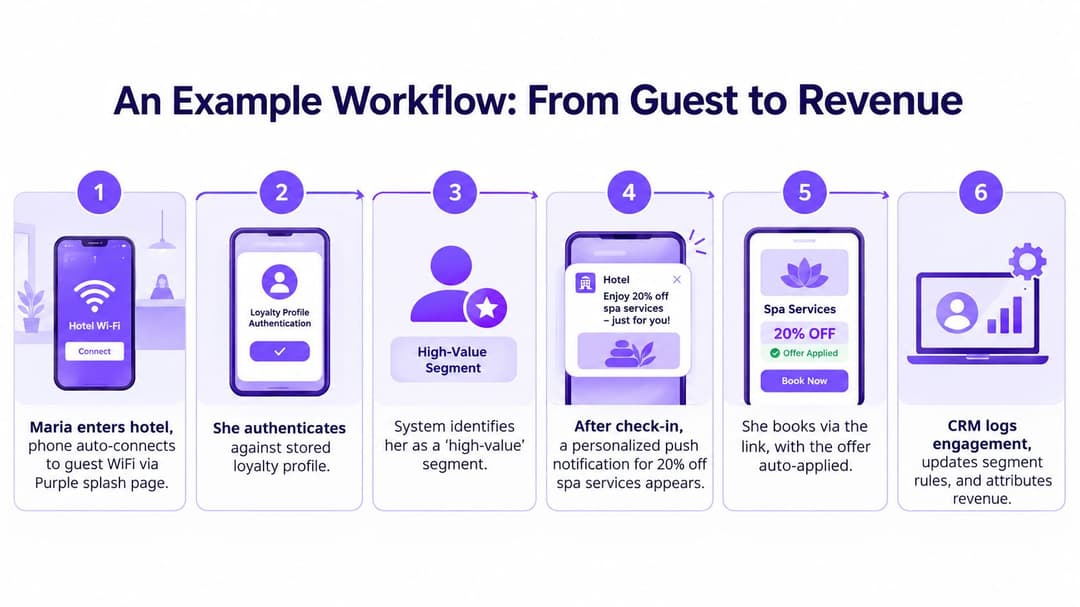
An Example Workflow From Guest to Revenue
Maria is a loyalty member arriving at her favourite hotel. Her phone reconnects to the guest WiFi, and the access journey presents the venue's authentication and privacy choices. Once she signs in, the system matches the session to her stored profile and places her in a returning-guest segment, subject to the permissions she has granted.
The automation engine checks her current stay context and whether a relevant spa benefit is available. After check-in, it sends a focused message with the booking route rather than a general list of hotel promotions. Maria books a treatment, and the booking system records the campaign identifier attached to the interaction.
The marketing team sees the result in its next dashboard view:
- Identity capture, through the authenticated WiFi session.
- Segmentation, based on the approved loyalty and stay context.
- Contextual trigger, linked to arrival or check-in.
- Personalised content, limited to a useful spa action.
- Conversion, recorded by the booking system.
- Attribution, joined back to the WiFi touchpoint.
The same pattern can support different outcomes elsewhere. A retail loyalty shopper may receive a fitting-room prompt, a hospital patient may receive wayfinding information, and an event attendee may see a seat-upgrade option. The message changes, but the operating sequence remains stable: identify appropriately, segment responsibly, detect context, communicate usefully, and close the loop with an outcome.
The workflow also exposes weak points early. If authentication succeeds but consent isn't recorded, activation must stop. If a booking occurs but the campaign identifier isn't passed to the booking system, the venue can't prove value. If a visitor receives a message after completing the action, suppression rules need attention.
Getting Started Without Overreach
Maturity matters more than ambition. Begin with one venue, one audience, and one measurable outcome, such as spa bookings from returning hotel guests, amenity reservations from residents, or completed check-ins at a clinic.
Identity-based WiFi is often a sensible starting point because the access journey can create a consented visitor record and a direct measurement event. Beacons, geofences, NFC, and passive presence can then add precision when the first use case has proved useful.
Before committing budget, answer four questions:
- What action defines success? Choose a booking, purchase, completed check-in, or another observable outcome.
- Where will consent be captured? Document the splash-page wording, purpose, channels, and withdrawal route.
- How will revenue be reconciled? Decide how online interactions will join to POS, booking, ticketing, or property systems.
- Who owns the data afterwards? Assign responsibility for retention, access, suppression, and reporting.
Avoid installing beacons without a content plan, chasing opt-in volume without segmentation, treating compliance as a one-off legal review, or buying hardware before checking network coverage and visitor behaviour. Scale only when the pilot produces a credible return, the consent flow is auditable, and the team can review and improve the data regularly.
Purple provides authenticated guest WiFi, identity management, analytics, and integrations that can support consent-led proximity marketing across venues. Visit Purple to explore how its WiFi and identity layer could connect your network, visitor journeys, and measurable commercial outcomes.