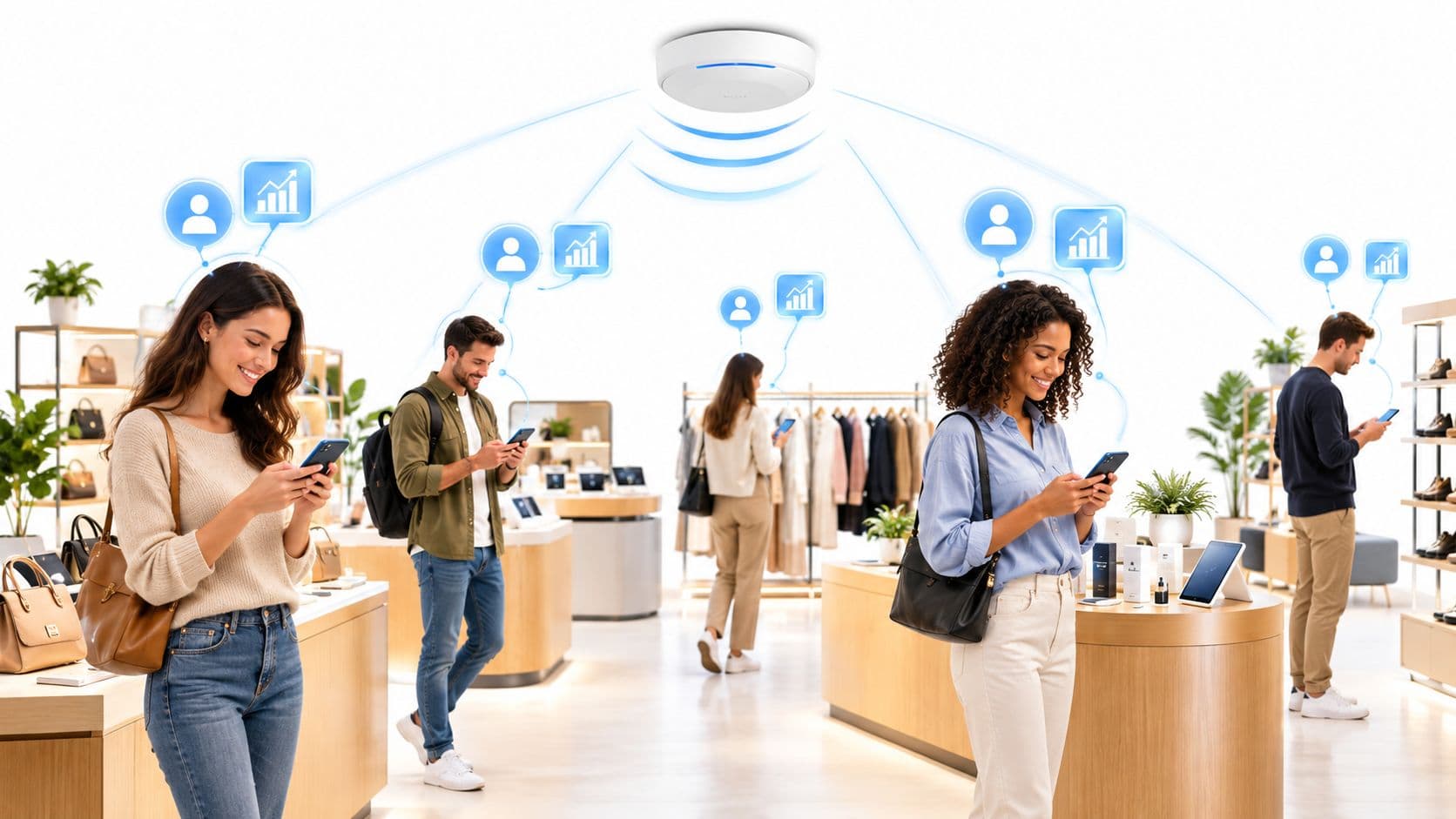
A hotel guest joins the WiFi at breakfast, a shopper connects in the food court, a patient uses a hospital network, or a resident signs into connectivity in a build-to-rent building. The business may have captured a valuable first-party signal, yet the marketing team still works with separate booking records, CRM entries, loyalty profiles and email lists. The result is familiar: untimely messages, duplicated contacts and staff manually moving information between systems.
So, what is marketing automation? It's the use of connected software, customer data and decision rules to deliver relevant actions at the right point in a customer journey. Email is one output, but the wider job is orchestration. Marketing automation can connect identity capture, segmentation, lead management, CRM updates, messaging, measurement and human approvals into one operating process.
For UK venues, that operating process increasingly starts with a consented first-party record. A WiFi login, for example, can provide an identifiable relationship where a business previously saw only an anonymous device. From there, the team can design a useful journey rather than send another generic broadcast.
Why Marketing Automation Matters for Modern Venues
A hotel marketing manager might know that a guest stayed recently, while the reservations system knows the booking details and the WiFi platform knows that the guest returned to the lobby. The loyalty system may contain an email address under a slightly different spelling. None of those facts becomes useful until the business agrees how to connect them, what permission applies and which action should follow.
Marketing automation provides that connective layer. It takes an approved signal, matches it to a customer record, applies audience logic and activates a journey. The journey might welcome a first-time visitor, remind a previous guest about a relevant service or alert a sales colleague that a business enquiry deserves attention.
Start with identity, not a message
The strongest programmes begin by asking, “Who is this person, and what are we allowed to do with the information?” A WiFi authentication flow can be an entry point for collecting first-party identity data, provided the venue explains the purpose clearly and handles consent appropriately. Purple's WiFi solution for marketing teams illustrates how guest connectivity can sit alongside marketing data capture and customer journey activity.
That record can then be connected to systems such as a CRM, property-management platform, booking engine or loyalty database. The value doesn't come from collecting another email address. It comes from making the record useful across the customer lifecycle, while retaining control over access, consent and retention.
Move from isolated sends to coordinated journeys
A manually sent campaign answers one question, usually who should receive an email today. Automation answers a broader set of questions:
- Audience: Which guests, shoppers, patients or residents should enter the journey?
- Trigger: What event starts it, such as a first visit, a WiFi login or an abandoned enquiry?
- Action: Should the system send a message, update a CRM field, create a task or wait?
- Control: When should a person review, approve or stop the next step?
- Outcome: Did the journey create a booking, visit, enquiry, renewal or other agreed business result?
The UK market context supports this shift. One independent forecast estimates UK marketing automation revenue at USD 421.1 million in 2024, rising to USD 889.0 million by 2030, with a projected 13.9% CAGR from 2025 to 2030. The same forecast identifies email marketing as the largest revenue-generating solution in the UK market in 2024. The UK marketing automation market forecast therefore points to a category that has moved beyond a niche email feature.
The practical lesson is simple. A venue doesn't need automation because sending email faster sounds impressive. It needs automation because fragmented customer signals create poor experiences, wasted staff time and weak visibility into revenue.
The Five Core Components of Marketing Automation
A hotel check-in gives a useful mental model. A guest arrives, the receptionist identifies the booking, checks the relevant details, decides what applies, delivers a personalized welcome and records the interaction. Marketing automation follows the same pattern, using software rather than a front desk colleague for repeatable decisions.
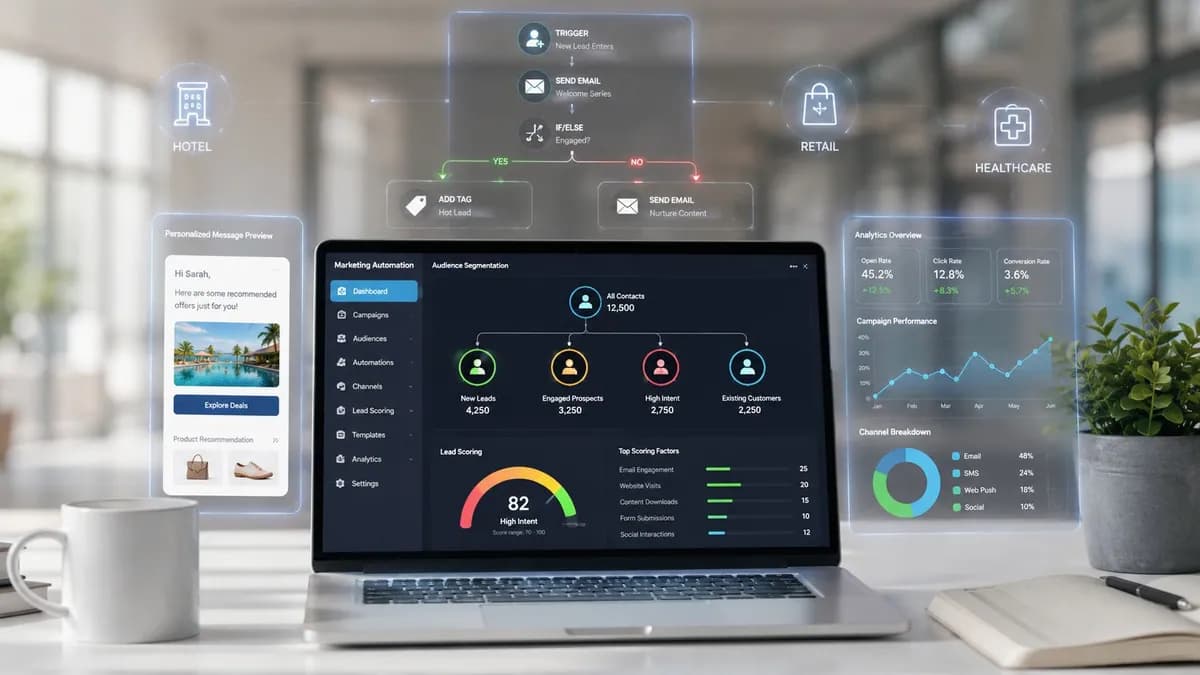
1. Segmentation
Segmentation divides records into meaningful groups. A hotel could separate first-time guests, returning guests, corporate bookers and people who have opted into a particular offer. A retailer might distinguish shoppers by location or recent product interest.
Good segmentation uses information that changes the next action. A label such as “all contacts” rarely helps a team decide what to say.
2. Lead scoring
Lead scoring assigns a level of attention to a contact or account based on agreed signals. A business hotel could give more attention to an enquiry that includes meeting-room requirements than to a general newsletter sign-up. The score should support a clear handoff, not create a mysterious ranking that sales doesn't trust.
3. Workflows
A workflow is the sequence of conditions and actions. A first WiFi login might trigger a welcome message, a wait period, a follow-up based on engagement and a task for a colleague if the contact requests information. For practical guidance on designing triggered email sequences, Mailadept's email automation guide offers a useful complementary resource.
4. Personalisation
Personalisation changes the experience according to known context. That could mean referencing a venue, service category, booking preference or resident event. It shouldn't mean inserting a first name into a message that remains irrelevant. The content, timing and offer should all reflect the record.
5. Analytics
Analytics closes the loop. The team needs to know whether messages were delivered, opened, clicked and acted upon, but also whether those actions supported bookings, enquiries, visits or retention. Without measurement, automation becomes a collection of busy workflows rather than a managed commercial process.
| Component | Primary job | Example in a UK venue |
|---|---|---|
| Segmentation | Group contacts by useful attributes | Separate hotel guests who have opted into local offers |
| Lead scoring | Prioritise attention | Flag a corporate enquiry with clear event requirements |
| Workflows | Coordinate triggers and actions | Send a welcome sequence after an approved WiFi sign-up |
| Personalisation | Adapt the experience | Promote a relevant retail department or resident service |
| Analytics | Measure behaviour and outcomes | Connect engagement with bookings or qualified enquiries |
Practical rule: Automate a decision only when the team can explain the input, the action and the reason the action helps the customer.
Benefits and ROI UK Operators Can Realistically Expect
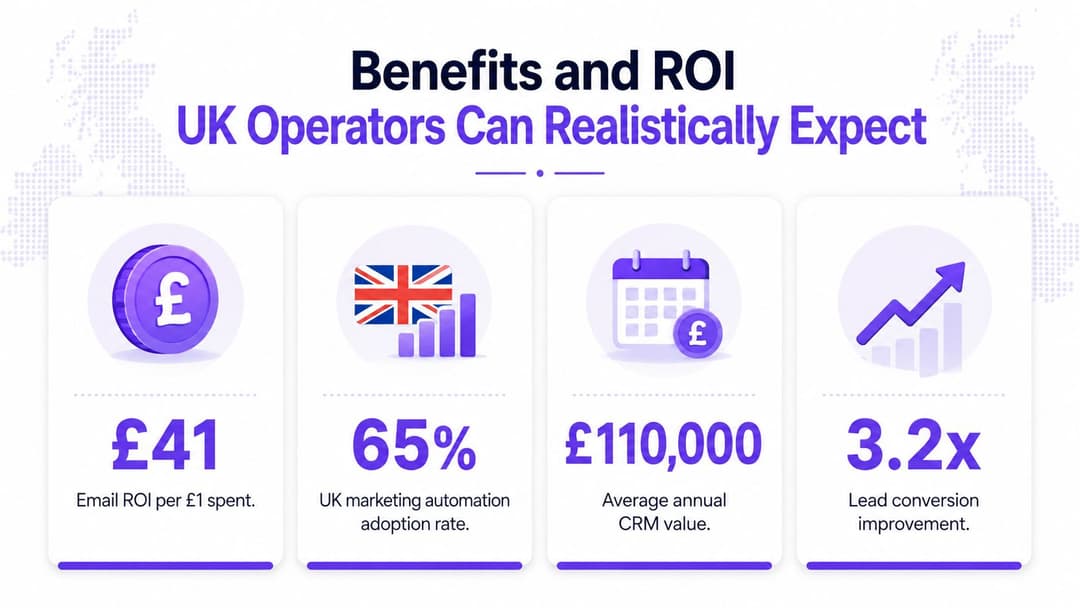
The commercial case for automation should start with a measurable business outcome, not a promise that every campaign will perform equally well. UK email data offers a useful baseline because email was an early, scalable automation channel. The DMA Marketer Email Tracker 2026 reports £41 in return for every £1 spent, up from £38 in the previous tracker year, as reported in this UK email marketing ROI summary.
The same reporting set says 442 billion emails were analysed in the 2025 DMA Email Benchmarking Report. It records a 35.9% average UK open rate in 2024 and a 2.3% average unique click rate, with both measures rising for a third consecutive year. Those figures don't guarantee a result for an individual venue, but they show why triggered, segmented email remains a credible performance channel.
Build the business case around operating value
A UK dataset reports marketing automation adoption at 65%, alongside an average annual CRM investment of £110,000 per company. It also claims an 85% improvement in customer data management efficiency. The most useful interpretation for an operations team is that value sits in synchronisation, routing and lifecycle management, not merely in scheduling emails. The UK CRM integration statistics provide the cited context for these figures.
A credible business case should therefore connect:
- Data quality: Fewer duplicate or incomplete records.
- Staff capacity: Less manual copying between systems.
- Commercial response: Faster follow-up for qualified enquiries.
- Customer relevance: Messages based on actual context.
- Measurement: Clearer links between activity and outcomes.
The labour market points in the same direction. Over the prior six months, 110 permanent UK job adverts cited marketing automation, compared with 42 a year earlier, while the median salary was £52,500 and the reported year-on-year median salary increase was 17.98%. UK marketing automation job data suggests employers increasingly value campaign logic, scoring, CRM integration and workflow optimisation as specialist skills.
The right expectation is disciplined improvement. A venue should define its baseline, choose one lifecycle problem, measure the full journey and expand only after the data and governance work.
Industry Use Cases From Hospitality to Residential Property
The same architecture behaves differently in each sector because the customer journey differs. A WiFi authentication event can be the starting signal, but the next step depends on whether the person is a hotel guest, a shopper, a patient or a resident.
Hospitality
A hotel collects a consented guest identity during WiFi access. The CRM can associate that record with the property and the guest's permitted preferences. A welcome journey might provide practical information during the stay, while a later message can invite feedback or present a relevant future-stay option.
The operator shouldn't treat every login as a sales lead. A first-time leisure guest and a corporate booker may need different content, permissions and follow-up rules. The workflow should also suppress messages that conflict with the guest's current status, such as promotional material during an unresolved service issue.
Retail
A shopping centre can use WiFi authentication to create a known relationship with a visitor who previously appeared only as anonymous footfall. If that visitor opts into communications, the retailer or centre team can segment future messaging by location, visit context or declared interest.
The useful outcome isn't a flood of offers. It's a more relevant journey, such as a welcome message for a first visit, information about centre services or an invitation connected to a retailer category. Location and visit signals can also help operators understand how spaces are used. Purple's WiFi location analytics resource provides context for how connected venue data can support that operational view.
Healthcare
Healthcare requires a stricter boundary between helpful communication and inappropriate marketing. A provider might use automation for approved service updates, appointment-related information or feedback requests, with access limited according to role and purpose. The system must distinguish a person's identity from sensitive clinical information and apply the organisation's consent and governance policies.
For a healthcare administrator, automation is valuable when it reduces avoidable manual handling without allowing a workflow to make an unreviewed decision about a patient.
Residential and BTR
A build-to-rent operator can use an authenticated resident relationship to organise welcome communications, building updates, amenity information and community events. A new resident might receive a practical onboarding sequence, while an established resident receives information relevant to their building or stated interests.
The property team can also route service requests into the right operational queue. Marketing automation doesn't replace the property-management platform. It coordinates approved communications around it, so residents receive consistent information and staff can see which actions still require a human response.
Across all four settings, the first-party record matters because it gives the business a durable relationship rather than a one-off anonymous interaction. The governance standard must rise with the usefulness of the data.
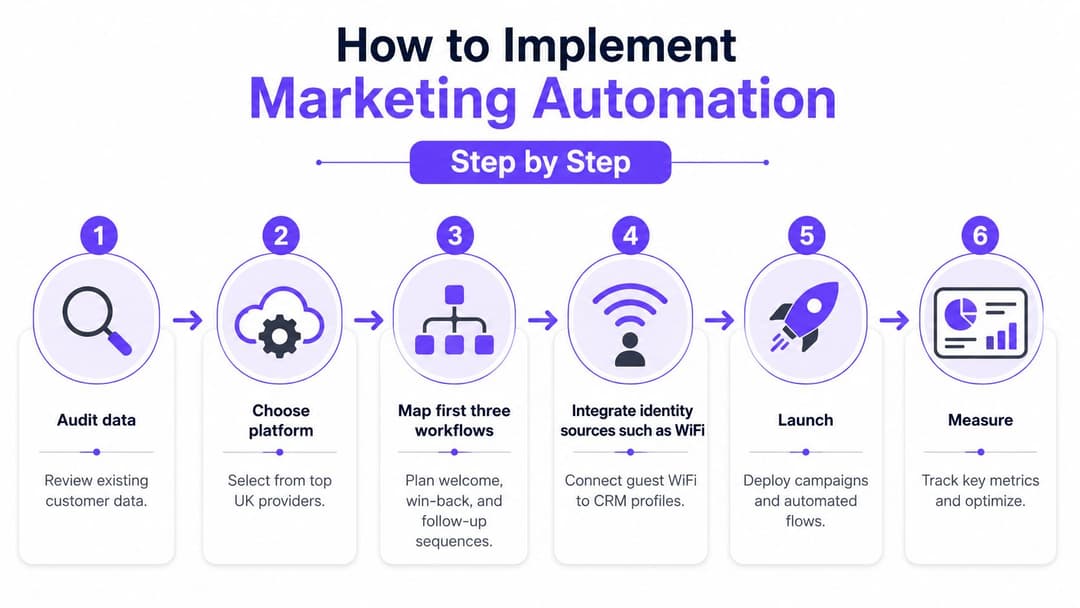
How to Implement Marketing Automation Step by Step
Use this as the single planning sequence. Don't begin by buying a platform and asking the team to find a use for it.
1. Audit the data
List the systems that hold customer information, such as the CRM, PMS, booking engine, loyalty platform, WiFi service desk and analytics tools. Record the field definitions, consent status, ownership and matching rules. You need to know which record is authoritative before you build a workflow.
2. Choose the platform
Select software that can integrate with the systems your venue already relies on. Assess workflow logic, CRM synchronisation, reporting, permissions, auditability and data-residency options. A small email platform may suit a narrow journey, while a multi-site operator may need broader orchestration.
3. Map the first three workflows
Start with journeys that have a clear trigger and outcome. A welcome sequence, a win-back flow and a follow-up process for a qualified enquiry are practical candidates. For each, write the entry condition, exclusions, message sequence, wait rules, exit condition and human escalation.
4. Integrate identity sources
Connect approved identity signals, including WiFi where appropriate, to the customer record. Purple's WiFi first-party data approach is relevant for venues that want authenticated connectivity to contribute to a governed first-party data strategy.
5. Launch in a controlled way
Test with internal records and a small approved audience before expanding. Check personalisation fields, suppression rules, consent handling, CRM updates and failure alerts. Give frontline staff a simple explanation of what the workflow does and when they need to intervene.
6. Measure and improve
Choose one primary outcome for each workflow. Review engagement, conversion, data quality and operational handoffs together. When a journey works reliably, refine its logic and then consider the next use case.
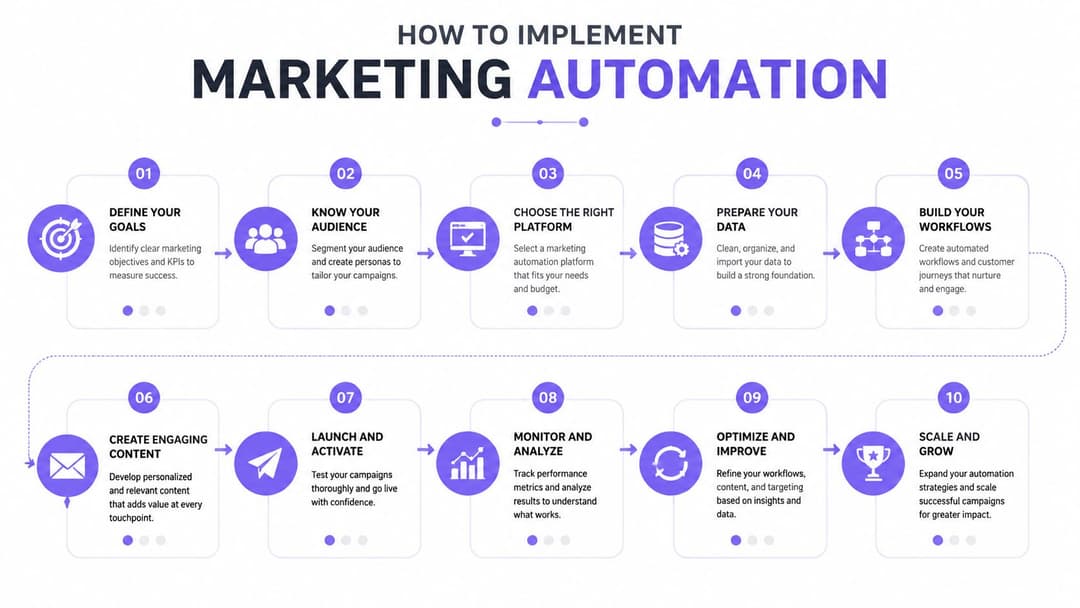
The timescale depends on data quality, procurement, integrations and approval requirements. Treat implementation as an operational change programme, not a campaign task.
Best Practices, Metrics and Common Pitfalls
Automation fails when teams confuse activity with control. A platform can send a message perfectly and still create a poor customer experience if the record is wrong, consent is missing or the workflow ignores what happened offline.
Start with a measurement hierarchy. Open and click rates help diagnose message engagement, but they're not the whole commercial picture. A B2B team may track the movement from marketing-qualified lead to sales-qualified lead, while a venue may focus on bookings, visits, enquiries or resident participation. Conversion and lifetime value should sit closer to the business outcome than surface engagement alone.
Use governance as part of the design
UK and EU data-residency expectations, audit logs and compliance reporting belong in the platform assessment, not in a later remediation project. A UK-focused B2B automation guide highlights those requirements and also reports that 84% of UK marketers use AI daily, while 86% say it saves time on analysis and reporting. It further says that almost all marketers still edit AI output before publication. The UK B2B automation guide shows why control and approval are operational requirements.
Build a checklist around:
- Data cleanliness: Define ownership, deduplication and field standards.
- Consent: Record purpose, status, source and withdrawal handling.
- Suppression: Stop messages when a customer changes status or opts out.
- Human review: Require approval for sensitive, high-impact or brand-critical actions.
- Auditability: Keep a usable record of changes, decisions and workflow versions.
Challenge the set-and-forget model
Rule-based workflows remain useful, but agentic workflows introduce a different question. An AI system might draft a response, route an enquiry or recommend a next-best action, while a person approves the decision. UK trend coverage describes this shift and recommends human-in-the-loop checkpoints, one KPI per lifecycle stage and automation of handoffs rather than content generation alone. UK marketing automation spending and trend coverage also reports that 76% of UK marketers have seen tangible ROI from AI tools.
Control point: If nobody can explain why the system selected a person, message or action, the workflow isn't ready for autonomous execution.
Where Marketing Automation Goes From Here
The next stage isn't just more email automation. It's a governed operating model in which authenticated first-party signals enter a shared data layer, workflows coordinate the journey and AI helps teams decide what should happen next.
That changes the central question from “Can automation send an email?” to “Which parts of the funnel should AI be allowed to orchestrate?” Drafting a routine message may need limited oversight. Changing a customer segment, routing a sensitive healthcare enquiry or making a high-value commercial recommendation may require explicit human approval.
The strongest UK deployments will combine three disciplines. First, they'll capture identity through useful interactions such as consented WiFi access. Second, they'll measure the complete path from engagement to conversion and lifetime value. Third, they'll design governance into data residency, permissions, audit logs, consent and approval checkpoints.
Your next planning meeting should identify the records you trust, the three workflows that deserve attention first, the metrics that define success and the decisions that must remain with people. That's the practical answer to what is marketing automation in 2026. It's a controlled system for turning customer signals into useful action.
Purple can help venues connect authenticated WiFi identity data with customer journeys, analytics and marketing automation across hospitality, retail, healthcare and residential environments. Visit Purple to explore how a governed first-party data entry point could support your next automation programme.