
Commercial landlord WiFi tender template: tenant networks, shared amenity floors and visitor sign-in
Use this template to issue a WiFi tender for a multi-let office that makes bidders prove tenant isolation on shared access points, one sign-in model for tenants, members and visitors, consented amenity reporting and recoverable costs. You can then apply pass or fail gates and a weighted scoring sheet to compare bids on price, support and onboarding speed.
By James KeanPublished
📖 15 min read3,274 words3 worked examples12 key definitions
Part of our core series: Multi-tenant WiFi: the complete guide →
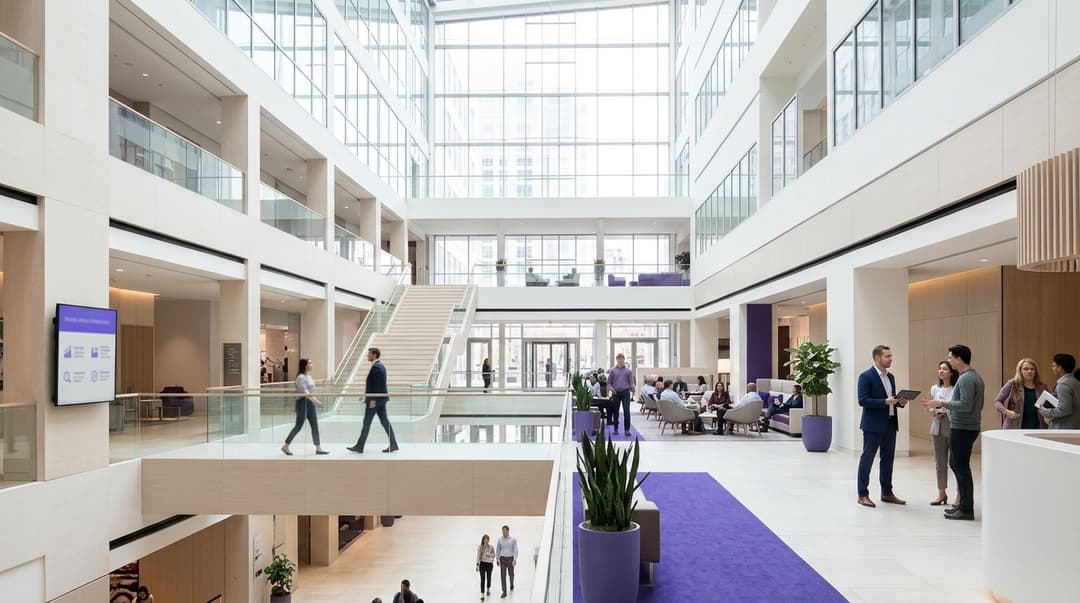
Your tender to commercial landlord WiFi providers should make bidders prove four things. Tenants get private, segmented networks on shared access points. Tenants, members and visitors share one sign-in model across lobbies and amenity floors. Amenity reporting runs on consented data. Costs are recoverable through the service charge or tenant packages. Score bids on price, support and onboarding speed.
What should your tender ask commercial landlord WiFi providers to prove?
A multi-let office building puts three groups on one set of access points. Tenant staff need a private network that behaves like their own office. Members and visitors need fast, consented access in the lobby, cafe and amenity floors. You need evidence that those floors earn the space they occupy.
Most tenders ask about access point counts and throughput. Those questions favour hardware vendors. They reveal nothing about tenant onboarding, data protection or how you recover the cost. This template asks different questions, in six sections:
- Private tenant networks on shared infrastructure.
- Lobbies, cafes and amenity floors.
- Visitor and event sign-in.
- Reporting on amenity use.
- Cost and recharge model.
- Support, onboarding and exit.
Each section gives the questions to paste into your invitation to tender and describes a strong answer. The scoring sheet then turns those answers into a number you can compare.
Settle two things internally before you issue it. First, confirm what your leases allow you to recover through the service charge. Second, decide whether you are buying a service on your existing access points or a full network rebuild. If your access points are serviceable, ask bidders to price a cloud overlay. Why your next WiFi upgrade doesn't need new hardware sets out that case.
What should you specify for private tenant networks on shared infrastructure?
A private tenant network on shared infrastructure gives each tenant its own segment. Every other tenant's devices stay out of reach, even though all tenants share the building's access points. Bidders typically use one of two methods.
- iPSK (identity pre-shared key, also called PPSK). Everyone joins one network name, but each tenant or device gets its own key. The key decides which VLAN the device lands in. A VLAN is a virtual LAN, a logically separate network segment.
- IEEE 802.1X. This standard makes each person or device authenticate with its own credentials before getting network access. A RADIUS server checks those credentials and tells the access point which segment to use. WPA3-Enterprise is the current WiFi Alliance security mode for 802.1X networks.
iPSK suits printers, AV kit and tenants without an identity system. 802.1X suits tenants that already manage staff identities centrally. A strong bid supports both on the same infrastructure.
Questions to put to bidders
- How is each tenant's traffic separated from other tenants and from the amenity network? Name the mechanism (VLAN, iPSK or 802.1X) and the encryption mode (WPA2 or WPA3).
- Can tenant staff sign in with their existing identity provider, such as Microsoft Entra ID, Okta or Google Workspace?
- When a tenant disables a leaver in their identity provider, does WiFi access end automatically? How long does it take?
- Can each tenant's IT lead add staff and devices without raising a ticket with the landlord?
- How do headless devices, such as printers, meeting room panels and AV kit, join the tenant network?
- What is the elapsed time from signed lease to a live tenant network, and what does the landlord have to do?
- How is a departing tenant's network removed, and which data is deleted, and when?
- Which access point vendors does your platform run on today, in production?
- How does the design keep card terminals in retail or cafe units out of scope for PCI DSS on the shared network?
On the last point, the PCI Security Standards Council treats network segmentation as the way to reduce the systems in scope for PCI DSS. A cafe operator's payment devices should never share a segment with the lobby network.
What a strong answer looks like
Purple's Identity-Based Networks give each tenant a Private Area Network (PAN) on the building's shared access points. A tenant's laptops and office printer can see each other. Nothing outside that private network bubble can see them. Staff can authenticate against Microsoft Entra ID, Okta or Google Workspace, so joiners, movers and leavers follow the tenant's own directory.
Purple runs on Cisco Meraki, HPE Aruba, Ruckus, Juniper Mist, Ubiquiti UniFi, Cambium, Extreme and Fortinet. No rip and replace is required.
How should lobbies, cafes and amenity floors handle tenants, members and visitors?
Shared spaces carry the widest mix of people in the building. Write a separate rule for each group into the specification.
Tenant staff
Tenant staff should connect automatically when they walk from their desk to the cafe, without a second sign-in. Ask bidders whether they support Passpoint for this. Passpoint, also known as Hotspot 2.0, is the WiFi Alliance standard that lets a device join automatically using a stored profile. OpenRoaming, a federation run by the Wireless Broadband Alliance, extends that automatic access across participating venues. Passpoint and OpenRoaming: Complete Guide covers both standards in depth.
Members
Coworking members, gym members and club members should get access tied to their membership status. When a membership lapses, WiFi access should lapse with it. Ask bidders how membership status reaches the WiFi platform and how quickly a change takes effect.
Visitors
Visitors should sign in through a captive portal, the web page a device shows before it gets internet access. Keep it short and branded. Separate marketing consent from access. Purple uses conscious-choice opt-ins, so no visitor is opted in by default. Hotel WiFi login page: What guests see and fixes shows the design issues that apply equally to an office lobby. Our Guest WiFi page describes the visitor flow.
Two regulations govern the consent screen. UK GDPR Article 7 requires consent to be distinguishable from other matters and as easy to withdraw as to give. The Privacy and Electronic Communications Regulations (PECR) govern any marketing email you send afterwards. Ask every bidder to submit screenshots of their consent screen with the tender.
Event sign-in
Amenity floors hired for events need their own sign-in, separate from day-to-day visitor access. Add these questions:
- Can the building team create time-limited event access without contacting the provider?
- Can event access carry the organiser's branding and expire automatically when the event ends?
- How is tenant bandwidth protected when 250 attendees connect on one floor?
- Who receives consented attendee data: the landlord, the event organiser or both, and under what contract?
The bandwidth question matters. A strong bid applies rate limits per network, so an event floor cannot starve tenant floors.
What reporting on amenity space use should bidders provide?
Amenity floors take lettable area out of income. Your asset plan needs evidence that they attract and retain tenants. WiFi connection data is the cheapest source of that evidence, provided it is collected lawfully.
Ask bidders to show sample reports covering:
- Connected visitors by floor or zone, by hour and by day of the week.
- Dwell time per zone.
- The split between tenant staff, members and visitors.
- Repeat visit rate for members and visitors.
- Event attendance against registrations.
- Peak concurrent connections, for capacity, cleaning and catering schedules.
- Building-level and portfolio-level views, scheduled exports and an API.
Then ask the privacy questions. Which reports show personal data, and which show only aggregates? What is the default retention period, and can you shorten it? Under UK GDPR, the landlord is normally the controller and the WiFi provider the processor. Article 28 requires a written processor contract, so request the bidder's standard terms with the bid.
Purple's WiFi Analytics reports visits, dwell time and repeat visits by venue and zone. The Engage plan uses consented visitor and event data to promote amenity spaces, for example by inviting past attendees to the next event. Purple integrates with CRM and marketing platforms, and holds ISO 27001, Cyber Essentials and B Corp certification. Purple handles 500 million users and logins a year (Purple's own data).
Where commercial landlord WiFi providers genuinely differ
Bids usually fall into one of four delivery models. Identify which model each bidder is offering before you score anything.
| Delivery model | Hardware needed | Time to first tenant live | Tenant isolation | Visitor and event sign-in | Amenity reporting | Who it suits |
|---|---|---|---|---|---|---|
| Cloud overlay on existing access points | Existing access points from Cisco Meraki, HPE Aruba, Ruckus, Juniper Mist, Ubiquiti UniFi, Cambium, Extreme or Fortinet | Weeks: configuration only, no new cabling | Per-tenant segment via iPSK or 802.1X | Captive portal, event access, Passpoint | Zone-level, consented, portfolio view | Landlords with serviceable access points and a changing tenant mix |
| Managed network rebuild | New access points and switching on every floor | Months: survey, cabling and installation | VLAN per tenant | Only where the bidder bundles sign-in software | Only where the bidder bundles analytics software | Buildings with end-of-life access points or a major refurbishment under way |
| Tenant-procured networks | Separate access points in every tenant demise | Each tenant's own fit-out programme | Physical separation | None in common parts unless the landlord buys separately | None across the building | Single-floor tenants with strict internal IT policies |
| Basic shared guest network | Existing access points | Days: one open network name | None between tenants | Click-through page only | Connection counts only | Lobbies alone, never tenant floors |
The tenant-procured model carries a hidden cost. Many overlapping networks on the same floor plate create co-channel interference, which degrades performance for everyone. It also leaves the landlord with no amenity data at all.
Got questions about your specific setup?
Our team works with venue operators, IT managers, and network engineers across 80,000 venues. Book a 20-minute call and we will show you how others like you solved it.
Guaranteed response within 4 business hours - No commitment required
What does landlord-provided WiFi cost, and how do you recover it?
Ask bidders to price each line separately, over a term aligned to your leases. Five years is a sensible default.
- Platform licence, per building or per access point.
- Hardware, if any is needed.
- Installation and configuration.
- Support tier and service levels.
- Internet circuits, if the bidder supplies them.
- Exit costs, including data return and handover.
Then ask each bidder to show how their invoices split by building and by service. You cannot recharge what you cannot itemise.
Three ways to recover the cost
| Recovery route | What it covers | Basis of charge | Main risk |
|---|---|---|---|
| Service charge | Lobby, cafe and amenity floor WiFi as a common-parts service | Apportioned by net internal area, per the lease | Lease does not permit recovery, so cost is irrecoverable |
| Tenant packages | Private tenant networks, higher bandwidth, enhanced support | Fixed monthly fee per tenant or per tier, billed directly | Low take-up if tenants already run their own networks |
| Event and hire charges | Event sign-in and bandwidth on amenity floors | Bundled into the room hire fee | Under-recovery if events are infrequent |
The RICS professional statement Service charges in commercial property expects recoverable costs to be transparent and consistent with the lease. Itemised invoices from your WiFi provider make that easier to demonstrate at year-end reconciliation.
A worked example, with illustrative figures. Common-parts WiFi costs £30,000 a year in a building of 100,000 sq ft net internal area. A tenant occupying 10,000 sq ft pays 10% of that cost, £3,000. Their private network package is billed separately, so tenants who do not take one pay nothing for it.
How do you score bids on price, support and onboarding speed?
Apply pass or fail gates first. Remove any bid that fails one, regardless of price:
- ISO 27001 certification or equivalent.
- UK GDPR Article 28 processor terms supplied with the bid.
- Proven operation on your installed access point vendor.
- Cyber Essentials, where you are a public body. UK central government requires it for contracts handling certain personal information.
Score the remaining bids on this sheet.
| Criterion | Weight | Scores 5 when the bid offers | Scores 1 when the bid offers |
|---|---|---|---|
| Price (five-year total cost) | 30 | Lowest total cost | Highest total cost |
| Tenant network security and isolation | 20 | Per-tenant segments via iPSK and 802.1X, WPA3, automatic leaver revocation | One shared password across tenants |
| Onboarding speed (tenants and events) | 15 | Tenant live within days of lease signing; building team sets up events unaided | New cabling per tenant; every event needs a provider ticket |
| Support and service levels | 15 | 24/7 cover, severity-based response times, uptime SLA with service credits | Business-hours email support, no SLA |
| Amenity and visitor sign-in | 10 | Automatic tenant roaming, branded portal, separate consent, membership-linked access | One click-through page for everyone |
| Reporting and data protection | 10 | Zone-level reports, portfolio view, API, configurable retention | Monthly connection counts in a PDF |
Score price with a formula, not judgement: (lowest bid ÷ this bid) × 30. Score each quality criterion from 0 to 5, then multiply by its weight divided by five. Ask a second evaluator to score independently, then reconcile differences above one point.
On support, ask for response and resolution times by severity, and the hours they apply. Ask what service credits apply below the uptime commitment. Purple runs at 99.999% uptime (Purple's own data).
How the template works in practice
These are worked scenarios built from typical buildings, not named deployments. The figures are modelled to show the method.
Scenario 1: a public-sector civic office
Situation. A council owns a seven-storey civic office. It occupies four floors and lets the rest to an NHS team and two charities. The ground floor has a public cafe and a community events room. Each occupier runs its own access points, so nine network names compete on some floors. Visitors are handed a shared password written on a card.
What was done. The council issued this template with Cyber Essentials and Article 28 terms as pass or fail gates. It weighted tenant network security at 25 instead of 20, given the NHS team's data. The winning bid ran a cloud overlay on the council's existing access points. Each occupier received its own segment, with staff signing in through their existing identity provider. Visitors used a captive portal on the ground floor only.
Outcome. Network names per floor fell from nine to three: tenant, visitor and events. The shared password card was withdrawn. The council now reports cafe and events room use by hour, from aggregated data. The same segmentation pattern appears in Healthcare settings, where staff and visitor networks must stay apart.
Scenario 2: an events-led multi-let office with a ground-floor cafe
Situation. A 12-storey city-centre office houses 18 tenants. A coffee operator leases the ground-floor unit. The eighth floor is an amenity floor hired for events of up to 250 attendees. The landlord cannot show the investment committee whether the amenity floor is used. The events team shares one password, and the cafe operator wants card terminals off the shared network.
What was done. The tender used the standard weights. The cafe's payment devices were specified onto their own segment, the approach Retail operators use to limit PCI DSS scope. Event sign-in had to be operable by the building team. Visitor access follows the same pattern as Hotels, where guests and staff share access points but never a network.
Outcome. Three bids passed the gates and were scored as follows.
| Bid | Five-year total cost | Price (30) | Security (20) | Onboarding (15) | Support (15) | Sign-in (10) | Reporting (10) | Total |
|---|---|---|---|---|---|---|---|---|
| A: cloud overlay | £120,000 | 25 | 20 | 12 | 12 | 8 | 10 | 87 |
| B: basic shared network | £100,000 | 30 | 12 | 6 | 9 | 6 | 4 | 67 |
| C: managed rebuild | £150,000 | 20 | 16 | 9 | 15 | 6 | 6 | 72 |
The cheapest bid finished 20 points behind the winner. It offered one shared password and no event sign-in for the building team. Common-parts WiFi was recharged through the service charge by net internal area. Event WiFi was folded into the room hire fee.
How do you decide for your estate?
Run the template on one building before you roll it out across a portfolio.
- Audit each building. List the access point vendor, model age and lease recharge clauses. Buildings with serviceable access points suit a cloud overlay.
- Pilot where the mix is widest. Choose the building with the most tenants and the busiest amenity floor. It will test every section of the tender.
- Standardise the scoring sheet. Keep the weights constant across buildings, so portfolio-wide bids stay comparable.
- Align the contract with the service charge year. This simplifies reconciliation and budgeting.
- Write exit terms in now. Specify data return, deletion and handover timelines before you sign.
If your buildings also house residents or public retail space, read Mixed-use development WiFi: residents, retail tenants and public spaces on one platform. Purple runs in 80,000+ live venues across 90 countries (Purple's own data).
Frequently asked questions
Can landlord-provided WiFi run on the access points already in the building?
Yes, provided the access points are from a supported vendor and still receive firmware updates. Purple runs as a cloud overlay on Cisco Meraki, HPE Aruba, Ruckus, Juniper Mist, Ubiquiti UniFi, Cambium, Extreme and Fortinet. Tenant segmentation, amenity WiFi and visitor sign-in are configured in software, with no rip and replace. Ask every bidder to confirm production deployments on your specific vendor before you shortlist them.
Can WiFi costs be recovered through the service charge?
Yes, where the lease permits recovery of the relevant services. Common-parts WiFi in lobbies, cafes and amenity floors is usually apportioned by net internal area. Private tenant networks are better sold as optional packages billed directly, so tenants who decline pay nothing. The RICS professional statement on commercial service charges expects transparency, so require bidders to itemise invoices by building and by service.
Is a shared network secure enough for tenants in finance or healthcare?
Yes, when each tenant has its own segment and personal or device-level credentials. Specify IEEE 802.1X with WPA3-Enterprise for tenants that manage identities centrally, and iPSK for devices that cannot use 802.1X. Leavers should lose access automatically when their employer disables them in Microsoft Entra ID, Okta or Google Workspace. Weight security more heavily in your scoring sheet for regulated tenants.
How quickly can a new tenant be connected?
A tenant can be connected on move-in day when the network is a cloud overlay. Credentials and segments are created in software rather than by installing cabling or access points in the demise. Make the elapsed time from signed lease to live network a scored criterion. Ask bidders whether the tenant's own IT lead can then add staff and devices without contacting the landlord.
Who owns the visitor data collected on amenity floors?
The landlord is normally the controller, and the WiFi provider acts as processor under UK GDPR. Article 28 requires a written processor contract, so request the bidder's terms with the tender. Where event organisers receive attendee data, agree in writing who controls it. Marketing consent must be separate from WiFi access, and any marketing emails must also meet PECR.
Can tenants keep their own network if they already have one?
Yes. A tenant with its own network can keep it inside its demise, while the landlord runs WiFi for common parts and other tenants. Offer private network packages as optional, not mandatory. Over time, tenants often move across to avoid running separate access points, which also reduces co-channel interference on shared floors. Your tender should ask bidders how they coexist with tenant-owned networks.
How do we switch from an incumbent WiFi provider without downtime?
You switch by running the new service in parallel, then moving one group at a time. A cloud overlay can broadcast new network names on existing access points while the old service stays live. Migrate visitors first, then tenants floor by floor, then retire the old networks. Write data return and deletion obligations into the incumbent's exit, and the new contract.
Do tenant staff have to sign in again on amenity floors?
No, not when the network supports automatic roaming. Tenant staff authenticated by 802.1X, iPSK or a Passpoint profile connect on amenity floors as they do at their desk. They stay in their own tenant segment, while visitors on the same floor use the captive portal. Ask bidders to demonstrate this during the tender, on your building's access points.
Key Definitions
iPSK (identity pre-shared key, also PPSK)
A WPA2 or WPA3-Personal technique in which many unique pre-shared keys are accepted on one SSID, with the RADIUS server or controller mapping each key to a tenant or device and returning a VLAN assignment. It is a vendor implementation on top of IEEE 802.11 security rather than a separate IEEE standard.
You meet it when connecting printers, meeting room panels and AV kit, or tenants with no identity system. Bids that support iPSK alongside 802.1X can segment every device type on shared access points.
IEEE 802.1X
The IEEE standard for port-based network access control. It carries Extensible Authentication Protocol (EAP) messages between a device, the access point and an authentication server, so each person or device authenticates with its own credentials before getting network access.
Specify it for tenants that manage staff identities centrally, including finance and healthcare occupiers. It is the basis for per-person credentials and automatic leaver revocation in the scoring sheet.
RADIUS
Remote Authentication Dial-In User Service, defined in IETF RFC 2865. The server checks credentials passed by the access point and returns attributes, such as the VLAN, that decide which segment a device joins.
Sits behind both 802.1X and iPSK designs. Ask bidders whose RADIUS service decides tenant placement and how it links to each tenant's identity provider.
VLAN
A virtual LAN as defined in IEEE 802.1Q, which tags Ethernet frames so one physical network carries several logically separate segments.
The segment each tenant, the amenity network and cafe payment devices land in. Separate VLANs are how a shared access point keeps one tenant's devices out of reach of another's.
WPA3-Enterprise
The current WiFi Alliance security certification for networks that authenticate with IEEE 802.1X, succeeding WPA2-Enterprise and requiring Protected Management Frames.
The encryption mode the scoring sheet rewards with full marks under tenant network security. Ask bidders to state WPA2 or WPA3 for every network name they propose.
Passpoint (Hotspot 2.0)
A WiFi Alliance certification programme built on IEEE 802.11u that lets a device discover and join a network automatically using a stored credential profile, without a captive portal.
Lets tenant staff walk from desk to cafe or amenity floor and stay connected without a second sign-in. Include it in your questions on lobbies and amenity floors.
OpenRoaming
A roaming federation run by the Wireless Broadband Alliance that uses Passpoint profiles and a shared trust framework so devices connect automatically across participating venues.
Extends automatic access beyond your building. Relevant when you want members and tenant staff to roam between your sites and other participating venues.
Captive portal
The web page a device shows before it gets internet access, used for visitor sign-in and consent capture. It is subject to UK GDPR Article 7 conditions for consent where marketing permission is requested.
The visitor and event sign-in screen in your lobby and amenity floors. Ask for screenshots with each bid to check consent is separate from access.
UK GDPR Article 28
The article of the UK General Data Protection Regulation that requires a controller to appoint a processor only under a written contract setting out the subject matter, duration, purpose and security obligations of processing.
The landlord is normally controller and the WiFi provider processor. Supplying Article 28 terms with the bid is a pass or fail gate in this template.
PECR
The Privacy and Electronic Communications Regulations 2003, enforced by the ICO, which govern electronic marketing such as email sent after a visitor has given consent.
Applies to any campaign you send from consented amenity or event data. Bidders' consent flows must support it as well as UK GDPR.
PCI DSS segmentation
The PCI Security Standards Council's Data Security Standard treats network segmentation as the method of isolating the cardholder data environment so that systems outside it fall out of PCI DSS scope.
Applies to coffee operators and retail units with card terminals. Ask how the design keeps payment devices off the lobby network.
Co-channel interference
Performance degradation that occurs when several IEEE 802.11 networks on the same floor plate transmit on the same channel and must share airtime.
The hidden cost of the tenant-procured model, where each demise runs its own access points. Consolidating onto one segmented network reduces it.
Worked Examples
A council owns a seven-storey civic office, occupies four floors and lets the rest to an NHS team and two charities. Each occupier runs its own access points, nine network names compete on some floors, and visitors receive a shared password on a card. How should the tender be set up?
The council issued the template with Cyber Essentials and UK GDPR Article 28 terms as pass or fail gates. It raised the tenant network security weight from 20 to 25 because of the NHS team's data. The winning bid ran a cloud overlay on the council's existing access points. Each occupier received its own segment, with staff signing in through their existing identity provider. Visitors used a captive portal on the ground floor only. Network names per floor fell from nine to three: tenant, visitor and events. The shared password card was withdrawn, and the council now reports cafe and events room use by hour from aggregated data.
A 12-storey multi-let office with 18 tenants has a ground-floor coffee operator and an eighth-floor amenity floor hired for events of up to 250 attendees. The landlord cannot evidence amenity use, and the cafe wants card terminals off the shared network. Which bid should win?
The tender used standard weights. Cafe payment devices were specified onto their own segment to limit PCI DSS scope, and event sign-in had to be operable by the building team. Three bids passed the gates. Bid A, a cloud overlay at £120,000 over five years, scored 87. Bid C, a managed rebuild at £150,000, scored 72. Bid B, a basic shared network at £100,000, scored 67. The cheapest bid finished 20 points behind because it offered one shared password and no event sign-in for the building team. Common-parts WiFi was recharged through the service charge by net internal area, and event WiFi was folded into the room hire fee.
Common-parts WiFi costs £30,000 a year in a building of 100,000 sq ft net internal area. How much does a 10,000 sq ft tenant pay, and how are private networks charged?
Apportion the common-parts cost by net internal area, as the lease allows. The tenant occupies 10% of the building, so it pays 10% of the cost, £3,000 a year, through the service charge. Its private network package is billed separately as a fixed monthly fee, so tenants who decline a package pay nothing for it. This split keeps recoverable costs transparent and consistent with the lease, as the RICS professional statement on commercial service charges expects. It works only if your provider itemises invoices by building and by service, so make that a tender requirement.
Frequently asked questions
Can landlord-provided WiFi run on the access points already in the building?
Yes, provided the access points are from a supported vendor and still receive firmware updates. Purple runs as a cloud overlay on Cisco Meraki, HPE Aruba, Ruckus, Juniper Mist, Ubiquiti UniFi, Cambium, Extreme and Fortinet. Tenant segmentation, amenity WiFi and visitor sign-in are configured in software, with no rip and replace. Ask every bidder to confirm production deployments on your specific vendor before you shortlist them.
Can WiFi costs be recovered through the service charge?
Yes, where the lease permits recovery of the relevant services. Common-parts WiFi in lobbies, cafes and amenity floors is usually apportioned by net internal area. Private tenant networks are better sold as optional packages billed directly, so tenants who decline pay nothing. The RICS professional statement on commercial service charges expects transparency, so require bidders to itemise invoices by building and by service.
Is a shared network secure enough for tenants in finance or healthcare?
Yes, when each tenant has its own segment and personal or device-level credentials. Specify IEEE 802.1X with WPA3-Enterprise for tenants that manage identities centrally, and iPSK for devices that cannot use 802.1X. Leavers should lose access automatically when their employer disables them in Microsoft Entra ID, Okta or Google Workspace. Weight security more heavily in your scoring sheet for regulated tenants.
How quickly can a new tenant be connected?
A tenant can be connected on move-in day when the network is a cloud overlay. Credentials and segments are created in software rather than by installing cabling or access points in the demise. Make the elapsed time from signed lease to live network a scored criterion. Ask bidders whether the tenant's own IT lead can then add staff and devices without contacting the landlord.
Who owns the visitor data collected on amenity floors?
The landlord is normally the controller, and the WiFi provider acts as processor under UK GDPR. Article 28 requires a written processor contract, so request the bidder's terms with the tender. Where event organisers receive attendee data, agree in writing who controls it. Marketing consent must be separate from WiFi access, and any marketing emails must also meet PECR.
Can tenants keep their own network if they already have one?
Yes. A tenant with its own network can keep it inside its demise, while the landlord runs WiFi for common parts and other tenants. Offer private network packages as optional, not mandatory. Over time, tenants often move across to avoid running separate access points, which also reduces co-channel interference on shared floors. Your tender should ask bidders how they coexist with tenant-owned networks.
How do we switch from an incumbent WiFi provider without downtime?
You switch by running the new service in parallel, then moving one group at a time. A cloud overlay can broadcast new network names on existing access points while the old service stays live. Migrate visitors first, then tenants floor by floor, then retire the old networks. Write data return and deletion obligations into the incumbent's exit, and the new contract.
Do tenant staff have to sign in again on amenity floors?
No, not when the network supports automatic roaming. Tenant staff authenticated by 802.1X, iPSK or a Passpoint profile connect on amenity floors as they do at their desk. They stay in their own tenant segment, while visitors on the same floor use the captive portal. Ask bidders to demonstrate this during the tender, on your building's access points.
Sources
- IEEE 802.1X-2020: port-based network access control
- WiFi Alliance: WiFi security and WPA3
- WiFi Alliance: Passpoint
- Wireless Broadband Alliance: OpenRoaming
- UK GDPR (Regulation (EU) 2016/679 as retained), legislation.gov.uk
- ICO: guide to PECR and direct marketing
- PCI Security Standards Council
- NCSC: Cyber Essentials overview
Continue reading in this series
Mixed-use development WiFi: residents, retail tenants and public spaces on one platform
You will be able to decide how to run residents, retail and office tenants, and public plazas on one WiFi platform using shared access points. You can then plan the SSID count, VLAN and firewall design, resident key lifecycle, tenant lease clauses, public filtering policy and consent capture before you pilot a single building.
Later-living and retirement village WiFi providers checklist: resident keys, telecare isolation and visitor access
Use this checklist to judge retirement village WiFi providers against five tests: per-apartment keys, isolated telecare, one-screen visitor sign-in, DNS scam filtering, and single-step key issue and revocation. You can then map every device group to its own segment, run a go-live test plan and fix the common faults before residents notice them.
Housing association WiFi providers checklist: resident keys, community rooms and staff access
Use this checklist to compare housing association WiFi providers on six requirements: private keys per home, tenancy-linked revocation, one-tap community room sign-in, 802.1X and time-limited staff and carer access, communal filtering and aggregated funder reports. You can then specify, test and budget a scheme network on your existing access points.
Got questions about your specific setup?
Our team works with venue operators, IT managers, and network engineers across 80,000 venues. Book a 20-minute call and we will show you how others like you solved it.
Guaranteed response within 4 business hours - No commitment required