
Garden centre WiFi platforms: visitor sign-in, cafe footfall and repeat-visit reports
You will be able to shortlist a garden centre WiFi platform on four tests: mixed hardware support, outdoor count accuracy, season-based reporting and clean consent. You can then plan coverage zone by zone, calibrate visit counts against door data and build a lawful visitor list for Christmas, events and cafe offers.
By Dean CooksonPublished
📖 13 min read2,922 words3 worked examples10 key definitions
Part of our core series: WiFi analytics and location intelligence: the complete guide →
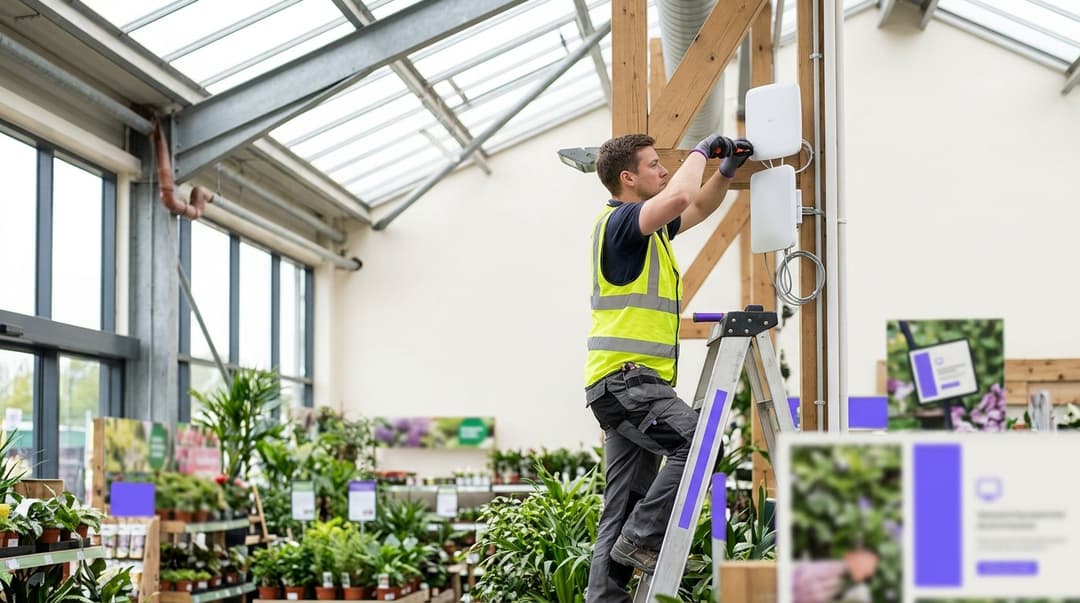
Garden centre WiFi platforms unify sign-ins, cafe footfall, and repeat-visit reporting across mixed access points like Cisco Meraki and HPE Aruba. Operating under UK GDPR and PECR, cloud overlays deliver zonal tracking, custom dwell thresholds, and separate marketing consent across 80,000+ live venues in 90 countries without requiring total hardware replacement.
Which garden centre WiFi platform should you choose?
Most garden centre groups already own access points, the radios mounted on walls and ceilings. The real decision is the software layer on top of them. That layer covers three things:
- the sign-in page visitors see
- the reports your centre managers read
- the list your marketing team emails
It is what turns a free hotspot into planning data.
Choose a platform that does three things at every centre:
- A short sign-in that works everywhere. It should behave the same in the shop, the glasshouses, the outdoor plant area and the cafe.
- Reports by centre and by season. It should show visits, dwell time and repeat visits for each centre and each trading season.
- Marketing consent as a separate choice. It should record consent with its own unticked box. That keeps your Christmas and events list lawful under UK GDPR and the Privacy and Electronic Communications Regulations (PECR).
Purple's Guest WiFi does all three as a hardware-agnostic cloud overlay. It runs on Cisco Meraki, HPE Aruba, Ruckus, Juniper Mist, Ubiquiti UniFi, Cambium, Extreme and Fortinet access points. A group with mixed hardware from acquisitions does not need to standardise first. Purple runs across 80,000+ live venues in 90 countries and handles 500 million users and logins a year.
Use this matrix to set your priorities before you book demos.
| Your situation | What to prioritise | What to ask in the demo |
|---|---|---|
| Several centres on different access point brands | One dashboard across all hardware | "Show me two centres on different hardware in one report." |
| Busy cafe, quiet shop on weekdays | Separate reporting for the cafe area | "Can I see cafe visits and dwell time apart from the shop?" |
| Large outdoor plant area next to a road | Filters that exclude passers-by | "How do you stop passing devices counting as visits?" |
| Christmas and events drive the year | Season and event comparisons | "Show me last December against this December for one centre." |
| Email already runs from a CRM or email platform | Direct integration, not CSV exports | "Which fields sync, and how often?" |
| One or two centres, small team | Quick setup and a simple weekly report | "What does a centre manager see on Monday morning?" |
Where garden centre WiFi platforms genuinely differ
Every platform will show you a sign-in page. They differ on mixed hardware, outdoor accuracy, season reporting and how cleanly consent reaches your email platform.
How does a garden centre cover glasshouses, outdoor areas and the cafe?
Coverage comes from the access points, not the platform. The two are still linked, because a platform can only count visitors where there is signal. Plan coverage zone by zone, using a site survey at each centre.
| Zone | What makes it hard | What to deploy | Reporting tip |
|---|---|---|---|
| Main shop | Tall racking, metal shelving, high ceilings | Ceiling or wall access points, spaced from a site survey | Group as a "Shop" zone |
| Glasshouses | Metal frames, coated glass, humidity, irrigation spray | Outdoor-rated access points (IP65 or above under IEC 60529), mounted clear of sprinklers | Group as a "Glasshouse" zone |
| Outdoor plant area | Few mounting points, long distances, weather | Outdoor access points on poles or building edges, aimed into the yard | Set a minimum dwell time before a visit counts |
| Cafe | Dense seating, lunchtime peak, longer stays | Dedicated access points sized for the lunchtime peak | Group as a "Cafe" zone for separate dwell reports |
| Car park and entrance | Signal spills onto roads and pavements | No deliberate coverage, antennas pointed inward | Exclude from visit counts |
Cabling is often the hidden cost. Copper Ethernet runs are limited to 100 metres under IEEE 802.3, and glasshouses are frequently further from the comms room than that. Use fibre or a point-to-point wireless bridge for longer runs. Power over Ethernet (IEEE 802.3af, 802.3at or 802.3bt) then powers each access point through its data cable.
Keep guest WiFi on its own VLAN, a logically separate network on the same cabling. It should have no route to tills, card terminals or back-office systems. PCI DSS recognises network segmentation as a way to reduce the number of systems in scope for card data security. For open guest networks, Opportunistic Wireless Encryption (RFC 8110) encrypts traffic without asking visitors for a password. Securing a business network: A practical guide for 2026 covers the wider picture.
What should the visitor sign-in ask for?
A captive portal is the page a device sees when it joins guest WiFi, before it can browse. On a garden centre network, keep it short. UK GDPR's data minimisation principle (Article 5(1)(c)) says you should collect only what you need.
A practical sign-in for garden centre guest WiFi asks for:
- First name. This personalises seasonal emails.
- Email address. This is the contact field for your list.
- Postcode (optional). This shows the catchment of each centre.
- Interests (optional). Houseplants, outdoor plants, cafe offers or events, and only if you will act on them.
- A separate, unticked marketing opt-in, with a link to your privacy notice.
Before you choose, compare the common sign-in methods.
| Sign-in method | What you collect | Effort for the visitor | Fit for consented email |
|---|---|---|---|
| Email form | Name, email, optional postcode | Three short fields | Strong when paired with an unticked opt-in |
| Social login | Name and email the social provider releases | One tap if already signed in | Good, but still needs its own opt-in |
| SMS one-time code | Mobile number | Enter number, then code | SMS only. Email needs a separate field |
| Click-through terms | No contact details | One tap | None. Counts visits only |
During demos, check that returning visitors can reconnect without filling in the form again. A regular who meets the form every Saturday will stop connecting. You will then lose that visitor from your repeat-visit reports.
Which footfall and repeat-visit reports help a group compare centres and seasons?
Garden centre footfall is seasonal, so reports must follow your trading calendar rather than calendar quarters. Define your seasons once, for example spring bedding, summer, autumn bulbs and Christmas. Then use them at every centre. Easter falls between 22 March and 25 April, so compare Easter weekends, not fixed dates.
| Report | Question it answers | Who reads it | How often |
|---|---|---|---|
| Visits by centre | Which centres are busiest, week by week? | Operations director | Weekly |
| New versus returning visitors | Is each centre winning repeat visits or relying on first-timers? | Marketing manager | Monthly |
| Repeat-visit frequency | How many visitors returned within 30, 60 or 90 days? | Marketing manager | Monthly |
| Season comparison | Is this spring busier than last spring at the same centre? | Operations director | Each season |
| Cafe visits and dwell time | How long do cafe visitors stay at each centre? | Centre manager | Weekly |
| Event uplift | Did the Christmas launch bring new visitors who returned in spring? | Marketing manager | After each event |
| Hour of day and day of week | When should the tills and cafe be fully staffed? | Centre manager | Weekly |
Purple's WiFi Analytics reports visits and returning visitors by venue. Every centre's numbers sit side by side in one view. The same approach serves multi-site Retail estates.
How accurate are WiFi visit counts outdoors and with randomised device addresses?
Treat WiFi counts as a consistent trend measure, not an exact headcount. Five factors shape accuracy at a garden centre.
- Only WiFi-enabled devices count. Visitors without a phone, with WiFi switched off, or children without devices never appear.
- There are two kinds of count. Signed-in visits are exact for the people who join. Detected devices come from probe requests, the signals phones broadcast while searching for networks. These counts are wider but less precise.
- Outdoor signal spills. A plant yard next to a road picks up passing phones. Set a minimum dwell time and a signal strength threshold, so a phone must stay a while before it counts.
- Device addresses are randomised. A MAC address is the identifier a device announces on a network. Apple devices on iOS 14 and later use a private address on each network by default, and recent iOS versions add a rotating option. Android 10 and later randomise the address by default. One phone can therefore appear as several devices over time.
- Sign-in identity is steadier. A repeat visit matched on a signed-in profile is less affected by address changes than one matched on device address alone. Ask each vendor how it matches returning visitors.
Calibrate before you rely on the numbers. Pick one centre with a door counter or reliable till data. Compare the two counts for four weeks. If WiFi records 9,000 visits while the door counter records 15,000, your capture ratio is 60%. Apply that ratio as a guide at similar centres, and re-check it each season.
How can visitor sign-ins feed seasonal and event email with consent?
Under PECR regulation 22, you need consent to send marketing email to individuals. The one exception is the soft opt-in. It covers contact details collected during a sale or negotiation for a sale, used to market similar products. A WiFi sign-in is not a sale, so ask for consent explicitly.
UK GDPR Article 7(4) and ICO guidance mean consent should not be a condition of a service that does not need it. GDPR Recital 32 rules out pre-ticked boxes. In practice, WiFi must work whether or not the visitor opts in. Purple's conscious-choice opt-ins follow this pattern.
Once consent is clean, segment the list by:
- centre, for local events and openings
- season of first visit, for timed offers such as autumn bulbs
- cafe visitors, for cafe offers and afternoon tea events
- event attendance, for Christmas grotto and workshop invitations
- stated interests, if the sign-in collected them
Purple's Engage plan turns consented sign-ins into these segments and seasonal campaigns. It integrates with CRM and marketing platforms. Record when, where and under what wording each consent was given. First party data strategy for UK venues explains how this list fits a wider data plan.
Got questions about your specific setup?
Our team works with venue operators, IT managers, and network engineers across 80,000 venues. Book a 20-minute call and we will show you how others like you solved it.
Where does each approach fit in a garden centre group?
The figures in these scenarios are worked examples that show the method. They are not results from a named site.
Scenario 1: a 14-centre retail group on three hardware brands
Situation. Acquisitions had left a group with Cisco Meraki at eight centres, HPE Aruba at four and Ubiquiti UniFi at two. Each brand ran its own splash page with different consent wording. Every Monday, marketing merged three exports in three formats. Nobody could compare centres on a like-for-like basis.
What was done. The group put one hardware-agnostic cloud overlay across all 14 centres and kept the existing access points. It used one sign-in form, one consent wording and one set of trading seasons. It grouped access points into shop, glasshouse, outdoor and cafe zones. It piloted one centre per hardware brand, then rolled out to the rest. Multi-site WiFi rollout plan: moving guest, staff and filtering to one platform across an estate sets out that phasing.
Measurable outcome. One weekly report replaced three exports. The operations director could rank all 14 centres on visits and returning-visitor share in a single view. Every new contact carried the same consent record, so the group could email the whole list under one audit trail.
Scenario 2: Christmas events at a destination garden centre
Situation. A large centre ran six Christmas weekends with a grotto, late-night shopping and wreath-making workshops. The marketing manager needed to know whether event visitors came back after Christmas or vanished until next December.
What was done. The centre labelled sign-ins made during event hours. It added an "events" interest box beside the unticked marketing opt-in. In March, it sent the consented event segment a spring planting invitation. It then measured returning visits through to the end of May.
Measurable outcome. Across the six weekends, 7,200 visitors signed in and 2,520 opted in, a 35% opt-in rate. By the end of May, 410 event visitors had returned, 5.7% of event sign-ins. The centre compared that rate across events. It kept the workshops and cut a lower-return late-night evening the following year.
What does garden centre WiFi cost to run?
Pricing models differ between vendors, so model each one on your Christmas peak, not a quiet February weekday.
| Cost line | One-off or recurring | What drives it | How to reduce it |
|---|---|---|---|
| Platform licence | Recurring | Number of centres or access points | Confirm the pricing basis in writing before comparing quotes |
| Access points | One-off | Gaps in glasshouses, outdoor areas and cafe | Reuse existing hardware under a cloud overlay |
| Cabling and bridges | One-off | Distance from comms room to glasshouses | Use point-to-point wireless bridges where trenching is costly |
| Broadband | Recurring | Peak cafe and weekend demand | Set per-device bandwidth limits on the guest network |
| Staff time | Recurring | Manual exports and list cleaning | Integrate sign-ins directly with your email platform |
The largest saving is usually hardware you do not replace. Why your next WiFi upgrade doesn't need new hardware explains the overlay approach. On the return side, measure three things: the size of your consented list, the share of returning visitors at each centre, and the uplift from each seasonal event.
How do you decide for your estate?
Work through these steps before you sign a contract.
- List your hardware. Record the access point brand and model at every centre, and confirm the platform supports each one.
- Map your zones. Mark shop, glasshouses, outdoor areas, cafe and car park on a plan of each centre.
- Write the sign-in and consent wording. Have your data protection lead review it before the pilot starts.
- Agree your seasons and report pack. Fix the trading seasons and the five or six reports each role will read.
- Pilot two centres. Choose one with a large outdoor area, and run the pilot through a busy weekend.
- Calibrate counts. Compare WiFi visits with door or till data for four weeks.
- Connect email. Sync one consented segment to your email platform and send a test campaign.
- Roll out in phases. Group the remaining centres by hardware brand.
Purple holds ISO 27001, Cyber Essentials and B Corp certification and is GDPR and CCPA compliant. Purple runs guest WiFi for retail and hospitality brands including Harrods, Pizza Express and Premier Inn. The same sign-in and reporting model that serves Hotels also suits garden centre cafe WiFi.
Frequently asked questions
Does Purple work with the access points already installed in our centres?
Yes. Purple is hardware-agnostic and runs as a cloud overlay on Cisco Meraki, HPE Aruba, Ruckus, Juniper Mist, Ubiquiti UniFi, Cambium, Extreme and Fortinet access points. A group with different brands at different centres can run one sign-in and one set of reports across all of them. You only need new hardware where there is no coverage today, such as a glasshouse or an outdoor plant area.
Can we make marketing consent a condition of using the free WiFi?
No. Under UK GDPR, consent must be freely given, and the ICO advises against making it a condition of a service that does not need it. Offer WiFi to everyone who accepts the terms. Then ask for marketing consent with a separate, unticked box. Purple's conscious-choice opt-ins work this way. The list you build may be smaller, but every contact on it is lawful to email.
How accurate are WiFi visitor counts compared with door counters?
WiFi counts are a consistent trend measure, not a headcount. They miss people without a phone or with WiFi switched off, and outdoor areas can pick up passers-by. Randomised device addresses can also split one phone into several devices. Calibrate by comparing WiFi visits with door counts or till data at one centre for four weeks. Then use WiFi to compare centres and seasons.
Can we switch from our current splash page without losing our visitor list?
Yes. Moving to Purple usually means pointing your existing guest network at Purple's sign-in rather than replacing access points. Your old list stays yours. Check the consent wording each record was collected under before you email it. Records without a clear, separate marketing opt-in should not join your email list. Run old and new side by side at a pilot centre before you switch the whole group.
Do we need to keep guest WiFi separate from our tills and back office?
Yes. Put guest WiFi on its own network segment, such as a separate VLAN, with no route to tills, card terminals or back-office systems. PCI DSS recognises segmentation as a way to reduce the number of systems in scope for card data security. Separation also limits what a compromised visitor device can reach. Ask your network partner to confirm the separation in writing before go-live.
Can we report on the cafe separately from the shop?
Yes, if the cafe has its own access points. Group the access points that serve the cafe as a zone, then report visits, dwell time and repeat visits for that zone. Compare cafe and shop figures at each centre to see where the cafe drives visits. Avoid a single access point shared between cafe and shop, because the two sets of figures will blur together.
How is visitor data protected?
Purple holds ISO 27001 and Cyber Essentials certification and is GDPR and CCPA compliant. You choose the fields the sign-in collects, so collect only what you will use, as UK GDPR's data minimisation principle requires. Publish a clear privacy notice on the sign-in page and set a retention period for visitor records. Record when and where each marketing consent was given, because the ICO will ask for it after a complaint.
Key Definitions
Captive portal
The web page a device is redirected to when it joins a guest network, before it can browse. It hosts the sign-in form, terms and, under UK GDPR Article 7 and Recital 32, any marketing consent request as a separate, unticked choice.
Your visitors meet it in the shop, glasshouse or cafe. Keep it to name, email and optional postcode, and let returning visitors reconnect without refilling the form.
VLAN
A virtual LAN defined by IEEE 802.1Q, which tags traffic so one physical cabling plant carries logically separate networks with no route between them unless one is configured.
Guest WiFi belongs on its own VLAN, isolated from tills and card terminals. PCI DSS recognises this segmentation as a way to reduce the systems in scope.
Power over Ethernet (PoE)
Power delivered to a device over its Ethernet data cable, specified in IEEE 802.3af, 802.3at and 802.3bt. Copper Ethernet runs under IEEE 802.3 are limited to 100 metres.
Each access point in a glasshouse or plant area draws power through its data cable. Runs beyond 100 metres need fibre or a point-to-point wireless bridge.
Opportunistic Wireless Encryption (OWE)
A method specified in IETF RFC 8110 that encrypts traffic on an open wireless network without a shared password, using a key exchange during association.
It lets you encrypt guest WiFi traffic while visitors still join without a password, then complete the captive portal sign-in.
MAC address randomisation
The practice of a device presenting a private or rotating hardware address per network. Apple applies it by default from iOS 14, and Android applies it by default from Android 10.
One phone can appear as several devices over time, which inflates detected-device counts. Repeat visits matched on a signed-in profile are steadier.
Probe request
An IEEE 802.11 management frame a device broadcasts while scanning for networks. Platforms can count these frames to estimate devices nearby, including devices that never sign in.
Detected-device counts from probe requests are wider than signed-in visits but less precise, and they pick up passers-by near outdoor plant areas.
Soft opt-in
The exception in PECR regulation 22 that allows marketing email without prior consent where contact details were collected during a sale or negotiation for a sale, for similar products.
A WiFi sign-in is not a sale, so the soft opt-in does not cover it. You need explicit consent before emailing visitors about Christmas or events.
Data minimisation
The principle in UK GDPR Article 5(1)(c) that personal data must be adequate, relevant and limited to what is necessary for the purpose.
It shapes your sign-in form. Collect interests or postcode only if you will act on them, and set a retention period for visitor records.
IP65
An Ingress Protection rating defined in IEC 60529, which classifies how well an enclosure resists dust and water.
Glasshouses bring humidity and irrigation spray, so specify outdoor-rated access points at IP65 or above and mount them clear of sprinklers.
Cloud overlay
A software layer hosted in the cloud that runs sign-in, reporting and consent on top of existing access points, configured through each vendor's guest access settings.
It lets a group with Cisco Meraki, HPE Aruba and Ubiquiti UniFi at different centres run one sign-in and one report without replacing hardware.
Worked Examples
A 14-centre group had Cisco Meraki at eight centres, HPE Aruba at four and Ubiquiti UniFi at two. Each ran its own splash page with different consent wording, and marketing merged three exports every Monday. How did the group get like-for-like reporting?
The group deployed one hardware-agnostic cloud overlay across all 14 centres and kept the existing access points. It set one sign-in form, one consent wording and one set of trading seasons. It grouped access points into shop, glasshouse, outdoor and cafe zones. It piloted one centre per hardware brand, then rolled out to the rest. One weekly report replaced three exports. The operations director could rank all 14 centres on visits and returning-visitor share in one view. Every new contact carried the same consent record, so the whole list sat under one audit trail.
A destination garden centre ran six Christmas weekends with a grotto, late-night shopping and wreath-making workshops. The marketing manager needed to know whether event visitors returned after Christmas. How was this measured?
The centre labelled sign-ins made during event hours and added an events interest box beside the unticked marketing opt-in. In March it sent the consented event segment a spring planting invitation, then measured returning visits to the end of May. Across the six weekends, 7,200 visitors signed in and 2,520 opted in, a 35% opt-in rate. By the end of May, 410 event visitors had returned, 5.7% of event sign-ins. Comparing return rates by event, the centre kept the workshops and cut a lower-return late-night evening the following year. These are worked figures that show the method.
A group wants to use WiFi visit counts across centres, but its plant yards sit next to roads and many phones randomise their addresses. How should it make the numbers usable?
Treat WiFi counts as a consistent trend measure, not a headcount. First, set a minimum dwell time and a signal strength threshold so passing phones do not count, and point antennas inward at the car park. Then calibrate at one centre with a door counter or reliable till data, comparing both counts for four weeks. If WiFi records 9,000 visits while the door counter records 15,000, the capture ratio is 60%. Apply that ratio as a guide at similar centres and re-check it each season. Match repeat visits on signed-in profiles, which address changes affect less.
Frequently asked questions
Does Purple work with the access points already installed in our centres?
Yes. Purple is hardware-agnostic and runs as a cloud overlay on Cisco Meraki, HPE Aruba, Ruckus, Juniper Mist, Ubiquiti UniFi, Cambium, Extreme and Fortinet access points. A group with different brands at different centres can run one sign-in and one set of reports across all of them. You only need new hardware where there is no coverage today, such as a glasshouse or an outdoor plant area.
Can we make marketing consent a condition of using the free WiFi?
No. Under UK GDPR, consent must be freely given, and the ICO advises against making it a condition of a service that does not need it. Offer WiFi to everyone who accepts the terms. Then ask for marketing consent with a separate, unticked box. Purple's conscious-choice opt-ins work this way. The list you build may be smaller, but every contact on it is lawful to email.
How accurate are WiFi visitor counts compared with door counters?
WiFi counts are a consistent trend measure, not a headcount. They miss people without a phone or with WiFi switched off, and outdoor areas can pick up passers-by. Randomised device addresses can also split one phone into several devices. Calibrate by comparing WiFi visits with door counts or till data at one centre for four weeks. Then use WiFi to compare centres and seasons.
Can we switch from our current splash page without losing our visitor list?
Yes. Moving to Purple usually means pointing your existing guest network at Purple's sign-in rather than replacing access points. Your old list stays yours. Check the consent wording each record was collected under before you email it. Records without a clear, separate marketing opt-in should not join your email list. Run old and new side by side at a pilot centre before you switch the whole group.
Do we need to keep guest WiFi separate from our tills and back office?
Yes. Put guest WiFi on its own network segment, such as a separate VLAN, with no route to tills, card terminals or back-office systems. PCI DSS recognises segmentation as a way to reduce the number of systems in scope for card data security. Separation also limits what a compromised visitor device can reach. Ask your network partner to confirm the separation in writing before go-live.
Can we report on the cafe separately from the shop?
Yes, if the cafe has its own access points. Group the access points that serve the cafe as a zone, then report visits, dwell time and repeat visits for that zone. Compare cafe and shop figures at each centre to see where the cafe drives visits. Avoid a single access point shared between cafe and shop, because the two sets of figures will blur together.
How is visitor data protected?
Purple holds ISO 27001 and Cyber Essentials certification and is GDPR and CCPA compliant. You choose the fields the sign-in collects, so collect only what you will use, as UK GDPR's data minimisation principle requires. Publish a clear privacy notice on the sign-in page and set a retention period for visitor records. Record when and where each marketing consent was given, because the ICO will ask for it after a complaint.
Sources
- UK GDPR (Regulation (EU) 2016/679 as retained in UK law)
- Privacy and Electronic Communications (EC Directive) Regulations 2003, regulation 22
- ICO guidance on direct marketing and PECR
- IETF RFC 8110: Opportunistic Wireless Encryption
- PCI Security Standards Council: PCI DSS
- IEEE 802.3 Ethernet Working Group
- Android Open Source Project: MAC randomisation behaviour
Continue reading in this series
Car dealership WiFi platforms checklist: customer lounges, workshop devices and showroom visit reports
Use this checklist to choose and deploy a car dealership WiFi platform across your group. You will be able to separate guest, staff and workshop traffic, and build a GDPR-compliant service lounge sign-in. You can also compare visits and dwell time by site, and test every vendor live against eight requirements during demos.
Cisco Spaces alternatives for mixed-vendor estates: Aruba, Ruckus, Mist and Meraki compared
You will be able to decide whether to standardise on Cisco, run each vendor's own tool or add a hardware-neutral layer across a mixed estate. You will also be able to plan a staged, eight-step move off Cisco Spaces. That move covers the captive portal, Passpoint, CRM connectors and Staff WiFi, without replacing working access points.
Visitor attraction WiFi platforms: ticket holders, annual members and dwell time by zone
Use this guide to choose a visitor attraction WiFi platform that signs day visitors in at the gate, recognises annual pass holders by sign-in identity and reports dwell time by zone. You can then staff queues, cafes and shops against real demand. You can also invite consenting visitors back lawfully under UK GDPR and PECR.
Got questions about your specific setup?
Our team works with venue operators, IT managers, and network engineers across 80,000 venues. Book a 20-minute call and we will show you how others like you solved it.