
Multi-site WiFi rollout plan: moving guest, staff and filtering to one platform across an estate
You will be able to plan and run a multi-site WiFi rollout in four phases: pilot, site template, cutover waves and sign-off. You can decide which sites to pilot, the order in which guest, staff and filtering move, how to size waves, and how to keep estate reporting comparable while legacy and Purple sites run side by side.
By Tom HackettPublished
📖 14 min read3,166 words2 worked examples12 key definitions
Part of our core series: Guest WiFi: the complete guide →
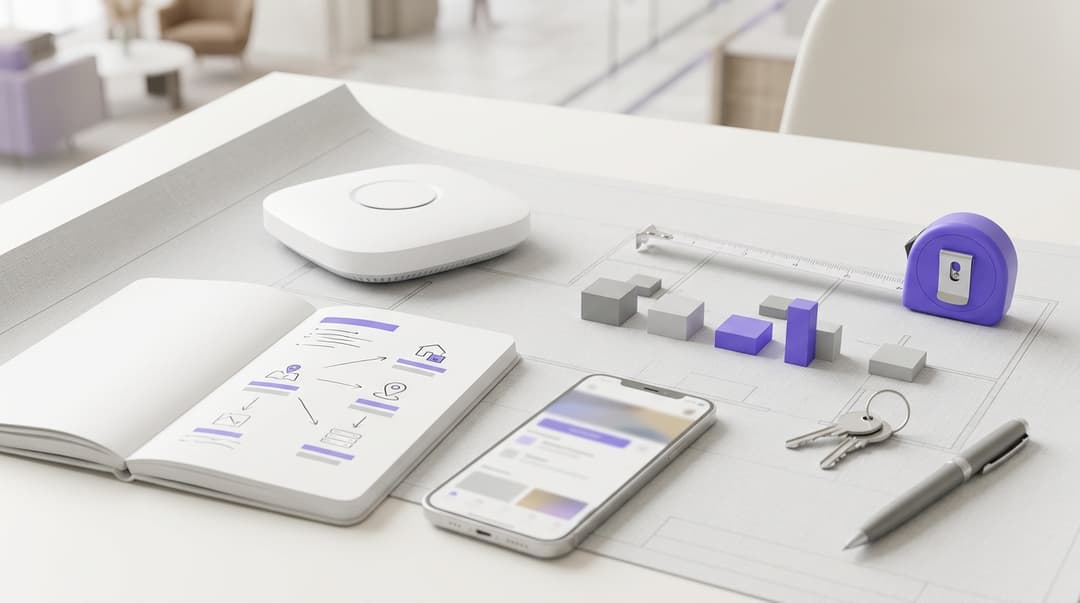
Run a multi-site WiFi rollout in four phases: pilot, template, cutover waves and sign-off. Pilot three to five representative sites, then freeze a site template. Move guest WiFi and its filtering together first, then staff authentication, in planned waves. Every site passes the same sign-off checks and carries a platform tag, so estate reporting stays comparable.
What does a multi-site WiFi rollout change across your estate?
Most estates reach this point by accretion. One guest WiFi provider arrived with an acquisition and another with a refit. Staff networks still run on shared passwords set years ago. Filtering often sits on site firewalls, configured differently in every location.
A multi-site WiFi rollout replaces that patchwork with one platform, one configuration and one set of reports. With Purple, three things move:
- Guest sign-in. The captive portal is the page a visitor sees before getting online. It moves to Guest WiFi, together with the consent it captures.
- Staff authentication. Staff WiFi runs on Identity-Based Networks. Each person or device authenticates against your identity provider, not a shared password.
- Filtering. Shield applies DNS filtering policies per network. DNS filtering blocks categories of site by refusing to resolve their domain names. Guest and staff networks get different policies from the same console.
Purple is a hardware-agnostic cloud overlay. It runs on the access points you already own: Cisco Meraki, HPE Aruba, Ruckus, Juniper Mist, Ubiquiti UniFi, Cambium, Extreme and Fortinet. That makes the rollout a configuration and change programme, not a hardware project. Your constraints are change windows, site contacts and data migration, not cabling or capital budget.
What do you need before the first site moves?
Five inputs decide whether the programme runs to plan. Collect them before you pick a pilot.
A site inventory. For every site, record the access point vendor and management platform, the legacy guest provider and its contract end date. Add the staff network method, current filtering, a named local contact and trading hours. Contract end dates matter more than most teams expect, because they set your wave order.
An identity provider ready for network access. Staff WiFi authenticates against Microsoft Entra ID, Okta or Google Workspace. Make sure the groups that map to network roles already exist and are accurate. If "store managers" is not a group today, create it before the pilot.
A staff device census. IEEE 802.1X is the standard that authenticates each device before it joins the network, usually via RADIUS, the protocol that checks credentials against a directory. Laptops and phones handle 802.1X well. Handheld scanners, label printers and older tablets often do not. List every device class per site and mark which can use 802.1X. The rest need iPSK (identity pre-shared key), where each device or group gets its own key on one network name.
A consent export from your legacy guest platform. GDPR Article 7(1) requires you to demonstrate that each person consented. Export each record with its timestamp, the consent wording shown and the site of capture. Records without that provenance should not feed marketing after migration.
An agreed filtering policy. Decide the blocked categories for guest and staff networks with HR, legal and, for public-sector or family venues, your safeguarding lead. Agree it once, centrally, before any site moves.
If your hardware is in mixed condition, Why your next WiFi upgrade doesn't need new hardware covers why the access point refresh and the platform move can run on separate timelines.
How do you run the rollout, from pilot to final wave?
Which sites make a good pilot?
Choose three to five sites that represent the estate's variety, not its best behaviour. A pilot built only on your newest, best-run sites proves very little about the other 90%. Use this matrix to pick them.
| Pilot site type | Why include it | What it proves | Risk if you skip it |
|---|---|---|---|
| Typical site: most common vendor and layout | Represents the majority of later waves | The template applies with no per-site edits | Template edits surface in wave one, at scale |
| Hardest site: minority vendor or oldest firmware | Exposes integration gaps early | The platform works on every vendor in the estate | A whole vendor group stalls mid-programme |
| Busiest site: highest daily sign-ins | Tests the sign-in flow under peak demand | Consent capture holds at your highest volume | Peak-day failures reach your busiest venue first |
| Most complex staff device mix | Tests 802.1X and iPSK side by side | Every staff device class connects and is filtered | Scanners or tills drop off after cutover |
| Site with a strong local manager | Gives fast, honest feedback on the runbook | Site teams can follow the cutover steps unaided | The runbook only works with engineers on site |
One site can fill two rows. Avoid your flagship venue during its peak season, and avoid any site with building works scheduled.
What should the pilot prove?
Write the pass criteria before the pilot starts, not after. A pilot without a pass mark always "succeeds". Seven criteria cover most estates:
- The site template applies with only the agreed per-site variables changed.
- Guest sign-in works on iOS, Android, Windows and macOS.
- Staff authenticate through your identity provider, and a disabled account loses access.
- Shield blocks the agreed categories on each network, with different policies for guest and staff.
- Guest devices cannot reach staff or payment networks.
- Reports from pilot sites reconcile with the metric dictionary described below.
- The rollback restores the legacy configuration within the agreed change window.
Measure the time each cutover takes, from change start to sign-off. That figure sizes every wave that follows.
What goes into the site template?
The template is the single definition of a correctly configured site. Every location inherits it, and nobody edits it locally. It should contain:
- Network names and security. A guest network with the captive portal, and a staff network using WPA3-Enterprise where devices support it. Add an iPSK network for devices that cannot use 802.1X.
- VLAN mapping. A VLAN is a logical network segment that keeps traffic types apart on shared hardware. Map guest, staff and device traffic to separate VLANs.
- Captive portal design. Branding, the data fields you collect and the exact consent wording, with conscious-choice opt-ins.
- Shield policies. One filtering policy per network type, referenced by name, not rebuilt per site.
- Role mapping. Which identity provider groups reach which network and VLAN.
- Site tags. Region, brand, wave number, platform status and cutover date.
Then write a short list of per-site variables: site name, address, local VLAN IDs if they differ, and access point vendor. Anything not on that list is locked. Purple's support documentation covers the vendor-specific configuration steps. Follow it for values rather than copying settings from site to site.
In what order should guest, staff and filtering move?
Move them in three steps, and keep filtering paired with each network as it moves.
Step one: guest WiFi and guest filtering, in the same change window. The guest network is self-contained and has no dependency on your identity provider. Failures show up within minutes. Filtering moves at the same time, because a guest network should never trade unfiltered. One change window also means one test cycle, not two.
Step two: staff WiFi and staff filtering. Bring up the new staff network alongside the legacy one for an agreed overlap period. Migrate device classes one at a time, starting with laptops and phones, then iPSK devices. Retire the shared password only when every class is confirmed. Staff networks carry tills, scanners and back-office systems, so a failure here stops trading. That is why staff moves second, using a runbook already proven on guest.
Step three: decommission. Remove legacy network names from the access points, export and archive legacy data, then end the legacy contract for that site.
For more on the access controls behind step two, see Securing a business network: A practical guide for 2026.
How big should each wave be?
Size waves by your sign-off capacity, not your ambition. Take the per-site cutover time from the pilot and set it against the engineer hours available in each change window. Keep the first post-pilot wave small enough to absorb surprises, then grow it once two waves pass cleanly.
Group each wave by access point vendor and region, so engineers repeat one set of steps. Order waves by legacy contract end date to cut double-running costs. Set freeze periods around peak trading: the golden quarter for retail, conference season for hotels, and match days for stadiums.
Which checks must each site pass before sign-off?
Every site passes the same checks, recorded with the same evidence. This table is the sign-off sheet.
| Check | Pass standard | Evidence recorded | Owner |
|---|---|---|---|
| Guest sign-in | iOS, Android, Windows and macOS each reach the internet after sign-in | Test log per operating system | Site engineer |
| Consent capture | Test sign-in appears in Purple with timestamp and consent wording | Record reference | Data protection lead |
| Guest filtering | A domain in a blocked category fails to resolve on the guest network | Test result with domain and time | Security lead |
| Staff authentication | Test account connects; disabled test account is refused | Authentication log entries | Identity owner |
| Staff device classes | Every device class from the census connects via 802.1X or iPSK | Device class checklist | Site engineer |
| Staff filtering | Staff policy applies and differs from the guest policy | Test result per network | Security lead |
| Segmentation | Guest device cannot reach staff or payment VLANs | Failed connection test | Network architect |
| Legacy removal | Old network names no longer broadcast | Access point configuration export | Site engineer |
| Reporting | Site appears in estate reports with correct tags and cutover date | Report screenshot | Programme manager |
For sites that take card payments, the segmentation check carries extra weight. PCI DSS treats network segmentation as the control that keeps guest traffic out of scope of the cardholder data environment. Keep that evidence with your PCI DSS records.
Got questions about your specific setup?
Our team works with venue operators, IT managers, and network engineers across 80,000 venues. Book a 20-minute call and we will show you how others like you solved it.
How do you report across the estate while two platforms are live?
For weeks or months, some sites report from Purple and others from legacy platforms. Each platform counts differently, so naive totals mislead. Five practices keep reporting honest.
Write a metric dictionary. Define connection, sign-in, unique visitor, opt-in and repeat visit in words both platforms can satisfy. Where a legacy platform cannot produce a metric, leave it out of estate reports until migration finishes.
Tag every site. Platform status and cutover date sit on every site record. Every report can then split "legacy", "migrated" and "migrated this month" without manual lists.
Compare rates, not raw counts. Opt-in rate and repeat-visit share survive definitional differences better than totals. Compare each site against itself before and after cutover. Use the same weeks last year to remove seasonality.
Use one reporting layer. Migrated sites report through Purple's WiFi Analytics. Export legacy data into the same schema and combine both in your BI tool. Reconcile the pilot sites first, so you know how far the two platforms diverge before trusting estate totals.
Report the migration itself. Show sites by status: not started, guest migrated, staff migrated, signed off, decommissioned. Leadership sees progress, and you catch stalled sites early.
Guest data needs the same care. Engage carries guest records across with their consent history, so a migrated guest keeps their original consent date and wording. Marketing lists do not reset at cutover, and your GDPR evidence stays intact. If those records feed your CRM, 8 smart integration ideas to connect guest WiFi and CRM covers the patterns.
What does this look like on a real estate?
Worked scenario: a 45-hotel group with two legacy guest providers
Situation. A hotel group of 45 properties ran two guest WiFi providers, inherited through acquisitions. Most hotels used HPE Aruba; 12 used Ruckus. Staff shared one password per hotel, and filtering lived on firewalls configured differently at each site.
What was done. The pilot covered four hotels: a typical Aruba property, a Ruckus property, the busiest city-centre hotel and a resort whose spa staff used tablets. The Ruckus pilot showed local VLAN IDs differed, so VLAN IDs joined the per-site variables list. Staff WiFi authenticated against Microsoft Entra ID groups for front office, housekeeping and management. Spa tablets that could not use 802.1X moved to iPSK. Waves were grouped by vendor and ordered by legacy contract end date, avoiding conference season.
Outcome. All 45 hotels ran one template with four per-site variables. Guest data moved from two consent formats to one consent record per guest. Shared staff passwords were retired at every property, so a leaver loses access when their directory account is disabled. Guest and staff filtering ran from one Shield policy set instead of 45 firewall configurations. More on the sector: Hotels.
Worked scenario: a 150-store retail chain on Cisco Meraki
Situation. A retail chain ran 150 stores on Cisco Meraki. Store staff used handheld scanners on a shared key, head office used laptops, and guest WiFi came from a provider whose contract ended in spring.
What was done. The device census showed the scanners could not use 802.1X, so they moved to iPSK with one key per store. Laptops authenticated via 802.1X against Okta. The programme respected the golden quarter freeze. The pilot ran in October, and cutover waves started after the January sales. The first wave covered 10 stores; later waves covered 25 each. Segmentation evidence for every store went to the PCI DSS file.
Outcome. All 150 stores moved in seven waves between the end of the freeze and Easter trading, before the legacy contract ended. Estate reporting compared opt-in rate per store before and after cutover, using site tags rather than spreadsheets. More on the sector: Retail.
What goes wrong, and how do you fix it?
Template drift. A site team edits a setting locally to fix an urgent problem, and the estate quietly diverges. Fix it by locking everything outside the variables list. Feed any genuine local need back into the template for every site.
Staff devices found late. A device class missing from the census fails on cutover day. Fix it by making the census a pilot exit criterion, with iPSK ready for anything that cannot use 802.1X.
Captive portal not appearing. On some devices the sign-in page fails to load, usually because the access point's pre-authentication allow list is incomplete. Check the vendor-specific steps in Purple's support documentation rather than adding domains by trial and error.
Consent records without provenance. Legacy exports sometimes drop the consent wording or timestamp. Import those records for history only, and exclude them from marketing until they consent again.
Reports that appear to fall off a cliff. Opt-in or visitor counts change sharply at cutover because definitions differ. Check the metric dictionary before raising an incident.
No one on site. A cutover stalls because the local contact is on leave. Confirm the named contact 48 hours before every change window.
What does the rollout cost, and what do you get back?
What it costs. Licensing follows the Purple plan you choose (Connect, Capture or Engage), with SecurePass, Verify and Shield as add-ons. Programme cost comes mainly from engineer time per site and the overlap period, when you pay both legacy and Purple at a migrated site. Order waves by contract end date to shorten that overlap. There is no access point replacement cost, because Purple runs on the hardware you own.
What you get back. One template means the 100th site costs the same effort as the 10th. You get one consent record per guest instead of several formats. Staff access follows your directory, so joiners, movers and leavers are handled in the identity provider. Filtering runs from one policy set, not a firewall configuration per site. Your network vendor estate stays mixed if that suits you.
Purple holds ISO 27001, Cyber Essentials and B Corp certification and operates in line with GDPR and CCPA. Purple runs at 80,000+ live venues in over 90 countries.
Frequently asked questions
Do we need to replace our access points to move to Purple?
No, Purple runs on the access points you already own. It is a hardware-agnostic cloud overlay that works with Cisco Meraki, HPE Aruba, Ruckus, Juniper Mist, Ubiquiti UniFi, Cambium, Extreme and Fortinet. You can move guest, staff and filtering to Purple without a hardware refresh. You can also run a mixed-vendor estate under one site template, with the vendor recorded as a per-site variable.
Can we run Purple alongside our current guest WiFi provider during the rollout?
Yes, and most multi-site rollouts do exactly that. Sites move to Purple in waves while unmigrated sites stay on the legacy platform. Tag every site with its platform status and cutover date, and report on rates rather than raw counts. Your estate figures then stay comparable until the final wave is signed off and the legacy contract ends.
What happens to the guest data and consent we already hold?
Engage carries existing guest records across with their consent history intact. A migrated guest keeps their original consent date and wording, so marketing lists do not reset at cutover. GDPR Article 7(1) requires you to demonstrate consent. Export legacy records with timestamp, wording and source, and keep any records lacking that provenance out of marketing.
Which identity providers does Purple support for staff WiFi?
Purple Staff WiFi authenticates against Microsoft Entra ID, Okta and Google Workspace. Staff connect through IEEE 802.1X using their directory identity, so access follows your existing groups and roles. When someone leaves and their account is disabled, their network access ends with it. Devices that cannot use 802.1X, such as handheld scanners, connect through iPSK instead.
How is Purple licensed across an estate of many sites?
Purple is licensed by plan: Connect, Capture or Engage, with SecurePass, Verify and Shield available as add-ons. You choose the plan that matches what each network needs, and your quote reflects your site count and add-ons. Factor in the overlap period, when a migrated site still has a legacy contract running. Ordering waves by contract end date reduces that double-running cost.
Is Purple compliant with GDPR and ISO 27001?
Yes. Purple holds ISO 27001 certification and Cyber Essentials, and operates in line with GDPR and CCPA. Guest sign-in uses conscious-choice opt-ins, and each consent is stored with its timestamp and wording, so you can demonstrate it under GDPR. Purple is also a certified B Corp. Keep your own segmentation evidence for PCI DSS, because that standard applies to your card payment environment.
How long does a multi-site WiFi rollout take?
Your change windows and sign-off capacity set the timeline, not the platform. Measure how long one cutover takes during the pilot, then divide your site count by what engineers can sign off per window. Build in freeze periods for peak trading. Most of the risk sits in the pilot and first wave, so schedule time to fix the template before scaling.
Should guest or staff WiFi move first?
Move guest WiFi first, with its filtering policy in the same change window. The guest network is self-contained, has no identity provider dependency, and shows failures within minutes. Staff WiFi moves second, alongside the legacy staff network for an agreed overlap. Staff networks carry tills and scanners, so a failure stops trading. Use a runbook already proven on guest before you touch them.
Key Definitions
Captive portal
A web page presented to an unauthenticated device before internet access is granted, enforced by the access point redirecting HTTP traffic and holding the client in a pre-authentication state with a limited allow list of domains.
Guest sign-in and consent capture move to Purple Guest WiFi through the captive portal. An incomplete pre-authentication allow list is the usual reason the sign-in page fails to load after cutover.
IEEE 802.1X
The IEEE standard for port-based network access control. It defines the supplicant, authenticator and authentication server roles and carries Extensible Authentication Protocol (EAP) messages over the LAN using EAPOL before a device is admitted to the network.
Staff WiFi on Identity-Based Networks uses 802.1X so each person or device authenticates against Microsoft Entra ID, Okta or Google Workspace. The device census decides which staff devices can use it.
RADIUS
Remote Authentication Dial-In User Service, specified in IETF RFC 2865. It is the protocol an access point uses to send credentials to an authentication server and receive an accept or reject decision, plus attributes such as VLAN assignment.
RADIUS sits behind 802.1X, checking staff credentials against your directory. It is why a disabled account loses network access once staff authentication has moved.
iPSK (identity pre-shared key)
A method that issues a separate pre-shared key to each device or device group on a single network name, using WPA2 or WPA3 personal-mode key handling defined under IEEE 802.11, with the key-to-identity mapping held centrally.
Handheld scanners, label printers, older tablets and spa tablets that cannot use 802.1X connect through iPSK, so the shared staff password can still be retired.
WPA3-Enterprise
The enterprise mode of the WPA3 security certification, which uses IEEE 802.1X and EAP for per-user authentication and requires Protected Management Frames (IEEE 802.11w) on the connection.
The site template specifies WPA3-Enterprise for the staff network where devices support it, with an iPSK network for devices that do not.
VLAN
A virtual LAN as defined by IEEE 802.1Q, which tags Ethernet frames with a VLAN identifier so separate logical network segments can share the same physical switches and access points.
The template maps guest, staff and device traffic to separate VLANs. Local VLAN IDs can differ by site, which is why they may need to be a per-site variable.
DNS filtering
Policy enforcement at the Domain Name System layer, the name resolution protocol specified in IETF RFC 1034 and RFC 1035, where the resolver refuses to return addresses for domains in blocked categories.
Shield applies DNS filtering per network, so guest and staff get different policies from one console instead of a separate firewall configuration at each site.
GDPR Article 7(1)
The provision of Regulation (EU) 2016/679 stating that where processing is based on consent, the controller must be able to demonstrate that the data subject consented to the processing of their personal data.
It drives the consent export: each legacy record needs its timestamp, the consent wording shown and the site of capture, or it should stay out of marketing after migration.
PCI DSS network segmentation
Under the Payment Card Industry Data Security Standard, segmentation isolates the cardholder data environment from other networks so that out-of-scope systems, such as guest WiFi, are not part of the assessed environment.
For sites that take card payments, the sign-off segmentation check proves guest devices cannot reach staff or payment VLANs. Keep that evidence with your PCI DSS records.
Hardware-agnostic cloud overlay
A cloud-managed authentication, sign-in and policy layer that configures access points through their existing management platforms rather than replacing them, so the same configuration applies across multiple access point vendors.
Purple runs on Cisco Meraki, HPE Aruba, Ruckus, Juniper Mist, Ubiquiti UniFi, Cambium, Extreme and Fortinet, making the rollout a configuration and change programme rather than a hardware project.
Site template
The single definition of a correctly configured site: network names and security, VLAN mapping, captive portal design and consent wording, Shield policies, role mapping and site tags, with a short list of permitted per-site variables.
Every location inherits the template and nobody edits it locally. Locking everything outside the variables list prevents template drift across the estate.
Metric dictionary
A written definition of connection, sign-in, unique visitor, opt-in and repeat visit that both the legacy platform and Purple can satisfy, used as the basis for estate reporting.
While two platforms are live, the dictionary stops sharp changes at cutover being mistaken for incidents and keeps estate reports comparable.
Worked Examples
A 45-hotel group runs two inherited guest WiFi providers, mostly on HPE Aruba with 12 properties on Ruckus. Staff share one password per hotel, and filtering sits on firewalls configured differently at each site.
The pilot covered four hotels: a typical Aruba property, a Ruckus property, the busiest city-centre hotel and a resort whose spa staff used tablets. The Ruckus pilot showed local VLAN IDs differed, so VLAN IDs joined the per-site variables list. Staff WiFi authenticated against Microsoft Entra ID groups for front office, housekeeping and management, and spa tablets that could not use 802.1X moved to iPSK. Waves were grouped by vendor, ordered by legacy contract end date and kept clear of conference season. All 45 hotels ended on one template with four per-site variables, one consent record per guest, no shared staff passwords and one Shield policy set in place of 45 firewall configurations.
A 150-store retail chain on Cisco Meraki has handheld scanners on a shared key, head office laptops, and a guest WiFi contract that ends in spring.
The device census showed the scanners could not use 802.1X, so they moved to iPSK with one key per store. Laptops authenticated via 802.1X against Okta. The programme respected the golden quarter freeze: the pilot ran in October and cutover waves started after the January sales. The first wave covered 10 stores to absorb surprises, and later waves covered 25 each. Segmentation evidence for every store went to the PCI DSS file. All 150 stores moved in seven waves before Easter trading and before the legacy contract ended. Estate reporting compared opt-in rate per store before and after cutover using site tags, not spreadsheets.
Frequently asked questions
Do we need to replace our access points to move to Purple?
No, Purple runs on the access points you already own. It is a hardware-agnostic cloud overlay that works with Cisco Meraki, HPE Aruba, Ruckus, Juniper Mist, Ubiquiti UniFi, Cambium, Extreme and Fortinet. You can move guest, staff and filtering to Purple without a hardware refresh. You can also run a mixed-vendor estate under one site template, with the vendor recorded as a per-site variable.
Can we run Purple alongside our current guest WiFi provider during the rollout?
Yes, and most multi-site rollouts do exactly that. Sites move to Purple in waves while unmigrated sites stay on the legacy platform. Tag every site with its platform status and cutover date, and report on rates rather than raw counts. Your estate figures then stay comparable until the final wave is signed off and the legacy contract ends.
What happens to the guest data and consent we already hold?
Engage carries existing guest records across with their consent history intact. A migrated guest keeps their original consent date and wording, so marketing lists do not reset at cutover. GDPR Article 7(1) requires you to demonstrate consent. Export legacy records with timestamp, wording and source, and keep any records lacking that provenance out of marketing.
Which identity providers does Purple support for staff WiFi?
Purple Staff WiFi authenticates against Microsoft Entra ID, Okta and Google Workspace. Staff connect through IEEE 802.1X using their directory identity, so access follows your existing groups and roles. When someone leaves and their account is disabled, their network access ends with it. Devices that cannot use 802.1X, such as handheld scanners, connect through iPSK instead.
How is Purple licensed across an estate of many sites?
Purple is licensed by plan: Connect, Capture or Engage, with SecurePass, Verify and Shield available as add-ons. You choose the plan that matches what each network needs, and your quote reflects your site count and add-ons. Factor in the overlap period, when a migrated site still has a legacy contract running. Ordering waves by contract end date reduces that double-running cost.
Is Purple compliant with GDPR and ISO 27001?
Yes. Purple holds ISO 27001 certification and Cyber Essentials, and operates in line with GDPR and CCPA. Guest sign-in uses conscious-choice opt-ins, and each consent is stored with its timestamp and wording, so you can demonstrate it under GDPR. Purple is also a certified B Corp. Keep your own segmentation evidence for PCI DSS, because that standard applies to your card payment environment.
How long does a multi-site WiFi rollout take?
Your change windows and sign-off capacity set the timeline, not the platform. Measure how long one cutover takes during the pilot, then divide your site count by what engineers can sign off per window. Build in freeze periods for peak trading. Most of the risk sits in the pilot and first wave, so schedule time to fix the template before scaling.
Should guest or staff WiFi move first?
Move guest WiFi first, with its filtering policy in the same change window. The guest network is self-contained, has no identity provider dependency, and shows failures within minutes. Staff WiFi moves second, alongside the legacy staff network for an agreed overlap. Staff networks carry tills and scanners, so a failure stops trading. Use a runbook already proven on guest before you touch them.
Continue reading in this series
Leisure centre and gym WiFi providers: members, swim-school parents and staff on one platform
Use this guide to shortlist leisure centre WiFi providers and specify three networks on your existing access points: filtered guest WiFi for members and swim-school parents, 802.1X Staff WiFi tied to work accounts, and an isolated device network for turnstiles and tills. You can then test each provider against 10 questions on filtering, PCI DSS scope and consented marketing.
Guest WiFi and DNS filtering platforms for MSPs: a multi-site checklist for multi-tenant management and white label
You will be able to shortlist a guest WiFi platform for your MSP practice and run multi-tenant management across every client from one console. You can template white-label sign-in pages, layer DNS filtering by client, site and network, and close bypass routes. You will also be able to pick a billing model that matches the contracts you sell.
Guest WiFi total cost of ownership: licensing, RADIUS infrastructure and support costs compared
You will be able to cost guest WiFi on nine lines, not just the licence, and compare an in-house build, a controller splash page and Purple's cloud platform. You can also test how per-AP, per-venue and session-based pricing scale from 10 to 1,000 venues. Finally, you can calculate how many extra visits first-party data must generate to cover the subscription.
Got questions about your specific setup?
Our team works with venue operators, IT managers, and network engineers across 80,000 venues. Book a 20-minute call and we will show you how others like you solved it.