

गेस्ट WiFi डेटा कलेक्शन के लिए GDPR अनुपालन
This guide provides IT managers, network architects, and Data Protection Officers with a comprehensive, actionable framework for achieving GDPR compliance across guest WiFi deployments in hospitality, retail, and public-sector venues. It covers the full spectrum of data collected by guest WiFi networks, the legal requirements for obtaining valid consent, best-practice data retention policies, and how to implement a defensible compliance architecture. Venue operators will learn how to transform their guest WiFi from a potential regulatory liability into a strategic asset that builds customer trust and drives measurable business intelligence.
🎧 इस गाइड को सुनें
ट्रांसक्रिप्ट देखें
कार्यकारी सारांश
यह गाइड IT प्रबंधकों, नेटवर्क आर्किटेक्ट्स और वेन्यू ऑपरेटरों को यह सुनिश्चित करने के लिए एक व्यावहारिक, कार्रवाई योग्य ढांचा प्रदान करती है कि उनकी गेस्ट WiFi सेवाएं जनरल डेटा प्रोटेक्शन रेगुलेशन (GDPR) का पूरी तरह से अनुपालन करती हैं। हम गेस्ट WiFi के माध्यम से एकत्र किए गए विशिष्ट प्रकार के डेटा, सहमति और डेटा हैंडलिंग के लिए कानूनी आवश्यकताओं, और एक अनुपालन समाधान लागू करने के लिए वेंडर-न्यूट्रल सर्वोत्तम प्रथाओं का पता लगाएंगे। चीफ टेक्नोलॉजी ऑफिसर और डेटा प्रोटेक्शन ऑफिसर के लिए, यह दस्तावेज़ रेखांकित करता है कि गैर-अनुपालन से जुड़े कानूनी और वित्तीय जोखिमों को कैसे कम किया जाए, जिसमें वार्षिक वैश्विक टर्नओवर के 4% तक का जुर्माना शामिल हो सकता है। ऑपरेशंस डायरेक्टर के लिए, यह प्रदर्शित करता है कि एक अनुपालन गेस्ट WiFi डिप्लॉयमेंट कैसे ग्राहकों का विश्वास बढ़ा सकता है और मूल्यवान, नैतिक रूप से प्राप्त बिजनेस इंटेलिजेंस प्रदान कर सकता है। हम Captive Portal के डिज़ाइन से लेकर डेटा रिटेंशन नीतियों के स्वचालन तक, एक अनुपालन प्रणाली के तकनीकी आर्किटेक्चर को कवर करेंगे। इस गाइड में हॉस्पिटैलिटी और रिटेल से वास्तविक दुनिया के केस स्टडीज़ भी शामिल हैं, जो Purple जैसे एक अच्छी तरह से डिज़ाइन किए गए, अनुपालन गेस्ट WiFi प्लेटफॉर्म के ठोस ROI को प्रदर्शित करते हैं। इस गाइड में दिए गए सिद्धांतों का पालन करके, संगठन उपयोगकर्ता की गोपनीयता का सम्मान करते हुए अपने गेस्ट WiFi को संभावित अनुपालन देयता से एक रणनीतिक संपत्ति में बदल सकते हैं जो व्यवसाय के विकास को गति प्रदान करती है。

तकनीकी डीप-डाइव
गेस्ट WiFi के लिए GDPR अनुपालन को समझना प्रोसेस किए जा रहे डेटा के स्पष्ट मूल्यांकन से शुरू होता है। नियमन के तहत, 'व्यक्तिगत डेटा' को व्यापक रूप से किसी पहचाने गए या पहचाने जा सकने वाले प्राकृतिक व्यक्ति से संबंधित किसी भी जानकारी के रूप में परिभाषित किया गया है। गेस्ट WiFi नेटवर्क के संदर्भ में, इसमें कई संगठनों के अनुमान से कहीं अधिक डेटा पॉइंट शामिल होते हैं। इस डेटा को सही ढंग से वर्गीकृत करने में विफलता अनुपालन रणनीति में एक बुनियादी त्रुटि है।
गेस्ट WiFi में डेटा श्रेणियां
गेस्ट WiFi नेटवर्क के माध्यम से एकत्र किए गए डेटा को चार प्राथमिक श्रेणियों में विभाजित किया जा सकता है। प्रत्येक का GDPR अनुपालन के लिए अलग-अलग प्रभाव है, विशेष रूप से प्रोसेसिंग के कानूनी आधार और आवश्यक रिटेंशन अवधि के संबंध में।
| डेटा श्रेणी | उदाहरण | प्राथमिक कानूनी आधार | प्रमुख अनुपालन विचार |
|---|---|---|---|
| पंजीकरण डेटा | नाम, ईमेल पता, फोन नंबर, सोशल मीडिया प्रोफाइल डेटा | सहमति | स्वतंत्र रूप से दी गई, विशिष्ट, सूचित और स्पष्ट होनी चाहिए। एकत्र किया गया डेटा न्यूनतम होना चाहिए। |
| डिवाइस और सेशन डेटा | MAC पता, IP पता, डिवाइस का प्रकार, ब्राउज़र, कनेक्शन/डिस्कनेक्शन टाइमस्टैम्प, डेटा उपयोग | वैध हित / सहमति | पारदर्शिता महत्वपूर्ण है। उपयोगकर्ताओं को इस संग्रह के बारे में सूचित किया जाना चाहिए। जहां संभव हो वहां गुमनामी (Anonymization) का उपयोग किया जाना चाहिए। |
| लोकेशन डेटा | रीयल-टाइम डिवाइस लोकेशन, फुटफॉल पैटर्न, ड्वेल टाइम, हीटमैप | स्पष्ट सहमति | उच्च जोखिम वाली प्रोसेसिंग। एक स्पष्ट, विशिष्ट ऑप्ट-इन की आवश्यकता है। उद्देश्य स्पष्ट रूप से व्यक्त किया जाना चाहिए (उदा., 'स्टोर लेआउट में सुधार करने के लिए')। |
| उपयोग और ब्राउज़िंग डेटा | विज़िट की गई वेबसाइटें, उपयोग किए गए एप्लिकेशन (कम सामान्य) | स्पष्ट सहमति | अत्यधिक उच्च जोखिम वाला और शायद ही कभी उचित ठहराया जा सकने वाला। जब तक कोई महत्वपूर्ण, स्पष्ट और सहमति प्राप्त उद्देश्य न हो, इससे बचा जाना चाहिए। |
कानूनी आधार: सहमति बनाम वैध हित
जबकि नेटवर्क सुरक्षा और प्रदर्शन निगरानी (उदा., GDPR के रीसायटल 49 के अनुसार) के लिए आवश्यक बुनियादी सेशन डेटा को प्रोसेस करने के लिए वैध हित (Legitimate Interest) का तर्क दिया जा सकता है, ICO और अन्य EU डेटा संरक्षण प्राधिकरणों ने एक उच्च मानक निर्धारित किया है। मार्केटिंग, एनालिटिक्स या उपयोगकर्ता प्रोफाइलिंग के लिए उपयोग किए जाने वाले किसी भी डेटा के लिए, सहमति (Consent) ही एकमात्र उपयुक्त कानूनी आधार है।
ICO के अनुसार, "आपको यह सुनिश्चित करना होगा कि आप यह प्रदर्शित कर सकें कि सहमति स्वतंत्र रूप से दी गई थी, विशिष्ट और सूचित थी, और यह व्यक्ति की इच्छाओं का एक स्पष्ट संकेत था।"
इसके लिए शर्तों की निष्क्रिय स्वीकृति से एक सक्रिय, विस्तृत सहमति तंत्र में बदलाव की आवश्यकता है। इसलिए आपके Captive Portal का आर्किटेक्चर केवल एक तकनीकी विचार नहीं है, बल्कि एक कानूनी विचार भी है।
अनुपालन के लिए आर्किटेक्चरल घटक
एक GDPR-अनुपालक गेस्ट WiFi आर्किटेक्चर 'प्राइवेसी बाय डिज़ाइन एंड बाय डिफ़ॉल्ट' के सिद्धांत पर बनाया गया है। इसका मतलब है कि डेटा सुरक्षा कोई ऐड-ऑन नहीं है, बल्कि सिस्टम के डिज़ाइन का एक मुख्य घटक है।
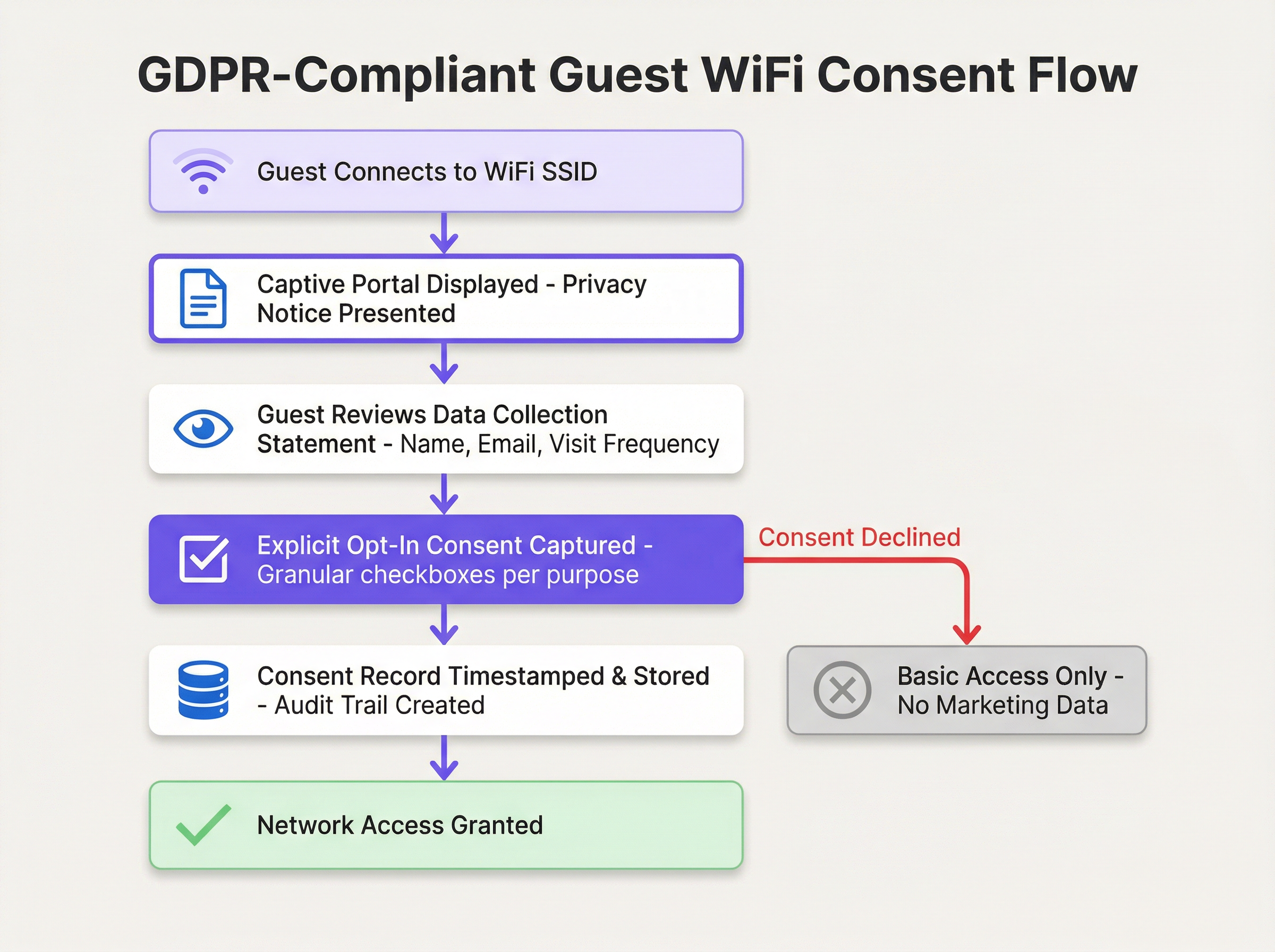
- सुरक्षित नेटवर्क फाउंडेशन (WPA3/802.1X): कोई भी डेटा एकत्र करने से पहले, नेटवर्क का सुरक्षित होना आवश्यक है। WPA3 का उपयोग वर्तमान उद्योग मानक है, जो ईव्सड्रॉपिंग के खिलाफ मजबूत सुरक्षा प्रदान करता है। एंटरप्राइज़ वातावरण के लिए, IEEE 802.1X पोर्ट-आधारित नेटवर्क एक्सेस कंट्रोल प्रदान करता है, यह सुनिश्चित करते हुए कि केवल प्रमाणित और अधिकृत डिवाइस ही कनेक्ट हो सकें।
- अनुपालक Captive Portal: यह सबसे महत्वपूर्ण उपयोगकर्ता-सामना करने वाला घटक है। उपयोगकर्ता द्वारा कोई भी जानकारी दर्ज करने से पहले इसे 'जस्ट-इन-टाइम' गोपनीयता नोटिस प्रस्तुत करना चाहिए, एक पूर्ण और सुलभ गोपनीयता नीति से लिंक करना चाहिए, प्रत्येक प्रोसेसिंग उद्देश्य के लिए विस्तृत अनटिक किए गए चेकबॉक्स का उपयोग करना चाहिए, और मैन-इन-द-मिडिल हमलों को रोकने के लिए HTTPS पर चलना चाहिए।
- कंसेंट मैनेजमेंट प्लेटफॉर्म (CMP): पर्दे के पीछे, एक अपरिवर्तनीय ऑडिट ट्रेल के साथ प्रत्येक सहमति कार्रवाई को लॉग करने, वापसी सहित सहमति जीवनचक्र का प्रबंधन करने, और किसी विशिष्ट उपयोगकर्ता के डेटा को आसानी से खोजने, निर्यात करने या हटाने की सुविधा के लिए DSAR वर्कफ़्लो के साथ एकीकृत करने के लिए एक मजबूत CMP की आवश्यकता होती है।
कार्यान्वयन गाइड
एक GDPR-अनुपालक गेस्ट WiFi समाधान को तैनात करने के लिए नीति परिभाषा से तकनीकी कॉन्फ़िगरेशन की ओर बढ़ते हुए एक संरचित दृष्टिकोण की आवश्यकता होती है।
चरण 1: नीति और आवश्यकता परिभाषा (सप्ताह 1-2)
किसी भी हार्डवेयर या सॉफ़्टवेयर को तैनात करने से पहले, आपके संगठन को अपनी नीतियों को परिभाषित करना होगा। गेस्ट WiFi के उद्देश्य पर सहमत होने के लिए IT, कानूनी, मार्केटिंग और ऑपरेशंस के प्रतिनिधियों के साथ एक हितधारक कार्यशाला आयोजित करें। अनुरोध किए गए प्रत्येक डेटा पॉइंट के लिए विशिष्ट व्यावसायिक औचित्य का दस्तावेजीकरण करते हुए, एक डेटा न्यूनीकरण मूल्यांकन (Data Minimisation Assessment) आयोजित करें। डेटा की प्रत्येक श्रेणी के लिए रिटेंशन अवधि को परिभाषित और दस्तावेज़ीकृत करें, और प्रत्येक प्रोसेसिंग गतिविधि के लिए कानूनी आधार को औपचारिक रूप से चुनें और दस्तावेज़ीकृत करें।
चरण 2: तकनीकी समाधान डिज़ाइन और वेंडर चयन (सप्ताह 3-4)
एक स्पष्ट नीति के साथ, WPA3 और VLAN सेगमेंटेशन क्षमता के लिए अपने वर्तमान नेटवर्क बुनियादी ढांचे का आकलन करें। अनुकूलन योग्य पोर्टल डिज़ाइन, मजबूत और खोजने योग्य सहमति ऑडिट लॉग, DSAR ऑटोमेशन टूल, स्वचालित डेटा रिटेंशन नियम और CRM एकीकरण क्षमताओं सहित मानदंडों के विरुद्ध Captive Portal और CMP वेंडरों का मूल्यांकन करें।
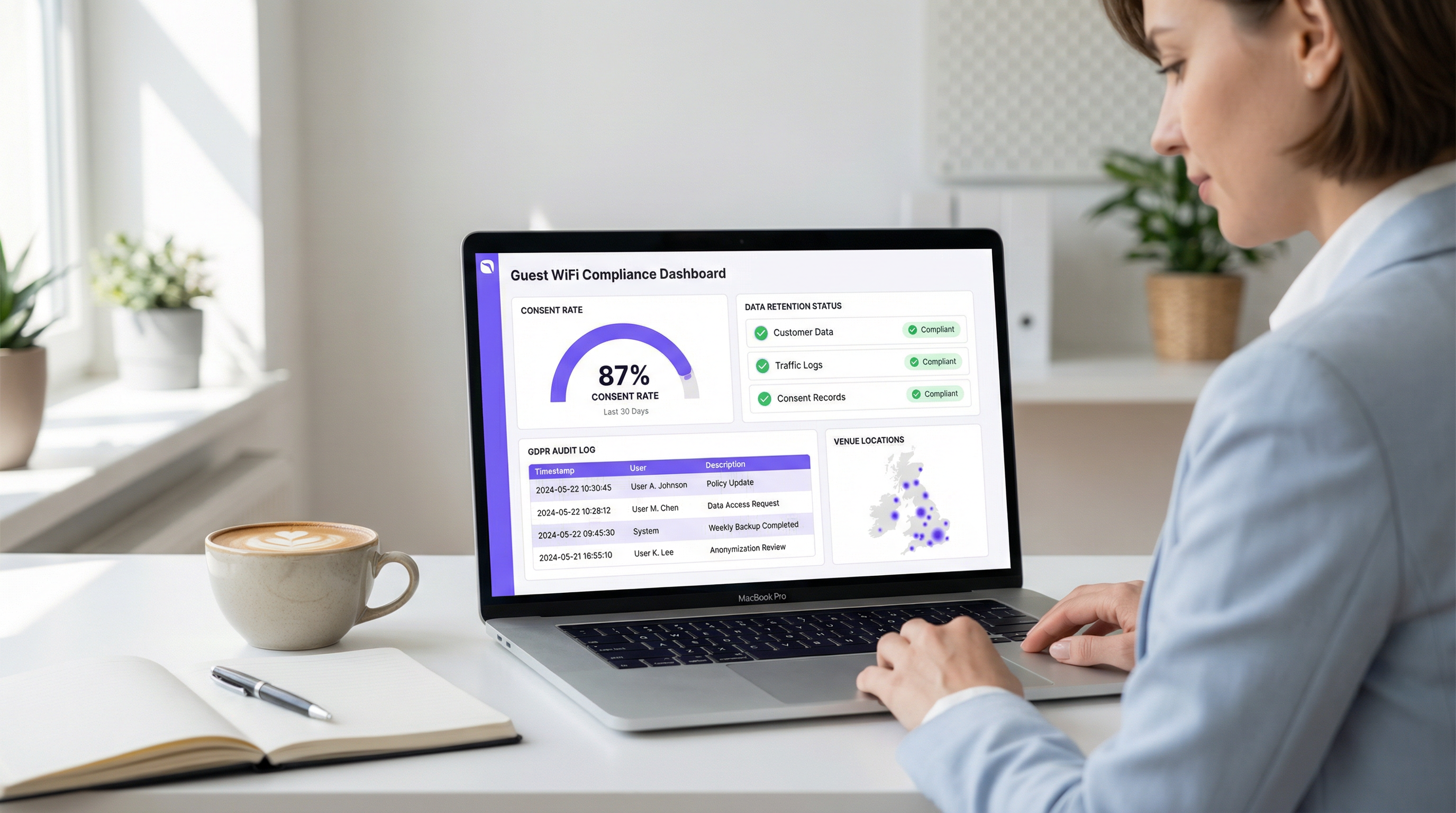
चरण 3: डिप्लॉयमेंट और परीक्षण (सप्ताह 5-6)
समाधान को पहले एक स्टेजिंग वातावरण में तैनात करें। अंतिम रूप दिए गए टेक्स्ट और अनटिक किए गए सहमति बॉक्स के साथ Captive Portal को कॉन्फ़िगर करें, डेटा रिटेंशन नियम सेट करें, और भूमिका-आधारित एक्सेस कंट्रोल लागू करें। सहमति स्वीकृति, सहमति अस्वीकृति, DSAR सबमिशन और स्वचालित डेटा विलोपन सहित संपूर्ण उपयोगकर्ता यात्रा का एंड-टू-एंड परीक्षण करें।
चरण 4: प्रोडक्शन रोलआउट और स्टाफ प्रशिक्षण (सप्ताह 7-8)
वेन्यूज़ में चरणबद्ध तरीके से समाधान को रोल आउट करें। बुनियादी उपयोगकर्ता प्रश्नों का उत्तर देने और गोपनीयता-विशिष्ट प्रश्नों को डेटा प्रोटेक्शन ऑफिसर तक पहुंचाने के लिए IT हेल्पडेस्क और फ्रंट-ऑफ-हाउस कर्मचारियों को प्रशिक्षित करें। सुनिश्चित करें कि सभी कॉन्फ़िगरेशन और प्रक्रियाएं पूरी तरह से प्रलेखित हैं。
सर्वोत्तम प्रथाएं
तकनीकी कार्यान्वयन से परे, दीर्घकालिक GDPR अनुपालन बनाए रखने और अपने उपयोगकर्ताओं के साथ विश्वास बनाने के लिए उद्योग-मानक सर्वोत्तम प्रथाओं का पालन करना महत्वपूर्ण है।
न्यूनतम विशेषाधिकार का सिद्धांत: भूमिका-आधारित एक्सेस कंट्रोल (RBAC) का उपयोग करके सख्त 'जानने की आवश्यकता' (need-to-know) के आधार पर व्यक्तिगत डेटा तक पहुंच प्रदान करें। मार्केटिंग टीमों के पास नेटवर्क सुरक्षा लॉग तक पहुंच नहीं होनी चाहिए, और इसके विपरीत।
नियमित ऑडिट और पेनेट्रेशन टेस्टिंग: सहमति लॉग समीक्षा, रिटेंशन नीति सत्यापन और DSAR प्रक्रिया परीक्षण को कवर करने वाले वार्षिक ऑडिट शेड्यूल करें। Captive Portal और WiFi बुनियादी ढांचे के पेनेट्रेशन टेस्टिंग के लिए किसी तीसरे पक्ष को नियुक्त करें।
उपयोगकर्ता-सामना करने वाली पारदर्शिता: Captive Portal पर एक स्तरित गोपनीयता नोटिस लागू करें, उपयोगकर्ताओं को अपना डेटा प्रबंधित करने के लिए एक स्वयं-सेवा प्राथमिकता केंद्र प्रदान करें, और अपने वेन्यू में स्पष्ट ऑन-साइट साइनेज के साथ डिजिटल प्रयासों को पूरक करें।
डेटा गुमनामीकरण और छद्मीकरण (Anonymization and Pseudonymization): डेटा जीवनचक्र में जितनी जल्दी हो सके गुमनामीकरण या छद्मीकरण तकनीकों का उपयोग करें। एनालिटिक्स के लिए, रॉ आइडेंटिफ़ायर के बजाय MAC पते का वन-वे हैश स्टोर करें, और अनुपालन दायरे को कम करने के लिए अपने एनालिटिक्स डेटाबेस में छद्म पहचानकर्ताओं का उपयोग करें।
समस्या निवारण और जोखिम न्यूनीकरण
एक अच्छी तरह से डिज़ाइन किए गए सिस्टम के साथ भी, परिचालन संबंधी समस्याएं और अनुपालन जोखिम उत्पन्न हो सकते हैं। इन परिदृश्यों की सक्रिय रूप से पहचान करना और उनके लिए योजना बनाना एक परिपक्व डेटा गवर्नेंस प्रोग्राम की पहचान है।
| विफलता मोड | प्रभाव | न्यूनीकरण और समाधान |
|---|---|---|
| सहमति रिकॉर्ड बेमेल | उच्च। सहमति साबित करने में असमर्थता से विनियामक जुर्माना हो सकता है। | एक अपरिवर्तनीय, टाइमस्टैम्प्ड ऑडिट लॉग के साथ एक CMP तैनात करें। विवाद होने पर उपयोगकर्ता को तुरंत मार्केटिंग सूचियों से हटा दें। |
| डेटा रिटेंशन विफलता | मध्यम से उच्च। नीति का तकनीकी उल्लंघन, यदि विलोपन DSAR प्राप्त होता है तो महत्वपूर्ण है। | सभी डेटा पर्ज जॉब्स के लिए मजबूत निगरानी और अलर्टिंग लागू करें। मैन्युअल रूप से पर्ज ट्रिगर करें और पोस्ट-मॉर्टम करें। |
| Captive Portal बाईपास | निम्न से मध्यम। अनधिकृत नेटवर्क एक्सेस जोखिम। | पोर्टल पर DHCP और DNS को छोड़कर अप्रमाणित उपकरणों से सभी ट्रैफ़िक को अवरुद्ध करने वाले सख्त फ़ायरवॉल नियम लागू करें। |
| DSAR प्रक्रिया ब्रेकडाउन | उच्च। एक महीने के भीतर जवाब देने में विफलता GDPR अनुच्छेद 15 का उल्लंघन करती है। | एक समर्पित मॉनिटर किया गया गोपनीयता ईमेल उपनाम (alias) बनाएं। DSAR पहचान और एस्केलेशन पर अनिवार्य वार्षिक कर्मचारी प्रशिक्षण आयोजित करें। |
सक्रिय जोखिम न्यूनीकरण के लिए, गेस्ट WiFi सिस्टम को तैनात करने या महत्वपूर्ण रूप से संशोधित करने से पहले एक डेटा प्रोटेक्शन इम्पैक्ट असेसमेंट (DPIA) आयोजित करें। सुरक्षा प्रमाणपत्रों (ISO 27001, SOC 2) की समीक्षा करते हुए और यह सुनिश्चित करते हुए कि एक मजबूत डेटा प्रोसेसिंग परिशिष्ट (Data Processing Addendum) मौजूद है, पूरी तरह से वेंडर ड्यू डिलिजेंस करें। एक प्रलेखित घटना प्रतिक्रिया योजना (incident response plan) बनाए रखें जो 72-घंटे की ब्रीच अधिसूचना आवश्यकता को कवर करती हो।
ROI और व्यावसायिक प्रभाव
एक GDPR-अनुपालक गेस्ट WiFi समाधान को लागत केंद्र के रूप में नहीं देखा जाना चाहिए। जब इसे सही ढंग से लागू किया जाता है, तो यह जोखिम न्यूनीकरण, ग्राहकों के बढ़े हुए विश्वास और नैतिक बिजनेस इंटेलिजेंस के माध्यम से मापने योग्य ROI प्रदान करने वाला एक रणनीतिक इनेबलर है।
GDPR जुर्माना €20 मिलियन या वार्षिक वैश्विक टर्नओवर के 4% तक पहुंच सकता है। सालाना €50,000 की लागत वाला एक अनुपालक प्लेटफॉर्म इस संभावित देयता का एक अंश मात्र है। जोखिम न्यूनीकरण से परे, उपयोगकर्ता की सहमति से एकत्र किया गया गुमनाम और एकत्रित डेटा फुटफॉल, ड्वेल टाइम, विज़िट की आवृत्ति और जनसांख्यिकीय पैटर्न में शक्तिशाली अंतर्दृष्टि प्रदान करता है। €50M वार्षिक टर्नओवर वाली एक रिटेल चेन जो €2M के जुर्माने से बचती है और अपने सहमति प्राप्त मार्केटिंग डेटाबेस को 10,000 उपयोगकर्ताओं (औसतन €10 के लीड मूल्य पर) तक बढ़ाती है, एक सम्मोहक, बहु-आयामी ROI प्राप्त करती है।
जोखिम न्यूनीकरण, ग्राहकों के विश्वास और नैतिक डेटा-संचालित निर्णय लेने के इर्द-गिर्द चर्चा को तैयार करके, IT लीडर यह प्रदर्शित कर सकते हैं कि एक GDPR-अनुपालक गेस्ट WiFi समाधान केवल एक कानूनी आवश्यकता नहीं है, बल्कि व्यवसाय के विकास के लिए एक शक्तिशाली इंजन है।
मुख्य शब्द और परिभाषाएं
GDPR (General Data Protection Regulation)
The EU's primary data protection law, which came into force on 25 May 2018 and was retained in UK law post-Brexit as the UK GDPR. It governs how organizations collect, process, store, and share personal data of individuals in the UK and EU. Non-compliance can result in fines of up to €20 million or 4% of annual global turnover.
IT teams encounter GDPR as the overarching legal framework governing every aspect of their guest WiFi data collection. It is the source of all consent, retention, and transparency requirements discussed in this guide.
Captive Portal
A web page presented to a user when they first connect to a guest WiFi network, before they are granted full internet access. It is the primary mechanism for presenting privacy notices, capturing consent, and collecting registration data (e.g., name, email). Under GDPR, the design of the captive portal is a critical compliance control.
Network architects and IT managers configure captive portals as part of the guest WiFi deployment. The portal's design — specifically the consent checkboxes and privacy notice — directly determines the organization's GDPR compliance posture.
Data Controller
The organization that determines the purposes and means of processing personal data. When a hotel, retailer, or venue operator deploys guest WiFi and decides what data to collect and why, they become the Data Controller and bear primary responsibility for GDPR compliance.
Venue operators are often surprised to learn they are the Data Controller for their guest WiFi, not their technology vendor. This distinction is critical because it means the legal obligations and potential fines fall on the venue operator, not the platform provider.
Data Processor
An organization that processes personal data on behalf of a Data Controller. A guest WiFi platform provider like Purple acts as a Data Processor. The relationship must be governed by a formal Data Processing Addendum (DPA) that defines the processor's obligations and restrictions.
IT managers must ensure that a DPA is in place with every technology vendor that handles personal data collected via the guest WiFi. Without a DPA, the organization is in breach of GDPR Article 28.
Consent Management Platform (CMP)
A software system that manages the collection, storage, and lifecycle of user consent. In a guest WiFi context, a CMP records every consent event with a timestamp, the specific purposes consented to, and the version of the privacy notice presented. It also manages consent withdrawal and integrates with DSAR workflows.
A CMP is the technical backbone of GDPR compliance for guest WiFi. IT managers should evaluate any guest WiFi platform on the robustness of its CMP capabilities, particularly the immutability and searchability of its consent audit log.
Data Subject Access Request (DSAR)
A formal request from an individual (the 'data subject') to an organization, asking for a copy of all personal data held about them, or requesting that their data be corrected or deleted. Under GDPR, organizations must respond to DSARs within one calendar month.
IT managers and DPOs must have a documented, tested process for handling DSARs. Guest WiFi platforms should provide tools to quickly search for and export or delete a specific user's data, reducing the operational burden of fulfilling these requests.
Data Minimisation
A core GDPR principle (Article 5(1)(c)) requiring that personal data collected must be 'adequate, relevant and limited to what is necessary in relation to the purposes for which they are processed.' In practice, this means only collecting the data you genuinely need for a specific, stated purpose.
Data minimisation is the most commonly violated principle in guest WiFi deployments. IT managers should challenge every data field on the captive portal with the question: 'What specific business purpose does this serve, and can we achieve that purpose without this data?'
Data Protection Impact Assessment (DPIA)
A formal process for identifying and minimizing the data protection risks of a project or system. Under GDPR Article 35, a DPIA is legally mandatory before undertaking any processing that is 'likely to result in a high risk' to individuals' rights and freedoms. This includes large-scale location tracking and systematic behavioural profiling.
IT managers and DPOs must conduct a DPIA before deploying guest WiFi systems that include footfall analytics, real-time location tracking, or marketing profiling. Failure to conduct a required DPIA is itself a GDPR violation.
Pseudonymisation
A data processing technique that replaces directly identifying information (e.g., a name or email address) with an artificial identifier, such that the data can no longer be attributed to a specific individual without the use of additional information kept separately. Unlike anonymisation, pseudonymisation is reversible.
IT architects use pseudonymisation in guest WiFi analytics databases to reduce the risk associated with a data breach. If the analytics database is compromised, the attacker cannot directly identify individuals. The 'key' linking the pseudonym to the real identity is stored separately with stronger access controls.
ICO (Information Commissioner's Office)
The UK's independent authority set up to uphold information rights in the public interest, promoting openness by public bodies and data privacy for individuals. The ICO is the primary supervisory authority for GDPR compliance in the UK. It has the power to issue fines, conduct audits, and publish enforcement actions.
UK-based venue operators must comply with UK GDPR as enforced by the ICO. IT managers should monitor ICO guidance and enforcement notices, as these provide practical interpretation of how the law applies to specific scenarios, including guest WiFi.
केस स्टडीज
A 250-room, four-star hotel group with 12 properties across the UK wants to deploy guest WiFi across all sites. Their primary goals are to provide a seamless connectivity experience for guests, build a consented marketing database for their loyalty programme, and gain footfall analytics to optimise lobby and restaurant layouts. Their current setup is a basic, unmanaged open WiFi network with no captive portal. How should they approach a GDPR-compliant deployment?
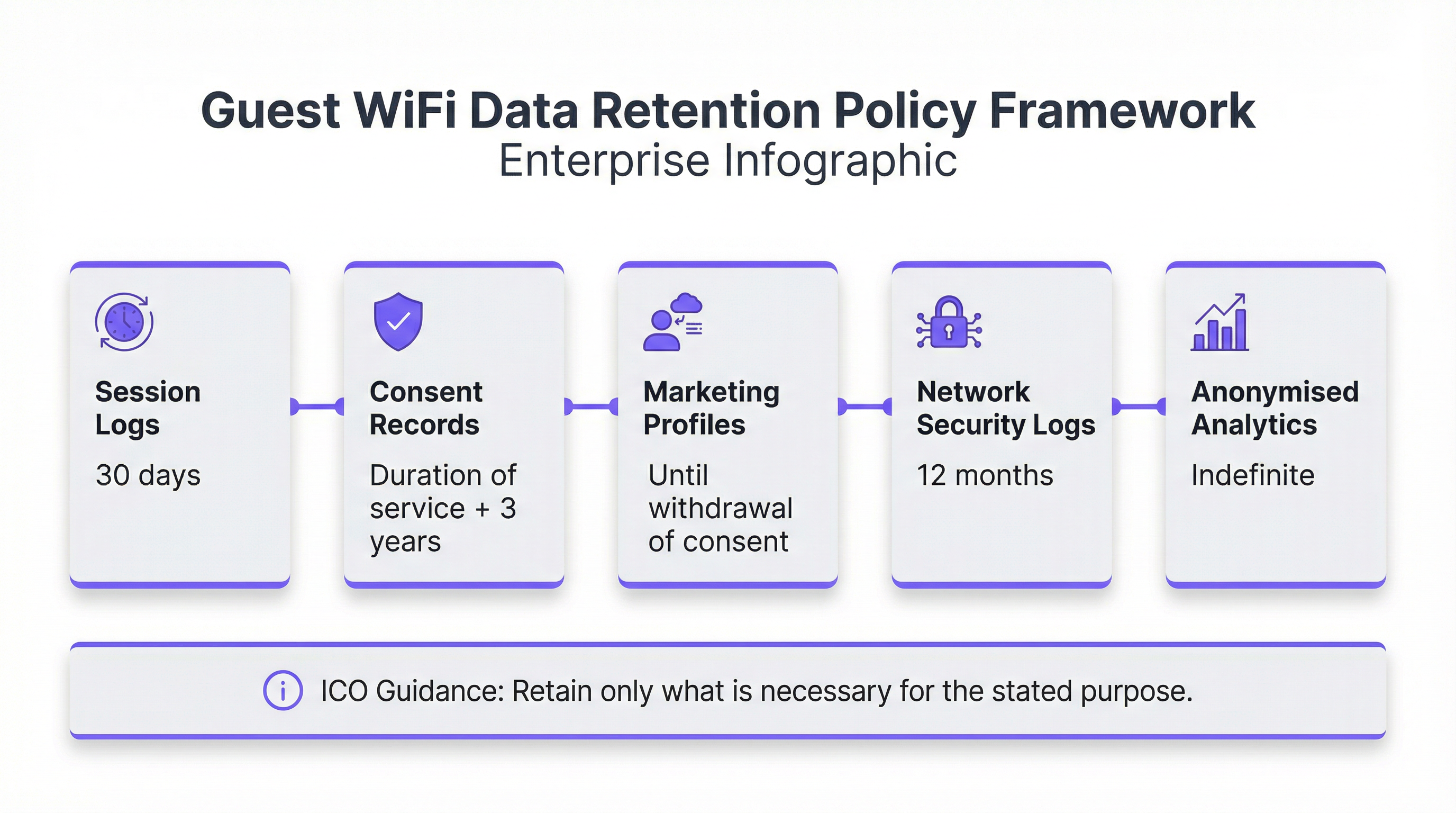
The deployment should follow a four-phase approach. In Phase 1 (Policy), the hotel group must convene a workshop with IT, Marketing, Legal, and the DPO. They need to define three distinct processing purposes: (1) providing network access, (2) marketing communications for the loyalty programme, and (3) footfall analytics. Each purpose requires a separate legal basis and consent mechanism. In Phase 2 (Design), they should select a managed guest WiFi platform such as Purple, which provides a customizable captive portal, a consent management platform, and integrated analytics. The captive portal should be designed with a clear, two-step flow: first, a mandatory acceptance of terms for network access (which can use Legitimate Interest for basic session data); second, two separate, optional, unticked checkboxes — one for 'Loyalty Programme Marketing' and one for 'Anonymous Footfall Analytics'. The privacy notice must be concise and clearly explain each purpose. In Phase 3 (Deployment), the solution should be staged at a single property first. The team must configure automated data retention rules: session logs purged after 30 days, marketing profiles retained until consent is withdrawn, and footfall analytics data anonymised at the point of collection and retained indefinitely. In Phase 4 (Rollout), the solution is deployed to all 12 properties with a phased rollout over 8 weeks. Front desk staff are trained to direct guests to the WiFi and to escalate any data queries to the DPO.
A national retail chain with 85 stores wants to use their guest WiFi to run footfall heatmaps and measure the effectiveness of in-store promotional displays. Their marketing team wants to use the WiFi to send push notifications to customers who are currently in-store. Their IT team is concerned about GDPR compliance, particularly around the use of MAC addresses for tracking. How should the IT manager advise the business?
The IT manager should advise the business that this use case is achievable but requires careful architectural decisions. First, regarding MAC address tracking: modern mobile devices (iOS 14+ and Android 10+) use MAC address randomization by default, which means that a MAC address is not a stable, persistent identifier for a specific device. However, it is still considered personal data when collected, as it can be combined with other data to identify an individual. The IT manager should recommend that the analytics platform anonymise the MAC address immediately upon collection (using a one-way hash), and that the analytics dashboard only ever display aggregated, anonymised data. This significantly reduces the GDPR risk. Second, regarding in-store push notifications: this is a high-risk processing activity that requires explicit, specific consent. The captive portal must include a specific, unticked checkbox that reads: 'I consent to receiving personalised offers and notifications while I am connected to the store WiFi.' The purpose must be clearly explained. Third, the IT manager should recommend conducting a DPIA before deploying the push notification feature, as it involves real-time location-based processing of personal data. The DPIA should assess the risk to user privacy and document the mitigations in place. A platform like Purple can support this use case with its consent management, analytics, and marketing automation capabilities, while providing the audit trail needed to demonstrate compliance.
परिदृश्य विश्लेषण
Q1. You are the IT Manager for a 50-store retail chain. Your Marketing Director wants to deploy guest WiFi and use it to send in-store push notifications to customers who have previously visited any of your stores. The notifications would be triggered when a known device (identified by MAC address) reconnects to any store's WiFi. Your DPO has flagged this as high-risk. What steps must you take before this feature can be deployed, and what technical safeguards are required?
💡 संकेत:Consider the DPIA trigger checklist, the specific consent required for cross-store device tracking, and the technical challenges of MAC address randomization on modern devices.
अनुशंसित दृष्टिकोण दिखाएं
Before deploying this feature, you must: (1) Conduct a mandatory Data Protection Impact Assessment (DPIA), as this involves systematic monitoring of individuals across multiple locations using device identifiers — a clear GDPR Article 35 trigger. The DPIA must document the risks and the mitigations. (2) Redesign the captive portal to include a specific, unticked consent checkbox that clearly explains cross-store device recognition and targeted notifications. The language must be explicit: 'I consent to [Brand] recognising my device across all stores and sending me personalised offers when I connect.' (3) Address the MAC randomization challenge: since modern iOS and Android devices randomize MAC addresses, you cannot reliably use raw MAC addresses for cross-store recognition. You must instead require users to authenticate via a persistent identifier such as an email address or social login, which then becomes the cross-store tracking key. (4) Implement a Data Processing Addendum with your push notification provider. (5) Provide a clear, accessible opt-out mechanism in every push notification and in a self-service preference center. Only after completing these steps and obtaining sign-off from the DPO should the feature be deployed.
Q2. Your organization has received a Data Subject Access Request from a former hotel guest who stayed 18 months ago. They are requesting a copy of all personal data you hold about them, including their WiFi session history. Your current guest WiFi platform stores session logs indefinitely. What are your immediate obligations, and what systemic changes should you make?
💡 संकेत:Consider the one-month response deadline, the data minimisation principle, and the need for a documented retention policy.
अनुशंसित दृष्टिकोण दिखाएं
Your immediate obligations are: (1) Acknowledge the DSAR in writing within 5 working days, confirming you have received it and will respond within one calendar month. (2) Search all systems — your guest WiFi CMP, CRM, and any email marketing platforms — for all personal data associated with this individual. (3) Compile and provide a copy of all data found, in a commonly used electronic format, within one calendar month of receipt. This includes session logs, consent records, and any marketing profile data. The systemic change required is urgent: storing session logs indefinitely is a clear violation of the GDPR data minimisation and storage limitation principles. You must immediately define and implement a data retention policy. Session logs should be purged after 30-90 days. You must configure automated retention rules in your guest WiFi platform to enforce this policy going forward. Additionally, you should implement a formal DSAR intake process — a dedicated privacy email alias, a trained point of contact, and a documented workflow — to ensure future requests are handled efficiently and within the statutory deadline.
Q3. A conference centre is deploying guest WiFi for a major three-day event with 5,000 attendees. The event organiser wants to use the WiFi analytics to provide sponsors with data on how many unique visitors attended each sponsor's exhibition stand. The data would be presented as a report showing stand visit counts and average dwell times per stand. Is this use case GDPR-compliant as described, and what conditions must be met for it to proceed?
💡 संकेत:Consider the distinction between anonymised aggregate data and personal data, and the specific consent required for location-based analytics.
अनुशंसित दृष्टिकोण दिखाएं
The use case as described is potentially compliant, but only under specific conditions. The key question is whether the data provided to sponsors is truly anonymised and aggregated, or whether it could be used to identify individuals. If the report shows only aggregate counts (e.g., 'Stand A received 342 unique device visits with an average dwell time of 4.2 minutes'), and if the underlying device-level data has been irreversibly anonymised before any analysis, then this data is no longer personal data and can be shared with sponsors without restriction. However, to get to this point, the following conditions must be met: (1) The captive portal for the event WiFi must include a specific, unticked consent checkbox for 'Anonymous footfall analytics to measure event attendance and stand popularity.' The purpose and the fact that aggregated data will be shared with event sponsors must be clearly disclosed. (2) The analytics platform must anonymise device identifiers (e.g., hash the MAC address) at the point of collection, before any analysis is performed. (3) The reports shared with sponsors must contain only aggregated data with no possibility of re-identification. If any stand had very few visitors, the data for that stand should be suppressed to prevent re-identification. (4) A DPIA should be conducted given the large scale of the data collection. If these conditions are met, the use case is compliant and represents a legitimate and valuable application of guest WiFi analytics.
मुख्य निष्कर्ष
- ✓Guest WiFi networks collect four categories of personal data under GDPR: registration data, device and session data, location data, and usage data. Each requires a distinct legal basis and compliance approach.
- ✓Consent for marketing and analytics must be freely given, specific, informed, and unambiguous. This means separate, unticked checkboxes for each purpose on the captive portal — never bundled with the terms of service for network access.
- ✓A robust data retention policy is non-negotiable. Session logs should be purged after 30 days, consent records retained for 2 years post-last-interaction, and marketing profiles deleted upon consent withdrawal. Automate these rules in your CMP.
- ✓A Data Protection Impact Assessment (DPIA) is legally mandatory before deploying guest WiFi systems that involve large-scale location tracking, behavioural profiling, or processing data from vulnerable groups.
- ✓Your guest WiFi vendor is a Data Processor. A formal Data Processing Addendum (DPA) must be in place before any personal data is shared with them. Evaluate vendors on their security certifications (ISO 27001, SOC 2) and GDPR compliance documentation.
- ✓GDPR compliance for guest WiFi is not just a cost — it is a strategic enabler. A compliant platform mitigates fines of up to 4% of global turnover, builds customer trust, and provides ethically sourced business intelligence that drives operational and marketing ROI.
- ✓In the event of a personal data breach, the 72-hour notification clock starts the moment you become aware of it. Build this timeline into your incident response plan and ensure your team knows to notify before the investigation is complete.




