

अपने CRM के साथ गेस्ट WiFi डेटा को कैसे इंटीग्रेट करें
This guide provides a comprehensive technical reference for IT managers, network architects, and marketing leaders on integrating guest WiFi analytics with CRM platforms such as Salesforce and HubSpot. It covers the strategic rationale, core architectural patterns (Direct API and Webhooks), available data fields, and step-by-step deployment guidance. Venue operators in hospitality, retail, and events will find actionable frameworks for building a compliant, scalable, first-party data pipeline that drives measurable marketing ROI.
🎧 इस गाइड को सुनें
ट्रांसक्रिप्ट देखें

कार्यकारी सारांश
गेस्ट WiFi इन्फ्रास्ट्रक्चर को कस्टमर रिलेशनशिप मैनेजमेंट (CRM) सिस्टम से जोड़ना अब कोई सामान्य रणनीति नहीं रह गई है — यह किसी भी भौतिक स्थान (फिजिकल वेन्यू) के लिए आधुनिक डिजिटल एंगेजमेंट रणनीति का एक महत्वपूर्ण घटक है। होटल, रिटेल चेन, स्टेडियम और बड़े सार्वजनिक स्थानों के IT प्रबंधकों, नेटवर्क आर्किटेक्ट्स और संचालन निदेशकों के लिए, यह एकीकरण (इंटीग्रेशन) अज्ञात विज़िटर ट्रैफ़िक को एक समृद्ध, फर्स्ट-पार्टी डेटा एसेट में बदलने का एक शक्तिशाली तरीका प्रस्तुत करता है。
गेस्ट WiFi उपयोगकर्ताओं से डेटा कैप्चर और विश्लेषण करके — जैसे विज़िट की आवृत्ति (फ़्रीक्वेंसी), ड्वेल टाइम (रुकने का समय), और बुनियादी जनसांख्यिकीय विवरण — संगठन बेहतर मार्केटिंग वैयक्तिकरण (पर्सनलाइज़ेशन), बेहतर ग्राहक वफादारी और डेटा-संचालित परिचालन निर्णयों के माध्यम से महत्वपूर्ण ROI प्राप्त कर सकते हैं। यह गाइड एक सफल एकीकरण प्राप्त करने के लिए वेंडर-न्यूट्रल तकनीकी ब्लूप्रिंट प्रदान करती है। यह डायरेक्ट API कनेक्शन से लेकर वेबहुक-आधारित इवेंट स्ट्रीमिंग तक कोर आर्किटेक्चरल पैटर्न की रूपरेखा तैयार करती है, और सिंक्रोनाइज़ेशन के लिए आमतौर पर उपलब्ध डेटा फ़ील्ड का विवरण देती है। हम डेटा गुणवत्ता सुनिश्चित करने, GDPR और PCI DSS के साथ अनुपालन बनाए रखने और सामान्य सुरक्षा जोखिमों को कम करने के लिए सर्वोत्तम प्रथाओं (बेस्ट प्रैक्टिसेस) का पता लगाते हैं। इसका उद्देश्य तकनीकी लीडर्स को एक मजबूत, स्केलेबल और सुरक्षित गेस्ट WiFi CRM एकीकरण को डिज़ाइन, परिनियोजित (डिप्लॉय) और प्रबंधित करने के लिए आवश्यक कार्रवाई योग्य ज्ञान से लैस करना है जो मापने योग्य व्यावसायिक प्रभाव प्रदान करता है।
गेस्ट WiFi CRM एकीकरण पर हमारी 10 मिनट की ऑडियो ब्रीफिंग सुनें — रणनीति, आर्किटेक्चर और कार्यान्वयन पर एक वरिष्ठ सलाहकार का दृष्टिकोण।
तकनीकी डीप-डाइव
गेस्ट WiFi डेटा को CRM के साथ एकीकृत करने में कई प्रमुख तकनीकी घटक और आर्किटेक्चरल निर्णय शामिल होते हैं। इसके मूल में, यह प्रक्रिया WiFi नेटवर्क के एक्सेस कंट्रोलर या Captive Portal से उपयोगकर्ता प्रमाणीकरण (ऑथेंटिकेशन) और सेशन डेटा को कैप्चर करने और इसे एक संरचित, मान्य प्रारूप में CRM में पुश करने के बारे में है। इसके लिए प्राथमिक तंत्र डायरेक्ट API एकीकरण, वेबहुक और मध्यवर्ती डेटा कनेक्टर हैं।
आर्किटेक्चरल पैटर्न
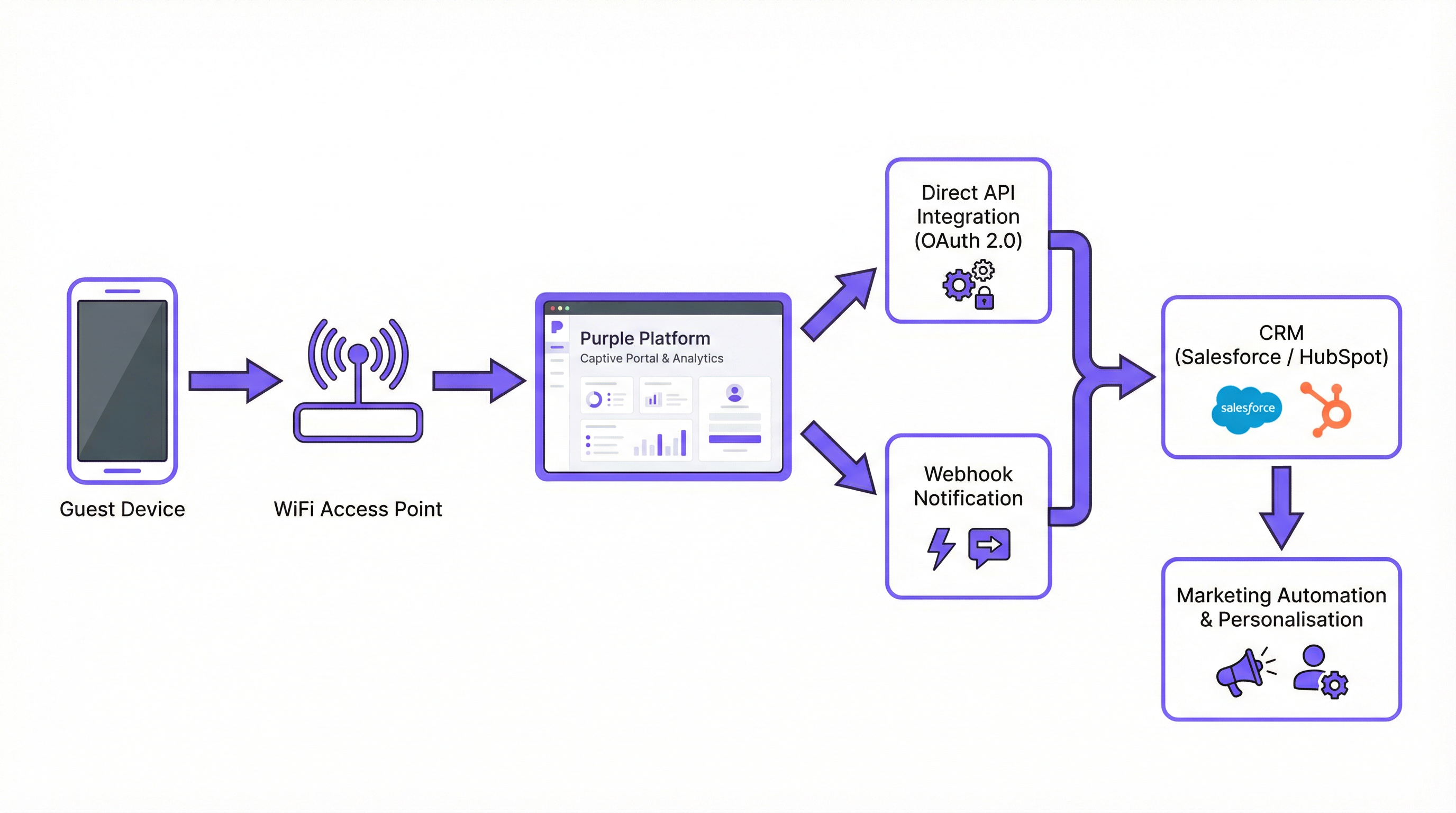
डायरेक्ट API इंटीग्रेशन आधुनिक एंटरप्राइज़ डिप्लॉयमेंट के लिए सबसे आम और अनुशंसित तरीका है। WiFi प्लेटफ़ॉर्म — जैसे Purple — सीधे CRM के REST API पर प्रमाणित API कॉल करता है। यह एक सर्वर-टू-सर्वर कनेक्शन है। जब कोई उपयोगकर्ता गेस्ट WiFi पर प्रमाणित होता है, तो WiFi कंट्रोलर डेटा एकत्र करता है और इसे रीयल-टाइम में CRM को भेजता है। यह पैटर्न उन डिप्लॉयमेंट के लिए आदर्श है जहाँ डेटा की ताज़गी (फ्रेशनेस) महत्वपूर्ण है, जैसे कि तत्काल वेलकम ईमेल ट्रिगर करना या लॉयल्टी प्रोग्राम बैलेंस अपडेट करना।
वेबहुक (Webhooks) एक हल्का, इवेंट-संचालित विकल्प प्रदान करते हैं। इस मॉडल में, WiFi प्लेटफ़ॉर्म एक विशिष्ट घटना (इवेंट) होने पर पूर्व-कॉन्फ़िगर किए गए URL — CRM या मध्यस्थ सेवा में एक एंडपॉइंट — पर रीयल-टाइम HTTP POST सूचना भेजता है। उदाहरण के लिए, एक guest_connected इवेंट एक वेबहुक को ट्रिगर कर सकता है जो CRM में एक संपर्क (कांटेक्ट) बनाता या अपडेट करता है। यह अत्यधिक कुशल है और इवेंट-संचालित आर्किटेक्चर के आसपास निर्मित सिस्टम के लिए उपयुक्त है।
मिडलवेयर कनेक्टर्स जैसे Zapier, MuleSoft, या कस्टम-निर्मित इंटीग्रेशन लेयर जटिल परिदृश्यों के लिए उपयुक्त हैं जहाँ डायरेक्ट इंटीग्रेशन उपलब्ध नहीं है या जहाँ डेटा के CRM तक पहुँचने से पहले महत्वपूर्ण डेटा ट्रांसफ़ॉर्मेशन की आवश्यकता होती है। यह दृष्टिकोण परिचालन जटिलता जोड़ता है लेकिन अधिकतम लचीलापन प्रदान करता है।
| पैटर्न | लेटेंसी | जटिलता | इसके लिए सर्वोत्तम |
|---|---|---|---|
| डायरेक्ट API | रीयल-टाइम | निम्न–मध्यम | अधिकांश आधुनिक CRM (Salesforce, HubSpot) |
| वेबहुक | रीयल-टाइम | निम्न | इवेंट-संचालित आर्किटेक्चर |
| मिडलवेयर | नियर रीयल-टाइम | उच्च | कस्टम CRM, जटिल ट्रांसफ़ॉर्मेशन |
डेटा फ़ील्ड और पेलोड
गेस्ट WiFi प्रमाणीकरण से उपलब्ध डेटा एक साधारण ईमेल पते की तुलना में काफी अधिक समृद्ध है। नए गेस्ट कनेक्शन पर CRM को भेजे गए एक सामान्य JSON पेलोड में निम्नलिखित श्रेणियां शामिल होती हैं:
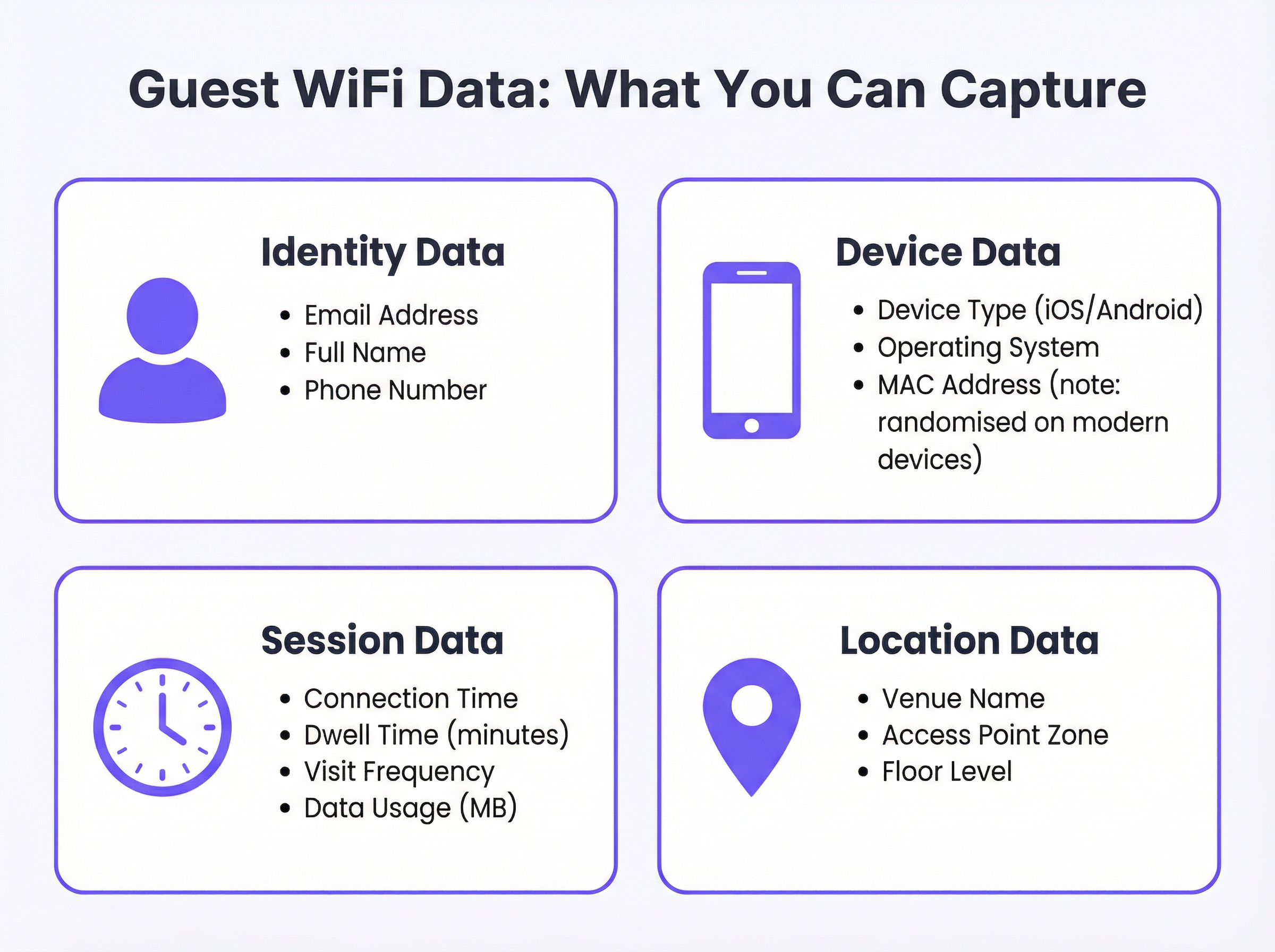
एक प्रतिनिधि API पेलोड को इस प्रकार संरचित किया जा सकता है:
{
  "email": "guest@example.com",
  "full_name": "Jane Smith",
  "phone": "+44 7700 900000",
  "device_type": "iPhone",
  "os": "iOS 17",
  "connect_time": "2025-03-15T14:32:00Z",
  "dwell_time_minutes": 47,
  "visit_count": 3,
  "venue_name": "The Grand Hotel - Manchester",
  "access_point_zone": "Lobby",
  "marketing_consent": true
}
marketing_consent बूलियन फ़ील्ड पर ध्यान दें। यह किसी भी GDPR-अनुपालक डिप्लॉयमेंट में एक अनिवार्य फ़ील्ड है और इसे Captive Portal पर उपयोगकर्ता की कार्रवाई के आधार पर स्पष्ट रूप से सेट किया जाना चाहिए।
प्रमाणीकरण और सुरक्षा आर्किटेक्चर
सुरक्षा के साथ कोई समझौता नहीं किया जा सकता। सभी डेटा ट्रांसमिशन TLS 1.2 या उच्चतर का उपयोग करके HTTPS पर होना चाहिए। CRM API के साथ प्रमाणीकरण के लिए OAuth 2.0 का उपयोग किया जाना चाहिए, जो क्रेडेंशियल्स को उजागर किए बिना सुरक्षित, प्रत्यायोजित (डेलीगेटेड) एक्सेस प्रदान करता है। API कुंजियों और OAuth टोकन को एक समर्पित सीक्रेट्स मैनेजमेंट सिस्टम में संग्रहीत किया जाना चाहिए — साझा सर्वर पर कॉन्फ़िगरेशन फ़ाइलों या पर्यावरण चर (एनवायरनमेंट वेरिएबल्स) में कभी भी हार्डकोड नहीं किया जाना चाहिए।
नेटवर्क की ओर, पोर्ट-आधारित नेटवर्क एक्सेस कंट्रोल के लिए IEEE 802.1X और WiFi एन्क्रिप्शन के लिए WPA3 का पालन यह सुनिश्चित करता है कि कनेक्शन के बिंदु पर उपयोगकर्ता डेटा सुरक्षित है। भुगतान कार्ड डेटा संसाधित करने वाले स्थानों के लिए, PCI DSS द्वारा आवश्यक नेटवर्क सेगमेंटेशन को बनाए रखा जाना चाहिए, यह सुनिश्चित करते हुए कि गेस्ट WiFi नेटवर्क किसी भी कार्डधारक डेटा वातावरण से अलग है।
कार्यान्वयन गाइड
चरण 1: डिस्कवरी और आवश्यकता संरेखण (रिक्वायरमेंट्स अलाइनमेंट)
कोई भी तकनीकी कॉन्फ़िगरेशन शुरू होने से पहले, IT, मार्केटिंग और कानूनी/अनुपालन (लीगल/कंप्लायंस) से युक्त एक क्रॉस-डिपार्टमेंटल वर्किंग ग्रुप बुलाएं। मार्केटिंग को आवश्यक विशिष्ट डेटा फ़ील्ड और इच्छित उपयोग के मामलों को परिभाषित करना चाहिए। IT को मौजूदा WiFi इन्फ्रास्ट्रक्चर और लक्ष्य CRM की क्षमताओं का आकलन करना चाहिए। कानूनी टीम को GDPR अनुपालन सुनिश्चित करने के लिए प्रस्तावित Captive Portal कॉपी और सहमति तंत्र की समीक्षा करनी चाहिए। इस बैठक के परिणामों को एक औपचारिक आवश्यकता विनिर्देश (रिक्वायरमेंट्स स्पेसिफिकेशन) के रूप में दस्तावेज़ित करें।
चरण 2: अपना इंटीग्रेशन पैटर्न चुनें
CRM की API क्षमताओं और आपके इन्फ्रास्ट्रक्चर के आधार पर, उपयुक्त आर्किटेक्चरल पैटर्न का चयन करें। Salesforce के लिए, OAuth 2.0 और कनेक्टेड ऐप फ्रेमवर्क के साथ REST API का उपयोग करें। HubSpot के लिए, नेटिव Purple कनेक्टर का उपयोग करें, जो HubSpot के Contacts API का लाभ उठाता है। अन्य प्लेटफ़ॉर्म के लिए, आकलन करें कि क्या कोई नेटिव कनेक्टर मौजूद है; यदि नहीं, तो मिडलवेयर विकल्पों का मूल्यांकन करें।
चरण 3: WiFi प्लेटफ़ॉर्म कॉन्फ़िगर करें
Purple पोर्टल में, Connectors & Integrations पर नेविगेट करें। अपना लक्ष्य CRM चुनें। आपको इसके लिए संकेत दिया जाएगा:
- प्रमाणीकरण (Authenticate): OAuth 2.0 फ़्लो शुरू करने के लिए 'Connect' पर क्लिक करें। आपको संपर्क बनाने और अपडेट करने के लिए Purple को अनुमति देने हेतु आपके CRM के ऑथराइज़ेशन पेज पर रीडायरेक्ट किया जाएगा।
- डेटा मैपिंग कॉन्फ़िगर करें: परिभाषित करें कि कौन से Purple डेटा फ़ील्ड किस CRM फ़ील्ड में मैप होते हैं। कस्टम फ़ील्ड पर विशेष ध्यान दें। उदाहरण के लिए,
dwell_time_minutesको आपके CRM में बनाए गए कस्टम फ़ील्ड में मैप करने की आवश्यकता हो सकती है, जैसे Salesforce मेंLast_Visit_Duration__c। - ट्रिगर शर्तें सेट करें: परिभाषित करें कि कौन सी घटनाएँ डेटा सिंक को ट्रिगर करती हैं। आमतौर पर, यह
on_login(जब कोई उपयोगकर्ता पहली बार प्रमाणित होता है) और वैकल्पिक रूप सेon_return_visit(किसी ज्ञात उपयोगकर्ता द्वारा बाद की विज़िट के लिए) होता है。
चरण 4: परीक्षण और सत्यापन (टेस्ट और वैलिडेट)
एक परीक्षण डिवाइस का उपयोग करके, गेस्ट WiFi नेटवर्क से कनेक्ट करें और Captive Portal लॉगिन पूरा करें। अपने CRM पर नेविगेट करें और पुष्टि करें कि सही फ़ील्ड मानों के साथ एक नया संपर्क बनाया गया है। निम्नलिखित एज केसेस का परीक्षण करें: एक लौटने वाला उपयोगकर्ता (अपडेट होना चाहिए, डुप्लिकेट नहीं), एक उपयोगकर्ता जो मार्केटिंग सहमति को अस्वीकार करता है (बनाया जाना चाहिए लेकिन मार्केटिंग सूचियों में नहीं जोड़ा जाना चाहिए), और एक सिम्युलेटेड API रेट लिमिट परिदृश्य के दौरान एक कनेक्शन इवेंट।
चरण 5: डिप्लॉय और मॉनिटर करें
प्रोडक्शन वेन्यू के लिए इंटीग्रेशन सक्षम करें। मॉनिटरिंग डैशबोर्ड स्थापित करें जो इंटीग्रेशन हेल्थ मेट्रिक्स को ट्रैक करते हैं: API कॉल सफलता दर, त्रुटि दर, औसत सिंक लेटेंसी, और प्रति दिन बनाए गए नए संपर्कों की संख्या। परिभाषित सीमा से अधिक त्रुटि दर के लिए अलर्ट सेट करें (उदा., 1% से अधिक सिंक प्रयास विफल होना)। डिप्लॉयमेंट के बाद पहले महीने के लिए साप्ताहिक आधार पर CRM में डेटा गुणवत्ता की समीक्षा करें।
सर्वोत्तम प्रथाएँ (Best Practices)
डेटा न्यूनीकरण और सहमति (Data Minimisation and Consent)। केवल वही डेटा एकत्र करें जो आपके परिभाषित उपयोग के मामलों के लिए अत्यंत आवश्यक है। आपके Captive Portal को एक स्पष्ट, सरल भाषा वाला गोपनीयता नोटिस और मार्केटिंग सहमति के लिए एक स्पष्ट, अनटिक किया हुआ चेकबॉक्स प्रस्तुत करना चाहिए। पहले से टिक किए गए बॉक्स GDPR के अनुरूप नहीं हैं। सहमति रिकॉर्ड — जिसमें टाइमस्टैम्प और सहमति कथन के सटीक शब्द शामिल हैं — आपके CRM में संपर्क रिकॉर्ड के साथ संग्रहीत किया जाना चाहिए।
डेटा गुणवत्ता और स्वच्छता (Data Quality and Hygiene)। CRM में डेटा लिखे जाने से पहले सर्वर-साइड वैलिडेशन लागू करें। कम से कम, यह मान्य करें कि ईमेल पते RFC 5322 प्रारूप के अनुरूप हैं। एक ही व्यक्ति के लिए कई संपर्क रिकॉर्ड बनने से रोकने के लिए डी-डुप्लीकेशन रणनीति लागू करें। एक सामान्य दृष्टिकोण ईमेल पते को प्राथमिक विशिष्ट पहचानकर्ता (प्राइमरी यूनिक आइडेंटिफ़ायर) के रूप में उपयोग करना है और एक साधारण 'क्रिएट' के बजाय 'अपसर्ट' (upsert - यदि मौजूद है तो अपडेट करें, यदि नहीं है तो बनाएं) करने के लिए CRM इंटीग्रेशन को कॉन्फ़िगर करना है।
स्केलेबिलिटी प्लानिंग। पहले दिन से ही पीक ट्रैफ़िक के लिए डिज़ाइन करें। सोल्ड-आउट इवेंट की मेज़बानी करने वाले स्टेडियम में एक साथ हज़ारों कनेक्शन हो सकते हैं। API कॉल के लिए बैचिंग लागू करें — अधिकांश CRM API बल्क ऑपरेशंस का समर्थन करते हैं जो आपको एक ही अनुरोध में कई संपर्क बनाने या अपडेट करने की अनुमति देते हैं, जिससे आवश्यक API कॉल की संख्या काफी कम हो जाती है। ट्रैफ़िक स्पाइक्स के दौरान इवेंट्स को बफ़र करने के लिए एक एसिंक्रोनस प्रोसेसिंग क्यू (जैसे AWS SQS या RabbitMQ) पर विचार करें।
अनुपालन और ऑडिटेबिलिटी (Compliance and Auditability)। एक व्यापक डेटा मैप बनाए रखें जो हर उस सिस्टम का दस्तावेजीकरण करता है जिसमें गेस्ट WiFi डेटा संग्रहीत है। वैधानिक 30-दिन की विंडो के भीतर GDPR डेटा सब्जेक्ट एक्सेस रिक्वेस्ट और राइट-टू-इरेज़र रिक्वेस्ट का जवाब देने के लिए यह आवश्यक है। पूर्ण और ऑडिट योग्य इरेज़र सुनिश्चित करने के लिए सभी सिस्टम — CRM, WiFi प्लेटफ़ॉर्म, ईमेल मार्केटिंग टूल — में विलोपन (डिलीशन) वर्कफ़्लो को स्वचालित करें।
समस्या निवारण और जोखिम न्यूनीकरण (Troubleshooting and Risk Mitigation)
API रेट लिमिटिंग। सबसे आम तकनीकी विफलता मोड। CRM सख्त API कॉल सीमाएँ लागू करते हैं — उदाहरण के लिए, Salesforce आपके लाइसेंस टियर के आधार पर सीमाएँ लागू करता है। इन सीमाओं को पार करने पर HTTP 429 त्रुटियाँ और डेटा हानि होती है। न्यूनीकरण (Mitigation): बैचिंग और एक्सपोनेंशियल बैक-ऑफ़ रीट्राई लॉजिक लागू करें। रीयल-टाइम में अपनी आवंटित सीमाओं के विरुद्ध अपने API उपयोग की निगरानी करें।
गलत डेटा मैपिंग। गलत कॉन्फ़िगर की गई फ़ील्ड मैपिंग के कारण डेटा गलत CRM फ़ील्ड में लिखा जा सकता है या सिंक चुपचाप विफल हो सकता है। न्यूनीकरण: एक स्कीमा-वैलिडेशन लेयर का उपयोग करें जो ट्रांसमिशन से पहले CRM की फ़ील्ड परिभाषाओं के विरुद्ध आउटगोइंग पेलोड की जाँच करता है। सभी API अनुरोधों और प्रतिक्रियाओं की व्यापक लॉगिंग लागू करें।
पुराना या परस्पर विरोधी डेटा। यदि कोई ग्राहक सीधे CRM में अपना विवरण अपडेट करता है (उदा., नया फ़ोन नंबर), तो बाद का WiFi लॉगिन इसे पुराने डेटा के साथ अधिलेखित (ओवरराइट) कर सकता है। न्यूनीकरण: प्रत्येक डेटा फ़ील्ड के लिए एक स्पष्ट 'सोर्स ऑफ़ ट्रुथ' परिभाषित करें। ईमेल और नाम जैसे पहचान डेटा के लिए, CRM आमतौर पर मास्टर होता है। ड्वेल टाइम और विज़िट फ़्रीक्वेंसी जैसे व्यवहारिक डेटा के लिए, WiFi प्लेटफ़ॉर्म मास्टर होता है। अपने इंटीग्रेशन को केवल उन फ़ील्ड को अपडेट करने के लिए कॉन्फ़िगर करें जहाँ WiFi प्लेटफ़ॉर्म आधिकारिक स्रोत है।
GDPR इरेज़र विफलताएँ। एक राइट-टू-इरेज़र अनुरोध जो सभी सिस्टम में पूरी तरह से निष्पादित नहीं होता है, महत्वपूर्ण कानूनी जोखिम पैदा करता है। न्यूनीकरण: एक केंद्रीय गोपनीयता प्रबंधन पोर्टल से ट्रिगर होने वाला एक स्वचालित, एंड-टू-एंड इरेज़र वर्कफ़्लो लागू करें। वर्कफ़्लो को डेटा मैप में प्रत्येक सिस्टम को डिलीशन API कॉल करना चाहिए और प्रत्येक डिलीशन की पुष्टि को लॉग करना चाहिए।
ROI और व्यावसायिक प्रभाव
इस इंटीग्रेशन निवेश का प्राथमिक औचित्य एक सकारात्मक, मापने योग्य रिटर्न उत्पन्न करना है। जिन संगठनों ने गेस्ट WiFi CRM इंटीग्रेशन को सफलतापूर्वक डिप्लॉय किया है, वे आमतौर पर कई आयामों में परिणामों की रिपोर्ट करते हैं।
बढ़ी हुई कस्टमर लाइफटाइम वैल्यू (CLV)। वफादार, लगातार आने वाले विज़िटर्स की पहचान करने और उन्हें वैयक्तिकृत ऑफ़र भेजने के लिए WiFi डेटा का उपयोग करके, वेन्यू बार-बार आने की आवृत्ति और मूल्य बढ़ा सकते हैं। एक होटल चेन जो ऐसे अतिथि की पहचान करती है जो छह महीने में तीन बार रुका है, वह सक्रिय रूप से उन्हें लॉयल्टी रेट की पेशकश कर सकती है, जिससे एक अस्थायी अतिथि एक वफादार ग्राहक में बदल जाता है。
बेहतर मार्केटिंग एट्रिब्यूशन। रिटेल ऑपरेटरों के लिए, किसी अतिथि के WiFi कनेक्शन को डिजिटल विज्ञापन अभियान के उनके पूर्व एक्सपोज़र के साथ सहसंबंधित करने की क्षमता ऑनलाइन-टू-ऑफ़लाइन रूपांतरण (कन्वर्ज़न) का ठोस प्रमाण प्रदान करती है — जो आधुनिक मार्केटिंग में सबसे मूल्यवान और मायावी मेट्रिक्स में से एक है। यह डेटा सीधे विज्ञापन बजट आवंटन निर्णयों को सूचित करता है।
परिचालन दक्षता (Operational Efficiency)। WiFi सेशन एनालिटिक्स से प्राप्त ड्वेल टाइम और फुटफॉल डेटा का उपयोग स्टाफिंग स्तर, स्टोर लेआउट और सेवा वितरण को अनुकूलित करने के लिए किया जा सकता है। एक वेन्यू जो 12:00 और 14:00 के बीच ड्वेल टाइम में लगातार पीक की पहचान करता है, वह उस विंडो के दौरान पर्याप्त स्टाफिंग सुनिश्चित कर सकता है।
डेटा एसेट वैल्यू। फर्स्ट-पार्टी WiFi डेटा से भरा एक अच्छी तरह से प्रबंधित, सहमति-आधारित CRM डेटाबेस एक दीर्घकालिक रणनीतिक संपत्ति है। जैसे-जैसे थर्ड-पार्टी कुकीज़ को हटाया जा रहा है और डिजिटल विज्ञापन अधिक महंगे होते जा रहे हैं, फर्स्ट-पार्टी डेटा सभी मार्केटिंग गतिविधियों की नींव के रूप में तेजी से मूल्यवान होता जा रहा है।
मुख्य शब्द और परिभाषाएं
Captive Portal
The web page that a user is redirected to and must interact with before being granted access to a public or guest WiFi network. It is the primary point of data capture, consent collection, and brand presentation.
IT teams configure the captive portal to enforce network access policies and present authentication options. Marketing teams design its user experience to maximise data capture rates while maintaining brand consistency. Legal teams review its copy to ensure the privacy notice and consent mechanism are compliant with GDPR.
Guest WiFi CRM Integration
The technical process of connecting a venue's guest WiFi platform to a Customer Relationship Management system, enabling the automated transfer of visitor authentication and session data to build and enrich customer profiles.
This is the central topic of this guide. It is the mechanism by which anonymous venue visitors are converted into known, actionable contacts in the organisation's marketing and sales systems.
API (Application Programming Interface)
A defined set of protocols and data formats that allows different software systems to communicate with each other programmatically. In this context, it refers to the CRM's REST API, which the WiFi platform uses to create and update contact records.
The CRM's API is the technical gateway for your guest WiFi data. Understanding the API's capabilities — particularly its rate limits, supported operations, and authentication requirements — is essential for designing a reliable integration.
Webhook
An automated, event-driven HTTP POST notification sent from one application to another when a specific event occurs. Unlike polling (where one system repeatedly asks another for updates), webhooks push data in real-time only when there is something to report.
Webhooks are an efficient alternative to direct API polling for real-time event notification. A 'guest_connected' webhook, for example, allows the WiFi platform to instantly notify the CRM or a middleware system the moment a new visitor authenticates, without the CRM needing to continuously query the WiFi platform.
OAuth 2.0
An industry-standard authorisation protocol that allows a user or application to grant a third-party service limited, scoped access to resources on another service, without exposing the primary credentials (username and password).
When connecting your WiFi platform to your CRM, OAuth 2.0 is the mandatory authentication mechanism. It ensures that the WiFi platform can create and update contacts in the CRM without ever having access to your CRM administrator's password. Always use OAuth 2.0; never use basic authentication for production integrations.
GDPR (General Data Protection Regulation)
A regulation in EU law (effective May 2018) governing the collection, processing, storage, and transfer of personal data for all individuals within the European Union and the European Economic Area. It applies to any organisation that processes the data of EU residents, regardless of where the organisation is based.
GDPR is the primary legal framework governing guest WiFi data collection in the UK and EU. Key requirements include lawful basis for processing (typically consent for marketing), data minimisation, the right of access, and the right to erasure. Non-compliance can result in fines of up to €20 million or 4% of global annual turnover, whichever is higher.
Dwell Time
The duration for which a specific device, and by extension a visitor, remains connected to the WiFi network within a venue. Measured in minutes or hours.
Dwell time is one of the most operationally valuable metrics derived from guest WiFi data. In retail, it correlates with customer engagement and purchase likelihood. In hospitality, it can indicate satisfaction levels. In transport hubs, it supports passenger flow analysis and resource optimisation.
MAC Address Randomisation
A privacy feature implemented in modern mobile operating systems (iOS 14+ and Android 10+) that causes the device to present a different, randomly generated MAC address to each WiFi network it connects to, rather than its permanent hardware MAC address.
This feature significantly limits the ability to use MAC addresses as a persistent identifier for tracking individual users across sessions. IT teams and data architects must account for this when designing analytics pipelines. The correct response is to rely on authenticated identifiers — specifically, the email address provided during captive portal login — rather than device-level identifiers.
Upsert
A database and API operation that combines 'update' and 'insert'. It updates an existing record if one is found matching a specified key (e.g., email address), or creates a new record if no match is found.
Configuring your CRM integration to use upsert operations rather than simple inserts is a critical data quality practice. It prevents the creation of duplicate contact records for returning visitors, which is one of the most common and damaging issues in WiFi-to-CRM integrations.
केस स्टडीज
A 250-room luxury hotel wants to increase direct bookings and build a loyalty programme. The majority of their guests book through online travel agencies (OTAs), meaning the hotel has no direct relationship with them. How can they use guest WiFi to populate their new Salesforce CRM and begin building that direct relationship?
1. Infrastructure and Portal Design. The hotel deploys Purple across the property. The captive portal is designed to reflect the hotel's premium brand identity. It offers two login options: a quick-access option requiring only an email address and acceptance of the terms of service, and a 'Loyalty Club' sign-up option that offers premium, higher-speed internet in exchange for additional details — name, birthday, and marketing consent. This tiered approach creates a tangible incentive for guests to share more data.
2. Salesforce Integration. In the Purple dashboard, the Salesforce connector is configured using OAuth 2.0. A custom 'Guest WiFi' record type is created in Salesforce, linked to the standard Contact object. Data mapping is configured as follows: email maps to Email, full_name maps to Name, connect_time maps to First_WiFi_Connect_Date__c, and dwell_time_minutes is aggregated to a Total_Stay_Duration__c field.
3. Marketing Automation. A Salesforce Flow is triggered upon the creation of a new Guest record with marketing_consent = true. The flow sends a branded 'Welcome to our Loyalty Club' email within 15 minutes of check-in, containing a special offer for their next direct booking — bypassing the OTA commission entirely.
4. Measurement. The hotel tracks new CRM contacts generated per month, the open rate and conversion rate of the welcome email, and the revenue attributable to direct bookings made by guests who were first acquired via the WiFi loyalty programme.
A large retail chain with 100 stores wants to measure the effectiveness of their digital advertising campaigns in driving in-store visits. They are using HubSpot for marketing automation. How can they leverage guest WiFi data to build an online-to-offline attribution model?
1. Goal Definition. The primary objective is to determine whether customers who were exposed to a digital ad campaign subsequently visited a physical store. This requires correlating an online event (ad click or impression) with an offline event (in-store WiFi connection).
2. HubSpot Integration. The chain activates Purple's native HubSpot connector. Authentication is completed via OAuth 2.0. The integration is configured to create or update a HubSpot Contact upon each guest WiFi login, with the venue_name mapped to a custom contact property called Last_Visited_Store.
3. Attribution Workflow. In HubSpot, a workflow is configured as follows: when a contact connects to in-store WiFi (trigger: Last_Visited_Store property is set), the workflow checks whether the contact's email address exists in the active list of users who clicked on the current Facebook or Google ad campaign. If a match is found, the contact is enrolled in a 'Confirmed In-Store Visitor — Ad Attributed' list. This list is then used to calculate the campaign's true cost-per-store-visit.
4. Post-Visit Engagement. A second workflow sends a post-visit survey 24 hours after the WiFi connection, asking about the in-store experience and offering a discount code for the next visit. This closes the loop between the digital campaign and in-store behaviour.
5. Reporting. The marketing team builds a HubSpot report comparing the in-store visit rate for contacts who were exposed to the ad campaign versus those who were not. This provides a clear, data-driven view of the campaign's incremental impact.
परिदृश्य विश्लेषण
Q1. Your organisation is a fast-food chain with 500 small locations. You want to build a simple, opt-in email marketing list of customers. Your CRM is a custom-built system with a basic REST API that supports a single endpoint for creating new contacts. Which integration pattern would you recommend, and what is the most critical technical risk to mitigate at this scale?
💡 संकेत:Consider both the simplicity of the CRM's API and the aggregate volume of connections across 500 locations during peak hours.
अनुशंसित दृष्टिकोण दिखाएं
A direct API integration is the most suitable pattern. The custom CRM has a REST API for creating contacts, which is exactly what the Purple platform's direct API connector requires. Middleware would add unnecessary cost and complexity for a straightforward contact creation task.
However, the most critical risk at this scale is API rate limiting. With 500 locations, even a modest average of 20 new opt-in connections per hour per location generates 10,000 API calls per hour. Most APIs cannot sustain this volume of individual calls. The mitigation is to implement batching — configuring the integration to accumulate connections over a short window (e.g., 60 seconds) and then submit them as a single bulk API request. This reduces the call volume by orders of magnitude and is the single most important architectural decision for a deployment of this scale.
Q2. You are the IT Director for a large conference centre. You are hosting a major technology conference with 8,000 attendees over two days. You need to provide guest WiFi and also want to share attendee connection data with three event sponsors in near real-time. What are the key scalability and compliance challenges you must address before the event?
💡 संकेत:Consider both the burst traffic pattern of a conference registration period and the legal requirements for sharing personal data with third-party sponsors.
अनुशंसित दृष्टिकोण दिखाएं
Scalability: The primary challenge is the burst traffic pattern. At a conference, the majority of attendees will attempt to connect within the first 30–60 minutes of the event opening. This creates a massive, simultaneous spike — potentially thousands of authentication events in minutes. A synchronous, direct API integration will almost certainly hit rate limits and cause data loss during this window.
The correct architecture is asynchronous: implement a message queue (e.g., AWS SQS) between the Purple platform and the downstream systems. Authentication events are written to the queue immediately, and a consumer process reads from the queue and makes API calls at a controlled, sustainable rate. This decouples the ingestion rate from the processing rate and ensures no data is lost during the spike.
Compliance: Sharing personal data with sponsors is a significant GDPR risk. You cannot share attendee data with sponsors simply because they have agreed to it commercially. You must have explicit, granular consent from each attendee. The captive portal must present a separate, clearly labelled, unticked checkbox for each sponsor (e.g., 'I consent to my data being shared with [Sponsor Name] for marketing purposes'). You cannot bundle this into the general terms of service. You must also have a Data Processing Agreement (DPA) in place with each sponsor before any data is shared, clearly defining their obligations as a data processor or controller.
Q3. A hotel guest who previously consented to marketing and logged into your guest WiFi three months ago now submits a formal 'right to erasure' request under GDPR Article 17. Describe the complete technical process you must execute to fulfil this request within the 30-day statutory deadline.
💡 संकेत:The erasure must be comprehensive and auditable. Consider every system in which this individual's data may reside as a result of the WiFi integration.
अनुशंसित दृष्टिकोण दिखाएं
The process must be systematic, automated where possible, and fully auditable.
1. Intake and Verification. The request is received via the designated privacy channel. The individual's identity is verified against the email address used for the WiFi login.
2. Data Discovery. Using the centralised data map, identify every system in which this individual's data resides as a result of the WiFi integration. This will typically include: the Purple platform (authentication history, profile data), the CRM (contact record, interaction history), the email marketing platform (contact record, campaign history), and any analytics or data warehouse systems.
3. Automated Deletion Workflow. Trigger an automated workflow that makes deletion API calls to each identified system in sequence: a) Purple platform: delete the user's authentication history and profile via the Purple API. b) CRM (e.g., Salesforce): delete the Contact record via the REST API. c) Email marketing platform (e.g., Mailchimp): delete the subscriber record via the API. d) Analytics/data warehouse: execute a DELETE statement targeting the user's email address across all relevant tables.
4. Confirmation and Audit Log. Each system must return a confirmation of deletion. These confirmations are logged in the privacy management system with timestamps, creating an auditable record that the erasure was completed. A confirmation email is sent to the individual.
5. Deadline Management. The entire process must be completed within 30 calendar days of the request. Automated workflows with SLA monitoring should alert the Data Protection Officer if any step fails or is approaching the deadline.
मुख्य निष्कर्ष
- ✓A guest WiFi CRM integration converts anonymous venue visitors into first-party CRM contacts, enabling personalised marketing, loyalty programme development, and online-to-offline advertising attribution.
- ✓The two primary integration patterns are Direct API Integration (real-time, server-to-server, ideal for Salesforce and HubSpot) and Webhooks (event-driven, lightweight, ideal for event-based architectures).
- ✓Available data fields span four categories: Identity (email, name, phone), Device (type, OS), Session (dwell time, visit frequency, data usage), and Location (venue, access point zone, floor level).
- ✓GDPR compliance is non-negotiable: your captive portal must present explicit, unticked marketing consent checkboxes, and you must have an automated, auditable process for handling right-to-erasure requests across all integrated systems.
- ✓Design for peak traffic from the outset: implement API call batching and asynchronous message queuing to prevent data loss during high-traffic events such as conferences or stadium events.
- ✓Use 'upsert' operations (not simple inserts) in your CRM integration to prevent duplicate contact records for returning visitors — the most common data quality failure in WiFi-to-CRM deployments.
- ✓Measure ROI through downstream commercial metrics: direct booking conversion rates, cost-per-store-visit from ad campaigns, and customer lifetime value growth among WiFi-acquired contacts.




