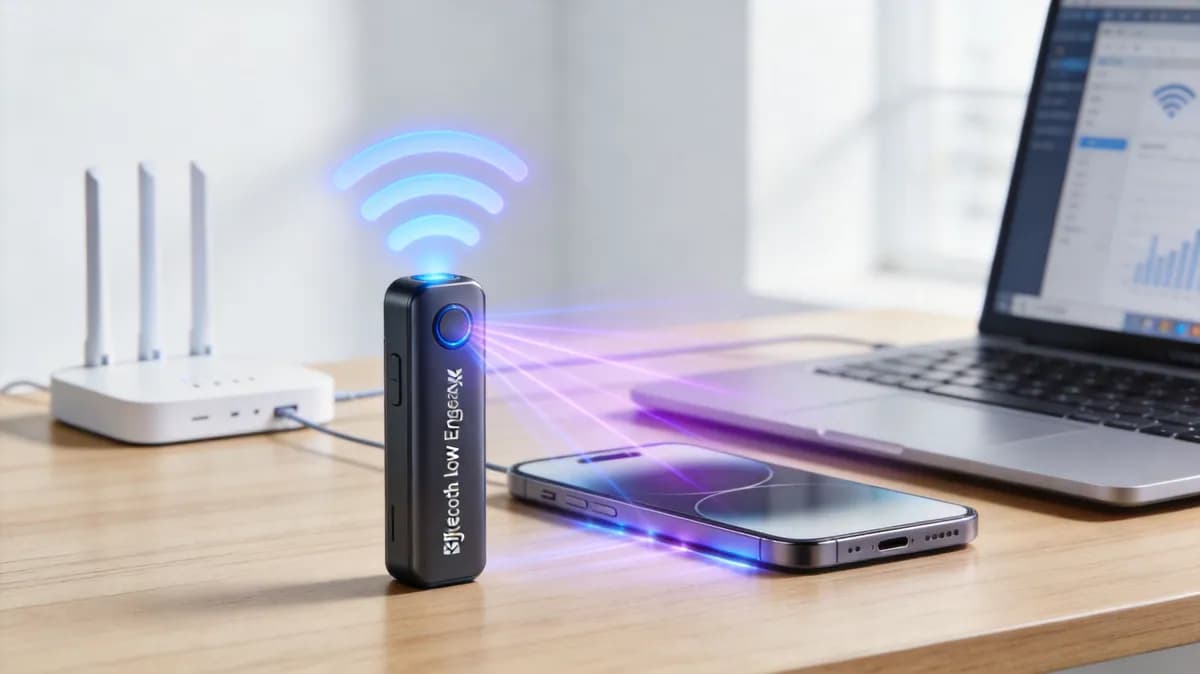
WiFi RTLS indoor location architecture planner
Model access point density, trilateration hearability, tag battery longevity, and existing vendor API integration requirements for real-time indoor tracking.
WiFi RSSI Trilateration with perimeter AP grid
Deployment guidance for Hospital / Healthcare Facility
- Target Assets: Optimised for Infusion pumps, ultrasound carts, beds, and clinical lone-worker badges.
- Perimeter AP Placement: Trilateration requires placing APs along the outer perimeter walls to enclose the tracking area. Avoid placing all APs down a single central hallway corridor, which creates 1D linear ambiguity.
- Controller Ingestion: Telemetry streams via Cisco Spaces Firehose API to the Purple location processing engine. Native telemetry streaming with hyperlocation antenna and BLE beacon support.
- RF Calibration: Plan an initial walk test survey to account for 12 dB attenuation from Dense concrete core, lead-lined X-ray partitions, and patient rooms.
Purple wireless engineers can validate your AP placement, calculate BLE beacon gateway requirements, and provide a full location analytics architecture review.
Real-Time Location Systems (RTLS) track the location of physical assets, personnel, and mobile devices within a venue in real time. By converting radio frequency signals into accurate spatial coordinates, WiFi RTLS enables automated asset tracking, staff safety alerting, and detailed footfall location analytics. Because it overlays on existing venue WiFi network infrastructure, businesses can implement spatial tracking without investing in dedicated overlay hardware.
Key takeaways: WiFi RTLS location tracking
- Definition & core mechanism: WiFi Real-Time Location Systems (RTLS) track physical assets, staff badges, and mobile devices across venues by measuring wireless radio signals in real time. Explore our WiFi analytics guide.
- Zero extra hardware: Overlays directly on existing wireless access point networks (such as Cisco Meraki, HPE Aruba, Ruckus, Juniper Mist, and Ubiquiti UniFi) without expensive hardware overhauls.
- Positioning algorithms: Combines Received Signal Strength Indicator (RSSI) trilateration and Angle of Arrival (AoA) measurements to determine indoor coordinates.
- Enterprise applications: Used across healthcare, retail, hospitality, and smart venues to analyse footfall, streamline asset management, and improve staff safety.
- ROI & privacy compliance: Implements cryptographical hashing to protect visitor privacy while delivering operational efficiency. Calculate returns with our captive portal ROI calculator.
What is WiFi RTLS?
WiFi RTLS refers to a location tracking system that uses standard WiFi radio signals transmitted between client devices (smartphones, tablets, asset tags, or wearable badges) and enterprise access points. While outdoor satellite GPS fails to penetrate building walls or differentiate between building storeys, WiFi RTLS operates indoors to provide continuous room-level and sub-room positioning data.
How WiFi RTLS location tracking works
An enterprise WiFi RTLS architecture calculates indoor position through a four-step telemetry pipeline:
- Signal transmission: WiFi-enabled smartphones, laptops, asset tags, or staff safety badges continuously emit wireless probe requests or data packets.
- Telemetry capture: Nearby access points (such as Cisco Meraki, HPE Aruba, Ruckus, or Juniper Mist) receive these signals and measure data metrics including Received Signal Strength Indicator (RSSI) and Angle of Arrival (AoA).
- Trilateration calculation: The cloud positioning engine aggregates signal measurements from multiple access points, applying mathematical trilateration and signal fingerprinting to pinpoint X,Y coordinates on a digital venue map.
- Data integration: Spatial coordinates integrate into venue management systems, triggering automated geofence alerts, live tracking maps, and location analytics dashboards.
WiFi RTLS technology comparison
Selecting the right indoor positioning protocol depends on required positioning precision, infrastructure budget, and operational goals.
| Technology | Positioning Accuracy | Hardware Requirement | Tag Battery Life | Primary Enterprise Use Cases |
|---|---|---|---|---|
| WiFi (RSSI / AoA) | 3 - 8 metres | Zero extra hardware (Uses existing APs) | 1 - 3 years (or smartphone) | Visitor footfall analytics, zone occupancy, general asset tracking |
| Bluetooth Low Energy (BLE) | 1 - 3 metres | Low (Leverages AP BLE radios) | 3 - 7 years | Staff panic badges, high-precision asset tracking, indoor wayfinding |
| Ultra-Wideband (UWB) | 10 - 30 centimetres | High (Dedicated UWB anchors) | 1 - 2 years | High-security manufacturing, hazardous zone tracking, sub-metre asset control |
| Active RFID | 2 - 5 metres | Medium (Fixed RFID gateways) | 3 - 5 years | Choke-point inventory portals, warehouse shipment tracking |
Key enterprise use cases for WiFi RTLS
1. Healthcare equipment & staff panic response
Hospitals deploy RTLS tags on medical equipment - such as infusion pumps, wheel chairs, and diagnostic monitors - to eliminate search time for clinical staff. Wearable badges with integrated panic buttons allow nurses and doctors to transmit precise floor and room coordinates during emergency incidents.
2. Retail footfall analytics & dwell mapping
Retail store operators use WiFi RTLS to analyse customer movement paths, identify high-dwell store zones, and optimise floor layouts. When paired with captive portal splash pages, retailers can deliver contextual promotions as shoppers enter specific departments.
3. Hospitality asset tracking & service delivery
Hotels and resort venues use RTLS to track housekeeping carts, luggage trolleys, and room service equipment. Real-time alerts notify staff when room service trays are left in corridors, keeping floor walkways clear and enhancing guest satisfaction.
4. Smart stadium & venue crowd management
Large entertainment venues deploy location telemetry to monitor concession queue density, detect bottleneck areas, and redirect crowd flows in real time. Read our guide to WiFi marketing strategies for venue engagement.
Deployment considerations and privacy compliance
When planning a WiFi RTLS deployment, venue managers should consider these technical factors:
- Access point density: Signal trilateration requires devices to be visible to at least three access points simultaneously. Proper AP spacing around room perimeters ensures consistent location resolution.
- Privacy & GDPR compliance: Telemetry systems must anonymise visitor data. Purple applies one-way cryptographic hashing to device MAC addresses, ensuring compliance with international data privacy regulations.
- Vendor independence: Avoid proprietary lock-in by choosing an open cloud solution like Purple that overlays on your existing wireless network hardware.
Frequently asked questions about WiFi RTLS
What is WiFi RTLS?
WiFi RTLS (Real-Time Location System) uses WiFi access points and wireless signals to calculate the real-time position of physical assets, staff badges, and mobile devices within a venue.
How accurate is WiFi RTLS positioning?
Standard WiFi RTLS achieves a positioning accuracy of 3 to 8 metres using RSSI signal strength and Angle of Arrival (AoA) algorithms on existing access points. Adding BLE beacons improves accuracy to 1 to 3 metres.
Does WiFi RTLS require installing new hardware?
No. Purple WiFi RTLS software overlays directly onto existing enterprise access points, including Cisco Meraki, HPE Aruba, Ruckus, Juniper Mist, and Ubiquiti UniFi, requiring zero additional overlay hardware.
How does WiFi RTLS protect visitor privacy?
Purple anonymises device data by running one-way cryptographic hashes on MAC addresses, removing personally identifiable information (PII) before calculating location telemetry.
What is the difference between WiFi RTLS and GPS?
GPS uses satellite signals for outdoor tracking, which cannot penetrate thick building walls. WiFi RTLS uses indoor wireless access points to deliver accurate multi-storey indoor location tracking.
Transform venue efficiency and safety with Purple WiFi RTLS
Track high-value assets, safeguard staff, and deliver personalised experiences with hardware-agnostic location telemetry.