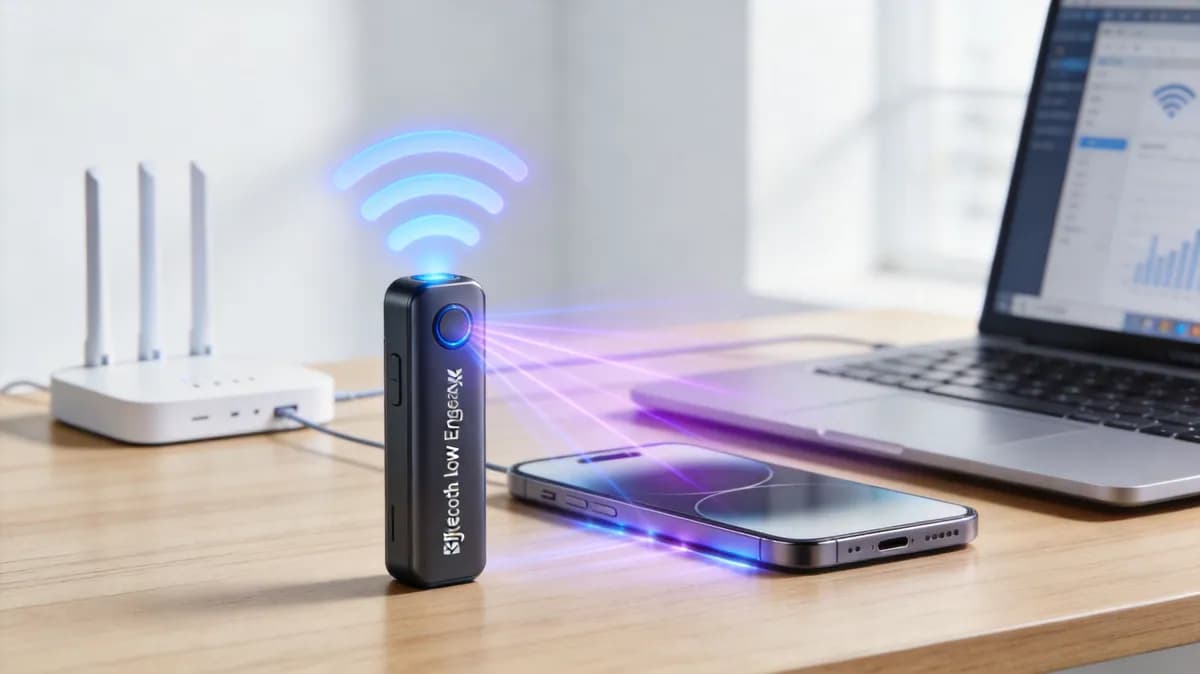
WiFi vs BLE beacons: location architecture and TCO calculator
Model hardware requirements, 3-year total cost of ownership, and actual audience reach between enterprise WiFi positioning and standalone Bluetooth Low Energy (BLE) beacons.
Venue dimensions and deployment parameters
Comparative architecture assessment
Technical attribute comparison: WiFi positioning vs BLE beacons
| Attribute | Enterprise WiFi LBS | Standalone BLE Beacons | Hybrid AP-Integrated BLE |
|---|---|---|---|
| Spatial accuracy | 3 to 8 metres (RSSI) / 1 to 2 m (802.11mc FTM, Android only) | 1 to 3 metres (Proximity / RSSI) | 1 to 3 metres (Unified telemetry) |
| Mobile app required? | No (passive 802.11 probe detection) | Yes (app required to scan BLE frames) | No for footfall; yes for navigation |
| Audience data coverage | 75% to 85% of devices present (unique visitors need logins) | 3% to 6% (app install bottleneck) | 75% to 85% macro; 5% micro |
| Power and maintenance | PoE powered, zero battery upkeep | Coin/AA batteries every 12 to 24 months | PoE powered via AP infrastructure |
| Hardware deployment | Uses existing APs (Cisco Meraki, HPE Aruba, Juniper Mist and others) | Physical wall/ceiling pucks to mount | Uses existing AP internal BLE radios |
| Privacy compliance | GDPR legitimate interest with hashed MACs (still pseudonymous personal data) | OS location permission popups required | Anonymised WiFi + consented app SDK |
Plan your venue location services with Purple
Whether you want venue-wide footfall analytics without battery maintenance or sub-metre navigation, Purple integrates with your existing wireless hardware to deliver enterprise spatial intelligence. Speak with a location services architect for a tailored deployment review.
Location-Based Services (LBS) enable enterprise venues to detect, navigate, and engage visitors using spatial wireless signals. By leveraging mobile device transmissions picked up by access points or Bluetooth nodes, venue operators convert physical footfall into actionable operational intelligence. Choosing between WiFi positioning systems (WPS) and Bluetooth Low Energy (BLE) beacons depends on your target location accuracy, existing infrastructure, and engagement goals.
An executive comparison of indoor location technology
While Global Positioning System (GPS) satellites revolutionized outdoor positioning, satellite signals struggle to penetrate reinforced concrete, glass facades, and multi-story commercial buildings. Indoor location-based services bridge this gap by utilizing localized radio frequency (RF) networks inside physical venues.
For enterprise IT executives across retail, healthcare, hospitality, transport, and stadium venues, choosing the right LBS architecture is a core strategic decision. Deploying the wrong wireless signal protocol can lead to excessive hardware maintenance costs or insufficient positioning accuracy for critical venue workflows.
Comparing WiFi positioning, BLE beacons, and hybrid architectures
How WiFi positioning systems (WPS) calculate location
WiFi positioning systems calculate a mobile client device's spatial coordinates by capturing probe requests and data frames transmitted to nearby access points. WPS uses three primary mathematical methods:
- Received Signal Strength Indicator (RSSI) Trilateration: Access points measure signal attenuation to estimate distance from the client device. Triangulating radii from three or more access points determines estimated device coordinates.
- RF Fingerprinting: Venue operators perform an initial radio survey to construct a signal heatmap database. Real-time device RSSI readings are matched against stored fingerprints to resolve location in non-line-of-sight environments.
- Fine Timing Measurement (FTM / IEEE 802.11az): Wi-Fi 6 and Wi-Fi 7 access points measure packet propagation timing at the speed of light, yielding 1-to-2-meter accuracy unaffected by wall fading or obstruction attenuation.
How Bluetooth Low Energy (BLE) beacons work
BLE beacons are compact, battery-powered or USB-powered transmitters that broadcast identifier signals (such as iBeacon or Eddystone protocols) at regular intervals. Mobile apps on nearby smartphones pick up these signals to trigger localized responses.
Unlike WiFi positioning - where the network calculates client location - BLE positioning can operate client-side. The smartphone measures beacon signal strength locally to calculate its precise position on a venue map, powering responsive turn-by-turn indoor wayfinding.
Key enterprise use cases for WiFi and BLE location services
Enterprise venues deploy location-based services across five core commercial verticals to solve operational challenges and improve visitor experiences:
- Shopping centres and retail malls: Mall operators track visitor movement across concourses, evaluate store tenant footfall, and trigger opt-in proximity offers when shoppers enter specific retail zones. Learn more in our guest WiFi guide.
- Airports and transit hubs: Wayfinding apps guide passenger traffic to departure gates, dining areas, and baggage claims, reducing boarding delays while increasing concession spend per passenger.
- Healthcare facilities: Hospitals track high-value mobile medical equipment - including infusion pumps and telemetry monitors - reducing equipment search times and improving patient flow across clinical departments.
- Sports stadiums and event arenas: Arena managers monitor real-time queue lengths at concession stands and gate entrances, redirecting fan traffic to improve overall venue throughput.
- Corporate smart offices: Hybrid office platforms assist employees in finding available hot desks, meeting rooms, and colleagues across large corporate campuses.
Data privacy and Zero Trust location compliance
Deploying enterprise location-based services requires strict compliance with global privacy regulations. Modern mobile operating systems employ randomized MAC addresses to prevent passive tracking without user consent.
Purple processes location metrics using cryptographic tokenization and anonymized spatial aggregation. Visitors connecting through branded guest WiFi portals retain transparent opt-in controls, ensuring full compliance with GDPR, CCPA, HIPAA, and regional privacy frameworks. Explore our enterprise WiFi security guide for detailed architecture standards.
Enterprise evaluation checklist for LBS deployment
To ensure maximum Return on Investment (ROI) when implementing location-based services, enterprise IT teams should execute a structured evaluation plan:
- Audit existing access point density: Evaluate whether current enterprise access points support BLE gateway capabilities or IEEE 802.11az FTM protocols.
- Define zone vs point positioning requirements: Determine if your operational use case requires high-level zone presence (3-5m) or sub-meter micro-zone triggers (<1m).
- Integrate with cloud WiFi analytics: Connect spatial telemetry into Purple's WiFi analytics platform to generate real-time footfall heatmaps and dwell time reports.
- Deploy unified guest onboarding: Streamline visitor opt-in choices using branded captive portals tailored to your venue brand.
Frequently asked questions about LBS, WiFi, and BLE beacons
Can WiFi positioning work without deploying BLE beacons?
Yes. Enterprise WiFi networks can detect client devices and generate footfall heatmaps, zone presence, and dwell time metrics without requiring standalone BLE beacons.
What is the battery lifespan of a BLE beacon?
Standard battery-powered BLE beacons operate between 2 and 5 years, depending on transmit power and broadcast interval. Modern enterprise access points often feature built-in USB or PoE BLE gateways that eliminate standalone battery replacements.
How accurate is WiFi location tracking compared to BLE beacons?
Standard WiFi positioning delivers 3-to-5-meter accuracy, whereas BLE beacons achieve 1-to-3-meter precision. Wi-Fi 6/7 FTM standards narrow this gap by supporting 1-to-2-meter positioning over existing access points.
Does location tracking work if a smartphone is not connected to guest WiFi?
Yes. As long as a smartphone has WiFi or Bluetooth enabled, it broadcasts probe signals that nearby access points or BLE sensors can detect to count anonymous footfall.
Transform venue analytics with Purple Location Services
Turn your existing enterprise WiFi and BLE infrastructure into an intelligent location engine. Capture footfall heatmaps, guide visitors with turn-by-turn wayfinding, and boost venue engagement across your physical facilities.