

आउटडोर WiFi डिप्लॉयमेंट: वेदरप्रूफिंग, PoE, और मेश विकल्प
यह आधिकारिक गाइड आउटडोर WiFi डिप्लॉयमेंट के लिए महत्वपूर्ण इंजीनियरिंग विचारों का विवरण देता है, जिसमें वेदरप्रूफिंग (IP रेटिंग), लंबी केबल रन के लिए पावर ओवर ईथरनेट (PoE) रणनीतियाँ, और मेश तथा वायर्ड बैकहॉल के बीच आर्किटेक्चरल ट्रेड-ऑफ पर ध्यान केंद्रित किया गया है। यह IT लीडर्स के लिए प्रतिकूल आउटडोर वातावरण में लचीली, उच्च-प्रदर्शन कनेक्टिविटी सुनिश्चित करने के लिए कार्रवाई योग्य सिफारिशें प्रदान करता है।
🎧 Listen to this Guide
View Transcript
कार्यकारी सारांश
आउटडोर वातावरण में WiFi डिप्लॉय करना—चाहे वह एक विशाल रिसॉर्ट हो, एक ओपन-एयर रिटेल पार्क हो, या 50,000 सीटों वाला स्टेडियम हो—इनडोर कार्पेटेड स्थानों से मौलिक रूप से भिन्न भौतिक और आर्किटेक्चरल चुनौतियाँ प्रस्तुत करता है। IT मैनेजर्स और नेटवर्क आर्किटेक्ट्स को आउटडोर वातावरण को नेटवर्किंग उपकरण के लिए सक्रिय रूप से प्रतिकूल मानना चाहिए। नमी, अत्यधिक तापमान, बिजली और विस्तारित भौतिक दूरियाँ सभी मिलकर प्रदर्शन को खराब करती हैं और हार्डवेयर को नष्ट करती हैं।
यह गाइड आउटडोर WiFi डिप्लॉयमेंट के लिए एक व्यापक ढाँचा प्रदान करता है। हम एक्सेस पॉइंट (APs) और केबलिंग के लिए आवश्यक अनिवार्य इनग्रेस प्रोटेक्शन (IP) रेटिंग, पावर ओवर ईथरनेट (PoE) के लिए 100-मीटर ईथरनेट सीमा को दूर करने की रणनीतियों, और वायरलेस मेश बनाम वायर्ड बैकहॉल का उपयोग कब करना है, इसका एक महत्वपूर्ण विश्लेषण करते हैं। इन इंजीनियरिंग सिद्धांतों का पालन करके, वेन्यू ऑपरेटर्स यह सुनिश्चित कर सकते हैं कि उनके आउटडोर नेटवर्क उच्च-घनत्व वाले Guest WiFi के लिए आवश्यक नियतात्मक प्रदर्शन और WiFi Analytics के लिए विश्वसनीय डेटा संग्रह प्रदान करें।
तकनीकी गहन-विश्लेषण
वेदरप्रूफिंग और IP रेटिंग सिस्टम
किसी भी आउटडोर डिप्लॉयमेंट का आधार भौतिक लचीलापन है। पर्यावरण संरक्षण को परिभाषित करने के लिए उद्योग मानक इनग्रेस प्रोटेक्शन (IP) रेटिंग सिस्टम है। एंटरप्राइज़ आउटडोर डिप्लॉयमेंट के लिए, उपभोक्ता-ग्रेड या "मौसम-प्रतिरोधी" हार्डवेयर अपर्याप्त है।
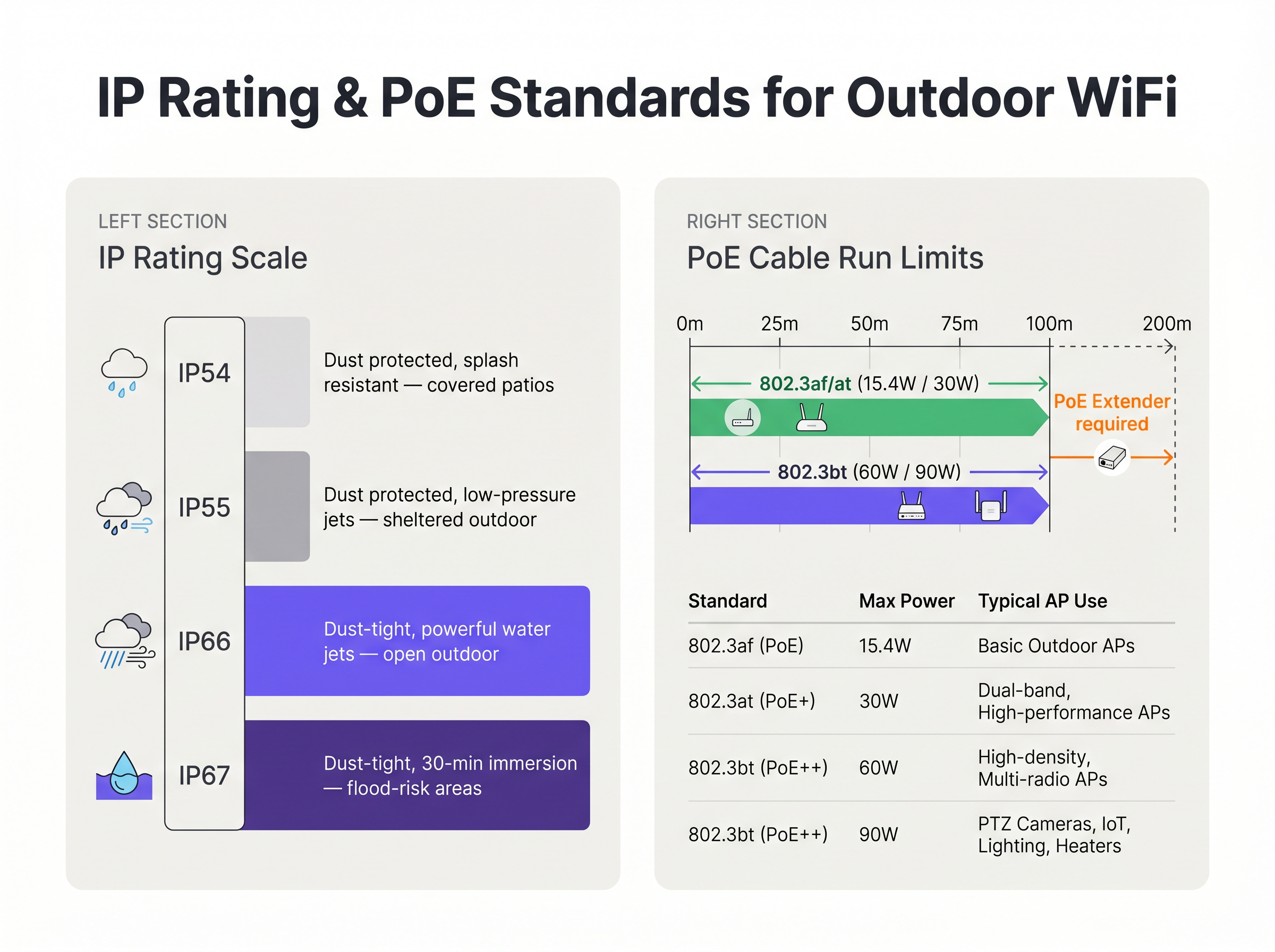
- IP54/IP55: केवल अत्यधिक आश्रय वाले क्षेत्रों के लिए उपयुक्त, जैसे कि गहरे ढके हुए आँगन या लोडिंग बे जो सीधी बारिश से सुरक्षित हों।
- IP66: सामान्य आउटडोर डिप्लॉयमेंट के लिए न्यूनतम मानक। यह सुनिश्चित करता है कि यूनिट पूरी तरह से धूल-रोधी है और किसी भी दिशा से शक्तिशाली पानी के जेट का सामना कर सकती है।
- IP67: खुले वातावरण के लिए स्वर्ण मानक, पानी में अस्थायी विसर्जन से सुरक्षा प्रदान करता है। यह बाढ़-प्रवण क्षेत्रों, मरीना या गंभीर उष्णकटिबंधीय तूफानों के अधीन क्षेत्रों के लिए अनिवार्य है।
महत्वपूर्ण रूप से, AP हाउसिंग शायद ही कभी विफलता का बिंदु होता है। सबसे आम भेद्यता केबल इनग्रेस है। अनुचित रूप से सील किए गए RJ45 कनेक्टर पानी को ईथरनेट केबल के माध्यम से सीधे AP के चेसिस में या PoE स्विच तक जाने देते हैं। डिप्लॉयमेंट में निर्माता-अनुमोदित वेदरप्रूफ केबल ग्लैंड्स, आउटडोर-रेटेड (UV-स्थिर) CAT6A केबलिंग, और कनेक्टर से पानी को दूर रखने के लिए अनिवार्य ड्रिप लूप का उपयोग करना चाहिए।
विस्तारित दूरियों के लिए पावर ओवर ईथरनेट (PoE)
आउटडोर डिप्लॉयमेंट अक्सर ट्विस्टेड पेयर पर मानक ईथरनेट के लिए IEEE 802.3 द्वारा निर्दिष्ट 100-मीटर अधिकतम चैनल लंबाई से अधिक होते हैं। जब एक AP को निकटतम इंटरमीडिएट डिस्ट्रीब्यूशन फ्रेम (IDF) से 150 मीटर दूर एक लाइट पोल पर लगाया जाता है, तो इंजीनियरों को एक उपयुक्त पावर और डेटा डिलीवरी विधि का चयन करना होगा।
- लोकल पावर के साथ फाइबर ऑप्टिक: सिंगल-मोड फाइबर चलाने से डेटा के लिए वस्तुतः असीमित दूरी मिलती है, लेकिन AP स्थान पर एक लोकल पावर स्रोत की आवश्यकता होती है। इसमें अक्सर स्ट्रीट लाइटिंग पावर सर्किट में टैप करना शामिल होता है, जो केवल रात में ही सक्रिय हो सकते हैं, जिससे महंगे इनलाइन बैटरी बैकअप या रीवायरिंग की आवश्यकता होती है।
- PoE एक्सटेंडर्स: इनलाइन रिपीटर डेटा सिग्नल को रीजेनरेट कर सकते हैं और PoE पावर को आगे बढ़ा सकते हैं, जिससे प्रभावी रूप से 200 मीटर तक की पहुँच दोगुनी हो जाती है। हालांकि, वे विफलता के अतिरिक्त बिंदु पेश करते हैं और उन्हें स्वयं वेदरप्रूफ NEMA एनक्लोजर में रखा जाना चाहिए।
- लॉन्ग-रीच PoE स्विच: विशेष स्विच मानक कॉपर पर 250 मीटर तक पावर और डेटा भेज सकते हैं, लेकिन यह आमतौर पर लिंक को 10 Mbps तक ऑटो-नेगोशिएट करने के लिए मजबूर करता है। जबकि कम-बैंडविड्थ वाले Sensors के लिए पर्याप्त है, यह उच्च-घनत्व वाले उपयोगकर्ता ट्रैफिक के लिए पूरी तरह से अपर्याप्त है।
इसके अलावा, आधुनिक उच्च-घनत्व वाले आउटडोर APs, विशेष रूप से ठंडी जलवायु के लिए आंतरिक हीटर वाले, पर्याप्त पावर की मांग करते हैं। उन्हें अक्सर IEEE 802.3bt (PoE++) की आवश्यकता होती है, जो 60W या 90W तक पावर खींचते हैं। अंतर्निहित स्विच इंफ्रास्ट्रक्चर को सभी उपयोग किए गए पोर्ट्स पर इस पावर बजट को बनाए रखने में सक्षम होना चाहिए।
बैकहॉल आर्किटेक्चर: मेश बनाम वायर्ड
आउटडोर AP को कोर नेटवर्क से कैसे जोड़ा जाए, इसका आर्किटेक्चरल निर्णय डिप्लॉयमेंट के दीर्घकालिक प्रदर्शन और विश्वसनीयता को निर्धारित करता है।
वायर्ड बैकहॉल (स्वर्ण मानक) प्रत्येक AP तक कंड्यूट खोदना और फाइबर या कॉपर खींचना सबसे मजबूत समाधान है। यह नियतात्मक लेटेंसी की गारंटी देता है, अधिकतम एग्रीगेट थ्रूपुट प्रदान करता है, और सुनिश्चित करता है कि बैकहॉल लिंक RF हस्तक्षेप से प्रतिरक्षित है। स्टेडियम और Transport हब जैसे स्थायी स्थानों के लिए, वायर्ड बैकहॉल दीर्घकालिक ROI के लिए एकमात्र स्वीकार्य आर्किटेक्चर है।
वायरलेस मेश (व्यावहारिक विकल्प) जब ट्रेंचिंग आर्थिक रूप से निषेधात्मक हो, भौतिक रूप से असंभव हो (जैसे, विरासत स्थल), या डिप्लॉयमेंट अस्थायी हो, तो वायरलेस मेश का उपयोग किया जाता है। मेश APs एक रूट नोड से वायरलेस तरीके से कनेक्ट होते हैं जिसमें वायर्ड कनेक्शन होता है।
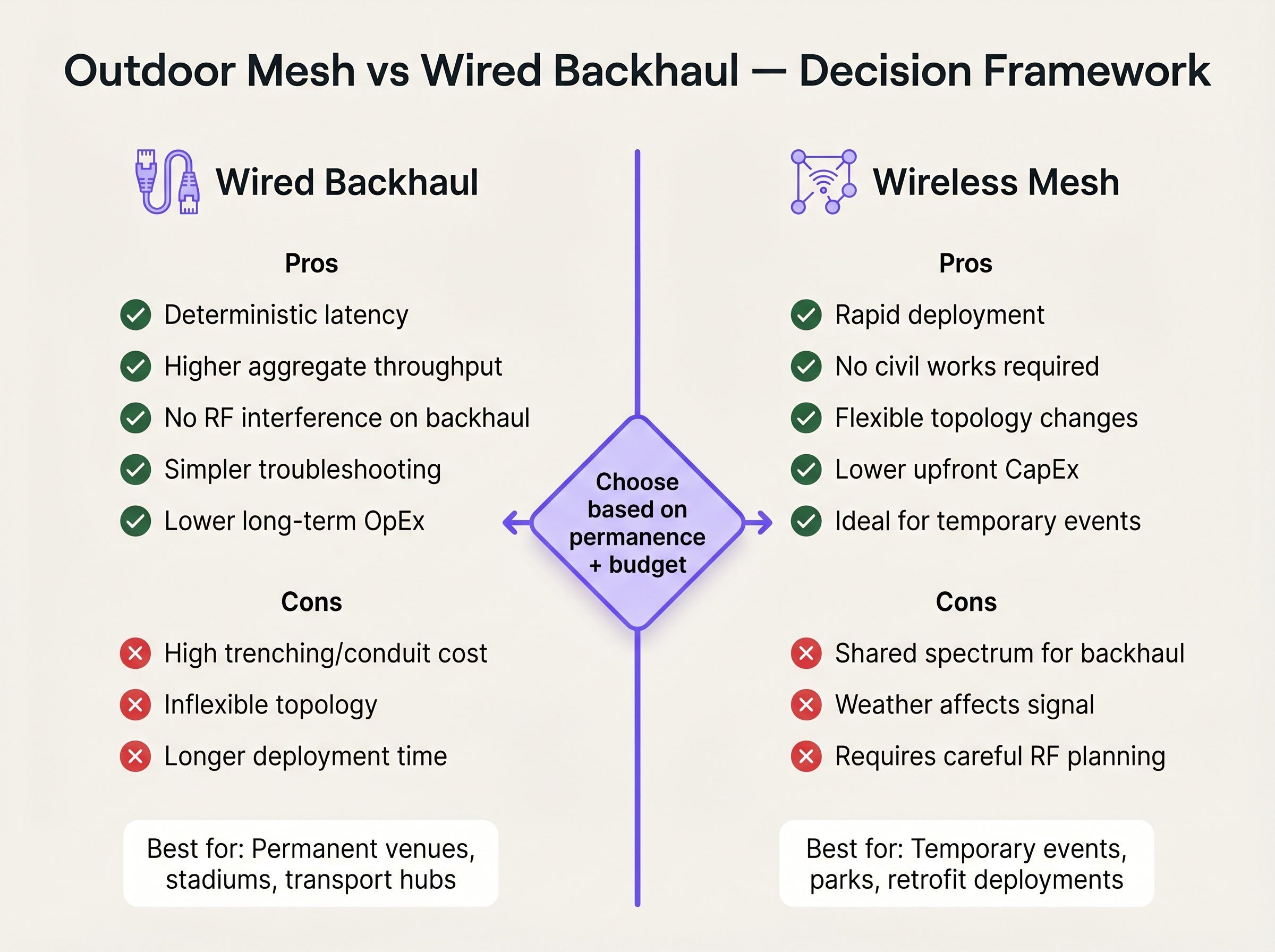
जबकि मेश सिविल वर्क्स CapEx और डिप्लॉयमेंट समय को नाटकीय रूप से कम करता है, यह महत्वपूर्ण तकनीकी समझौते पेश करता है। प्रत्येक वायरलेस हॉप उस पथ के लिए उपलब्ध बैंडविड्थ को प्रभावी ढंग से आधा कर देता है, क्योंकि रेडियो को डेटा प्राप्त करना और फिर से ट्रांसमिट करना होता है। इसके अलावा, बैकहॉल लिंक क्लाइंट डिवाइस के समान RF स्पेक्ट्रम साझा करता है, जिससे यह हस्तक्षेप और मौसम-प्रेरित सिग्नल क्षरण के प्रति संवेदनशील हो जाता है। यदि मेश अपरिहार्य है, तो इंजीनियरों को ट्राई-रेडियो APs डिप्लॉय करने चाहिए, क्लाइंट-फेसिंग क्षमता को बनाए रखने के लिए बैकहॉल लिंक के लिए विशेष रूप से 5 GHz या 6 GHz रेडियो समर्पित करना चाहिए।
कार्यान्वयन गाइड
1. साइट सर्वे और RF प्लानिंग
आउटडोया RF वातावरण जटिल होते हैं। दीवारों के बिना सिग्नल और आगे फैलते हैं जिससे उन्हें क्षीण करना मुश्किल होता है, यदि प्रबंधित न किया जाए तो गंभीर सह-चैनल हस्तक्षेप हो सकता है। विशेष सॉफ्टवेयर का उपयोग करके एक पूर्वानुमानित सर्वेक्षण करें, जिसके बाद AP-ऑन-ए-स्टिक सक्रिय सर्वेक्षण किया जाए। RF ऊर्जा को ठीक वहीं केंद्रित करने के लिए दिशात्मक पैच एंटेना का उपयोग करें जहाँ उपयोगकर्ता एकत्रित होते हैं, बजाय इसके कि सर्वदिशात्मक एंटेना का उपयोग करें जो खाली जगह में सिग्नल प्रसारित करते हैं।
2. भौतिक माउंटिंग और ग्राउंडिंग
एक धातु के खंभे पर AP को माउंट करने से बिजली गिरने का खतरा पैदा होता है। [1]
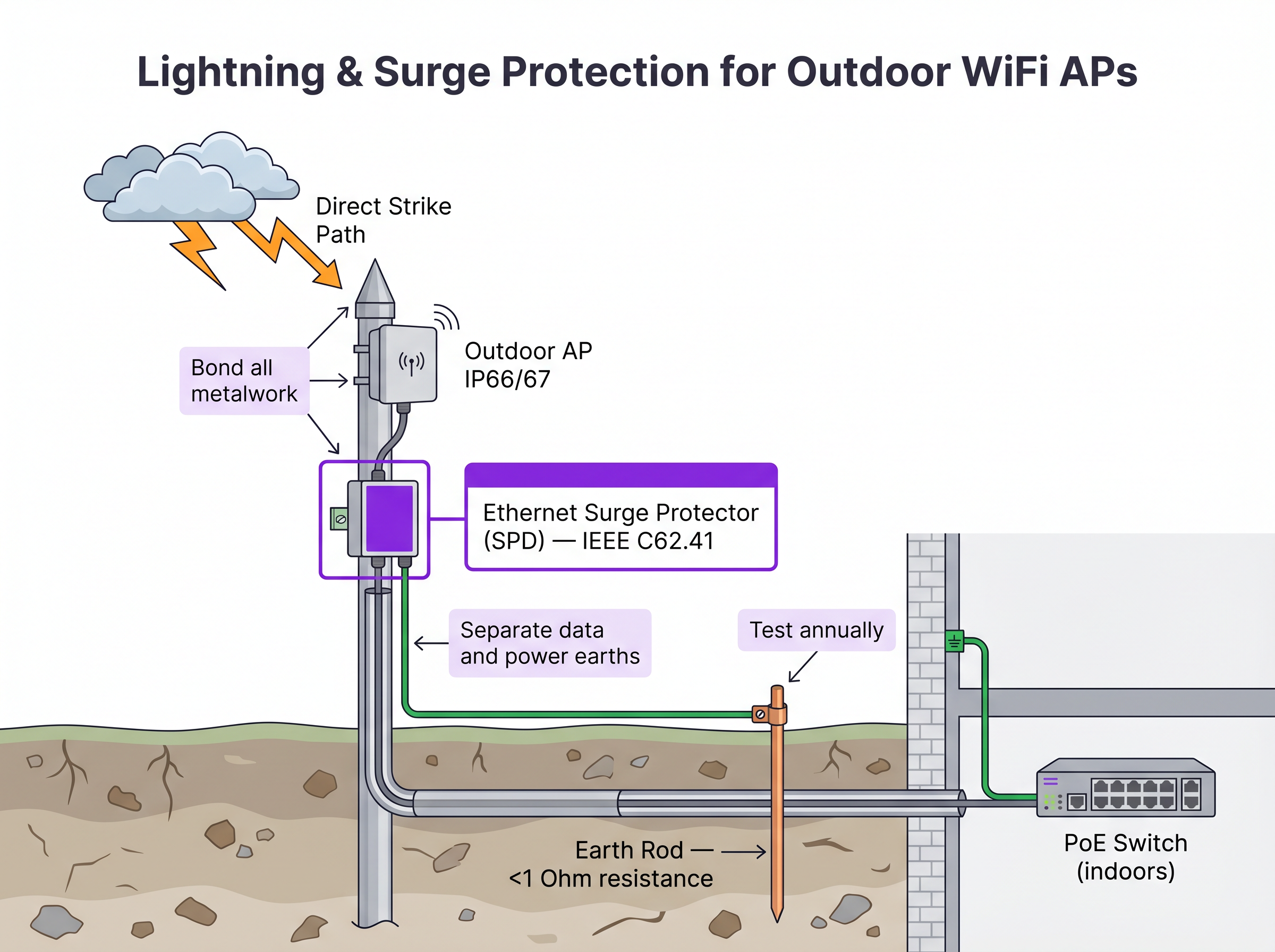
- सर्ज प्रोटेक्शन डिवाइसेस (SPDs): इनडोर स्विचिंग इंफ्रास्ट्रक्चर की सुरक्षा के लिए AP छोर और बिल्डिंग प्रवेश बिंदु दोनों पर इनलाइन ईथरनेट SPDs स्थापित करें।
- बॉन्डिंग: सुनिश्चित करें कि AP माउंट, खंभा और SPDs एक समर्पित अर्थ रॉड से जुड़े हों जिसका प्रतिरोध 1 ओम से कम हो।
- पवन भार: सत्यापित करें कि माउंटिंग हार्डवेयर और खंभा स्वयं स्थानीय अधिकतम पवन भार गणनाओं का सामना कर सकते हैं, विशेष रूप से बड़े दिशात्मक एंटेना के लिए।
3. कॉन्फ़िगरेशन और सुरक्षा
आउटडोर APs दुर्भावनापूर्ण तत्वों के लिए भौतिक रूप से सुलभ होते हैं।
- AP पर अप्रयुक्त ईथरनेट पोर्ट अक्षम करें।
- AP को जोड़ने वाले स्विच पोर्ट पर IEEE 802.1X पोर्ट-आधारित नेटवर्क एक्सेस कंट्रोल (NAC) लागू करें। यदि AP को हटा दिया जाता है और एक अनधिकृत डिवाइस को केबल में प्लग किया जाता है, तो स्विच को पोर्ट को गतिशील रूप से अक्षम करना होगा। विस्तृत NAC तुलनाओं के लिए, हमारी मार्गदर्शिका देखें: Aruba ClearPass vs Cisco ISE: NAC Platform Comparison ।
- सुनिश्चित करें कि प्रबंधन ट्रैफ़िक एक समर्पित VLAN पर अलग किया गया है।
ROI और व्यावसायिक प्रभाव
एंटरप्राइज़-ग्रेड आउटडोर WiFi इंफ्रास्ट्रक्चर में निवेश सीधे स्थल की लाभप्रदता और परिचालन दक्षता को प्रभावित करता है। Hospitality स्थलों के लिए, सर्वव्यापी आउटडोर कवरेज अतिथि संतुष्टि स्कोर बढ़ाता है और पूल और समुद्र तटों पर मोबाइल ऑर्डरिंग को सक्षम बनाता है। Retail वातावरण में, यह कर्बसाइड पिकअप और आउटडोर पॉइंट-ऑफ-सेल (POS) सिस्टम को सुगम बनाता है।
इनडोर हार्डवेयर को बाहर तैनात करने की झूठी मितव्ययिता से बचकर, या जहाँ ट्रेंचिंग संभव थी वहाँ मेश पर अत्यधिक निर्भर रहने से, IT टीमें गंभीर मौसम के दौरान विनाशकारी हार्डवेयर विफलता के जोखिम को कम करती हैं और रुक-रुक कर होने वाले RF बैकहॉल मुद्दों के निवारण के चल रहे OpEx व्यय को समाप्त करती हैं। एक ठीक से इंजीनियर किया गया आउटडोर नेटवर्क Wayfinding जैसी उन्नत स्थान-आधारित सेवाओं और परिचालन प्लेटफार्मों के साथ एकीकरण के लिए आवश्यक विश्वसनीय आधार प्रदान करता है, जैसा कि Connecting WiFi Events to 1,500+ Apps with Zapier and Purple में विस्तृत है।
संदर्भ
[1] IEEE स्टैंडर्ड फॉर लोकल एंड मेट्रोपॉलिटन एरिया नेटवर्क्स। "IEEE 802.3-2018 - IEEE स्टैंडर्ड फॉर ईथरनेट", IEEE स्टैंडर्ड्स एसोसिएशन।
Key Terms & Definitions
IP67 (Ingress Protection)
An equipment rating certifying the device is completely dust-tight (6) and can withstand temporary immersion in water up to 1 metre deep for 30 minutes (7).
Mandatory baseline for outdoor hardware in areas subject to heavy storms or flooding to ensure survivability.
IEEE 802.3bt (PoE++)
The Power over Ethernet standard capable of delivering up to 60W (Type 3) or 90W (Type 4) of DC power over standard twisted-pair cabling.
Required for modern, high-density outdoor APs that power multiple radios, dedicated security scanning radios, and internal heating elements.
Drip Loop
A deliberate downward U-shape formed in a cable just before it enters a device enclosure.
A critical physical installation technique that forces water running down the cable to drip off the bottom of the loop rather than entering the equipment chassis.
Surge Protection Device (SPD)
An inline component designed to protect electrical devices from voltage spikes by shunting excess current to ground.
Essential for outdoor networking to prevent lightning strikes near outdoor APs from sending destructive surges down the Ethernet cable into core switching infrastructure.
Wireless Mesh Backhaul
A network topology where access points connect to the core network wirelessly through other access points, rather than via a direct cabled connection.
Used when trenching cables is impossible or too expensive, but requires careful RF planning to mitigate bandwidth degradation and latency.
Co-Channel Interference (CCI)
Signal degradation caused when multiple access points on the same network transmit on the same frequency channel simultaneously.
A severe problem in outdoor deployments where signals travel further without physical walls to block them, necessitating careful channel planning and directional antennas.
Directional Patch Antenna
An antenna designed to focus RF energy in a specific direction (e.g., a 60-degree cone) rather than broadcasting in all directions.
Crucial for high-density outdoor deployments like stadiums to sectorize coverage and prevent APs from interfering with each other.
802.1X Port-Based NAC
A security protocol that requires a device to authenticate before the network switch will allow it to pass traffic.
Critical security control for outdoor APs; prevents an attacker from unplugging an AP and connecting a laptop to gain access to the internal corporate network.
Case Studies
A luxury resort needs to provide high-density WiFi coverage to a pool area located 180 metres from the main building's IDF. The ground is paved with expensive decorative stone, making trenching highly undesirable. How should the connectivity be engineered?
- Avoid Trenching: Utilize a Point-to-Point (PtP) wireless bridge using dedicated 60 GHz radios to establish a multi-gigabit wireless backhaul from the main building to a central pole at the pool area. 60 GHz provides high bandwidth and avoids interference with the 5 GHz client WiFi.
- Local Distribution: At the pool pole, install a weatherproof NEMA enclosure containing a hardened, temperature-rated PoE switch.
- Power: Provide local AC power to the NEMA enclosure by tapping into the pool area's lighting or utility power circuit, ensuring it is on a 24/7 unswitched circuit.
- AP Deployment: Connect IP67-rated, dual-band outdoor APs to the hardened PoE switch. Use directional patch antennas to focus coverage on the loungers and cabanas, minimizing signal reflection off the water.
A municipal park is deploying Guest WiFi. The APs will be mounted on metal lampposts. What specific physical layer protections must be implemented to prevent network damage from weather and electrical events?
- Cable Ingress: Use outdoor-rated, UV-stabilized CAT6A cable. Terminate the connection at the AP using the manufacturer-supplied weatherproof cable gland. Crucially, form a 'drip loop' in the cable just before it enters the AP, ensuring water drips off the bottom of the loop rather than running into the connector.
- Lightning Protection: Install an inline Ethernet Surge Protection Device (SPD) on the pole, bonded to the metal pole (if the pole is properly earthed) or a dedicated earth rod.
- Building Protection: Install a second SPD at the point where the Ethernet cable enters the building housing the core switch, bonding it to the building's main earth terminal.
Scenario Analysis
Q1. You are designing the WiFi for a large outdoor music festival that will run for 3 days. Trenching is not permitted. You need to provide coverage to the main stage viewing area, which is 300 metres from the wired network drop. What is the most appropriate backhaul architecture?
💡 Hint:Consider the duration of the event and the performance requirements of a dense crowd.
Show Recommended Approach
A Point-to-Point (PtP) wireless bridge (preferably 60 GHz) should be used to shoot the connection from the wired drop to the main stage area. From there, a localized wireless mesh or temporary cabling can distribute the connection to the individual APs serving the crowd. This avoids trenching while providing a high-capacity backbone, which standard multi-hop mesh cannot provide over 300 metres.
Q2. An outdoor AP mounted on a lighting pole is experiencing intermittent power reboots. The cable run is 115 metres of CAT6. The switch is providing 802.3at (30W) PoE+. What are the two most likely causes of the failure?
💡 Hint:Evaluate both the physical layer limitations and the power requirements.
Show Recommended Approach
- Voltage drop over distance: The 115m run exceeds the 100m Ethernet standard. The resistance in the copper cable causes voltage to drop, meaning the AP may not receive sufficient power to operate under load. 2) Insufficient PoE budget: Modern outdoor APs, especially those with heaters, often require 802.3bt (60W). If the switch only provides 30W, the AP will reboot when it attempts to draw more power than is available.
Q3. During an audit of a newly installed outdoor AP on a building roof, you notice the CAT6A cable runs straight down from the AP port and into a hole drilled in the roof membrane. The AP has an IP67 rating. What is the critical installation error, and what is the risk?
💡 Hint:Consider how water behaves on physical surfaces.
Show Recommended Approach
The critical error is the absence of a drip loop. Without a drip loop, water will run down the outside of the cable and pool directly at the entry point to the roof, or track into the AP's RJ45 connector if the gland fails. The risk is water ingress into the building or the AP chassis, leading to hardware failure, despite the AP's IP67 rating.




