

पहली बार Purple WiFi कैसे सेट अप करें: एक तकनीकी अवलोकन
This technical reference guide provides IT managers, network architects, and CTOs with a comprehensive overview of the Purple WiFi platform's initial setup process. It covers the core technical architecture, hardware integration, portal configuration, and best practices for a successful deployment in enterprise environments like hotels, retail, and stadiums. Following this guide, IT teams can confidently deploy a secure, GDPR-compliant guest WiFi solution that delivers both seamless connectivity and actionable business intelligence.
🎧 इस गाइड को सुनें
ट्रांसक्रिप्ट देखें
कार्यकारी सारांश
एंटरप्राइज़ परिवेश में एक नया गेस्ट WiFi समाधान तैनात करने के लिए तकनीकी आर्किटेक्चर, कार्यान्वयन के चरणों और निवेश पर संभावित रिटर्न (ROI) की स्पष्ट समझ की आवश्यकता होती है। यह मार्गदर्शिका उन IT पेशेवरों के लिए एक तकनीकी अवलोकन के रूप में कार्य करती है, जिन्हें पहली बार Purple WiFi इंटेलिजेंस प्लेटफ़ॉर्म सेट अप करने का काम सौंपा गया है। यह सात-चरण वाले क्लाउड-आधारित परिनियोजन (deployment) मॉडल का विवरण देता है, जो ऑन-प्रिमाइसेस हार्डवेयर फ़ुटप्रिंट को कम करने के लिए मौजूदा नेटवर्क इंफ्रास्ट्रक्चर का लाभ उठाता है। यह प्रक्रिया अकाउंट पंजीकरण से शुरू होती है और एक लाइव, डेटा-कैप्चरिंग गेस्ट WiFi नेटवर्क के रूप में परिणत होती है। इसमें शामिल प्रमुख विचारों में सुरक्षा के लिए नेटवर्क सेगमेंटेशन, एक्सेस कंट्रोल के लिए RADIUS-आधारित प्रमाणीकरण (authentication), और निर्बाध उपयोगकर्ता अनुभव के लिए वॉल्ड गार्डन (walled garden) कॉन्फ़िगरेशन शामिल हैं। यह मार्गदर्शिका प्लेटफ़ॉर्म की व्यापक हार्डवेयर संगतता (compatibility) का भी पता लगाती है, जो Cisco, Aruba और Ruckus सहित 50 से अधिक प्रमुख वेंडर्स का समर्थन करती है। बताए गए चरणों का पालन करके, संगठन एक सुरक्षित, अनुपालन-युक्त (compliant) और स्केलेबल गेस्ट WiFi समाधान तैनात करने की उम्मीद कर सकते हैं जो न केवल निर्बाध कनेक्टिविटी प्रदान करता है बल्कि परिचालन दक्षता बढ़ाने और ग्राहक जुड़ाव को बेहतर बनाने के लिए समृद्ध एनालिटिक्स और बिज़नेस इंटेलिजेंस भी प्रदान करता है। अपेक्षित परिणाम एक मजबूत गेस्ट WiFi नेटवर्क है जो आधुनिक एंटरप्राइज़ की कठोर सुरक्षा और अनुपालन मांगों को पूरा करता है, साथ ही विज़िटर के व्यवहार के बारे में मूल्यवान डेटा-संचालित इनसाइट्स को अनलॉक करता है。
तकनीकी डीप-डाइव
मूल रूप से, Purple एक क्लाउड-होस्टेड प्लेटफ़ॉर्म है जो आपके मौजूदा WiFi हार्डवेयर के लिए एक इंटेलिजेंट ओवरले के रूप में कार्य करता है। पारंपरिक ऑन-प्रिमाइसेस समाधानों के विपरीत, जिन्हें RADIUS, पोर्टल होस्टिंग और एनालिटिक्स के लिए समर्पित सर्वर इंफ्रास्ट्रक्चर की आवश्यकता होती है, Purple का आर्किटेक्चर इन सभी कार्यों को क्लाउड में केंद्रीकृत करता है। यह मॉडल परिनियोजन की जटिलता और स्वामित्व की कुल लागत (TCO) को काफी कम कर देता है, क्योंकि समर्पित ऑन-साइट सर्वर की कोई आवश्यकता नहीं होती है। प्राथमिक तकनीकी घटक Purple क्लाउड प्लेटफ़ॉर्म — जिसमें एनालिटिक्स इंजन, RADIUS सर्वर और पोर्टल प्रबंधन सिस्टम शामिल हैं — वेन्यू का स्थानीय नेटवर्क इंफ्रास्ट्रक्चर, और एंड-यूज़र के गेस्ट डिवाइस हैं।
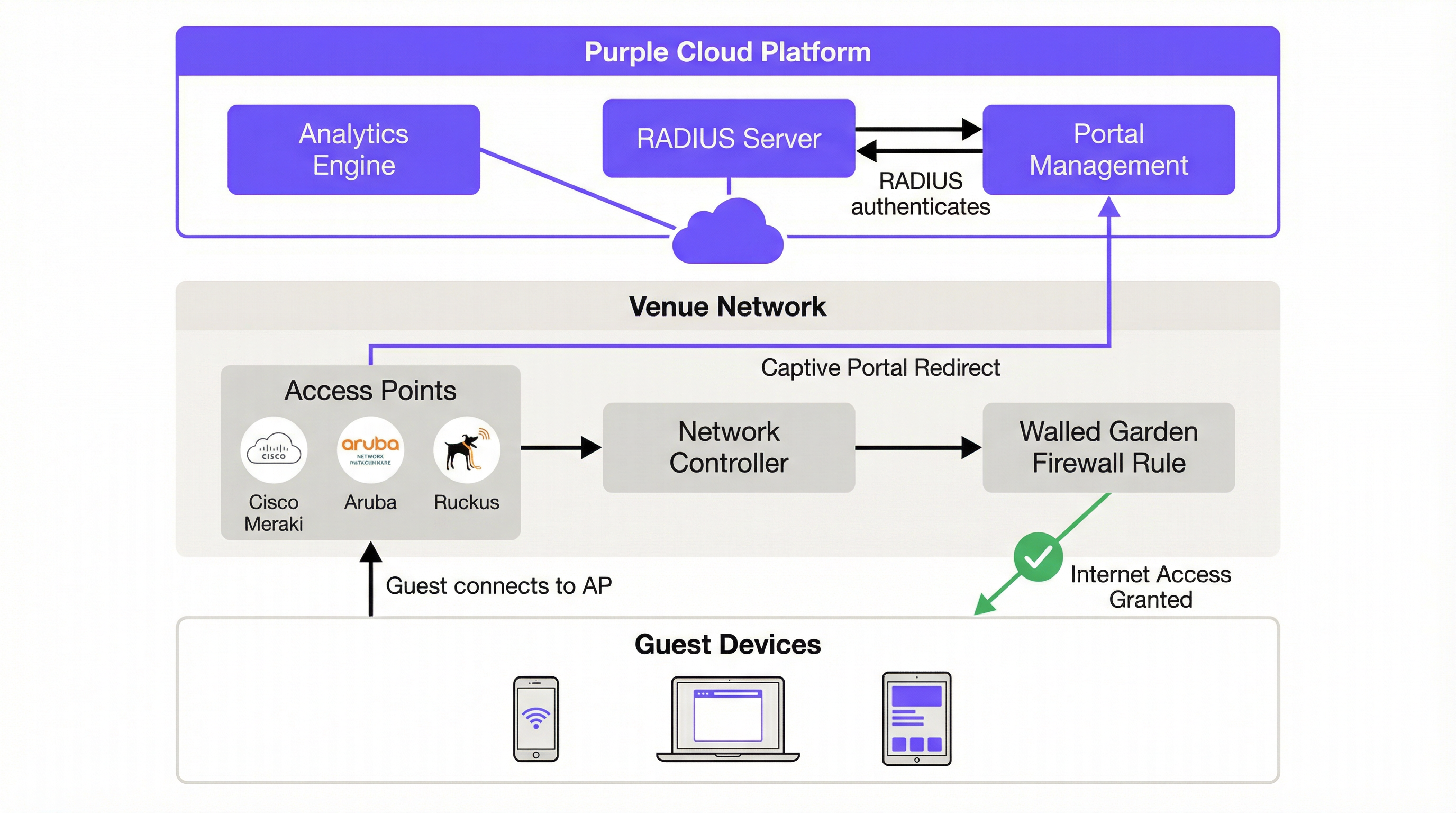
प्रमाणीकरण प्रवाह उसी क्षण शुरू होता है जब कोई गेस्ट निर्दिष्ट SSID से कनेक्ट होता है। डिवाइस का Captive Network Assistant (CNA) स्वचालित रूप से एक पूर्वनिर्धारित URL — iOS पर captive.apple.com, या Android पर connectivitycheck.gstatic.com — से संपर्क करने का प्रयास करता है ताकि यह निर्धारित किया जा सके कि नेटवर्क अप्रतिबंधित इंटरनेट एक्सेस प्रदान करता है या नहीं। ऑन-प्रिमाइसेस नेटवर्क कंट्रोलर इस अनुरोध को इंटरसेप्ट करता है और आपके द्वारा कॉन्फ़िगर किए गए Captive Portal नियमों के आधार पर, उपयोगकर्ता के ब्राउज़र को Purple के क्लाउड-होस्टेड स्प्लैश पेज पर रीडायरेक्ट करता है। यह HTTP 302 रीडायरेक्ट वह मूलभूत तंत्र है जो गेस्ट की प्रमाणीकरण यात्रा शुरू करता है।
प्रमाणीकरण से पहले, उपयोगकर्ता 'वॉल्ड गार्डन' (walled garden) परिवेश में मौजूद होता है — एक फ़ायरवॉल नीति जो उनकी पहुंच को व्हाइटलिस्ट किए गए डोमेन के एक विशिष्ट सेट तक सीमित करती है। इस वॉल्ड गार्डन में Purple का पोर्टल डोमेन, कोई भी सोशल लॉगिन प्रदाता (Facebook, Google), और उनसे जुड़े कंटेंट डिलीवरी नेटवर्क (CDNs) शामिल होने चाहिए। इस कॉन्फ़िगरेशन की सटीकता महत्वपूर्ण है। एक अधूरा वॉल्ड गार्डन परिनियोजन विफलताओं का सबसे आम कारण है, क्योंकि यह पोर्टल को लोड होने से रोकता है या सोशल लॉगिन के लिए OAuth प्रवाह को तोड़ देता है।
प्रमाणीकरण स्वयं Purple के क्लाउड-आधारित RADIUS (रिमोट ऑथेंटिकेशन डायल-इन यूज़र सर्विस) सर्वर द्वारा नियंत्रित किया जाता है, जो IEEE 802.1X मानक के अनुसार काम करता है। जब कोई उपयोगकर्ता Captive Portal के माध्यम से अपने क्रेडेंशियल्स सबमिट करता है — चाहे वह सोशल लॉगिन, फ़ॉर्म भरने, वाउचर कोड, या केवल नियम और शर्तें स्वीकार करने के माध्यम से हो — अनुरोध को Purple के प्लेटफ़ॉर्म द्वारा प्रोसेस किया जाता है। क्लाउड RADIUS सर्वर अनुरोध को मान्य करता है और ऑन-प्रिमाइसेस नेटवर्क कंट्रोलर को वापस 'Access-Accept' संदेश भेजता है, जो फिर फ़ायरवॉल नियम खोलता है और डिवाइस को पूर्ण इंटरनेट एक्सेस प्रदान करता है। प्रत्येक प्रमाणित सत्र (session) को एक विशिष्ट सेशन कुंजी (session key) सौंपी जाती है, जो नेटवर्क स्निफ़िंग को रोकती है और ट्रांज़िट में उपयोगकर्ता डेटा की सुरक्षा करती है। यह संपूर्ण प्रवाह एंड-यूज़र के लिए पारदर्शी है, जो केवल एक लॉगिन पेज देखता है और कुछ ही क्षणों बाद, एक कनेक्टेड डिवाइस।
एंटरप्राइज़ परिनियोजन के लिए जिन्हें उच्च सुरक्षा स्थिति की आवश्यकता होती है, Purple SecurePass का भी समर्थन करता है, जो बिना Captive Portal के प्रमाणपत्र-आधारित (certificate-based) या क्रेडेंशियल-आधारित प्रमाणीकरण के लिए WPA2-Enterprise (EAP के साथ IEEE 802.1X) का लाभ उठाता है। यह कॉर्पोरेट गेस्ट नेटवर्क के लिए विशेष रूप से प्रासंगिक है जहां IT नीति एक साधारण फ़ॉर्म भरने की तुलना में अधिक मजबूत प्रमाणीकरण अनिवार्य करती है।
कार्यान्वयन मार्गदर्शिका
Purple WiFi का कार्यान्वयन स्पष्टता और दक्षता के लिए डिज़ाइन की गई एक संरचित, सात-चरणीय प्रक्रिया का पालन करता है। इन चरणों का व्यवस्थित रूप से पालन करने से एक सुचारू और सफल परिनियोजन सुनिश्चित होता है, चाहे आप एक ही वेन्यू को कॉन्फ़िगर कर रहे हों या मल्टी-साइट एस्टेट में रोल आउट कर रहे हों।
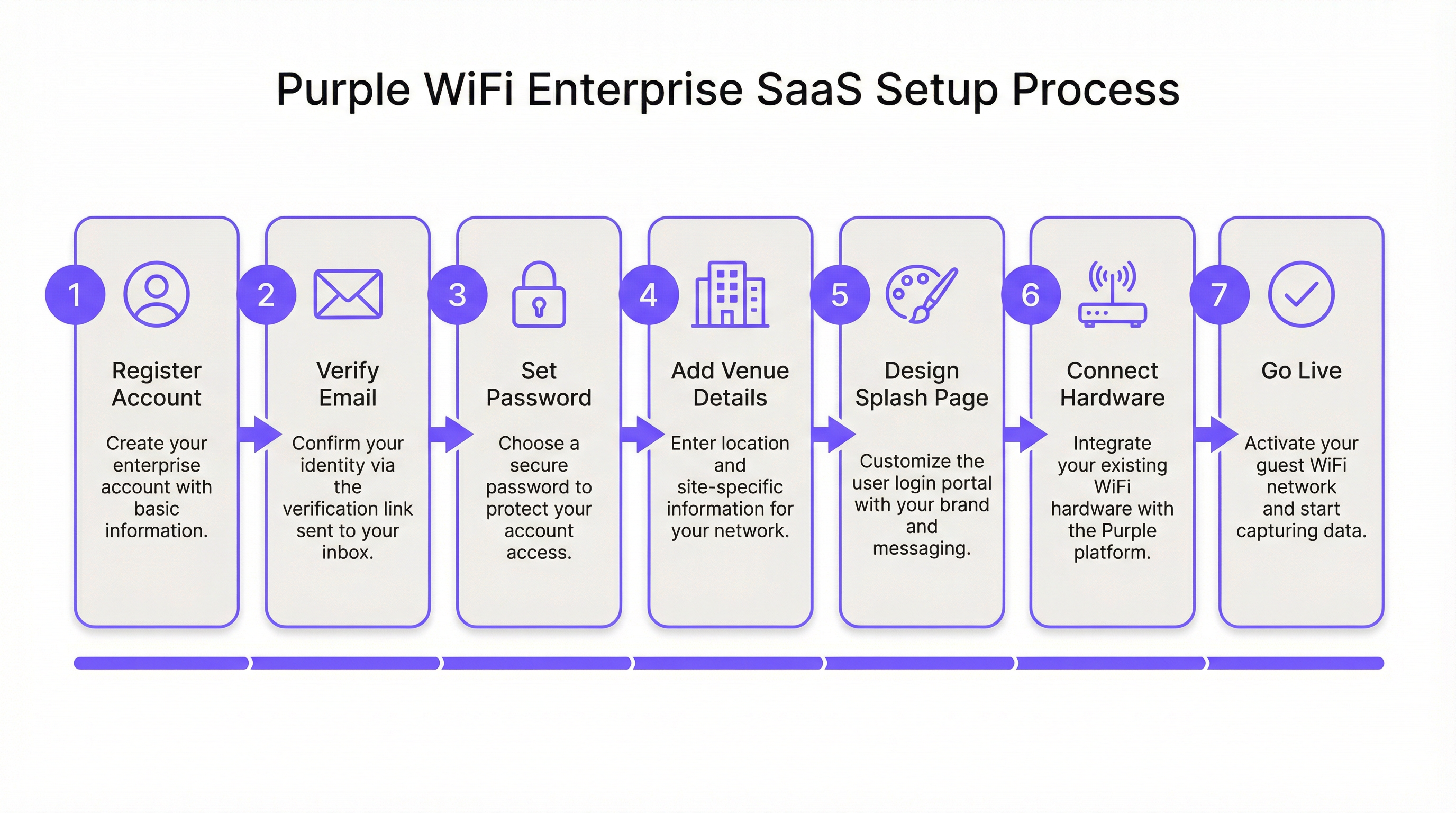
चरण 1: अकाउंट पंजीकरण और सत्यापन। प्रक्रिया purple.ai से शुरू होती है, जहां आप ग्राहक पंजीकरण फ़ॉर्म पूरा करते हैं। एक सत्यापन ईमेल तुरंत भेजा जाता है; इस लिंक पर 24 घंटे के भीतर कार्रवाई की जानी चाहिए, क्योंकि यह स्वचालित रूप से समाप्त हो जाता है। सत्यापन पर, एक दूसरा ईमेल ऑनबोर्डिंग विज़ार्ड शुरू करने के लिए 'Get Started' लिंक प्रदान करता है। इस स्तर पर, आप एक सुरक्षित पोर्टल पासवर्ड बनाएंगे। यह सलाह दी जाती है कि पासवर्ड मैनेजर का उपयोग करें और यदि आपके संगठन की सुरक्षा नीति इसे अनिवार्य करती है तो मल्टी-फ़ैक्टर ऑथेंटिकेशन (MFA) कॉन्फ़िगर करें।
चरण 2: वेन्यू और ग्रुप कॉन्फ़िगरेशन। Purple पोर्टल के भीतर पहला महत्वपूर्ण कार्य एक वेन्यू (Venue) बनाना है — वह तार्किक इकाई जो भौतिक स्थान को मैप करती है। आप वेन्यू का नाम, पता और श्रेणी (होटल, रिटेल, स्टेडियम, सम्मेलन केंद्र, आदि) दर्ज करेंगे। यह मेटाडेटा केवल प्रशासनिक नहीं है; Purple का एनालिटिक्स इंजन इसका उपयोग विज़िटर डेटा को प्रासंगिक बनाने और आपके एस्टेट में सार्थक तुलनाओं को सक्षम करने के लिए करता है। मल्टी-साइट ऑपरेटरों के लिए, ग्रुप्स (Groups) एक पदानुक्रमित (hierarchical) प्रबंधन परत प्रदान करते हैं, जिससे आप एक साथ कई वेन्यू में सुसंगत नीतियां, एक्सेस जर्नी टेम्प्लेट और रिपोर्टिंग कॉन्फ़िगरेशन लागू कर सकते हैं। उदाहरण के लिए, 50 स्टोर वाली एक रिटेल चेन एक सिंगल ग्रुप बनाएगी और फिर प्रत्येक स्टोर को चाइल्ड वेन्यू के रूप में जोड़ेगी, जिससे केंद्रीकृत प्रबंधन और विस्तृत प्रति-स्टोर एनालिटिक्स दोनों सक्षम होंगे।
चरण 3: स्प्लैश पेज डिज़ाइन। Purple दो अलग-अलग स्प्लैश पेज प्रकार प्रदान करता है जो उपयोगकर्ता यात्रा में विभिन्न उद्देश्यों की पूर्ति करते हैं। ऑफ़लाइन स्प्लैश पेज स्वयं Captive Portal है — प्रमाणीकरण से पहले, SSID से कनेक्ट होने पर गेस्ट सबसे पहले यही देखता है। यह पेज जल्दी लोड होना चाहिए, आपके ब्रांड को स्पष्ट रूप से प्रस्तुत करना चाहिए, और प्रमाणीकरण क्रिया को स्पष्ट बनाना चाहिए। ऑनलाइन स्प्लैश पेज सफल प्रमाणीकरण के बाद प्रदर्शित होता है, जो एक लैंडिंग पेज के रूप में कार्य करता है जो कनेक्टिविटी की पुष्टि करता है और इसका उपयोग प्रचार संदेश, लॉयल्टी प्रोग्राम की जानकारी, या किसी विशिष्ट URL जैसे होटल के बुकिंग इंजन या रिटेलर के प्रचार पृष्ठ पर रीडायरेक्ट करने के लिए किया जा सकता है। Purple का मानक ड्रैग-एंड-ड्रॉप एडिटर अधिकांश परिनियोजन के लिए पर्याप्त है। कस्टम HTML एडिटर उन टीमों के लिए उपलब्ध है जिन्हें पिक्सेल-परफ़ेक्ट ब्रांड अलाइनमेंट, उन्नत फ़ॉर्म लॉजिक, या थर्ड-पार्टी ट्रैकिंग स्क्रिप्ट के साथ एकीकरण की आवश्यकता होती है।
चरण 4: एक्सेस जर्नी कॉन्फ़िगरेशन। एक्सेस जर्नी (Access Journey) वह ऑर्केस्ट्रेशन लेयर है जो स्प्लैश पेज, प्रमाणीकरण विधि, डेटा कैप्चर आवश्यकताओं, नियम और शर्तों, सेशन नीतियों और प्रमाणीकरण के बाद रीडायरेक्ट को एक साथ जोड़ती है। यहीं पर आपके गेस्ट WiFi का बिज़नेस लॉजिक परिभाषित किया जाता है। एक ही वेन्यू कई समवर्ती एक्सेस जर्नी का समर्थन कर सकता है, जो विभिन्न उपयोगकर्ता सेगमेंट के लिए विभेदित (differentiated) अनुभव सक्षम करता है। उदाहरण के लिए, एक सम्मेलन केंद्र आम सार्वजनिक आगंतुकों के लिए एक जर्नी (न्यूनतम डेटा कैप्चर के साथ क्लिक-थ्रू), इवेंट प्रतिनिधियों के लिए दूसरी (पूर्ण डेटा कैप्चर और मार्केटिंग संचार के लिए सहमति के साथ फ़ॉर्म-आधारित), और प्रदर्शकों के लिए तीसरी (उच्च बैंडविड्थ आवंटन के साथ वाउचर-आधारित) कॉन्फ़िगर कर सकता है। प्रत्येक जर्नी को स्वतंत्र रूप से प्रकाशित किया जाता है, जिससे IT टीमों और मार्केटिंग टीमों को लाइव परिनियोजन को बाधित किए बिना उपयोगकर्ता अनुभव पर पुनरावृत्ति (iterate) करने का लचीलापन मिलता है।
चरण 5: हार्डवेयर एकीकरण। नेटवर्क इंजीनियरों के लिए यह तकनीकी रूप से सबसे अधिक मांग वाला चरण है। Purple 50 से अधिक हार्डवेयर वेंडर्स का समर्थन करता है, जिसमें एंटरप्राइज़ WiFi इंफ्रास्ट्रक्चर का पूरा स्पेक्ट्रम शामिल है। एकीकरण दृष्टिकोण सभी वेंडर्स में सुसंगत है: आप वेंडर, मॉडल और MAC एड्रेस निर्दिष्ट करके Purple पोर्टल में अपना एक्सेस पॉइंट या वायरलेस LAN कंट्रोलर (WLC) पंजीकृत करते हैं। Purple फिर वेंडर-विशिष्ट प्लेसहोल्डर सेटिंग्स का एक सेट जनरेट करता है — जिसमें RADIUS सर्वर IP एड्रेस, शेयर्ड सीक्रेट, Captive Portal URL और वॉल्ड गार्डन डोमेन सूची शामिल है — जिसे आप अपने हार्डवेयर के कॉन्फ़िगरेशन इंटरफ़ेस पर लागू करते हैं।
Cisco Meraki परिनियोजन के लिए, कॉन्फ़िगरेशन Meraki डैशबोर्ड में किया जाता है: एक नया गेस्ट SSID बनाएं, स्प्लैश पेज प्रकार को 'Sign-on with Purple' पर सेट करें, RADIUS सर्वर विवरण दर्ज करें, और Purple द्वारा प्रदान किए गए डोमेन के साथ वॉल्ड गार्डन को पॉप्युलेट करें। Aruba Instant APs के लिए, प्रक्रिया में IAP क्लस्टर पर एक बाहरी Captive Portal प्रोफ़ाइल कॉन्फ़िगर करना, Purple के पोर्टल URL को पॉइंट करना और RADIUS सर्वर सेटिंग्स कॉन्फ़िगर करना शामिल है। Ruckus SmartZone के लिए, कॉन्फ़िगरेशन कंट्रोलर स्तर पर किया जाता है, जिसमें बाहरी Captive Portal और RADIUS सेटिंग्स के साथ एक WLAN प्रोफ़ाइल बनाई जाती है। प्रत्येक वेंडर के पास Purple सपोर्ट पोर्टल में एक समर्पित, चरण-दर-चरण मार्गदर्शिका उपलब्ध है और, महत्वपूर्ण रूप से, Purple पोर्टल के भीतर Management > Venues > Hardware के अंतर्गत सीधे एक्सेस की जा सकती है।
चरण 6: परीक्षण और सत्यापन। लाइव होने से पहले, संपूर्ण गेस्ट जर्नी का व्यापक परीक्षण अनिवार्य है। गेस्ट SSID से एक परीक्षण डिवाइस कनेक्ट करें और निम्नलिखित सत्यापित करें: Captive Portal iOS, Android और Windows पर सही ढंग से और तुरंत लोड होता है (प्रत्येक CNA को अलग तरह से हैंडल करता है और विशिष्ट वॉल्ड गार्डन प्रविष्टियों की आवश्यकता हो सकती है); प्रत्येक कॉन्फ़िगर की गई प्रमाणीकरण विधि सफलतापूर्वक पूरी होती है; प्रमाणीकरण के बाद रीडायरेक्ट URL अपेक्षानुसार कार्य करता है; और प्रमाणित सत्र (sessions) लगभग रीयल-टाइम में Purple एनालिटिक्स डैशबोर्ड में दिखाई देते हैं। यह सत्यापित करने के लिए कि लौटने वाले उपयोगकर्ता के व्यवहार को सही ढंग से संभाला गया है, उस डिवाइस पर जर्नी का परीक्षण करने की भी सलाह दी जाती है जो पहले कनेक्ट हो चुका है।
चरण 7: गो-लाइव और निरंतर निगरानी। परीक्षण पूरा होने के बाद, Purple पोर्टल में एक्सेस जर्नी प्रकाशित करें। इस बिंदु से, निर्दिष्ट SSID पर सभी गेस्ट ट्रैफ़िक को Purple द्वारा प्रबंधित किया जाता है। वेलकम डैशबोर्ड लाइव एनालिटिक्स तक तत्काल पहुंच प्रदान करता है, जिसमें वर्तमान सक्रिय सत्र, प्रमाणीकरण विधि का विवरण, और नए बनाम लौटने वाले विज़िटर का अनुपात शामिल है। एनालिटिक्स रिपोर्ट की समीक्षा के लिए एक नियमित तालमेल स्थापित करें — Purple का डैशबोर्ड कस्टम रिपोर्टिंग का समर्थन करता है और हितधारकों को निर्धारित रिपोर्ट देने के लिए कॉन्फ़िगर किया जा सकता है।

सर्वोत्तम कार्यप्रणालियां
नेटवर्क सेगमेंटेशन किसी भी गेस्ट WiFi परिनियोजन के लिए मूलभूत सुरक्षा आवश्यकता है। गेस्ट SSID को एक समर्पित VLAN पर रखा जाना चाहिए, जिसमें सख्त फ़ायरवॉल नियम गेस्ट सेगमेंट से किसी भी ट्रैफ़िक को कॉर्पोरेट, परिचालन या PCI-स्कोप वाले नेटवर्क तक पहुंचने से रोकते हैं। यह केवल एक सर्वोत्तम कार्यप्रणाली की सिफारिश नहीं है; यह समान भौतिक नेटवर्क इंफ्रास्ट्रक्चर पर कार्ड भुगतान संसाधित करने वाले किसी भी संगठन के लिए PCI DSS 4.0 के तहत एक अनुपालन आवश्यकता है, और यह GDPR के डेटा न्यूनीकरण सिद्धांतों के अनुरूप है। होटल परिवेश में, इसका मतलब है कि प्रॉपर्टी मैनेजमेंट सिस्टम (PMS), पॉइंट-ऑफ़-सेल टर्मिनल और बैक-ऑफ़िस सिस्टम पूरी तरह से अलग नेटवर्क सेगमेंट पर होने चाहिए。
मल्टी-साइट परिनियोजन के लिए, पायलट-फ़र्स्ट दृष्टिकोण की दृढ़ता से अनुशंसा की जाती है। एक ऐसा सिंगल वेन्यू चुनें जो आपके व्यापक एस्टेट का प्रतिनिधि हो, पूर्ण परिनियोजन और परीक्षण चक्र पूरा करें, और परिणामी कॉन्फ़िगरेशन का उपयोग बाद के रोलआउट के लिए एक मान्य टेम्प्लेट के रूप में करें। यह दृष्टिकोण जोखिम को कम करता है, व्यापक परिनियोजन को गति देता है, और समस्या निवारण (troubleshooting) के लिए एक संदर्भ परिवेश प्रदान करता है।
प्रमाणीकरण विधियों को कॉन्फ़िगर करते समय, प्रत्येक विकल्प के डेटा गुणवत्ता निहितार्थों पर विचार करें। सोशल लॉगिन समृद्ध जनसांख्यिकीय डेटा प्रदान करता है लेकिन यह उपयोगकर्ता के सोशल प्रोफ़ाइल की सटीकता के अधीन है। फ़ॉर्म-आधारित प्रमाणीकरण आपको विशिष्ट फ़ील्ड कैप्चर करने की अनुमति देता है लेकिन घर्षण (friction) पैदा करता है जो पूर्णता दर को कम कर सकता है। क्लिक-थ्रू प्रमाणीकरण कनेक्शन दरों को अधिकतम करता है लेकिन न्यूनतम डेटा देता है। इष्टतम विकल्प डेटा कैप्चर उद्देश्यों और उपयोगकर्ता अनुभव आवश्यकताओं के बीच संतुलन पर निर्भर करता है, और परिनियोजन शुरू होने से पहले IT और मार्केटिंग हितधारकों के बीच इस संतुलन पर सहमति होनी चाहिए।
समस्या निवारण और जोखिम न्यूनीकरण
| सामान्य समस्या | मूल कारण | न्यूनीकरण रणनीति |
|---|---|---|
| Captive Portal iOS पर दिखाई नहीं देता है | iOS 14+ डिफ़ॉल्ट रूप से MAC रैंडमाइज़ेशन का उपयोग करता है, और CNA प्रोब DNS या फ़ायरवॉल नियमों द्वारा अवरुद्ध हो सकता है। | सत्यापित करें कि गेस्ट VLAN पर captive.apple.com के लिए DNS रिज़ॉल्यूशन अवरुद्ध नहीं है। सुनिश्चित करें कि नेटवर्क कंट्रोलर में Captive Portal रीडायरेक्ट नियम सही ढंग से लागू किया गया है। |
| सोशल लॉगिन बटन अनुत्तरदायी (unresponsive) हैं | सोशल प्रदाता के लिए आवश्यक CDN और API डोमेन वॉल्ड गार्डन में शामिल नहीं हैं। | Purple के दस्तावेज़ों से प्रमाणीकरण-संबंधित सभी डोमेन को वॉल्ड गार्डन व्हाइटलिस्ट में जोड़ें। Facebook के लिए, इसमें connect.facebook.net, graph.facebook.com और संबंधित CDN डोमेन शामिल हैं। |
| उपयोगकर्ताओं को बार-बार पुनः प्रमाणित करने के लिए कहा जाता है | लघु सेशन टाइमआउट सेटिंग्स या MAC एड्रेस रैंडमाइज़ेशन का प्रभाव जिसके कारण नेटवर्क डिवाइस को नया मानता है। | एक्सेस जर्नी सेटिंग्स में सेशन टाइमआउट की समीक्षा करें और उसे बढ़ाएं। स्थायी पहचान के लिए, उपयोगकर्ताओं को Purple ऐप या ईमेल-आधारित प्रमाणीकरण का उपयोग करने के लिए प्रोत्साहित करें। |
| प्रमाणीकरण के बाद धीमी कनेक्शन गति | अपर्याप्त इंटरनेट बैंडविड्थ या एक्सेस जर्नी में अत्यधिक प्रतिबंधात्मक प्रति-डिवाइस बैंडविड्थ थ्रॉटलिंग। | बैंडविड्थ क्षमता मूल्यांकन करें। सभी कनेक्टेड डिवाइसों में उचित उपयोग के साथ उपयोगकर्ता अनुभव को संतुलित करने के लिए एक्सेस जर्नी में प्रति-डिवाइस बैंडविड्थ सीमाएं समायोजित करें। |
| एनालिटिक्स डैशबोर्ड पॉप्युलेट नहीं हो रहा है | RADIUS अकाउंटिंग पैकेट Purple के क्लाउड प्लेटफ़ॉर्म तक नहीं पहुंच रहे हैं, या हार्डवेयर को अकाउंटिंग डेटा भेजने के लिए कॉन्फ़िगर नहीं किया गया है। | सत्यापित करें कि नेटवर्क कंट्रोलर पर RADIUS अकाउंटिंग सक्षम है और अकाउंटिंग सर्वर IP और पोर्ट Purple की प्रदान की गई सेटिंग्स से मेल खाते हैं। यह सुनिश्चित करने के लिए फ़ायरवॉल नियमों की जांच करें कि कंट्रोलर से UDP पोर्ट 1813 आउटबाउंड खुला है। |
ROI और व्यावसायिक प्रभाव
Purple को तैनात करने का व्यावसायिक मामला इंटरनेट एक्सेस के प्रावधान से कहीं आगे तक फैला हुआ है। यह प्लेटफ़ॉर्म गेस्ट WiFi नेटवर्क को एक रणनीतिक डेटा एसेट में बदल देता है। हॉस्पिटैलिटी ऑपरेटरों के लिए, विज़िटर जनसांख्यिकी, ड्वेल टाइम (dwell time) और वापसी यात्रा की आवृत्ति पर एनालिटिक्स सीधे राजस्व प्रबंधन और मार्केटिंग रणनीतियों को सूचित करते हैं। एक होटल जो यह समझता है कि कौन से गेस्ट सेगमेंट सबसे अधिक बार लौटते हैं, वह तदनुसार लॉयल्टी प्रोग्राम प्रोत्साहन तैयार कर सकता है। एक रिटेल चेन जो WiFi ड्वेल टाइम और लेनदेन मूल्य के बीच संबंध को माप सकती है, वह स्टोर लेआउट और स्टाफ़िंग को अनुकूलित कर सकती है।
प्लेटफ़ॉर्म की एकीकरण क्षमताएं इस मूल्य को और बढ़ाती हैं। Salesforce, HubSpot और अन्य प्रमुख CRM प्लेटफ़ॉर्म के लिए Purple के नेटिव कनेक्टर WiFi विज़िट डेटा के साथ ग्राहक रिकॉर्ड के स्वचालित संवर्धन (enrichment) को सक्षम करते हैं, जिससे ग्राहक का एक एकीकृत दृश्य बनता है जो डिजिटल और भौतिक दोनों इंटरैक्शन तक फैला होता है। यह डेटा एकीकरण प्रभावी ओमनीचैनल मार्केटिंग की नींव है।
IT परिचालन के दृष्टिकोण से, क्लाउड-आधारित आर्किटेक्चर मापने योग्य दक्षता लाभ प्रदान करता है। एक प्रमुख वैश्विक फ़ास्ट-फ़ूड चेन ने Purple को तैनात करने के बाद ऑन-साइट IT इंजीनियर के दौरों की आवश्यकता में 90% की कमी दर्ज की, क्योंकि केंद्रीकृत प्रबंधन और रिमोट डायग्नोस्टिक्स क्षमताओं ने IT टीम को भौतिक उपस्थिति के बिना अधिकांश नेटवर्क समस्याओं को हल करने की अनुमति दी। सैकड़ों स्थानों वाली एक चेन के लिए, यह परिचालन व्यय में पर्याप्त कमी को दर्शाता है। Purple के क्लाउड इंफ्रास्ट्रक्चर द्वारा प्रदान किया गया 99.99% अपटाइम SLA सेवा व्यवधान के जोखिम और प्रतिक्रियाशील (reactive) समर्थन की संबंधित लागतों को और कम करता है।
पुस्तकालयों, काउंसिल भवनों या परिवहन केंद्रों में गेस्ट WiFi तैनात करने वाले सार्वजनिक क्षेत्र के संगठनों के लिए, ROI की गणना अलग तरह से की जाती है — डिजिटल समावेशन, नागरिक जुड़ाव और सार्वजनिक पहुंच दायित्वों के अनुपालन के संदर्भ में। Purple की GDPR-अनुपालक डेटा कैप्चर और कंटेंट फ़िल्टरिंग (Shield) क्षमताएं इसे इन परिवेशों के लिए एक उपयुक्त प्लेटफ़ॉर्म बनाती हैं, जहां विनियामक अनुपालन (regulatory compliance) सर्वोपरि है।
मुख्य शब्द और परिभाषाएं
Captive Portal
A web page that a user is obligated to view and interact with before being granted access to the internet. It intercepts the initial web traffic from a newly connected device and presents an authentication or consent interface.
This is the core mechanism for user authentication and for presenting terms and conditions. IT teams configure their network hardware to redirect unauthenticated users to the captive portal hosted on Purple's cloud platform.
RADIUS (Remote Authentication Dial-In User Service)
A client/server networking protocol that provides centralised Authentication, Authorization, and Accounting (AAA) management for users connecting to a network service. Defined in RFC 2865.
Purple uses a cloud-based RADIUS server to authenticate guest users. Your access points and controllers act as RADIUS clients, forwarding authentication requests to Purple's cloud server, which eliminates the need for an on-premise RADIUS server and its associated maintenance overhead.
Walled Garden
A firewall policy that restricts a user's network access to a limited set of pre-approved domains and IP addresses before they have completed the authentication process on a captive portal network.
This is a critical firewall configuration step. If the walled garden does not include all the domains required for the captive portal and its authentication providers to function, the login process will fail. IT teams must configure this on their network gateway or firewall using the domain list provided by Purple.
SSID (Service Set Identifier)
The public name of a wireless local area network (WLAN) that is broadcast to nearby devices. It is the network name that appears in a device's list of available WiFi connections.
IT teams create a specific SSID for guest access (e.g., 'Hotel_Guest_WiFi') and associate it with the captive portal redirect, the VLAN, and the RADIUS configuration for the Purple service. This SSID should be kept separate from any corporate or operational SSIDs.
VLAN (Virtual Local Area Network)
A method of creating logically independent network segments over a single physical network infrastructure. Devices on different VLANs cannot communicate with each other without being explicitly routed through a firewall or router.
For security and compliance, the guest WiFi SSID must be placed on its own dedicated VLAN. This isolates guest traffic from sensitive corporate or operational network traffic. This is a prerequisite for PCI DSS compliance and aligns with GDPR data minimisation principles.
MAC Address (Media Access Control Address)
A unique hardware identifier assigned to a network interface card (NIC). It is a 48-bit address, typically displayed as six groups of two hexadecimal digits (e.g., 00:1A:2B:3C:4D:5E).
Purple uses the MAC address to identify unique devices and track returning visitors. However, MAC address randomisation in modern iOS and Android devices means this identifier changes on each connection, which can affect the accuracy of return visitor analytics. This limitation should be communicated to marketing stakeholders.
Access Journey
A Purple platform-specific term for the complete, configurable end-to-end authentication flow that a guest user experiences when connecting to the WiFi network. It encompasses the splash page, authentication method, data capture forms, session policies, and post-authentication redirect.
This is the primary configuration object within the Purple portal. IT managers and marketing teams collaborate to define Access Journeys that balance security requirements, data capture objectives, and user experience. Multiple journeys can be active simultaneously for different user segments.
IEEE 802.1X
An IEEE standard for port-based Network Access Control (PNAC). It provides an authentication mechanism to devices wishing to attach to a LAN or WLAN, using the Extensible Authentication Protocol (EAP) framework.
This is the enterprise-grade authentication standard that underpins WPA2-Enterprise and WPA3-Enterprise. Purple's RADIUS-based authentication aligns with this standard. For deployments requiring the highest security posture, Purple's SecurePass feature leverages 802.1X for certificate or credential-based authentication without a captive portal.
केस स्टडीज
A 250-room luxury hotel needs to replace its legacy guest WiFi system. They have existing Cisco WLC (AireOS) infrastructure and require a solution that offers tiered access: free standard access for all guests and a premium, high-speed option for conference attendees and VIP guests. They also need to ensure full compliance with GDPR for all data captured.
The hotel would deploy Purple as an overlay on their existing Cisco WLC infrastructure, avoiding any capital expenditure on new hardware. Two separate Access Journeys would be configured in the Purple portal. The 'Standard Guest' journey would use form-based authentication, capturing the guest's name and email address, with clearly worded consent checkboxes for GDPR compliance (separate consents for terms of service and marketing communications). This journey would have bandwidth limits of 5 Mbps per device and a session duration of 24 hours. The 'Premium Access' journey would be configured with voucher-based authentication. The hotel's event coordination team would generate batches of unique, time-limited vouchers from the Purple portal and distribute them to conference organisers. This journey would offer higher bandwidth limits (25 Mbps per device) and a 72-hour session duration. Both journeys would be linked to the same guest SSID, and the captive portal would present guests with a clear choice between the free tier and the premium voucher entry field. All captured data would be automatically synchronised to the hotel's CRM via Purple's integration connector.
A retail chain with 50 stores across the UK wants to understand customer loyalty and in-store behaviour. They have a mix of Cisco Meraki and Aruba IAP hardware across their estate. The marketing team wants to integrate the WiFi analytics with their Salesforce CRM to enable targeted re-engagement campaigns.
The retail chain would use Purple's multi-venue management capabilities to create a 'Group' for their entire estate, with each of the 50 stores configured as a separate child 'Venue'. This enables both centralised management and per-store analytics. A single, standardised Access Journey template would be configured and applied across all venues, using social login (Facebook or Google) as the primary authentication method to gather rich demographic data with minimal friction. The hardware integration would be performed in two batches: the Meraki stores would be configured via the Meraki Dashboard using Purple's SSID and RADIUS settings, while the Aruba IAP stores would be configured via the Aruba Central or Instant AP controller. The key integration step is activating the Purple Salesforce Connector. In the Purple portal, the data fields captured during WiFi authentication (name, email, age, gender, visit frequency) would be mapped to the corresponding fields on the Contact object in Salesforce. This would automatically create or update a contact record in Salesforce for every user who authenticates, enriching the CRM with physical visit data that can be used to trigger automated re-engagement campaigns.
परिदृश्य विश्लेषण
Q1. You are deploying Purple in a 20,000-capacity stadium with high-density WiFi requirements. During peak event times, you anticipate over 12,000 concurrent authenticated users. What is your primary technical consideration regarding the underlying network infrastructure, and how does Purple's architecture mitigate or exacerbate this challenge?
💡 संकेत:Consider the path of both the authentication traffic and the subsequent internet traffic, and where the bottlenecks are most likely to occur.
अनुशंसित दृष्टिकोण दिखाएं
The primary consideration is the capacity and performance of the on-premise Wireless LAN Controller (WLC) and the internet gateway. While Purple's authentication is cloud-based, all guest traffic — including the initial captive portal redirect, the RADIUS accounting packets, and the subsequent internet traffic — must pass through the venue's own network hardware. The WLC must be able to handle the high volume of RADIUS authentication and accounting packets during peak connection events (e.g., when gates open and thousands of devices connect simultaneously). The internet gateway must have sufficient bandwidth and processing power to manage 12,000+ concurrent sessions. Purple's cloud architecture mitigates the server-side load by handling the portal and RADIUS processing in the cloud, but the on-premise hardware remains the critical bottleneck. The recommended approach is to ensure the WLC is properly sized, the internet uplink has sufficient headroom, and bandwidth-per-device limits are configured in the Access Journey to prevent any single user from consuming a disproportionate share of capacity.
Q2. Your marketing team wants to use a highly stylised, graphically-intensive video on the captive portal splash page to promote a new product launch. What is the main technical risk associated with this request, and how would you advise them to achieve their marketing objective without compromising the user experience?
💡 संकेत:Consider the user's network state and available bandwidth at the precise moment the splash page is displayed.
अनुशंसित दृष्टिकोण दिखाएं
The main risk is poor user experience and high abandonment rates. Before authentication, the user is on a restricted network with limited bandwidth — they are in the walled garden, and only the portal's whitelisted domains are accessible. A large video file will load slowly or fail to load entirely, leading to user frustration and a high proportion of guests abandoning the connection attempt. I would advise the marketing team to use a lightweight, optimised static image on the Offline Splash Page (the captive portal) to ensure a fast loading time and a high authentication completion rate. The video would be far more effective on the Online Splash Page, which is displayed after the user has successfully authenticated and has full, high-speed internet access. This approach achieves the marketing objective without compromising the critical first-impression user experience.
Q3. A public-sector client wants to provide free WiFi in a city library. They are concerned about their legal obligations regarding illegal content and the safeguarding of vulnerable users, including children. Which Purple feature would you highlight to address this concern, and what additional steps would you recommend to ensure the client has a defensible compliance position?
💡 संकेत:Think about both the technical controls available and the policy and legal framework that must surround them.
अनुशंसित दृष्टिकोण दिखाएं
I would highlight Purple's Shield content filtering feature, which allows the organisation to block access to specific categories of websites — including adult content, gambling, extremist material, and malware sites — at the network level. This provides a meaningful technical control. However, I would strongly advise the client that technical filtering alone is not sufficient for a defensible compliance position. Additional steps should include: publishing a clear Acceptable Use Policy (AUP) that users must accept before connecting; configuring the Access Journey to require explicit acceptance of the AUP; retaining session logs for a legally appropriate period in accordance with data retention policies; and conducting a Data Protection Impact Assessment (DPIA) under GDPR Article 35, given the likelihood of processing data relating to children. The client should also be advised that no content filtering system is 100% effective, and that the AUP acceptance creates a clear record of the user's agreement to the terms of use.
मुख्य निष्कर्ष
- ✓Purple WiFi is a cloud-hosted overlay platform that integrates with your existing network hardware from over 50 vendors, requiring no on-premise server infrastructure.
- ✓The setup is a seven-step process: Register, Verify, Configure Venue, Design Splash Pages, Set Up Access Journeys, Integrate Hardware, and Go Live.
- ✓Proper network segmentation — placing guest traffic on a dedicated, isolated VLAN — is the most critical security and compliance measure before any Purple configuration begins.
- ✓Correctly configuring the Walled Garden in your firewall is essential for the captive portal and social logins to function; an incomplete walled garden is the most common cause of deployment failures.
- ✓Authentication is handled by Purple's cloud-based RADIUS server, aligned with IEEE 802.1X standards, eliminating the need for on-premise AAA infrastructure.
- ✓The platform delivers significant business value through rich visitor analytics and CRM integrations (Salesforce, HubSpot), transforming guest WiFi from an amenity into a data asset.
- ✓MAC address randomisation in modern iOS and Android devices affects return visitor tracking accuracy; communicate this limitation to marketing stakeholders and consider the Purple App for persistent user identification.




