

Zero Trust WiFi आर्किटेक्चर: वेन्यू नेटवर्क पर Zero Trust लागू करना
एक व्यापक तकनीकी संदर्भ मार्गदर्शिका जो विस्तार से बताती है कि वेन्यू ऑपरेटर एंटरप्राइज WiFi नेटवर्क पर Zero Trust सिद्धांतों को कैसे लागू कर सकते हैं। इसमें हॉस्पिटैलिटी, रिटेल और सार्वजनिक क्षेत्र के वातावरण को लेटरल मूवमेंट और अनुपालन जोखिमों से सुरक्षित करने के लिए निरंतर सत्यापन, माइक्रो-सेगमेंटेशन और डिवाइस पोस्चर एन्फोर्समेंट को शामिल किया गया है।
🎧 इस गाइड को सुनें
ट्रांसक्रिप्ट देखें
कार्यकारी सारांश
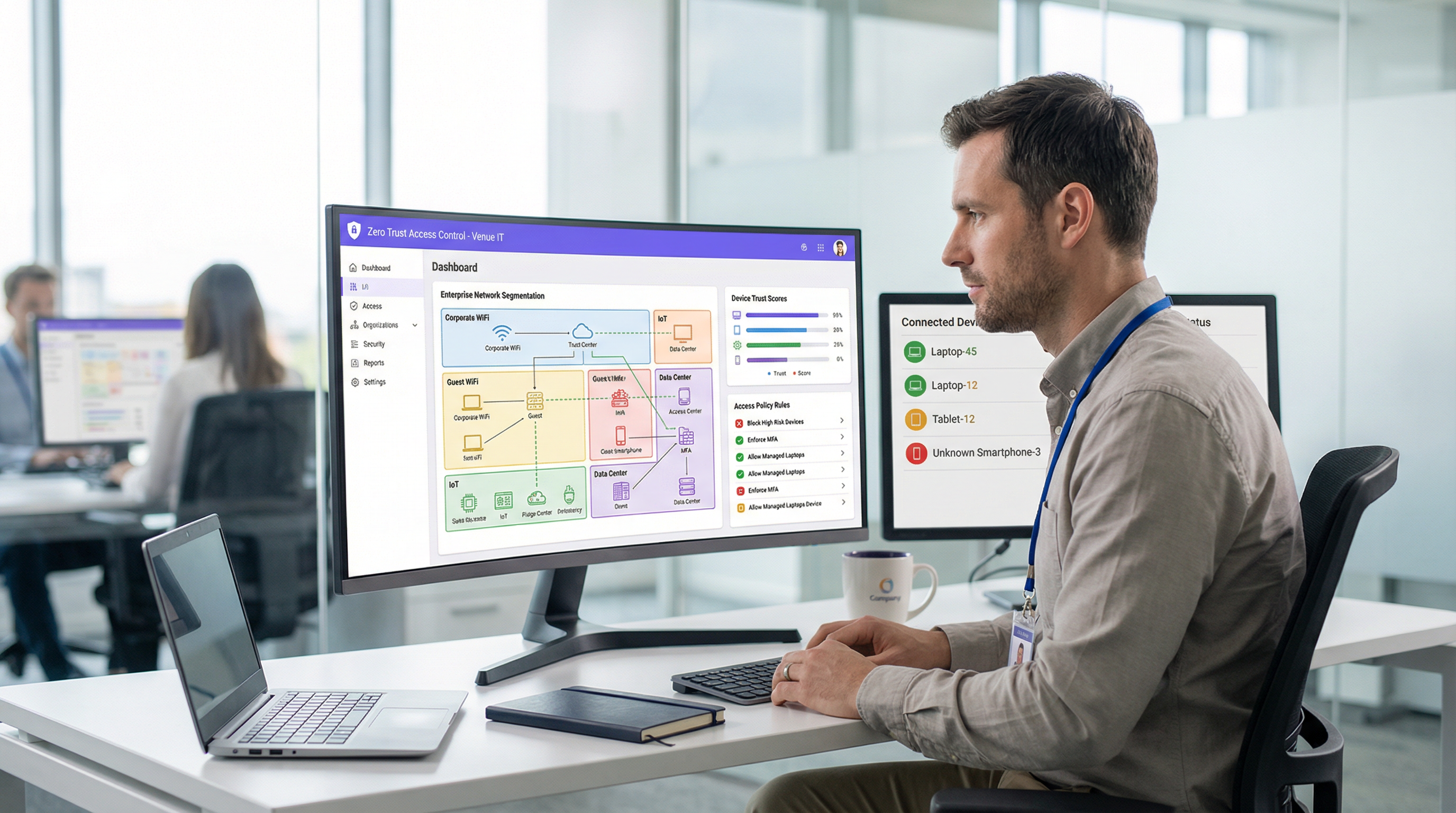
पेरिमीटर का दौर खत्म हो गया है। वेन्यू ऑपरेटरों—होटल, रिटेल चेन, स्टेडियम और सार्वजनिक क्षेत्र के संगठनों—के लिए, WiFi नेटवर्क पर सफलतापूर्वक प्रमाणित होने वाले किसी भी डिवाइस पर भरोसा करने का पारंपरिक सुरक्षा मॉडल अब व्यावहारिक नहीं है। एक आधुनिक वेन्यू नेटवर्क कॉर्पोरेट लैपटॉप, BYOD स्मार्टफोन, अनमैनेज्ड गेस्ट डिवाइस, IoT सेंसर और POS टर्मिनल और प्रॉपर्टी मैनेजमेंट सिस्टम जैसे महत्वपूर्ण इंफ्रास्ट्रक्चर का एक जटिल इकोसिस्टम है, जो सभी एक ही फिजिकल एयरस्पेस साझा करते हैं।
Zero Trust WiFi आर्किटेक्चर इस वातावरण को सुरक्षित करने के लिए एक रणनीतिक अनिवार्यता है। यह त्रुटिपूर्ण "भरोसा करें लेकिन सत्यापित करें" मॉडल को निरंतर सत्यापन, न्यूनतम-विशेषाधिकार एक्सेस और सख्त माइक्रो-सेगमेंटेशन के साथ बदल देता है। यह व्यावहारिक संदर्भ मार्गदर्शिका IT लीडर्स को एंटरप्राइज वायरलेस नेटवर्क पर Zero Trust सिद्धांतों को लागू करने के लिए ब्लूप्रिंट प्रदान करती है। हम बुनियादी तकनीकों—IEEE 802.1X, WPA3-Enterprise, और RADIUS पॉलिसी एन्फोर्समेंट—का विवरण देते हैं और उपयोगकर्ता अनुभव से समझौता किए बिना आपके वेन्यू को सुरक्षित करने के लिए कार्रवाई योग्य परिनियोजन मार्गदर्शन प्रदान करते हैं। इन नियंत्रणों को लागू करके, संगठन अपने अटैक सरफेस को काफी कम कर सकते हैं, PCI DSS और GDPR का अनुपालन सुनिश्चित कर सकते हैं, और उल्लंघन की स्थिति में लेटरल मूवमेंट के जोखिम को कम कर सकते हैं।
Zero Trust WiFi आर्किटेक्चर पर हमारी कार्यकारी ब्रीफिंग सुनें:
तकनीकी डीप-डाइव: Zero Trust WiFi के चार स्तंभ
Zero Trust कोई एक उत्पाद नहीं है जिसे आप खरीदकर अपने सर्वर रूम में लगा सकें; यह एक आर्किटेक्चरल फ्रेमवर्क है। जब इसे वायरलेस एज पर लागू किया जाता है, तो यह सुरक्षा को नेटवर्क पेरिमीटर से व्यक्तिगत डिवाइस और उपयोगकर्ताओं पर स्थानांतरित करने के लिए चार बुनियादी स्तंभों पर निर्भर करता है।
1. निरंतर सत्यापन
पारंपरिक WiFi सुरक्षा मॉडल एक बार के प्रमाणीकरण इवेंट पर निर्भर करता है। एक उपयोगकर्ता PSK या अपने Active Directory क्रेडेंशियल दर्ज करता है, एक्सेस पॉइंट एक्सेस प्रदान करता है, और सत्र की अवधि के लिए डिवाइस पर भरोसा किया जाता है। Zero Trust निरंतर सत्यापन को अनिवार्य बनाता है।
इसका मतलब है कि भरोसे को कभी भी स्थायी नहीं माना जाता है। उन्नत RADIUS कॉन्फ़िगरेशन और नेटवर्क एक्सेस कंट्रोल (NAC) पॉलिसियों का उपयोग करते हुए, नेटवर्क संसाधनों तक पहुंचने के डिवाइस के अधिकार का निरंतर पुनर्मूल्यांकन करता है। यदि किसी डिवाइस का संदर्भ बदलता है—उदाहरण के लिए, यदि उसका एंडपॉइंट प्रोटेक्शन एजेंट अक्षम है, या वह अपने सामान्य व्यवहार प्रोफाइल के बाहर संसाधनों तक पहुंचने का प्रयास करता है—तो उसके एक्सेस विशेषाधिकारों को सत्र के बीच में ही गतिशील रूप से रद्द या प्रतिबंधित किया जा सकता है। इसके लिए सत्र पुन: प्रमाणीकरण टाइमर कॉन्फ़िगर करने और आपके वायरलेस कंट्रोलर को एक मजबूत पहचान प्रदाता के साथ एकीकृत करने की आवश्यकता होती है।
2. न्यूनतम-विशेषाधिकार नेटवर्क एक्सेस
एक बार डिवाइस प्रमाणित हो जाने के बाद, वह क्या कर सकता है? एक फ्लैट नेटवर्क में, उत्तर है "लगभग कुछ भी।" Zero Trust आर्किटेक्चर में, प्रत्येक डिवाइस को अपना कार्य करने के लिए आवश्यक पूर्ण न्यूनतम एक्सेस प्रदान किया जाता है।
Guest WiFi के माध्यम से जुड़ने वाले अतिथि को आउटबाउंड इंटरनेट एक्सेस और DNS रिज़ॉल्यूशन की आवश्यकता होती है; उनका स्थानीय सबनेट के साथ संचार करने का कोई वैध कारण नहीं है। एक प्रबंधित कॉर्पोरेट लैपटॉप को आंतरिक फ़ाइल शेयर और क्लाउड एप्लिकेशन तक पहुंच की आवश्यकता हो सकती है। एक स्मार्ट थर्मोस्टेट को केवल अपने विशिष्ट क्लाउड कंट्रोलर के साथ संचार की आवश्यकता होती है। यह सिद्धांत नेटवर्क एज पर डायनेमिक रोल असाइनमेंट के माध्यम से लागू किया जाता है, जहां RADIUS सर्वर एक्सेस पॉइंट को विशिष्ट वेंडर-स्पेसिफिक एट्रिब्यूट्स (VSAs) लौटाता है, जिससे डिवाइस को एक व्यापक, अनुमति देने वाले नेटवर्क सेगमेंट के बजाय एक कड़ाई से नियंत्रित भूमिका में रखा जाता है।
3. डायनेमिक VLAN के माध्यम से माइक्रो-सेगमेंटेशन
माइक्रो-सेगमेंटेशन वह तंत्र है जिसके द्वारा नेटवर्क लेयर पर न्यूनतम-विशेषाधिकार एक्सेस लागू किया जाता है। सभी वायरलेस क्लाइंट के लिए एक ही बड़ा सबनेट बनाए रखने के बजाय, नेटवर्क को अलग-अलग, तार्किक रूप से पृथक सेगमेंट में विभाजित किया जाता है, आमतौर पर डायनेमिक VLAN असाइनमेंट का उपयोग करके।
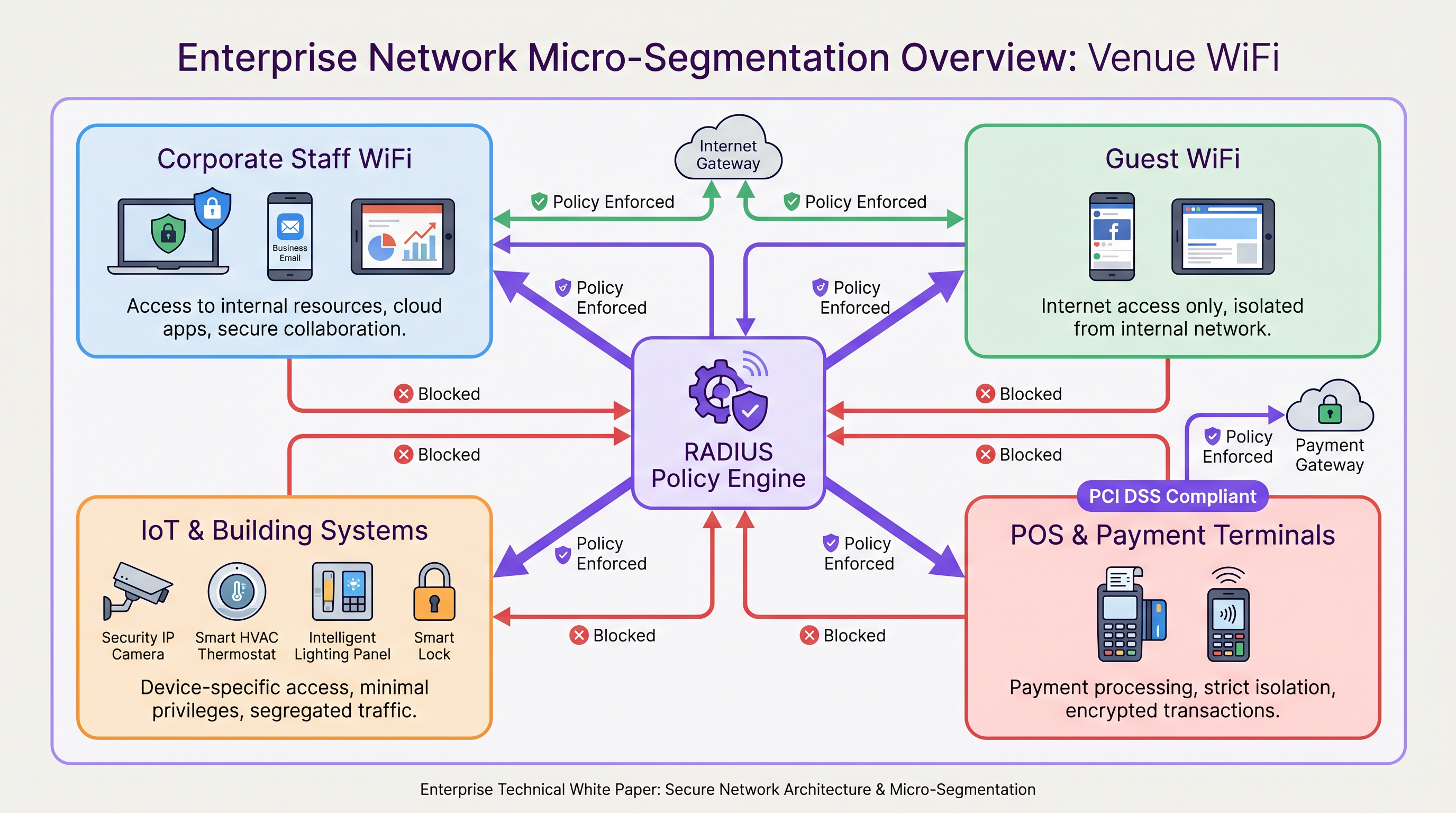
जब कोई डिवाइस 802.1X के माध्यम से प्रमाणित होता है, तो RADIUS पॉलिसी इंजन उपयोगकर्ता की पहचान, डिवाइस के प्रकार और स्थान का मूल्यांकन करता है, और डिवाइस को उपयुक्त VLAN में असाइन करता है। फायरवॉल और एक्सेस कंट्रोल लिस्ट (ACLs) इसके बाद इन माइक्रो-सेगमेंट के बीच ट्रैफिक प्रवाह को नियंत्रित करते हैं। उदाहरण के लिए, Retail वातावरण में, PCI DSS अनुपालन कार्डधारक डेटा वातावरण के सख्त अलगाव को अनिवार्य बनाता है। माइक्रो-सेगमेंटेशन यह सुनिश्चित करता है कि गेस्ट नेटवर्क पर कोई समझौता किया गया डिवाइस POS टर्मिनल के साथ संचार नहीं कर सकता।
4. डिवाइस पोस्चर एन्फोर्समेंट
भरोसा स्थापित करने के लिए केवल पहचान ही पर्याप्त नहीं है; डिवाइस के स्वास्थ्य और अनुपालन को भी सत्यापित किया जाना चाहिए। डिवाइस पोस्चर एन्फोर्समेंट एक्सेस देने से पहले एंडपॉइंट की स्थिति की जांच करता है।
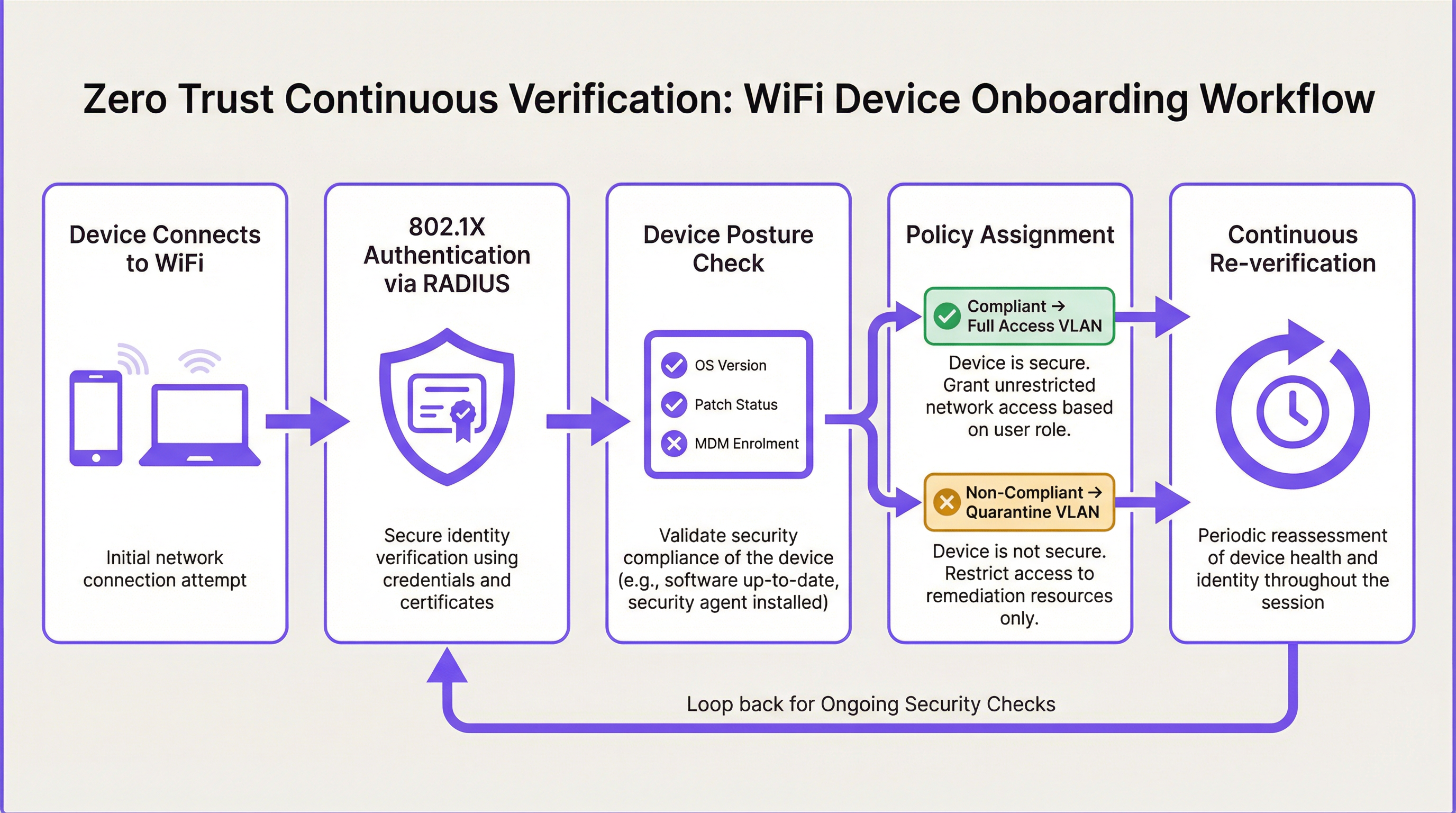
क्या डिवाइस एक समर्थित, पैच किए गए ऑपरेटिंग सिस्टम पर चल रहा है? क्या यह कॉर्पोरेट मोबाइल डिवाइस मैनेजमेंट (MDM) प्लेटफॉर्म में नामांकित है? क्या एंटीवायरस सॉफ़्टवेयर सक्रिय और अपडेट है? यदि कोई डिवाइस इन पोस्चर जांचों में विफल रहता है, तो उसे केवल डिस्कनेक्ट नहीं किया जाता है; उसे पैच सर्वर या IT सपोर्ट पोर्टल तक सीमित पहुंच के साथ एक रेमेडिएशन VLAN में रखा जाता है, जिससे उपयोगकर्ता को मैन्युअल IT हस्तक्षेप की आवश्यकता के बिना अनुपालन समस्या को हल करने की अनुमति मिलती है।
कार्यान्वयन मार्गदर्शिका: समाधान की रूपरेखा तैयार करना
Zero Trust WiFi को तैनात करने के लिए वायरलेस LAN, प्रमाणीकरण इंफ्रास्ट्रक्चर और नेटवर्क सुरक्षा स्टैक में एक समन्वित दृष्टिकोण की आवश्यकता होती है।
मुख्य प्रौद्योगिकियां और मानक
- IEEE 802.1X: सुरक्षित नेटवर्क एक्सेस की नींव। 802.1X पोर्ट-आधारित एक्सेस कंट्रोल प्रदान करता है, यह सुनिश्चित करता है कि डिवाइस तब तक ट्रैफिक (EAP ऑथेंटिकेशन फ्रेम के अलावा) पास नहीं कर सकते जब तक कि उन्हें RADIUS सर्वर द्वारा स्पष्ट रूप से ऑथेंटिकेट और ऑथोराइज न किया गया हो।
- EAP-TLS (एक्सटेंसिबल ऑथेंटिकेशन प्रोटोकॉल - ट्रांसपोर्ट लेयर सिक्योरिटी): डिवाइस ऑथेंटिकेशन के लिए गोल्ड स्टैंडर्ड। EAP-TLS म्यूचुअल ऑथेंटिकेशन के लिए क्लाइंट-साइड और सर्वर-साइड डिजिटल सर्टिफिकेट का उपयोग करता है, जिससे फिशिंग या मैन-इन-द-मिडल (MitM) हमलों के माध्यम से क्रेडेंशियल चोरी के जोखिम को पूरी तरह से समाप्त किया जा सकता है। ऑथेंटिकेशन प्रोटोकॉल के बारे में गहराई से जानने के लिए, हमारी गाइड देखें: Comparativa de métodos EAP: PEAP, EAP-TLS, EAP-TTLS y EAP-FAST ।
- WPA3-Enterprise: वायरलेस एन्क्रिप्शन के लिए वर्तमान मानक। WPA3-Enterprise, विशेष रूप से जब 192-बिट मोड में तैनात किया जाता है, तो अत्यधिक संवेदनशील वातावरण के लिए आवश्यक क्रिप्टोग्राफिक मजबूती प्रदान करता है, जो असुरक्षित WPA2 मानक की जगह लेता है।
- RADIUS Policy Engine: आर्किटेक्चर का केंद्रीय मस्तिष्क। RADIUS सर्वर परिभाषित नीतियों के विरुद्ध ऑथेंटिकेशन अनुरोधों का मूल्यांकन करता है और एक्सेस पॉइंट पर डायनेमिक एट्रिब्यूट्स (VLAN IDs, ACLs, बैंडविड्थ सीमाएं) लौटाता है।
स्टेप-बाय-स्टेप डिप्लॉयमेंट चरण
- डिस्कवरी और प्रोफाइलिंग: आप उसे सुरक्षित नहीं कर सकते जिसे आप देख नहीं सकते। वर्तमान में नेटवर्क पर मौजूद सभी डिवाइसों की प्रोफाइलिंग से शुरुआत करें। डिवाइसों को लॉजिकल समूहों (जैसे, कॉर्पोरेट IT, BYOD, गेस्ट, IoT, POS) में वर्गीकृत करने के लिए DHCP फिंगरप्रिंटिंग, MAC OUI विश्लेषण और HTTP यूजर-एजेंट पार्सिंग का उपयोग करें।
- माइक्रो-सेगमेंट परिभाषित करें: डिस्कवरी चरण के आधार पर, अपने लक्षित VLAN आर्किटेक्चर को परिभाषित करें। एक विशिष्ट Hospitality डिप्लॉयमेंट के लिए गेस्ट इंटरनेट, स्टाफ ऑपरेशंस, प्रॉपर्टी मैनेजमेंट सिस्टम (PMS) और बिल्डिंग IoT के लिए सेगमेंट की आवश्यकता हो सकती है।
- हाई-अवेलेबिलिटी RADIUS तैनात करें: एक मजबूत RADIUS इन्फ्रास्ट्रक्चर लागू करें जो ऑथेंटिकेशन लोड और पॉलिसी मूल्यांकन को संभालने में सक्षम हो। विफलता के एकल बिंदु को रोकने के लिए एक्टिव-एक्टिव या एक्टिव-पैसिव रिडंडेंसी सुनिश्चित करें।
- प्रबंधित डिवाइसों के लिए 802.1X लागू करें: कॉर्पोरेट-प्रबंधित लैपटॉप और टैबलेट को EAP-TLS के साथ 802.1X पर माइग्रेट करके शुरुआत करें। एक सहज उपयोगकर्ता अनुभव सुनिश्चित करने के लिए अपने MDM समाधान के माध्यम से आवश्यक सर्टिफिकेट और वायरलेस प्रोफाइल पुश करें।
- MAC ऑथेंटिकेशन बाईपास (MAB) और प्रोफाइलिंग के माध्यम से IoT को संबोधित करें: कई पुराने IoT डिवाइस (प्रिंटर, स्मार्ट टीवी, Sensors ) 802.1X सप्लीकेंट्स का समर्थन नहीं करते हैं। इन डिवाइसों के लिए, सख्त डिवाइस प्रोफाइलिंग के साथ संयुक्त MAB लागू करें। RADIUS सर्वर डिवाइस को उसके MAC एड्रेस के आधार पर ऑथेंटिकेट करता है लेकिन एक अत्यधिक प्रतिबंधात्मक ACL लागू करता है जो केवल आवश्यक सर्वरों के साथ संचार की अनुमति देता है।
- SD-WAN के साथ एकीकृत करें: सुनिश्चित करें कि आपका वायरलेस माइक्रो-सेगमेंटेशन आपके व्यापक नेटवर्क आर्किटेक्चर के साथ संरेखित है। जैसा कि The Core SD WAN Benefits for Modern Businesses में चर्चा की गई है, SD-WAN इन सेगमेंटेड नीतियों को WAN तक विस्तारित कर सकता है, जिससे एंड-टू-एंड ज़ीरो ट्रस्ट प्रवर्तन सुनिश्चित होता है।
वेन्यू नेटवर्क के लिए सर्वोत्तम अभ्यास
- कॉर्पोरेट एक्सेस के लिए कभी भी PSKs पर भरोसा न करें: प्री-शेयर्ड कीज़ (PSKs) एन्क्रिप्शन प्रदान करती हैं लेकिन पहचान सत्यापन शून्य होता है। पासवर्ड रखने वाला कोई भी व्यक्ति एक्सेस कर सकता है। PSKs को विशेष रूप से पुराने IoT नेटवर्क (आदर्श रूप से MPSK/DPSK जैसी तकनीकों के माध्यम से प्रति डिवाइस अद्वितीय PSK का उपयोग करके) या ओपन गेस्ट नेटवर्क तक ही सीमित रखा जाना चाहिए।
- डिवाइस ऑनबोर्डिंग को ऑटोमेट करें: 802.1X और सर्टिफिकेट-आधारित ऑथेंटिकेशन में परिवर्तन एंड-यूज़र के लिए घर्षण रहित होना चाहिए। ऑनबोर्डिंग पोर्टल्स का उपयोग करें जो IT हेल्पडेस्क टिकटों की आवश्यकता के बिना BYOD डिवाइसों को सही सर्टिफिकेट और नेटवर्क प्रोफाइल के साथ स्वचालित रूप से प्रोविजन करते हैं।
- व्यवहार की निगरानी और बेसलाइनिंग: ज़ीरो ट्रस्ट के लिए दृश्यता की आवश्यकता होती है। सामान्य नेटवर्क व्यवहार के लिए बेसलाइन स्थापित करने के लिए WiFi Analytics का लाभ उठाएं। यदि कोई IP कैमरा अचानक आंतरिक सर्वरों से SSH कनेक्शन शुरू करने का प्रयास करता है, तो पॉलिसी इंजन को इस विसंगति का पता लगाना चाहिए और डिवाइस को स्वचालित रूप से क्वारंटाइन करना चाहिए।
- आधुनिक हार्डवेयर के साथ संरेखित करें: सुनिश्चित करें कि आपका इन्फ्रास्ट्रक्चर आवश्यक मानकों का समर्थन करता है। WPA3 और डायनेमिक पॉलिसी प्रवर्तन के लिए आवश्यक क्षमताओं को समझने के लिए Wireless Access Points Definition Your Ultimate 2026 Guide पर हमारी गाइड देखें।
समस्या निवारण और जोखिम न्यूनीकरण
लाइव वेन्यू नेटवर्क पर ज़ीरो ट्रस्ट लागू करने में परिचालन जोखिम होते हैं। सबसे आम विफलता मोड में वैध ट्रैफिक को ब्लॉक करना या ऑथेंटिकेशन लूप बनाना शामिल है।
| जोखिम/विफलता मोड | कारण | न्यूनीकरण रणनीति |
|---|---|---|
| 802.1X ऑथेंटिकेशन टाइमआउट | सप्लीकेंट मिसकॉन्फ़िगरेशन या RADIUS सर्वर लेटेंसी। | सुनिश्चित करें कि RADIUS सर्वर वेन्यू के भौगोलिक रूप से निकट हों। क्लाइंट डिवाइसों पर सर्टिफिकेट ट्रस्ट चेन को सत्यापित करें। यूजर क्रेडेंशियल प्रॉम्प्ट से बचने के लिए EAP-TLS का उपयोग करें। |
| IoT डिवाइस ऑफलाइन होना | डिवाइस MAC ऑथेंटिकेशन बाईपास में विफल हो रहे हैं या पोस्चर चेक में विफल हो रहे हैं। | ब्लॉक नीतियों को लागू करने से पहले 'मॉनिटर मोड' चरण लागू करें। सभी MAB विफलताओं को लॉग करें और प्रवर्तन मोड पर स्विच करने से पहले डिवाइस प्रोफाइलिंग नियमों को परिष्कृत करें। |
| ओवर-सेगमेंटेशन जटिलता | बहुत अधिक VLAN बनाना, जिससे रूटिंग जटिलता और टूटे हुए एप्लिकेशन (जैसे, Bonjour/mDNS जैसी मल्टीकास्ट डिस्कवरी विफलताएं) पैदा होती हैं। | व्यापक कार्यात्मक सेगमेंट (गेस्ट, स्टाफ, IoT, सिक्योर) के साथ शुरुआत करें। आगे सेगमेंटेशन तभी पेश करें जब कोई विशिष्ट जोखिम या अनुपालन जनादेश (जैसे, PCI DSS) इसकी आवश्यकता हो। यदि क्रॉस-VLAN डिस्कवरी आवश्यक है तो Bonjour गेटवे का उपयोग करें। |
| Captive Portal बाईपास | उन्नत उपयोगकर्ता गेस्ट पोर्टल ऑथेंटिकेशन को बायपास करने के लिए MAC एड्रेस को स्पूफ कर रहे हैं। | MAC एड्रेस आसानी से स्पूफ किए जा सकते हैं। MAC स्पूफिंग के प्रभाव को कम करने के लिए ब्राउज़र फिंगरप्रिंटिंग के साथ MAC ट्रैकिंग को मिलाएं और सेशन टाइमआउट लागू करें। |
ROI और व्यावसायिक प्रभाव
ज़ीरो ट्रस्ट WiFi आर्किटेक्चर में संक्रमण के लिए इंजीनियरिंग समय, RADIUS इन्फ्रास्ट्रक्चर और पोटेसंभावित रूप से NAC लाइसेंसिंग। हालांकि, एंटरप्राइज वेन्यू के लिए निवेश पर रिटर्न पर्याप्त और मापने योग्य है:
- उल्लंघन के प्रभाव में कमी (ब्लास्ट रेडियस में कमी): नेटवर्क को माइक्रो-सेगमेंटिंग करके, एक समझौता किए गए गेस्ट डिवाइस या असुरक्षित IoT सेंसर का उपयोग महत्वपूर्ण बुनियादी ढांचे पर हमला करने के लिए पिवट पॉइंट के रूप में नहीं किया जा सकता है। यह किसी घटना के "ब्लास्ट रेडियस" को सीमित करता है, जिससे उल्लंघन के संभावित वित्तीय और प्रतिष्ठा संबंधी नुकसान में भारी कमी आती है।
- सुव्यवस्थित अनुपालन ऑडिट: रिटेल और हॉस्पिटैलिटी वेन्यू के लिए, PCI DSS और GDPR अनुपालन महत्वपूर्ण परिचालन बोझ हैं। माइक्रो-सेगमेंटेशन कार्डहोल्डर डेटा एनवायरनमेंट (CDE) और व्यक्तिगत रूप से पहचान योग्य जानकारी (PII) को प्रोसेस करने वाले सिस्टम को स्पष्ट रूप से परिभाषित और अलग करता है। यह अनुपालन ऑडिट के दायरे को कम करता है, जिससे महत्वपूर्ण समय और परामर्श शुल्क की बचत होती है।
- परिचालन दक्षता: PSK मैनेजमेंट और मैन्युअल VLAN असाइनमेंट से हटकर डायनेमिक, पॉलिसी-संचालित एक्सेस की ओर बढ़ने से IT हेल्पडेस्क का बोझ कम हो जाता है। ऑटोमेटेड ऑनबोर्डिंग और सेल्फ-सर्विस रेमेडिएशन वर्कफ़्लो वरिष्ठ इंजीनियरों को WiFi पासवर्ड रीसेट करने के बजाय रणनीतिक पहलों पर ध्यान केंद्रित करने के लिए मुक्त करते हैं।
- वेन्यू को भविष्य के लिए तैयार करना: जैसे-जैसे वेन्यू अधिक उन्नत तकनीकें तैनात करते हैं— वेफाइंडिंग सिस्टम से लेकर ऑटोमेटेड चेक-इन कियोस्क तक—हमले का दायरा बढ़ता जाता है। एक ज़ीरो ट्रस्ट फाउंडेशन यह सुनिश्चित करता है कि कोर नेटवर्क से समझौता किए बिना नई तकनीकों को सुरक्षित रूप से एकीकृत किया जा सके। जैसा कि मॉडर्न हॉस्पिटैलिटी WiFi सॉल्यूशंस जिसके आपके मेहमान हकदार हैं में बताया गया है, सुरक्षा आधुनिक गेस्ट अनुभव का अदृश्य आधार है।
मुख्य शब्द और परिभाषाएं
Zero Trust Network Access (ZTNA)
A security framework that requires all users and devices, whether inside or outside the organisation's network, to be authenticated, authorised, and continuously validated before being granted access to applications and data.
The overarching philosophy that drives the shift from perimeter-based security to identity- and context-based security on venue WiFi networks.
Micro-Segmentation
The practice of dividing a network into distinct security segments down to the individual workload or device level, applying strict access controls to dictate how these segments communicate.
Essential for limiting the 'blast radius' of a breach; ensures a compromised guest device cannot access corporate servers or POS terminals.
IEEE 802.1X
An IEEE Standard for port-based Network Access Control (PNAC), providing an authentication mechanism to devices wishing to attach to a LAN or WLAN.
The foundational protocol for enforcing Zero Trust at the wireless edge, acting as the gatekeeper before any network traffic is permitted.
RADIUS (Remote Authentication Dial-In User Service)
A networking protocol that provides centralised Authentication, Authorization, and Accounting (AAA) management for users who connect and use a network service.
The policy engine in a Zero Trust WiFi architecture that evaluates credentials and dynamically assigns VLANs and access policies.
EAP-TLS (Extensible Authentication Protocol - Transport Layer Security)
An EAP method that uses public key infrastructure (PKI) and digital certificates for mutual authentication between the client and the authentication server.
The most secure authentication method for managed devices, eliminating reliance on passwords and protecting against credential theft.
Dynamic VLAN Assignment
A network configuration where a RADIUS server assigns a device to a specific Virtual Local Area Network (VLAN) based on its authenticated identity or profile, rather than the SSID it connected to.
The primary mechanism for enforcing micro-segmentation and least-privilege access on enterprise wireless networks.
MAC Authentication Bypass (MAB)
A technique used to authenticate devices that do not support 802.1X supplicants (like many IoT devices) by using their MAC address as the identity credential.
A pragmatic workaround for legacy devices, which must be paired with strict profiling and restricted VLAN assignment due to the ease of MAC spoofing.
Device Posture
The security state of an endpoint device, including factors such as OS patch level, antivirus status, firewall configuration, and MDM enrolment.
A critical component of continuous verification; devices failing posture checks are quarantined regardless of valid user credentials.
केस स्टडीज
A 350-room hotel group needs to secure its flat network architecture where guest devices, staff laptops, IP cameras, and the Property Management System (PMS) currently share the same VLAN, creating significant GDPR and lateral movement risks.
Deploy a micro-segmented architecture using dynamic VLAN assignment via RADIUS. Create four distinct segments: Guest Internet, Staff Corporate, IoT/Building Systems, and PMS Access. Implement 802.1X with EAP-TLS certificate authentication for staff devices via MDM. Use MAC Authentication Bypass (MAB) with strict profiling for IoT devices, placing them in an isolated VLAN with restrictive ACLs. Guest devices authenticate via a captive portal, receiving internet-only access.
A major retail chain with 200 stores must achieve PCI DSS compliance by isolating its Point of Sale (POS) terminals from the customer WiFi and staff productivity networks, all of which currently operate on the same physical wireless infrastructure.
Implement role-based access control and micro-segmentation. Configure the RADIUS policy engine to assign devices to three isolated VLANs: Customer Guest WiFi (internet only), Staff WiFi (role-based access for managers vs. associates), and a dedicated POS segment. Secure the POS segment using WPA3-Enterprise and EAP-TLS, enforcing strict firewall rules that only permit traffic to the payment gateway. Integrate RADIUS accounting logs into the SIEM for audit trails.
A stadium venue needs to deploy a new fleet of smart turnstiles. These devices support basic WPA2-Personal but do not have an 802.1X supplicant. How should the network architect integrate them into the Zero Trust WiFi environment?
The architect should utilise MAC Authentication Bypass (MAB) configured on the RADIUS server. The turnstiles' MAC addresses should be profiled, and upon connection, the RADIUS server should dynamically assign them to a dedicated, highly restricted 'Turnstile IoT' VLAN. The firewall rules for this VLAN must enforce least-privilege, permitting outbound communication only to the specific ticketing gateway IP addresses on the required ports, blocking all lateral movement to other network segments.
परिदृश्य विश्लेषण
Q1. During a network audit, you discover that the 'Staff Corporate' SSID uses a single Pre-Shared Key (PSK) shared among 50 employees. What are the primary security risks of this configuration in a Zero Trust context, and what is the recommended remediation?
💡 संकेत:Focus on identity verification and the impact of employee turnover.
अनुशंसित दृष्टिकोण दिखाएं
The primary risks are the lack of individual identity verification (anyone with the PSK is trusted) and the inability to revoke access for a single user without changing the password for everyone (e.g., when an employee leaves). The recommended remediation is to migrate the 'Staff Corporate' SSID to WPA3-Enterprise using 802.1X. Ideally, deploy EAP-TLS with certificates pushed via MDM for seamless, highly secure authentication, allowing individual device access to be revoked instantly.
Q2. A managed corporate laptop successfully authenticates via EAP-TLS and is assigned to the 'Corporate Access' VLAN. However, the user subsequently disables their endpoint detection and response (EDR) agent. How should a Zero Trust architecture handle this event?
💡 संकेत:Think about the 'continuous verification' and 'device posture' pillars of Zero Trust.
अनुशंसित दृष्टिकोण दिखाएं
A Zero Trust architecture must enforce continuous verification. The Network Access Control (NAC) solution, integrated with the EDR platform, should detect the posture change (EDR disabled). The NAC should then issue a Change of Authorization (CoA) to the wireless controller, dynamically revoking the laptop's 'Corporate Access' privileges mid-session and reassigning it to a 'Quarantine' VLAN until the EDR agent is re-enabled.
Q3. A hotel guest connects to the open 'Guest WiFi' SSID and authenticates via the captive portal. However, the network administrator notices that the guest device is attempting to scan IP addresses within the 10.0.0.0/8 range, which is used for internal hotel systems. What Zero Trust principle is failing, and how should it be corrected?
💡 संकेत:Consider the principles of micro-segmentation and least-privilege access.
अनुशंसित दृष्टिकोण दिखाएं
The principle of least-privilege access (and micro-segmentation) is failing. A guest device should only have outbound internet access and should not be able to route traffic to internal subnets. This should be corrected by ensuring the Guest VLAN has strict Access Control Lists (ACLs) applied at the firewall or gateway that explicitly drop any traffic destined for RFC 1918 private IP ranges, permitting only traffic destined for the public internet.
मुख्य निष्कर्ष
- ✓Zero Trust WiFi assumes no device is inherently safe, replacing perimeter security with continuous verification.
- ✓Least-privilege access ensures devices only reach the specific network resources required for their function.
- ✓Micro-segmentation via dynamic VLAN assignment isolates critical systems (like POS) from guest and IoT traffic.
- ✓Device posture enforcement validates OS patching and security agents before granting network access.
- ✓IEEE 802.1X and WPA3-Enterprise form the technical foundation for secure, policy-driven wireless authentication.
- ✓EAP-TLS certificate-based authentication is the gold standard for securing managed corporate devices.
- ✓Implementing Zero Trust reduces the 'blast radius' of breaches and streamlines compliance for PCI DSS and GDPR.




