

Architettura WiFi Zero Trust: applicare lo Zero Trust alle reti delle strutture
A comprehensive technical reference guide detailing how venue operators can apply Zero Trust principles to enterprise WiFi networks. It covers continuous verification, micro-segmentation, and device posture enforcement to secure hospitality, retail, and public-sector environments against lateral movement and compliance risks.
🎧 Ascolta questa guida
Visualizza trascrizione
Riepilogo esecutivo
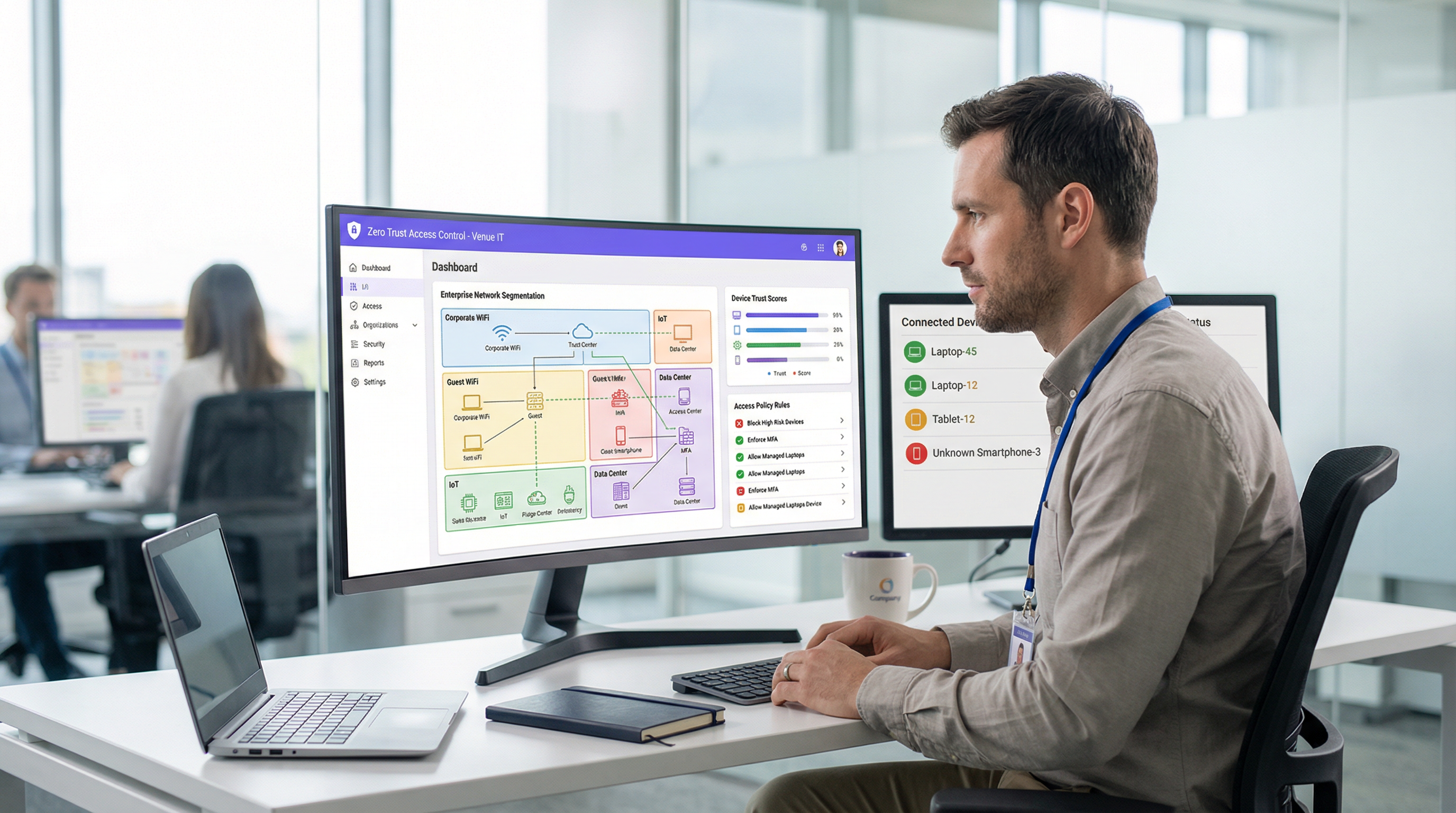
Il perimetro è morto. Per gli operatori delle strutture (hotel, catene di vendita al dettaglio, stadi e organizzazioni del settore pubblico), il modello di sicurezza tradizionale che consiste nel fidarsi di qualsiasi dispositivo che si autentichi con successo alla rete WiFi non è più praticabile. Una rete moderna di una struttura è un ecosistema complesso di laptop aziendali, smartphone BYOD, dispositivi non gestiti degli ospiti, sensori IoT e infrastrutture critiche come terminali POS e sistemi di gestione delle proprietà, che condividono tutti lo stesso spazio aereo fisico.
L'architettura WiFi Zero Trust è l'imperativo strategico per proteggere questo ambiente. Sostituisce il modello imperfetto "fidati ma verifica" con una verifica continua, un accesso con privilegi minimi e una rigorosa micro-segmentazione. Questa guida pratica di riferimento fornisce ai leader IT il progetto per applicare i principi Zero Trust alle reti wireless aziendali. Analizziamo in dettaglio le tecnologie fondamentali (IEEE 802.1X, WPA3-Enterprise e l'applicazione delle policy RADIUS) e forniamo indicazioni pratiche di implementazione per proteggere le vostre strutture senza compromettere l'esperienza utente. Implementando questi controlli, le organizzazioni possono ridurre drasticamente la loro superficie di attacco, garantire la conformità a PCI DSS e GDPR e mitigare il rischio di movimenti laterali in caso di violazione.
Ascolta il nostro briefing esecutivo sull'architettura WiFi Zero Trust:
Approfondimento tecnico: i quattro pilastri del WiFi Zero Trust
Lo Zero Trust non è un singolo prodotto che si può acquistare e installare nella sala server; è un framework architetturale. Se applicato all'edge wireless, si basa su quattro pilastri fondamentali per spostare la sicurezza dal perimetro di rete ai singoli dispositivi e utenti.
1. Verifica continua
Il modello di sicurezza WiFi tradizionale si basa su un evento di autenticazione una tantum. Un utente inserisce una PSK o le proprie credenziali Active Directory, l'access point concede l'accesso e il dispositivo è considerato attendibile per l'intera durata della sessione. Lo Zero Trust impone una verifica continua.
Ciò significa che la fiducia non è mai considerata permanente. Utilizzando configurazioni RADIUS avanzate e policy NAC (Network Access Control), la rete rivaluta continuamente il diritto del dispositivo di accedere alle risorse. Se il contesto di un dispositivo cambia (ad esempio, se il suo agente di protezione endpoint viene disabilitato o se tenta di accedere a risorse al di fuori del suo normale profilo comportamentale), i suoi privilegi di accesso possono essere revocati o limitati dinamicamente a metà sessione. Ciò richiede la configurazione di timer di riautenticazione della sessione e l'integrazione del controller wireless con un solido provider di identità.
2. Accesso di rete con privilegi minimi
Una volta autenticato un dispositivo, cosa può fare? In una rete piatta, la risposta è "quasi tutto". In un'architettura Zero Trust, a ogni dispositivo viene concesso l'accesso minimo assoluto necessario per svolgere la propria funzione.
Un ospite che si connette tramite Guest WiFi richiede l'accesso a Internet in uscita e la risoluzione DNS; non ha alcun motivo legittimo per comunicare con la sottorete locale. Un laptop aziendale gestito potrebbe richiedere l'accesso a condivisioni di file interne e applicazioni cloud. Un termostato intelligente richiede la comunicazione solo con il suo specifico controller cloud. Questo principio viene applicato all'edge della rete tramite l'assegnazione dinamica dei ruoli, in cui il server RADIUS restituisce specifici attributi VSA (Vendor-Specific Attributes) all'access point, inserendo il dispositivo in un ruolo strettamente controllato anziché in un segmento di rete ampio e permissivo.
3. Micro-segmentazione tramite VLAN dinamiche
La micro-segmentazione è il meccanismo attraverso il quale l'accesso con privilegi minimi viene applicato a livello di rete. Invece di mantenere un'unica grande sottorete per tutti i client wireless, la rete è divisa in segmenti discreti e logicamente isolati, in genere utilizzando l'assegnazione dinamica delle VLAN.
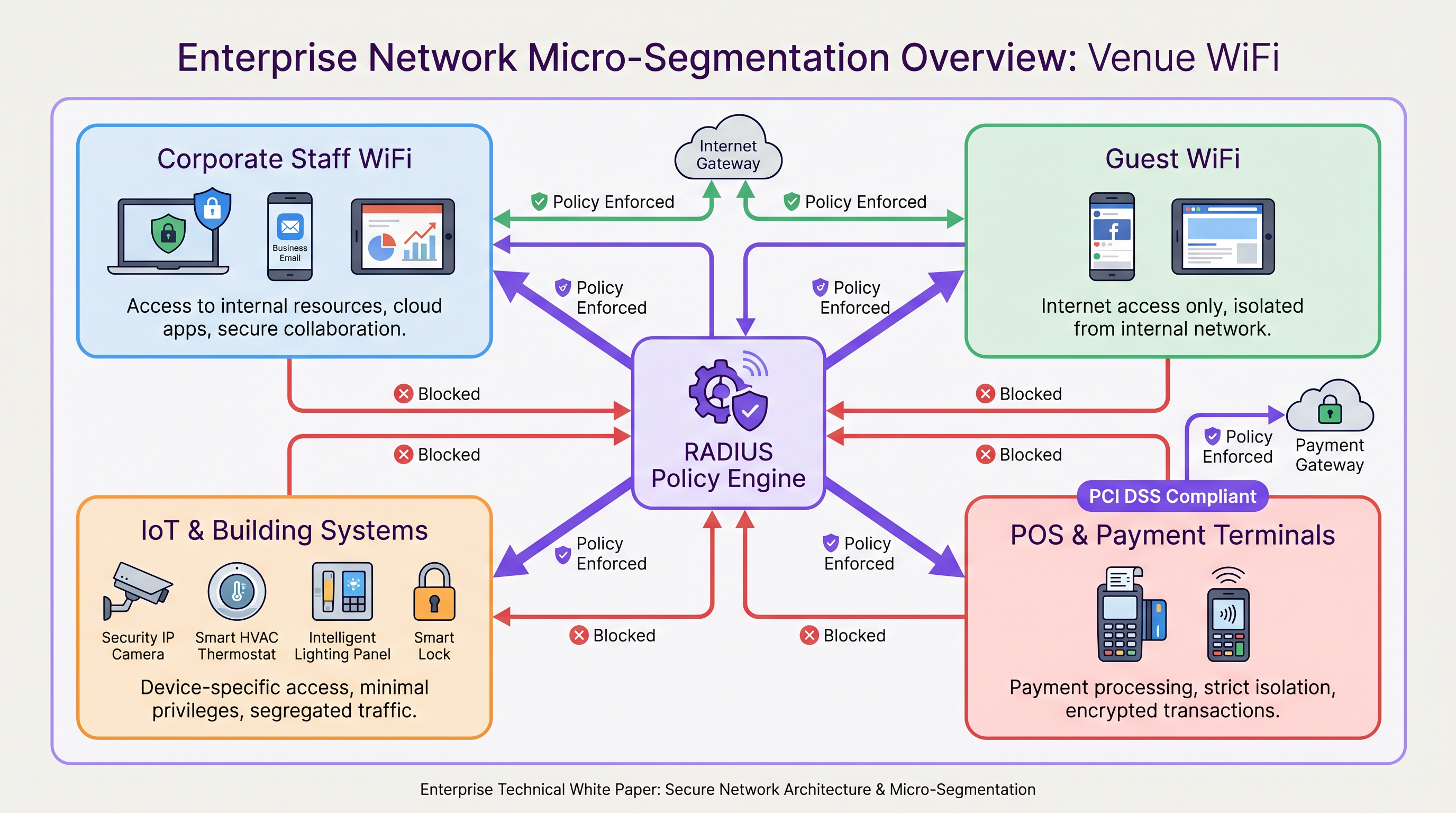
Quando un dispositivo si autentica tramite 802.1X, il motore delle policy RADIUS valuta l'identità dell'utente, il tipo di dispositivo e la posizione, assegnando il dispositivo alla VLAN appropriata. Firewall e Access Control List (ACL) governano quindi il flusso di traffico tra questi micro-segmenti. Ad esempio, negli ambienti Retail , la conformità PCI DSS impone un rigoroso isolamento dell'ambiente dei dati dei titolari di carta. La micro-segmentazione garantisce che un dispositivo compromesso sulla rete degli ospiti non possa fare perno e comunicare con i terminali POS.
4. Applicazione della postura del dispositivo
L'identità da sola non è sufficiente per stabilire la fiducia; devono essere verificate anche l'integrità e la conformità del dispositivo. L'applicazione della postura del dispositivo controlla lo stato dell'endpoint prima di concedere l'accesso.
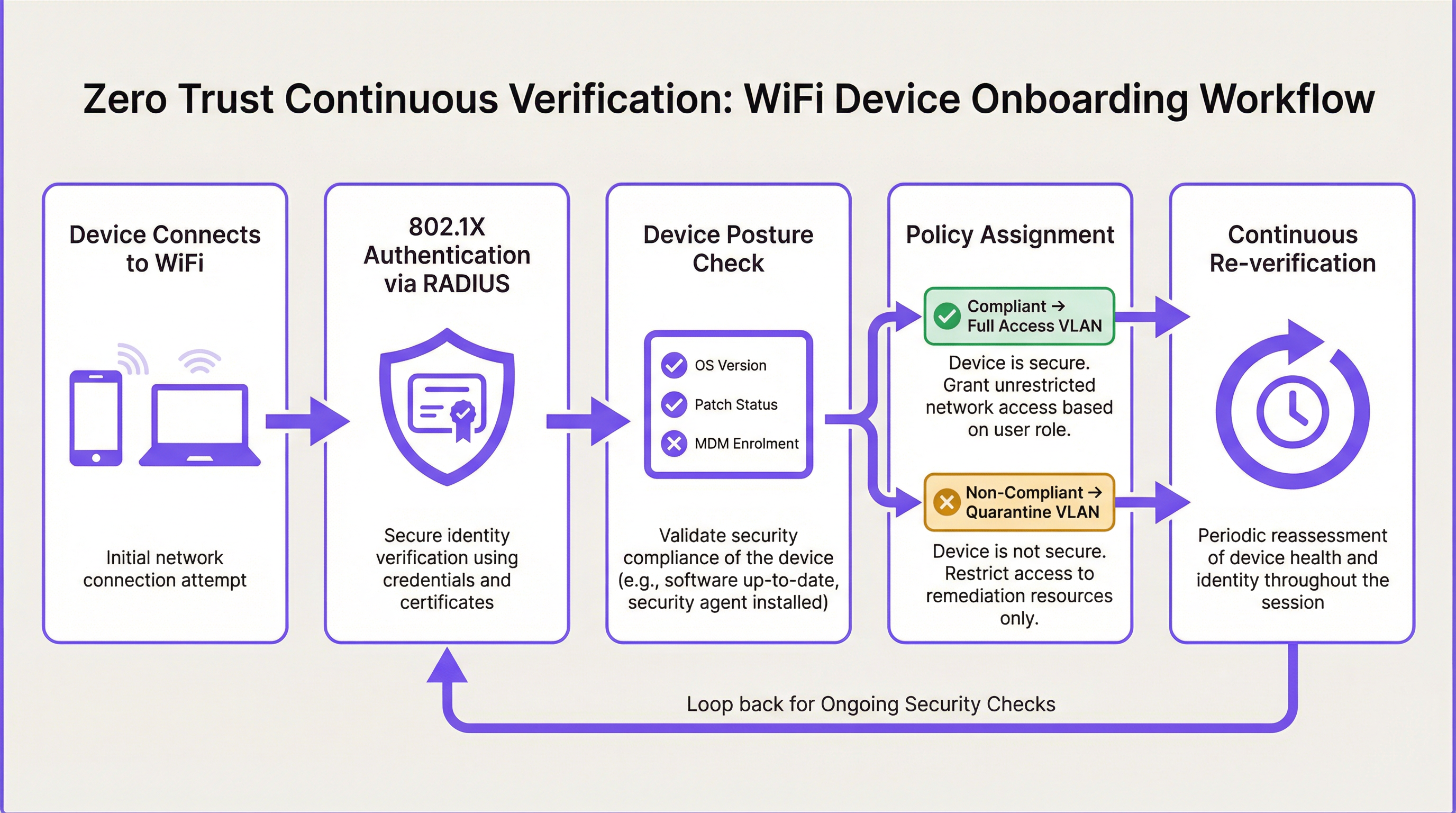
Il dispositivo esegue un sistema operativo supportato e aggiornato? È registrato nella piattaforma MDM (Mobile Device Management) aziendale? Il software antivirus è attivo e aggiornato? Se un dispositivo non supera questi controlli di postura, non viene semplicemente disconnesso; viene inserito in una VLAN di remediation con accesso limitato ai server di patch o ai portali di supporto IT, consentendo all'utente di risolvere il problema di conformità senza richiedere l'intervento manuale dell'IT.
Guida all'implementazione: architettare la soluzione
L'implementazione del WiFi Zero Trust richiede un approccio coordinato tra la LAN wireless, l'infrastruttura di autenticazione e lo stack di sicurezza di rete.
Tecnologie e standard principali
- IEEE 802.1X: La base dell'accesso sicuro alla rete. L'802.1X fornisce un controllo degli accessi basato sulle porte, garantendo che i dispositivi non possano far passare traffico (diverso dai frame di autenticazione EAP) finché non sono stati esplicitamente autenticati e autorizzati dal server RADIUS.
- EAP-TLS (Extensible Authentication Protocol - Transport Layer Security): Il gold standard per l'autenticazione dei dispositivi. L'EAP-TLS utilizza certificati digitali lato client e lato server per l'autenticazione reciproca, eliminando del tutto il rischio di furto di credenziali tramite phishing o attacchi Man-in-the-Middle (MitM). Per un approfondimento sui protocolli di autenticazione, consulta la nostra guida: Confronto dei metodi EAP: PEAP, EAP-TLS, EAP-TTLS e EAP-FAST .
- WPA3-Enterprise: L'attuale standard per la crittografia wireless. Il WPA3-Enterprise, in particolare se implementato in modalità a 192 bit, fornisce la solidità crittografica richiesta per ambienti altamente sensibili, sostituendo il vulnerabile standard WPA2.
- Motore delle policy RADIUS: Il cervello centrale dell'architettura. Il server RADIUS valuta le richieste di autenticazione rispetto alle policy definite e restituisce attributi dinamici (ID VLAN, ACL, limiti di larghezza di banda) all'access point.
Fasi di implementazione passo dopo passo
- Individuazione e profilazione: Non è possibile proteggere ciò che non si vede. Iniziate profilando tutti i dispositivi attualmente sulla rete. Utilizzate il fingerprinting DHCP, l'analisi MAC OUI e il parsing dell'user-agent HTTP per classificare i dispositivi in gruppi logici (es. IT aziendale, BYOD, Guest, IoT, POS).
- Definizione dei micro-segmenti: Sulla base della fase di individuazione, definite l'architettura VLAN di destinazione. Una tipica implementazione nel settore Hospitality potrebbe richiedere segmenti per Internet degli ospiti, operazioni del personale, sistemi di gestione delle proprietà (PMS) e IoT dell'edificio.
- Implementazione di RADIUS ad alta disponibilità: Implementate una solida infrastruttura RADIUS in grado di gestire il carico di autenticazione e la valutazione delle policy. Garantite una ridondanza attivo-attivo o attivo-passivo per prevenire un singolo punto di guasto.
- Implementazione di 802.1X per i dispositivi gestiti: Iniziate la migrazione passando i laptop e i tablet gestiti dall'azienda a 802.1X con EAP-TLS. Distribuite i certificati e i profili wireless richiesti tramite la vostra soluzione MDM per garantire un'esperienza utente fluida.
- Gestione dell'IoT tramite MAC Authentication Bypass (MAB) e profilazione: Molti dispositivi IoT legacy (stampanti, smart TV, Sensori ) non supportano i supplicant 802.1X. Per questi dispositivi, implementate il MAB combinato con una rigorosa profilazione del dispositivo. Il server RADIUS autentica il dispositivo in base al suo indirizzo MAC, ma applica un'ACL altamente restrittiva che consente la comunicazione solo con i server richiesti.
- Integrazione con SD-WAN: Assicuratevi che la micro-segmentazione wireless sia allineata con la vostra architettura di rete più ampia. Come discusso in I principali vantaggi della SD-WAN per le aziende moderne , la SD-WAN può estendere queste policy segmentate attraverso la WAN, garantendo l'applicazione dello Zero Trust end-to-end.
Best practice per le reti delle strutture
- Mai fare affidamento sulle PSK per l'accesso aziendale: Le chiavi precondivise (PSK) forniscono crittografia ma nessuna verifica dell'identità. Chiunque abbia la password ha accesso. Le PSK dovrebbero essere relegate esclusivamente alle reti IoT legacy (idealmente utilizzando PSK univoche per dispositivo tramite tecnologie come MPSK/DPSK) o alle reti aperte per gli ospiti.
- Automatizzare l'onboarding dei dispositivi: Il passaggio a 802.1X e all'autenticazione basata su certificati deve essere privo di attriti per l'utente finale. Utilizzate portali di onboarding che eseguono automaticamente il provisioning dei dispositivi BYOD con i certificati e i profili di rete corretti senza richiedere ticket all'helpdesk IT.
- Monitorare e stabilire le baseline di comportamento: Lo Zero Trust richiede visibilità. Sfruttate WiFi Analytics per stabilire le baseline per il normale comportamento della rete. Se una telecamera IP inizia improvvisamente a tentare di avviare connessioni SSH verso server interni, il motore delle policy deve rilevare questa anomalia e mettere automaticamente in quarantena il dispositivo.
- Allinearsi con l'hardware moderno: Assicuratevi che la vostra infrastruttura supporti gli standard richiesti. Consultate la nostra guida su Definizione degli access point wireless: la guida definitiva per il 2026 per comprendere le funzionalità necessarie per il WPA3 e l'applicazione dinamica delle policy.
Risoluzione dei problemi e mitigazione dei rischi
L'implementazione dello Zero Trust su una rete di una struttura attiva comporta rischi operativi. Le modalità di guasto più comuni riguardano il blocco del traffico legittimo o la creazione di loop di autenticazione.
| Rischio/Modalità di guasto | Causa | Strategia di mitigazione |
|---|---|---|
| Timeout di autenticazione 802.1X | Errata configurazione del supplicant o latenza del server RADIUS. | Assicurarsi che i server RADIUS siano geograficamente vicini alle strutture. Verificare le catene di attendibilità dei certificati sui dispositivi client. Utilizzare EAP-TLS per evitare richieste di credenziali utente. |
| Dispositivi IoT che si disconnettono | Dispositivi che non superano il MAC Authentication Bypass o i controlli di postura. | Implementare una fase in 'modalità monitor' prima di applicare le policy di blocco. Registrare tutti gli errori MAB e perfezionare le regole di profilazione dei dispositivi prima di passare alla modalità di applicazione. |
| Complessità da sovra-segmentazione | Creazione di troppe VLAN, con conseguente complessità di routing e interruzione delle applicazioni (es. errori di discovery multicast come Bonjour/mDNS). | Iniziare con ampi segmenti funzionali (Guest, Staff, IoT, Secure). Introdurre un'ulteriore segmentazione solo quando un rischio specifico o un mandato di conformità (es. PCI DSS) lo richiede. Utilizzare gateway Bonjour se è necessaria la discovery tra VLAN. |
| Bypass del Captive Portal | Utenti avanzati che falsificano gli indirizzi MAC per aggirare l'autenticazione del portale ospiti. | Gli indirizzi MAC sono facilmente falsificabili. Combinare il tracciamento MAC con il fingerprinting del browser e applicare timeout di sessione per mitigare l'impatto dello spoofing MAC. |
ROI e impatto aziendale
Il passaggio a un'architettura WiFi Zero Trust richiede investimenti in tempo di ingegnerizzazione, infrastruttura RADIUS e potenzialmente licenze NAC. Tuttavia, il ritorno sull'investimento per le strutture aziendali è sostanziale e misurabile:
- Riduzione dell'impatto delle violazioni (riduzione del raggio d'azione): Grazie alla micro-segmentazione della rete, un dispositivo ospite compromesso o un sensore IoT vulnerabile non può essere utilizzato come punto di snodo per attaccare l'infrastruttura critica. Ciò limita il "raggio d'azione" di un incidente, riducendo drasticamente i potenziali danni finanziari e reputazionali di una violazione.
- Semplificazione degli audit di conformità: Per le strutture retail e hospitality, la conformità a PCI DSS e GDPR rappresenta un onere operativo significativo. La micro-segmentazione definisce e isola chiaramente il Cardholder Data Environment (CDE) e i sistemi che elaborano le informazioni di identificazione personale (PII). Ciò riduce l'ambito degli audit di conformità, risparmiando tempo prezioso e costi di consulenza.
- Efficienza operativa: L'abbandono della gestione delle PSK e delle assegnazioni manuali delle VLAN a favore di un accesso dinamico basato su policy riduce il carico di lavoro dell'helpdesk IT. L'onboarding automatizzato e i flussi di lavoro di remediation self-service liberano gli ingegneri senior, consentendo loro di concentrarsi su iniziative strategiche anziché reimpostare le password del WiFi.
- Strutture a prova di futuro: Man mano che le strutture implementano tecnologie più avanzate (dai sistemi di Wayfinding ai chioschi per il check-in automatizzato), la superficie di attacco si espande. Una base Zero Trust garantisce che le nuove tecnologie possano essere integrate in modo sicuro senza compromettere la rete principale. Come evidenziato in Soluzioni WiFi moderne per l'hospitality che i vostri ospiti meritano , la sicurezza è il fondamento invisibile della moderna esperienza degli ospiti.
Termini chiave e definizioni
Zero Trust Network Access (ZTNA)
A security framework that requires all users and devices, whether inside or outside the organisation's network, to be authenticated, authorised, and continuously validated before being granted access to applications and data.
The overarching philosophy that drives the shift from perimeter-based security to identity- and context-based security on venue WiFi networks.
Micro-Segmentation
The practice of dividing a network into distinct security segments down to the individual workload or device level, applying strict access controls to dictate how these segments communicate.
Essential for limiting the 'blast radius' of a breach; ensures a compromised guest device cannot access corporate servers or POS terminals.
IEEE 802.1X
An IEEE Standard for port-based Network Access Control (PNAC), providing an authentication mechanism to devices wishing to attach to a LAN or WLAN.
The foundational protocol for enforcing Zero Trust at the wireless edge, acting as the gatekeeper before any network traffic is permitted.
RADIUS (Remote Authentication Dial-In User Service)
A networking protocol that provides centralised Authentication, Authorization, and Accounting (AAA) management for users who connect and use a network service.
The policy engine in a Zero Trust WiFi architecture that evaluates credentials and dynamically assigns VLANs and access policies.
EAP-TLS (Extensible Authentication Protocol - Transport Layer Security)
An EAP method that uses public key infrastructure (PKI) and digital certificates for mutual authentication between the client and the authentication server.
The most secure authentication method for managed devices, eliminating reliance on passwords and protecting against credential theft.
Dynamic VLAN Assignment
A network configuration where a RADIUS server assigns a device to a specific Virtual Local Area Network (VLAN) based on its authenticated identity or profile, rather than the SSID it connected to.
The primary mechanism for enforcing micro-segmentation and least-privilege access on enterprise wireless networks.
MAC Authentication Bypass (MAB)
A technique used to authenticate devices that do not support 802.1X supplicants (like many IoT devices) by using their MAC address as the identity credential.
A pragmatic workaround for legacy devices, which must be paired with strict profiling and restricted VLAN assignment due to the ease of MAC spoofing.
Device Posture
The security state of an endpoint device, including factors such as OS patch level, antivirus status, firewall configuration, and MDM enrolment.
A critical component of continuous verification; devices failing posture checks are quarantined regardless of valid user credentials.
Casi di studio
A 350-room hotel group needs to secure its flat network architecture where guest devices, staff laptops, IP cameras, and the Property Management System (PMS) currently share the same VLAN, creating significant GDPR and lateral movement risks.
Deploy a micro-segmented architecture using dynamic VLAN assignment via RADIUS. Create four distinct segments: Guest Internet, Staff Corporate, IoT/Building Systems, and PMS Access. Implement 802.1X with EAP-TLS certificate authentication for staff devices via MDM. Use MAC Authentication Bypass (MAB) with strict profiling for IoT devices, placing them in an isolated VLAN with restrictive ACLs. Guest devices authenticate via a captive portal, receiving internet-only access.
A major retail chain with 200 stores must achieve PCI DSS compliance by isolating its Point of Sale (POS) terminals from the customer WiFi and staff productivity networks, all of which currently operate on the same physical wireless infrastructure.
Implement role-based access control and micro-segmentation. Configure the RADIUS policy engine to assign devices to three isolated VLANs: Customer Guest WiFi (internet only), Staff WiFi (role-based access for managers vs. associates), and a dedicated POS segment. Secure the POS segment using WPA3-Enterprise and EAP-TLS, enforcing strict firewall rules that only permit traffic to the payment gateway. Integrate RADIUS accounting logs into the SIEM for audit trails.
A stadium venue needs to deploy a new fleet of smart turnstiles. These devices support basic WPA2-Personal but do not have an 802.1X supplicant. How should the network architect integrate them into the Zero Trust WiFi environment?
The architect should utilise MAC Authentication Bypass (MAB) configured on the RADIUS server. The turnstiles' MAC addresses should be profiled, and upon connection, the RADIUS server should dynamically assign them to a dedicated, highly restricted 'Turnstile IoT' VLAN. The firewall rules for this VLAN must enforce least-privilege, permitting outbound communication only to the specific ticketing gateway IP addresses on the required ports, blocking all lateral movement to other network segments.
Analisi degli scenari
Q1. During a network audit, you discover that the 'Staff Corporate' SSID uses a single Pre-Shared Key (PSK) shared among 50 employees. What are the primary security risks of this configuration in a Zero Trust context, and what is the recommended remediation?
💡 Suggerimento:Focus on identity verification and the impact of employee turnover.
Mostra l'approccio consigliato
The primary risks are the lack of individual identity verification (anyone with the PSK is trusted) and the inability to revoke access for a single user without changing the password for everyone (e.g., when an employee leaves). The recommended remediation is to migrate the 'Staff Corporate' SSID to WPA3-Enterprise using 802.1X. Ideally, deploy EAP-TLS with certificates pushed via MDM for seamless, highly secure authentication, allowing individual device access to be revoked instantly.
Q2. A managed corporate laptop successfully authenticates via EAP-TLS and is assigned to the 'Corporate Access' VLAN. However, the user subsequently disables their endpoint detection and response (EDR) agent. How should a Zero Trust architecture handle this event?
💡 Suggerimento:Think about the 'continuous verification' and 'device posture' pillars of Zero Trust.
Mostra l'approccio consigliato
A Zero Trust architecture must enforce continuous verification. The Network Access Control (NAC) solution, integrated with the EDR platform, should detect the posture change (EDR disabled). The NAC should then issue a Change of Authorization (CoA) to the wireless controller, dynamically revoking the laptop's 'Corporate Access' privileges mid-session and reassigning it to a 'Quarantine' VLAN until the EDR agent is re-enabled.
Q3. A hotel guest connects to the open 'Guest WiFi' SSID and authenticates via the captive portal. However, the network administrator notices that the guest device is attempting to scan IP addresses within the 10.0.0.0/8 range, which is used for internal hotel systems. What Zero Trust principle is failing, and how should it be corrected?
💡 Suggerimento:Consider the principles of micro-segmentation and least-privilege access.
Mostra l'approccio consigliato
The principle of least-privilege access (and micro-segmentation) is failing. A guest device should only have outbound internet access and should not be able to route traffic to internal subnets. This should be corrected by ensuring the Guest VLAN has strict Access Control Lists (ACLs) applied at the firewall or gateway that explicitly drop any traffic destined for RFC 1918 private IP ranges, permitting only traffic destined for the public internet.
Punti chiave
- ✓Zero Trust WiFi assumes no device is inherently safe, replacing perimeter security with continuous verification.
- ✓Least-privilege access ensures devices only reach the specific network resources required for their function.
- ✓Micro-segmentation via dynamic VLAN assignment isolates critical systems (like POS) from guest and IoT traffic.
- ✓Device posture enforcement validates OS patching and security agents before granting network access.
- ✓IEEE 802.1X and WPA3-Enterprise form the technical foundation for secure, policy-driven wireless authentication.
- ✓EAP-TLS certificate-based authentication is the gold standard for securing managed corporate devices.
- ✓Implementing Zero Trust reduces the 'blast radius' of breaches and streamlines compliance for PCI DSS and GDPR.




