

Arquitetura Zero Trust WiFi: Aplicando Zero Trust a Redes de Locais
A comprehensive technical reference guide detailing how venue operators can apply Zero Trust principles to enterprise WiFi networks. It covers continuous verification, micro-segmentation, and device posture enforcement to secure hospitality, retail, and public-sector environments against lateral movement and compliance risks.
🎧 Ouça este Guia
Ver Transcrição
Resumo Executivo
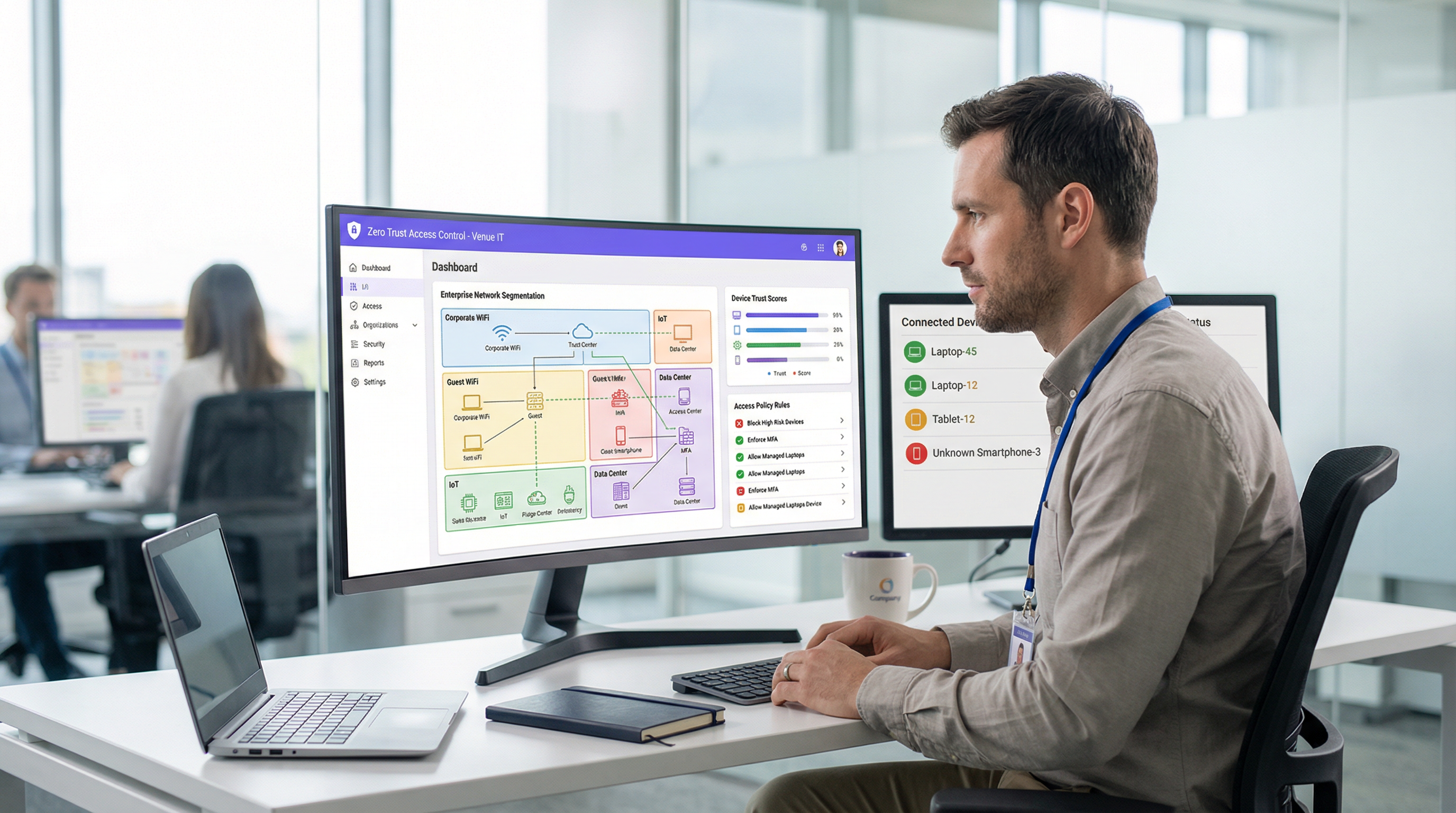
O perímetro está morto. Para operadores de locais — hotéis, redes de varejo, estádios e organizações do setor público —, o modelo de segurança tradicional de confiar em qualquer dispositivo que se autentique com sucesso na rede WiFi não é mais viável. Uma rede de local moderna é um ecossistema complexo de laptops corporativos, smartphones BYOD, dispositivos de convidados não gerenciados, sensores IoT e infraestrutura crítica, como terminais de PDV e sistemas de gestão de propriedades, todos compartilhando o mesmo espaço aéreo físico.
A Arquitetura Zero Trust WiFi é o imperativo estratégico para proteger esse ambiente. Ela substitui o modelo falho de "confiar, mas verificar" por verificação contínua, acesso de menor privilégio e microssegmentação rigorosa. Este guia de referência prático fornece aos líderes de TI o projeto para aplicar os princípios de Zero Trust a redes sem fio corporativas. Detalhamos as tecnologias fundamentais — IEEE 802.1X, WPA3-Enterprise e aplicação de políticas RADIUS — e fornecemos orientações de implantação acionáveis para proteger seus locais sem comprometer a experiência do usuário. Ao implementar esses controles, as organizações podem reduzir drasticamente sua superfície de ataque, garantir a conformidade com PCI DSS e GDPR, e mitigar o risco de movimento lateral em caso de violação.
Ouça nosso briefing executivo sobre a Arquitetura Zero Trust WiFi:
Análise Técnica Aprofundada: Os Quatro Pilares do Zero Trust WiFi
Zero Trust não é um produto único que você pode comprar e instalar na sua sala de servidores; é um framework arquitetônico. Quando aplicado à borda sem fio, ele se baseia em quatro pilares fundamentais para transferir a segurança do perímetro da rede para dispositivos e usuários individuais.
1. Verificação Contínua
O modelo tradicional de segurança WiFi depende de um evento de autenticação único. Um usuário insere uma PSK ou suas credenciais do Active Directory, o ponto de acesso concede o acesso e o dispositivo é considerado confiável durante toda a sessão. O Zero Trust exige verificação contínua.
Isso significa que a confiança nunca é presumida como permanente. Usando configurações avançadas de RADIUS e políticas de Controle de Acesso à Rede (NAC), a rede reavalia continuamente o direito do dispositivo de acessar recursos. Se o contexto de um dispositivo mudar — por exemplo, se seu agente de proteção de endpoint for desativado ou se tentar acessar recursos fora de seu perfil comportamental normal —, seus privilégios de acesso podem ser revogados ou restritos dinamicamente no meio da sessão. Isso exige a configuração de temporizadores de reautenticação de sessão e a integração da sua controladora sem fio com um provedor de identidade robusto.
2. Acesso à Rede com Menor Privilégio
Uma vez que um dispositivo é autenticado, o que ele pode fazer? Em uma rede plana, a resposta é "quase tudo". Em uma arquitetura Zero Trust, cada dispositivo recebe o acesso mínimo absoluto necessário para executar sua função.
Um convidado se conectando via Guest WiFi precisa de acesso de saída à internet e resolução de DNS; ele não tem motivos legítimos para se comunicar com a sub-rede local. Um laptop corporativo gerenciado pode exigir acesso a compartilhamentos de arquivos internos e aplicativos em nuvem. Um termostato inteligente requer comunicação apenas com sua controladora em nuvem específica. Esse princípio é aplicado na borda da rede por meio da atribuição dinâmica de funções, onde o servidor RADIUS retorna Atributos Específicos do Fornecedor (VSAs) específicos para o ponto de acesso, colocando o dispositivo em uma função rigorosamente controlada, em vez de um segmento de rede amplo e permissivo.
3. Microssegmentação via VLANs Dinâmicas
A microssegmentação é o mecanismo pelo qual o acesso de menor privilégio é aplicado na camada de rede. Em vez de manter uma única sub-rede grande para todos os clientes sem fio, a rede é dividida em segmentos discretos e logicamente isolados, normalmente usando atribuição dinâmica de VLAN.
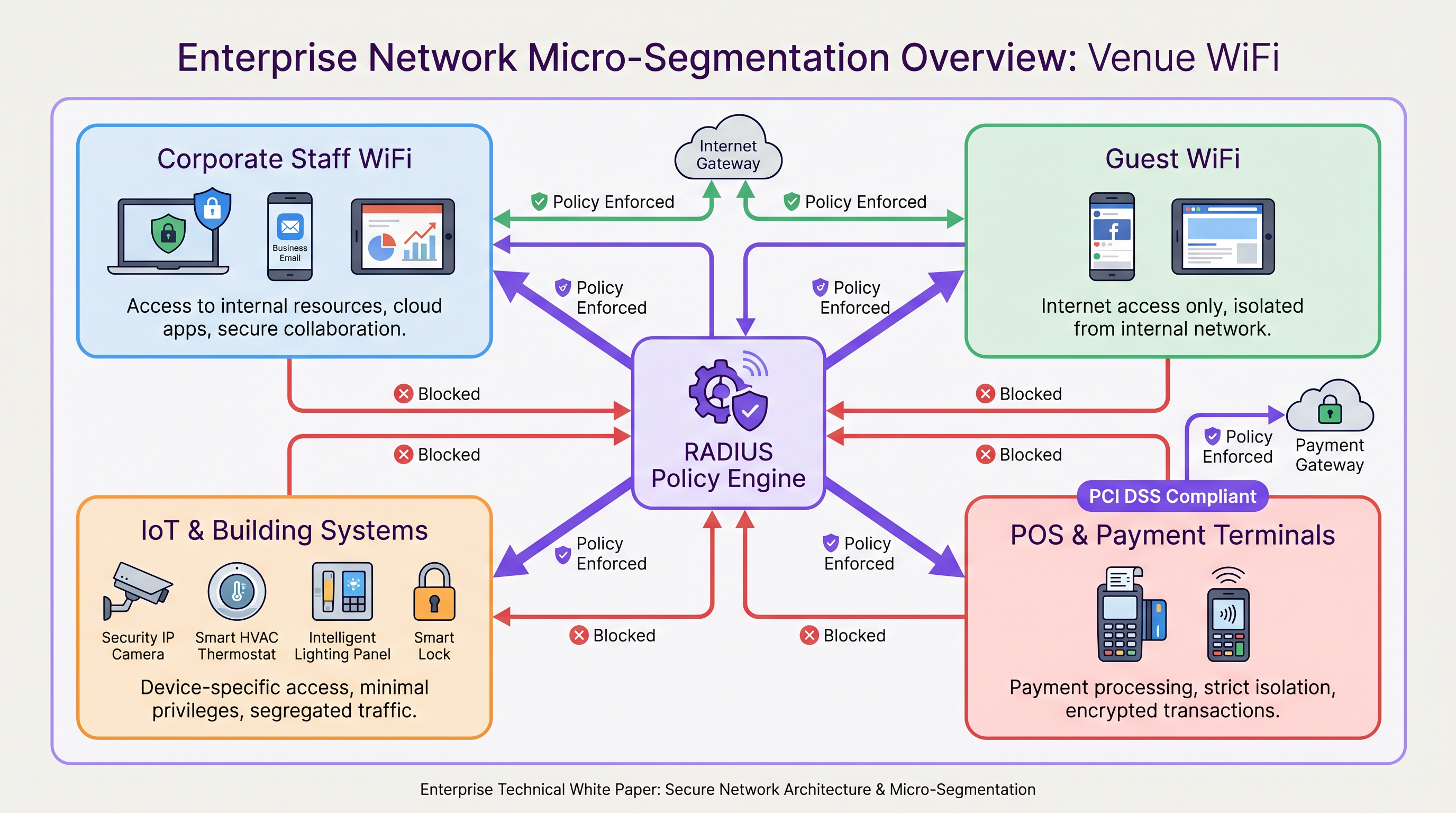
Quando um dispositivo se autentica via 802.1X, o mecanismo de política RADIUS avalia a identidade do usuário, o tipo de dispositivo e a localização, e atribui o dispositivo à VLAN apropriada. Firewalls e Listas de Controle de Acesso (ACLs) governam então o fluxo de tráfego entre esses microssegmentos. Por exemplo, em ambientes de Varejo , a conformidade com o PCI DSS exige o isolamento rigoroso do ambiente de dados do titular do cartão. A microssegmentação garante que um dispositivo comprometido na rede de convidados não possa girar e se comunicar com terminais de PDV.
4. Aplicação de Postura do Dispositivo
A identidade por si só é insuficiente para estabelecer confiança; a integridade e a conformidade do dispositivo também devem ser verificadas. A aplicação da postura do dispositivo verifica o estado do endpoint antes de conceder acesso.
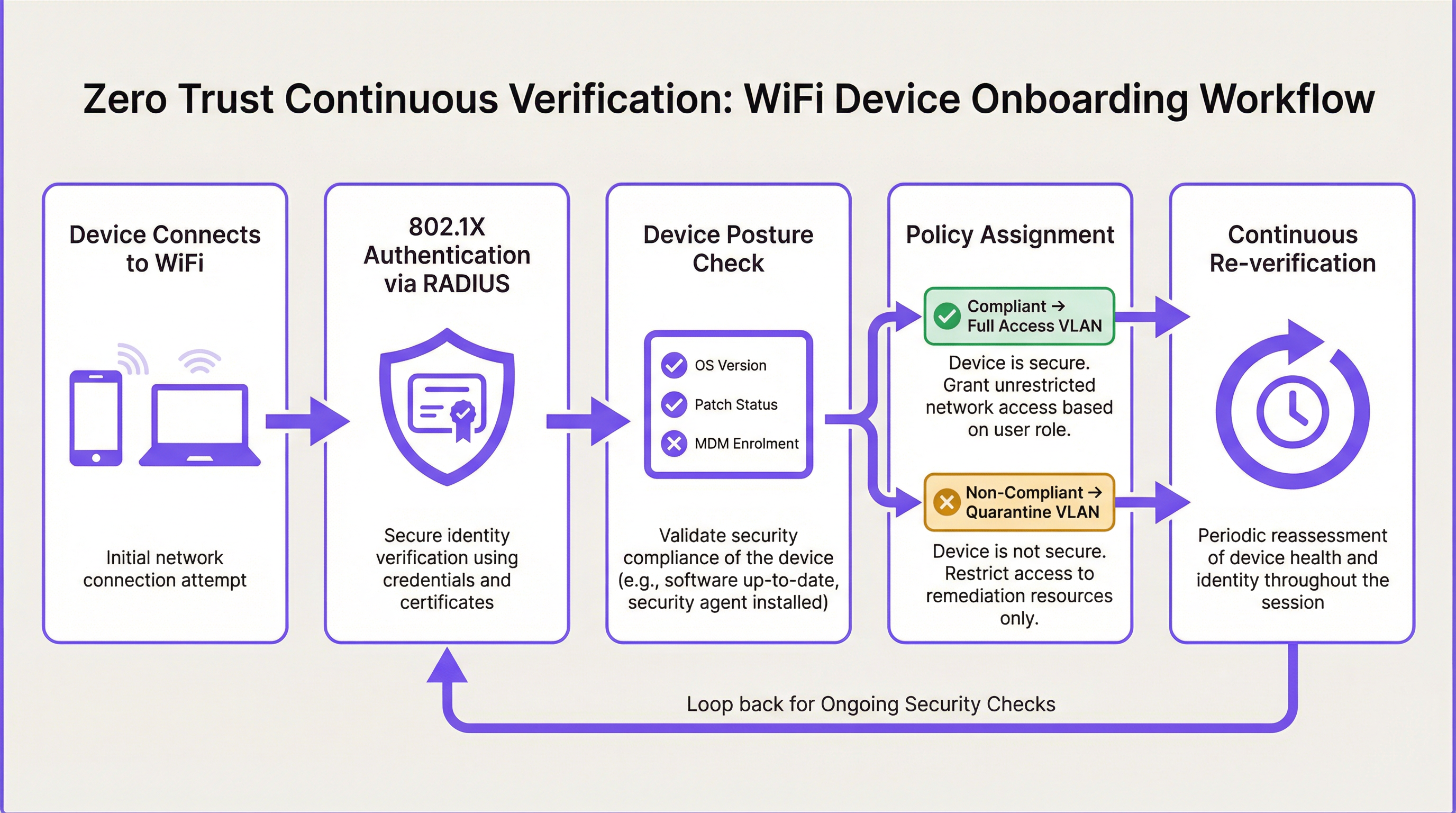
O dispositivo está executando um sistema operacional compatível e atualizado? Ele está registrado na plataforma corporativa de Gerenciamento de Dispositivos Móveis (MDM)? O software antivírus está ativo e atualizado? Se um dispositivo falhar nessas verificações de postura, ele não é simplesmente desconectado; ele é colocado em uma VLAN de remediação com acesso limitado a servidores de patch ou portais de suporte de TI, permitindo que o usuário resolva o problema de conformidade sem exigir intervenção manual da TI.
Guia de Implementação: Arquitetando a Solução
A implantação do Zero Trust WiFi requer uma abordagem coordenada em toda a LAN sem fio, a infraestrutura de autenticação e a pilha de segurança de rede.
Tecnologias e Padrões Principais
- IEEE 802.1X: A base do acesso seguro à rede. O 802.1X fornece controle de acesso baseado em porta, garantindo que os dispositivos não possam passar tráfego (além de quadros de autenticação EAP) até que tenham sido explicitamente autenticados e autorizados pelo servidor RADIUS.
- EAP-TLS (Extensible Authentication Protocol - Transport Layer Security): O padrão ouro para autenticação de dispositivos. O EAP-TLS usa certificados digitais no lado do cliente e no lado do servidor para autenticação mútua, eliminando totalmente o risco de roubo de credenciais via phishing ou ataques Man-in-the-Middle (MitM). Para um aprofundamento nos protocolos de autenticação, revise nosso guia: Comparativo de métodos EAP: PEAP, EAP-TLS, EAP-TTLS e EAP-FAST .
- WPA3-Enterprise: O padrão atual para criptografia sem fio. O WPA3-Enterprise, particularmente quando implantado no modo de 192 bits, fornece a força criptográfica necessária para ambientes altamente sensíveis, substituindo o vulnerável padrão WPA2.
- Mecanismo de Política RADIUS: O cérebro central da arquitetura. O servidor RADIUS avalia as solicitações de autenticação em relação às políticas definidas e retorna atributos dinâmicos (IDs de VLAN, ACLs, limites de largura de banda) para o ponto de acesso.
Fases de Implantação Passo a Passo
- Descoberta e Criação de Perfil: Você não pode proteger o que não pode ver. Comece criando o perfil de todos os dispositivos atualmente na rede. Use fingerprinting de DHCP, análise de MAC OUI e análise de user-agent HTTP para categorizar dispositivos em grupos lógicos (por exemplo, TI Corporativa, BYOD, Convidados, IoT, PDV).
- Definir Microssegmentos: Com base na fase de descoberta, defina sua arquitetura de VLAN de destino. Uma implantação típica de Hospitalidade pode exigir segmentos para Internet de Convidados, Operações de Equipe, Sistemas de Gestão de Propriedades (PMS) e IoT Predial.
- Implantar RADIUS de Alta Disponibilidade: Implemente uma infraestrutura RADIUS robusta capaz de lidar com a carga de autenticação e a avaliação de políticas. Garanta redundância ativo-ativo ou ativo-passivo para evitar um ponto único de falha.
- Implementar 802.1X para Dispositivos Gerenciados: Comece a migração fazendo a transição de laptops e tablets gerenciados corporativamente para 802.1X com EAP-TLS. Envie os certificados e perfis sem fio necessários por meio da sua solução MDM para garantir uma experiência de usuário perfeita.
- Abordar IoT via MAC Authentication Bypass (MAB) e Criação de Perfil: Muitos dispositivos IoT legados (impressoras, smart TVs, Sensores ) não suportam suplicantes 802.1X. Para esses dispositivos, implemente MAB combinado com a criação rigorosa de perfil de dispositivo. O servidor RADIUS autentica o dispositivo com base em seu endereço MAC, mas aplica uma ACL altamente restritiva que permite apenas a comunicação com os servidores necessários.
- Integrar com SD-WAN: Certifique-se de que sua microssegmentação sem fio esteja alinhada com sua arquitetura de rede mais ampla. Conforme discutido em Os Principais Benefícios do SD-WAN para Empresas Modernas , o SD-WAN pode estender essas políticas segmentadas por toda a WAN, garantindo a aplicação do Zero Trust de ponta a ponta.
Melhores Práticas para Redes de Locais
- Nunca Dependa de PSKs para Acesso Corporativo: Chaves Pré-Compartilhadas (PSKs) fornecem criptografia, mas nenhuma verificação de identidade. Qualquer pessoa com a senha tem acesso. As PSKs devem ser relegadas exclusivamente a redes IoT legadas (idealmente usando PSKs exclusivas por dispositivo via tecnologias como MPSK/DPSK) ou redes abertas de convidados.
- Automatizar a Integração de Dispositivos: A transição para 802.1X e autenticação baseada em certificado deve ser sem atritos para o usuário final. Utilize portais de integração que provisionam automaticamente dispositivos BYOD com os certificados e perfis de rede corretos sem exigir chamados de suporte de TI.
- Monitorar e Estabelecer Linha de Base de Comportamento: O Zero Trust requer visibilidade. Aproveite o WiFi Analytics para estabelecer linhas de base para o comportamento normal da rede. Se uma câmera IP de repente começar a tentar iniciar conexões SSH para servidores internos, o mecanismo de política deve detectar essa anomalia e colocar o dispositivo automaticamente em quarentena.
- Alinhar com Hardware Moderno: Certifique-se de que sua infraestrutura suporte os padrões exigidos. Revise nosso guia sobre Definição de Pontos de Acesso Sem Fio: Seu Guia Definitivo para 2026 para entender os recursos necessários para WPA3 e aplicação dinâmica de políticas.
Solução de Problemas e Mitigação de Riscos
A implementação do Zero Trust em uma rede de local ativa traz riscos operacionais. Os modos de falha mais comuns envolvem o bloqueio de tráfego legítimo ou a criação de loops de autenticação.
| Risco/Modo de Falha | Causa | Estratégia de Mitigação |
|---|---|---|
| Timeouts de Autenticação 802.1X | Configuração incorreta do suplicante ou latência do servidor RADIUS. | Certifique-se de que os servidores RADIUS estejam geograficamente próximos aos locais. Verifique as cadeias de confiança de certificados nos dispositivos clientes. Use EAP-TLS para evitar prompts de credenciais de usuário. |
| Dispositivos IoT Ficando Offline | Dispositivos falhando no MAC Authentication Bypass ou nas verificações de postura. | Implemente uma fase de 'modo de monitoramento' antes de aplicar políticas de bloqueio. Registre todas as falhas de MAB e refine as regras de criação de perfil de dispositivo antes de mudar para o modo de aplicação. |
| Complexidade de Supersegmentação | Criação de muitas VLANs, levando à complexidade de roteamento e aplicativos quebrados (por exemplo, falhas de descoberta multicast como Bonjour/mDNS). | Comece com segmentos funcionais amplos (Convidados, Equipe, IoT, Seguro). Introduza segmentação adicional apenas quando um risco específico ou mandato de conformidade (por exemplo, PCI DSS) exigir. Use gateways Bonjour se a descoberta entre VLANs for necessária. |
| Bypasses de Captive Portal | Usuários avançados falsificando endereços MAC para contornar a autenticação do portal de convidados. | Endereços MAC são facilmente falsificados. Combine o rastreamento de MAC com o fingerprinting do navegador e imponha timeouts de sessão para mitigar o impacto da falsificação de MAC. |
ROI e Impacto nos Negócios
A transição para uma arquitetura Zero Trust WiFi requer investimento em tempo de engenharia, infraestrutura RADIUS e, potencialmente, licenciamento NAC. No entanto, o retorno sobre o investimento para locais corporativos é substancial e mensurável:
- Impacto de Violação Reduzido (Redução do Raio de Explosão): Ao microssegmentar a rede, um dispositivo de convidado comprometido ou um sensor IoT vulnerável não pode ser usado como ponto de articulação para atacar a infraestrutura crítica. Isso limita o "raio de explosão" de um incidente, reduzindo drasticamente os possíveis danos financeiros e de reputação de uma violação.
- Auditorias de Conformidade Otimizadas: Para locais de varejo e hospitalidade, a conformidade com PCI DSS e GDPR são encargos operacionais significativos. A microssegmentação define e isola claramente o Ambiente de Dados do Titular do Cartão (CDE) e os sistemas que processam Informações Pessoalmente Identificáveis (PII). Isso reduz o escopo das auditorias de conformidade, economizando tempo significativo e taxas de consultoria.
- Eficiência Operacional: Afastar-se do gerenciamento de PSK e das atribuições manuais de VLAN para um acesso dinâmico e orientado por políticas reduz a carga do suporte de TI. A integração automatizada e os fluxos de trabalho de remediação de autoatendimento liberam engenheiros seniores para se concentrarem em iniciativas estratégicas, em vez de redefinir senhas de WiFi.
- Preparando o Local para o Futuro: À medida que os locais implantam tecnologias mais avançadas — de sistemas de Wayfinding a quiosques de check-in automatizados —, a superfície de ataque se expande. Uma base Zero Trust garante que novas tecnologias possam ser integradas com segurança sem comprometer a rede principal. Conforme destacado em Soluções Modernas de WiFi para Hospitalidade que Seus Convidados Merecem , a segurança é a base invisível da experiência moderna do convidado.
Termos-Chave e Definições
Zero Trust Network Access (ZTNA)
A security framework that requires all users and devices, whether inside or outside the organisation's network, to be authenticated, authorised, and continuously validated before being granted access to applications and data.
The overarching philosophy that drives the shift from perimeter-based security to identity- and context-based security on venue WiFi networks.
Micro-Segmentation
The practice of dividing a network into distinct security segments down to the individual workload or device level, applying strict access controls to dictate how these segments communicate.
Essential for limiting the 'blast radius' of a breach; ensures a compromised guest device cannot access corporate servers or POS terminals.
IEEE 802.1X
An IEEE Standard for port-based Network Access Control (PNAC), providing an authentication mechanism to devices wishing to attach to a LAN or WLAN.
The foundational protocol for enforcing Zero Trust at the wireless edge, acting as the gatekeeper before any network traffic is permitted.
RADIUS (Remote Authentication Dial-In User Service)
A networking protocol that provides centralised Authentication, Authorization, and Accounting (AAA) management for users who connect and use a network service.
The policy engine in a Zero Trust WiFi architecture that evaluates credentials and dynamically assigns VLANs and access policies.
EAP-TLS (Extensible Authentication Protocol - Transport Layer Security)
An EAP method that uses public key infrastructure (PKI) and digital certificates for mutual authentication between the client and the authentication server.
The most secure authentication method for managed devices, eliminating reliance on passwords and protecting against credential theft.
Dynamic VLAN Assignment
A network configuration where a RADIUS server assigns a device to a specific Virtual Local Area Network (VLAN) based on its authenticated identity or profile, rather than the SSID it connected to.
The primary mechanism for enforcing micro-segmentation and least-privilege access on enterprise wireless networks.
MAC Authentication Bypass (MAB)
A technique used to authenticate devices that do not support 802.1X supplicants (like many IoT devices) by using their MAC address as the identity credential.
A pragmatic workaround for legacy devices, which must be paired with strict profiling and restricted VLAN assignment due to the ease of MAC spoofing.
Device Posture
The security state of an endpoint device, including factors such as OS patch level, antivirus status, firewall configuration, and MDM enrolment.
A critical component of continuous verification; devices failing posture checks are quarantined regardless of valid user credentials.
Estudos de Caso
A 350-room hotel group needs to secure its flat network architecture where guest devices, staff laptops, IP cameras, and the Property Management System (PMS) currently share the same VLAN, creating significant GDPR and lateral movement risks.
Deploy a micro-segmented architecture using dynamic VLAN assignment via RADIUS. Create four distinct segments: Guest Internet, Staff Corporate, IoT/Building Systems, and PMS Access. Implement 802.1X with EAP-TLS certificate authentication for staff devices via MDM. Use MAC Authentication Bypass (MAB) with strict profiling for IoT devices, placing them in an isolated VLAN with restrictive ACLs. Guest devices authenticate via a captive portal, receiving internet-only access.
A major retail chain with 200 stores must achieve PCI DSS compliance by isolating its Point of Sale (POS) terminals from the customer WiFi and staff productivity networks, all of which currently operate on the same physical wireless infrastructure.
Implement role-based access control and micro-segmentation. Configure the RADIUS policy engine to assign devices to three isolated VLANs: Customer Guest WiFi (internet only), Staff WiFi (role-based access for managers vs. associates), and a dedicated POS segment. Secure the POS segment using WPA3-Enterprise and EAP-TLS, enforcing strict firewall rules that only permit traffic to the payment gateway. Integrate RADIUS accounting logs into the SIEM for audit trails.
A stadium venue needs to deploy a new fleet of smart turnstiles. These devices support basic WPA2-Personal but do not have an 802.1X supplicant. How should the network architect integrate them into the Zero Trust WiFi environment?
The architect should utilise MAC Authentication Bypass (MAB) configured on the RADIUS server. The turnstiles' MAC addresses should be profiled, and upon connection, the RADIUS server should dynamically assign them to a dedicated, highly restricted 'Turnstile IoT' VLAN. The firewall rules for this VLAN must enforce least-privilege, permitting outbound communication only to the specific ticketing gateway IP addresses on the required ports, blocking all lateral movement to other network segments.
Análise de Cenário
Q1. During a network audit, you discover that the 'Staff Corporate' SSID uses a single Pre-Shared Key (PSK) shared among 50 employees. What are the primary security risks of this configuration in a Zero Trust context, and what is the recommended remediation?
💡 Dica:Focus on identity verification and the impact of employee turnover.
Mostrar Abordagem Recomendada
The primary risks are the lack of individual identity verification (anyone with the PSK is trusted) and the inability to revoke access for a single user without changing the password for everyone (e.g., when an employee leaves). The recommended remediation is to migrate the 'Staff Corporate' SSID to WPA3-Enterprise using 802.1X. Ideally, deploy EAP-TLS with certificates pushed via MDM for seamless, highly secure authentication, allowing individual device access to be revoked instantly.
Q2. A managed corporate laptop successfully authenticates via EAP-TLS and is assigned to the 'Corporate Access' VLAN. However, the user subsequently disables their endpoint detection and response (EDR) agent. How should a Zero Trust architecture handle this event?
💡 Dica:Think about the 'continuous verification' and 'device posture' pillars of Zero Trust.
Mostrar Abordagem Recomendada
A Zero Trust architecture must enforce continuous verification. The Network Access Control (NAC) solution, integrated with the EDR platform, should detect the posture change (EDR disabled). The NAC should then issue a Change of Authorization (CoA) to the wireless controller, dynamically revoking the laptop's 'Corporate Access' privileges mid-session and reassigning it to a 'Quarantine' VLAN until the EDR agent is re-enabled.
Q3. A hotel guest connects to the open 'Guest WiFi' SSID and authenticates via the captive portal. However, the network administrator notices that the guest device is attempting to scan IP addresses within the 10.0.0.0/8 range, which is used for internal hotel systems. What Zero Trust principle is failing, and how should it be corrected?
💡 Dica:Consider the principles of micro-segmentation and least-privilege access.
Mostrar Abordagem Recomendada
The principle of least-privilege access (and micro-segmentation) is failing. A guest device should only have outbound internet access and should not be able to route traffic to internal subnets. This should be corrected by ensuring the Guest VLAN has strict Access Control Lists (ACLs) applied at the firewall or gateway that explicitly drop any traffic destined for RFC 1918 private IP ranges, permitting only traffic destined for the public internet.
Principais Conclusões
- ✓Zero Trust WiFi assumes no device is inherently safe, replacing perimeter security with continuous verification.
- ✓Least-privilege access ensures devices only reach the specific network resources required for their function.
- ✓Micro-segmentation via dynamic VLAN assignment isolates critical systems (like POS) from guest and IoT traffic.
- ✓Device posture enforcement validates OS patching and security agents before granting network access.
- ✓IEEE 802.1X and WPA3-Enterprise form the technical foundation for secure, policy-driven wireless authentication.
- ✓EAP-TLS certificate-based authentication is the gold standard for securing managed corporate devices.
- ✓Implementing Zero Trust reduces the 'blast radius' of breaches and streamlines compliance for PCI DSS and GDPR.




