

OpenRoaming आर्किटेक्चर आणि ऑथेंटिकेशनसाठी अंतिम मार्गदर्शक
हे मार्गदर्शक WBA OpenRoaming आर्किटेक्चरवर एक अधिकृत तांत्रिक संदर्भ प्रदान करते, ज्यामध्ये Passpoint फाउंडेशन, RADIUS फेडरेशन, RadSec mTLS सुरक्षा आणि एंटरप्राइझ ठिकाणांसाठी स्टेप-बाय-स्टेप डिप्लॉयमेंट मार्गदर्शन समाविष्ट आहे. हे IT मॅनेजर्स, नेटवर्क आर्किटेक्ट्स आणि ठिकाण ऑपरेटरना Captive Portal च्या जागी अखंड, सुरक्षित आणि सुसंगत Wi-Fi कनेक्टिव्हिटीसह सुसज्ज करते जी मोजण्यायोग्य ROI प्रदान करते.
🎧 हे मार्गदर्शक ऐका
ट्रान्सक्रिप्ट पहा

कार्यकारी सारांश
गेस्ट Wi-Fi साठी पारंपारिक Captive Portal मॉडेल आता कालबाह्य झाले आहे. अनेक दशकांपासून, ठिकाणे मॅन्युअल लॉगिन स्क्रीनवर अवलंबून आहेत जी वापरकर्त्यांना निराश करतात, खराब सुरक्षा देतात आणि लक्षणीय सपोर्ट ओव्हरहेड निर्माण करतात. WBA OpenRoaming एक मूलभूत आर्किटेक्चरल बदल दर्शवते, जे Passpoint (Hotspot 2.0) तंत्रज्ञान आणि 802.1X ऑथेंटिकेशन: आधुनिक उपकरणांवर नेटवर्क ॲक्सेस सुरक्षित करणे वर आधारित सुरक्षित, स्वयंचलित कनेक्शनच्या जागतिक फेडरेशनसह मॅन्युअल ऑथेंटिकेशनची जागा घेते.
IT मॅनेजर्स आणि नेटवर्क आर्किटेक्ट्ससाठी, OpenRoaming तैनात करणे आता केवळ वापरकर्त्याचा अनुभव सुधारण्यापुरते मर्यादित नाही — नेटवर्क सुरक्षा वाढवणे, सपोर्ट तिकिटे कमी करणे आणि उच्च नेटवर्क वापराद्वारे मोजण्यायोग्य ROI मिळवणे ही एक धोरणात्मक गरज आहे. हे मार्गदर्शक OpenRoaming आर्किटेक्चर लागू करण्यासाठी, RADIUS फेडरेशन नेव्हिगेट करण्यासाठी आणि एंटरप्राइझ, रिटेल , आणि हॉस्पिटॅलिटी वातावरणात आधुनिक सुरक्षा मानकांचे पालन सुनिश्चित करण्यासाठी सर्वसमावेशक तांत्रिक संदर्भ प्रदान करते.
तांत्रिक सखोल माहिती: OpenRoaming आर्किटेक्चर
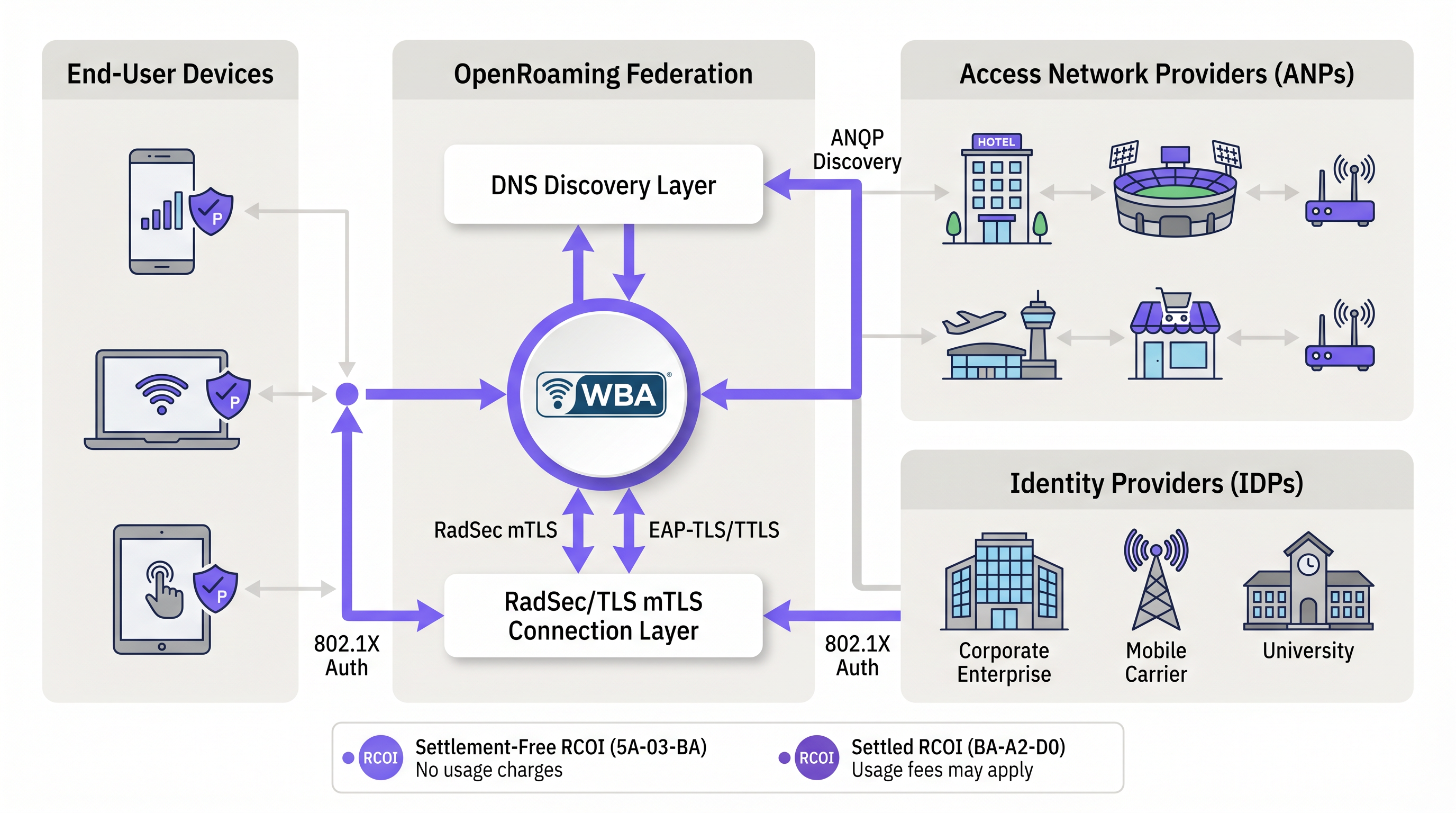
OpenRoaming आर्किटेक्चर वायरलेस ब्रॉडबँड अलायन्स (WBA) द्वारे व्यवस्थापित ट्रस्ट फेडरेशनद्वारे कार्य करते. हे आयडेंटिटी प्रोव्हायडर्स (IDPs) जे क्रेडेंशियल जारी करतात आणि ॲक्सेस नेटवर्क प्रोव्हायडर्स (ANPs) जे Wi-Fi इन्फ्रास्ट्रक्चर चालवतात यांच्यातील दरी भरून काढते.
Passpoint फाउंडेशन
OpenRoaming च्या केंद्रस्थानी Wi-Fi Alliance Passpoint मानक (IEEE 802.11u वर आधारित) आहे. Passpoint उपकरणांना स्वयंचलितपणे Wi-Fi नेटवर्क शोधण्यास आणि ऑथेंटिकेट करण्यास सक्षम करते. जेव्हा एखादे उपकरण OpenRoaming-सक्षम ठिकाणी प्रवेश करते, तेव्हा ते कनेक्शन करण्यापूर्वी समर्थित रोमिंग कन्सोर्टियम ऑर्गनायझेशन आयडेंटिफायर्स (RCOIs) साठी ॲक्सेस पॉइंटची चौकशी करण्यासाठी Access Network Query Protocol (ANQP) वापरते. हा प्री-असोसिएशन शोध वापरकर्त्यासाठी पूर्णपणे अदृश्य असतो — कोणतेही कनेक्शन सुरू करण्यापूर्वी डिव्हाइस शांतपणे ठरवते की त्याच्याकडे नेटवर्कसाठी वैध क्रेडेंशियल आहेत की नाही.
RADIUS फेडरेशन आणि RadSec
पारंपारिक कॅरियर Wi-Fi रोमिंग द्विपक्षीय करारांद्वारे भरलेल्या स्टॅटिक RADIUS राउटिंग टेबल्सवर अवलंबून असते, जे IPSec टनेलद्वारे सुरक्षित केले जाते. हे मॉडेल जागतिक, खुल्या फेडरेशनसाठी स्केल होत नाही. OpenRoaming डायनॅमिक DNS-आधारित पीअर डिस्कव्हरी (RFC 7585) आणि RadSec (RADIUS over TLS, RFC 6614) वापरून हे सोडवते.
जेव्हा ॲक्सेस पॉइंटला ऑथेंटिकेशन विनंती प्राप्त होते, तेव्हा स्थानिक RADIUS प्रॉक्सी IDP चे RadSec सर्व्हर डायनॅमिकरित्या शोधण्यासाठी वापरकर्त्याच्या रिअलमवर DNS NAPTR लुकअप करते. WBA च्या चार-स्तरीय पब्लिक की इन्फ्रास्ट्रक्चर (PKI) द्वारे जारी केलेल्या प्रमाणपत्रांसह म्युच्युअल TLS (mTLS) वापरून सिग्नलिंग सुरक्षित केले जाते, जे पूर्व-स्थापित द्विपक्षीय करारांची आवश्यकता नसताना ॲक्सेस नेटवर्क आणि आयडेंटिटी प्रोव्हायडर दरम्यान एंड-टू-एंड सुरक्षा सुनिश्चित करते.
रोमिंग कन्सोर्टियम ऑर्गनायझेशन आयडेंटिफायर्स (RCOIs)
OpenRoaming पॉलिसी कंट्रोल्स आणि सेटलमेंट मॉडेल्स ब्रॉडकास्ट करण्यासाठी विशिष्ट RCOIs वापरते. हे 802.11 बीकनमध्ये आणि ANQP द्वारे जाहिरात केले जातात:
| RCOI मूल्य | मॉडेल | वर्णन |
|---|---|---|
| 5A-03-BA | सेटलमेंट-फ्री | ANP आयडेंटिटी प्रोव्हायडरला कोणत्याही खर्चाशिवाय कनेक्टिव्हिटी प्रदान करते. एंटरप्राइझ, रिटेल आणि हॉस्पिटॅलिटीसाठी प्रमुख मॉडेल. |
| BA-A2-D0 | सेटल्ड | ANP आर्थिक भरपाईची अपेक्षा करते. प्रीमियम कनेक्टिव्हिटी परिस्थितीसाठी वापरले जाते. |
RCOI चे 12 सर्वात महत्त्वाचे बिट्स Closed Access Group (CAG) पॉलिसी परिभाषित करण्यासाठी देखील वापरले जाऊ शकतात, ज्यामुळे ANPs आणि IDPs ला क्वालिटी ऑफ सर्व्हिस टियर्स, आयडेंटिटी प्रूफिंग लेव्हल्स आणि प्रायव्हसी आवश्यकतांवर वाटाघाटी करण्यास सक्षम करते.
अंमलबजावणी मार्गदर्शक
OpenRoaming तैनात करण्यासाठी नेटवर्क हार्डवेअर, RADIUS इन्फ्रास्ट्रक्चर आणि आयडेंटिटी मॅनेजमेंटमध्ये समन्वयाची आवश्यकता असते. हार्डवेअर आवश्यकतांच्या सर्वसमावेशक विहंगावलोकनासाठी, आमचे वायरलेस ॲक्सेस पॉइंट्स व्याख्या: तुमचे अंतिम 2026 मार्गदर्शक पहा.
पायरी 1: इन्फ्रास्ट्रक्चर सज्जता मूल्यांकन
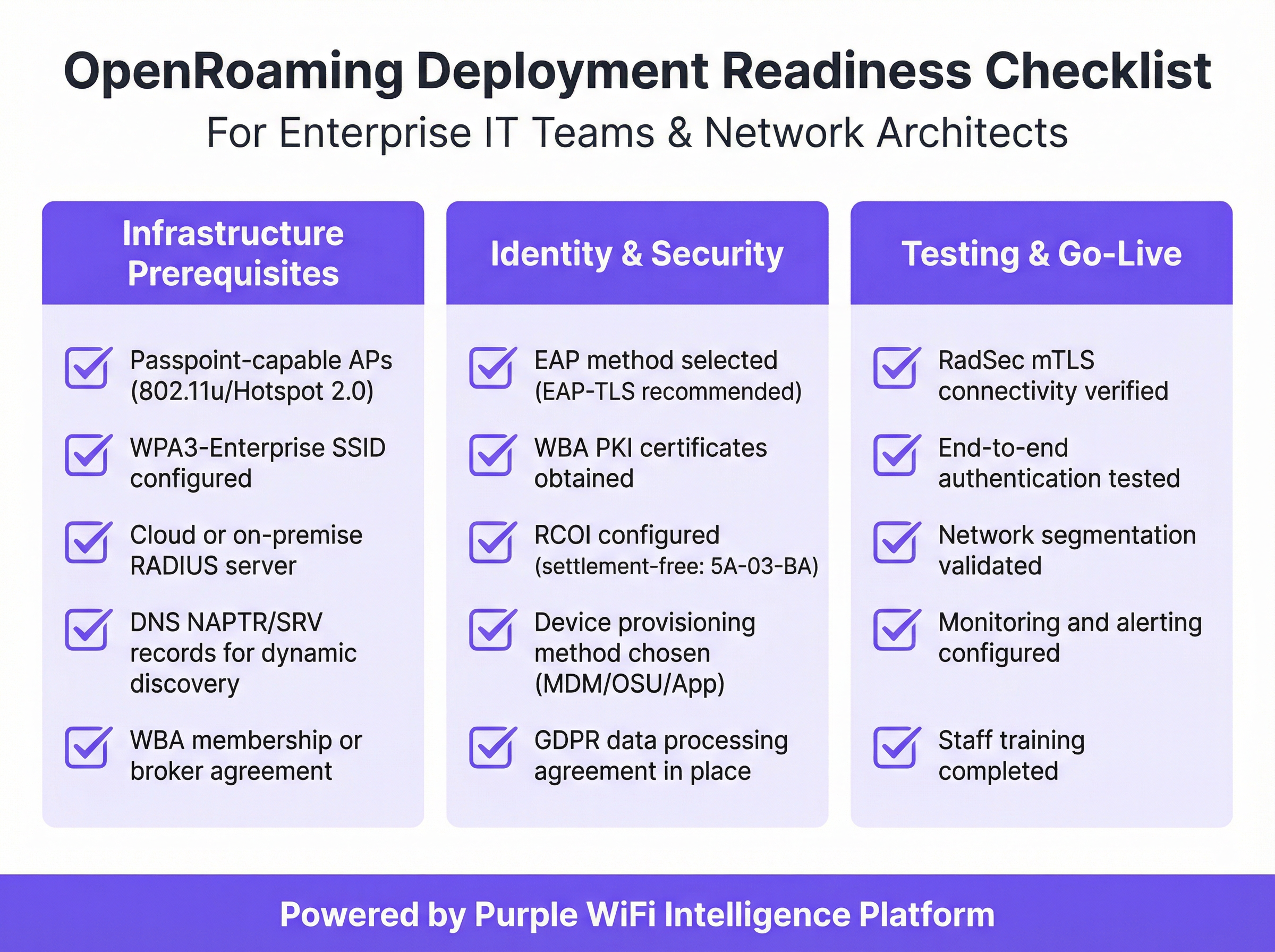
तुमचे ॲक्सेस पॉइंट्स आणि वायरलेस LAN कंट्रोलर्स Passpoint/Hotspot 2.0 (IEEE 802.11u) ला सपोर्ट करतात याची खात्री करा. 2018 नंतर उत्पादित केलेल्या बहुतेक एंटरप्राइझ-ग्रेड उपकरणांमध्ये नेटिव्ह सपोर्ट समाविष्ट आहे. WPA3-Enterprise (किंवा जुन्या डिव्हाइस सुसंगततेसाठी WPA2-Enterprise) सह सुरक्षित एक समर्पित SSID कॉन्फिगर करा. हा SSID OpenRoaming ट्रॅफिक वाहून नेईल आणि तुमचा RCOI ब्रॉडकास्ट करण्यासाठी योग्य ANQP सेटिंग्जसह कॉन्फिगर केलेला असणे आवश्यक आहे.
पायरी 2: WBA सदस्यत्व आणि ब्रोकर सहभाग
OpenRoaming फेडरेशनमध्ये सहभागी होण्यासाठी, तुमच्या संस्थेने एकतर थेट WBA मध्ये सामील होणे आवश्यक आहे किंवा अधिकृत WBA ब्रोकरची मदत घेणे आवश्यक आहे. ब्रोकर तुमच्या संस्थेला WBA Identity (WBAID) नियुक्त करेल, WBA PKI अंतर्गत तुमचे RadSec प्रमाणपत्रे जारी करेल आणि डायनॅमिक शोध सक्षम करण्यासाठी तुमचे DNS NAPTR/SRV रेकॉर्ड कॉन्फिगर करेल. ही मूलभूत पायरी आहे जी तुमच्या इन्फ्रास्ट्रक्चरला जागतिक फेडरेशनशी जोडते.
पायरी 3: RADIUS इन्फ्रास्ट्रक्चर कॉन्फिगरेशन
तुमचा RADIUS सर्व्हर OpenRoaming फेडरेशनकडे ऑथेंटिकेशन विनंत्या रूट करण्यासाठी कॉन्फिगर केलेला असणे आवश्यक आहे. यामध्ये तुमची WBA-जारी केलेली प्रमाणपत्रे वापरून mTLS कनेक्शन स्थापित करण्यासाठी RadSec कॉन्फिगर करणे समाविष्ट आहे. RADIUS प्रॉक्सी IDP एंडपॉइंट्स डायनॅमिकरित्या रिझॉल्व्ह करण्यासाठी DNS NAPTR लुकअप करण्यास सक्षम असणे आवश्यक आहे. क्लाउड-आधारित RADIUS सोल्यूशन्स जटिल DNS शोध आणि प्रमाणपत्र व्यवस्थापन प्रक्रिया सुलभ करून ही पायरी लक्षणीयरीत्या सोपी करू शकतात.
पायरी 4: डिव्हाइस प्रोव्हिजनिंग धोरण
वापरकर्त्याच्या उपकरणांवर Passpoint प्रोफाइल मिळवणे हा प्राथमिक कार्यात्मक विचार आहे. चार दृष्टिकोन उपलब्ध आहेत:
| पद्धत | कशासाठी सर्वोत्तम | यंत्रणा |
|---|---|---|
| MDM पुश | व्यवस्थापित कॉर्पोरेट उपकरणे | Intune, Jamf, किंवा Workspace ONE प्रोफाइल स्वयंचलितपणे पुश करतात |
| ऑनलाइन साइन-अप (OSU) | ग्राहक-केंद्रित डिप्लॉयमेंट | Passpoint OSU प्रोटोकॉलद्वारे प्रमाणित स्व-नोंदणी |
| ॲप-आधारित प्रोव्हिजनिंग | लॉयल्टी प्रोग्राम सदस्य | मोबाईल ॲप ऑथेंटिकेशननंतर Passpoint प्रोफाइल स्थापित करते |
| QR कोड नोंदणी | हॉस्पिटॅलिटी चेक-इन | फिजिकल QR कोड प्रोफाइल इन्स्टॉलेशन ट्रिगर करतो |
पायरी 5: पॉलिसी कॉन्फिगरेशन आणि VLAN सेगमेंटेशन
तुमच्या WLAN कंट्रोलरला ANQP द्वारे योग्य OpenRoaming RCOIs ब्रॉडकास्ट करण्यासाठी कॉन्फिगर करा. गेस्ट ट्रॅफिक कॉर्पोरेट नेटवर्कपासून वेगळे राहील याची खात्री करण्यासाठी RADIUS ॲट्रिब्युट्सद्वारे डायनॅमिक VLAN असाइनमेंट लागू करा. रिटेल वातावरणात PCI DSS पालनासाठी हे अनिवार्य आहे आणि सर्व व्हर्टिकल्समध्ये सर्वोत्तम सराव आहे.
सुरक्षा आणि पालनासाठी सर्वोत्तम पद्धती
OpenRoaming मूलभूतपणे ठिकाणच्या Wi-Fi ची सुरक्षा स्थिती सुधारते, खुल्या, अनएनक्रिप्टेड नेटवर्ककडून मजबूत एंटरप्राइझ-ग्रेड सुरक्षेकडे वळते. अंतर्निहित ऑथेंटिकेशन यंत्रणेच्या सखोल माहितीसाठी, 802.1X ऑथेंटिकेशन: आधुनिक उपकरणांवर नेटवर्क ॲक्सेस सुरक्षित करणे पहा.
WPA3-Enterprise आणि 802.1X ऑथेंटिकेशन
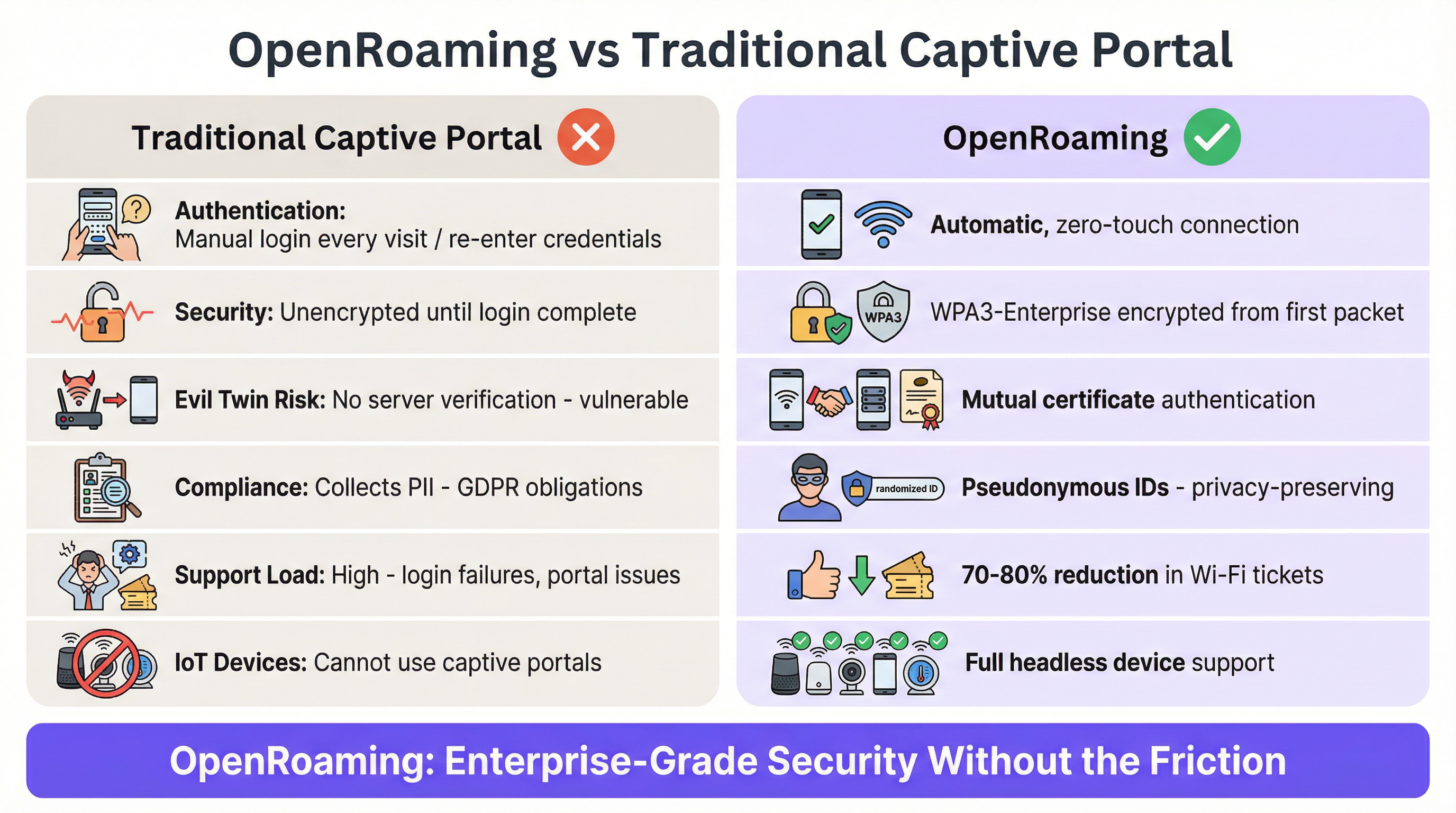
Captive Portal च्या उलट जिथे लॉगिन होईपर्यंत ट्रॅफिक अनएनक्रिप्टेड असते, OpenRoaming पहिल्या पॅकेटपासून WPA3-Enterprise एनक्रिप्शन वापरते. 802.1X म्युच्युअल ऑथेंटिकेशन प्रक्रिया हे सुनिश्चित करते की वापरकर्त्याचे डिव्हाइस कोणतीही क्रेडेंशियल प्रसारित करण्यापूर्वी नेटवर्कची ओळख क्रिप्टोग्राफिकरित्या सत्यापित करते, ज्यामुळे "Evil Twin" फसव्या ॲक्सेस पॉइंट्सचा धोका टळतो — ही एक असुरक्षितता आहे जी पारंपारिक Captive Portal हाताळू शकत नाहीत.
गोपनीयता आणि GDPR पालन
पारंपारिक Captive Portal अनेकदा मोठ्या प्रमाणावर वैयक्तिकरित्या ओळखण्यायोग्य माहिती (PII) गोळा करतात, ज्यामुळे GDPR पालनाचा मोठा भार निर्माण होतो. OpenRoaming वापरकर्त्यांना Chargeable-User-Identity (CUI) ॲट्रिब्युट सारख्या टोपणनाव आयडेंटिफायर्स द्वारे ऑथेंटिकेट करते. ठिकाण वापरकर्त्याची कच्ची PII न घेता तो वैध असल्याचे सत्यापित करते, जे GDPR डेटा मिनिमायझेशन तत्त्वांशी सुसंगत आहे आणि तुमच्या डेटा प्रोसेसिंग जबाबदाऱ्यांची व्याप्ती कमी करते.
नेटवर्क सेगमेंटेशन आणि PCI DSS
रिटेल वातावरणासाठी, PCI DSS पालन अत्यंत महत्त्वाचे आहे. OpenRoaming ट्रॅफिक पॉइंट ऑफ सेल (POS) सिस्टम आणि कॉर्पोरेट नेटवर्कपासून काटेकोरपणे वेगळे केले पाहिजे. ऑथेंटिकेशन झाल्यावर लगेच गेस्ट ट्रॅफिक वेगळे करण्यासाठी RADIUS ॲट्रिब्युट्सद्वारे डायनॅमिक VLAN असाइनमेंट वापरा, त्याला केवळ डीफॉल्ट इंटरनेट मार्ग आणि सर्व अंतर्गत RFC 1918 ॲड्रेस स्पेससाठी स्पष्ट नकार नियमांसह VRF इन्स्टन्समध्ये ठेवा.
केस स्टडीज: उत्पादनात OpenRoaming
केस स्टडी 1: RAI Amsterdam कन्व्हेन्शन सेंटर (इव्हेंट्स आणि कॉन्फरन्सिंग)
RAI Amsterdam कन्व्हेन्शन सेंटर, जे दरवर्षी 1.5 दशलक्ष पाहुण्यांचे स्वागत करणारे युरोपमधील सर्वात मोठ्या इव्हेंट ठिकाणांपैकी एक आहे, त्यांनी 2023 मध्ये WBA OpenRoaming सह Wi-Fi 6 तैनात केले. Cisco Live Europe मध्ये, 18,000 पेक्षा जास्त उपस्थितांना अखंड OpenRoaming कनेक्टिव्हिटी मिळाली, ज्यांनी चार दिवसांत 77 टेराबाइट पेक्षा जास्त डेटा वापरला. उपस्थितांनी नेटवर्कवर सरासरी सहा तास घालवले. या डिप्लॉयमेंटने दाखवून दिले की OpenRoaming कनेक्शनचा तो ओघ कसा काढून टाकते जो सहसा इव्हेंटचे दरवाजे उघडल्यावर येतो, ऑथेंटिकेशन लोड फेडरेशनमध्ये समान रीतीने वितरीत करतो. ट्रान्सपोर्ट हब आणि कॉन्फरन्स सेंटरसाठी, हा केस स्टडी एक निश्चित पुरावा आहे.
केस स्टडी 2: Delhaize रिटेल चेन (रिटेल)
बेल्जियन रिटेल ग्रुप Delhaize ने ग्राहकांची कनेक्टिव्हिटी सुधारण्यासाठी आणि ऑपरेशन्स सुलभ करण्यासाठी त्यांच्या स्टोअर नेटवर्कमध्ये OpenRoaming तैनात केले. या डिप्लॉयमेंटने Captive Portal कन्व्हर्जन रेट्सच्या सततच्या समस्या सोडवल्या — हे सर्व रिटेल ऑपरेटरसमोरील आव्हान आहे कारण ग्राहक मॅन्युअल लॉगिन स्क्रीन वापरण्याऐवजी मोबाईल डेटाला प्राधान्य देतात. लॉयल्टी ॲप वापरकर्त्यांसाठी स्वयंचलित, सुरक्षित कनेक्टिव्हिटी सक्षम करून, Delhaize ने Wi-Fi अवलंब वाढवला आणि इन-स्टोअर ॲनालिटिक्स डेटाची गुणवत्ता सुधारली, ज्यामुळे मर्चेंडाइजिंग आणि स्पेस वापराच्या निर्णयांना थेट पाठबळ मिळाले. हे WiFi Analytics ला रिटेल इंटेलिजन्स प्लॅटफॉर्मसह एकत्रित करण्याच्या व्यापक कलानुसार आहे.
ट्रबलशूटिंग आणि जोखीम कमी करणे
OpenRoaming एंड-युजरचा अनुभव सोपा करत असले तरी, त्यामागील इन्फ्रास्ट्रक्चर जटिल आहे. नेटवर्क आर्किटेक्ट्सनी सामान्य बिघाड टाळण्यासाठी सक्रियपणे प्रयत्न केले पाहिजेत:
RadSec सर्टिफिकेट कालबाह्यता ही सर्वात गंभीर कार्यात्मक जोखीम आहे. mTLS कनेक्शन WBA PKI प्रमाणपत्रांवर अवलंबून असतात. कालबाह्य झालेले प्रमाणपत्र फेडरेशन राउटिंग त्वरित खंडित करेल, ज्यामुळे ऑथेंटिकेशन अपयशी ठरेल. किमान 60 दिवस आधी चेतावणी आणि परिभाषित नूतनीकरण प्रक्रियेसह मॉनिटरिंग लागू करा.
DNS रिझोल्यूशन अपयश हे OpenRoaming आउटेजचे दुसरे सर्वात सामान्य कारण आहे. डायनॅमिक पीअर डिस्कव्हरी NAPTR आणि SRV रेकॉर्डच्या विश्वसनीय DNS रिझोल्यूशनवर अवलंबून असते. तुमच्या RADIUS प्रॉक्सीमध्ये रिडंडंट, हाय-परफॉर्मन्स DNS फॉरवर्डर्स कॉन्फिगर केलेले असल्याची खात्री करा आणि तुमच्या नियमित नेटवर्क हेल्थ चेकचा भाग म्हणून DNS रिझोल्यूशनची चाचणी घ्या.
जुन्या डिव्हाइस सुसंगततेसाठी संक्रमणादरम्यान नियोजन केले पाहिजे. आधुनिक iOS, Android, Windows आणि macOS उपकरणे नेटिव्हली Passpoint ला सपोर्ट करत असताना, जुनी उपकरणे करत नाहीत. सार्वत्रिक कव्हरेज सुनिश्चित करण्यासाठी संक्रमण कालावधीत समांतर पारंपारिक Guest WiFi नेटवर्क राखा.
RADIUS प्रॉक्सी चुकीचे कॉन्फिगरेशन रिअलम-आधारित राउटिंग अपयशास कारणीभूत ठरू शकते. तुमची प्रॉक्सी EAP-Identity रिअलम योग्यरित्या हाताळते आणि तुमचे DNS NAPTR रेकॉर्ड RFC 7585 डिस्कव्हरीसाठी योग्यरित्या फॉरमॅट केलेले आहेत याची खात्री करा. गो-लाईव्ह होण्यापूर्वी एकाधिक IDP रिअलम्ससह चाचणी करा.
ROI आणि व्यवसायावर परिणाम
OpenRoaming साठी बिझनेस केस तांत्रिक उत्कृष्टतेच्या पलीकडे आहे. ठिकाण ऑपरेटर अनेक क्षेत्रांमध्ये मोजण्यायोग्य परताव्याची अपेक्षा करू शकतात:
| मेट्रिक | ठराविक परिणाम | स्रोत |
|---|---|---|
| Wi-Fi सपोर्ट तिकीट घट | 70–80% घट | WBA डिप्लॉयमेंट रिपोर्ट |
| Wi-Fi अवलंब दर वाढ | 40–50% वाढ | WBA एअरपोर्ट डिप्लॉयमेंट डेटा |
| प्रति वापरकर्ता डेटा वापर | Captive Portal च्या तुलनेत लक्षणीयरीत्या जास्त | RAI Amsterdam केस स्टडी |
| PII अनुपालन जोखीम | लक्षणीयरीत्या कमी | GDPR टोपणनाव ID मॉडेल |
OpenRoaming स्वीकारून, ठिकाणे तुमच्या पाहुण्यांना मिळायला हवे असलेले आधुनिक हॉस्पिटॅलिटी WiFi सोल्यूशन्स प्रदान करतात, Wi-Fi ला एका निराशाजनक सुविधेपासून डिजिटल अनुभवाच्या अखंड, अदृश्य सक्षमकर्त्यामध्ये रूपांतरित करतात. WiFi Analytics प्लॅटफॉर्मसह एकत्रीकरण अधिक मौल्यवान बनते कारण उच्च अटॅच रेट्स अधिक समृद्ध, अधिक प्रतिनिधी डेटा संच तयार करतात. व्यापक नेटवर्क आधुनिकीकरणाचा विचार करणाऱ्या संस्थांसाठी, आधुनिक व्यवसायांसाठी मुख्य SD WAN फायदे OpenRoaming आधुनिक, सॉफ्टवेअर-डिफाइन्ड नेटवर्क आर्किटेक्चरमध्ये कसे बसते यावर पूरक संदर्भ प्रदान करते.
हेल्थकेअर क्षेत्राला देखील याचा मोठा फायदा होऊ शकतो, OpenRoaming मुळे भेट देणारे क्लिनिशियन्स आणि मेडिकल IoT उपकरणांसाठी सुरक्षित, स्वयंचलित कनेक्टिव्हिटी सक्षम होते — खुल्या गेस्ट नेटवर्कच्या अनुपालन जोखमीशिवाय किंवा प्रति-डिव्हाइस Captive Portal व्यवस्थापनाच्या कार्यात्मक ओव्हरहेडशिवाय.
महत्त्वाच्या संज्ञा आणि व्याख्या
Passpoint (Hotspot 2.0)
A Wi-Fi Alliance certification programme based on IEEE 802.11u that enables devices to automatically discover and authenticate to Wi-Fi networks without user intervention, using pre-provisioned credentials.
The foundational technology that makes the seamless OpenRoaming experience possible on the end-user device. Without Passpoint support on both the AP and the device, OpenRoaming cannot function.
RadSec
A protocol (RFC 6614) that transports RADIUS packets over a TCP and TLS connection, providing encrypted, reliable, and authenticated delivery of authentication signalling.
Used to secure authentication traffic traversing the public internet between the venue's RADIUS proxy and the global OpenRoaming federation. Replaces the legacy IPSec tunnel model.
RCOI (Roaming Consortium Organization Identifier)
A 3-octet or 5-octet identifier broadcast by access points in 802.11 beacons and ANQP responses to indicate which roaming federations and settlement policies the network supports.
Devices read the RCOI to determine if they hold valid credentials to connect before attempting authentication. The settlement-free RCOI (5A-03-BA) is the standard for enterprise deployments.
ANQP (Access Network Query Protocol)
An IEEE 802.11 protocol used by devices to query access points for network information — including supported RCOIs, venue name, and NAI realm list — prior to association.
Enables devices to silently evaluate whether a network supports their credentials without disrupting the user or initiating a connection attempt.
Identity Provider (IDP)
An organisation that maintains user identities and issues the Passpoint credentials (certificates or profiles) used for OpenRoaming authentication.
Mobile carriers, corporate IT departments, and loyalty programmes act as IDPs. The IDP authenticates the user and signals the result to the ANP via the RADIUS federation.
Access Network Provider (ANP)
The venue or organisation that operates the physical Wi-Fi infrastructure, broadcasts OpenRoaming RCOIs, and enforces local access policies.
Hotels, stadiums, retail stores, and enterprise offices act as ANPs. The ANP controls what authenticated users can access, regardless of which IDP authenticated them.
WBA PKI
The four-level Public Key Infrastructure managed by the Wireless Broadband Alliance, used to issue the mTLS certificates required for RadSec connections between federation participants.
Provides the foundational cryptographic trust that allows thousands of independent networks to securely federate without pre-established bilateral agreements.
802.1X
An IEEE standard for port-based network access control that provides an authentication mechanism for devices wishing to attach to a LAN or WLAN, using EAP (Extensible Authentication Protocol) methods.
The robust security framework underpinning OpenRoaming. It prevents unauthorised access and enables WPA3-Enterprise encryption from the first data packet.
Chargeable-User-Identity (CUI)
A RADIUS attribute (RFC 4372) that provides a pseudonymous, stable identifier for a user across multiple sessions, without exposing their actual identity to the access network.
Enables venues to track unique visitors for analytics purposes while minimising PII collection, directly supporting GDPR data minimisation compliance.
केस स्टडीज
A 500-room luxury hotel currently uses a captive portal requiring guests to log in with their room number and last name. They are experiencing high support volumes and poor guest satisfaction scores regarding Wi-Fi. They want to implement OpenRoaming but are concerned about losing the ability to tier bandwidth for VIP guests and loyalty programme members.
The hotel should deploy OpenRoaming using the settlement-free RCOI (5A-03-BA), with the hotel's loyalty app acting as an Identity Provider. When a VIP loyalty member authenticates, the IDP's RADIUS Access-Accept response includes Vendor-Specific Attributes (VSAs) that instruct the hotel's WLAN controller to assign the user to a premium QoS profile and a dedicated high-bandwidth VLAN. Standard guests authenticated via a third-party IDP (e.g., their mobile carrier) receive the default QoS profile. The hotel's RADIUS server acts as the policy enforcement point, translating IDP-supplied identity attributes into local network policies.
A large retail chain with 200 stores wants to deploy OpenRoaming to improve customer connectivity and feed their WiFi Analytics platform with richer footfall data. Their security team is concerned about PCI DSS compliance and the risk of guest devices accessing the corporate network or point-of-sale systems.
The retail chain must implement strict network segmentation as a prerequisite to deployment. The OpenRoaming SSID must be mapped to an isolated guest VLAN at the access layer (the AP or distribution switch). The RADIUS server should enforce dynamic VLAN assignment, ensuring all OpenRoaming-authenticated users are placed into a VRF instance with only a default route to the internet and explicit ACL deny rules for all RFC 1918 internal address space. The OpenRoaming RADIUS proxy should be deployed in a DMZ, with no direct routing path to the corporate network. A quarterly penetration test should verify that the segmentation boundary holds.
परिस्थिती विश्लेषण
Q1. Your venue is experiencing frequent silent authentication failures for a subset of OpenRoaming users. Packet captures confirm the EAP-Identity response is received by the AP, but no RADIUS Access-Request ever reaches the Identity Provider. What is the most likely architectural failure point, and how would you diagnose it?
💡 संकेत:Consider the steps required for the RADIUS proxy to locate the correct destination for the specific user's realm before it can forward the authentication request.
शिफारस केलेला दृष्टिकोन दाखवा
The most likely failure point is DNS resolution at the RADIUS proxy. OpenRoaming relies on dynamic discovery (RFC 7585), requiring the proxy to perform a DNS NAPTR/SRV lookup on the realm provided in the EAP-Identity. If DNS fails, the proxy cannot determine the IP address of the IDP's RadSec server, resulting in a silent failure. Diagnose by running a manual NAPTR lookup from the RADIUS proxy for the affected realm, verifying that the correct SRV records are returned and that the RadSec server IP is reachable on port 2083.
Q2. A hospital IT director wants to deploy OpenRoaming to improve connectivity for visiting clinicians and medical IoT devices, but mandates that all guest traffic must be encrypted over the air from the moment of connection to comply with internal security policy. They currently use a captive portal with WPA2-Personal (PSK). Does OpenRoaming satisfy this requirement, and how does the encryption model differ?
💡 संकेत:Compare the encryption timing of captive portals versus 802.1X-based authentication, and consider what happens to traffic before the captive portal login is completed.
शिफारस केलेला दृष्टिकोन दाखवा
Yes, OpenRoaming fully satisfies this requirement. With a captive portal, traffic is unencrypted over the air until the user completes the login process — creating a vulnerability window. OpenRoaming uses 802.1X authentication and WPA3-Enterprise (or WPA2-Enterprise), which establishes a unique, cryptographically secure encrypted session via a 4-way handshake immediately upon successful authentication, before any user data is transmitted. Each session uses a unique PMK derived from the EAP exchange, ensuring per-session encryption that is far stronger than the shared PSK model.
Q3. You are configuring the WLAN controller for a new stadium deployment that will participate in the settlement-free OpenRoaming federation. A colleague suggests also broadcasting the settled RCOI to maximise compatibility. What are the implications of broadcasting both RCOIs simultaneously, and what is your recommendation?
💡 संकेत:Consider the commercial and operational implications of the settled RCOI, and how devices prioritise RCOI matching.
शिफारस केलेला दृष्टिकोन दाखवा
Broadcasting the settled RCOI (BA-A2-D0) alongside the settlement-free RCOI (5A-03-BA) is technically possible but carries significant commercial risk. The settled RCOI signals to Identity Providers that the ANP expects financial compensation for connectivity. This may deter IDPs from allowing their users to connect, as they would incur charges. For a stadium seeking maximum user adoption and seamless connectivity, broadcasting only the settlement-free RCOI is the correct approach. The settled RCOI should only be used when a specific commercial settlement agreement is in place with the relevant IDPs.
महत्त्वाचे निष्कर्ष
- ✓OpenRoaming replaces manual captive portals with automatic, zero-touch Wi-Fi connectivity built on Passpoint (IEEE 802.11u) and 802.1X authentication.
- ✓The global federation scales through dynamic DNS-based peer discovery (RFC 7585) and RadSec mTLS (RFC 6614), eliminating the need for static routing tables or bilateral agreements.
- ✓WPA3-Enterprise encryption is established from the very first packet, and mutual certificate authentication eliminates Evil Twin attack vectors.
- ✓Pseudonymous identifiers (Chargeable-User-Identity) minimise PII collection, directly reducing GDPR compliance obligations for venue operators.
- ✓Venues typically report a 70-80% reduction in Wi-Fi-related support tickets and a 40-50% increase in Wi-Fi adoption rates after deployment.
- ✓Certificate lifecycle management is the single most critical operational task — expired WBA PKI certificates cause silent RadSec failures.
- ✓Dynamic VLAN assignment via RADIUS is mandatory for PCI DSS compliance in retail environments and best practice across all verticals.




