

Zero Trust WiFi-Architektur: Anwendung von Zero Trust auf Standort-Netzwerke
Ein umfassender technischer Leitfaden, der detailliert beschreibt, wie Standortbetreiber Zero Trust-Prinzipien auf Enterprise-WiFi-Netzwerke anwenden können. Er behandelt kontinuierliche Verifizierung, Mikro-Segmentierung und die Durchsetzung des Gerätestatus (Device Posture), um Umgebungen in den Bereichen Hospitality, Einzelhandel und im öffentlichen Sektor gegen Lateral Movement und Compliance-Risiken abzusichern.
🎧 Diesen Leitfaden anhören
Transkript anzeigen
Executive Summary
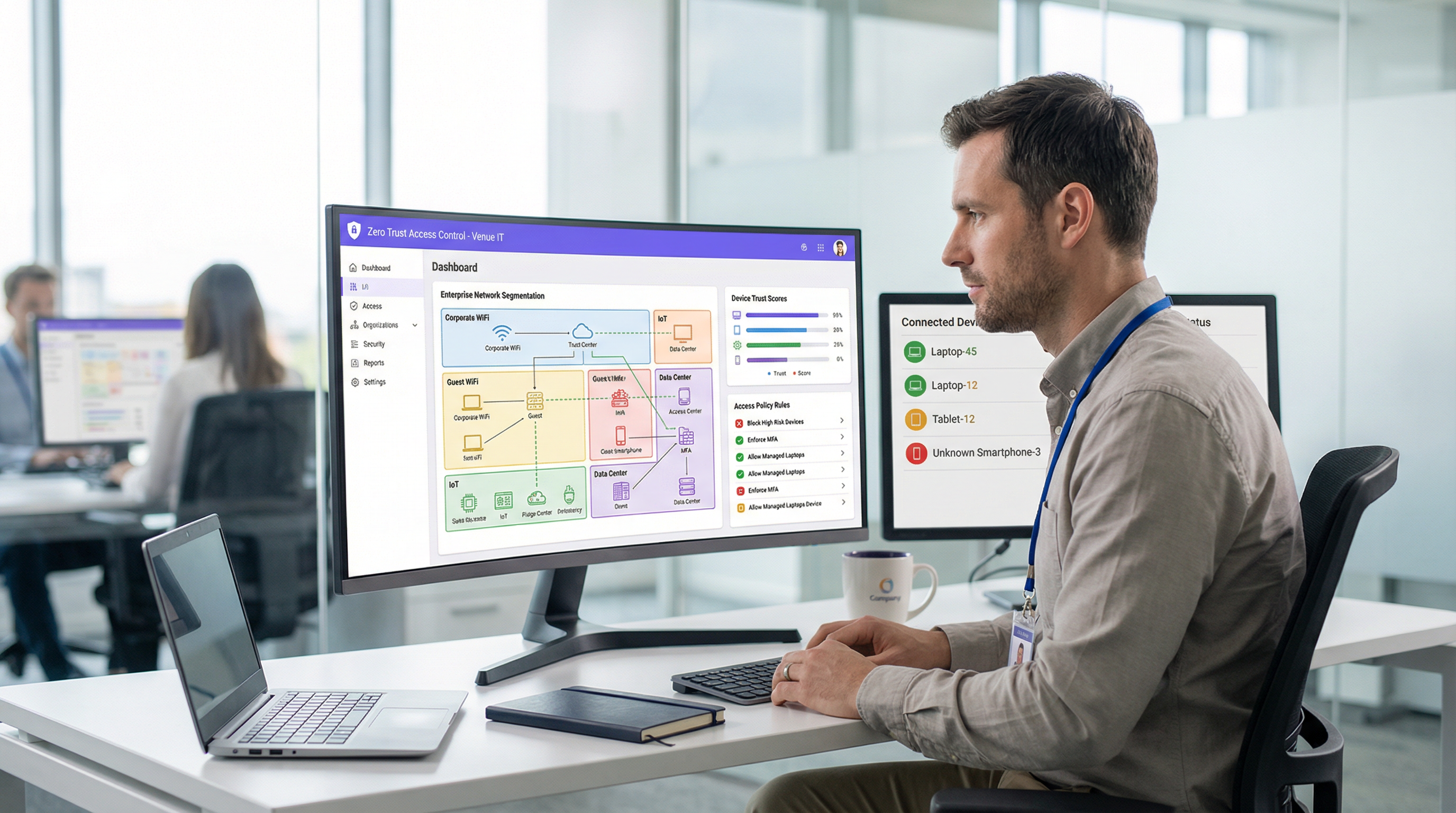
Der Perimeter ist tot. Für Standortbetreiber – Hotels, Einzelhandelsketten, Stadien und Organisationen des öffentlichen Sektors – ist das traditionelle Sicherheitsmodell, jedem Gerät zu vertrauen, das sich erfolgreich am WiFi-Netzwerk authentifiziert, nicht mehr tragbar. Ein modernes Standort-Netzwerk ist ein komplexes Ökosystem aus Firmen-Laptops, BYOD-Smartphones, nicht verwalteten Gastgeräten, IoT-Sensoren und kritischer Infrastruktur wie POS-Terminals und Property-Management-Systemen, die sich alle denselben physischen Luftraum teilen.
Die Zero Trust WiFi-Architektur ist die strategische Notwendigkeit zur Absicherung dieser Umgebung. Sie ersetzt das fehlerhafte „Vertrauen, aber Verifizieren“-Modell durch kontinuierliche Verifizierung, Least-Privilege-Zugriff und strikte Mikro-Segmentierung. Dieser praxisorientierte Leitfaden bietet IT-Verantwortlichen die Blaupause für die Anwendung von Zero Trust-Prinzipien auf drahtlose Unternehmensnetzwerke. Wir erläutern die grundlegenden Technologien – IEEE 802.1X, WPA3-Enterprise und RADIUS-Richtliniendurchsetzung – und bieten praktische Anleitungen für die Implementierung, um Ihre Standorte abzusichern, ohne das Nutzererlebnis zu beeinträchtigen. Durch die Implementierung dieser Kontrollen können Unternehmen ihre Angriffsfläche drastisch reduzieren, die Einhaltung von PCI DSS und GDPR sicherstellen und das Risiko von Lateral Movement im Falle einer Sicherheitsverletzung minimieren.
Hören Sie sich unser Executive Briefing zur Zero Trust WiFi-Architektur an:
Technischer Deep-Dive: Die vier Säulen von Zero Trust WiFi
Zero Trust ist kein einzelnes Produkt, das man kaufen und im Serverraum installieren kann; es ist ein Architektur-Framework. Bei der Anwendung auf den Wireless Edge stützt es sich auf vier Grundpfeiler, um die Sicherheit vom Netzwerkperimeter auf einzelne Geräte und Benutzer zu verlagern.
1. Kontinuierliche Verifizierung
Das traditionelle WiFi-Sicherheitsmodell basiert auf einem einmaligen Authentifizierungsereignis. Ein Benutzer gibt einen PSK oder seine Active Directory-Anmeldedaten ein, der Access Point gewährt Zugriff, und dem Gerät wird für die Dauer der Sitzung vertraut. Zero Trust schreibt eine kontinuierliche Verifizierung vor.
Das bedeutet, dass Vertrauen niemals als dauerhaft vorausgesetzt wird. Mithilfe fortschrittlicher RADIUS-Konfigurationen und Network Access Control (NAC)-Richtlinien bewertet das Netzwerk kontinuierlich die Berechtigung des Geräts für den Zugriff auf Ressourcen neu. Wenn sich der Kontext eines Geräts ändert – zum Beispiel, wenn sein Endpoint-Protection-Agent deaktiviert wird oder es versucht, auf Ressourcen außerhalb seines normalen Verhaltensprofils zuzugreifen – können seine Zugriffsberechtigungen während der Sitzung dynamisch widerrufen oder eingeschränkt werden. Dies erfordert die Konfiguration von Timern für die Sitzungs-Re-Authentifizierung und die Integration Ihres Wireless-Controllers mit einem robusten Identity Provider.
2. Least-Privilege-Netzwerkzugriff
Was kann ein Gerät tun, sobald es authentifiziert ist? In einem flachen Netzwerk lautet die Antwort: „fast alles“. In einer Zero Trust-Architektur erhält jedes Gerät den absolut minimalen Zugriff, der zur Erfüllung seiner Funktion erforderlich ist.
Ein Gast, der sich über Guest WiFi verbindet, benötigt ausgehenden Internetzugang und DNS-Auflösung; er hat keinen legitimen Grund, mit dem lokalen Subnetz zu kommunizieren. Ein verwalteter Firmen-Laptop benötigt möglicherweise Zugriff auf interne Dateifreigaben und Cloud-Anwendungen. Ein intelligentes Thermostat muss nur mit seinem spezifischen Cloud-Controller kommunizieren. Dieses Prinzip wird am Netzwerkrand durch dynamische Rollenzuweisung durchgesetzt, wobei der RADIUS-Server spezifische Vendor-Specific Attributes (VSAs) an den Access Point zurückgibt und das Gerät so in eine streng kontrollierte Rolle statt in ein breites, offenes Netzwerksegment einordnet.
3. Mikro-Segmentierung über dynamische VLANs
Mikro-Segmentierung ist der Mechanismus, mit dem der Least-Privilege-Zugriff auf der Netzwerkschicht durchgesetzt wird. Anstatt ein einziges großes Subnetz für alle Wireless-Clients zu unterhalten, wird das Netzwerk in diskrete, logisch isolierte Segmente unterteilt, in der Regel durch dynamische VLAN-Zuweisung.
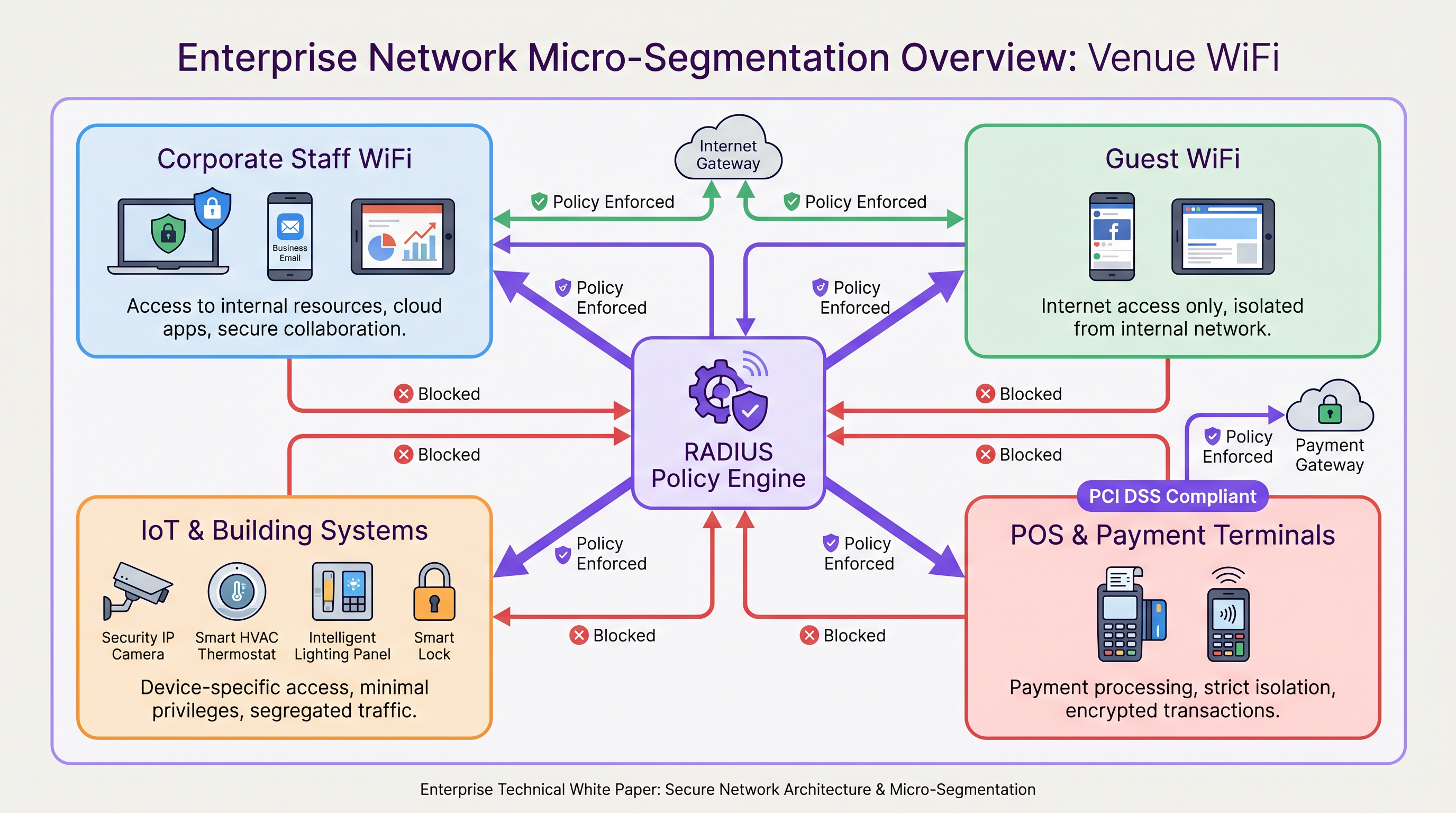
Wenn sich ein Gerät über 802.1X authentifiziert, bewertet die RADIUS-Richtlinien-Engine die Identität des Benutzers, den Gerätetyp sowie den Standort und weist das Gerät dem entsprechenden VLAN zu. Firewalls und Access Control Lists (ACLs) steuern dann den Datenverkehr zwischen diesen Mikro-Segmenten. Zum Beispiel schreibt die PCI DSS-Compliance in Einzelhandelsumgebungen eine strikte Isolierung der Karteninhaber-Datenumgebung vor. Mikro-Segmentierung stellt sicher, dass ein kompromittiertes Gerät im Gastnetzwerk nicht auf POS-Terminals übergreifen und mit ihnen kommunizieren kann.
4. Durchsetzung des Gerätestatus (Device Posture Enforcement)
Identität allein reicht nicht aus, um Vertrauen aufzubauen; auch der Zustand und die Compliance des Geräts müssen verifiziert werden. Die Durchsetzung des Gerätestatus prüft den Zustand des Endpunkts, bevor Zugriff gewährt wird.
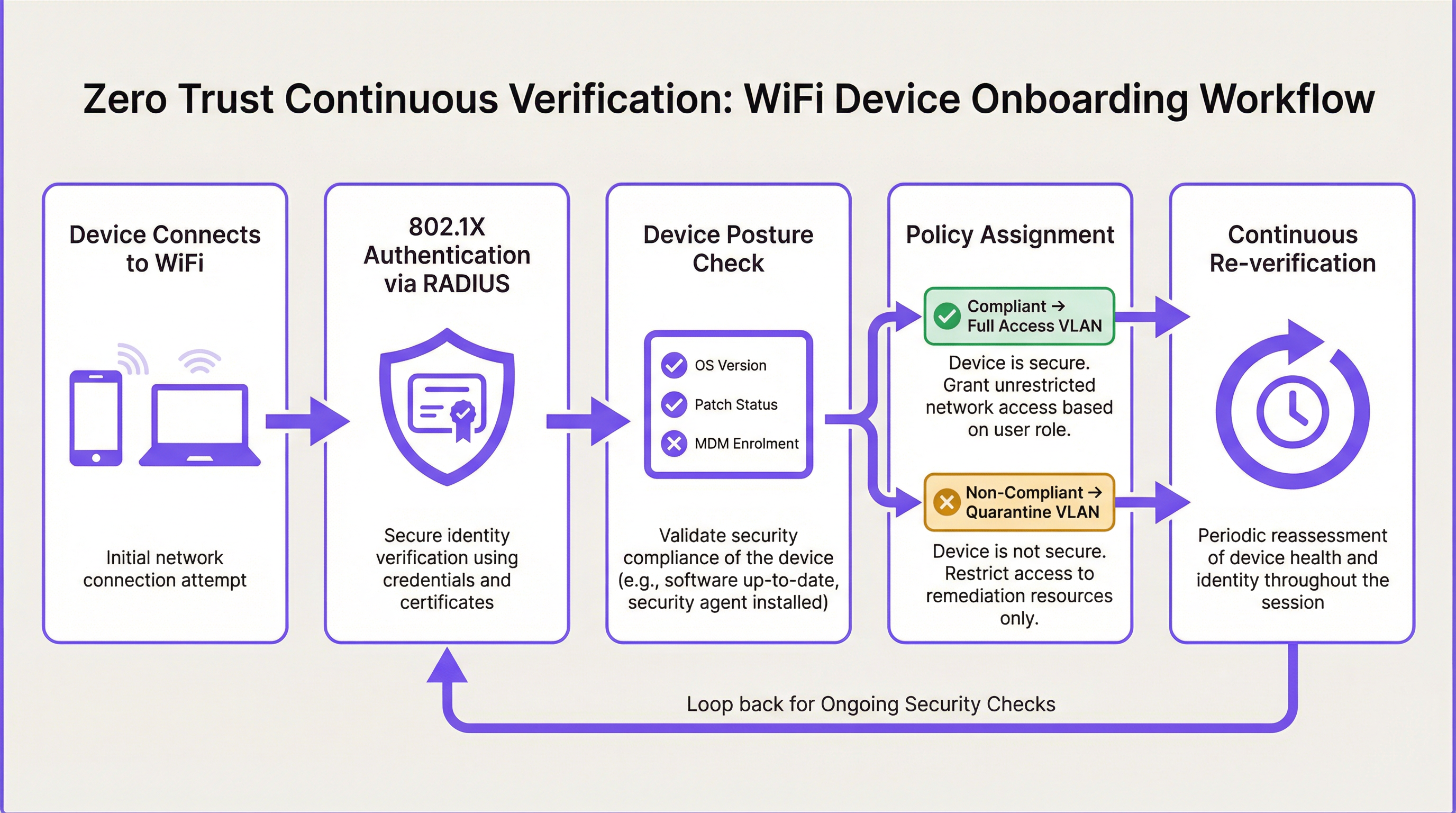
Läuft auf dem Gerät ein unterstütztes, gepatchtes Betriebssystem? Ist es in der Mobile Device Management (MDM)-Plattform des Unternehmens registriert? Ist die Antivirensoftware aktiv und auf dem neuesten Stand? Wenn ein Gerät diese Statusprüfungen nicht besteht, wird es nicht einfach getrennt; es wird in ein Remediation-VLAN mit begrenztem Zugriff auf Patch-Server oder IT-Support-Portale verschoben, sodass der Benutzer das Compliance-Problem ohne manuelles Eingreifen der IT lösen kann.
Implementierungsleitfaden: Architektur der Lösung
Die Bereitstellung von Zero Trust WiFi erfordert einen koordinierten Ansatz über das Wireless LAN, die Authentifizierungsinfrastruktur und den Netzwerksicherheits-Stack hinweg.
Kerntechnologien und Standards
- IEEE 802.1X: Die Grundlage für sicheren Netzwerkzugriff. 802.1X bietet eine portbasierte Zugriffskontrolle und stellt sicher, dass Geräte keinen Datenverkehr (außer EAP-Authentifizierungsframes) senden können, bis sie explizit vom RADIUS-Server authentifiziert und autorisiert wurden.
- EAP-TLS (Extensible Authentication Protocol - Transport Layer Security): Der Goldstandard für die Geräteauthentifizierung. EAP-TLS verwendet client- und serverseitige digitale Zertifikate für die gegenseitige Authentifizierung, wodurch das Risiko von Anmeldedatendiebstahl durch Phishing oder Man-in-the-Middle (MitM)-Angriffe vollständig eliminiert wird. Für einen tieferen Einblick in Authentifizierungsprotokolle lesen Sie unseren Leitfaden: Comparativa de métodos EAP: PEAP, EAP-TLS, EAP-TTLS y EAP-FAST .
- WPA3-Enterprise: Der aktuelle Standard für die drahtlose Verschlüsselung. WPA3-Enterprise bietet, insbesondere im 192-Bit-Modus, die kryptografische Stärke, die für hochsensible Umgebungen erforderlich ist, und ersetzt den anfälligen WPA2-Standard.
- RADIUS-Richtlinien-Engine: Das zentrale Gehirn der Architektur. Der RADIUS-Server bewertet Authentifizierungsanfragen anhand definierter Richtlinien und gibt dynamische Attribute (VLAN-IDs, ACLs, Bandbreitenbeschränkungen) an den Access Point zurück.
Schritt-für-Schritt-Bereitstellungsphasen
- Erkennung und Profiling: Man kann nicht sichern, was man nicht sieht. Beginnen Sie mit dem Profiling aller Geräte, die sich derzeit im Netzwerk befinden. Nutzen Sie DHCP-Fingerprinting, MAC-OUI-Analyse und HTTP-User-Agent-Parsing, um Geräte in logische Gruppen zu kategorisieren (z. B. Corporate IT, BYOD, Guest, IoT, POS).
- Mikro-Segmente definieren: Definieren Sie basierend auf der Erkennungsphase Ihre Ziel-VLAN-Architektur. Eine typische Bereitstellung im Bereich Hospitality könnte Segmente für Gast-Internet, Personalbetrieb, Property-Management-Systeme (PMS) und Gebäude-IoT erfordern.
- Hochverfügbares RADIUS implementieren: Implementieren Sie eine robuste RADIUS-Infrastruktur, die in der Lage ist, die Authentifizierungslast und Richtlinienbewertung zu bewältigen. Stellen Sie eine Active-Active- oder Active-Passive-Redundanz sicher, um einen Single Point of Failure zu vermeiden.
- 802.1X für verwaltete Geräte implementieren: Beginnen Sie die Migration, indem Sie firmenverwaltete Laptops und Tablets auf 802.1X mit EAP-TLS umstellen. Verteilen Sie die erforderlichen Zertifikate und Wireless-Profile über Ihre MDM-Lösung, um ein nahtloses Nutzererlebnis zu gewährleisten.
- IoT über MAC Authentication Bypass (MAB) und Profiling adressieren: Viele ältere IoT-Geräte (Drucker, Smart-TVs, Sensoren ) unterstützen keine 802.1X-Supplicants. Implementieren Sie für diese Geräte MAB in Kombination mit striktem Geräte-Profiling. Der RADIUS-Server authentifiziert das Gerät anhand seiner MAC-Adresse, wendet jedoch eine hochgradig restriktive ACL an, die nur die Kommunikation mit erforderlichen Servern erlaubt.
- Integration mit SD-WAN: Stellen Sie sicher, dass Ihre Wireless-Mikro-Segmentierung mit Ihrer umfassenderen Netzwerkarchitektur übereinstimmt. Wie in The Core SD WAN Benefits for Modern Businesses beschrieben, kann SD-WAN diese segmentierten Richtlinien über das WAN hinweg erweitern und so eine durchgängige Zero Trust-Durchsetzung gewährleisten.
Best Practices für Standort-Netzwerke
- Verlassen Sie sich beim Unternehmenszugriff niemals auf PSKs: Pre-Shared Keys (PSKs) bieten Verschlüsselung, aber keine Identitätsprüfung. Jeder mit dem Passwort hat Zugriff. PSKs sollten ausschließlich auf ältere IoT-Netzwerke (idealerweise mit eindeutigen PSKs pro Gerät über Technologien wie MPSK/DPSK) oder offene Gastnetzwerke beschränkt werden.
- Geräte-Onboarding automatisieren: Der Übergang zu 802.1X und zertifikatsbasierter Authentifizierung muss für den Endbenutzer reibungslos verlaufen. Nutzen Sie Onboarding-Portale, die BYOD-Geräte automatisch mit den richtigen Zertifikaten und Netzwerkprofilen ausstatten, ohne dass IT-Helpdesk-Tickets erforderlich sind.
- Verhalten überwachen und Baselines erstellen: Zero Trust erfordert Sichtbarkeit. Nutzen Sie WiFi Analytics , um Baselines für normales Netzwerkverhalten zu erstellen. Wenn eine IP-Kamera plötzlich versucht, SSH-Verbindungen zu internen Servern aufzubauen, muss die Richtlinien-Engine diese Anomalie erkennen und das Gerät automatisch unter Quarantäne stellen.
- Abstimmung auf moderne Hardware: Stellen Sie sicher, dass Ihre Infrastruktur die erforderlichen Standards unterstützt. Lesen Sie unseren Leitfaden Wireless Access Points Definition Your Ultimate 2026 Guide , um die für WPA3 und dynamische Richtliniendurchsetzung erforderlichen Funktionen zu verstehen.
Fehlerbehebung & Risikominderung
Die Implementierung von Zero Trust in einem Live-Standort-Netzwerk birgt betriebliche Risiken. Die häufigsten Fehlerszenarien bestehen darin, legitimen Datenverkehr zu blockieren oder Authentifizierungsschleifen zu erzeugen.
| Risiko/Fehlermodus | Ursache | Minderungsstrategie |
|---|---|---|
| 802.1X Authentifizierungs-Timeouts | Fehlkonfiguration des Supplicants oder Latenz des RADIUS-Servers. | Stellen Sie sicher, dass RADIUS-Server geografisch nah an den Standorten liegen. Überprüfen Sie die Zertifikatsvertrauensketten auf Client-Geräten. Verwenden Sie EAP-TLS, um Abfragen von Benutzeranmeldedaten zu vermeiden. |
| IoT-Geräte verlieren die Verbindung | Geräte bestehen den MAC Authentication Bypass oder die Statusprüfungen nicht. | Implementieren Sie eine „Monitor-Modus“-Phase, bevor Sie Blockierungsrichtlinien durchsetzen. Protokollieren Sie alle MAB-Fehler und verfeinern Sie die Geräte-Profiling-Regeln, bevor Sie in den Durchsetzungsmodus wechseln. |
| Komplexität durch Über-Segmentierung | Erstellung zu vieler VLANs, was zu Routing-Komplexität und fehlerhaften Anwendungen führt (z. B. Multicast-Erkennungsfehler wie Bonjour/mDNS). | Beginnen Sie mit breiten funktionalen Segmenten (Gast, Personal, IoT, Sicher). Führen Sie eine weitere Segmentierung nur ein, wenn ein spezifisches Risiko oder eine Compliance-Vorgabe (z. B. PCI DSS) dies erfordert. Verwenden Sie Bonjour-Gateways, wenn eine VLAN-übergreifende Erkennung erforderlich ist. |
| Captive Portal-Umgehungen | Fortgeschrittene Benutzer fälschen MAC-Adressen, um die Authentifizierung am Gastportal zu umgehen. | MAC-Adressen sind leicht zu fälschen. Kombinieren Sie MAC-Tracking mit Browser-Fingerprinting und setzen Sie Sitzungs-Timeouts durch, um die Auswirkungen von MAC-Spoofing zu minimieren. |
ROI & geschäftliche Auswirkungen
Der Übergang zu einer Zero Trust WiFi-Architektur erfordert Investitionen in Engineering-Zeit, RADIUS-Infrastruktur und potenziell NAC-Lizenzierung. Der Return on Investment für Enterprise-Standorte ist jedoch erheblich und messbar:
- Reduzierte Auswirkungen von Sicherheitsverletzungen (Reduzierung des Blast Radius): Durch die Mikro-Segmentierung des Netzwerks kann ein kompromittiertes Gastgerät oder ein anfälliger IoT-Sensor nicht als Sprungbrett für Angriffe auf kritische Infrastrukturen genutzt werden. Dies begrenzt den „Blast Radius“ eines Vorfalls und reduziert den potenziellen finanziellen und Reputationsschaden einer Sicherheitsverletzung drastisch.
- Optimierte Compliance-Audits: Für Einzelhandels- und Hospitality-Standorte sind PCI DSS- und GDPR-Compliance erhebliche betriebliche Belastungen. Mikro-Segmentierung definiert und isoliert die Karteninhaber-Datenumgebung (CDE) und Systeme, die personenbezogene Daten (PII) verarbeiten, klar. Dies reduziert den Umfang von Compliance-Audits und spart erhebliche Zeit und Beratungsgebühren.
- Operative Effizienz: Der Verzicht auf PSK-Management und manuelle VLAN-Zuweisungen zugunsten eines dynamischen, richtliniengesteuerten Zugriffs entlastet den IT-Helpdesk. Automatisierte Onboarding- und Self-Service-Remediation-Workflows geben erfahrenen Ingenieuren den Freiraum, sich auf strategische Initiativen zu konzentrieren, anstatt WiFi-Passwörter zurückzusetzen.
- Zukunftssicherheit des Standorts: Da Standorte immer fortschrittlichere Technologien einsetzen – von Wayfinding -Systemen bis hin zu automatisierten Check-in-Kiosken – vergrößert sich die Angriffsfläche. Ein Zero Trust-Fundament stellt sicher, dass neue Technologien sicher integriert werden können, ohne das Kernnetzwerk zu gefährden. Wie in Modern Hospitality WiFi Solutions Your Guests Deserve hervorgehoben, ist Sicherheit das unsichtbare Fundament des modernen Gasterlebnisses.
Schlüsselbegriffe & Definitionen
Zero Trust Network Access (ZTNA)
A security framework that requires all users and devices, whether inside or outside the organisation's network, to be authenticated, authorised, and continuously validated before being granted access to applications and data.
The overarching philosophy that drives the shift from perimeter-based security to identity- and context-based security on venue WiFi networks.
Micro-Segmentation
The practice of dividing a network into distinct security segments down to the individual workload or device level, applying strict access controls to dictate how these segments communicate.
Essential for limiting the 'blast radius' of a breach; ensures a compromised guest device cannot access corporate servers or POS terminals.
IEEE 802.1X
An IEEE Standard for port-based Network Access Control (PNAC), providing an authentication mechanism to devices wishing to attach to a LAN or WLAN.
The foundational protocol for enforcing Zero Trust at the wireless edge, acting as the gatekeeper before any network traffic is permitted.
RADIUS (Remote Authentication Dial-In User Service)
A networking protocol that provides centralised Authentication, Authorization, and Accounting (AAA) management for users who connect and use a network service.
The policy engine in a Zero Trust WiFi architecture that evaluates credentials and dynamically assigns VLANs and access policies.
EAP-TLS (Extensible Authentication Protocol - Transport Layer Security)
An EAP method that uses public key infrastructure (PKI) and digital certificates for mutual authentication between the client and the authentication server.
The most secure authentication method for managed devices, eliminating reliance on passwords and protecting against credential theft.
Dynamic VLAN Assignment
A network configuration where a RADIUS server assigns a device to a specific Virtual Local Area Network (VLAN) based on its authenticated identity or profile, rather than the SSID it connected to.
The primary mechanism for enforcing micro-segmentation and least-privilege access on enterprise wireless networks.
MAC Authentication Bypass (MAB)
A technique used to authenticate devices that do not support 802.1X supplicants (like many IoT devices) by using their MAC address as the identity credential.
A pragmatic workaround for legacy devices, which must be paired with strict profiling and restricted VLAN assignment due to the ease of MAC spoofing.
Device Posture
The security state of an endpoint device, including factors such as OS patch level, antivirus status, firewall configuration, and MDM enrolment.
A critical component of continuous verification; devices failing posture checks are quarantined regardless of valid user credentials.
Fallstudien
A 350-room hotel group needs to secure its flat network architecture where guest devices, staff laptops, IP cameras, and the Property Management System (PMS) currently share the same VLAN, creating significant GDPR and lateral movement risks.
Deploy a micro-segmented architecture using dynamic VLAN assignment via RADIUS. Create four distinct segments: Guest Internet, Staff Corporate, IoT/Building Systems, and PMS Access. Implement 802.1X with EAP-TLS certificate authentication for staff devices via MDM. Use MAC Authentication Bypass (MAB) with strict profiling for IoT devices, placing them in an isolated VLAN with restrictive ACLs. Guest devices authenticate via a captive portal, receiving internet-only access.
A major retail chain with 200 stores must achieve PCI DSS compliance by isolating its Point of Sale (POS) terminals from the customer WiFi and staff productivity networks, all of which currently operate on the same physical wireless infrastructure.
Implement role-based access control and micro-segmentation. Configure the RADIUS policy engine to assign devices to three isolated VLANs: Customer Guest WiFi (internet only), Staff WiFi (role-based access for managers vs. associates), and a dedicated POS segment. Secure the POS segment using WPA3-Enterprise and EAP-TLS, enforcing strict firewall rules that only permit traffic to the payment gateway. Integrate RADIUS accounting logs into the SIEM for audit trails.
A stadium venue needs to deploy a new fleet of smart turnstiles. These devices support basic WPA2-Personal but do not have an 802.1X supplicant. How should the network architect integrate them into the Zero Trust WiFi environment?
The architect should utilise MAC Authentication Bypass (MAB) configured on the RADIUS server. The turnstiles' MAC addresses should be profiled, and upon connection, the RADIUS server should dynamically assign them to a dedicated, highly restricted 'Turnstile IoT' VLAN. The firewall rules for this VLAN must enforce least-privilege, permitting outbound communication only to the specific ticketing gateway IP addresses on the required ports, blocking all lateral movement to other network segments.
Szenarioanalyse
Q1. During a network audit, you discover that the 'Staff Corporate' SSID uses a single Pre-Shared Key (PSK) shared among 50 employees. What are the primary security risks of this configuration in a Zero Trust context, and what is the recommended remediation?
💡 Hinweis:Focus on identity verification and the impact of employee turnover.
Empfohlenen Ansatz anzeigen
The primary risks are the lack of individual identity verification (anyone with the PSK is trusted) and the inability to revoke access for a single user without changing the password for everyone (e.g., when an employee leaves). The recommended remediation is to migrate the 'Staff Corporate' SSID to WPA3-Enterprise using 802.1X. Ideally, deploy EAP-TLS with certificates pushed via MDM for seamless, highly secure authentication, allowing individual device access to be revoked instantly.
Q2. A managed corporate laptop successfully authenticates via EAP-TLS and is assigned to the 'Corporate Access' VLAN. However, the user subsequently disables their endpoint detection and response (EDR) agent. How should a Zero Trust architecture handle this event?
💡 Hinweis:Think about the 'continuous verification' and 'device posture' pillars of Zero Trust.
Empfohlenen Ansatz anzeigen
A Zero Trust architecture must enforce continuous verification. The Network Access Control (NAC) solution, integrated with the EDR platform, should detect the posture change (EDR disabled). The NAC should then issue a Change of Authorization (CoA) to the wireless controller, dynamically revoking the laptop's 'Corporate Access' privileges mid-session and reassigning it to a 'Quarantine' VLAN until the EDR agent is re-enabled.
Q3. A hotel guest connects to the open 'Guest WiFi' SSID and authenticates via the captive portal. However, the network administrator notices that the guest device is attempting to scan IP addresses within the 10.0.0.0/8 range, which is used for internal hotel systems. What Zero Trust principle is failing, and how should it be corrected?
💡 Hinweis:Consider the principles of micro-segmentation and least-privilege access.
Empfohlenen Ansatz anzeigen
The principle of least-privilege access (and micro-segmentation) is failing. A guest device should only have outbound internet access and should not be able to route traffic to internal subnets. This should be corrected by ensuring the Guest VLAN has strict Access Control Lists (ACLs) applied at the firewall or gateway that explicitly drop any traffic destined for RFC 1918 private IP ranges, permitting only traffic destined for the public internet.
Wichtigste Erkenntnisse
- ✓Zero Trust WiFi assumes no device is inherently safe, replacing perimeter security with continuous verification.
- ✓Least-privilege access ensures devices only reach the specific network resources required for their function.
- ✓Micro-segmentation via dynamic VLAN assignment isolates critical systems (like POS) from guest and IoT traffic.
- ✓Device posture enforcement validates OS patching and security agents before granting network access.
- ✓IEEE 802.1X and WPA3-Enterprise form the technical foundation for secure, policy-driven wireless authentication.
- ✓EAP-TLS certificate-based authentication is the gold standard for securing managed corporate devices.
- ✓Implementing Zero Trust reduces the 'blast radius' of breaches and streamlines compliance for PCI DSS and GDPR.




