

क्लाउड-मॅनेज्ड WiFi विरुद्ध कंट्रोलर-बेस्ड WiFi: तुम्ही कशाची निवड करावी?
This guide provides a vendor-neutral technical comparison of cloud-managed WiFi and controller-based (on-premise) WiFi architectures, helping IT managers, network architects, and CTOs make an informed deployment decision. It covers the architectural trade-offs across scalability, data sovereignty, cost model, and offline resilience, with real-world case studies from hospitality, retail, and public-sector environments. It also explains how Purple's WiFi intelligence platform integrates with either architecture to deliver guest experience management, first-party data capture, and GDPR-compliant analytics.
🎧 हे मार्गदर्शक ऐका
ट्रान्सक्रिप्ट पहा
कार्यकारी सारांश
क्लाउड-मॅनेज्ड WiFi आणि कंट्रोलर-बेस्ड WiFi यापैकी एकाची निवड करणे हा या दशकात नेटवर्क टीमने घेतलेल्या सर्वात महत्त्वाच्या आर्किटेक्चरल निर्णयांपैकी एक आहे. दोन्ही मॉडेल्स एंटरप्राइझ-ग्रेड वायरलेस कनेक्टिव्हिटी प्रदान करतात, परंतु इंटेलिजन्स कुठे आहे, ते कसे स्केल करतात, कालांतराने त्यांचा खर्च किती असतो आणि ते कंप्लायन्स जबाबदाऱ्या कशा हाताळतात या बाबतीत ते मूलभूतपणे भिन्न आहेत.
क्लाउड-मॅनेज्ड WiFi कंट्रोलर फंक्शनला व्हेंडर-होस्टेड क्लाउड प्लॅटफॉर्मवर हलवते, ज्यामुळे झिरो-टच प्रोव्हिजनिंग, ऑटोमॅटिक फर्मवेअर अपडेट्स आणि अमर्यादित साइट्सवर सिंगल-पेन-ऑफ-ग्लास मॅनेजमेंट शक्य होते. कंट्रोलर-बेस्ड WiFi ते इंटेलिजन्स ऑन-प्रिमाइस ठेवते, जे जास्तीत जास्त डेटा सार्वभौमत्व, ऑफलाइन लवचिकता आणि ग्रॅन्युलर कंट्रोल प्रदान करते — परंतु यासाठी जास्त CapEx आणि अधिक ऑपरेशनल ओव्हरहेड खर्च येतो.
बहुतेक मल्टी-साइट ऑपरेटर्ससाठी — हॉटेल चेन्स, रिटेल इस्टेट्स, स्टेडियम ऑपरेटर्स आणि स्थानिक प्राधिकरणांसाठी — क्लाउड-मॅनेज्ड WiFi आता ऑपरेशनलदृष्ट्या एक उत्कृष्ट पर्याय आहे. कठोर डेटा रेसिडेन्सी आवश्यकता असलेल्या मोठ्या सिंगल-कॅम्पस डिप्लॉयमेंट्ससाठी, ऑन-प्रिमाइस कंट्रोलर्स अजूनही आकर्षक पर्याय आहेत. कोणत्याही परिस्थितीत, Purple चे WiFi मॅनेजमेंट प्लॅटफॉर्म इन्फ्रास्ट्रक्चर-अग्नोस्टिक ओव्हरले म्हणून काम करते, जे तुम्ही निवडलेल्या कोणत्याही आर्किटेक्चरवर गेस्ट एक्सपिरियन्स मॅनेजमेंट, GDPR-कंप्लायंट डेटा कॅप्चर आणि ॲक्शनेबल ॲनालिटिक्स जोडते.
तांत्रिक सखोल माहिती (Technical Deep-Dive)
क्लाउड-मॅनेज्ड WiFi म्हणजे काय?
क्लाउड-मॅनेज्ड WiFi हे एक वायरलेस LAN आर्किटेक्चर आहे ज्यामध्ये कंट्रोलर फंक्शन — ऑथेंटिकेशन, पॉलिसी एन्फोर्समेंट, रेडिओ फ्रिक्वेन्सी मॅनेजमेंट, फर्मवेअर डिस्ट्रिब्युशन आणि मॉनिटरिंग — डेडिकेटेड ऑन-प्रिमाइस हार्डवेअरऐवजी व्हेंडर-ऑपरेटेड क्लाउड प्लॅटफॉर्मवर होस्ट केले जाते. स्थानिक साइट्सवरील ॲक्सेस पॉइंट्स एन्क्रिप्टेड HTTPS किंवा CAPWAP टनल्सद्वारे क्लाउड मॅनेजमेंट प्लॅटफॉर्मशी कनेक्ट होतात, त्यांचे कॉन्फिगरेशन प्राप्त करतात आणि टेलिमेट्री डेटा अपस्ट्रीम पाठवतात. डेटा प्लेन — युझर ट्रॅफिकचे प्रत्यक्ष फॉरवर्डिंग — सामान्यतः ॲक्सेस पॉइंटवर स्थानिक राहते, ज्यामुळे WAN आउटेजमुळे सक्रिय युझर सेशन्समध्ये व्यत्यय येत नाही याची खात्री होते.
अग्रगण्य क्लाउड-मॅनेज्ड WiFi प्लॅटफॉर्म्समध्ये Cisco Meraki, Aruba Central (HPE), Juniper Mist, Extreme Networks CloudIQ आणि Ruckus One यांचा समावेश आहे. प्रत्येक प्लॅटफॉर्म वेब-बेस्ड मॅनेजमेंट कन्सोल, थर्ड-पार्टी सिस्टीम्ससोबत इंटिग्रेशनसाठी RESTful API आणि वेगवेगळ्या स्तरावरील AI-ड्रिव्हन RF ऑप्टिमायझेशन आणि ॲनोमली डिटेक्शन प्रदान करतो.
कंट्रोलर-बेस्ड WiFi म्हणजे काय?
कंट्रोलर-बेस्ड WiFi हे पारंपारिक एंटरप्राइझ वायरलेस आर्किटेक्चर आहे ज्यामध्ये साइट किंवा कॅम्पसमधील सर्व ॲक्सेस पॉइंट्स व्यवस्थापित करण्यासाठी फिजिकल किंवा व्हर्च्युअल वायरलेस LAN कंट्रोलर (WLC) ऑन-प्रिमाइस डिप्लॉय केला जातो. कंट्रोलर RADIUS द्वारे IEEE 802.1X ऑथेंटिकेशन हाताळतो, QoS आणि सिक्युरिटी पॉलिसी लागू करतो, ॲक्सेस पॉइंट्स (IEEE 802.11r) दरम्यान फास्ट रोमिंग व्यवस्थापित करतो आणि सेंट्रलाइज्ड मॉनिटरिंग आणि ट्रबलशूटिंग प्रदान करतो. स्प्लिट-टनेल किंवा लोकल-स्विचिंग कॉन्फिगरेशनमध्ये, युझर ट्रॅफिक ॲक्सेस पॉइंटवर लोकली फॉरवर्ड केले जाते; सेंट्रलाइज्ड-स्विचिंग कॉन्फिगरेशनमध्ये, सर्व ट्रॅफिक कंट्रोलरकडे परत टनेल केले जाते.
प्रमुख कंट्रोलर-बेस्ड प्लॅटफॉर्म्समध्ये Cisco Catalyst Wireless (पूर्वीचे AireOS), Aruba Mobility Controllers, ऑन-प्रिमाइस व्हर्च्युअल कंट्रोलर्ससह Juniper Mist आणि Ruckus SmartZone यांचा समावेश आहे. हे प्लॅटफॉर्म्स परिपक्व, वैशिष्ट्यपूर्ण आहेत आणि एंटरप्राइझ, हेल्थकेअर आणि सार्वजनिक क्षेत्रातील वातावरणात मोठ्या प्रमाणावर डिप्लॉय केले जातात.
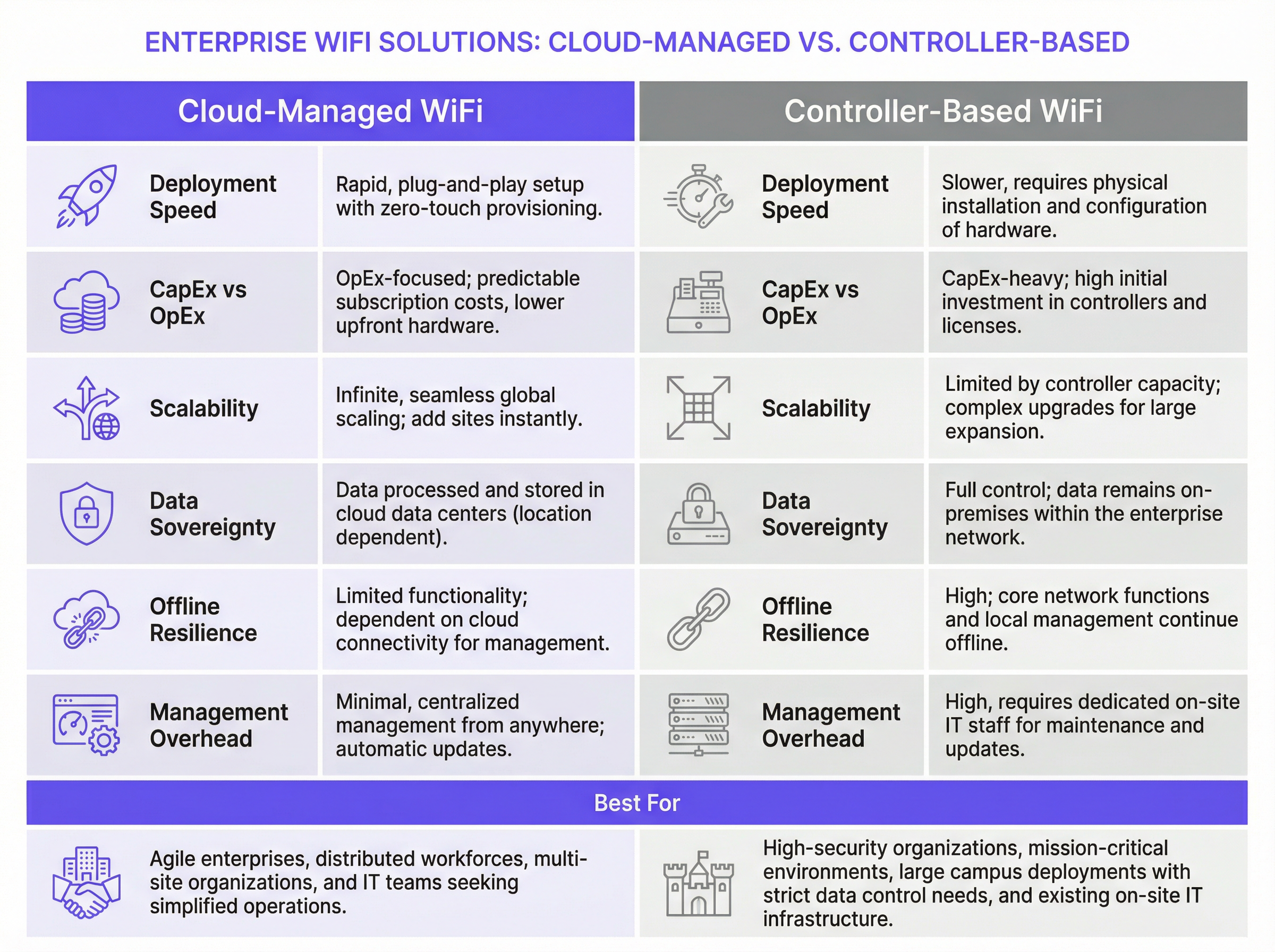
आर्किटेक्चरल ट्रेड-ऑफ्स: एक स्ट्रक्चर्ड तुलना
| परिमाण (Dimension) | क्लाउड-मॅनेज्ड WiFi | कंट्रोलर-बेस्ड WiFi |
|---|---|---|
| डिप्लॉयमेंटचा वेग | जलद; प्री-स्टेज्ड AP कॉन्फिगरेशनद्वारे झिरो-टच प्रोव्हिजनिंग | संथ; ऑन-साइट कंट्रोलर इन्स्टॉलेशन आणि AP रजिस्ट्रेशन आवश्यक |
| खर्च मॉडेल | OpEx-प्रबळ; प्रति-AP सबस्क्रिप्शन लायसन्सिंग | CapEx-प्रबळ; हार्डवेअर खरेदी आणि वार्षिक सपोर्ट कॉन्ट्रॅक्ट्स |
| स्केलेबिलिटी | प्रभावीपणे अमर्यादित; हार्डवेअर बदलांशिवाय साइट्स जोडा | कंट्रोलर क्षमतेनुसार मर्यादित; स्केल करण्यासाठी हार्डवेअर अपग्रेड्स आवश्यक |
| ऑफलाइन लवचिकता | लोकल ट्रॅफिक फॉरवर्डिंग सुरू राहते; मॅनेजमेंट ॲक्सेस गमावला जातो | संपूर्ण मॅनेजमेंट आणि डेटा प्लेन कार्यक्षमता लोकली राखली जाते |
| डेटा सार्वभौमत्व | मॅनेजमेंट डेटा क्लाउडमध्ये प्रोसेस केला जातो (प्रदेशावर अवलंबून) | सर्व डेटा एंटरप्राइझ नेटवर्क सीमेच्या आत राहतो |
| फर्मवेअर मॅनेजमेंट | ऑटोमॅटिक, व्हेंडर-मॅनेज्ड अपडेट्स | मॅन्युअल किंवा शेड्यूल्ड; IT टीमच्या देखरेखीची आवश्यकता |
| प्रगत वैशिष्ट्ये | वेगाने सुधारत आहेत; AI-ड्रिव्हन RF ऑप्टिमायझेशन उपलब्ध | परिपक्व; प्रगत QoS, लोकेशन सर्व्हिसेस आणि पॉलिसी ग्रॅन्युलॅरिटी |
| मल्टी-साइट मॅनेजमेंट | सर्व साइट्सवर नेटिव्हली सिंगल पेन ऑफ ग्लास | अतिरिक्त NOC टूलिंग किंवा प्रति-साइट मॅनेजमेंट आवश्यक |
| IT ओव्हरहेड | कमी; किमान ऑन-साइट तज्ञांची आवश्यकता | जास्त; देखभालीसाठी कुशल वायरलेस इंजिनिअर्सची आवश्यकता |
सिक्युरिटी आर्किटेक्चरमधील विचार
दोन्ही आर्किटेक्चर्स एंटरप्राइझ-ग्रेड सिक्युरिटी मानकांना सपोर्ट करतात. IEEE 802.1X ऑथेंटिकेशनसह WPA3-Enterprise सर्व आधुनिक क्लाउड-मॅनेज्ड आणि कंट्रोलर-बेस्ड प्लॅटफॉर्म्सवर उपलब्ध आहे. सेंट्रलाइज्ड ऑथेंटिकेशनसाठी RADIUS इंटिग्रेशन दोन्ही मॉडेल्समध्ये स्टँडर्ड आहे. गेस्ट, स्टाफ आणि IoT ट्रॅफिक वेगळे करण्यासाठी VLAN सेगमेंटेशन सर्व प्रमुख व्हेंडर्सद्वारे सपोर्ट केले जाते.
मुख्य सिक्युरिटी फरक मॅनेजमेंट प्लेनमध्ये आहे. कंट्रोलर-बेस्ड डिप्लॉयमेंटमध्ये, सर्व मॅनेजमेंट ट्रॅफिक तुमच्या नेटवर्क परिमितीमध्ये राहते, जे PCI DSS (ज्याला कार्डहोल्डर डेटा वातावरणावर कठोर नियंत्रणे आवश्यक आहेत) किंवा ISO 27001 सर्टिफिकेशन आवश्यकतांच्या अधीन असलेल्या संस्थांसाठी एक महत्त्वपूर्ण फायदा आहे. क्लाउड-मॅनेज्ड डिप्लॉयमेंटमध्ये, मॅनेजमेंट ट्रॅफिक पब्लिक इंटरनेटवरून जाते — जरी ते एन्क्रिप्टेड असले तरी — आणि तुमची सिक्युरिटी पोश्चर अंशतः क्लाउड व्हेंडरच्या स्वतःच्या सिक्युरिटी कंट्रोल्स आणि सर्टिफिकेशन्सवर अवलंबून असते.
विशेषतः गेस्ट WiFi साठी, GDPR कंप्लायन्सची आवश्यकता आहे की Captive Portal द्वारे गोळा केलेला कोणताही वैयक्तिक डेटा — ज्यामध्ये ईमेल पत्ते, सोशल लॉगिन टोकन्स किंवा डिव्हाइस आयडेंटिफायर्स समाविष्ट आहेत — स्पष्ट, माहितीपूर्ण संमतीने कॅप्चर केला जावा, सुरक्षितपणे स्टोअर केला जावा आणि ॲक्सेस आणि इरेजरसह डेटा सब्जेक्ट अधिकारांच्या अधीन असावा. तुमचे मूळ नेटवर्क क्लाउड-मॅनेज्ड असो वा कंट्रोलर-बेस्ड, हे बंधन लागू होते. Purple चे कन्सेंट मॅनेजमेंट फ्रेमवर्क या आवश्यकतेला थेट संबोधित करते, टाइमस्टॅम्प केलेले कन्सेंट रेकॉर्ड्स, ऑटोमेटेड डेटा रिटेन्शन पॉलिसीज आणि डेटा सब्जेक्ट विनंत्यांसाठी सेल्फ-सर्व्हिस पोर्टल प्रदान करते.
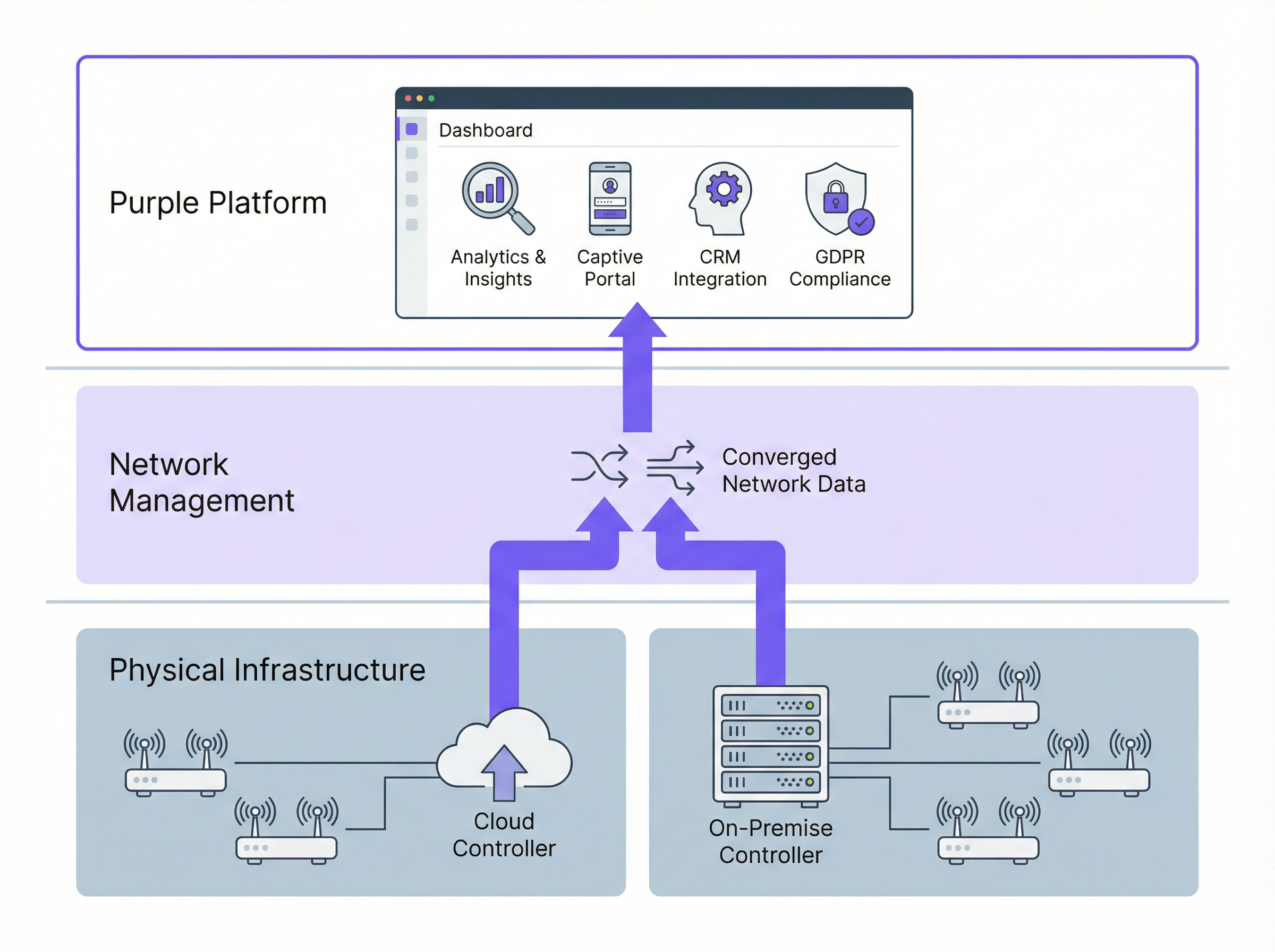
Purple दोन्ही आर्किटेक्चर्ससोबत कसे इंटिग्रेट होते
Purple WiFi इंटेलिजन्स ओव्हरले म्हणून काम करते — ते तुमच्या नेटवर्क व्हेंडरला बदलत नाही, तर गेस्ट एक्सपिरियन्स आणि ॲनालिटिक्स लेयरसह त्यात वाढ करते. तुमचे ॲक्सेस पॉइंट्स क्लाउड प्लॅटफॉर्मद्वारे व्यवस्थापित केले जात असोत किंवा ऑन-प्रिमाइस कंट्रोलरद्वारे, Purple स्टँडर्ड APIs आणि RADIUS इंटिग्रेशनद्वारे तुमच्या नेटवर्क इन्फ्रास्ट्रक्चरशी कनेक्ट होते.
गेस्ट WiFi साठी, Purple एक कस्टमाइझेबल Captive Portal प्रदान करते जे युझर ऑथेंटिकेशन (सोशल लॉगिन, ईमेल, SMS व्हेरिफिकेशन किंवा Purple ॲप), GDPR-कंप्लायंट कन्सेंट कॅप्चर आणि नेटवर्कवर अखंड हँडऑफ हाताळते. स्टाफ WiFi साठी, Purple च्या आयडेंटिटी-बेस्ड नेटवर्किंग क्षमता तुमच्या HR किंवा आयडेंटिटी मॅनेजमेंट सिस्टीमशी जोडलेल्या ऑटोमॅटिक ॲक्सेस प्रोव्हिजनिंग आणि रिव्होकेशनला सक्षम करतात — ज्यामुळे नोकरी सोडून जाणाऱ्या कर्मचाऱ्याचा नेटवर्क ॲक्सेस मॅन्युअल हस्तक्षेपाशिवाय संपुष्टात येतो याची खात्री होते.
Purple चे ॲनालिटिक्स प्लॅटफॉर्म त्यानंतर फूटफॉल मेट्रिक्स, ड्वेल टाइम ॲनालिसिस, नवीन विरुद्ध परत येणाऱ्या अभ्यागतांचे प्रमाण आणि डेमोग्राफिक इनसाइट्स जनरेट करण्यासाठी कनेक्शन डेटा प्रोसेस करते. हे ॲनालिटिक्स Purple च्या डॅशबोर्डद्वारे, तुमच्या बिझनेस इंटेलिजन्स टूल्ससोबत API इंटिग्रेशनद्वारे किंवा Salesforce, HubSpot आणि Microsoft Dynamics सह प्लॅटफॉर्म्सवरील थेट CRM कनेक्टर्सद्वारे उपलब्ध आहेत.
अंमलबजावणी मार्गदर्शक (Implementation Guide)
पायरी 1: तुमची आवश्यकता प्रोफाइल परिभाषित करा
व्हेंडर्सचे मूल्यांकन करण्यापूर्वी, पाच परिमाणांमध्ये तुमच्या आवश्यकतांचे दस्तऐवजीकरण करा: साइट संख्या आणि वितरण (सिंगल कॅम्पस विरुद्ध मल्टी-साइट इस्टेट); कंप्लायन्स जबाबदाऱ्या (GDPR, PCI DSS, डेटा रेसिडेन्सी आवश्यकता); IT टीमची क्षमता (तुम्ही प्रत्येक साइटवर ऑन-प्रिमाइस हार्डवेअरला सपोर्ट करू शकता का?); व्यावसायिक उद्दिष्टे (तुम्हाला गेस्ट डेटा कॅप्चर आणि ॲनालिटिक्सची आवश्यकता आहे का?); आणि बजेट मॉडेल (CapEx विरुद्ध OpEx प्राधान्य).
पायरी 2: तुमचे आर्किटेक्चर मॉडेल निवडा
खालील निर्णय लॉजिक लागू करा. जर तुम्ही भौगोलिकदृष्ट्या वितरित पाचपेक्षा जास्त साइट्स चालवत असाल, तर क्लाउड-मॅनेज्ड WiFi हा तुमच्या ॲक्सेस लेयरसाठी निश्चितपणे योग्य पर्याय आहे — सेंट्रलाइज्ड मॅनेजमेंट आणि झिरो-टच प्रोव्हिजनिंगमधून होणारी ऑपरेशनल बचत बारा ते अठरा महिन्यांत सबस्क्रिप्शन खर्चापेक्षा जास्त होईल. जर तुम्ही कठोर डेटा सार्वभौमत्व आवश्यकतांसह एकच मोठा कॅम्पस चालवत असाल, तर हार्डवेअर CapEx कमी करणाऱ्या व्हर्च्युअल कंट्रोलर पर्यायांसह ऑन-प्रिमाइस कंट्रोलर्सचे मूल्यांकन करा. जर तुमच्याकडे साइट प्रकारांचे मिश्रण असेल, तर प्रत्येक डिप्लॉयमेंट प्रकारासाठी स्पष्टपणे परिभाषित निकषांसह जाणीवपूर्वक हायब्रिड मॉडेलचा विचार करा.
पायरी 3: नेटवर्क व्हेंडर्सचे मूल्यांकन करा
खालील गोष्टी कव्हर करणारा एक स्ट्रक्चर्ड RFP जारी करा: AP हार्डवेअर स्पेसिफिकेशन्स (Wi-Fi 6E सपोर्ट, अँटेना डिझाइन, PoE आवश्यकता); मॅनेजमेंट प्लॅटफॉर्म क्षमता (API पूर्णता, मॉनिटरिंग, अलर्टिंग); सिक्युरिटी सर्टिफिकेशन्स (क्लाउड प्लॅटफॉर्मसाठी SOC 2 Type II, ISO 27001); SLA कमिटमेंट्स (अपटाइम गॅरंटी, सपोर्ट रिस्पॉन्स टाइम्स); आणि इंटिग्रेशन इकोसिस्टीम (RADIUS, VLAN, थर्ड-पार्टी प्लॅटफॉर्म APIs).
पायरी 4: तुमचा इंटेलिजन्स लेयर म्हणून Purple डिप्लॉय करा
एकदा तुमचे नेटवर्क इन्फ्रास्ट्रक्चर निवडले गेले की, गेस्ट एक्सपिरियन्स मॅनेजमेंट आणि ॲनालिटिक्स जोडण्यासाठी Purple डिप्लॉय करा. Purple च्या डिप्लॉयमेंट प्रक्रियेमध्ये हे समाविष्ट आहे: तुमच्या नेटवर्क इन्फ्रास्ट्रक्चरवर एक डेडिकेटेड गेस्ट SSID कॉन्फिगर करणे; SSID चे स्प्लॅश पेज किंवा RADIUS ऑथेंटिकेशन Purple च्या क्लाउड प्लॅटफॉर्मकडे पॉइंट करणे; तुमच्या ब्रँड आयडेंटिटी आणि कन्सेंट फ्लोजसह Captive Portal कस्टमाइझ करणे; आणि इंटिग्रेशन्स मार्केटप्लेसद्वारे Purple ला तुमच्या CRM आणि मार्केटिंग ऑटोमेशन प्लॅटफॉर्मशी कनेक्ट करणे.
पायरी 5: कंप्लायन्स आणि सिक्युरिटी प्रमाणित करा
गो-लाइव्ह करण्यापूर्वी, खालील गोष्टी कव्हर करणारा कंप्लायन्स रिव्ह्यू घ्या: GDPR कन्सेंट फ्लो व्हॅलिडेशन (संमती स्पष्ट, ग्रॅन्युलर आणि रेकॉर्ड केलेली असल्याची खात्री करा); नेटवर्क सेगमेंटेशन व्हेरिफिकेशन (गेस्ट ट्रॅफिक अंतर्गत सिस्टीम्सपर्यंत पोहोचू शकत नाही याची पुष्टी करा); PCI DSS स्कोप असेसमेंट (जर पेमेंट कार्ड डेटा नेटवर्कवर कुठेही प्रोसेस केला जात असेल); आणि गेस्ट WiFi वातावरणाचे पेनिट्रेशन टेस्टिंग.
सर्वोत्तम पद्धती (Best Practices)
आक्रमकपणे सेगमेंट करा. गेस्ट, स्टाफ आणि IoT डिव्हाइसेससाठी नेहमी स्वतंत्र SSIDs डिप्लॉय करा, जे योग्य फायरवॉल पॉलिसीजसह डेडिकेटेड VLAN ला मॅप केलेले असावेत. विशिष्ट व्यावसायिक आवश्यकता असल्याशिवाय, गेस्ट ट्रॅफिक डीफॉल्टनुसार अंतर्गत सिस्टीम्सपासून वेगळे केले पाहिजे, ज्यामध्ये केवळ इंटरनेट ॲक्सेस असावा.
जिथे हार्डवेअर सपोर्ट करते तिथे WPA3 लागू करा. Wi-Fi 6 आणि Wi-Fi 6E ॲक्सेस पॉइंट्स युनिव्हर्सली WPA3 ला सपोर्ट करतात. गेस्ट नेटवर्क्ससाठी, Simultaneous Authentication of Equals (SAE) सह WPA3-Personal हे WPA2-PSK पेक्षा ऑफलाइन डिक्शनरी ॲटॅक्सविरुद्ध लक्षणीयरीत्या मजबूत संरक्षण प्रदान करते. स्टाफ नेटवर्क्ससाठी, 802.1X सह WPA3-Enterprise प्रति-युझर ऑथेंटिकेशन आणि फॉरवर्ड सिक्रसी प्रदान करते.
OpenRoaming साठी योजना करा. Passpoint (IEEE 802.11u) वर तयार केलेले Wi-Fi Alliance चे OpenRoaming स्टँडर्ड, युझर्सना त्यांच्या होम आयडेंटिटी प्रोव्हायडरकडील — त्यांचा मोबाईल कॅरियर, त्यांचा नियोक्ता किंवा Purple ॲप सारख्या प्लॅटफॉर्मकडील क्रेडेंशियल्स वापरून कोणत्याही OpenRoaming-सक्षम नेटवर्कशी स्वयंचलितपणे कनेक्ट होण्याची अनुमती देते. OpenRoaming डिप्लॉय केल्याने ऑथेंटिकेटेड, सुरक्षित ॲक्सेस राखून परत येणाऱ्या युझर्ससाठी Captive Portal चे घर्षण दूर होते. Purple नेटिव्हली OpenRoaming ला सपोर्ट करते.
फर्मवेअर मॅनेजमेंट ऑटोमेट करा. अनपॅच केलेले फर्मवेअर हे एंटरप्राइझ WiFi डिप्लॉयमेंट्समधील सर्वात सामान्य ॲटॅक व्हेक्टर्सपैकी एक आहे. क्लाउड-मॅनेज्ड प्लॅटफॉर्म्स हे स्वयंचलितपणे हाताळतात; ऑन-प्रिमाइस डिप्लॉयमेंट्ससाठी, त्रैमासिक फर्मवेअर रिव्ह्यू सायकल स्थापित करा आणि मेंटेनन्स विंडोज दरम्यान अपडेट्स पुश करण्यासाठी तुमच्या कंट्रोलरच्या शेड्यूल्ड अपडेट कार्यक्षमतेचा वापर करा.
सतत मॉनिटर करा. रोग ॲक्सेस पॉइंट्स, डीऑथेंटिकेशन ॲटॅक्स आणि इव्हिल ट्विन ॲटॅक्स शोधण्यासाठी सर्व प्रमुख एंटरप्राइझ प्लॅटफॉर्म्सवर उपलब्ध असलेल्या WIDS (Wireless Intrusion Detection System) क्षमता डिप्लॉय करा. सेंट्रलाइज्ड सिक्युरिटी मॉनिटरिंगसाठी तुमच्या SIEM प्लॅटफॉर्मसोबत WIDS अलर्ट्स इंटिग्रेट करा.
ट्रबलशूटिंग आणि जोखीम कमी करणे (Risk Mitigation)
जोखीम: क्लाउड मॅनेजमेंट प्लॅटफॉर्म आउटेज. उपाय: तुमचा निवडलेला प्लॅटफॉर्म लोकल AP सर्व्हायव्हेबिलिटीला सपोर्ट करतो याची पडताळणी करा — क्लाउड कनेक्टिव्हिटी गमावल्यास ॲक्सेस पॉइंट्स त्यांच्या शेवटच्या-ज्ञात कॉन्फिगरेशनसह कार्य करणे सुरू ठेवण्याची क्षमता. सर्व प्रमुख क्लाउड प्लॅटफॉर्म्स (Meraki, Aruba Central, Juniper Mist) या क्षमतेला सपोर्ट करतात. तुमच्या ॲक्सेप्टन्स टेस्टिंग टप्प्यात याची स्पष्टपणे चाचणी करा.
जोखीम: गेस्ट डेटा कॅप्चरमध्ये GDPR नॉन-कंप्लायन्स. उपाय: Purple सारखा प्लॅटफॉर्म वापरा जो प्री-बिल्ट, कायदेशीररित्या पुनरावलोकन केलेले कन्सेंट मॅनेजमेंट फ्रेमवर्क प्रदान करतो. कायदेशीर पुनरावलोकनाशिवाय कस्टम Captive Portal तयार करणे टाळा — GDPR संमतीसाठी विशिष्ट भाषा, ग्रॅन्युलॅरिटी आणि रेकॉर्डिंग आवश्यकता अचूक आहेत आणि बऱ्याचदा चुकीच्या पद्धतीने लागू केल्या जातात.
जोखीम: ऑन-प्रिमाइस डिप्लॉयमेंट्समध्ये कंट्रोलर हार्डवेअर बिघाड. उपाय: ऑटोमॅटिक फेलओव्हरसह हाय-अव्हेलेबिलिटी जोड्यांमध्ये कंट्रोलर्स डिप्लॉय करा. व्हर्च्युअल कंट्रोलर्ससाठी, अंतर्निहित हायपरवायझर इन्फ्रास्ट्रक्चरमध्ये योग्य रिडंडन्सी असल्याची खात्री करा. तुमच्या रिकव्हरी टाइम ऑब्जेक्टिव्ह (RTO) चे दस्तऐवजीकरण करा आणि दरवर्षी फेलओव्हर प्रक्रियेची चाचणी करा.
जोखीम: क्लाउड मॅनेजमेंटसाठी अपुरा WAN बँडविड्थ. उपाय: क्लाउड मॅनेजमेंट ट्रॅफिक सामान्यतः माफक असते — प्रति शंभर ॲक्सेस पॉइंट्स एक ते दोन मेगाबिट्स प्रति सेकंद — परंतु फर्मवेअर अपडेट्स दरम्यान ते वाढते. ऑफ-पीक अवर्समध्ये फर्मवेअर अपडेट्स शेड्यूल करा आणि WAN बँडविड्थ मर्यादित असल्यास गेस्ट डेटापेक्षा मॅनेजमेंट ट्रॅफिकला प्राधान्य देण्यासाठी QoS पॉलिसीज वापरा.
जोखीम: व्हेंडर लॉक-इन. उपाय: तुमच्या निवडलेल्या प्लॅटफॉर्मच्या API च्या मोकळेपणाचे आणि व्हेंडर-न्यूट्रल स्टँडर्ड्स (RADIUS, 802.1X, VLAN टॅगिंग) साठी त्याच्या सपोर्टचे मूल्यांकन करा. Purple च्या इन्फ्रास्ट्रक्चर-अग्नोस्टिक आर्किटेक्चरचा अर्थ असा आहे की तुम्ही तुमचा गेस्ट डेटा, ॲनालिटिक्स हिस्ट्री किंवा CRM इंटिग्रेशन्स न गमावता तुमचा मूळ नेटवर्क व्हेंडर बदलू शकता.
ROI आणि व्यावसायिक प्रभाव
इंटेलिजन्स लेयर म्हणून Purple सह क्लाउड-मॅनेज्ड WiFi साठी बिझनेस केस अनेक व्हर्टिकल्समध्ये प्रस्थापित आहे. McDonald's, जे Purple चे ग्राहक आहेत, त्यांनी सेंट्रलाइज्ड मॅनेजमेंटसह क्लाउड-मॅनेज्ड गेस्ट WiFi डिप्लॉय करून ऑन-साइट IT इंजिनिअर भेटींमध्ये 90% घट साध्य केली — ही थेट ऑपरेशनल खर्चातील बचत आहे जिने पहिल्या वर्षातच प्लॅटफॉर्म गुंतवणुकीला निधी दिला. ब्रुसेल्स साऊथ शार्लरोई एअरपोर्टने सुधारित प्रवासी अनुभव, रिटेल क्षेत्रातील वाढलेला ड्वेल टाइम आणि डेटा-ड्रिव्हन व्यावसायिक निर्णयांमुळे Purple च्या गेस्ट WiFi ॲनालिटिक्समधून 10,630% चा ROI साध्य केला.
सामान्य 40-प्रॉपर्टी हॉटेल इस्टेटसाठी, फायनान्शियल मॉडेल अंदाजे खालीलप्रमाणे दिसते. कंट्रोलर-बेस्ड डिप्लॉयमेंट: कंट्रोलर हार्डवेअर CapEx मध्ये £80,000 ते £120,000, अधिक सपोर्ट कॉन्ट्रॅक्ट्समध्ये प्रति वर्ष £15,000 ते £25,000, अधिक देखभालीसाठी इंजिनिअरिंग वेळ. क्लाउड-मॅनेज्ड डिप्लॉयमेंट: £0 कंट्रोलर हार्डवेअर, अधिक प्लॅटफॉर्म सबस्क्रिप्शन्समध्ये प्रति वर्ष £8,000 ते £15,000, अधिक लक्षणीयरीत्या कमी झालेले इंजिनिअरिंग ओव्हरहेड. क्लाउड-मॅनेज्ड मॉडेल सामान्यतः 18 ते 24 महिन्यांत ब्रेक-इव्हन गाठते आणि पाच वर्षांच्या कालावधीत मालकीचा एकूण खर्च (Total Cost of Ownership) कमी करते.
Purple च्या ॲनालिटिक्स लेयरचे व्यावसायिक मूल्य ROI गणनेमध्ये आणखी एक परिमाण जोडते. Purple च्या Captive Portal द्वारे कॅप्चर केलेल्या फर्स्ट-पार्टी गेस्ट डेटाला — ईमेल पत्ते, भेटीची वारंवारता, डेमोग्राफिक डेटा — मार्केटिंग मोहिमा, लॉयल्टी प्रोग्राम नोंदणी आणि वैयक्तिकृत संवादांसाठी थेट व्यावसायिक मूल्य आहे. ज्या संस्था Purple ला त्यांच्या CRM प्लॅटफॉर्मसोबत इंटिग्रेट करतात त्या सामान्यतः डिप्लॉयमेंटच्या पहिल्या बारा महिन्यांत मार्केटिंग-क्वालिफाइड कॉन्टॅक्ट्समध्ये 25 ते 40% वाढ नोंदवतात.
आर्किटेक्चर ट्रेड-ऑफ्स, अंमलबजावणी शिफारसी आणि रॅपिड-फायर Q&A कव्हर करणाऱ्या या मार्गदर्शकाच्या 10-मिनिटांच्या ऑडिओ वॉकथ्रूसाठी Purple टेक्निकल ब्रीफिंग पॉडकास्ट ऐका.
महत्त्वाच्या संज्ञा आणि व्याख्या
Cloud-Managed WiFi
A wireless LAN architecture in which the controller function — including authentication, policy enforcement, radio frequency management, and firmware distribution — is hosted in a vendor-operated cloud platform. Access points connect to the cloud platform for configuration and monitoring, while local traffic forwarding typically remains at the access point.
IT teams encounter this term when evaluating modern WiFi platforms from vendors such as Cisco Meraki, Aruba Central, and Juniper Mist. It is the dominant deployment model for new enterprise WiFi deployments as of 2024.
On-Premise WiFi Controller (WLC)
A physical or virtual appliance deployed within the enterprise network that centrally manages all access points, handling authentication, QoS, roaming, and security policy enforcement. All management traffic remains within the enterprise network perimeter.
IT teams encounter this in legacy enterprise environments and in organisations with strict data sovereignty or compliance requirements. Major platforms include Cisco Catalyst 9800, Aruba Mobility Controller, and Ruckus SmartZone.
Zero-Touch Provisioning (ZTP)
A deployment capability that allows network devices — access points, switches, or routers — to be shipped directly to a site and automatically configured upon first connection to the network, without requiring on-site engineer intervention. The device contacts a cloud management platform, downloads its pre-staged configuration, and becomes operational.
ZTP is a primary operational advantage of cloud-managed WiFi for multi-site deployments. It eliminates the need to pre-configure devices in a staging environment or dispatch engineers to remote sites for initial setup.
IEEE 802.1X
An IEEE standard for port-based network access control that provides an authentication framework for devices connecting to a LAN or WLAN. It requires a supplicant (the connecting device), an authenticator (the access point or switch), and an authentication server (typically a RADIUS server) to complete an authentication exchange before network access is granted.
IT teams implement 802.1X for staff WiFi networks to enforce per-user authentication, typically using EAP-TLS (certificate-based) or PEAP-MSCHAPv2 (username/password) as the inner authentication method. It is required for WPA3-Enterprise deployments.
WPA3-Enterprise
The current generation of WiFi security protocol for enterprise networks, defined by the Wi-Fi Alliance. WPA3-Enterprise uses IEEE 802.1X for authentication and supports 192-bit cryptographic strength (CNSA suite) for high-security environments. It provides forward secrecy, meaning that the compromise of a long-term key does not expose past session traffic.
IT teams should be deploying WPA3-Enterprise on all new staff WiFi SSIDs where hardware supports it. All Wi-Fi 6 and Wi-Fi 6E certified access points are required to support WPA3.
Captive Portal
A web page presented to users when they connect to a WiFi network, requiring them to complete an action — accepting terms of service, entering credentials, or providing personal information — before being granted internet access. Captive portals are implemented using DNS and HTTP redirection at the network level.
IT teams deploy captive portals for guest WiFi to enforce acceptable use policies, capture user data for marketing or analytics purposes, and comply with legal requirements for identifying users on public networks. Purple provides a fully customisable, GDPR-compliant captive portal as a core product feature.
GDPR (General Data Protection Regulation)
The European Union's primary data protection regulation, effective from May 2018, which governs the collection, processing, and storage of personal data relating to EU residents. Under GDPR, organisations must have a lawful basis for processing personal data, provide transparent privacy notices, and respect data subject rights including access, rectification, and erasure.
GDPR is directly relevant to guest WiFi deployments because the collection of email addresses, device identifiers, or behavioural data via a captive portal constitutes processing of personal data. Organisations must ensure their captive portal consent flows meet GDPR requirements for valid consent under Article 7.
OpenRoaming
A Wi-Fi Alliance standard built on Passpoint (IEEE 802.11u) that enables automatic, seamless WiFi authentication across networks operated by different providers, using credentials from a user's home identity provider (mobile carrier, employer, or platform account). Users connect without a captive portal, and the network authenticates them via a federated identity exchange.
IT teams deploying guest WiFi in venues with high repeat visitor rates — airports, hotel chains, retail estates — should evaluate OpenRoaming to reduce authentication friction for returning users. Purple supports OpenRoaming natively, enabling users who have previously authenticated via the Purple App to connect automatically at any Purple-enabled venue.
PCI DSS (Payment Card Industry Data Security Standard)
A set of security standards developed by the major card networks (Visa, Mastercard, Amex, Discover) that applies to any organisation that stores, processes, or transmits payment card data. PCI DSS includes specific requirements for network segmentation, access control, encryption, and monitoring that directly affect WiFi architecture design.
IT teams at hospitality, retail, and events venues must ensure that their WiFi architecture does not bring guest or staff networks into PCI DSS scope unnecessarily. The standard approach is to isolate payment card processing systems on a dedicated, firewalled network segment that is physically and logically separated from guest WiFi traffic.
WiFi Management Platform
A software platform that provides centralised visibility, configuration management, analytics, and policy enforcement for a wireless LAN deployment. This term encompasses both the network management layer (controller or cloud platform) and the application layer (guest experience, analytics, and compliance platforms such as Purple).
IT teams use this term when evaluating the full stack of software required to operate an enterprise WiFi deployment. It is important to distinguish between the network management layer (which controls how APs operate) and the intelligence layer (which extracts business value from the network).
केस स्टडीज
A 45-property mid-market hotel chain is replacing end-of-life WiFi infrastructure across its estate. Properties range from 80 to 220 rooms. The IT team consists of three engineers based at head office, with no dedicated on-site IT staff at individual properties. The chain wants to capture guest email addresses for its loyalty programme and needs GDPR-compliant data handling. Budget is constrained, with a preference for OpEx over CapEx. Which WiFi architecture should they choose, and how should Purple be deployed?
This scenario is a strong fit for cloud-managed WiFi with Purple as the guest experience layer. The recommended deployment approach is as follows.
Infrastructure selection: Deploy a cloud-managed platform such as Cisco Meraki MR or Aruba Instant On across all 45 properties. Use zero-touch provisioning: pre-stage AP configurations in the cloud management portal, then ship APs directly to each property for installation by local staff or a third-party field services provider. No on-site controller hardware is required.
SSID architecture: Configure three SSIDs per property: (1) a guest SSID mapped to an internet-only VLAN, with Purple's captive portal as the splash page; (2) a staff SSID using WPA3-Enterprise with 802.1X authentication against the chain's Active Directory via a cloud RADIUS service such as Cisco ISE or JumpCloud; (3) an IoT SSID for in-room devices, isolated on a dedicated VLAN with restricted inter-device communication.
Purple deployment: Configure Purple's captive portal on the guest SSID. Implement a two-step consent flow: step one collects the guest's email address and loyalty programme opt-in; step two presents the WiFi terms of service and GDPR privacy notice with explicit consent checkboxes. Connect Purple to the chain's CRM (e.g., Salesforce) via Purple's native connector to sync guest profiles automatically.
Compliance validation: Enable Purple's data retention policies to automatically anonymise guest records after 24 months in line with the chain's data retention schedule. Configure Purple's consent audit log to satisfy GDPR Article 7(1) requirements for demonstrating valid consent.
Ongoing management: All 45 properties are managed from a single cloud dashboard. Firmware updates are pushed automatically during the 02:00–04:00 maintenance window. The three-person IT team receives automated alerts for AP offline events and can remotely diagnose and resolve most issues without travel.
A Premier League football stadium with a capacity of 62,000 seats is upgrading its WiFi infrastructure ahead of a major international tournament. The stadium hosts 25 home matches per year plus concerts and corporate events. Peak concurrent users are estimated at 18,000 during sold-out events. The stadium's IT team has five engineers on-site. Data sovereignty is a concern as the stadium processes payment card data in its hospitality suites. The stadium wants to offer free guest WiFi to all fans and capture connection data for sponsorship reporting. What architecture is recommended?
This scenario warrants a hybrid architecture with on-premise controllers for the primary network and Purple as the analytics and guest experience layer.
Infrastructure selection: Deploy a centralised on-premise wireless LAN controller cluster (e.g., Cisco Catalyst 9800 or Aruba Mobility Controller) in the stadium's data centre. Deploy Wi-Fi 6E access points (802.11ax, 6 GHz band) across the bowl, concourses, hospitality suites, and back-of-house areas — approximately 800 to 1,200 APs depending on the stadium's geometry. Use a high-density AP deployment design with directional antennas to serve seated fans without co-channel interference.
Network segmentation: Create separate VLANs for: fan guest WiFi (internet-only, Purple captive portal); hospitality suite WiFi (internet plus access to point-of-sale systems, PCI DSS scoped); staff and operations WiFi (access to stadium management systems); and broadcast and media WiFi (dedicated high-bandwidth SSID for press and broadcast teams).
PCI DSS compliance: The hospitality suite network must be isolated from the guest network and subject to PCI DSS controls including network segmentation, access logging, and quarterly vulnerability scanning. The on-premise controller architecture supports this by keeping all PCI-scoped traffic within the stadium's network perimeter.
Purple deployment: Deploy Purple's captive portal on the fan guest WiFi SSID. For a stadium environment, minimise friction: use a single-click social login or the Purple App for authentication. Configure Purple's analytics to capture per-event connection counts, peak concurrent users, and return visitor rates — the key metrics for sponsorship reporting. Integrate Purple with the stadium's sponsorship management platform via API to automate report generation.
Capacity planning: For 18,000 peak concurrent users, target a minimum of one AP per 30 to 40 concurrent users in high-density seating areas, with a throughput budget of 2 to 5 Mbps per user for typical fan usage patterns (social media, messaging, live score apps).
A national retail chain with 280 stores wants to deploy guest WiFi to capture customer data for its marketing team, while also improving store operations through WiFi-based footfall analytics. The chain's IT team manages infrastructure centrally. Stores range from small convenience formats (500 sq ft) to large superstore formats (50,000 sq ft). Some stores are in areas with limited or unreliable internet connectivity. How should the architecture be designed to handle the connectivity variability?
Architecture: Cloud-managed WiFi with local AP survivability enabled, plus Purple for guest experience and analytics.
Connectivity resilience: For stores in areas with unreliable internet connectivity, configure APs with local survivability mode — this ensures that guest WiFi continues to operate with the last-known configuration even if the cloud management connection is lost. For the most connectivity-constrained stores, consider deploying a 4G/LTE failover router as a secondary WAN link, with automatic failover triggered when the primary connection drops below a defined threshold.
Tiered AP deployment: For small convenience formats, deploy two to three APs per store. For large superstore formats, deploy 15 to 25 APs with a high-density design in checkout and food service areas. Use the cloud management platform's template-based configuration to push consistent SSID, VLAN, and security policies across all 280 stores from a single configuration template.
Purple analytics for operations: Beyond guest data capture, configure Purple's footfall analytics to measure customer dwell time in key departments, identify peak traffic periods, and compare performance across the estate. This data feeds directly into the retail operations team's workforce planning and merchandising decisions.
Data architecture: Connect Purple to the chain's CDP (Customer Data Platform) via API to merge WiFi-derived behavioural data with transactional data from the POS system, creating unified customer profiles that the marketing team can use for personalised campaigns.
परिस्थिती विश्लेषण
Q1. A regional NHS trust operates 12 hospitals and 45 GP surgeries across a county. The trust's IT team of eight engineers manages all infrastructure centrally. The trust is subject to NHS Data Security and Protection Toolkit requirements and processes patient data on its clinical networks. It wants to offer free guest WiFi to patients and visitors in waiting areas, and is evaluating whether to deploy cloud-managed or controller-based WiFi. What architecture would you recommend, and what are the key compliance considerations?
💡 संकेत:Consider the NHS DSP Toolkit requirements around data residency and the separation between clinical and guest networks. Also consider the IT team's capacity to manage 57 sites.
शिफारस केलेला दृष्टिकोन दाखवा
The recommended architecture is cloud-managed WiFi for the guest network, with strict network segmentation to ensure the guest network is completely isolated from clinical systems. The 57-site scale and the small central IT team make cloud-managed WiFi the operationally superior choice — the alternative of deploying on-premise controllers at each site would require significantly more engineering resource than the team can sustain. The guest WiFi SSID should be on a dedicated VLAN with internet-only access, enforced by firewall rules that block all traffic to clinical network segments. This segmentation ensures that the guest network does not fall within the scope of NHS DSP Toolkit clinical data requirements. For data residency, select a cloud-managed platform that processes and stores data within the UK (or EEA at minimum), and verify this in the vendor's data processing agreement. Deploy Purple on the guest SSID for GDPR-compliant patient data capture, with consent flows that clearly distinguish between WiFi access (which requires minimal data) and optional marketing communications (which require explicit opt-in). The key compliance consideration is demonstrating to NHS Digital that clinical data cannot be accessed from the guest network — this requires documented network segmentation evidence, not just a policy statement.
Q2. A conference centre operator runs a single 15,000 sq metre venue that hosts 200 events per year, ranging from small boardroom meetings (20 delegates) to large exhibitions (5,000 attendees). The venue's IT team has two engineers. The operator wants to offer exhibitor-grade WiFi (dedicated bandwidth per stand) as a paid service, alongside free delegate WiFi. The venue currently has an ageing on-premise controller that is out of support. What architecture should replace it?
💡 संकेत:Consider the variable density requirements (20 to 5,000 users), the paid WiFi service model, and the small IT team. Also consider how Purple can support the commercial model.
शिफारस केलेला दृष्टिकोन दाखवा
Replace the ageing on-premise controller with a cloud-managed WiFi platform, deploying Wi-Fi 6E access points throughout the venue. The cloud-managed model suits the small IT team and eliminates the hardware maintenance burden of an on-premise controller. For the paid exhibitor WiFi service, configure dedicated SSIDs per exhibition stand using dynamic VLAN assignment, with bandwidth shaping policies enforced at the access point level — all major cloud-managed platforms support this capability. For the free delegate WiFi, deploy Purple's captive portal to capture delegate data (email, organisation, job title) with GDPR-compliant consent, creating a valuable database for the venue's marketing and event follow-up activities. Purple's analytics will also provide the venue operator with per-event attendance data, dwell time metrics, and return visitor rates — useful for commercial reporting to event organisers. The variable density requirement (20 to 5,000 users) is handled by the cloud management platform's dynamic RF management, which automatically adjusts transmit power and channel allocation based on active user density. Ensure the AP deployment design includes sufficient density for peak exhibition capacity, and validate throughput during a high-density test before the first major event.
Q3. A luxury hotel group is deploying a new WiFi estate across 8 five-star properties in Europe. Each property has 150 to 300 rooms, multiple F&B outlets, spa facilities, and conference rooms. The group's CTO wants to use WiFi data to personalise the guest experience — recognising returning guests, understanding their movement patterns within the property, and triggering personalised offers via the hotel app. The group's legal team has flagged GDPR concerns about tracking guest movements. How should the architecture be designed to achieve the commercial objective while remaining GDPR-compliant?
💡 संकेत:Consider the distinction between network-level data (which device is connected to which AP) and personal data (which guest is connected). GDPR compliance depends on the consent basis and the data minimisation principle.
शिफारस केलेला दृष्टिकोन दाखवा
Deploy cloud-managed WiFi across all 8 properties with Purple as the guest intelligence layer. The GDPR compliance framework requires careful design of the consent and data architecture. At the point of WiFi authentication via Purple's captive portal, present guests with a layered consent notice: the first layer covers basic WiFi access (minimal data, legitimate interest basis); the second layer, presented as an optional enhancement, covers personalised services including movement analytics and targeted offers (explicit consent basis, clearly described). Guests who consent to personalised services have their device's WiFi probe data associated with their guest profile, enabling movement pattern analysis. Guests who do not consent receive standard WiFi access without tracking. This approach satisfies GDPR's requirement for granular, informed consent and the data minimisation principle (only collecting movement data from guests who have explicitly consented). Purple's consent management framework records consent timestamps and scope for each guest, providing the audit trail required under GDPR Article 7. The hotel app integration allows consenting guests to receive personalised offers triggered by their location within the property — for example, a spa offer when they are near the spa entrance. The legal team should review the privacy notice language to ensure the description of movement analytics is sufficiently clear and specific to constitute valid informed consent.
महत्त्वाचे निष्कर्ष
- ✓Cloud-managed WiFi is operationally superior for multi-site deployments (5+ sites) due to zero-touch provisioning, automatic firmware updates, and single-pane-of-glass management — typically delivering lower total cost of ownership than on-premise controllers within 18 to 24 months.
- ✓Controller-based WiFi remains the right choice for large single-campus deployments with strict data sovereignty requirements, PCI DSS scope concerns, or the need for advanced features such as granular QoS and real-time RF optimisation.
- ✓Purple operates as an infrastructure-agnostic WiFi intelligence overlay — it integrates with both cloud-managed and controller-based architectures, adding GDPR-compliant guest data capture, footfall analytics, and CRM integration without requiring changes to the underlying network infrastructure.
- ✓GDPR compliance for guest WiFi is non-negotiable and applies regardless of network architecture: consent must be explicit, granular, and recorded before any personal data is processed. Purple's consent management framework addresses this requirement out of the box.
- ✓Security best practice for any enterprise WiFi deployment requires WPA3-Enterprise on staff networks, strict VLAN segmentation between guest, staff, and IoT traffic, and a documented firmware management process — automated in cloud-managed deployments, scheduled quarterly in on-premise deployments.
- ✓The commercial ROI of guest WiFi analytics is well-evidenced: Purple customers including McDonald's (90% reduction in IT engineer site visits) and Brussels South Charleroi Airport (10,630% ROI) demonstrate that WiFi intelligence delivers measurable business value beyond connectivity.
- ✓Avoid the hybrid trap: if you must operate both cloud-managed and controller-based infrastructure, define explicit criteria for each deployment type and ensure your monitoring and security operations tools can span both environments — unmanaged architectural complexity erodes the cost savings you were trying to achieve.




