

WiFi ऑथेंटिकेशन के लिए OCSP और सर्टिफिकेट रिवोकेशन
यह व्यापक गाइड एंटरप्राइज WiFi वातावरण में सर्टिफिकेट रिवोकेशन के महत्वपूर्ण तंत्रों का पता लगाती है, जिसमें CRLs से OCSP में ट्रांज़िशन पर ध्यान केंद्रित किया गया है। यह बड़े पैमाने पर, हाई-डेंसिटी नेटवर्क का प्रबंधन करने वाली IT टीमों के लिए व्यावहारिक कार्यान्वयन रणनीतियां प्रदान करती है जहाँ रीयल-टाइम सुरक्षा और लो लेटेंसी सर्वोपरि हैं।
🎧 इस गाइड को सुनें
ट्रांसक्रिप्ट देखें

कार्यकारी सारांश
हाई-डेंसिटी WiFi नेटवर्क संचालित करने वाले एंटरप्राइज वेन्यू के लिए—विस्तृत रिटेल चेन से लेकर आधुनिक कॉन्फ्रेंस सेंटरों तक—सर्टिफिकेट-आधारित ऑथेंटिकेशन (EAP-TLS) नेटवर्क एक्सेस को सुरक्षित करने के लिए निश्चित मानक है। हालांकि, सर्टिफिकेट जारी करना लाइफसाइकिल का केवल आधा हिस्सा है। महत्वपूर्ण परिचालन चुनौती रिवोकेशन में निहित है: यह सुनिश्चित करना कि जब कोई डिवाइस समझौता (compromised), खोया या डिकमीशन किया जाता है, तो उसका नेटवर्क एक्सेस तुरंत समाप्त कर दिया जाए। यह गाइड सर्टिफिकेट रिवोकेशन के तकनीकी आर्किटेक्चर की खोज करती है, जिसमें लेगेसी सर्टिफिकेट रिवोकेशन लिस्ट (CRLs) की तुलना ऑनलाइन सर्टिफिकेट स्टेटस प्रोटोकॉल (OCSP) से की गई है। हम विस्तार से बताते हैं कि कैसे RADIUS सर्वर रीयल-टाइम रिवोकेशन लागू करने के लिए पब्लिक की इंफ्रास्ट्रक्चर (PKI) के साथ एकीकृत होते हैं, 802.1X संदर्भ में OCSP स्टेपलिंग की जटिलताएं, और निर्बाध उपयोगकर्ता अनुभव के साथ कड़ी सुरक्षा को संतुलित करने के लिए आवश्यक रणनीतिक परिनियोजन मॉडल। मजबूत OCSP चेकिंग लागू करके, वेन्यू ऑपरेटर जोखिम को कम कर सकते हैं, अनुपालन सुनिश्चित कर सकते हैं और Guest WiFi और एंटरप्राइज एक्सेस के लिए आवश्यक हाई थ्रूपुट बनाए रख सकते हैं।
इस विषय पर हमारी 10 मिनट की कार्यकारी ब्रीफिंग सुनें:
तकनीकी गहन विश्लेषण
802.1X में रिवोकेशन की कार्यप्रणाली
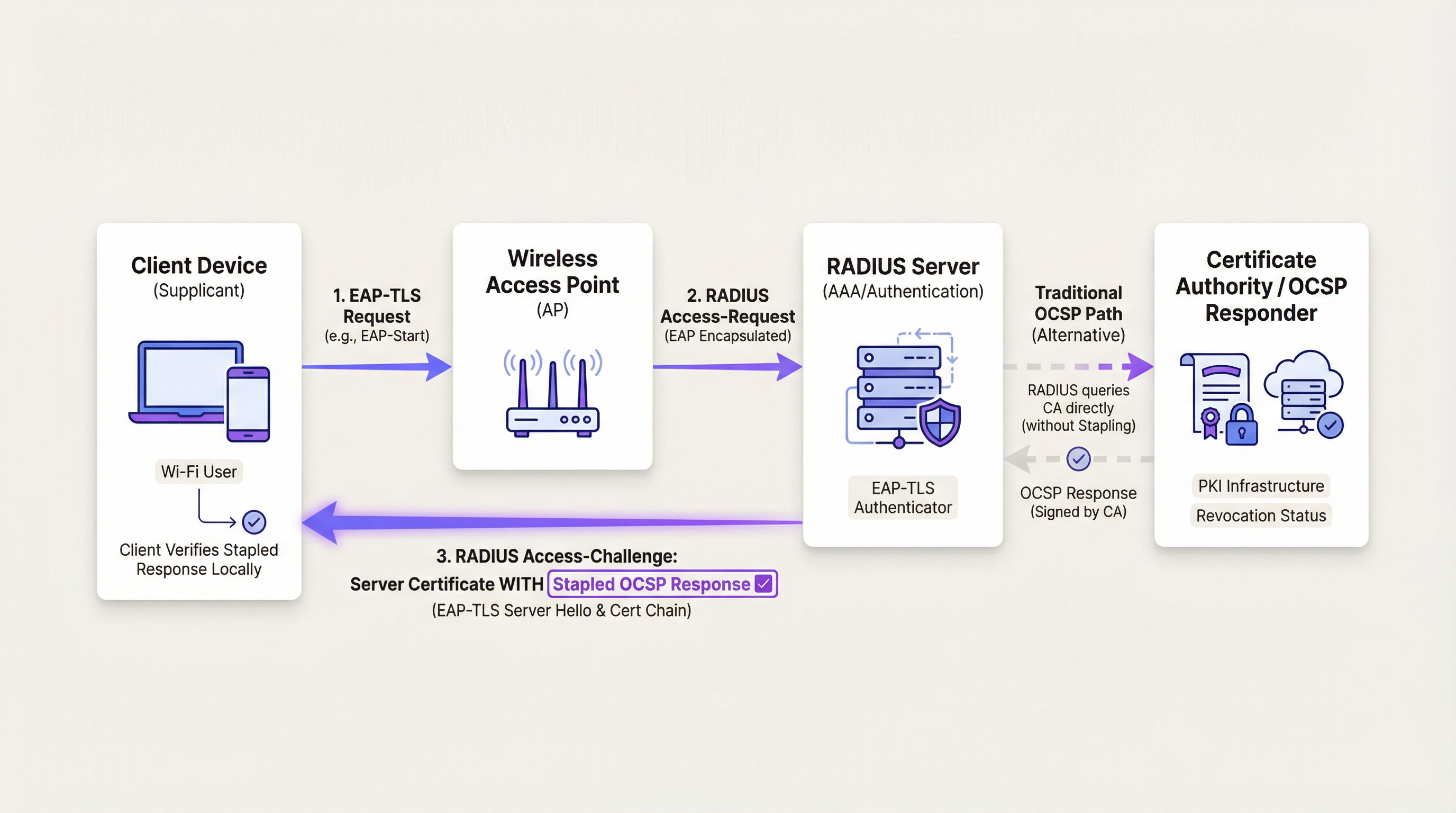
एक 802.1X ऑथेंटिकेशन फ्लो में, वायरलेस एक्सेस पॉइंट (AP) एक ऑथेंटिकेटर के रूप में कार्य करता है, जो क्लाइंट डिवाइस (सप्लीकेंट) और RADIUS सर्वर के बीच एक्सटेंसिबल ऑथेंटिकेशन प्रोटोकॉल (EAP) संदेशों को पास करता है। जब कोई क्लाइंट EAP-TLS हैंडशेक के दौरान सर्टिफिकेट प्रस्तुत करता है, तो RADIUS सर्वर को उसकी क्रिप्टोग्राफिक अखंडता को मान्य करना चाहिए, उसकी ट्रस्ट चेन को सत्यापित करना चाहिए और उसकी वर्तमान रिवोकेशन स्थिति की पुष्टि करनी चाहिए।
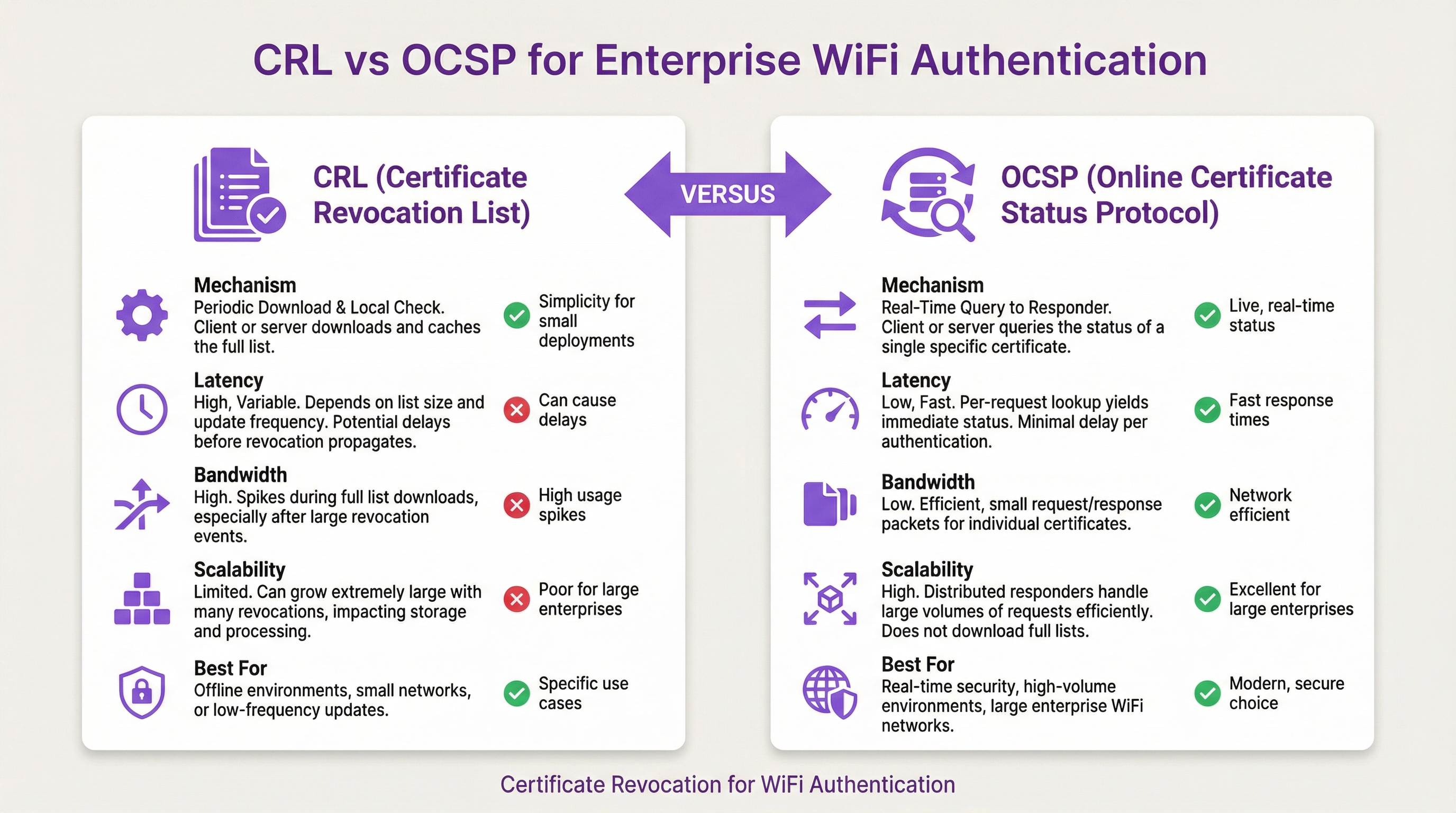
ऐतिहासिक रूप से, यह सर्टिफिकेट रिवोकेशन लिस्ट (CRL) के माध्यम से प्राप्त किया गया था। CRL एक डिजिटल रूप से हस्ताक्षरित फ़ाइल है जिसमें एक विशिष्ट सर्टिफिकेट अथॉरिटी (CA) द्वारा जारी किए गए सभी रिवोक किए गए सर्टिफिकेट के सीरियल नंबर होते हैं। RADIUS सर्वर समय-समय पर इस फ़ाइल को डाउनलोड करता है और इसे स्थानीय रूप से कैश करता है। हालांकि लागू करना सरल है, CRLs महत्वपूर्ण स्केलेबिलिटी चुनौतियां पेश करते हैं। बड़े एंटरप्राइज वातावरण में, जैसे कि Retail क्षेत्र में पाए जाते हैं, CRLs आकार में मेगाबाइट तक बढ़ सकते हैं। इन सूचियों को डाउनलोड और पार्स करना बैंडविड्थ और प्रोसेसिंग साइकिल की खपत करता है। अधिक महत्वपूर्ण बात यह है कि CRLs एक भेद्यता विंडो (vulnerability window) पेश करते हैं: CA पर सर्टिफिकेट रिवोक होने और RADIUS सर्वर द्वारा अपडेट की गई सूची डाउनलोड करने के बीच का समय।
OCSP में ट्रांज़िशन
CRLs की सीमाओं को दूर करने के लिए, ऑनलाइन सर्टिफिकेट स्टेटस प्रोटोकॉल (OCSP) विकसित किया गया था। OCSP बल्क डाउनलोड मॉडल को रीयल-टाइम, लक्षित क्वेरी तंत्र के साथ बदल देता है। जब कोई क्लाइंट सर्टिफिकेट प्रस्तुत करता है, तो RADIUS सर्वर सर्टिफिकेट के अथॉरिटी इंफॉर्मेशन एक्सेस (AIA) एक्सटेंशन से OCSP रिस्पॉन्डर URI निकालता है। फिर यह रिस्पॉन्डर को एक लाइटवेट HTTP अनुरोध भेजता है, जो उस विशिष्ट सर्टिफिकेट सीरियल नंबर की स्थिति के बारे में पूछताछ करता है। रिस्पॉन्डर एक हस्ताक्षरित प्रतिक्रिया देता है जो दर्शाती है कि सर्टिफिकेट 'Good', 'Revoked', या 'Unknown' है।
यह दृष्टिकोण CRLs से जुड़ी भेद्यता विंडो को समाप्त करता है, रिवोकेशन को तुरंत लागू करता है। यह बैंडविड्थ की खपत को भी काफी कम करता है, क्योंकि RADIUS सर्वर केवल सक्रिय रूप से ऑथेंटिकेशन का प्रयास करने वाले सर्टिफिकेट के लिए डेटा का अनुरोध करता है।
WiFi वातावरण में OCSP स्टेपलिंग
OCSP स्टेपलिंग एक परफॉरमेंस ऑप्टिमाइज़ेशन तकनीक है जिसका व्यापक रूप से वेब सर्वर में उपयोग किया जाता है। क्लाइंट द्वारा OCSP रिस्पॉन्डर से पूछताछ करने के बजाय, सर्वर समय-समय पर अपनी स्वयं की सर्टिफिकेट स्थिति के लिए रिस्पॉन्डर से पूछताछ करता है। फिर यह TLS हैंडशेक के दौरान क्लाइंट को प्रस्तुत किए जाने वाले सर्टिफिकेट के साथ हस्ताक्षरित प्रतिक्रिया को 'स्टेपल' (staple) कर देता है। यह क्वेरी का बोझ क्लाइंट से सर्वर पर स्थानांतरित कर देता है और आवश्यक बाहरी नेटवर्क कनेक्शन की संख्या को कम कर देता है।
WiFi ऑथेंटिकेशन के संदर्भ में, OCSP स्टेपलिंग अत्यधिक प्रासंगिक लेकिन सूक्ष्म है। EAP-TLS के दौरान, RADIUS सर्वर अपनी पहचान साबित करने के लिए क्लाइंट को अपना सर्वर सर्टिफिकेट प्रस्तुत करता है। RADIUS सर्वर यहाँ OCSP स्टेपलिंग का उपयोग कर सकता है, OCSP प्रतिक्रिया को EAP-TLS सर्वर हैलो (Server Hello) में जोड़ सकता है। यह क्लाइंट डिवाइस को अपनी स्वयं की इंटरनेट कनेक्शन की आवश्यकता के बिना RADIUS सर्वर की रिवोकेशन स्थिति को सत्यापित करने की अनुमति देता है—उन उपकरणों के लिए एक महत्वपूर्ण विशेषता जिन्हें अभी तक नेटवर्क एक्सेस नहीं दिया गया है।
हालांकि, क्लाइंट के सर्टिफिकेट की स्थिति को स्टेपल करना संभव नहीं है। क्लाइंट अपनी स्थिति को स्टेपल नहीं कर सकता क्योंकि नेटवर्क अभी तक क्लाइंट पर भरोसा नहीं करता है। इसलिए, क्लाइंट सर्टिफिकेट सत्यापन के लिए, RADIUS सर्वर को CA को एक पारंपरिक OCSP क्वेरी करनी होगी।
कार्यान्वयन गाइड
हाई-डेंसिटी एंटरप्राइज वातावरण में OCSP को तैनात करने के लिए सुरक्षा और उपलब्धता दोनों सुनिश्चित करने के लिए सावधानीपूर्वक आर्किटेक्चरल योजना की आवश्यकता होती है। निम्नलिखित चरण एक मजबूत परिनियोजन रणनीति की रूपरेखा तैयार करते हैं।
1. हाई-अवेलेबिलिटी CA इंफ्रास्ट्रक्चर
OCSP में बदलाव CA के रिस्पॉन्डर इंफ्रास्ट्रक्चर पर एक महत्वपूर्ण निर्भरता पेश करता है। यदि RADIUS सर्वर OCSP रिस्पॉन्डर तक नहीं पहुँच सकता है, तो वह निश्चित रूप से सर्टिफिकेट की स्थिति को सत्यापित नहीं कर सकता है। इसलिए, OCSP रिस्पॉन्डर अत्यधिक उपलब्ध, भौगोलिक रूप से वितरित और ऑथेंटिकेशन स्पाइक्स को संभालने के लिए लोड बैलेंसर्स के पीछे होना चाहिए, जैसे कि किसी बड़े सम्मेलन या खेल आयोजन के दौरान अनुभव किया जाता है।
2. RADIUS सर्वर कॉन्फ़िगरेशन और कैशिंग
रीयल-टाइम OCSP क्वेरी द्वारा पेश की गई लेटेंसी को कम करने के लिए, एंटरप्राइज RADIUS सर्वर को इंटेलिजेंट कैशिंग तंत्र के साथ कॉन्फ़िगर किया जाना चाहिए। जब एक RADIUS सर्वर को OCSP रिस्पॉन्डर से 'Good' प्रतिक्रिया प्राप्त होती है, तो उसे उस प्रतिक्रिया को एक कॉन्फ़िगर करने योग्य अवधि के लिए कैश करना चाहिए—आमतौर पर 15 से 60 मिनट के बीच। उस विंडो के भीतर उसी क्लाइंट से बाद के ऑथेंटिकेशन अनुरोधों को कैश के विरुद्ध मान्य किया जाएगा, जिससे बाहरी क्वेरी की बचत होगी। यह व्यस्त नेटवर्क की प्रदर्शन आवश्यकताओं के साथ रीयल-टाइम सुरक्षा की आवश्यकता को संतुलित करता है।
3. फेलओवर और रेजिलिएंस तंत्र
नेटवर्क आर्किटेक्ट्स को OCSP रिस्पॉन्डर के पहुंच से बाहर होने की स्थिति में RADIUS सर्वर के व्यवहार को परिभाषित करना चाहिए। इसे 'फेल ओपन' (fail open) बनाम 'फेल क्लोज्ड' (fail closed) के रूप में जाना जाता है। 'फेल क्लोज्ड' कॉन्फ़िगरेशन में, यदि RADIUS सर्वर सर्टिफिकेट की स्थिति को सत्यापित नहीं कर सकता है, तो वह एक्सेस से इनकार कर देगा। यह सबसे सुरक्षित स्थिति है लेकिन CA इंफ्रास्ट्रक्चर विफल होने पर व्यापक आउटेज का जोखिम उठाती है। 'फेल ओपन' कॉन्फ़िगरेशन में, यदि रिस्पॉन्डर पहुंच से बाहर है, तो RADIUS सर्वर एक्सेस की अनुमति देगा, सख्त सुरक्षा पर उपलब्धता को प्राथमिकता देगा।
एक अनुशंसित हाइब्रिड दृष्टिकोण में पहले OCSP क्वेरी का प्रयास करने के लिए RADIUS सर्वर को कॉन्फ़िगर करना शामिल है। यदि रिस्पॉन्डर पहुंच से बाहर है, तो सर्वर स्थानीय रूप से कैश किए गए CRL पर वापस आ जाता है। यह रिवोकेशन चेकिंग के बेसलाइन स्तर को बनाए रखते हुए CA आउटेज के खिलाफ लचीलापन प्रदान करता है।
सर्वोत्तम अभ्यास
- सर्टिफिकेट लाइफस्पैन को कम करें: जबकि रिवोकेशन समय से पहले अमान्य होने को संभालता है, सबसे प्रभावी सुरक्षा नियंत्रण एक छोटा सर्टिफिकेट लाइफस्पैन है। वर्षों के बजाय दिनों या हफ्तों के लिए वैध सर्टिफिकेट जारी करने के लिए MDM के माध्यम से स्वचालित सर्टिफिकेट प्रोविजनिंग लागू करें। यह पूरी तरह से रिवोकेशन तंत्र पर निर्भरता को कम करता है। आधुनिक डिवाइस सुरक्षा पर आगे पढ़ने के लिए, 802.1X Authentication: Securing Network Access on Modern Devices पर हमारी गाइड देखें।
- OCSP लेटेंसी की निगरानी करें: अपने RADIUS सर्वर से CA इंफ्रास्ट्रक्चर तक OCSP क्वेरी की लेटेंसी की निरंतर निगरानी करें। हाई लेटेंसी सीधे उपयोगकर्ता अनुभव को प्रभावित करेगी, जिससे ऑथेंटिकेशन टाइमआउट और कनेक्शन ड्रॉप हो जाएंगे।
- सख्त CA एक्सेस कंट्रोल लागू करें: आपके WiFi नेटवर्क की सुरक्षा आंतरिक रूप से आपके CA की सुरक्षा से जुड़ी है। सुनिश्चित करें कि सभी CA प्रबंधन इंटरफेस के लिए सख्त एक्सेस कंट्रोल, मल्टी-फैक्टर ऑथेंटिकेशन और व्यापक ऑडिटिंग मौजूद है।
समस्या निवारण और जोखिम न्यूनीकरण
OCSP को तैनात करते समय, IT टीमें अक्सर कई सामान्य विफलता मोड का सामना करती हैं:
- ऑथेंटिकेशन टाइमआउट: यदि OCSP रिस्पॉन्डर जवाब देने में धीमा है, तो EAP-TLS हैंडशेक टाइम आउट हो सकता है। यह अक्सर नेटवर्क कंजेशन या कम-प्रोविजन्ड CA इंफ्रास्ट्रक्चर के कारण होता है। न्यूनीकरण में RADIUS सर्वर पर OCSP कैशिंग को ऑप्टिमाइज़ करना और रिस्पॉन्डर इंफ्रास्ट्रक्चर को स्केल करना शामिल है।
- क्लॉक स्क्यू: OCSP प्रतिक्रियाएं टाइम-स्टैम्प्ड और हस्ताक्षरित होती हैं। यदि RADIUS सर्वर पर घड़ी CA के साथ सिंक नहीं है, तो सर्वर एक वैध OCSP प्रतिक्रिया को समाप्त (expired) के रूप में अस्वीकार कर सकता है। सुनिश्चित करें कि सभी इंफ्रास्ट्रक्चर घटक विश्वसनीय NTP सर्वर के माध्यम से सिंक्रनाइज़ हैं।
- फ़ायरवॉल ब्लॉकिंग: OCSP क्वेरी आमतौर पर HTTP (पोर्ट 80) या HTTPS (पोर्ट 443) का उपयोग करती हैं। सुनिश्चित करें कि RADIUS सर्वर और CA इंफ्रास्ट्रक्चर के बीच फ़ायरवॉल को इस ट्रैफ़िक की अनुमति देने के लिए कॉन्फ़िगर किया गया है। आधुनिक कार्यान्वयन गोपनीयता की रक्षा करने और नेटवर्क पर्यवेक्षकों को सर्टिफिकेट क्वेरी का विश्लेषण करने से रोकने के लिए तेजी से HTTPS का उपयोग कर रहे हैं।
ROI और व्यावसायिक प्रभाव
मजबूत सर्टिफिकेट रिवोकेशन तंत्र को लागू करना कच्चे सुरक्षा अनुपालन से परे मापने योग्य व्यावसायिक मूल्य प्रदान करता है।
- जोखिम न्यूनीकरण: CRLs से जुड़ी भेद्यता विंडो को समाप्त करके, OCSP संवेदनशील कॉर्पोरेट संसाधनों तक पहुँचने वाले समझौता किए गए डिवाइस के जोखिम को काफी कम कर देता है। यह बौद्धिक संपदा की रक्षा करता है और डेटा ब्रीच के वित्तीय और प्रतिष्ठित नुकसान को कम करता है।
- परिचालन दक्षता: OCSP के माध्यम से रिवोकेशन चेक को स्वचालित करना विशाल CRL फ़ाइलों के प्रबंधन से जुड़े प्रशासनिक ओवरहेड को कम करता है। IT टीमें CRL डाउनलोड विफलताओं के समस्या निवारण के बजाय रणनीतिक पहलों पर ध्यान केंद्रित कर सकती हैं।
- अनुपालन सक्षमता: Healthcare या वित्त जैसे विनियमित उद्योगों में काम करने वाले वेन्यू के लिए, सख्त एक्सेस कंट्रोल और रीयल-टाइम रिवोकेशन अक्सर अनिवार्य अनुपालन आवश्यकताएं (जैसे, HIPAA, PCI DSS) होती हैं। एक मजबूत OCSP परिनियोजन निरंतर अनुपालन सुनिश्चित करता है और ऑडिट प्रक्रियाओं को सरल बनाता है।
मुख्य शब्द और परिभाषाएं
OCSP (Online Certificate Status Protocol)
An internet protocol used for obtaining the revocation status of an X.509 digital certificate in real-time.
Used by RADIUS servers to instantly verify if a device's certificate has been revoked, closing the vulnerability window associated with legacy CRLs.
CRL (Certificate Revocation List)
A periodically updated, digitally signed list of certificate serial numbers that have been revoked by the issuing Certificate Authority.
The legacy method for revocation checking. It suffers from scalability issues and introduces a vulnerability window between updates.
OCSP Stapling
A mechanism where the certificate presenter (e.g., a RADIUS server) obtains a time-stamped OCSP response from the CA and appends it to the certificate during the TLS handshake.
Used to improve performance and privacy by offloading the OCSP query burden from the client device.
EAP-TLS (Extensible Authentication Protocol - Transport Layer Security)
A highly secure 802.1X authentication method that requires mutual certificate-based authentication between the client and the RADIUS server.
The standard protocol used in enterprise WiFi environments that necessitates robust certificate revocation checking.
Vulnerability Window
The period of time between a certificate being revoked at the CA and the enforcing system (e.g., RADIUS server) becoming aware of the revocation.
A primary driver for adopting OCSP over CRLs, as OCSP effectively reduces this window to near zero.
Fail Open vs. Fail Closed
A configuration decision determining the system's behaviour when a dependency (like an OCSP responder) is unreachable. 'Fail open' allows access; 'fail closed' denies access.
A critical architectural decision for IT teams balancing network availability against strict security compliance.
AIA (Authority Information Access)
An extension within an X.509 certificate that indicates how to access information and services for the issuer of the certificate, including the OCSP responder URI.
The RADIUS server reads this extension to determine exactly where to send the OCSP query for a specific client certificate.
Supplicant
The software client on a device (e.g., a laptop or smartphone) that attempts to access the network and responds to authentication requests.
The entity presenting the client certificate that the RADIUS server must validate against the OCSP responder.
केस स्टडीज
A 500-room luxury hotel in the [Hospitality](/industries/hospitality) sector is upgrading its back-of-house WiFi network to use EAP-TLS for staff devices. They currently use a centralized RADIUS server in their corporate data centre, connected via SD-WAN. They are concerned that real-time OCSP queries to their cloud-based CA will cause authentication timeouts during shift changes when hundreds of staff connect simultaneously.
The implementation must prioritize low-latency authentication without compromising security. The solution involves three steps: 1) Deploy a localized RADIUS proxy at the hotel property to handle the initial EAP termination. 2) Configure the RADIUS proxy to perform OCSP queries and cache the 'Good' responses for 60 minutes. 3) Implement a fallback mechanism where the RADIUS proxy relies on a locally downloaded, daily CRL if the SD-WAN link to the cloud CA fails.
A large public-sector organisation is deploying [Sensors](/products/sensors) across multiple municipal buildings. These IoT devices authenticate via 802.1X using certificates with a 5-year lifespan. The IT security team requires immediate network disconnection if a sensor is reported stolen.
Given the long certificate lifespan, robust revocation is critical. The organisation must configure their RADIUS servers to perform mandatory OCSP queries for every authentication request from the sensor VLAN. Caching should be disabled or set to a very short duration (e.g., 5 minutes). The RADIUS servers must be configured to 'fail closed'—if the OCSP responder is unreachable, the sensor is denied access.
परिदृश्य विश्लेषण
Q1. Your organisation is migrating from a daily CRL download to real-time OCSP checking for your corporate WiFi. During the pilot phase, you notice a significant increase in authentication timeouts, particularly for users roaming between buildings. What is the most likely cause and the recommended mitigation?
💡 संकेत:Consider the latency introduced by external network queries during the EAP-TLS handshake.
अनुशंसित दृष्टिकोण दिखाएं
The timeouts are likely caused by the latency of performing an external HTTP query to the OCSP responder for every authentication event, including fast reconnects during roaming. The recommended mitigation is to configure OCSP caching on the RADIUS server. By caching 'Good' responses for a period (e.g., 30 minutes), subsequent roam events will be validated locally against the cache, eliminating the external query latency and preventing timeouts.
Q2. A critical security audit requires that no compromised device can access the network for more than 5 minutes after its certificate is revoked in the MDM platform. Your RADIUS server is configured to use OCSP with a 60-minute cache. Does this configuration meet the audit requirement?
💡 संकेत:Analyze the relationship between the cache duration and the vulnerability window.
अनुशंसित दृष्टिकोण दिखाएं
No, this configuration fails the audit requirement. The 60-minute cache creates a vulnerability window of up to one hour. If a device authenticates and its 'Good' status is cached, and the certificate is revoked 1 minute later, the RADIUS server will continue to permit access for the remaining 59 minutes based on the cached response. To meet the 5-minute requirement, the OCSP cache duration must be reduced to 5 minutes or less, though this will increase the query load on the CA infrastructure.
Q3. During a major ISP outage, your cloud-based OCSP responder becomes unreachable. Your RADIUS server is configured for OCSP checking with a 'fail closed' policy. What is the impact on the network, and how could the architecture be improved for resilience?
💡 संकेत:Consider the implications of 'fail closed' when a critical dependency is unavailable.
अनुशंसित दृष्टिकोण दिखाएं
The impact is a total outage for all new WiFi authentications. Because the RADIUS server cannot reach the responder and is configured to 'fail closed', it will deny all access requests. To improve resilience, the architecture should implement a fallback mechanism. The RADIUS server should be configured to attempt OCSP first, and if unreachable, fall back to a locally cached CRL. This allows authentications to proceed using the last known good revocation state during the ISP outage.
मुख्य निष्कर्ष
- ✓OCSP replaces bulky CRL downloads with real-time, targeted certificate status queries, eliminating the vulnerability window.
- ✓In 802.1X environments, the RADIUS server performs the OCSP query to validate the client's certificate before granting network access.
- ✓OCSP stapling allows the RADIUS server to prove its own validity to the client without requiring the client to query the CA.
- ✓Intelligent caching of 'Good' OCSP responses on the RADIUS server is critical to prevent authentication timeouts in high-density venues.
- ✓Implementing a CRL fallback mechanism ensures network resilience if the primary OCSP responder becomes unreachable.
- ✓A 'fail closed' configuration maximizes security but risks widespread outages, whereas 'fail open' prioritizes availability.
- ✓Robust certificate lifecycle management, including short certificate lifespans, reduces reliance on revocation mechanisms.




