

आयडेंटिटी-बेस्ड नेटवर्किंग: ते काय आहे आणि ते का महत्त्वाचे आहे
This guide provides a comprehensive technical reference on Identity-Based Networking (IBN) — what it is, how it works, and why it is a critical investment for any organisation managing large, diverse user populations across hotels, retail chains, stadiums, and public-sector venues. It covers the core IEEE 802.1X architecture, Purple's cloud-native implementation, real-world deployment scenarios, and a clear ROI framework to support procurement decisions.
🎧 हे मार्गदर्शक ऐका
ट्रान्सक्रिप्ट पहा
कार्यकारी सारांश
आयडेंटिटी-बेस्ड नेटवर्किंग (IBN) नेटवर्क ऍक्सेस कसा व्यवस्थापित केला जातो यामधील मूलभूत बदल दर्शवते, जे स्टॅटिक, पोर्ट-आधारित मॉडेलवरून डायनॅमिक, वापरकर्ता-केंद्रित मॉडेलकडे जाते. पारंपारिक नेटवर्कमध्ये, ऍक्सेसचे अधिकार फिजिकल पोर्ट्स किंवा MAC ॲड्रेसशी जोडलेले असतात, ज्यामुळे एक कठोर आणि असुरक्षित वातावरण तयार होते. IBN नेटवर्क ऍक्सेसचे विशेषाधिकार वापरकर्त्याच्या पडताळणी केलेल्या ओळखीशी (identity) जोडते. याचा अर्थ असा की वापरकर्ता कसा किंवा कुठे कनेक्ट होतो — Wi-Fi, इथरनेट किंवा VPN द्वारे — याकडे दुर्लक्ष करून, नेटवर्क संसाधनांवरील त्यांचा ऍक्सेस ते कोण आहेत यावर ठरवला जातो, ते कोणते डिव्हाइस वापरत आहेत किंवा ते कुठे प्लग इन करत आहेत यावर नाही.
हॉटेल्स, रिटेल चेन्स आणि स्टेडियम्स सारख्या वातावरणात मोठ्या, वैविध्यपूर्ण वापरकर्ता बेसचे व्यवस्थापन करणाऱ्या संस्थांसाठी, हा एक गेम-चेंजर आहे. हे डीफॉल्टनुसार झिरो ट्रस्ट (Zero Trust) सुरक्षा पोश्चर सक्षम करते, जिथे ऍक्सेस मिळवण्यापूर्वी प्रत्येक वापरकर्ता आणि डिव्हाइसचे प्रमाणीकरण (authenticated) आणि अधिकृतता (authorised) होणे आवश्यक आहे. हे नेटवर्क सेगमेंटेशन नाटकीयरित्या सोपे करते, धोके रोखून सुरक्षा वाढवते आणि PCI DSS आणि GDPR सारख्या नियमांचे पालन सुव्यवस्थित करते.
CTO साठी, IBN जटिल VLANs आणि ऍक्सेस कंट्रोल लिस्ट्स (ACLs) व्यवस्थापित करण्याचा प्रशासकीय ओव्हरहेड कमी करून, सुरक्षा उल्लंघनाचा धोका कमी करून आणि व्यवसाय धोरणाची माहिती देऊ शकणाऱ्या नेटवर्क वापराच्या पॅटर्नमध्ये सखोल दृश्यमानता (visibility) प्रदान करून महत्त्वपूर्ण ROI देते. Purple चे IBN चे अंमलबजावणी विद्यमान पायाभूत सुविधांचा फायदा घेते आणि आधुनिक एंटरप्राइझसाठी योग्य असा स्केलेबल, लवचिक आणि बुद्धिमान ऍक्सेस लेयर प्रदान करण्यासाठी क्लाउड आयडेंटिटी प्रोव्हायडर्ससह अखंडपणे समाकलित होते.

तांत्रिक सखोल माहिती
पोर्ट्सकडून लोकांकडे: मुख्य आर्किटेक्चरल बदल
पारंपारिक नेटवर्किंग, ज्या काळात डिव्हाइसेस स्टॅटिक होती आणि वापरकर्ते डेस्कशी जोडलेले होते त्या काळातील एक अवशेष, नेटवर्क परिमितीमध्ये (perimeter) अंतर्निहित विश्वासाच्या तत्त्वावर कार्य करते. प्रमाणित डिव्हाइसवर विश्वास ठेवला जातो आणि त्याचा फिजिकल कनेक्शन पॉईंट (स्विच पोर्ट) त्याचा नेटवर्क ऍक्सेस ठरवतो. BYOD (Bring Your Own Device), IoT आणि मोबाईल वर्कफोर्सच्या आधुनिक युगात हे मॉडेल आव्हानांनी भरलेले आहे.
आयडेंटिटी-बेस्ड नेटवर्किंग (IBN), जे अनेकदा IEEE 802.1X स्टँडर्ड वापरून लागू केले जाते, ते मूलभूतपणे हे मॉडेल उलट करते. हे वापरकर्त्याला फिजिकल पोर्टपासून वेगळे करते आणि ओळखीला (identity) नवीन परिमिती बनवते. IBN आर्किटेक्चरचे मुख्य घटक खालीलप्रमाणे आहेत:
सप्लिकंट (Supplicant): नेटवर्क ऍक्सेसची विनंती करणारे क्लायंट डिव्हाइस (उदा. लॅपटॉप, स्मार्टफोन). हे असे सॉफ्टवेअर चालवते जे ऑथेंटिकेटरशी संवाद साधते. आधुनिक ऑपरेटिंग सिस्टीम्स — Windows, macOS, iOS आणि Android — मध्ये नेटिव्ह 802.1X सप्लिकंट समाविष्ट असतो, त्यामुळे अंतिम वापरकर्त्यांसाठी कोणत्याही अतिरिक्त सॉफ्टवेअर इन्स्टॉलेशनची आवश्यकता नसते.
ऑथेंटिकेटर (Authenticator): नेटवर्क ऍक्सेस डिव्हाइस, जसे की वायरलेस ऍक्सेस पॉईंट (WAP) किंवा इथरनेट स्विच. हे गेटकीपर म्हणून काम करते, सप्लिकंटकडून येणारा ट्रॅफिक ब्लॉक करते किंवा परवानगी देते. ऑथेंटिकेशन सर्व्हरकडून स्पष्ट सूचना मिळेपर्यंत ऑथेंटिकेटर पोर्टला अनधिकृत स्थितीत ठेवतो.
ऑथेंटिकेशन सर्व्हर (AS): सामान्यतः RADIUS (Remote Authentication Dial-In User Service) सर्व्हर. हा सर्व्हर या प्रक्रियेचा इंटेलिजन्स लेयर आहे. तो ऑथेंटिकेटरकडून सप्लिकंटचे क्रेडेंशियल्स प्राप्त करतो, आयडेंटिटी स्टोअरच्या (उदा. Azure Active Directory, Google Workspace, स्थानिक डेटाबेस) विरूद्ध त्यांची पडताळणी करतो आणि एक ऑथरायझेशन निर्णय परत पाठवतो ज्यामध्ये विशिष्ट नेटवर्क पॉलिसी समाविष्ट असते.
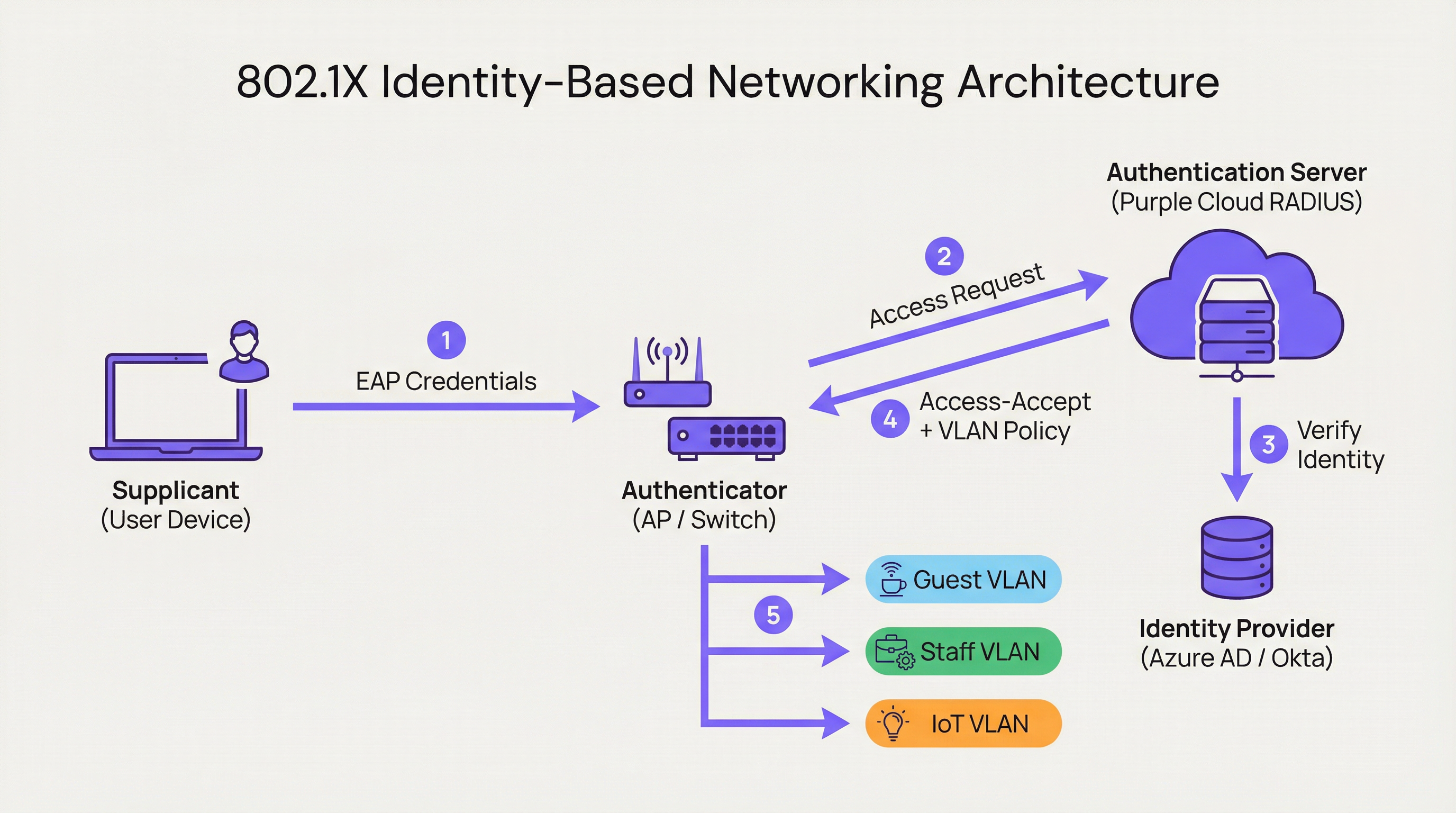
जेव्हा एखादा वापरकर्ता कनेक्ट होतो, तेव्हा ऑथेंटिकेटर पोर्टला अनधिकृत स्थितीत ठेवतो, 802.1X ऑथेंटिकेशन पॅकेट्स वगळता सर्व ट्रॅफिक ब्लॉक करतो. सप्लिकंट त्याचे क्रेडेंशियल्स प्रदान करतो, जे ऑथेंटिकेटर ऑथेंटिकेशन सर्व्हरकडे फॉरवर्ड करतो. AS ओळखीची तपासणी करतो आणि पूर्व-परिभाषित पॉलिसींवर आधारित, ऑथेंटिकेटरला काय करावे याची सूचना देतो. ही सूचना केवळ बायनरी परवानगी किंवा नकार नसते; यामध्ये डायनॅमिक VLAN असाइनमेंट, क्वालिटी ऑफ सर्व्हिस (QoS) प्रोफाइल्स, सेशन टाइमआउट्स आणि विशिष्ट फायरवॉल नियम समाविष्ट असू शकतात. कॉर्पोरेट वापरकर्त्याला अंतर्गत सर्व्हर्सच्या ऍक्सेससह CORP_VLAN वर ठेवले जाऊ शकते, तर अतिथीला (guest) केवळ इंटरनेट ऍक्सेससह GUEST_VLAN वर ठेवले जाते — तेही एकाच SSID किंवा फिजिकल पोर्टवरून.
Purple IBN ची अंमलबजावणी कशी करते
Purple चा प्लॅटफॉर्म क्लाउड-नेटिव्ह ऑथेंटिकेशन सर्व्हर आणि पॉलिसी इंजिन म्हणून काम करतो, जो मोठ्या सार्वजनिक ठिकाणांच्या जटिलतेसाठी डिझाइन केलेला आहे. आमचा दृष्टीकोन RADIUS आणि 802.1X कॉन्फिगरेशनची जटिलता दूर करण्यावर केंद्रित आहे.
क्लाउड-नेटिव्ह RADIUS: आम्ही ऑन-प्रिमाइसेस ऑथेंटिकेशन सर्व्हर्सची आवश्यकता दूर करतो, जागतिक स्तरावर वितरीत, अत्यंत उपलब्ध सेवा प्रदान करतो जी मागणीनुसार स्केल होते. रॅक करण्यासाठी कोणतेही सर्व्हर्स नाहीत, पॅच करण्यासाठी कोणतेही फर्मवेअर नाही आणि निकामी होण्याचा कोणताही सिंगल पॉईंट नाही.
आयडेंटिटी प्रोव्हायडर (IdP) इंटिग्रेशन: आम्ही Azure AD, Okta आणि Google Workspace सह आघाडीच्या IdPs सोबत अखंडपणे कनेक्ट होतो. यामुळे संस्थांना ओळखीसाठी त्यांच्या विद्यमान सिंगल सोर्स ऑफ ट्रुथचा वापर करण्याची अनुमती मिळते, हे सुनिश्चित करून की जेव्हा एखाद्या कर्मचाऱ्याचे खाते अक्षम केले जाते, तेव्हा त्यांचा नेटवर्क ऍक्सेस त्वरित रद्द केला जातो.
डायनॅमिक पॉलिसी इंजिन: आमचे अंतर्ज्ञानी मॅनेजमेंट कन्सोल IT व्यवस्थापकांना ग्रुप मेंबरशिप, भूमिका आणि विभाग यांसारख्या वापरकर्ता गुणधर्मांवर आधारित ग्रॅन्युलर ऍक्सेस पॉलिसी तयार करण्याची अनुमती देते. एखादी पॉलिसी असे सांगू शकते: "सकाळी 9 ते संध्याकाळी 5 दरम्यान 'Staff-WiFi' SSID शी कनेक्ट होणाऱ्या 'Retail-Staff' ग्रुपमधील सर्व वापरकर्त्यांना 10 Mbps च्या बँडविड्थ मर्यादेसह 'POS_VLAN' नियुक्त केले जाते."
डायनॅमिक VLAN असाइनमेंट: हा आमच्या IBN अंमलबजावणीचा एक आधारस्तंभ आहे. प्रत्येक स्विच पोर्टवर मॅन्युअली VLANs कॉन्फिगर करण्याऐवजी, नेटवर्क वापरकर्त्याला त्यांच्या ओळखीच्या आधारावर योग्य VLAN डायनॅमिकरित्या नियुक्त करते. हा एक मोठा ऑपरेशनल कार्यक्षमता लाभ आणि महत्त्वपूर्ण सुरक्षा सुधारणा आहे.

अंमलबजावणी मार्गदर्शक
Purple सह IBN तैनात करणे ही एक संरचित प्रक्रिया आहे जी पहिल्या दिवसापासून व्यत्यय कमी करण्यासाठी आणि सुरक्षा वाढवण्यासाठी डिझाइन केलेली आहे.
पायरी 1: नेटवर्क इन्फ्रास्ट्रक्चर ऑडिट
डिप्लॉयमेंट करण्यापूर्वी, तुमचे नेटवर्क हार्डवेअर — स्विचेस आणि ऍक्सेस पॉईंट्स — IEEE 802.1X ला सपोर्ट करतात याची पडताळणी करा. गेल्या दशकात उत्पादित केलेली बहुतांश एंटरप्राइझ-ग्रेड उपकरणे करतात. यामध्ये Cisco, Meraki, Aruba आणि Ruckus सारख्या व्हेंडर्सचा समावेश आहे. सर्व फर्मवेअर अद्ययावत असल्याची खात्री करा, कारण जुन्या फर्मवेअर आवृत्त्यांमध्ये ज्ञात 802.1X असुरक्षा असू शकतात.
पायरी 2: वापरकर्ता भूमिका आणि ऍक्सेस पॉलिसी परिभाषित करा
हा सर्वात महत्त्वाचा टप्पा आहे. सर्व नेटवर्क वापरकर्त्यांना विशिष्ट भूमिकांमध्ये वर्गीकृत करण्यासाठी HR, ऑपरेशन्स आणि व्यवस्थापनातील भागधारकांसोबत काम करा. सामान्य उदाहरणांमध्ये कॉर्पोरेट कर्मचारी (अंतर्गत संसाधनांचा पूर्ण ऍक्सेस), अतिथी वापरकर्ते (Captive Portal द्वारे केवळ इंटरनेट ऍक्सेस), कंत्राटदार (विशिष्ट ऍप्लिकेशन्सचा वेळ-मर्यादित ऍक्सेस), आणि IoT डिव्हाइसेस (केवळ त्यांच्या विशिष्ट मॅनेजमेंट सर्व्हरशी संवाद साधणाऱ्या समर्पित VLAN चा अत्यंत प्रतिबंधित ऍक्सेस) यांचा समावेश होतो. प्रत्येक भूमिकेसाठी, आवश्यक ऍक्सेस पातळी स्पष्टपणे परिभाषित करा.
पायरी 3: Purple ला ऑथेंटिकेशन सर्व्हर म्हणून कॉन्फिगर करा
तुमच्या नेटवर्क कंट्रोलरमध्ये — जसे की Meraki Dashboard किंवा Aruba Central — शेअर्ड सिक्रेटसह Purple ऑथेंटिकेशन एंडपॉइंट्सकडे निर्देशित करणारी नवीन RADIUS प्रोफाईल कॉन्फिगर करा. हे तुमचे नेटवर्क हार्डवेअर आणि Purple क्लाउड यांच्यात विश्वासाचे नाते प्रस्थापित करते. Purple चे ऑनबोर्डिंग डॉक्युमेंटेशन सर्व प्रमुख हार्डवेअर व्हेंडर्ससाठी टप्प्याटप्प्याने कॉन्फिगरेशन मार्गदर्शक प्रदान करते.
पायरी 4: टप्प्याटप्प्याने रोलआउट आणि टेस्टिंग
फ्लॅश-कट मायग्रेशनचा प्रयत्न करू नका. वापरकर्त्यांच्या पायलट ग्रुपसह किंवा तुमच्या ठिकाणाच्या विशिष्ट क्षेत्रासह, जसे की एकच मजला किंवा नॉन-क्रिटिकल रिटेल स्टोअरसह सुरुवात करा. IBN ट्रायलसाठी एक नवीन, समर्पित SSID तयार करा. पायलट वापरकर्त्यांना ऑनबोर्ड करा आणि सर्व परिभाषित भूमिकांची चाचणी करा. वापरकर्त्यांना योग्य VLANs नियुक्त केले जात आहेत आणि ऍक्सेस परवानग्या योग्यरित्या लागू केल्या जात आहेत याची पडताळणी करा. गंभीरपणे, फेल्युअर मोड्सची चाचणी करा: RADIUS सर्व्हर अनरिचेबल असल्यास काय होते? फेल-क्लोज्ड पोश्चरसाठी हार्डवेअर कॉन्फिगर करा.
पायरी 5: पूर्ण डिप्लॉयमेंट आणि लेगसी डिकमिशनिंग
एकदा पायलट यशस्वी झाल्यानंतर, संपूर्ण संस्थेमध्ये रोलआउटचा विस्तार करा. नवीन सुरक्षित नेटवर्कशी कनेक्ट होण्याच्या एक-वेळच्या प्रक्रियेद्वारे वापरकर्त्यांना मार्गदर्शन करण्यासाठी एक स्पष्ट संवाद योजना विकसित करा. एकदा सर्व वापरकर्ते मायग्रेट झाल्यानंतर, जुने, असुरक्षित SSIDs आणि पोर्ट कॉन्फिगरेशन्स डिकमिशन करा.
सर्वोत्तम पद्धती
WPA3-Enterprise चा लाभ घ्या: जिथे सपोर्टेड असेल तिथे 802.1X सोबत WPA3-Enterprise वापरा. हे WPA2 च्या तुलनेत महत्त्वपूर्ण सुरक्षा सुधारणा देते, ज्यामध्ये मॅनेजमेंट फ्रेम्ससाठी (802.11w) संरक्षण आणि मजबूत एन्क्रिप्शन अल्गोरिदम समाविष्ट आहेत.
सर्टिफिकेट-बेस्ड ऑथेंटिकेशन: कॉर्पोरेट डिव्हाइसेससाठी, युझरनेम आणि पासवर्ड क्रेडेंशियल्सच्या (EAP-PEAP) पलीकडे जा आणि सर्टिफिकेट-बेस्ड ऑथेंटिकेशन (EAP-TLS) लागू करा. हे 802.1X सुरक्षेसाठी सुवर्ण मानक आहे, कारण ते फिशिंगचे धोके कमी करते आणि पासवर्ड प्रॉम्प्ट्स दूर करून वापरकर्ता अनुभव सोपा करते.
ओळख केंद्रीकृत करा (Centralise Identity): वापरकर्त्याच्या ओळखीसाठी एकच, अधिकृत सोर्स ऑफ ट्रुथ राखून ठेवा. हे आयडेंटिटी स्प्रॉल (identity sprawl) प्रतिबंधित करते आणि हे सुनिश्चित करते की जेव्हा एखादा कर्मचारी संस्था सोडतो, तेव्हा त्यांचा नेटवर्क ऍक्सेस स्त्रोतावर त्वरित रद्द केला जातो.
नियमित पॉलिसी पुनरावलोकन: वापरकर्त्याच्या भूमिका आणि ऍक्सेस आवश्यकता बदलतात. तुमच्या IBN पॉलिसी अजूनही व्यवसायाच्या गरजा आणि सुरक्षा तत्त्वांशी संरेखित आहेत याची खात्री करण्यासाठी त्यांचे त्रैमासिक पुनरावलोकन करा. न वापरलेल्या भूमिका काढून टाका आणि परवानगी देणारे नियम कडक करा.
| सर्वोत्तम पद्धत | मानक / संदर्भ | प्राधान्य |
|---|---|---|
| WPA3-Enterprise | IEEE 802.11ax, Wi-Fi Alliance | उच्च |
| सर्टिफिकेट ऑथेंटिकेशन (EAP-TLS) | RFC 5216 | उच्च |
| डायनॅमिक VLAN सेगमेंटेशन | IEEE 802.1Q | गंभीर |
| केंद्रीकृत ओळख (IdP) | NIST SP 800-63 | गंभीर |
| फेल-क्लोज्ड RADIUS पॉलिसी | CIS Benchmark | उच्च |
| त्रैमासिक पॉलिसी पुनरावलोकन | ISO 27001 | मध्यम |
ट्रबलशूटिंग आणि जोखीम निवारण
फेल्युअर मोड: RADIUS सर्व्हर अनरिचेबल
जर ऑथेंटिकेटर Purple क्लाउडपर्यंत पोहोचू शकत नसेल, तर डीफॉल्ट हार्डवेअर वर्तन फेल-ओपन (सर्व ऍक्सेसला अनुमती देणे) किंवा फेल-क्लोज्ड (सर्व ऍक्सेस नाकारणे) असू शकते. जास्तीत जास्त सुरक्षेसाठी तुमचे हार्डवेअर फेल-क्लोज्ड पोश्चरसाठी कॉन्फिगर करा. Purple ची जिओ-डिस्ट्रिब्युटेड इन्फ्रास्ट्रक्चर विस्तारित आउटेजची शक्यता अत्यंत कमी करते, परंतु डिफेन्स-इन-डेप्थ आवश्यक आहे. गंभीर पायाभूत सुविधांसाठी स्थानिक RADIUS फॉलबॅक कॉन्फिगर करण्याचा विचार करा.
फेल्युअर मोड: चुकीच्या पद्धतीने कॉन्फिगर केलेल्या पॉलिसी
खराब लिहिलेली पॉलिसी जास्त विशेषाधिकार देऊ शकते किंवा कायदेशीर ऍक्सेस नाकारू शकते. प्रत्येक पॉलिसी बदलाला प्रोडक्शनमध्ये आणण्यापूर्वी त्याची चाचणी करण्यासाठी स्टेजिंग वातावरण किंवा पायलट ग्रुप वापरा. Purple चे पॉलिसी सिम्युलेटर तुम्हाला बदल कमिट करण्यापूर्वी वापरकर्त्याच्या अपेक्षित ऍक्सेस पातळीची चाचणी करण्याची अनुमती देते.
जोखीम: ऑनबोर्डिंगमधील जटिलता
वापरकर्त्यांसाठी प्रारंभिक कनेक्शन प्रक्रिया जटिल असू शकते, विशेषतः सर्टिफिकेट डिप्लॉयमेंटसह. स्क्रीनशॉट्ससह स्पष्ट, टप्प्याटप्प्याने मार्गदर्शक प्रदान करा आणि संक्रमण कालावधीत हेल्पडेस्क सपोर्ट ऑफर करा. डिव्हाइस कॉन्फिगरेशन प्रक्रिया स्वयंचलित करण्यासाठी Purple च्या नेटवर्क ऍक्सेस मॅनेजरसारखे ऑनबोर्डिंग टूल तैनात करण्याचा विचार करा.
जोखीम: 802.1X सपोर्ट नसलेली लेगसी डिव्हाइसेस
सर्व डिव्हाइसेस — विशेषतः जुने IoT हार्डवेअर, प्रिंटर्स आणि वैद्यकीय उपकरणे — 802.1X ला सपोर्ट करत नाहीत. या डिव्हाइसेससाठी MAC ऑथेंटिकेशन बायपास (MAB) वापरा, त्यांचे MAC ॲड्रेस पूर्व-नोंदणीकृत करा आणि त्यांना कठोर फायरवॉल नियमांसह अत्यंत प्रतिबंधित, आयसोलेटेड VLANs नियुक्त करा.
ROI आणि व्यावसायिक प्रभाव
IBN साठी बिझनेस केस तीन स्तंभांवर तयार केली आहे: खर्च कपात, जोखीम निवारण आणि व्यवसाय सक्षमीकरण.
खर्च कपात: प्राथमिक बचत ऑपरेशनल आहे. VLAN आणि ACL व्यवस्थापन स्वयंचलित केल्याने नेटवर्क प्रशासनासाठी लागणारे मानवी तास (man-hours) मोठ्या प्रमाणात कमी होतात. स्वतंत्र नेटवर्क ऑपरेशन्स बेंचमार्क्सनुसार, डायनॅमिक VLAN असाइनमेंट नेटवर्क प्रोव्हिजनिंग वेळ 85% पेक्षा जास्त कमी करू शकते. हे IT कर्मचाऱ्यांना नियमित देखभालीऐवजी धोरणात्मक उपक्रमांवर लक्ष केंद्रित करण्यासाठी मुक्त करते.
जोखीम निवारण: डेटा उल्लंघनाची किंमत लक्षणीय आहे — IBM चा कॉस्ट ऑफ अ डेटा ब्रीच रिपोर्ट सातत्याने जागतिक सरासरी USD 4 दशलक्षच्या वर ठेवतो. झिरो ट्रस्ट मॉडेल आणि मायक्रो-सेगमेंटेशन लागू करून, IBN हल्ल्याचा पृष्ठभाग (attack surface) लक्षणीयरीत्या कमी करते. जर वापरकर्त्याच्या डिव्हाइसशी तडजोड केली गेली, तर उल्लंघन त्यांच्या विशिष्ट, मर्यादित नेटवर्क सेगमेंटमध्ये समाविष्ट केले जाते. रिटेलमधील PCI DSS अनुपालनासाठी आणि सार्वजनिक क्षेत्रातील संस्थांमधील GDPR अनुपालनासाठी हे महत्त्वपूर्ण आहे.
व्यवसाय सक्षमीकरण: IBN नेटवर्क कोण वापरत आहे, ते कुठे आहेत आणि ते काय करत आहेत यावर समृद्ध डेटा प्रदान करते. ही माहिती (intelligence) ठिकाणाच्या ऑपरेशन्ससाठी अमूल्य आहे. हॉटेल अतिथींच्या हालचालींचे पॅटर्न समजू शकते, रिटेलर वेगवेगळ्या विभागांमधील फूटफॉलचे विश्लेषण करू शकतो आणि स्टेडियम रिअल-टाइम गर्दीच्या घनतेवर आधारित स्टाफिंग ऑप्टिमाइझ करू शकते. हे नेटवर्कला कॉस्ट सेंटरमधून धोरणात्मक व्यावसायिक मालमत्तेत रूपांतरित करते.
| ROI परिमाण | मेट्रिक | सामान्य परिणाम |
|---|---|---|
| ऑपरेशनल कार्यक्षमता | प्रति आठवडा वाचवलेले IT ॲडमिन तास | 40-60% घट |
| सुरक्षा पोश्चर | अटॅक सरफेसमध्ये घट | मायक्रो-सेगमेंटेशनद्वारे लक्षणीय |
| अनुपालन (Compliance) | ऑडिट तयारीची वेळ | स्वयंचलित लॉगिंगद्वारे कमी केली |
| बिझनेस इंटेलिजन्स | अतिथी डेटा कॅप्चर दर | Captive Portal इंटिग्रेशनद्वारे वाढला |
| कर्मचारी उत्पादकता | नेटवर्क प्रोव्हिजनिंग वेळ | 85%+ घट |
महत्त्वाच्या संज्ञा आणि व्याख्या
Identity-Based Networking (IBN)
An approach to network administration where access to network resources is granted based on the authenticated identity of a user or device, rather than its physical connection point or IP address.
IT teams use IBN to create more secure and flexible networks that can handle BYOD, IoT, and mobile users safely. It is the foundational technology for a Zero Trust network architecture.
IEEE 802.1X
An IEEE standard for Port-Based Network Access Control (PNAC). It provides an authentication mechanism to devices wishing to attach to a LAN or WLAN, using the EAP framework to carry authentication credentials.
This is the primary technical standard that underpins most IBN deployments. Network hardware must support 802.1X to be compatible with an identity-driven access model.
RADIUS
Remote Authentication Dial-In User Service. A networking protocol that provides centralised Authentication, Authorisation, and Accounting (AAA) management for users who connect and use a network service.
The RADIUS server is the brain of an IBN system. It makes the decisions about who gets access and what level of access they receive. Purple provides this as a cloud-native service, eliminating the need for on-premises RADIUS infrastructure.
Dynamic VLAN Assignment
The ability of a network to assign a user to a specific Virtual LAN (VLAN) based on their authenticated identity, regardless of the physical port or SSID they connect to.
This is a key operational benefit of IBN. It automates the process of network segmentation, saving significant administrative time and reducing the risk of misconfiguration that leads to security incidents.
Supplicant
The software on a client device (such as a laptop or smartphone) that provides credentials to the network authenticator as part of the 802.1X authentication process.
Modern operating systems (Windows, macOS, iOS, Android) have a built-in 802.1X supplicant, so end users do not need to install any special software to connect to an IBN-secured network.
EAP (Extensible Authentication Protocol)
An authentication framework that provides a common way for supplicants and authentication servers to negotiate an authentication method. Common EAP types include EAP-TLS (certificate-based) and EAP-PEAP (password-based).
IT teams choose an EAP type based on their desired balance of security and usability. EAP-TLS is the most secure option and is recommended for corporate devices; EAP-PEAP is simpler to deploy but relies on password security.
MAC Authentication Bypass (MAB)
A technique that allows devices without 802.1X supplicant support to be authenticated on an IBN network by pre-registering their hardware MAC address with the authentication server.
MAB is a pragmatic solution for IoT devices, printers, and legacy hardware that cannot participate in 802.1X. It is less secure than full 802.1X authentication and should be combined with strict VLAN isolation and firewall rules.
Zero Trust
A security model based on the principle of 'never trust, always verify.' It requires that all users, whether inside or outside the organisation's network, be authenticated, authorised, and continuously validated before being granted access to applications and data.
IBN is a foundational technology for implementing a Zero Trust architecture. It ensures that the principle of 'always verify' is applied right at the network edge, before any traffic is allowed to flow.
WPA3-Enterprise
The latest generation of the Wi-Fi Protected Access security protocol for enterprise networks. It mandates the use of 802.1X authentication and offers stronger encryption (192-bit security mode) and protection for management frames.
IT teams should target WPA3-Enterprise for all new deployments and hardware refreshes. It provides a significant security uplift over WPA2-Enterprise, particularly in high-density public environments.
केस स्टडीज
A 500-room luxury hotel needs to provide secure, differentiated Wi-Fi access for guests, conference attendees, staff, and back-of-house IoT devices (minibars, smart locks). They currently use a single, shared WPA2-Personal password for everyone, which is a major security and compliance risk.
Role Definition: Define four distinct roles: Guest, Conference, Staff, and IoT.
Policy Creation in Purple:
- Guest: Authenticate via captive portal with room number and surname. Assign to Guest_VLAN with a 20 Mbps bandwidth cap and client isolation enabled to prevent peer-to-peer attacks.
- Conference: Authenticate via a shared, time-limited credential provided by the event organiser. Assign to Conference_VLAN with a 50 Mbps cap, allowing communication between devices within the same conference group.
- Staff: Authenticate via Azure AD credentials. Assign to Staff_VLAN with access to the Property Management System (PMS) and internal servers only.
- IoT: Authenticate using MAC Authentication Bypass (MAB) with a pre-registered list of device MAC addresses. Assign to IoT_VLAN, which has no internet access and can only communicate with the IoT management platform.
Network Configuration: Configure hotel APs to use Purple's cloud RADIUS. Create a single SSID, Hotel_WiFi, using WPA2/WPA3-Enterprise.
Rollout: Pilot the new SSID in a single wing of the hotel before full deployment. Validate each role before expanding.
A retail chain with 150 stores wants to replace its aging guest Wi-Fi and provide secure network access for corporate staff, store associates using handheld scanners, and third-party vendors (merchandisers). They need to achieve and maintain PCI DSS compliance.
Role Definition: Define four roles: Corporate, Store_Associate, Vendor, and Guest.
Policy Creation in Purple:
- Corporate: Authenticate via Okta credentials. Assign to CORP_VLAN with full network access.
- Store_Associate: Authenticate handheld scanners via EAP-TLS (device certificates issued by the company CA). Assign to POS_VLAN, which is fully segmented from all other network traffic and only has access to the payment processing gateway and inventory server. This is the critical control for PCI DSS compliance.
- Vendor: Authenticate via a self-service portal where they register for time-limited access (e.g., 8 hours). Assign to Vendor_VLAN with internet-only access.
- Guest: Authenticate via a social login (Facebook, Google) or email on a branded captive portal. Assign to Guest_VLAN with client isolation.
Network Configuration: Deploy Meraki APs in all stores, managed centrally via Meraki Dashboard. Configure the Retail_Secure SSID to point to Purple for authentication. Centralise all policy management in Purple.
Measurement: Use Purple's analytics to track guest engagement, dwell times, and repeat visits, providing valuable data to the marketing team and demonstrating the commercial value of the Wi-Fi investment.
परिस्थिती विश्लेषण
Q1. A large conference centre is hosting a high-profile tech event with 5,000 attendees, 200 event staff, and a dedicated live-streaming production crew requiring guaranteed bandwidth. How would you design the IBN policy to serve all three groups from a single network infrastructure?
💡 संकेत:Consider the distinct requirements of each group: attendees need basic internet access, staff need access to event management systems, and the production crew needs guaranteed, high-priority bandwidth with no contention.
शिफारस केलेला दृष्टिकोन दाखवा
Define three distinct roles. Attendees authenticate via a simple captive portal (email address or event registration code). Place them on a Public_VLAN with a strict per-client bandwidth limit (e.g., 5 Mbps) and client isolation enabled to prevent peer-to-peer attacks and ensure fair bandwidth distribution. Event Staff authenticate using pre-shared credentials managed by the event organiser. Place them on a Staff_VLAN with a higher bandwidth limit (e.g., 25 Mbps) and access to event management systems. Production Crew is the most critical group. Authenticate their equipment using EAP-TLS certificates for maximum security. Place them on a dedicated Production_VLAN with the highest QoS priority (DSCP EF marking) and no bandwidth restrictions. This VLAN must be completely isolated from all other traffic to guarantee performance for the live stream. Use Purple's policy engine to set session timeouts for attendee credentials that align with the event schedule.
Q2. Your CFO is questioning the investment in an IBN solution, arguing that the existing WPA2-Personal passwords 'work fine.' How do you construct a compelling business case focused on ROI?
💡 संकेत:Translate the technical benefits — security, automation, compliance — into financial terms: cost savings, risk reduction, and revenue enablement.
शिफारस केलेला दृष्टिकोन दाखवा
The business case has three parts. First, Operational Savings: calculate the weekly hours your IT team spends on manual network changes (MAC whitelisting, VLAN updates, ACL changes, password resets). Show how automating this with IBN frees up that time for strategic projects. Even recovering five hours per week at a fully-loaded cost of £50/hour represents £13,000 per year in recovered productivity. Second, Risk Reduction: reference industry data on the average cost of a data breach. Frame IBN as an insurance policy that significantly lowers the probability of such an event by implementing micro-segmentation and Zero Trust principles. Third, Compliance Costs: if subject to PCI DSS or GDPR, highlight the cost of failing an audit or the scale of potential regulatory fines (up to 4% of global annual turnover under GDPR). Position IBN as a key enabler for compliance, directly reducing that financial risk.
Q3. You are deploying IBN in a hospital. A critical piece of medical equipment — an MRI scanner — does not support 802.1X. How do you securely connect it to the network while maintaining your Zero Trust posture?
💡 संकेत:The device cannot authenticate itself using standard 802.1X. How can the network authenticate it on its behalf, and what compensating controls are needed?
शिफारस केलेला दृष्टिकोन दाखवा
This is a classic use case for MAC Authentication Bypass (MAB). Register the MRI scanner's MAC address in the Purple platform and associate it with a Medical_Device access profile. When the switch detects that MAC address, it queries Purple, which instructs the switch to place the device into a highly restricted Medical_VLAN. This VLAN must have a strict firewall policy (implemented at the network layer) that only permits the MRI machine to communicate with its dedicated imaging server on specific ports, and blocks all other traffic. This provides a secure, albeit less ideal, alternative to 802.1X for legacy or non-supplicant devices. Document this as a known exception in your security risk register, and schedule a hardware refresh to a 802.1X-capable model at the next available opportunity. The compensating control of strict VLAN isolation and firewall rules is the key to maintaining your Zero Trust posture.
महत्त्वाचे निष्कर्ष
- ✓Identity-Based Networking (IBN) ties network access to verified user identity, not physical ports or MAC addresses.
- ✓It is a core component of a modern Zero Trust security strategy, operating on the principle of 'never trust, always verify.'
- ✓Key enabling technologies are IEEE 802.1X, RADIUS, EAP, and dynamic VLAN assignment.
- ✓IBN dramatically simplifies network administration by automating VLAN and access rule management.
- ✓It delivers measurable ROI through reduced operational costs, mitigated breach risk, and enhanced regulatory compliance (PCI DSS, GDPR).
- ✓Purple provides a cloud-native RADIUS platform that integrates with existing IdPs (Azure AD, Okta) to implement IBN at scale without on-premises infrastructure.
- ✓Deployment should follow a phased approach: audit infrastructure, define roles, configure Purple, pilot test, then roll out fully.




