

IPSK स्पष्टीकरण: WiFi ॲक्सेससाठी Identity Pre-Shared Keys
This guide provides IT managers, network architects, and venue operations directors with a definitive technical reference on Identity Pre-Shared Keys (IPSK) for WiFi access — explaining the architecture, comparing it against standard PSK and 802.1X Enterprise, and delivering actionable deployment guidance for hospitality, retail, events, and public-sector environments. It addresses the critical operational challenge of providing secure, individually-managed WiFi access across mixed-device fleets — including IoT and headless devices — without the infrastructure overhead of a full 802.1X deployment. Purple's platform is positioned as the orchestration layer that automates IPSK key lifecycle management at scale.
🎧 हे मार्गदर्शक ऐका
ट्रान्सक्रिप्ट पहा

कार्यकारी सारांश (Executive Summary)
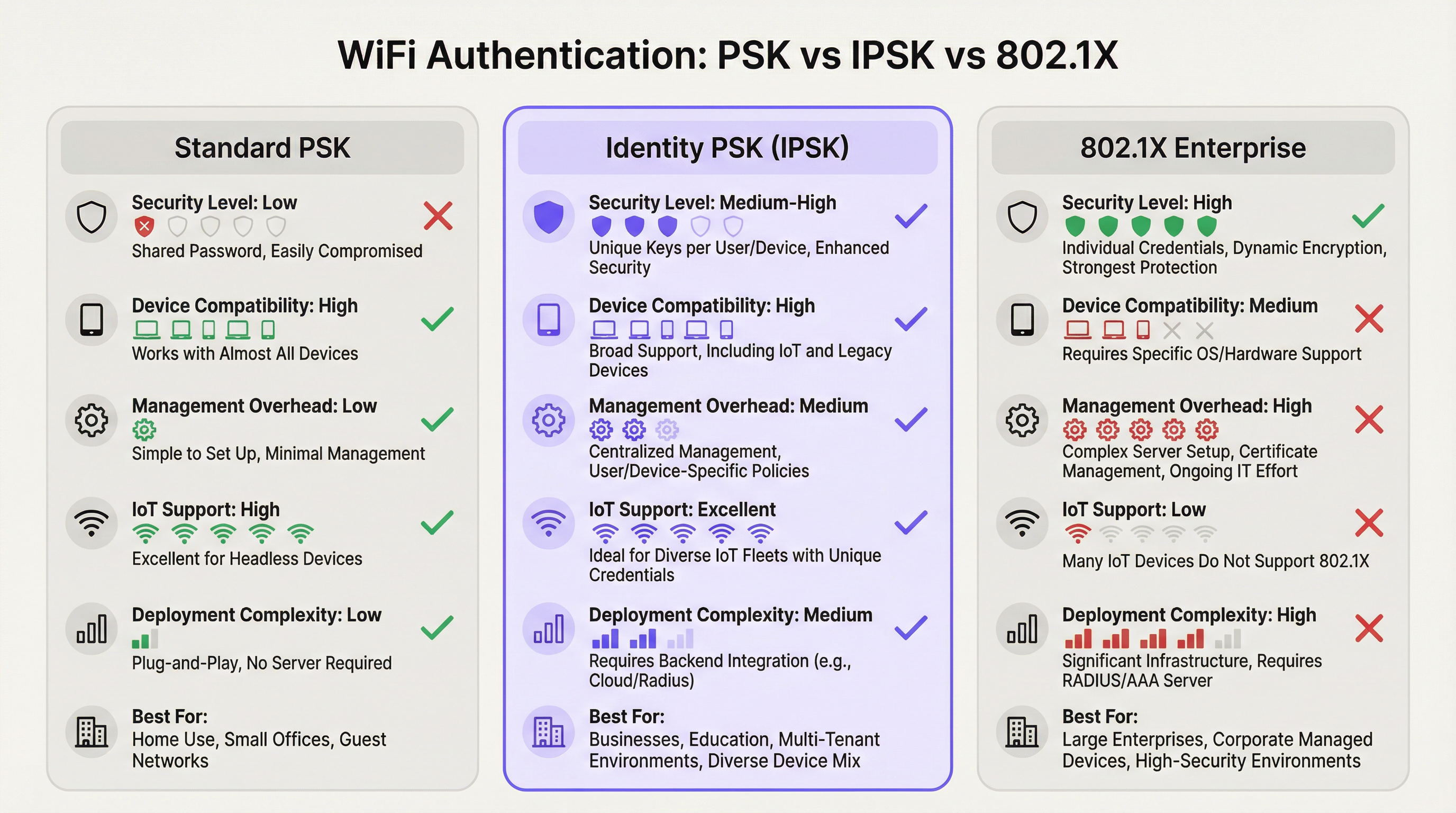
मल्टी-युझर, मिक्स्ड-डिव्हाइस वातावरणात नेटवर्क सिक्युरिटी आणि ऑपरेशनल सिम्पलिसिटी (कार्यप्रणालीतील सुलभता) यांच्यातील दीर्घकाळ चालत आलेला तणाव Identity Pre-Shared Key (IPSK) WiFi ऑथेंटिकेशन सोडवते. जिथे स्टँडर्ड WPA2-Personal (शेअर्ड PSK) वापरण्यास सुलभता देते परंतु वैयक्तिक जबाबदारी (accountability) शून्य असते, आणि WPA2/WPA3-Enterprise (802.1X) ग्रॅन्युलर कंट्रोल देते परंतु आधुनिक उपकरणांचा एक मोठा भाग वगळते, तिथे IPSK एक व्यावहारिक सुवर्णमध्य साधते: प्रत्येक युझर किंवा डिव्हाइसला एक युनिक क्रिप्टोग्राफिक की मिळते, सर्व एकाच SSID ला कनेक्ट होतात, आणि RADIUS द्वारे प्रति-कनेक्शन पॉलिसी लागू केली जाते.
व्हेन्यू ऑपरेटर्ससाठी — हॉटेल्स, रिटेल चेन्स, कॉन्फरन्स सेंटर्स आणि सार्वजनिक क्षेत्रातील इमारती — अतिथी (guest) आणि कर्मचारी (staff) या दोघांच्या WiFi साठी IPSK ही वाढत्या प्रमाणात डीफॉल्ट आर्किटेक्चर बनत आहे. हे शेअर्ड-पासवर्ड मॅनेजमेंटचे ऑपरेशनल ओझे दूर करते, कंझ्युमर आणि IoT उपकरणांच्या संपूर्ण स्पेक्ट्रमला सपोर्ट करते आणि PCI DSS आणि GDPR कंप्लायन्स फ्रेमवर्कसाठी आवश्यक असलेली ऑडिटेबिलिटी प्रदान करते. जेव्हा Purple सारख्या ऑटोमेटेड लाइफसायकल मॅनेजमेंट प्लॅटफॉर्मशी जोडले जाते, तेव्हा IPSK 50-खोल्यांच्या बुटीक हॉटेलपासून ते 10,000-आसनांच्या स्टेडियमपर्यंत स्केल होते, ज्यामध्ये IT ओव्हरहेडमध्ये कोणतीही मोठी वाढ होत नाही.
IPSK डिप्लॉय करण्याचा निर्णय तीन निकषांवर आधारित असावा: हेडलेस किंवा IoT एंडपॉइंट्सचा समावेश असलेला मिक्स्ड-डिव्हाइस फ्लीट; संपूर्ण नेटवर्कमध्ये व्यत्यय न आणता वैयक्तिक ॲक्सेस रद्द करण्याची (revocation) आवश्यकता; आणि घरातील कनेक्शनसारखाच विनाअडथळा अनुभव अपेक्षित असणारा युझर बेस. जर हे तिन्ही लागू होत असतील, तर IPSK हे योग्य आर्किटेक्चर आहे.
तांत्रिक सखोल माहिती (Technical Deep-Dive)
ऑथेंटिकेशन आर्किटेक्चर
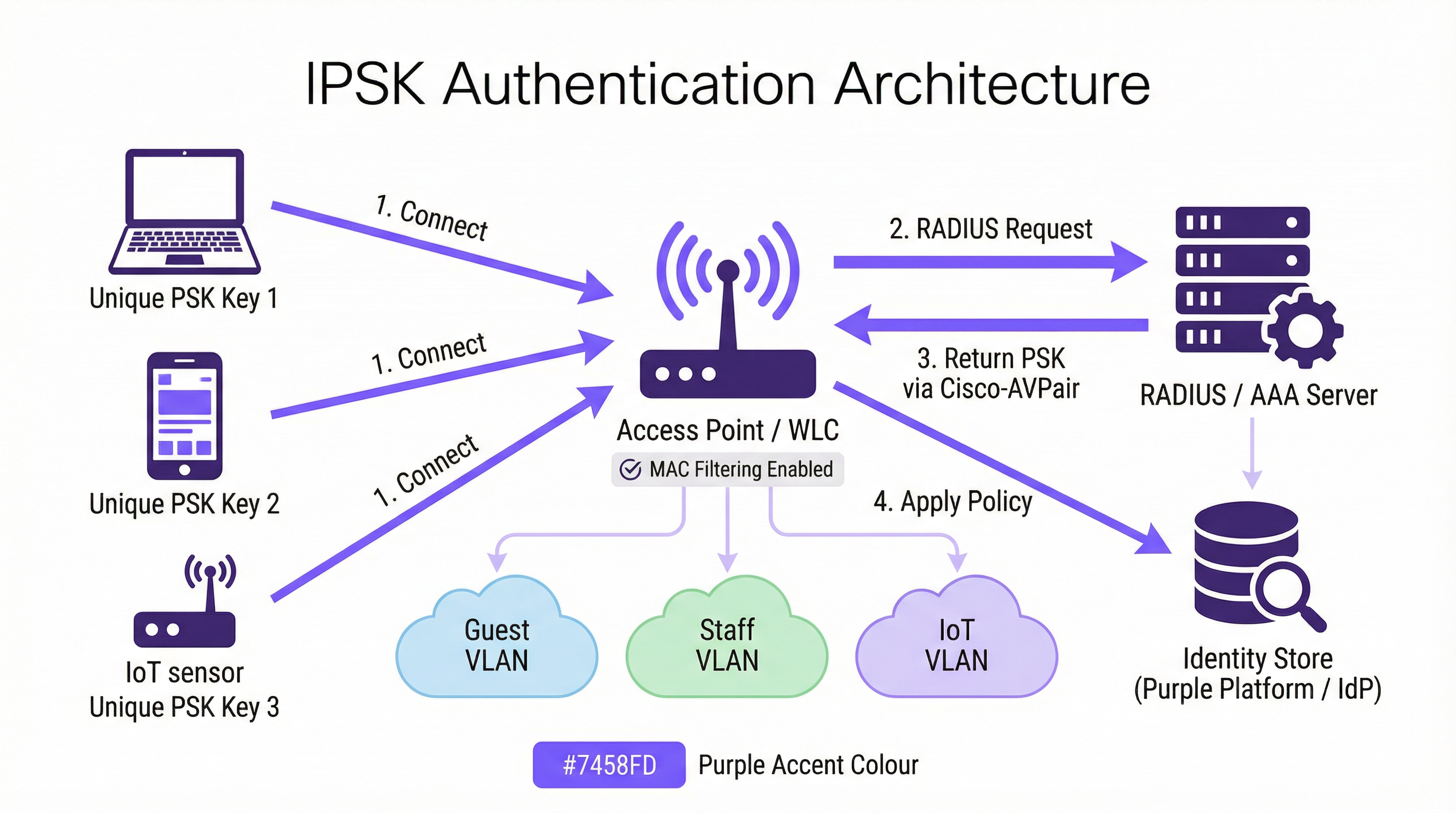
IPSK हे WPA2-Personal सिक्युरिटी फ्रेमवर्कमध्ये काम करते परंतु त्यात RADIUS-बॅक्ड आयडेंटिटी लेयरची भर घालते. ऑथेंटिकेशन फ्लो खालीलप्रमाणे चालतो. जेव्हा एखादे क्लायंट डिव्हाइस IPSK-सक्षम SSID सोबत असोसिएशन सुरू करते, तेव्हा Wireless LAN Controller (WLC) — किंवा कंट्रोलर-लेस डिप्लॉयमेंटमधील ॲक्सेस पॉईंट — डिव्हाइसचा MAC ॲड्रेस कॅप्चर करतो आणि MAC Authentication Bypass (MAB) किंवा स्टँडर्ड 802.1X रिक्वेस्टचा भाग म्हणून कॉन्फिगर केलेल्या RADIUS सर्व्हरकडे फॉरवर्ड करतो. RADIUS सर्व्हर त्याच्या आयडेंटिटी स्टोअरमध्ये क्वेरी करतो, त्या MAC ॲड्रेसशी संबंधित रेकॉर्ड शोधतो आणि Cisco Attribute-Value Pair (AVP) — विशेषतः cisco-av-pair = psk-mode=ascii आणि cisco-av-pair = psk=<unique_passphrase> — असलेला Access-Accept रिस्पॉन्स परत पाठवतो. WLC हा प्रति-डिव्हाइस पासफ्रेज एक्सट्रॅक्ट करतो आणि क्लायंटने प्रेझेंट केलेल्या फोर-वे WPA2 हँडशेकला व्हॅलिडेट करण्यासाठी त्याचा वापर करतो. जर पासफ्रेज जुळला, तर असोसिएशन पूर्ण होते आणि डिव्हाइसला त्याच्या नियुक्त केलेल्या बँडविड्थ आणि ॲक्सेस पॉलिसींसह त्याच्या नियुक्त केलेल्या VLAN वर ठेवले जाते.
या आर्किटेक्चरचा अर्थ असा आहे की क्लायंट डिव्हाइसला आपण स्टँडर्ड PSK ऐवजी IPSK वापरत आहोत हे कधीही जाणून घेण्याची आवश्यकता नसते. युझरचा अनुभव अगदी सारखाच असतो: पासफ्रेज एंटर करा, कनेक्ट करा. इंटेलिजन्स पूर्णपणे सर्व्हर-साईड असते.
व्हेंडर इम्प्लिमेंटेशन्स
तीन प्रमुख एंटरप्राइझ वायरलेस व्हेंडर्स प्रत्येकी वेगवेगळ्या प्रॉडक्ट नावांखाली आयडेंटिटी-बेस्ड PSK लागू करतात, तरीही फंक्शनल आर्किटेक्चर एकसमान असते:
| व्हेंडर (Vendor) | प्रॉडक्टचे नाव (Product Name) | RADIUS ॲट्रिब्युट फॉरमॅट |
|---|---|---|
| Cisco | iPSK (Identity PSK) | cisco-av-pair = psk=<passphrase> |
| Aruba / HPE | MPSK (Multi-PSK) | Aruba-MPSK-Passphrase |
| Ruckus / CommScope | DPSK (Dynamic PSK) | प्रोप्रायटरी DPSK इंजिन किंवा RADIUS |
| Meraki | IPSK with RADIUS | स्टँडर्ड Cisco AVP फॉरमॅट |
चारही इम्प्लिमेंटेशन्स RADIUS ॲट्रिब्युट्सद्वारे VLAN असाइनमेंट आणि QoS पॉलिसी डिलिव्हरीला सपोर्ट करतात, ज्यामुळे एकाच SSID वरून प्रति-डिव्हाइस नेटवर्क सेगमेंटेशन शक्य होते.
प्रायव्हेट एरिया नेटवर्क्स आणि लेयर 2 आयसोलेशन
मल्टी-टेनंट डिप्लॉयमेंट्समध्ये IPSK ची एक महत्त्वपूर्ण क्षमता म्हणजे प्रायव्हेट एरिया नेटवर्क (PAN). कारण प्रत्येक डिव्हाइसचा ट्रॅफिक एका युनिक की सह एन्क्रिप्ट केलेला असतो, त्यामुळे युझर्समधील लेयर 2 आयसोलेशन हे आर्किटेक्चरमध्येच अंतर्भूत असते. रूम 412 मधील अतिथी रूम 413 मधील अतिथीच्या उपकरणांना पाहू शकत नाही किंवा त्यांच्याशी संवाद साधू शकत नाही, जरी ते दोघेही एकाच Hotel-Guest SSID शी कनेक्ट केलेले असले तरीही. शेअर्ड-PSK नेटवर्क्सच्या तुलनेत ही एक मूलभूत सिक्युरिटी सुधारणा आहे, जिथे सर्व उपकरणे समान ब्रॉडकास्ट डोमेन शेअर करतात आणि एखादा अटॅकर अनएन्क्रिप्टेड ट्रॅफिक इंटरसेप्ट करू शकतो.
mDNS रिफ्लेक्शनसह एकत्रित केल्यावर — जे बहुतांश एंटरप्राइझ-ग्रेड कंट्रोलर्सवर उपलब्ध असलेले वैशिष्ट्य आहे — IPSK युझरच्या स्वतःच्या प्रायव्हेट सेगमेंटमध्ये डिव्हाइस डिस्कव्हरी सक्षम करते. अतिथी त्यांच्या स्वतःच्या Chromecast वर मीडिया कास्ट करू शकतात किंवा त्यांच्या पोर्टेबल प्रिंटरवर प्रिंट करू शकतात, तेही त्या उपकरणांना विस्तृत नेटवर्कवर एक्सपोज न करता. हे "होम-अवे-फ्रॉम-होम" कनेक्टिव्हिटी मॉडेल आहे जे हॉस्पिटॅलिटी ऑपरेटर्स वाढत्या प्रमाणात एक वेगळेपण (differentiator) म्हणून वापरत आहेत.
WPA3 कंपॅटिबिलिटी
WPA3-SAE (Simultaneous Authentication of Equals) WPA2 फोर-वे हँडशेकला ड्रॅगनफ्लाय की एक्सचेंजने रिप्लेस करते, ज्यामुळे प्रति-डिव्हाइस कीज कशा व्हॅलिडेट केल्या जातात ते बदलते. बहुतांश आधुनिक कंट्रोलर्स WPA2/WPA3 ट्रान्झिशन मोडमध्ये IPSK ला सपोर्ट करतात, जे लेगसी उपकरणांसाठी बॅकवर्ड कंपॅटिबिलिटी प्रदान करतात आणि त्याच वेळी WPA3-सक्षम क्लायंट्सना अधिक मजबूत हँडशेकचा लाभ घेण्याची परवानगी देतात. IPSK सह प्युअर WPA3-ओन्ली SSID ला कंट्रोलर फर्मवेअर सपोर्टची आवश्यकता असते जो आता 2025 पर्यंत Cisco Catalyst 9800, Aruba CX, आणि Ruckus One प्लॅटफॉर्म्सवर उपलब्ध आहे.
IEEE स्टँडर्ड्स कॉन्टेक्स्ट
IPSK हे IEEE 802.11 वायरलेस LAN स्टँडर्डमध्ये काम करते आणि त्याच्या RADIUS कम्युनिकेशनसाठी IEEE 802.1X ऑथेंटिकेशन फ्रेमवर्कचा लाभ घेते, जरी क्लायंट-साईड ऑथेंटिकेशन मेकॅनिझम EAP ऐवजी PSK असले तरीही. RADIUS प्रोटोकॉल स्वतः RFC 2865 आणि RFC 2868 मध्ये परिभाषित केला आहे. प्रति-डिव्हाइस पासफ्रेज वितरित करण्यासाठी वापरला जाणारा Cisco AVP फॉरमॅट हा स्टँडर्ड RADIUS ॲट्रिब्युट सेटचा एक व्हेंडर एक्स्टेंशन आहे, म्हणूनच IPSK हे औपचारिकरीत्या प्रमाणित IEEE स्पेसिफिकेशन नाही — ही प्रमाणित प्रोटोकॉल्सवर तयार केलेली एक व्हेंडर-इम्प्लिमेंटेड क्षमता आहे.
इम्प्लिमेंटेशन गाईड
टप्पा 1: इन्फ्रास्ट्रक्चर असेसमेंट
एकही ॲक्सेस पॉईंट कॉन्फिगर करण्यापूर्वी, चार क्षेत्रांचा समावेश असलेले सखोल इन्फ्रास्ट्रक्चर असेसमेंट करा. प्रथम, तुमचा वायरलेस कंट्रोलर IPSK ला सपोर्ट करतो याची खात्री करा — तुमच्या विशिष्ट प्लॅटफॉर्मसाठी फर्मवेअर व्हर्जनच्या आवश्यकता तपासा. दुसरे, तुमच्या RADIUS इन्फ्रास्ट्रक्चरचे मूल्यांकन करा: तुमच्याकडे विद्यमान RADIUS सर्व्हर (Cisco ISE, Microsoft NPS, FreeRADIUS) आहे का, किंवा तुम्ही क्लाउड-बेस्ड RADIUS सर्व्हिस वापराल? तिसरे, तुमचा आयडेंटिटी प्रोव्हायडर (IdP) ओळखा — Microsoft Entra ID, Okta, Google Workspace — आणि ऑटोमेटेड की प्रोव्हिजनिंगसाठी API कनेक्टिव्हिटीची पुष्टी करा. चौथे, MAC रँडमायझेशन समस्या किंवा नॉन-स्टँडर्ड WPA2 हँडशेक वर्तन असू शकणारी कोणतीही लेगसी उपकरणे ओळखण्यासाठी तुमच्या डिव्हाइस फ्लीटचे ऑडिट करा.
टप्पा 2: RADIUS कॉन्फिगरेशन
खालील घटकांसह तुमचा RADIUS सर्व्हर कॉन्फिगर करा. एक आयडेंटिटी स्टोअर तयार करा — युनिक पासफ्रेज आणि VLAN असाइनमेंट्सशी मॅप केलेल्या MAC ॲड्रेसेसचा डेटाबेस. हॉटेल डिप्लॉयमेंटसाठी, हे स्टोअर PMS इंटिग्रेशनद्वारे डायनॅमिकली पॉप्युलेट केले जाते; रिटेल डिप्लॉयमेंटसाठी, HR सिस्टीम किंवा MDM इंटिग्रेशनद्वारे. ऑथोरायझेशन प्रोफाइल्स तयार करा जे VLAN असाइनमेंट ॲट्रिब्युट्स (Tunnel-Type = VLAN, Tunnel-Medium-Type = 802, Tunnel-Private-Group-ID = <VLAN_ID>) सोबत योग्य Cisco AVP ॲट्रिब्युट्स (psk-mode आणि psk-password) परत करतात. इनकमिंग MAC ॲड्रेस रिक्वेस्ट्सना योग्य ऑथोरायझेशन प्रोफाइलशी मॅच करणारे पॉलिसी रूल्स कॉन्फिगर करा.
टप्पा 3: WLC/कंट्रोलर कॉन्फिगरेशन
वायरलेस कंट्रोलरवर, WPA2-PSK सिक्युरिटी आणि MAC फिल्टरिंग सक्षम करून IPSK SSID तयार करा. या SSID साठी ऑथेंटिकेशन सर्व्हर म्हणून RADIUS सर्व्हर कॉन्फिगर करा आणि RADIUS-रिटर्न्ड VLAN असाइनमेंट्सना SSID च्या डीफॉल्ट VLAN ला ओव्हरराइड करण्याची अनुमती देण्यासाठी AAA Override सक्षम करा. SSID वर एक डीफॉल्ट PSK सेट करा — हे RADIUS आयडेंटिटी स्टोअरमध्ये न सापडलेल्या उपकरणांसाठी फॉलबॅक म्हणून काम करते, आणि तो एक मजबूत, रँडमली जनरेट केलेला पासफ्रेज असावा जो युझर्सना वितरित केला जात नाही. सुधारित सिक्युरिटी पोश्चरसाठी Protected Management Frames (PMF) सक्षम करा.
टप्पा 4: की लाइफसायकल ऑटोमेशन
मॅन्युअल की मॅनेजमेंट स्केल होत नाही. मोजक्या उपकरणांच्या पलीकडील कोणत्याही डिप्लॉयमेंटसाठी, ऑर्केस्ट्रेशन प्लॅटफॉर्म वापरून संपूर्ण की लाइफसायकल ऑटोमेट करा. Purple चा प्लॅटफॉर्म तुमच्या IdP आणि PMS सोबत इंटिग्रेट होतो जेणेकरून ऑनबोर्डिंगच्या वेळी कीज प्रोव्हिजन करता येतील आणि ऑफबोर्डिंगच्या वेळी त्या रद्द करता येतील, ज्यामध्ये कोणत्याही मॅन्युअल IT हस्तक्षेपाची आवश्यकता नसते. प्रोव्हिजनिंग वर्कफ्लोमध्ये हे समाविष्ट असावे: की जनरेशन (क्रिप्टोग्राफिकली रँडम, किमान 12 कॅरेक्टर्स), की डिस्ट्रिब्युशन (ईमेल, SMS, किंवा प्रिंटेड कोलॅटरलद्वारे), आणि RADIUS आयडेंटिटी स्टोअरमध्ये की रजिस्ट्रेशन. ऑफबोर्डिंग वर्कफ्लोमध्ये हे समाविष्ट असावे: RADIUS स्टोअरमध्ये त्वरित की रिव्होकेशन, डिव्हाइस डिसअसोसिएट झाल्याची पुष्टी, आणि कंप्लायन्स उद्देशांसाठी ऑडिट लॉग एंट्री.
टप्पा 5: MAC रँडमायझेशन मिटिगेशन
क्लायंट्सना त्यांचा कायमस्वरूपी MAC ॲड्रेस वापरण्याची विनंती करणारी नेटवर्क पॉलिसी समाविष्ट करण्यासाठी तुमचा SSID कॉन्फिगर करा. iOS वर, हे डिव्हाइसच्या WiFi सेटिंग्जमध्ये विशिष्ट नेटवर्कसाठी "Private Wi-Fi Address" अक्षम करून साध्य केले जाते — ही एक पायरी आहे जी ऑनबोर्डिंग दरम्यान युझर्सना कम्युनिकेट केली जाऊ शकते. MDM मध्ये एनरोल केलेल्या मॅनेज्ड उपकरणांसाठी, DisableAssociationMACRandomization = true सेट करणारी WiFi कॉन्फिगरेशन प्रोफाइल पुश करा. अनमॅनेज्ड उपकरणांसाठी, तुमच्या युझर ऑनबोर्डिंग कम्युनिकेशन्समध्ये MAC रँडमायझेशन मार्गदर्शनाचा समावेश करा.
सर्वोत्तम पद्धती (Best Practices)
की युनिकनेस आणि किमान एन्ट्रॉपी लागू करा. प्रत्येक IPSK पासफ्रेज क्रिप्टोग्राफिकली रँडम आणि किमान 12 कॅरेक्टर्सचा असावा, ज्यामध्ये अप्पर आणि लोअर केस अक्षरे, अंक आणि चिन्हे यांचा मेळ असावा. डिक्शनरीतील शब्द, सीक्वेन्शियल पॅटर्न किंवा युझर-आयडेंटिफायेबल माहितीवरून घेतलेले कोणतेही शब्द टाळा. Purple चे की जनरेशन इंजिन असे पासफ्रेज तयार करते जे डीफॉल्टनुसार NIST SP 800-63B एन्ट्रॉपी आवश्यकता पूर्ण करतात.
केवळ युझरनुसार नाही, तर फंक्शननुसार सेगमेंट करा. डिव्हाइस फंक्शननुसार नेटवर्क सेगमेंटेशन लागू करण्यासाठी IPSK च्या VLAN असाइनमेंट क्षमतेचा वापर करा. IoT उपकरणे — थर्मोस्टॅट्स, सेन्सर्स, स्मार्ट लॉक्स — एका डेडिकेटेड IoT VLAN वर असावीत ज्यामध्ये मर्यादित इंटरनेट ॲक्सेस असेल आणि इतर VLANs कडे कोणतीही लॅटरल मूव्हमेंट नसेल. अतिथी उपकरणे केवळ इंटरनेट ॲक्सेस असलेल्या गेस्ट VLAN वर असावीत. कर्मचारी उपकरणे त्यांच्या भूमिकेनुसार योग्य असलेल्या अंतर्गत संसाधनांच्या ॲक्सेससह स्टाफ VLAN वर असावीत. पेमेंट कार्ड डेटा कॅरी करणाऱ्या कोणत्याही नेटवर्कसाठी हे सेगमेंटेशन एक PCI DSS आवश्यकता आहे.
RADIUS सर्व्हर रिडंडन्सी लागू करा. WLC वर ऑटोमॅटिक फेलओव्हरसह किमान दोन RADIUS सर्व्हर्स — प्रायमरी आणि सेकंडरी — कॉन्फिगर करा. दर तिमाहीला फेलओव्हर वर्तनाची चाचणी करा. ज्या डिप्लॉयमेंट्समध्ये ऑन-प्रिमाइसेस सर्व्हर रिडंडन्सी ऑपरेशनल दृष्ट्या व्यवहार्य नाही, तिथे क्लाउड-होस्टेड RADIUS सर्व्हिसचा विचार करा.
की वापराचे नियमितपणे ऑडिट करा. RADIUS अकाउंटिंग लॉग्स कोणते MAC ॲड्रेसेस ऑथेंटिकेट झाले, कधी झाले आणि कोणत्या ॲक्सेस पॉईंटवरून झाले याचा संपूर्ण रेकॉर्ड प्रदान करतात. विसंगतींसाठी (anomalies) दर महिन्याला या लॉग्सचे पुनरावलोकन करा — असामान्य वेळेत ऑथेंटिकेट होणारी उपकरणे, एकाधिक VLANs वर दिसणारी उपकरणे, किंवा ऑथेंटिकेशन फेल्युअर्स जे ब्रूट-फोर्स प्रयत्नाचे संकेत देऊ शकतात. Purple चा ॲनालिटिक्स डॅशबोर्ड हे पॅटर्न आपोआप समोर आणतो.
युझर लाइफसायकल इव्हेंट्ससोबत की रोटेशन अलाइन करा. कीज नैसर्गिक लाइफसायकल बाउंड्रीजवर रोटेट केल्या गेल्या पाहिजेत: अतिथीचा मुक्काम संपल्यावर, रोजगार करार संपुष्टात आल्यावर, एखाद्या इव्हेंटच्या शेवटी. ऑटोमेटेड रोटेशन मेकॅनिझमशिवाय निश्चित वेळापत्रकानुसार (उदा. दर 90 दिवसांनी) टाइम-बेस्ड की रोटेशन लागू करू नका — मोठ्या प्रमाणावर मॅन्युअल रोटेशनमध्ये चुका होण्याची शक्यता असते आणि त्यामुळे सिक्युरिटी गॅप्स निर्माण होतात.
कंप्लायन्स उद्देशांसाठी तुमच्या IPSK आर्किटेक्चरचे डॉक्युमेंटेशन करा. PCI DSS आवश्यकता 1.3 नुसार सर्व नेटवर्क कनेक्शन्स आणि सेगमेंटेशन कंट्रोल्सचे डॉक्युमेंटेशन आवश्यक आहे. एक वर्तमान नेटवर्क डायग्राम मेंटेन करा जो IPSK SSID कॉन्फिगरेशन, VLAN असाइनमेंट्स, RADIUS सर्व्हर टोपोलॉजी आणि आयडेंटिटी स्टोअर इंटिग्रेशन पॉईंट्स दर्शवतो. हे डॉक्युमेंटेशन PCI DSS असेसमेंट्ससाठी आवश्यक आहे आणि GDPR आर्टिकल 30 रेकॉर्ड्स ऑफ प्रोसेसिंग ॲक्टिव्हिटीजसाठी ही एक चांगली पद्धत आहे.
ट्रबलशूटिंग आणि रिस्क मिटिगेशन
ऑथेंटिकेशन फेल्युअर्स
IPSK ऑथेंटिकेशन फेल्युअरचे सर्वात सामान्य कारण म्हणजे WLC ला प्रेझेंट होणाऱ्या डिव्हाइसचा MAC ॲड्रेस आणि RADIUS आयडेंटिटी स्टोअरमध्ये रजिस्टर केलेला MAC ॲड्रेस यांच्यातील मिसमॅच. हे जवळजवळ नेहमीच MAC ॲड्रेस रँडमायझेशनमुळे होते. WLC च्या क्लायंट असोसिएशन लॉग्सचा वापर करून डिव्हाइसचा MAC ॲड्रेस व्हेरिफाय करा आणि RADIUS आयडेंटिटी स्टोअरसोबत त्याची तुलना करा. जर डिव्हाइस रँडमाइज्ड MAC प्रेझेंट करत असेल, तर नेटवर्कसाठी प्रायव्हेट ॲड्रेस अक्षम करण्यासाठी युझरला मार्गदर्शन करा, किंवा पहिल्या कनेक्शन प्रयत्नापूर्वी डिव्हाइसचा कायमस्वरूपी MAC ॲड्रेस कॅप्चर करणारे प्री-रजिस्ट्रेशन पोर्टल लागू करा.
दुसरे सर्वात सामान्य फेल्युअर म्हणजे RADIUS ऑथोरायझेशन प्रोफाइलमधील चुकीचा किंवा गहाळ असलेला Cisco AVP. AVP फॉरमॅट तुमच्या कंट्रोलरच्या अपेक्षित सिंटॅक्सशी जुळतो का ते व्हेरिफाय करा — cisco-av-pair = psk-mode=ascii आणि त्यानंतर cisco-av-pair = psk=<passphrase> — आणि SSID वर AAA Override सक्षम आहे का ते तपासा.
RADIUS सर्व्हर अनअव्हेलेबिलिटी
जर RADIUS सर्व्हर अनरिचेबल असेल, तर WLC SSID वर कॉन्फिगर केलेल्या डीफॉल्ट PSK वर फॉलबॅक करेल. हा डीफॉल्ट PSK केवळ आपत्कालीन ॲक्सेस मेकॅनिझम म्हणून मानला जावा आणि तो युझर्सना वितरित केला जाऊ नये. तुमच्या स्टँडर्ड इन्फ्रास्ट्रक्चर मॉनिटरिंग टूलिंगसह RADIUS सर्व्हरच्या उपलब्धतेवर लक्ष ठेवा आणि WLC वरील RADIUS टाइमआउट इव्हेंट्ससाठी अलर्टिंग कॉन्फिगर करा.
IoT डिव्हाइस कंपॅटिबिलिटी
काही लेगसी IoT उपकरणे नॉन-स्टँडर्ड WPA2 हँडशेक वर्तन लागू करतात ज्यामुळे IPSK सोबत अधूनमधून ऑथेंटिकेशन फेल्युअर्स होऊ शकतात. जर एखादा विशिष्ट डिव्हाइस प्रकार सातत्याने फेल होत असेल, तर डिव्हाइसच्या मूलभूत WPA2 क्षमतेची पुष्टी करण्यासाठी स्टँडर्ड PSK SSID वर आयसोलेशनमध्ये त्याची चाचणी करा. जर डिव्हाइस WPA2-PSK ला अजिबात सपोर्ट करू शकत नसेल, तर ते वायर्ड पोर्टद्वारे किंवा योग्य नेटवर्क आयसोलेशन असलेल्या डेडिकेटेड लेगसी SSID द्वारे कनेक्ट केले जावे.
की कॉम्प्रमाइज
जर एखादे डिव्हाइस हरवले, चोरीला गेले किंवा कॉम्प्रमाइज झाल्याचा संशय असेल, तर RADIUS आयडेंटिटी स्टोअरमध्ये त्याची IPSK की त्वरित रद्द करा. WLC त्याच्या पुढील री-ऑथेंटिकेशन प्रयत्नावर (सामान्यतः काही मिनिटांत) डिव्हाइसला डिसअसोसिएट करेल. युझरच्या रिप्लेसमेंट डिव्हाइससाठी नवीन की जनरेट करा आणि स्टँडर्ड ऑनबोर्डिंग वर्कफ्लोद्वारे ती प्रोव्हिजन करा. कंप्लायन्स उद्देशांसाठी तुमच्या सिक्युरिटी इन्सिडेंट लॉगमध्ये या घटनेचे डॉक्युमेंटेशन करा.
ROI आणि बिझनेस इम्पॅक्ट
मोजता येण्याजोगे परिणाम (Quantifiable Outcomes)
शेअर्ड PSK च्या तुलनेत IPSK साठी बिझनेस केस तीन आयामांवर (dimensions) प्रभावी आहे. पहिला म्हणजे ऑपरेशनल खर्चात कपात. शेअर्ड PSK मॉडेलवर चालणाऱ्या 200-खोल्यांच्या हॉटेलमध्ये, फ्रंट डेस्क टीम दररोज सरासरी 15-20 WiFi-संबंधित सपोर्ट रिक्वेस्ट्स हाताळते — पासवर्ड रिसेट्स, डिव्हाइस कनेक्शन समस्या, Captive Portal टाइमआउट्स. ऑटोमेटेड ऑनबोर्डिंगसह IPSK हे प्रमाण जवळपास शून्यावर आणते, ज्यामुळे फ्रंट डेस्क कर्मचाऱ्यांना महसूल-निर्मितीच्या कामांसाठी वेळ मिळतो. प्रति सपोर्ट इंटरॅक्शन 10 मिनिटे आणि कर्मचाऱ्यांचा खर्च £15 प्रति तास असा पुराणमतवादी अंदाज लावल्यास, 200-खोल्यांचे हॉटेल थेट कामगार खर्चात दरमहा अंदाजे £750-£1,000 वाचवते.
दुसरा आयाम म्हणजे सिक्युरिटी इन्सिडेंट कॉस्ट अव्हॉइडन्स (सुरक्षा घटनांचा खर्च टाळणे). शेअर्ड PSK नेटवर्क ब्रीच — जिथे एखाद्या दुर्भावनापूर्ण व्यक्तीला शेअर्ड पासवर्डचा ॲक्सेस मिळतो — नेटवर्कवरील सर्व उपकरणांना ट्रॅफिक इंटरसेप्शन आणि लॅटरल मूव्हमेंट अटॅक्ससाठी एक्सपोज करू शकतो. IBM च्या कॉस्ट ऑफ अ डेटा ब्रीच रिपोर्टनुसार, हॉस्पिटॅलिटी क्षेत्रातील डेटा ब्रीचचा सरासरी खर्च £3.5 दशलक्षपेक्षा जास्त आहे, जेव्हा त्यात नियामक दंड, रेमेडिएशन खर्च आणि प्रतिष्ठेचे नुकसान समाविष्ट असते. IPSK च्या प्रति-डिव्हाइस आयसोलेशनचा अर्थ असा आहे की कॉम्प्रमाइज झालेली की संपूर्ण नेटवर्कला नाही, तर केवळ एकाच डिव्हाइसला एक्सपोज करते.
तिसरा आयाम म्हणजे अतिथींचे समाधान आणि महसुलावरील परिणाम. हॉस्पिटॅलिटी क्षेत्रात, ऑनलाइन रिव्ह्यूजमध्ये WiFi ची गुणवत्ता सातत्याने टॉप-थ्री फॅक्टर म्हणून नमूद केली जाते. ज्या प्रॉपर्टीज Captive Portal-बेस्ड WiFi कडून IPSK कडे वळतात, त्या WiFi-संबंधित रिव्ह्यू स्कोअरमध्ये मोजता येण्याजोगी सुधारणा नोंदवतात, ज्यासोबत एकूण प्रॉपर्टी रेटिंग्जमध्येही सुधारणा होते. कॉर्नेल युनिव्हर्सिटीच्या हॉस्पिटॅलिटी संशोधनानुसार, हॉटेलच्या TripAdvisor स्कोअरमधील एक-पॉईंट सुधारणा ही महसूल प्रति उपलब्ध खोली (RevPAR) मधील सरासरी 11% वाढीशी संबंधित आहे.
मालकीचा एकूण खर्च (Total Cost of Ownership)
IPSK आणि 802.1X Enterprise मधील TCO तुलना व्हेन्यू वातावरणासाठी IPSK च्या बाजूने लक्षणीयरीत्या झुकते. संपूर्ण 802.1X डिप्लॉयमेंटसाठी PKI इन्फ्रास्ट्रक्चर, सर्टिफिकेट मॅनेजमेंट टूलिंग आणि चालू सर्टिफिकेट रिन्यूअल प्रक्रियेची आवश्यकता असते — ज्यामध्ये मध्यम आकाराच्या व्हेन्यूसाठी सामान्यतः सुरुवातीच्या डिप्लॉयमेंट खर्चामध्ये £15,000-£40,000 आणि वार्षिक देखभालीमध्ये £5,000-£15,000 ची भर पडते. IPSK ला RADIUS सर्व्हर (जो अनेकदा इन्फ्रास्ट्रक्चरमध्ये आधीपासूनच उपस्थित असतो) आणि Purple सारख्या ऑर्केस्ट्रेशन प्लॅटफॉर्मची आवश्यकता असते. विद्यमान RADIUS सर्व्हर नसलेल्या संस्थांसाठी, क्लाउड-होस्टेड RADIUS सेवा दरमहा £200-£500 पासून उपलब्ध आहेत, ज्यामुळे IPSK लहान व्हेन्यू ऑपरेटर्ससाठीही ॲक्सेसिबल बनते.

हे मार्गदर्शक एंटरप्राइझ WiFi इंटेलिजन्स प्लॅटफॉर्म, Purple द्वारे प्रकाशित केले आहे. टेक्निकल आर्किटेक्चर रिव्ह्यू आणि IPSK डिप्लॉयमेंट असेसमेंटसाठी, purple.ai वर Purple च्या सोल्युशन्स टीमशी संपर्क साधा.
महत्त्वाच्या संज्ञा आणि व्याख्या
IPSK (Identity Pre-Shared Key)
A WiFi authentication mechanism that assigns a unique WPA2 passphrase to each individual user or device, while all devices connect to the same SSID. The unique key is delivered to the Wireless LAN Controller by a RADIUS server at the time of authentication, enabling per-device policy enforcement without requiring 802.1X certificate infrastructure.
IT teams encounter IPSK when evaluating authentication options for mixed-device environments — hotels, retail, events — where 802.1X is too complex and shared PSK is too insecure. It is the recommended architecture for guest and staff WiFi in multi-tenant venue environments.
RADIUS (Remote Authentication Dial-In User Service)
A networking protocol (RFC 2865) that provides centralised Authentication, Authorisation, and Accounting (AAA) management for users connecting to a network. In IPSK deployments, the RADIUS server is the intelligence layer that maps device MAC addresses to unique passphrases and network policies.
IT teams interact with RADIUS when configuring the authentication backend for IPSK. Common RADIUS server implementations include Cisco ISE, Microsoft NPS, FreeRADIUS, and cloud-hosted services. RADIUS availability is critical to IPSK operation — if the RADIUS server is unreachable, new device authentications will fail.
MAC Authentication Bypass (MAB)
An authentication mechanism that uses a device's MAC address as its identity credential, rather than requiring the device to present a username/password or certificate. IPSK leverages MAB to identify devices at the point of RADIUS lookup, enabling headless devices with no user interface to authenticate based solely on their hardware address.
IT teams use MAB in IPSK deployments to support IoT devices, smart TVs, gaming consoles, and other headless endpoints that cannot present user credentials. MAB is the mechanism that makes IPSK compatible with 100% of WiFi-capable devices.
Cisco Attribute-Value Pair (AVP)
A vendor-specific RADIUS attribute format used by Cisco (and compatible) wireless controllers to exchange configuration parameters between the RADIUS server and the WLC. In IPSK deployments, the AVPs `cisco-av-pair = psk-mode=ascii` and `cisco-av-pair = psk=<passphrase>` deliver the per-device unique passphrase from the RADIUS server to the WLC.
IT teams need to understand AVP syntax when configuring RADIUS authorisation profiles for IPSK. Incorrect AVP formatting is the most common cause of IPSK authentication failures during initial deployment.
Private Area Network (PAN)
A virtual network segment created around a specific user's devices within a shared WiFi infrastructure. In IPSK deployments, each user's unique key creates cryptographic isolation from other users on the same SSID, while mDNS reflection allows the user's own devices to discover each other within their private segment.
IT teams deploy PAN capability in hospitality and multi-tenant residential environments to provide guests or residents with a home-like device ecosystem — casting, printing, gaming — without exposing their devices to other users on the shared infrastructure.
WPA2-SAE / WPA3 (Simultaneous Authentication of Equals)
The authentication handshake mechanism introduced in WPA3 that replaces the WPA2 four-way handshake with a Dragonfly key exchange, providing stronger resistance to offline dictionary attacks. WPA3-SAE changes how per-device keys are validated in IPSK deployments and requires specific controller firmware support.
IT teams evaluating WPA3 migration need to confirm their controller's IPSK support in WPA3 or transition mode. As of 2025, Cisco Catalyst 9800, Aruba CX, and Ruckus One platforms support IPSK in WPA2/WPA3 transition mode, enabling gradual migration without breaking legacy device compatibility.
AAA Override
A WLC configuration setting that allows RADIUS-returned attributes — including VLAN assignment, QoS policy, and ACLs — to override the SSID's default configuration on a per-client basis. AAA Override must be enabled on the SSID for IPSK's per-device VLAN assignment to function correctly.
IT teams must enable AAA Override when configuring IPSK SSIDs. Without it, all devices connecting to the SSID will be placed on the SSID's default VLAN regardless of what the RADIUS server returns, negating the segmentation benefits of IPSK.
MAC Address Randomisation
A privacy feature in modern operating systems (iOS 14+, Android 10+, Windows 11) that causes devices to present a randomly generated MAC address when scanning for or connecting to WiFi networks, rather than their permanent hardware MAC address. This feature is designed to prevent device tracking across networks but creates a conflict with IPSK's MAC-based identity lookup.
IT teams must address MAC randomisation in every IPSK deployment plan. The mitigation strategy depends on the device management model: MDM configuration profiles for managed devices, and user-facing guidance (disable Private Wi-Fi Address for the specific network) for unmanaged personal devices.
Key Lifecycle Management
The operational process of provisioning, distributing, rotating, and revoking cryptographic keys throughout their useful life. In IPSK deployments, key lifecycle management encompasses the automated generation of unique passphrases at user onboarding, their delivery to users, their registration in the RADIUS identity store, and their immediate revocation when the user's access should be terminated.
IT teams and venue operations directors must treat key lifecycle management as a core operational process, not an afterthought. Unrevoked keys — belonging to former guests, ex-employees, or decommissioned devices — represent an ongoing security risk. Automation via a platform such as Purple is the only viable approach at scale.
केस स्टडीज
A 350-room full-service hotel is running a shared WPA2-PSK network across all guest floors, the lobby, restaurant, and conference facilities. The network password is printed on key card folders and changed quarterly. Guests regularly complain that their Chromecasts and smart speakers cannot connect, and the front desk fields 20+ WiFi support calls per day. The IT manager needs to modernise the WiFi architecture without replacing the existing Cisco Catalyst 9800 controller infrastructure. What is the recommended approach?
The recommended architecture is IPSK with Purple platform orchestration integrated with the hotel's Property Management System (PMS). The deployment proceeds in five stages.
Stage 1 — Infrastructure preparation: Confirm Cisco Catalyst 9800 firmware is at 17.3 or later (required for full iPSK support). Deploy or configure a RADIUS server — Cisco ISE or a cloud-hosted RADIUS service — with the hotel's PMS as the upstream identity source. Configure the RADIUS authorisation profile to return cisco-av-pair = psk-mode=ascii and cisco-av-pair = psk=<unique_key> along with VLAN assignment attributes for Guest VLAN (internet-only) and Conference VLAN (with access to AV systems).
Stage 2 — SSID configuration: Create a single Hotel-Guest SSID with WPA2-PSK security, MAC filtering enabled, and AAA Override enabled. Set a strong default PSK (not distributed to users) as the fallback. Enable mDNS reflection to support Chromecast and AirPlay within each guest's private segment.
Stage 3 — PMS integration: Configure Purple's platform to receive check-in events from the PMS via API. On check-in, Purple generates a unique 16-character alphanumeric passphrase, registers it in the RADIUS identity store against the guest's registered device MAC addresses, and triggers delivery via the hotel's chosen channel — email, SMS, or printed on the key card folder. On check-out, Purple automatically revokes the key.
Stage 4 — MAC randomisation handling: Include a one-step instruction in the guest WiFi welcome communication: 'To connect your smart TV or streaming device, please disable Private Wi-Fi Address for the Hotel-Guest network in your device settings.' For guests connecting smartphones, the randomised MAC issue is resolved by the device presenting its permanent MAC after the first manual connection.
Stage 5 — Staff WiFi: Create a separate Hotel-Staff SSID using the same IPSK architecture, with keys provisioned via integration with the hotel's HR system. Staff keys are tied to employee records and automatically revoked on termination.
Expected outcomes: WiFi support calls reduced by 85% within 30 days of deployment. Guest Chromecast and smart device connectivity issues eliminated. Network security posture improved — no shared password to leak or rotate. PCI DSS compliance for the conference centre's payment processing network maintained through VLAN segmentation.
A national retail chain with 85 stores is running a mixed network environment: each store has WPA2-PSK WiFi for staff handhelds and tablets, a separate open guest WiFi network, and wired POS terminals. The IT security team has flagged that the shared staff WiFi password is the same across all 85 stores and has not been changed in 18 months. A recent PCI DSS assessment identified the staff WiFi as a compliance risk due to lack of individual authentication. The CTO wants a solution that improves security posture, maintains PCI DSS compliance, and can be deployed across all 85 stores within a single quarter without requiring store-level IT resources.
The recommended architecture is a centralised IPSK deployment managed through Purple's platform, with keys provisioned via integration with the retailer's existing Microsoft Entra ID (Azure AD) directory.
Architecture design: Deploy a single Staff-WiFi SSID across all 85 stores using IPSK. Each store's access points connect to a centralised cloud-managed WLC (Cisco Meraki or Aruba Central) or to store-level controllers managed from a central NOC. A cloud-hosted RADIUS service — configured with Microsoft Entra ID as the identity source — handles authentication for all stores from a single management plane.
Key provisioning: Purple's platform monitors Entra ID group membership. When a staff member is added to the RetailStaff-WiFi security group, Purple automatically generates a unique IPSK passphrase, registers it in the RADIUS identity store, and delivers it to the staff member via their corporate email. When a staff member leaves or is removed from the group — triggered by the HR offboarding workflow — Purple immediately revokes the key across all stores simultaneously.
PCI DSS compliance: The IPSK architecture, combined with VLAN segmentation (staff devices on VLAN 20, POS terminals on VLAN 30 with no wireless access, guest WiFi on VLAN 40), provides the network segmentation required by PCI DSS Requirement 1.3. Each staff member's unique key provides the individual authentication audit trail required by PCI DSS Requirement 8.2. Document the architecture in the network segmentation diagram for the QSA.
Deployment at scale: The centralised management architecture means store-level deployment requires only access point firmware updates and SSID reconfiguration — tasks that can be pushed remotely via the cloud management platform. No store-level IT resources are required. Target deployment timeline: 85 stores in 8 weeks, with a phased rollout of 10-12 stores per week.
Expected outcomes: Shared password eliminated across all 85 stores. Individual staff authentication audit trail established for PCI DSS compliance. Key revocation time reduced from days (manual password change across 85 stores) to seconds (automated RADIUS revocation). Estimated reduction in IT helpdesk tickets related to WiFi access: 60%.
परिस्थिती विश्लेषण
Q1. A 500-bed student accommodation provider is evaluating WiFi authentication options for their new development. The student population brings an average of 7 devices each — smartphones, laptops, gaming consoles, smart speakers, and tablets. The operator wants individual access control (so that access can be revoked if a student's tenancy ends early), seamless device connectivity (including gaming consoles and Chromecasts), and a management overhead that can be handled by a two-person IT team. Which authentication architecture should they deploy, and what are the key configuration requirements?
💡 संकेत:Consider the device fleet composition — specifically the proportion of headless devices — and the operational capacity of the IT team when evaluating 802.1X versus IPSK.
शिफारस केलेला दृष्टिकोन दाखवा
IPSK is the correct architecture for this deployment. The presence of gaming consoles and smart speakers in the device fleet immediately eliminates 802.1X as a viable option — these headless devices cannot support certificate-based authentication. Standard PSK is eliminated by the individual access control requirement. IPSK satisfies all three criteria: it supports 100% of the device fleet, enables individual key revocation when a tenancy ends, and — with automated lifecycle management via Purple integrated with the accommodation's tenancy management system — can be operated by a two-person IT team. Key configuration requirements: single SSID with IPSK, RADIUS server with tenancy system integration, mDNS reflection enabled for Private Area Networks (allowing students to use their own Chromecasts and printers within their private segment), MAC randomisation guidance included in the student onboarding pack, and automated key revocation triggered by tenancy end date in the management system.
Q2. An IT security manager at a conference centre is preparing for a major three-day industry event with 2,000 registered attendees. The event requires: secure WiFi for attendees (with access revoked after the event ends), a separate secure network for exhibitors with access to the venue's AV systems, and a dedicated network for the event management team with access to internal booking systems. The venue's existing infrastructure is Aruba-based. What IPSK architecture would you recommend, and how would you handle key provisioning at scale?
💡 संकेत:Focus on the key provisioning workflow for 2,000 attendees — how keys are generated, distributed, and revoked — and how VLAN segmentation achieves the three-network requirement from a single physical infrastructure.
शिफारस केलेला दृष्टिकोन दाखवा
Deploy three logical network segments from a single physical infrastructure using Aruba MPSK (Aruba's implementation of IPSK). Create one SSID — Event-WiFi — with MPSK enabled. The RADIUS authorisation profiles return different VLAN assignments based on the user's registration category: attendees on VLAN 10 (internet-only), exhibitors on VLAN 20 (internet plus AV systems), event management on VLAN 30 (internet plus internal booking systems). For key provisioning at scale: integrate Purple's platform with the event registration system. At registration, each attendee receives a unique MPSK passphrase via email confirmation, along with a QR code for easy device configuration. Exhibitors receive their keys via the exhibitor portal at least 48 hours before the event. Event management keys are provisioned via the venue's HR/staff system. At event end, Purple triggers bulk revocation of all attendee and exhibitor keys simultaneously. The event management keys remain active until manually revoked. This architecture eliminates the need for a captive portal (which would be impractical for 2,000 attendees), provides individual audit trails for all connections, and achieves the three-network segmentation requirement without creating three separate SSIDs.
Q3. A regional NHS trust is deploying WiFi across a new outpatient facility. The network must support: clinical staff with managed Windows laptops (enrolled in Intune MDM); nurses and allied health professionals with personal smartphones (BYOD); medical IoT devices including infusion pumps, patient monitors, and fall detection sensors; and a patient guest WiFi network. The trust's information governance team has flagged that all clinical data must remain on an isolated network segment, and that the IoT medical devices must be on a dedicated segment with no internet access. What authentication architecture would you recommend for each user/device category?
💡 संकेत:This scenario requires a hybrid architecture — not all user categories are best served by the same authentication mechanism. Consider which categories warrant 802.1X and which are better served by IPSK.
शिफारस केलेला दृष्टिकोन दाखवा
This scenario requires a hybrid authentication architecture. Clinical staff on managed Windows laptops should use WPA3-Enterprise with 802.1X (EAP-TLS with certificates deployed via Intune MDM) — these are fully managed endpoints where the certificate infrastructure is already in place and the stronger security posture is warranted for clinical data access. BYOD smartphones for nursing and AHP staff should use IPSK — these are unmanaged personal devices where certificate deployment is not operationally viable, but individual access control and VLAN assignment (to a clinical staff VLAN with access to clinical applications but not raw clinical data) is required. Medical IoT devices should use IPSK with MAC-based authentication — these headless devices cannot support any user-interactive authentication, and IPSK places them on a dedicated IoT VLAN with no internet access and no lateral movement to other VLANs. Patient guest WiFi should use a separate SSID with a captive portal for consent capture (required for GDPR compliance) and standard PSK or IPSK depending on the trust's guest data collection requirements. The IPSK components (BYOD staff and IoT devices) should be managed through Purple's platform with integration to the trust's Active Directory for staff key lifecycle management and a dedicated IoT device registry for medical device key management.
महत्त्वाचे निष्कर्ष
- ✓IPSK assigns a unique WPA2 passphrase to every user or device on a shared SSID, delivering per-device security and policy enforcement without the certificate infrastructure required by 802.1X Enterprise.
- ✓The authentication flow relies on RADIUS: the WLC forwards the device's MAC address to the RADIUS server, which returns the unique passphrase via Cisco Attribute-Value Pairs, enabling the WLC to validate the device's connection and assign it to the correct VLAN.
- ✓IPSK is the correct architecture when three conditions are simultaneously present: a mixed or unmanaged device fleet (including IoT/headless devices), a requirement for individual access revocation, and a user base that cannot or should not be asked to configure certificates.
- ✓Key lifecycle automation is non-negotiable at scale — integrate IPSK with your identity provider (Microsoft Entra ID, Okta) or property management system to provision and revoke keys automatically at onboarding and offboarding events.
- ✓MAC address randomisation in iOS 14+, Android 10+, and Windows 11 is the most common source of IPSK deployment failures — plan for it explicitly with MDM configuration profiles for managed devices and user-facing guidance for personal devices.
- ✓The business case for IPSK over shared PSK is compelling: reduced helpdesk overhead, improved security incident containment (compromised key affects one device, not the entire network), and measurable improvements in guest satisfaction scores in hospitality environments.
- ✓Purple's platform provides the orchestration layer that makes IPSK operationally viable at scale — automating key generation, distribution, lifecycle management, and compliance reporting across hotel, retail, events, and public-sector deployments.




