

Okta आणि RADIUS: तुमच्या आयडेंटिटी प्रोव्हायडरचा WiFi ऑथेंटिकेशनपर्यंत विस्तार करणे
हे मार्गदर्शक Okta-केंद्रित संस्थांमधील IT प्रशासकांसाठी एक सर्वसमावेशक तांत्रिक संदर्भ प्रदान करते ज्यांना Okta RADIUS एजंट वापरून त्यांच्या क्लाउड आयडेंटिटी प्रोव्हायडरचा WiFi ऑथेंटिकेशनपर्यंत विस्तार करायचा आहे. यामध्ये संपूर्ण ऑथेंटिकेशन आर्किटेक्चर, MFA अंमलबजावणीचे फायदे-तोटे, RADIUS ॲट्रिब्यूट मॅपिंगद्वारे डायनॅमिक VLAN असाइनमेंट आणि पासवर्ड-आधारित EAP-TTLS आणि सर्टिफिकेट-आधारित EAP-TLS मधील महत्त्वपूर्ण निर्णय समाविष्ट आहेत. वेन्यू ऑपरेटर्स आणि एंटरप्राइझ IT टीम्सना कृती करण्यायोग्य डिप्लॉयमेंट मार्गदर्शन, हॉस्पिटॅलिटी आणि रिटेलमधील वास्तविक केस स्टडीज आणि समर्पित गेस्ट WiFi सोल्यूशन्ससह Okta RADIUS समाकलित करण्यासाठी एक स्पष्ट फ्रेमवर्क मिळेल.
🎧 हे मार्गदर्शक ऐका
ट्रान्सक्रिप्ट पहा

कार्यकारी सारांश (Executive Summary)
हॉटेल चेनपासून स्टेडियमपर्यंत विखुरलेल्या वेन्यूजचे व्यवस्थापन करणाऱ्या एंटरप्राइझ IT टीम्ससाठी — क्लाउड आयडेंटिटी प्रोव्हायडरसह नेटवर्क ॲक्सेस कंट्रोल एकत्रित करणे हे Zero Trust कडे एक महत्त्वाचे पाऊल आहे. Okta RADIUS एजंट आधुनिक क्लाउड आयडेंटिटी आणि पारंपारिक 802.1X WiFi इन्फ्रास्ट्रक्चरमधील दरी भरून काढतो, ज्यामुळे संस्थांना नेटवर्क ऑथेंटिकेशनसाठी जुने ऑन-प्रिमाइसेस RADIUS सर्व्हर्स आणि Active Directory इन्फ्रास्ट्रक्चर बंद करणे शक्य होते.
हे मार्गदर्शक एंटरप्राइझ WiFi ऑथेंटिकेशनसाठी Okta RADIUS एजंट कसे डिप्लॉय करावे, प्रॉक्सी आर्किटेक्चर, MFA अंमलबजावणी यंत्रणा आणि पासवर्ड-आधारित EAP-TTLS आणि सर्टिफिकेट-आधारित EAP-TLS मधील तडजोडी याबद्दल तपशीलवार माहिती देते. हे डायनॅमिक VLAN असाइनमेंटसाठी Okta ग्रुप मेंबरशिपला RADIUS ॲट्रिब्यूट्समध्ये मॅप करण्याबाबत कृती करण्यायोग्य मार्गदर्शन देखील प्रदान करते — ही एक क्षमता आहे जी थेट PCI DSS नेटवर्क सेगमेंटेशन आवश्यकतांना समर्थन देते. स्टाफ ऑथेंटिकेशनसाठी Okta ला Guest WiFi सोल्यूशन्ससह समाकलित करून, वेन्यू ऑपरेटर्स आयडेंटिटी इन्फ्रास्ट्रक्चरची पुनरावृत्ती न करता एक युनिफाइड, सुरक्षित आणि सुसंगत ॲक्सेस लेयर प्राप्त करू शकतात.
तांत्रिक सखोल माहिती (Technical Deep-Dive)
Okta RADIUS एजंट कसे कार्य करते
Okta RADIUS एजंट ही एक लाइटवेट सिस्टम सर्व्हिस आहे जी नेटवर्क ॲक्सेस सर्व्हर्स (NAS) — जसे की वायरलेस ॲक्सेस पॉइंट्स (WAPs) किंवा वायरलेस LAN कंट्रोलर्स (WLCs) — आणि Okta क्लाउड दरम्यान प्रॉक्सी म्हणून कार्य करते. हे सहसा ऑन-प्रिमाइसेस किंवा क्लाउड VPC मधील Windows किंवा Linux सर्व्हरवर डिप्लॉय केले जाते आणि सुरुवातीच्या इन्स्टॉलेशननंतर ते पूर्णपणे Okta ॲडमिन कन्सोलवरून व्यवस्थापित केले जाते.
ऑथेंटिकेशन फ्लो मानक 802.1X प्रॉक्सी मॉडेलचे अनुसरण करतो. वापरकर्त्याचे डिव्हाइस (supplicant) एंटरप्राइझ SSID शी कनेक्ट होते आणि क्रेडेंशियल्स सादर करते. WAP किंवा WLC (authenticator) UDP पोर्ट 1812 वर Okta RADIUS एजंटला RADIUS Access-Request फॉरवर्ड करतो. एजंट HTTPS API कॉलद्वारे ही विनंती सुरक्षितपणे Okta क्लाउडवर पाठवतो, जिथे Okta चे पॉलिसी इंजिन वापरकर्ता डिरेक्टरी आणि कोणत्याही कॉन्फिगर केलेल्या साइन-ऑन पॉलिसीनुसार क्रेडेंशियल्सचे मूल्यमापन करते. ऑथेंटिकेशन यशस्वी झाल्यास, एजंट ऑथेंटिकेटरला RADIUS Access-Accept मेसेज परत करतो, ज्यामध्ये पर्यायाने VLAN असाइनमेंटसारख्या ऑथोरायझेशनसाठी RADIUS ॲट्रिब्यूट्स समाविष्ट असतात. जर MFA आवश्यक असेल, तर एजंट क्लायंटला RADIUS Access-Challenge परत पाठवतो, जो अंतिम निर्णय देण्यापूर्वी दुसऱ्या फॅक्टरसाठी विचारतो.
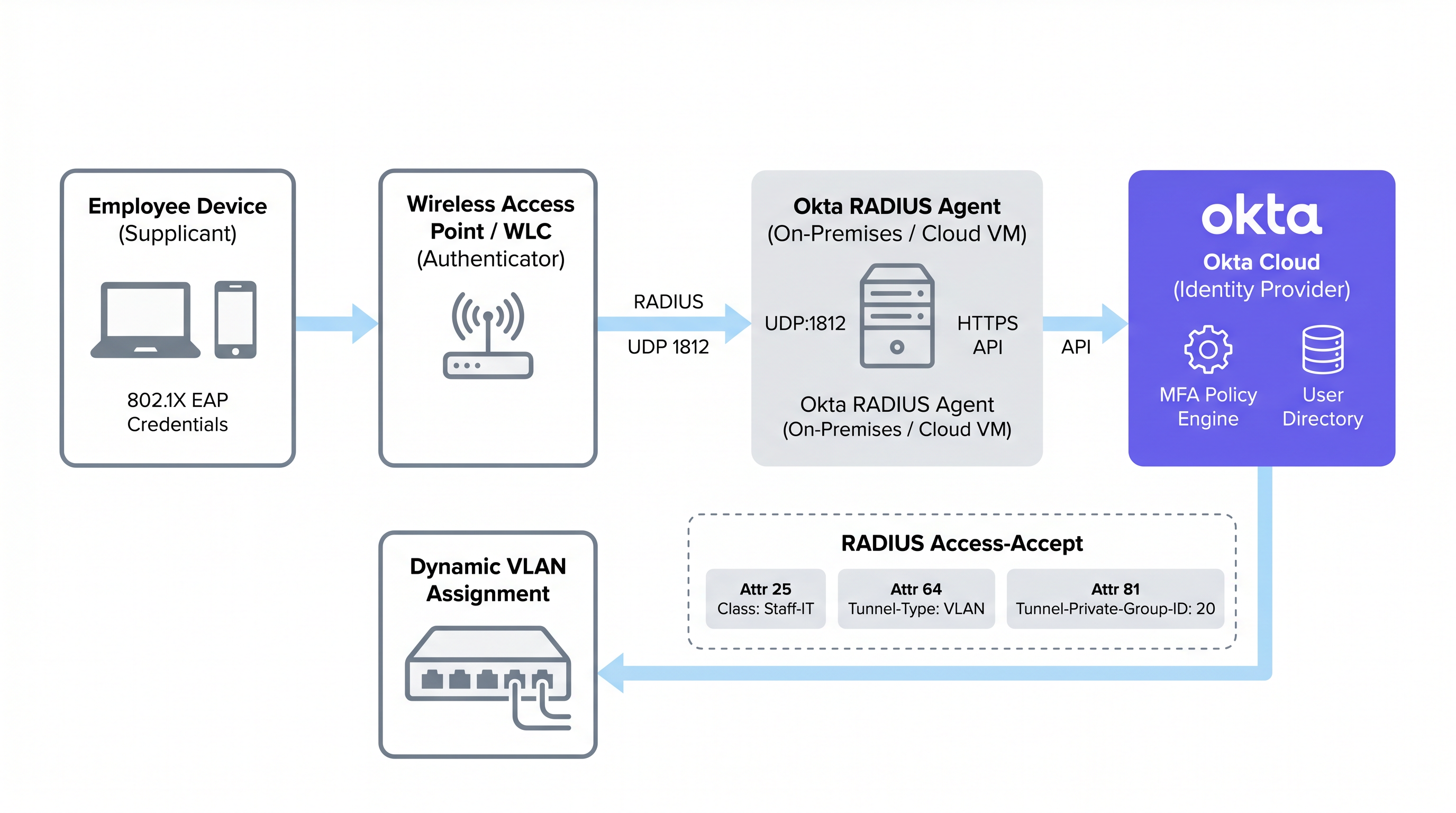
या प्रॉक्सी मॉडेलचा अर्थ असा आहे की Okta RADIUS एजंटला वापरकर्ता क्रेडेंशियल्स स्थानिक पातळीवर स्टोअर करण्याची आवश्यकता नाही. सर्व ऑथेंटिकेशन लॉजिक, पॉलिसी इव्हॅल्युएशन आणि ऑडिट लॉगिंग Okta क्लाउडमध्ये घडते, ज्यामुळे प्रशासकांना क्लाउड ॲप्लिकेशन्स आणि नेटवर्क ॲक्सेस या दोन्हीसाठी आयडेंटिटी गव्हर्नन्सचा एकच डॅशबोर्ड मिळतो.
समर्थित EAP प्रोटोकॉल आणि महत्त्वपूर्ण मर्यादा
Okta RADIUS एजंटची एक मूलभूत आर्किटेक्चरल मर्यादा म्हणजे प्राथमिक ऑथेंटिकेशनसाठी पासवर्ड ऑथेंटिकेशन प्रोटोकॉल (PAP) वर असलेली त्याची अवलंबित्व. PAP पासवर्डला इनर लेयरमध्ये प्लेनटेक्स्टमध्ये ट्रान्समिट करत असताना, हे एक्स्टेंसिबल ऑथेंटिकेशन प्रोटोकॉल (EAP) च्या आऊटर TLS टनेलद्वारे एन्कॅप्स्युलेटेड आणि संरक्षित केले जाते. समर्थित आऊटर प्रोटोकॉल EAP-TTLS (इनर मेथड म्हणून PAP सह) आणि EAP-GTC आहेत. EAP पद्धतींच्या सखोल तुलनेसाठी, Comparativa de métodos EAP: PEAP, EAP-TLS, EAP-TTLS y EAP-FAST संदर्भ मार्गदर्शक पहा.
महत्त्वाचे म्हणजे, PEAP-MSCHAPv2 समर्थित नाही. हा Windows क्लायंट आणि अनेक जुन्या एंटरप्राइझ वातावरणासाठी डीफॉल्ट 802.1X प्रोटोकॉल आहे. पारंपारिक NPS/Active Directory RADIUS सेटअपमधून स्थलांतरित होणाऱ्या संस्थांनी त्यांच्या क्लायंट सप्लिकंट्सना PAP सह EAP-TTLS वापरण्यासाठी पुन्हा कॉन्फिगर करणे आवश्यक आहे — हा बदल सहसा MDM किंवा ग्रुप पॉलिसीद्वारे पुश केलेल्या वायरलेस प्रोफाइलद्वारे आवश्यक असतो. हे लक्षात न घेणे हे Okta RADIUS डिप्लॉयमेंट अयशस्वी होण्याचे सर्वात सामान्य कारण आहे.
EAP-TLS, जे पूर्णपणे म्युच्युअल सर्टिफिकेट-आधारित ऑथेंटिकेशनवर अवलंबून असते, ते देखील Okta RADIUS एजंटद्वारे नेटिव्हली समर्थित नाही. EAP-TLS आवश्यक असलेल्या संस्थांनी समर्पित PKI किंवा क्लाउड RADIUS सोल्यूशन डिप्लॉय करणे आवश्यक आहे जे Okta RADIUS एजंट थेट वापरण्याऐवजी SAML किंवा OIDC द्वारे IdP म्हणून Okta शी समाकलित होते.
WiFi कनेक्शनवर MFA लागू करणे
Okta RADIUS एजंट WiFi ॲक्सेससाठी MFA ला समर्थन देतो, परंतु यामुळे वापरकर्त्याच्या अनुभवात आव्हाने निर्माण होतात ज्यांचा डिप्लॉयमेंटपूर्वी काळजीपूर्वक विचार केला पाहिजे. जेव्हा MFA पॉलिसी ट्रिगर होते, तेव्हा एजंट क्लायंटला RADIUS Access-Challenge पाठवतो. Okta RADIUS ॲप्लिकेशन्ससाठी अनेक फॅक्टर्सना समर्थन देते:
| MFA फॅक्टर | PAP | EAP-TTLS | नोट्स |
|---|---|---|---|
| Okta Verify Push | समर्थित | समर्थित | आउट-ऑफ-बँड पाठवले जाते; वापरकर्ता मोबाईलवर Approve टॅप करतो |
| TOTP (Okta Verify / Google Auth) | समर्थित | समर्थित | वापरकर्ता पासवर्डला OTP जोडतो (उदा., Pass123,456789) |
| SMS / Email / Voice | समर्थित | समर्थित | वापरकर्ता प्रथम ट्रिगर स्ट्रिंग (SMS, EMAIL, CALL) पाठवतो |
| Duo Push / SMS / Passcode | समर्थित | समर्थित | EAP-TTLS साठी फक्त Duo पासकोड |
| YubiKey / U2F / Windows Hello | समर्थित नाही | समर्थित नाही | हार्डवेअर टोकन्स RADIUS प्रोटोकॉलशी विसंगत आहेत |
व्यावहारिक मर्यादा रोमिंगची आहे. Hospitality वातावरणात, हाऊसकीपरचा टॅब्लेट प्रत्येक शिफ्टमध्ये डझनभर वेळा ॲक्सेस पॉइंट्स दरम्यान रोम होऊ शकतो, ज्यामुळे प्रत्येक वेळी पुन्हा-ऑथेंटिकेशन ट्रिगर होते. प्रत्येक रोमवर पुश नोटिफिकेशन अप्रूव्हलची आवश्यकता असणे ऑपरेशनल दृष्टीने कठीण आहे. सामान्य स्टाफ WiFi साठी, Okta च्या डिव्हाइस ट्रस्ट आणि नेटवर्क झोन पॉलिसीसह एकत्रित मजबूत पासवर्ड पॉलिसी सहसा सक्रिय MFA प्रॉम्प्ट्सपेक्षा अधिक पसंत केल्या जातात. WiFi वरील MFA प्रशासकीय SSIDs किंवा उच्च-विशेषाधिकार ॲक्सेस परिस्थितींसाठी राखीव असावे.
पासवर्ड-आधारित विरुद्ध सर्टिफिकेट-आधारित ऑथेंटिकेशन
पासवर्ड-आधारित RADIUS (Okta RADIUS एजंटद्वारे) आणि सर्टिफिकेट-आधारित EAP-TLS मधील निवड हा एंटरप्राइझ WiFi डिप्लॉयमेंटमधील सर्वात महत्त्वाचा निर्णय आहे. यातील तडजोडी केवळ सुरक्षिततेबद्दल नाहीत; त्यामध्ये डिप्लॉयमेंटची जटिलता, डिव्हाइस मॅनेजमेंटची परिपक्वता आणि ऑपरेशनल ओव्हरहेड यांचा समावेश होतो.
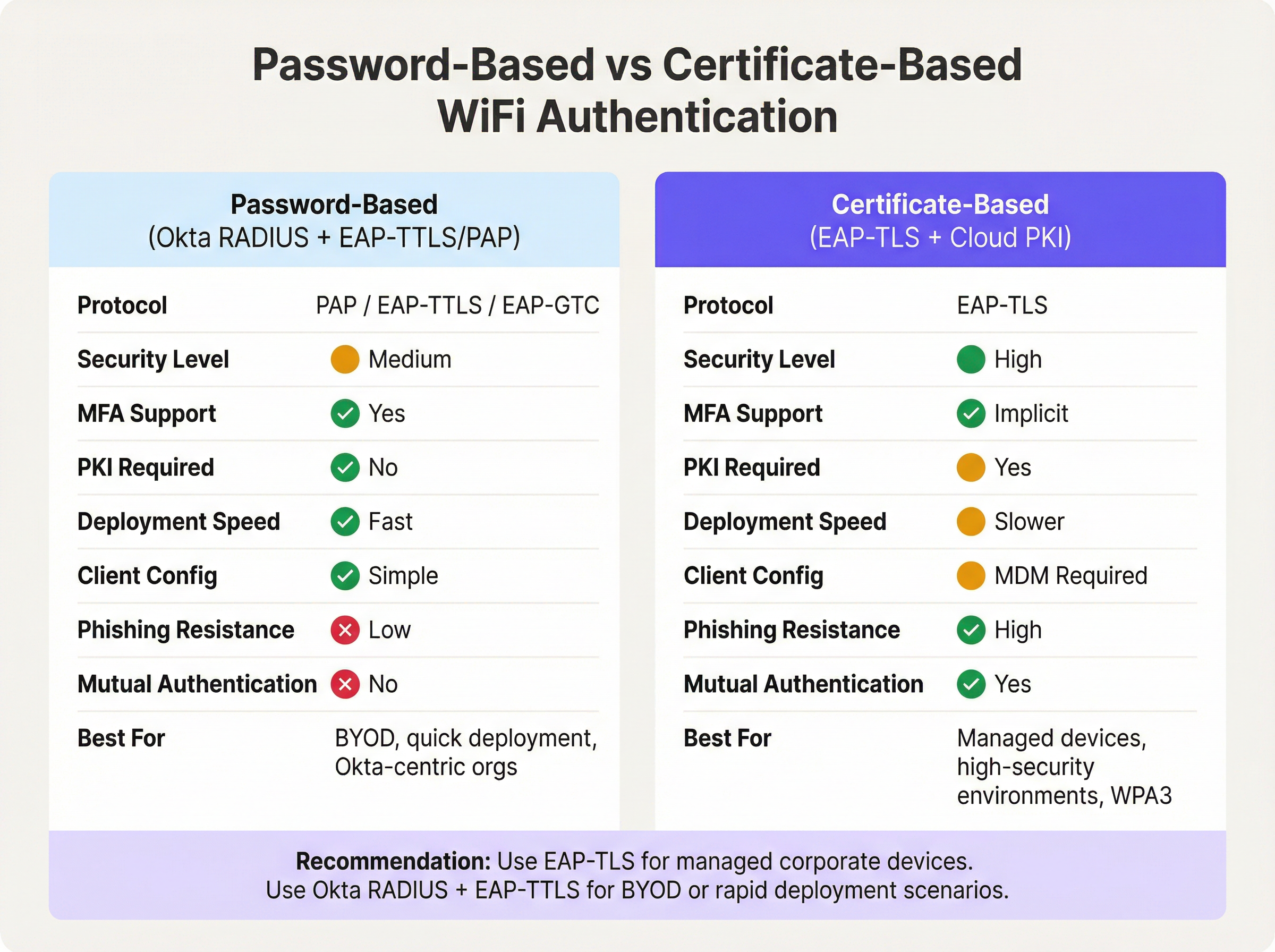
Okta RADIUS एजंटद्वारे पासवर्ड-आधारित ऑथेंटिकेशन युनिफाइड आयडेंटिटीसाठी जलद मार्ग देते. जर तुमची संस्था आधीच Okta मध्ये वापरकर्त्यांचे व्यवस्थापन करत असेल, तर डिप्लॉयमेंट आठवड्यांऐवजी तासांत पूर्ण होऊ शकते. तयार करण्यासाठी कोणतीही PKI नाही, वितरित करण्यासाठी कोणतीही सर्टिफिकेट्स नाहीत आणि कोणतीही MDM अवलंबित्व नाही. तडजोड अशी आहे की पासवर्ड हे प्राथमिक क्रेडेंशियल राहतात आणि म्युच्युअल ऑथेंटिकेशनच्या अभावाचा अर्थ असा आहे की क्लायंट नेटवर्कची ओळख क्रिप्टोग्राफिकली पडताळू शकत नाही — जो उच्च-जोखीम वातावरणात evil twin हल्ल्यांसाठी एक मार्ग असू शकतो.
सर्टिफिकेट-आधारित EAP-TLS WiFi ऑथेंटिकेशन समीकरणातून पासवर्ड पूर्णपणे काढून टाकते. क्लायंट डिव्हाइस सर्टिफिकेट सादर करतो आणि RADIUS सर्व्हर सर्व्हर सर्टिफिकेट सादर करतो, ज्यामुळे म्युच्युअल ऑथेंटिकेशन मिळते. WPA3-Enterprise नेटवर्कवरील IEEE 802.1X साठी, विशेषतः PCI DSS किंवा NCSC Cyber Essentials Plus च्या अधीन असलेल्या वातावरणात हा शिफारस केलेला दृष्टिकोन आहे. यासाठी पूर्वअट म्हणजे कार्यरत PKI — एकतर ऑन-प्रिमाइसेस Microsoft ADCS डिप्लॉयमेंट किंवा क्लाउड PKI सर्व्हिस — आणि सर्व व्यवस्थापित एंडपॉइंट्सना सर्टिफिकेट्स वितरित करण्यास सक्षम MDM प्लॅटफॉर्म. शेकडो व्यवस्थापित पॉइंट-ऑफ-सेल डिव्हाइसेस असलेल्या Retail वातावरणासाठी, ही गुंतवणूक सार्थ आहे. BYOD-जास्त वातावरण किंवा जलद डिप्लॉयमेंटसाठी, EAP-TTLS सह Okta RADIUS हा व्यावहारिक पर्याय आहे.
डायनॅमिक VLAN असाइनमेंटसाठी RADIUS ॲट्रिब्यूट मॅपिंग
डायनॅमिक VLAN असाइनमेंट हे असे क्षेत्र आहे जिथे Okta RADIUS इंटिग्रेशन त्याचे सर्वात मूर्त ऑपरेशनल मूल्य प्रदान करते. Okta ग्रुप मेंबरशिपला RADIUS ॲट्रिब्यूट्समध्ये मॅप करून, नेटवर्क प्रशासक प्रत्येक डिव्हाइस किंवा प्रत्येक लोकेशनसाठी स्वतंत्र VLAN पॉलिसी न ठेवता रोल-आधारित नेटवर्क सेगमेंटेशन लागू करू शकतात.
Okta RADIUS Access-Accept मेसेजमध्ये तीनपैकी एका ॲट्रिब्यूटचा वापर करून ग्रुप मेंबरशिप डेटा पास करतो, जो Okta ॲप्लिकेशनच्या Advanced RADIUS Settings मध्ये कॉन्फिगर करण्यायोग्य असतो:
- Attribute 11 (Filter-Id): ग्रुपचे नाव असलेले स्ट्रिंग ॲट्रिब्यूट. सर्व वेंडर्समध्ये मोठ्या प्रमाणावर समर्थित.
- Attribute 25 (Class): ऑथोरायझेशनसाठी वापरले जाणारे एक अपारदर्शक ॲट्रिब्यूट. Cisco ISE, Aruba ClearPass आणि Fortinet द्वारे समर्थित.
- Attribute 26 (Vendor-Specific): अधिक ग्रॅन्युलर कंट्रोलसाठी वेंडर-विशिष्ट सब-ॲट्रिब्यूट्सना अनुमती देते.
नेटवर्क कंट्रोलर (WLC, NAC अप्लायन्स) निवडलेल्या ॲट्रिब्यूटमध्ये Okta ग्रुपचे नाव प्राप्त करतो आणि VLAN असाइनमेंटसाठी आवश्यक असलेल्या मानक RADIUS टनेल ॲट्रिब्यूट्समध्ये मॅप करतो:
| RADIUS ॲट्रिब्यूट | व्हॅल्यू | उद्देश |
|---|---|---|
| 64 (Tunnel-Type) | 13 (VLAN) | VLAN टनेलिंग निर्दिष्ट करते |
| 65 (Tunnel-Medium-Type) | 6 (802) | IEEE 802 मिडियम निर्दिष्ट करते |
| 81 (Tunnel-Private-Group-ID) | उदा., 40 |
टार्गेट VLAN ID |
उदाहरणार्थ, Retail-POS-Staff या Okta ग्रुपमधील वापरकर्त्यासाठी Access-Accept मध्ये Class: Retail-POS-Staff परत केले जाईल. WLC पॉलिसी याला Tunnel-Private-Group-ID: 40 मध्ये मॅप करेल, ज्यामुळे डिव्हाइस VLAN 40 वर — आयसोलेटेड POS नेटवर्कवर येईल. Store-Management मधील वापरकर्त्याला VLAN 50 वर ठेवले जाईल. हे लॉजिक नेटवर्क एजवर लागू केले जाते, Okta मध्ये नाही, परंतु ते पूर्णपणे Okta ग्रुप मेंबरशिपद्वारे चालवले जाते.
अंमलबजावणी मार्गदर्शक (Implementation Guide)
पायरी १: Okta RADIUS एजंट डिप्लॉय करा (हाय अवेलेबिलिटी)
हाय अवेलेबिलिटी सुनिश्चित करण्यासाठी किमान दोन सर्व्हर्सवर — एकतर ऑन-प्रिमाइसेस किंवा क्लाउड VPC मध्ये — Okta RADIUS एजंट डिप्लॉय करा. सिंगल-एजंट डिप्लॉयमेंट ही एक मोठी जोखीम आहे: जर सर्व्हर पॅचिंगसाठी अनुपलब्ध असेल किंवा बिघाड झाला, तर संपूर्ण इस्टेटमध्ये सर्व 802.1X WiFi ऑथेंटिकेशन अयशस्वी होईल. दोन्ही एजंट्समध्ये RADIUS विनंत्यांचे लोड बॅलन्स करण्यासाठी तुमचे WLC किंवा NAC अप्लायन्स कॉन्फिगर करा.
इन्स्टॉलेशन दरम्यान, एजंटला ऑथोराईज करण्यासाठी आणि Okta टेनंटशी लिंक करण्यासाठी एजंट Okta ॲडमिन लॉगिनसाठी विचारेल. एकदा ऑथोराईज झाल्यावर, एजंट Okta ॲडमिन कन्सोलमध्ये Settings > Downloads > RADIUS Agent Status अंतर्गत दिसतो, जिथे आरोग्य आणि कनेक्टिव्हिटीचे निरीक्षण केले जाऊ शकते.
पायरी २: Okta मध्ये RADIUS ॲप्लिकेशन कॉन्फिगर करा
१. Okta ॲडमिन कन्सोलमध्ये, Applications > Applications वर जा आणि ॲप कॅटलॉगमध्ये RADIUS Application शोधा.
२. ॲप्लिकेशन जोडा, त्याला वर्णनात्मक नाव द्या (उदा., Corporate-WiFi-Staff), आणि Next वर क्लिक करा.
३. Sign On टॅब अंतर्गत, RADIUS Port (डीफॉल्ट 1812) कॉन्फिगर करा आणि किमान ३२ कॅरेक्टर्सचा एक मजबूत, यादृच्छिकपणे व्युत्पन्न केलेला Shared Secret तयार करा.
४. Advanced RADIUS Settings अंतर्गत, जर तुम्ही पासवर्डला जोडलेले TOTP समर्थित करणार असाल, तर Accept password and security token in the same login request सक्षम करा.
५. अखंड पुश-आधारित MFA साठी पर्यायाने Permit Automatic Push for Okta Verify Enrolled Users सक्षम करा.
६. तुमच्या स्टाफचे प्रतिनिधित्व करणाऱ्या संबंधित Okta ग्रुप्सना ॲप्लिकेशन असाइन करा.
पायरी ३: ग्रुप-आधारित VLAN असाइनमेंट कॉन्फिगर करा
१. RADIUS ॲप्लिकेशनच्या Sign On सेटिंग्जमध्ये, Advanced RADIUS Settings विभागात Edit वर क्लिक करा.
२. Include groups in RADIUS response चेक करा.
३. RADIUS ॲट्रिब्यूट निवडा: Aruba आणि Cisco वातावरणासाठी 25 Class शिफारसीय आहे; Fortinet आणि इतरांसाठी 11 Filter-Id.
४. समाविष्ट करण्यासाठी विशिष्ट Okta ग्रुपची नावे जोडा (उदा., Retail-POS-Staff, Store-Management, IT-Admins).
५. तुमच्या WLC किंवा NAC अप्लायन्सवर, प्रत्येक ग्रुपच्या नावाला संबंधित VLAN टनेल ॲट्रिब्यूट्समध्ये मॅप करणाऱ्या अंमलबजावणी पॉलिसी तयार करा.
पायरी ४: क्लायंट सप्लिकंट्स कॉन्फिगर करा
PEAP-MSCHAPv2 असमर्थित असल्याने, क्लायंट डिव्हाइसेसना इनर मेथड म्हणून EAP-TTLS सह PAP वापरण्यासाठी कॉन्फिगर करणे आवश्यक आहे. तुमच्या MDM प्लॅटफॉर्मद्वारे (उदा., Microsoft Intune, Jamf Pro) किंवा Windows डोमेन-जॉइन्ड डिव्हाइसेससाठी ग्रुप पॉलिसी ऑब्जेक्ट्स (GPO) द्वारे वायरलेस नेटवर्क प्रोफाइल डिप्लॉय करा. प्रोफाइलमध्ये खालील गोष्टी निर्दिष्ट असाव्यात:
- SSID: तुमच्या एंटरप्राइझ SSID चे नाव
- सुरक्षा: WPA2-Enterprise किंवा WPA3-Enterprise
- EAP पद्धत: EAP-TTLS
- इनर ऑथेंटिकेशन: PAP
- सर्व्हर सर्टिफिकेट व्हॅलिडेशन: सक्षम (तुमच्या RADIUS एजंटच्या सर्व्हर सर्टिफिकेट CN शी पिन करा)
पायरी ५: RADIUS टाइमआउट्स सेट करा
तुमच्या WLC वरील RADIUS टाइमआउट डीफॉल्ट ३-५ सेकंदांवरून ३०-६० सेकंद पर्यंत वाढवा. जर MFA पुश नोटिफिकेशन्स वापरात असतील तर हे अत्यंत महत्त्वाचे आहे, कारण WLC ने ऑथेंटिकेशनचा प्रयत्न सोडून देण्यापूर्वी वापरकर्त्याकडे त्यांच्या डिव्हाइसवर नोटिफिकेशन मंजूर करण्यासाठी पुरेसा वेळ असणे आवश्यक आहे.
सर्वोत्तम पद्धती (Best Practices)
WiFi ऑथेंटिकेशनसाठी Okta RADIUS डिप्लॉय करणे सोपे आहे, परंतु अनेक ऑपरेशनल सर्वोत्तम पद्धती एक लवचिक प्रोडक्शन डिप्लॉयमेंट आणि एक कमकुवत प्रूफ-ऑफ-कन्सेप्ट यामध्ये फरक करतात.
SSID स्तरावर गेस्ट आणि स्टाफ ट्रॅफिक वेगळे करा. Okta RADIUS हे वर्कफोर्स आयडेंटिटी टूल आहे. व्हिजिटर आणि गेस्ट ॲक्सेससाठी, समर्पित कॅप्टिव्ह पोर्टल सोल्यूशन डिप्लॉय करा. हे Okta लायसन्स खर्च गेस्ट व्हॉल्यूमसह वाढण्यापासून रोखते आणि कार्यांचे स्पष्ट वेगळेपण सुनिश्चित करते. Purple एंटरप्राइझ ग्राहक एकाच फिजिकल इन्फ्रास्ट्रक्चरवर स्टाफ ऑथेंटिकेशनसाठी Okta RADIUS वापरताना स्वतंत्र SSID वर Guest WiFi डिप्लॉय करू शकतात.
जटिल पॉलिसी वातावरणासाठी NAC अप्लायन्स वापरा. जर तुमच्या वातावरणात वापरकर्त्याच्या ओळखीसोबत डिव्हाइस पोश्चर, MAC ॲड्रेस फिल्टरिंग किंवा सर्टिफिकेट स्टेटसवर आधारित कंडिशनल ॲक्सेस आवश्यक असेल, तर Okta RADIUS एजंटकडे विनंत्या प्रॉक्सी करण्यासाठी इंटरमीडिएट NAC अप्लायन्स (Aruba ClearPass, Cisco ISE, किंवा Portnox) डिप्लॉय करा. NAC अप्लायन्स RADIUS रिस्पॉन्सला अतिरिक्त टनेल ॲट्रिब्यूट्ससह समृद्ध करू शकतो जे केवळ Okta एजंट तयार करू शकत नाही.
Okta सिस्टम लॉगद्वारे मॉनिटर करा. प्रत्येक ऑथेंटिकेशन इव्हेंट — यश, अपयश, MFA चॅलेंज आणि फॅक्टर प्रकार — Okta सिस्टम लॉगमध्ये रेकॉर्ड केला जातो. ऑथेंटिकेशन विसंगतींवर रिअल-टाइम अलर्टिंगसाठी तुमच्या SIEM मध्ये लॉग स्ट्रीमिंग कॉन्फिगर करा. ऑडिट आवश्यकतांच्या अधीन असलेल्या Healthcare आणि सार्वजनिक क्षेत्रातील संस्थांसाठी हे विशेषतः मौल्यवान आहे.
शेड्यूलनुसार शेअर केलेले सिक्रेट्स रोटेट करा. Okta RADIUS ॲप्लिकेशन आणि तुमचे NAS मधील शेअर केलेले सिक्रेट हे एक महत्त्वाचे सुरक्षा क्रेडेंशियल आहे. रोटेशन शेड्यूल (त्रैमासिक शिफारसीय आहे) लागू करा आणि Okta ॲप्लिकेशन आणि WLC/NAC कॉन्फिगरेशन दोन्ही एकाच वेळी अपडेट करा.
RADIUS सर्व्हिस ॲड्रेसेस प्रतिबंधित करा. Okta RADIUS एजंट कॉन्फिगरेशनमध्ये, कोणत्या IP ॲड्रेसेसना RADIUS विनंत्या पाठवण्याची परवानगी आहे ते प्रतिबंधित करा. हे अनधिकृत NAS डिव्हाइसेसना तुमच्या Okta टेनंट विरुद्ध ऑथेंटिकेशनचा प्रयत्न करण्यापासून रोखते.
व्यापक नेटवर्क आर्किटेक्चर संदर्भातील मार्गदर्शनासाठी, The Core SD WAN Benefits for Modern Businesses आणि Wireless Access Points Definition Your Ultimate 2026 Guide पहा.
त्रुटी निवारण आणि जोखीम कमी करणे (Troubleshooting & Risk Mitigation)
खालील तक्ता Okta RADIUS WiFi डिप्लॉयमेंटमध्ये येणारे सर्वात सामान्य बिघाड आणि त्यांच्या शिफारस केलेल्या उपायांचा सारांश देतो.
| बिघाड मोड | मूळ कारण | उपाय |
|---|---|---|
| ऑथेंटिकेशन टाइमआउट्स | Okta API किंवा MFA प्रतिसादासाठी WLC RADIUS टाइमआउट खूप कमी आहे | WLC RADIUS टाइमआउट ३०-६० सेकंदांपर्यंत वाढवा |
| Windows क्लायंट नाकारले गेले | Windows डीफॉल्टनुसार PEAP-MSCHAPv2 वापरते, जे Okta RADIUS नाकारते | MDM किंवा GPO द्वारे EAP-TTLS/PAP वायरलेस प्रोफाइल पुश करा |
| वापरकर्ते चुकीच्या VLAN मध्ये | Okta ग्रुपच्या नावातील तफावत किंवा WLC वर टनेल ॲट्रिब्यूट्स गहाळ | WLC Class/Filter-Id ला Tunnel-Private-Group-ID मध्ये मॅप करत असल्याची खात्री करा; Okta सिस्टम लॉग तपासा |
| एजंटशी संपर्क होऊ शकत नाही | सर्व्हर ऑफलाइन, API टोकन कालबाह्य, किंवा फायरवॉल Okta कडे HTTPS ब्लॉक करत आहे | रिडंडंट एजंट्स डिप्लॉय करा; Okta ॲडमिन कन्सोलमध्ये एजंट स्टेटस मॉनिटर करा; आऊटबाउंड HTTPS तपासा |
| MFA पुश डिलिव्हर झाले नाही | वापरकर्ता Okta Verify मध्ये एनरोल नाही, किंवा मोबाईल डिव्हाइस ऑफलाइन | Okta Verify एनरोलमेंट पॉलिसी लागू करा; फॉलबॅक म्हणून TOTP चा विचार करा |
| सर्टिफिकेट व्हॅलिडेशन एरर्स | क्लायंट RADIUS सर्व्हर सर्टिफिकेट व्हॅलिडेट करू शकत नाही | क्लायंट वायरलेस प्रोफाइलमध्ये सर्व्हर सर्टिफिकेट CN पिन करा; CA चेन विश्वसनीय असल्याची खात्री करा |
| VLAN ॲट्रिब्यूट्स पाठवले नाहीत | RADIUS रिस्पॉन्स कॉन्फिगरेशनमध्ये Okta ग्रुप समाविष्ट नाही | Advanced RADIUS Settings मध्ये ग्रुप लिस्टेड असल्याची खात्री करा; वापरकर्ता Okta मधील ग्रुपचा सदस्य असल्याची पुष्टी करा |
Transport आणि सार्वजनिक क्षेत्रातील वातावरणासाठी जिथे नेटवर्क अपटाइम मिशन-क्रिटिकल आहे, तिथे सिंथेटिक मॉनिटरिंग लागू करा जे वेळोवेळी RADIUS ऑथेंटिकेशनची एंड-टू-एंड चाचणी करते आणि वापरकर्त्यांवर परिणाम होण्यापूर्वी बिघाडाबद्दल अलर्ट देते.
ROI आणि व्यवसायावर होणारा परिणाम (ROI & Business Impact)
Okta RADIUS WiFi ऑथेंटिकेशनचा बिझनेस केस तीन स्तंभांवर आधारित आहे: ऑपरेशनल कार्यक्षमता, सुरक्षा स्थिती सुधारणे आणि अनुपालन (compliance) सज्जता.
ऑपरेशनल कार्यक्षमता. WiFi ऑथेंटिकेशनला Okta मध्ये एकत्रित केल्यामुळे प्रत्येक वेन्यू किंवा साइटवर स्वतंत्र ऑन-प्रिमाइसेस RADIUS इन्फ्रास्ट्रक्चर (NPS सर्व्हर्स, स्थानिक AD) राखण्याची गरज उरते. ५० प्रॉपर्टीज असलेल्या हॉटेल चेनसाठी, हे प्रति-साइट इन्फ्रास्ट्रक्चर खर्च आणि IT सपोर्ट ओव्हरहेडमध्ये लक्षणीय घट दर्शवू शकते. वापरकर्ता प्रोव्हिजनिंग आणि डीप्रोव्हिजनिंग सोपे होते: वापरकर्त्याला योग्य Okta ग्रुपमध्ये जोडल्याने ॲप्लिकेशन ॲक्सेस आणि योग्य WiFi VLAN ॲक्सेस दोन्ही एकाच वेळी मिळतात. जेव्हा एखादा कर्मचारी सोडून जातो, तेव्हा त्यांचे Okta खाते निष्क्रिय केल्याने सर्व साइट्सवरील WiFi ॲक्सेस त्वरित रद्द होतो.
सुरक्षा स्थिती. शेअर केलेले PSK WiFi पासवर्ड बदलून प्रति-वापरकर्ता 802.1X ऑथेंटिकेशन वापरल्याने क्रेडेंशियल शेअरिंग थांबते, जे इनसाइडर थ्रेट आणि अनधिकृत ॲक्सेसचे सामान्य कारण आहे. डायनॅमिक VLAN असाइनमेंटसह एकत्रित केल्यावर, हे नेटवर्क लेयरवर 'लीस्ट प्रिव्हिलेज'चे तत्व लागू करते. Okta सिस्टम लॉग प्रत्येक WiFi ऑथेंटिकेशन इव्हेंटचा संपूर्ण, फेरफार-पुरावा ऑडिट ट्रेल प्रदान करतो, जो इन्सिडेंट रिस्पॉन्ससाठी आवश्यक आहे.
अनुपालन सज्जता (Compliance Readiness). PCI DSS 4.0 आवश्यकता 8.3 सर्व नॉन-कन्सोल प्रशासकीय ॲक्सेससाठी MFA अनिवार्य करते. आवश्यकता 1.3 कार्डहोल्डर डेटा एन्व्हायर्नमेंट आणि इतर नेटवर्क दरम्यान नेटवर्क सेगमेंटेशनची आवश्यकता सांगते. ग्रुप-आधारित VLAN असाइनमेंटसह Okta RADIUS या दोन्ही आवश्यकता थेट पूर्ण करतो. GDPR अनुपालनासाठी, Okta सिस्टम लॉग वैयक्तिक डेटा प्रोसेसिंग सिस्टमवर योग्य तांत्रिक नियंत्रणे प्रदर्शित करण्यासाठी आवश्यक ॲक्सेस रेकॉर्ड प्रदान करतो. Modern Hospitality WiFi Solutions डिप्लॉय करणाऱ्या वेन्यूजसाठी, आयडेंटिटी आणि नेटवर्क ॲक्सेसचा हा युनिफाइड दृष्टिकोन एंटरप्राइझ प्रोक्युरमेंटसाठी वाढती पूर्वअट आहे.
हे इंटिग्रेशन पूर्ण करणाऱ्या संस्था सहसा WiFi-संबंधित IT सपोर्ट तिकिटांमध्ये घट (कमी पासवर्ड रिसेट विनंत्या, कमी VLAN मिसकॉन्फिगरेशन घटना) आणि सुरक्षा ऑडिट स्कोअरमध्ये मोजण्यायोग्य सुधारणा नोंदवतात. Okta RADIUS एजंट डिप्लॉय आणि कॉन्फिगर करण्यासाठी केलेली गुंतवणूक — जी सहसा सिंगल-साइट डिप्लॉयमेंटसाठी आठवड्यांऐवजी दिवसांत मोजली जाते — सतत ऑपरेशनल बचत प्रदान करते जी विखुरलेल्या इस्टेटमध्ये वाढत जाते.
महत्त्वाच्या संज्ञा आणि व्याख्या
Okta RADIUS Agent
A lightweight on-premises or cloud-hosted proxy service that translates RADIUS authentication requests from network infrastructure (access points, WLCs) into Okta API calls, enabling the Okta cloud to serve as the authentication backend for 802.1X WiFi.
IT teams encounter this when deploying enterprise WiFi authentication backed by Okta. It is the critical bridge component between legacy RADIUS-based network infrastructure and modern cloud identity.
802.1X
An IEEE standard for port-based Network Access Control (NAC) that defines an authentication framework for wired and wireless networks. It uses the Extensible Authentication Protocol (EAP) to carry authentication credentials between the supplicant (device), authenticator (AP/switch), and authentication server (RADIUS).
802.1X is the foundation of enterprise WiFi security. Any deployment using WPA2-Enterprise or WPA3-Enterprise is using 802.1X. IT teams must understand the three-party model (supplicant, authenticator, authentication server) to troubleshoot connectivity issues.
EAP-TTLS (Extensible Authentication Protocol - Tunnelled Transport Layer Security)
An EAP method that establishes a TLS tunnel using only a server-side certificate, then carries a simpler inner authentication protocol (such as PAP) inside the tunnel. This protects the inner credentials from eavesdropping while requiring only server-side certificate infrastructure.
EAP-TTLS with PAP is the recommended protocol for Okta RADIUS WiFi authentication. It is more secure than bare PAP but does not require client-side certificates, making it practical for BYOD and mixed-device environments.
EAP-TLS (Extensible Authentication Protocol - Transport Layer Security)
An EAP method that uses mutual certificate-based authentication — both the client and the server present digital certificates. It is the most secure 802.1X method, providing phishing-resistant, password-free authentication.
EAP-TLS is the gold standard for managed corporate device environments. It requires a PKI infrastructure and MDM for certificate distribution. The Okta RADIUS agent does not natively support EAP-TLS; a dedicated cloud PKI or RADIUS service is required.
PAP (Password Authentication Protocol)
A simple authentication protocol that transmits usernames and passwords in plaintext. In the context of 802.1X, PAP is used as the inner authentication method inside an EAP-TTLS tunnel, where the outer TLS layer provides encryption.
PAP is the primary authentication mechanism supported by the Okta RADIUS agent. IT teams must understand that PAP alone is insecure, but PAP inside EAP-TTLS is acceptable for enterprise WiFi when the server certificate is properly validated.
Dynamic VLAN Assignment
A network access control technique where a RADIUS server returns VLAN assignment attributes in the Access-Accept message, causing the wireless controller or switch to place the authenticated client on a specific VLAN based on their identity or group membership, rather than a static per-SSID VLAN.
Dynamic VLAN assignment is essential for network segmentation in multi-role environments (e.g., separating POS terminals from general staff devices). It is configured by returning RADIUS attributes 64, 65, and 81 in the Access-Accept message.
RADIUS Attribute 25 (Class)
A standard RADIUS attribute used to pass arbitrary authorisation data from the authentication server to the NAS. Okta uses this attribute to return Okta group membership information to the wireless controller, which can then use it for VLAN assignment or access policy decisions.
IT teams configuring Okta group-based VLAN assignment will configure the WLC to read the Class attribute value and map it to a VLAN ID. The exact attribute to use (11, 25, or 26) depends on the WLC vendor's documentation.
NAS (Network Access Server)
In RADIUS terminology, the NAS is the network device that receives the user's connection request and forwards it to the RADIUS server for authentication. In WiFi deployments, the NAS is typically the wireless access point or wireless LAN controller.
The NAS is the authenticator in the 802.1X model. IT teams must configure the NAS with the RADIUS server IP address, port, and shared secret. The NAS IP address should be whitelisted in the Okta RADIUS agent's service address filtering configuration.
Shared Secret
A pre-shared password used to authenticate RADIUS messages between the NAS (WLC/AP) and the RADIUS server (Okta RADIUS agent). It is used to compute a Message-Authenticator hash that verifies the integrity of RADIUS packets.
The shared secret must be identical on both the Okta RADIUS application configuration and the WLC/NAC RADIUS server entry. It should be at least 32 characters, randomly generated, and rotated on a regular schedule. A mismatch is a common cause of RADIUS authentication failures.
MFA Challenge (RADIUS Access-Challenge)
A RADIUS message type sent by the authentication server to the NAS when additional authentication factors are required. The NAS relays the challenge to the client, which must respond with the appropriate factor (e.g., OTP, push approval) before authentication can complete.
The Access-Challenge mechanism is how Okta enforces MFA over RADIUS. IT teams must ensure the WLC supports the challenge-response exchange and that the RADIUS timeout is long enough for the user to complete the MFA step.
केस स्टडीज
A 150-property hotel chain currently uses on-premises NPS servers at each property for 802.1X staff WiFi authentication. Each NPS server is joined to a local Active Directory domain. The IT team wants to centralise identity management in Okta and eliminate the per-property NPS infrastructure. How should they approach the migration?
The recommended approach is a phased migration using the Okta RADIUS agent deployed in a centralised cloud VPC rather than at each property. Phase 1: Deploy two Okta RADIUS agent instances in a cloud VPC (e.g., AWS or Azure) in the same region as the majority of properties. Configure the agents to listen on UDP 1812. Phase 2: For each property, add the Okta RADIUS agent IPs as secondary RADIUS servers on the WLC, keeping the existing NPS as primary. This allows parallel operation and testing without disrupting live authentication. Phase 3: Migrate users from local AD to Okta. Use Okta's AD agent to sync existing accounts initially, then progressively move to Okta as the authoritative source. Phase 4: For each property, configure the WLC to use EAP-TTLS/PAP and push the new wireless profile to staff devices via MDM. Phase 5: Once all devices are confirmed on EAP-TTLS, switch the WLC RADIUS priority to the Okta agents as primary and decommission the NPS servers. Configure Okta groups (Front-Desk, Housekeeping, F&B, Management, IT-Admins) and enable group-based VLAN assignment using Attribute 25 (Class). Map each group to the appropriate VLAN on the WLC. Increase WLC RADIUS timeout to 45 seconds to accommodate Okta API latency.
A national retail chain with 320 stores needs to achieve PCI DSS 4.0 compliance for its staff WiFi. Store associates use handheld devices for inventory management, and a separate set of devices handles point-of-sale transactions. The chain uses Okta for all workforce identity. How do they implement VLAN segmentation using Okta RADIUS to satisfy PCI DSS network segmentation requirements?
Create three Okta groups: POS-Staff (for employees who operate POS terminals), Inventory-Staff (for warehouse and shop floor associates), and Store-Management. In the Okta RADIUS application, enable 'Include groups in RADIUS response' and select Attribute 25 (Class). Add all three groups to the response configuration. On the wireless controller at each store (or centrally via a cloud WLC), create three enforcement policies: (1) If Class = POS-Staff, assign Tunnel-Private-Group-ID = 40 (the POS VLAN, which is in scope for PCI DSS and has firewall rules restricting access to only the payment processor). (2) If Class = Inventory-Staff, assign Tunnel-Private-Group-ID = 50 (the inventory VLAN, out of PCI scope). (3) If Class = Store-Management, assign Tunnel-Private-Group-ID = 60 (the management VLAN with access to store management systems). Devices connecting with credentials of a user in the POS-Staff group are automatically placed on VLAN 40. If a store associate's role changes, updating their Okta group membership immediately changes their VLAN assignment on next connection — no WLC reconfiguration required. Document the Okta group-to-VLAN mapping in the network segmentation diagram for the PCI DSS QSA audit.
परिस्थिती विश्लेषण
Q1. A mid-size conference centre uses Okta for all staff identity management. They want to deploy 802.1X WiFi for staff using their existing Cisco Meraki access points. Their Windows laptops are managed via Microsoft Intune. The IT manager wants to enforce Okta Verify push MFA for all WiFi connections. What are the three most critical configuration steps they must complete, and what is the most likely failure mode if they skip any of them?
💡 संकेत:Consider the EAP protocol compatibility between Okta RADIUS and Windows defaults, the RADIUS timeout setting, and the client wireless profile configuration.
शिफारस केलेला दृष्टिकोन दाखवा
The three critical steps are: (1) Deploy a wireless profile via Intune that configures Windows clients to use EAP-TTLS with PAP as the inner method — Windows defaults to PEAP-MSCHAPv2, which the Okta RADIUS agent does not support, causing all authentication attempts to be rejected. (2) Increase the Cisco Meraki RADIUS timeout from the default 5 seconds to at least 45-60 seconds — without this, the authentication request will time out before the user can approve the Okta Verify push notification. (3) Enable 'Permit Automatic Push for Okta Verify Enrolled Users' in the Okta RADIUS application's Advanced RADIUS Settings — without this, users may be prompted to manually select their MFA factor rather than receiving an automatic push. The most likely failure mode if step 1 is skipped is a complete authentication failure for all Windows devices. If step 2 is skipped, authentication will intermittently fail for users who take more than 5 seconds to approve the push. If step 3 is skipped, users will experience a confusing challenge prompt rather than a seamless push notification.
Q2. A large retail chain's security team has flagged that their current Okta RADIUS WiFi deployment uses a single RADIUS agent server. During a recent patching window, the server was offline for 45 minutes, causing WiFi authentication to fail across all 80 stores. What architectural changes should the IT team implement to prevent this, and what are the two deployment options for the agents?
💡 संकेत:Consider both the agent deployment topology and the WLC configuration required to support redundancy.
शिफारस केलेला दृष्टिकोन दाखवा
The IT team should deploy a minimum of two Okta RADIUS agent instances and configure the WLC at each store to use both agents. There are two deployment options: Option A (Centralised Cloud VMs) — deploy both agents in a cloud VPC (e.g., AWS or Azure), ideally in different availability zones. The WLC at each store points to both cloud IPs, with one as primary and one as secondary (or with load balancing enabled). This minimises per-site infrastructure but introduces WAN dependency. Option B (On-Premises Redundant Pair) — deploy two agent servers at a central data centre or co-location facility, with the WLC using RADIUS failover. On the WLC, configure the primary RADIUS server as Agent 1 and the secondary as Agent 2, with a failover timeout of 3-5 seconds. Enable 'Dead Server Detection' if supported by the WLC vendor. Additionally, the IT team should configure health monitoring in the Okta Admin Console and set up alerting if an agent goes offline. For stores with local servers, a local agent can serve as a tertiary fallback for resilience against WAN outages.
Q3. An enterprise organisation is evaluating whether to use the Okta RADIUS agent with EAP-TTLS/PAP or to invest in a cloud PKI solution for EAP-TLS for their corporate WiFi. They have 2,000 managed Windows and macOS devices enrolled in Microsoft Intune, and they are subject to PCI DSS 4.0. What is the recommended approach and what is the primary security justification?
💡 संकेत:Consider the PCI DSS requirements, the device management maturity (all devices are MDM-enrolled), and the security properties of each authentication method.
शिफारस केलेला दृष्टिकोन दाखवा
The recommended approach is to invest in EAP-TLS with a cloud PKI solution. The primary security justification is mutual authentication: EAP-TLS requires both the client and the RADIUS server to present digital certificates, meaning the device cryptographically proves its identity to the network and the network proves its identity to the device. This eliminates the risk of evil twin attacks (where a rogue AP impersonates the corporate SSID) and removes passwords from the WiFi authentication equation entirely, eliminating credential theft and phishing as attack vectors. For PCI DSS 4.0, EAP-TLS satisfies Requirement 8.3 (MFA for non-console admin access) implicitly through certificate-based authentication, and it supports WPA3-Enterprise 192-bit mode (Requirement 4.2.1 for strong cryptography). The prerequisite — all 2,000 devices enrolled in Intune — is already met, making certificate distribution via Intune SCEP profiles straightforward. The Okta RADIUS agent with EAP-TTLS/PAP would be an acceptable interim solution during the PKI build-out, but given the PCI DSS scope and the fully managed device estate, EAP-TLS is the correct long-term architecture. The additional investment in a cloud PKI service (typically $3-8 per device per year) is justified by the security uplift and reduced credential management overhead.
महत्त्वाचे निष्कर्ष
- ✓The Okta RADIUS agent proxies 802.1X WiFi authentication requests from network infrastructure to the Okta cloud via HTTPS, enabling cloud identity to govern network access without on-premises directory servers.
- ✓The agent supports EAP-TTLS with PAP and EAP-GTC, but does NOT support PEAP-MSCHAPv2 (the Windows default) or EAP-TLS — client supplicants must be reconfigured via MDM or GPO before deployment.
- ✓MFA on WiFi is technically supported (Okta Verify push, TOTP, SMS) but requires increasing the WLC RADIUS timeout to 30-60 seconds; it is best reserved for administrative SSIDs rather than general staff WiFi due to roaming friction.
- ✓Dynamic VLAN assignment is achieved by enabling 'Include groups in RADIUS response' in Okta and mapping the returned Class (Attribute 25) or Filter-Id (Attribute 11) to VLAN tunnel attributes (64, 65, 81) on the WLC or NAC appliance.
- ✓Always deploy a minimum of two Okta RADIUS agent instances for high availability — a single agent is a critical single point of failure for all WiFi authentication across the estate.
- ✓For fully managed device environments subject to PCI DSS or high-security requirements, EAP-TLS with a cloud PKI is the superior long-term architecture; Okta RADIUS with EAP-TTLS/PAP is the pragmatic choice for BYOD or rapid deployment scenarios.
- ✓Okta RADIUS is a workforce identity tool — deploy a dedicated guest WiFi captive portal solution for visitor access to avoid Okta licence scaling costs and maintain clean separation between staff and guest network access.




