

RADIUS ऑथेंटिकेशन म्हणजे काय आणि ते कसे काम करते?
This guide provides a definitive technical reference on RADIUS authentication for IT leaders managing enterprise and guest WiFi deployments. It demystifies the AAA protocol, explains how 802.1X and EAP methods work together, and details how Purple's cloud-based platform simplifies deployment for hotels, retail chains, stadiums, and public-sector organisations. Readers will leave with a clear implementation roadmap, real-world case studies, and the decision frameworks needed to migrate from insecure pre-shared keys to a robust, identity-driven network access control architecture.
🎧 हे मार्गदर्शक ऐका
ट्रान्सक्रिप्ट पहा

कार्यकारी सारांश
मल्टी-साइट ठिकाणांवरील (हॉटेल्स, रिटेल चेन्स, स्टेडियम्स आणि कॉन्फरन्स सेंटर्स) आयटी लीडर्ससाठी, दररोज हजारो युजर्सना सुरक्षित आणि विश्वासार्ह WiFi ॲक्सेस प्रदान करणे ही एक अत्यंत महत्त्वाची (mission-critical) सेवा आहे, ज्यामध्ये महत्त्वपूर्ण ऑपरेशनल आणि नियामक धोके (regulatory risk) असतात. अतिथी (guest) आणि कर्मचारी नेटवर्क्ससाठी सिंगल प्री-शेअर्ड की (PSK) वापरण्याचा जुना दृष्टिकोन आता सुरक्षिततेच्या दृष्टीने योग्य राहिलेला नाही. यामुळे संस्थांना PCI DSS आणि GDPR अंतर्गत अनुपालन उल्लंघने (compliance violations), ऑपरेशनल व्यत्यय आणि संभाव्य उल्लंघनांमुळे प्रतिष्ठेला हानी पोहोचण्याचा धोका निर्माण होतो.
यावरील आधुनिक आणि इंडस्ट्री-स्टँडर्ड उपाय म्हणजे RADIUS (Remote Authentication Dial-In User Service) प्रोटोकॉलद्वारे नेटवर्क ॲक्सेस कंट्रोलचे केंद्रीकरण करणे. RADIUS नेटवर्क सुरक्षेच्या तीन स्तंभांसाठी — ऑथेंटिकेशन (Authentication), ऑथोरायझेशन (Authorization) आणि अकाउंटिंग (Accounting) (AAA) — एक मजबूत फ्रेमवर्क प्रदान करते, जे प्रत्येक युजर आणि डिव्हाइससाठी ओळख-आधारित (identity-based) ॲक्सेस लागू करते. Azure AD, Google Workspace किंवा Okta सारख्या विद्यमान आयडेंटिटी डिरेक्टरीसोबत इंटिग्रेट करून, RADIUS हे सुनिश्चित करते की केवळ अधिकृत व्यक्तीच कनेक्ट होऊ शकतात आणि त्यांचा ॲक्सेस त्यांच्या भूमिकेनुसार (role) अचूकपणे मर्यादित केलेला आहे.
हे मार्गदर्शक RADIUS, मूळ IEEE 802.1X स्टँडर्ड आणि Purple चे WiFi इंटेलिजन्स प्लॅटफॉर्म डिप्लॉयमेंटची गुंतागुंत कशी दूर करते, याचा व्यावहारिक आणि कृतीयोग्य (actionable) आढावा प्रदान करते. हे नेटवर्क आर्किटेक्ट्स आणि आयटी मॅनेजर्ससाठी लिहिले आहे ज्यांना पुढील वर्षी नव्हे, तर याच तिमाहीत अंमलबजावणीचे निर्णय घेणे आवश्यक आहे.
तांत्रिक सखोल माहिती (Technical Deep-Dive)
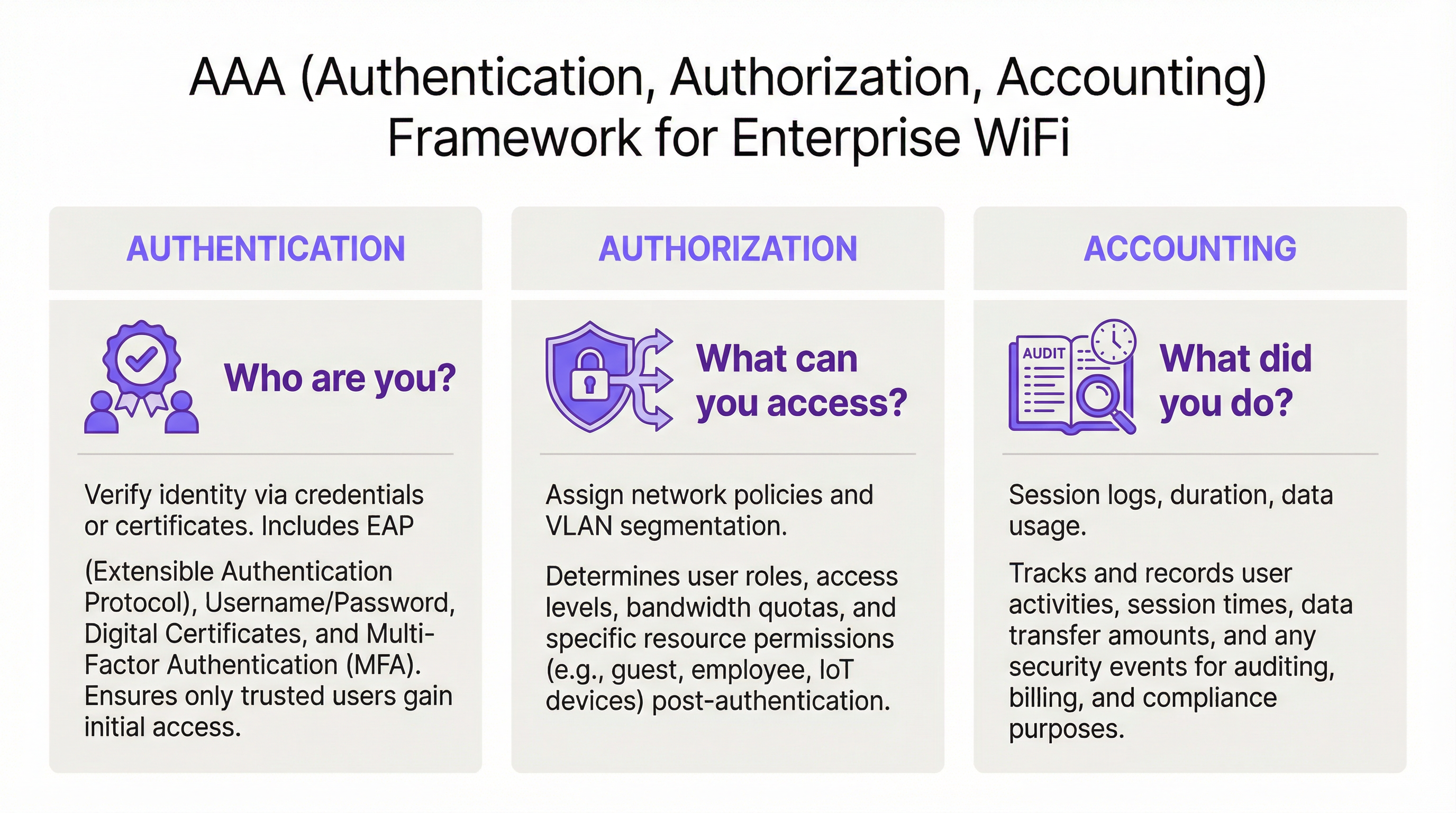
AAA फ्रेमवर्क: ऑथेंटिकेशन, ऑथोरायझेशन आणि अकाउंटिंग
RADIUS क्लायंट-सर्व्हर मॉडेलवर काम करते आणि नेटवर्क सुरक्षेतील मूलभूत संकल्पना असलेल्या AAA फ्रेमवर्कभोवती तयार केले गेले आहे. यशस्वी डिप्लॉयमेंटसाठी प्रत्येक घटक समजून घेणे आवश्यक आहे.
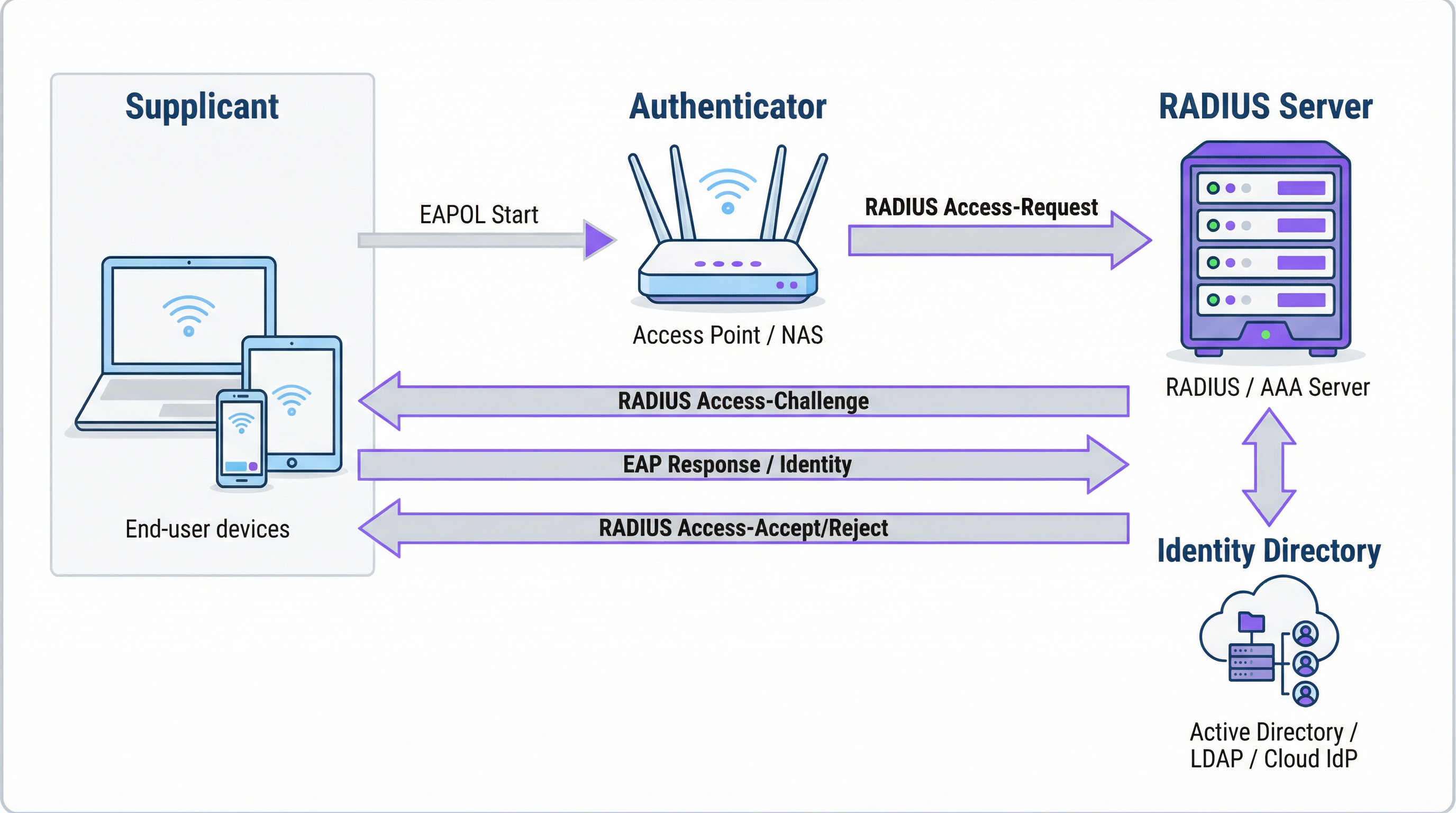
ऑथेंटिकेशन (Authentication) ही युजरची ओळख पडताळण्याची प्रक्रिया आहे. जेव्हा एखादा युजर WPA2/WPA3-Enterprise ने सुरक्षित असलेल्या WiFi नेटवर्कशी कनेक्ट करण्याचा प्रयत्न करतो, तेव्हा त्याचे डिव्हाइस — सप्लिकंट (Supplicant) — वायरलेस ॲक्सेस पॉईंटला — ऑथेंटिकेटर (Authenticator) — क्रेडेंशियल्स पाठवते. ऑथेंटिकेटर स्वतः ॲक्सेसचा निर्णय घेत नाही; तो ही विनंती RADIUS सर्व्हर कडे फॉरवर्ड करतो. RADIUS सर्व्हर कॉन्फिगर केलेल्या आयडेंटिटी सोर्स (जसे की Microsoft Active Directory, Okta सारखे क्लाउड IdP किंवा स्थानिक युजर डेटाबेस) विरुद्ध या क्रेडेंशियल्सची पडताळणी करतो. पडताळणीसाठी युजरनेम आणि पासवर्ड कॉम्बिनेशन वापरले जाऊ शकते किंवा अधिक मजबूत सुरक्षेसाठी EAP-TLS सारख्या EAP पद्धतीद्वारे डिजिटल सर्टिफिकेट वापरले जाऊ शकते.
ऑथोरायझेशन (Authorization) हे ठरवते की ऑथेंटिकेट झालेल्या युजरला काय करण्याची परवानगी आहे. नेटवर्क ॲडमिनिस्ट्रेटरने परिभाषित केलेल्या धोरणांवर (policies) आधारित, RADIUS सर्व्हर ऑथेंटिकेटरला विशिष्ट ॲट्रिब्यूट्स परत करतो. हे ॲट्रिब्यूट्स VLAN असाइनमेंट (अतिथी ट्रॅफिकला कॉर्पोरेट ट्रॅफिकपासून वेगळे करणे), बँडविड्थ मर्यादा आणि वेळेनुसार ॲक्सेसवरील निर्बंध ठरवतात. हे सूक्ष्म (granular) आणि डायनॅमिक पॉलिसी एन्फोर्समेंट हे स्टॅटिक PSK-आधारित सिस्टीम्सच्या तुलनेत RADIUS च्या मुख्य फायद्यांपैकी एक आहे.
अकाउंटिंग (Accounting) संपूर्ण सेशनमध्ये युजरच्या ॲक्टिव्हिटीचा मागोवा घेते. RADIUS सर्व्हर कनेक्शनचे टाइमस्टॅम्प्स, सेशनचा कालावधी, ट्रान्सफर केलेला डेटा आणि डिव्हाइसचे MAC ॲड्रेसेस लॉग करतो. हा ऑडिट ट्रेल ट्रबलशूटिंग, कपॅसिटी प्लॅनिंग आणि कंप्लायन्स रिपोर्टिंगसाठी अत्यंत मौल्यवान आहे. PCI DSS 4.0 अंतर्गत, नेटवर्क रिसोर्सेसच्या सर्व ॲक्सेसचे लॉगिंग आणि मॉनिटरिंग करणे हे एक अनिवार्य नियंत्रण (mandatory control) आहे.
RADIUS आणि 802.1X एकत्र कसे काम करतात
IEEE 802.1X स्टँडर्ड पोर्ट-आधारित नेटवर्क ॲक्सेस कंट्रोल परिभाषित करते. WiFi च्या संदर्भात, जोपर्यंत RADIUS सर्व्हर ऑथोरायझेशनची पुष्टी करत नाही, तोपर्यंत 802.1X ॲक्सेस पॉईंटला डिव्हाइसवरील सर्व ट्रॅफिक (ऑथेंटिकेशन मेसेजेस वगळता) ब्लॉक करण्यास सक्षम करते. सप्लिकंट आणि ऑथेंटिकेटर मधील संवाद Extensible Authentication Protocol (EAP) वापरतो, जो LAN वर EAPOL (EAP over LAN) म्हणून वाहून नेला जातो. त्यानंतर ऑथेंटिकेटर RADIUS प्रोटोकॉल वापरून हे RADIUS सर्व्हरकडे रिले करतो.
EAP पद्धतीची निवड हा एक अत्यंत महत्त्वाचा सुरक्षा निर्णय आहे:
| EAP पद्धत (EAP Method) | ऑथेंटिकेशन प्रकार (Authentication Type) | सुरक्षा पातळी (Security Level) | शिफारस केलेला युज केस (Recommended Use Case) |
|---|---|---|---|
| EAP-TLS | प्रमाणपत्र-आधारित (Certificate-based) | सर्वोच्च (Highest) | कॉर्पोरेट मॅनेज्ड डिव्हाइसेस — गोल्ड स्टँडर्ड |
| PEAP-MSCHAPv2 | क्रेडेंशियल-आधारित (Credential-based) | मध्यम (Medium) | प्रमाणपत्रांकडे (certificates) वळणारे विंडोज-हेवी एन्व्हायर्नमेंट्स |
| EAP-TTLS/PAP | क्रेडेंशियल-आधारित (Credential-based) | मध्यम (Medium) | लेगसी डिव्हाइस सपोर्टसह मिक्स्ड-OS एन्व्हायर्नमेंट्स |
कॉर्पोरेट डिव्हाइसेससाठी, EAP-TLS ही टार्गेट स्टेट आहे. हे म्युच्युअल सर्टिफिकेट ऑथेंटिकेशन वापरते — क्लायंट आणि सर्व्हर दोन्ही प्रमाणपत्रे (certificates) सादर करतात — ज्यामुळे पासवर्ड्स आणि क्रेडेंशियल चोरी तसेच फिशिंगचे संबंधित धोके पूर्णपणे दूर होतात.
RADIUS पोर्ट्स आणि ट्रान्सपोर्ट
बाय डिफॉल्ट, RADIUS ऑथेंटिकेशन आणि ऑथोरायझेशनसाठी UDP पोर्ट 1812 आणि अकाउंटिंगसाठी UDP पोर्ट 1813 वापरते. काही लेगसी डिप्लॉयमेंट्स 1645 आणि 1646 पोर्ट्स वापरतात. RFC 6613 पासून, RADIUS TLS (RadSec) सह TCP वर देखील काम करू शकते, ज्याचा वापर वर्धित ट्रान्सपोर्ट सुरक्षेसाठी क्लाउड डिप्लॉयमेंट्समध्ये वाढत्या प्रमाणात केला जात आहे.
अंमलबजावणी मार्गदर्शक (Implementation Guide)
PSK कडून RADIUS कडे वळणे: पाच-टप्प्यांचा रोडमॅप
पायरी 1: तुमचे RADIUS इन्फ्रास्ट्रक्चर निवडा. ऑन-प्रिमाइस सर्व्हर (विंडोज एन्व्हायर्नमेंट्ससाठी Microsoft NPS, ओपन-सोर्स डिप्लॉयमेंट्ससाठी FreeRADIUS) किंवा क्लाउड-आधारित RADIUS सेवा यापैकी एक निवडा. मल्टी-साइट संस्थांसाठी, Purple सारखे क्लाउड RADIUS प्लॅटफॉर्म ही जवळजवळ नेहमीच योग्य निवड असते. हे अंगभूत उच्च उपलब्धता (high availability), भौगोलिक रिडंडन्सी (geographic redundancy) प्रदान करते आणि सर्व्हर व्यवस्थापनाचा ऑपरेशनल भार दूर करते.
पायरी 2: तुमचा आयडेंटिटी सोर्स इंटिग्रेट करा. RADIUS सर्व्हरला तुमच्या संस्थेच्या अधिकृत आयडेंटिटी डिरेक्टरीशी कनेक्ट करा. आधुनिक क्लाउड RADIUS प्लॅटफॉर्म्स SAML किंवा LDAP द्वारे Azure AD, Google Workspace आणि Okta सोबत थेट इंटिग्रेशनला सपोर्ट करतात. अतिथी (guest) युजर्ससाठी, आयडेंटिटी सोर्स सामान्यतः CRM, प्रॉपर्टी मॅनेजमेंट सिस्टीम (PMS) किंवा खास तयार केलेले गेस्ट WiFi प्लॅटफॉर्म असते.
पायरी 3: नेटवर्क हार्डवेअर कॉन्फिगर करा. तुमच्या वायरलेस LAN कंट्रोलर किंवा ॲक्सेस पॉईंट्सवर, WPA2-Enterprise किंवा WPA3-Enterprise साठी कॉन्फिगर केलेले एक नवीन SSID तयार करा. SSID ला तुमच्या RADIUS सर्व्हरच्या IP ॲड्रेसवर पॉईंट करा आणि शेअर्ड सिक्रेट (shared secret) कॉन्फिगर करा — हा एक पासवर्ड आहे जो ॲक्सेस पॉईंट आणि RADIUS सर्व्हरमधील संवादाला एन्क्रिप्ट करतो. हे मूल्य दोन्ही बाजूंनी तंतोतंत जुळले पाहिजे; विसंगती (mismatch) हे सुरुवातीच्या डिप्लॉयमेंटमधील अपयशाच्या सर्वात सामान्य कारणांपैकी एक आहे.
पायरी 4: ऑथोरायझेशन पॉलिसीज परिभाषित करा. युजर ग्रुप्सना नेटवर्क पॉलिसीजशी मॅप करणारे नियम RADIUS सर्व्हरवर तयार करा. हॉटेलसाठीच्या ठराविक पॉलिसी सेटमध्ये हे समाविष्ट असू शकते: पूर्ण अंतर्गत ॲक्सेससह VLAN 10 वर कर्मचारी (Staff); मर्यादित ॲक्सेस आणि 50 Mbps बँडविड्थ कॅपसह VLAN 30 वर कंत्राटदार (Contractors); केवळ इंटरनेट ॲक्सेस आणि 8-तासांच्या सेशन मर्यादेसह VLAN 20 वर अतिथी (Guests).
पायरी 5: युजर्स आणि डिव्हाइसेस ऑनबोर्ड करा. कॉर्पोरेट कर्मचाऱ्यांसाठी, तुमच्या MDM प्लॅटफॉर्मद्वारे 802.1X सेटिंग्जसह WiFi प्रोफाइल्स डिप्लॉय करा. अतिथींसाठी, Captive Portal डिप्लॉय करा. Purple चे प्लॅटफॉर्म गेस्ट ऑनबोर्डिंग फ्लो स्वयंचलित करते — सोशल मीडिया लॉगिन्स, रजिस्ट्रेशन फॉर्म्स आणि व्हाउचर कोड्सना सपोर्ट करते — आणि तात्पुरती RADIUS युजर अकाउंट्स तयार करते जी आपोआप एक्सपायर होतात.

सर्वोत्तम पद्धती (Best Practices)
WPA3-Enterprise चा अवलंब करा. जिथे हार्डवेअर सपोर्ट करते, तिथे WPA3-Enterprise हे WPA2-Enterprise च्या तुलनेत लक्षणीय सुरक्षा सुधारणा प्रदान करते, ज्यामध्ये प्रोटेक्टेड मॅनेजमेंट फ्रेम्स (PMF) आणि 192-बिट सिक्युरिटी मोडद्वारे मजबूत एन्क्रिप्शनचा समावेश आहे. फर्मवेअर अपडेट्स किंवा रिप्लेसमेंटची आवश्यकता असलेले ॲक्सेस पॉईंट्स ओळखण्यासाठी हार्डवेअर ऑडिट करा.
कॉर्पोरेट डिव्हाइसेससाठी EAP-TLS लागू करा. प्रमाणपत्र-आधारित (Certificate-based) ऑथेंटिकेशन पासवर्डची असुरक्षितता दूर करते. तुमचा RADIUS सर्व्हर तुमच्या PKI सोबत इंटिग्रेट करा किंवा क्लाउड-आधारित सर्टिफिकेट मॅनेजमेंट सोल्यूशन वापरा. आयटी ओव्हरहेड कमी करण्यासाठी MDM द्वारे सर्टिफिकेट डिप्लॉयमेंट स्वयंचलित करा.
VLAN सेगमेंटेशन लागू करा. PCI DSS कंप्लायन्स आणि झिरो ट्रस्ट आर्किटेक्चरसाठी RADIUS द्वारे डायनॅमिक VLAN असाइनमेंट अनिवार्य आहे. तुमचे नेटवर्क स्विचेस आणि फायरवॉल्स इंटर-VLAN राउटिंग पॉलिसीज लागू करतात याची खात्री करा, जे गेस्ट ट्रॅफिकला कॉर्पोरेट रिसोर्सेसपर्यंत पोहोचण्यापासून रोखतात.
रिडंडंट RADIUS इन्फ्रास्ट्रक्चर डिप्लॉय करा. तुमच्या ॲक्सेस पॉईंट्सवर किमान एक प्रायमरी आणि सेकंडरी RADIUS सर्व्हर कॉन्फिगर करा. क्लाउड RADIUS प्लॅटफॉर्म्स सामान्यतः हे आपोआप प्रदान करतात. फेलओव्हरची नियमितपणे चाचणी करा.
ट्रबलशूटिंग आणि जोखीम निवारण (Troubleshooting and Risk Mitigation)
| अपयशाचा प्रकार (Failure Mode) | मूळ कारण (Root Cause) | उपाय (Resolution) |
|---|---|---|
| सर्व युजर्स रिजेक्ट झाले | AP आणि RADIUS सर्व्हर दरम्यान शेअर्ड सिक्रेट जुळत नाही | AP आणि RADIUS सर्व्हर कॉन्फिगरेशन दोन्हीवर शेअर्ड सिक्रेटची पडताळणी करा |
| क्लायंट डिव्हाइसेसवर सर्टिफिकेट एरर्स | RADIUS सर्व्हर सर्टिफिकेटवर क्लायंटचा विश्वास नाही | MDM द्वारे सर्व क्लायंट डिव्हाइसेसवर रूट CA सर्टिफिकेट इन्स्टॉल करा |
| अधूनमधून ऑथेंटिकेशन फेल्युअर्स | RADIUS सर्व्हर ओव्हरलोड झाला आहे किंवा अनरिचेबल आहे | सेकंडरी RADIUS सर्व्हर लागू करा; सर्व्हर क्षमतेचे पुनरावलोकन करा |
| गेस्ट पोर्टल रिडायरेक्ट होत नाही | वॉल्ड गार्डन मिसकॉन्फिगरेशन | पोर्टल URL आणि सोशल लॉगिन प्रोव्हायडर डोमेन्स वॉल्ड गार्डनमध्ये असल्याची खात्री करा |
| सेशन एक्सपायर झाल्यानंतर युजर्स पुन्हा कनेक्ट करू शकत नाहीत | अकाउंटिंग सेशन योग्यरित्या टर्मिनेट झाले नाही | RADIUS अकाउंटिंग कॉन्फिगरेशनचे पुनरावलोकन करा; स्टेल सेशन्स तपासा |
ROI आणि व्यावसायिक प्रभाव (ROI and Business Impact)
RADIUS डिप्लॉयमेंटसाठीचा बिझनेस केस अनेक आयामांवर प्रभावी आहे. सुरक्षा धोके कमी करणे (Security risk reduction) हा सर्वात तात्काळ फायदा आहे: शेअर्ड PSK च्या जागी ओळख-आधारित (identity-based) ॲक्सेस वापरल्याने WiFi-आधारित नेटवर्क घुसखोरीचा सर्वात सामान्य मार्ग दूर होतो, ज्यामुळे यूके मधील व्यवसायांसाठी सरासरी £3.4 दशलक्ष इतका असणारा ब्रीच खर्च संभाव्यतः टाळता येतो. PCI DSS, GDPR आणि क्षेत्र-विशिष्ट नियमांतर्गत अनुपालन हमी (Compliance assurance) ओळख-आधारित ॲक्सेस कंट्रोल आणि सर्वसमावेशक अकाउंटिंग लॉग्सच्या संयोजनाद्वारे प्राप्त केली जाते. मोठ्या डिप्लॉयमेंट्समध्ये ऑपरेशनल कार्यक्षमता (Operational efficiency) लक्षणीयरीत्या वाढते — केंद्रीकृत पॉलिसी मॅनेजमेंटचा अर्थ असा आहे की नवीन युजरला ऑनबोर्ड करणे किंवा सोडून जाणाऱ्या कर्मचाऱ्याचा ॲक्सेस काढून घेणे ही आयडेंटिटी डिरेक्टरीमधील एकच कृती असते, डझनभर ॲक्सेस पॉईंट्सवर मॅन्युअल रीकॉन्फिगरेशन करण्याची गरज नसते. शेवटी, RADIUS द्वारे व्युत्पन्न केलेला अकाउंटिंग डेटा कपॅसिटी प्लॅनिंगसाठी कृतीयोग्य बुद्धिमत्ता (actionable intelligence) प्रदान करतो, ज्यामुळे इन्फ्रास्ट्रक्चर गुंतवणुकीचे निर्णय अंदाजांऐवजी प्रत्यक्ष वापराच्या डेटावर आधारित घेता येतात.
महत्त्वाच्या संज्ञा आणि व्याख्या
RADIUS (Remote Authentication Dial-In User Service)
A networking protocol, standardised in RFC 2865, that provides centralised Authentication, Authorization, and Accounting (AAA) management for users connecting to a network service. It operates on a client-server model, where the Network Access Server (NAS) is the client and the RADIUS server is the decision-making authority.
This is the core engine of enterprise WiFi security. When an IT manager talks about 'moving to 802.1X', they are almost always talking about deploying a RADIUS server.
802.1X
An IEEE standard for port-based Network Access Control (PNAC). It defines the encapsulation of the Extensible Authentication Protocol (EAP) over IEEE 802 networks, enabling an authenticator (e.g., a WiFi access point) to enforce authentication before granting network access.
This is the standard that makes RADIUS work for WiFi. When configuring an SSID for 'WPA2-Enterprise', you are enabling 802.1X on that SSID.
AAA (Authentication, Authorization, Accounting)
A security framework for intelligently controlling access to computer resources, enforcing policies, and auditing usage. Authentication verifies identity, Authorization determines permitted actions, and Accounting records activity.
RADIUS servers are often called 'AAA servers'. Understanding this framework is the conceptual foundation for all network access control design.
Supplicant
In the 802.1X framework, the Supplicant is the client device — a laptop, smartphone, or IoT device — that is requesting access to the network. The supplicant software on the device handles the EAP authentication exchange.
When troubleshooting authentication failures, the supplicant configuration (e.g., the WiFi profile on a laptop) is often the source of the problem.
Authenticator
In the 802.1X framework, the Authenticator is the network device — typically a wireless access point or an Ethernet switch — that enforces access control. It relays EAP messages between the Supplicant and the Authentication Server but does not make the authentication decision itself.
The access point is a relay, not a decision-maker. This is a critical distinction: the AP's job is to forward the request to RADIUS and then act on the response.
EAP (Extensible Authentication Protocol)
An authentication framework defined in RFC 3748 that supports multiple authentication methods. EAP itself does not define a specific authentication mechanism; instead, it provides a standard format for negotiating and carrying various EAP methods (e.g., EAP-TLS, PEAP, EAP-TTLS).
When configuring 802.1X, you must choose an EAP method. The choice between EAP-TLS (certificates) and PEAP (passwords) is one of the most consequential security decisions in a WiFi deployment.
EAP-TLS (EAP Transport Layer Security)
A certificate-based EAP method that provides mutual authentication between the client and the RADIUS server using X.509 digital certificates. It is widely regarded as the most secure EAP method, as it eliminates passwords entirely.
EAP-TLS is the gold standard for corporate device authentication. Deploying it requires a Public Key Infrastructure (PKI) to issue and manage client certificates, which is why cloud-based certificate management solutions are increasingly popular.
Captive Portal
A web page that intercepts a user's connection to a public WiFi network, requiring them to complete an action — such as accepting terms of service, entering credentials, or authenticating via a social media account — before internet access is granted.
Captive portals work in conjunction with RADIUS for guest WiFi. The portal is the user-facing interface; RADIUS is the back-end authentication engine that validates the user's session and enforces access policies.
VLAN (Virtual Local Area Network)
A logical network segment created within a physical network infrastructure. VLANs allow network administrators to segregate traffic from different user groups — such as guests, staff, and IoT devices — even when they share the same physical hardware.
Dynamic VLAN assignment via RADIUS is the mechanism that enables network segmentation in enterprise WiFi. It is a fundamental requirement for PCI DSS compliance and Zero Trust architecture.
Shared Secret
A password configured on both the RADIUS client (the access point) and the RADIUS server to authenticate their communication and encrypt RADIUS attribute values. It must be identical on both sides.
A shared secret mismatch is one of the most common causes of RADIUS authentication failures during initial deployment. Always copy-paste rather than manually type this value.
केस स्टडीज
A 500-room hotel needs to provide secure WiFi for guests, conference attendees, and staff. Guests should have a frictionless onboarding experience, while staff require secure access to internal property management and point-of-sale systems. The hotel uses Oracle OPERA as its Property Management System (PMS).
Deploy Purple's cloud RADIUS platform integrated with the hotel's Oracle OPERA PMS. Provision three separate SSIDs: 'Hotel-Guest', 'Conference-WiFi', and 'Staff-Internal'. The 'Staff-Internal' SSID is configured for WPA3-Enterprise with EAP-TLS. Digital certificates are deployed to all hotel-owned devices via an MDM platform (e.g., Jamf or Microsoft Intune), enabling passwordless, seamless authentication for staff. The 'Hotel-Guest' SSID uses a branded captive portal integrated with OPERA. At check-in, OPERA automatically creates a temporary RADIUS user account with credentials valid for the duration of the guest's stay. The guest receives a QR code or a welcome email with a direct connection link. The 'Conference-WiFi' SSID uses a voucher-based system within Purple's platform, allowing event coordinators to generate unique, time-limited access codes for their attendees. All three SSIDs use dynamic VLAN assignment to enforce strict traffic segmentation.
A retail chain with 200 stores across the UK wants to replace its insecure, shared-password guest WiFi network. The marketing team requires opt-in demographic data from store visitors to support targeted campaigns. The IT team uses Azure Active Directory for all corporate identity management.
Deploy Purple's cloud RADIUS and guest WiFi platform across all 200 stores using a centralised, templated configuration. For guest access, configure a branded captive portal on a dedicated guest SSID. The portal offers authentication via social media accounts (Facebook, Google) or a simple registration form, capturing opt-in marketing consent in compliance with GDPR. Purple's platform aggregates this data into a centralised analytics dashboard, providing the marketing team with visitor demographics, dwell times, and repeat visit rates. For corporate staff, integrate the RADIUS server with the existing Azure AD tenant. Staff connect to a separate 'Staff' SSID using their Azure AD credentials via PEAP, with a phased migration plan to EAP-TLS with certificates for the highest-risk roles. All guest traffic is isolated on a dedicated VLAN with no access to the store's internal network or EPOS systems, meeting PCI DSS network segmentation requirements.
परिस्थिती विश्लेषण
Q1. You are the IT architect for a large conference centre. A major technology company is renting your venue for a three-day conference with 5,000 attendees. The client has a hard requirement that attendees can connect to a secure, high-performance WiFi network without manually entering a password each day. The client uses Okta as their identity provider. How would you design the authentication solution?
💡 संकेत:Consider how to provide a seamless, passwordless experience for a large number of users from a single external organisation. Think about certificate-based authentication and how to integrate with a third-party identity provider for a time-limited event.
शिफारस केलेला दृष्टिकोन दाखवा
The optimal solution is to provision a dedicated SSID for the conference configured for WPA3-Enterprise with EAP-TLS. Integrate your cloud RADIUS platform with the client's Okta tenant via SAML federation for the duration of the event. Before the conference opens, attendees are directed to a one-time onboarding portal where they authenticate with their Okta credentials. Upon successful authentication, a unique digital certificate is generated and installed on their device. For the remainder of the conference, their device automatically and securely connects to the SSID without any further user interaction. The certificates are issued with a validity period matching the conference duration and are automatically revoked at close. This delivers a seamless, passwordless experience while maintaining strong security, and it leverages the client's existing identity infrastructure rather than creating a separate credential system.
Q2. A private hospital needs to provide WiFi for patients and visitors, but must ensure this traffic is completely isolated from the network used for clinical systems, electronic health records, and medical devices, to comply with HIPAA and NHS DSP Toolkit requirements. What RADIUS feature is most critical to achieving this isolation, and how would you configure it?
💡 संकेत:Focus on the Authorization pillar of the AAA framework. The key is not just authenticating users, but controlling what they can reach after authentication. Consider how RADIUS communicates network policy to the access point.
शिफारस केलेला दृष्टिकोन दाखवा
The most critical feature is dynamic VLAN assignment via RADIUS authorization policies. You would create a dedicated 'Patient-Guest' VLAN (e.g., VLAN 50) on the network infrastructure, configured with firewall rules that permit only internet access and explicitly deny all traffic to the clinical network VLANs. On the RADIUS server, create an authorization policy that assigns any user authenticating to the patient WiFi SSID to VLAN 50, regardless of their credentials. The RADIUS server communicates this assignment to the access point via the Tunnel-Type, Tunnel-Medium-Type, and Tunnel-Private-Group-ID attributes in the Access-Accept message. The access point then places the user's traffic into VLAN 50 at the point of connection. This ensures that even if a patient's device is compromised, it has no network path to clinical systems — a fundamental requirement for HIPAA compliance and clinical network security.
Q3. Your organisation has deployed 802.1X with RADIUS across its corporate estate. An employee reports that they cannot connect to the corporate WiFi from their new laptop, but they can connect successfully from their smartphone and from their previous laptop. The IT helpdesk has confirmed the employee's account is active in Azure AD. What is your diagnostic approach, and what are the three most likely root causes?
💡 संकेत:The issue is device-specific, not user-specific — the user can authenticate from other devices. This narrows the problem to the device configuration, the device's certificate, or the device's supplicant settings. Start with the RADIUS server logs.
शिफारस केलेला दृष्टिकोन दाखवा
The diagnostic approach is to first examine the RADIUS server's authentication logs for Access-Reject messages corresponding to the MAC address of the new laptop. The rejection reason code will identify the root cause. The three most likely causes are: (1) Missing or invalid client certificate — if the deployment uses EAP-TLS, the new laptop may not yet have had a certificate provisioned via MDM. Check whether the device is enrolled in the MDM platform and whether the certificate deployment policy has been applied. (2) Incorrect WiFi profile — the new laptop may have the wrong 802.1X supplicant settings, such as the wrong EAP method, an incorrect RADIUS server certificate trust configuration, or the wrong username format. Verify the WiFi profile matches the standard corporate template. (3) Device not yet registered in the identity directory — some RADIUS policies perform a device compliance check against Azure AD. If the new laptop has not yet completed Azure AD join and device registration, it may fail this check even though the user's account is active.
महत्त्वाचे निष्कर्ष
- ✓RADIUS is the industry-standard protocol for centralised network access control, implementing the AAA (Authentication, Authorization, Accounting) framework to manage who can access your WiFi, what they can do, and to log all activity.
- ✓It replaces insecure pre-shared keys (PSKs) with robust, identity-based authentication, ensuring every user and device has a unique, verifiable identity on the network.
- ✓IEEE 802.1X is the standard that enables RADIUS to work with WiFi access points, blocking all network traffic from a device until the RADIUS server has confirmed authorisation.
- ✓EAP-TLS (certificate-based authentication) is the gold standard for corporate devices, eliminating passwords entirely and providing the strongest protection against credential theft and phishing.
- ✓Dynamic VLAN assignment via RADIUS authorization policies is the mechanism that enforces network segmentation — a mandatory control for PCI DSS compliance and a cornerstone of Zero Trust architecture.
- ✓For guest WiFi, RADIUS works in conjunction with a captive portal: the portal handles the user-facing onboarding experience, while RADIUS manages the back-end authentication and session policy enforcement.
- ✓Cloud-based RADIUS platforms such as Purple simplify deployment, provide built-in high availability, and integrate directly with modern identity providers (Azure AD, Google Workspace, Okta), making enterprise-grade network access control accessible for organisations of all sizes.




