

Conformidade com o GDPR na Recolha de Dados de WiFi para Convidados
This guide provides IT managers, network architects, and Data Protection Officers with a comprehensive, actionable framework for achieving GDPR compliance across guest WiFi deployments in hospitality, retail, and public-sector venues. It covers the full spectrum of data collected by guest WiFi networks, the legal requirements for obtaining valid consent, best-practice data retention policies, and how to implement a defensible compliance architecture. Venue operators will learn how to transform their guest WiFi from a potential regulatory liability into a strategic asset that builds customer trust and drives measurable business intelligence.
🎧 Ouça este Guia
Ver Transcrição
Resumo Executivo
Este guia fornece aos gestores de TI, arquitetos de redes e operadores de espaços uma estrutura prática e acionável para garantir que os seus serviços de WiFi para convidados estão em total conformidade com o Regulamento Geral sobre a Proteção de Dados (GDPR). Exploraremos os tipos específicos de dados recolhidos através do WiFi para convidados, os requisitos legais para o consentimento e tratamento de dados, e as melhores práticas independentes de fornecedores para implementar uma solução em conformidade. Para o Diretor de Tecnologia (CTO) e o Encarregado da Proteção de Dados (DPO), este documento descreve como mitigar os riscos legais e financeiros associados ao incumprimento, que podem incluir multas de até 4% da faturação global anual. Para o Diretor de Operações, demonstra como uma implementação de WiFi para convidados em conformidade pode aumentar a confiança dos clientes e fornecer inteligência de negócio valiosa e obtida de forma ética. Abordaremos a arquitetura técnica de um sistema em conformidade, desde o design do Captive Portal até à automatização das políticas de retenção de dados. O guia inclui também estudos de caso reais dos setores da hotelaria e retalho, demonstrando o ROI tangível de uma plataforma de WiFi para convidados bem arquitetada e em conformidade, como a Purple. Ao seguir os princípios deste guia, as organizações podem transformar o seu WiFi para convidados, passando de um potencial risco de conformidade para um ativo estratégico que impulsiona o crescimento do negócio, respeitando a privacidade dos utilizadores.

Análise Técnica Aprofundada
Compreender a conformidade com o GDPR para o WiFi para convidados começa com uma avaliação clara dos dados a serem processados. Ao abrigo do regulamento, os 'dados pessoais' são definidos de forma ampla como qualquer informação relativa a uma pessoa singular identificada ou identificável. No contexto de uma rede WiFi para convidados, isto engloba uma gama mais vasta de pontos de dados do que muitas organizações assumem. A falha na classificação correta destes dados é um erro basilar na estratégia de conformidade.
Categorias de Dados no WiFi para Convidados
Os dados recolhidos através de uma rede WiFi para convidados podem ser segmentados em quatro categorias principais. Cada uma tem implicações distintas para a conformidade com o GDPR, particularmente no que diz respeito à base legal para o processamento e ao período de retenção exigido.
| Categoria de Dados | Exemplos | Base Legal Principal | Principal Consideração de Conformidade |
|---|---|---|---|
| Dados de Registo | Nome, endereço de e-mail, número de telefone, dados de perfil de redes sociais | Consentimento | Deve ser dado de forma livre, específica, informada e inequívoca. Os dados recolhidos devem ser minimizados. |
| Dados de Dispositivo e Sessão | Endereço MAC, endereço IP, tipo de dispositivo, browser, carimbos de data/hora de ligação/desligamento, utilização de dados | Interesse Legítimo / Consentimento | A transparência é fundamental. Os utilizadores devem ser informados desta recolha. A anonimização deve ser utilizada sempre que possível. |
| Dados de Localização | Localização do dispositivo em tempo real, padrões de tráfego (footfall), tempos de permanência, mapas de calor | Consentimento Explícito | Processamento de alto risco. Requer um opt-in claro e específico. O propósito deve ser claramente articulado (ex.: 'para melhorar o layout da loja'). |
| Dados de Utilização e Navegação | Websites visitados, aplicações utilizadas (menos comum) | Consentimento Explícito | Risco extremamente elevado e raramente justificável. Deve ser evitado, a menos que exista um propósito crítico, explícito e consentido. |
A Base Legal: Consentimento vs. Interesse Legítimo
Embora o Interesse Legítimo possa ser argumentado para o processamento de dados básicos de sessão necessários para a segurança da rede e monitorização de desempenho (ex.: conforme o considerando 49 do GDPR), o ICO e outras autoridades de proteção de dados da UE estabeleceram um padrão elevado. Para quaisquer dados utilizados para marketing, análise ou criação de perfis de utilizadores, o Consentimento é a única base legal apropriada.
Segundo o ICO, "Deve certificar-se de que pode demonstrar que o consentimento foi dado de forma livre, específica e informada, e que foi uma indicação inequívoca da vontade do indivíduo."
Isto exige uma mudança da aceitação passiva de termos para um mecanismo de consentimento ativo e granular. A arquitetura do seu Captive Portal não é, portanto, apenas uma consideração técnica, mas também legal.
Componentes Arquitetónicos para a Conformidade
Uma arquitetura de WiFi para convidados em conformidade com o GDPR baseia-se no princípio da Privacidade desde a Conceção e por Defeito (Privacy by Design and by Default). Isto significa que a proteção de dados não é um complemento, mas sim uma componente central do design do sistema.
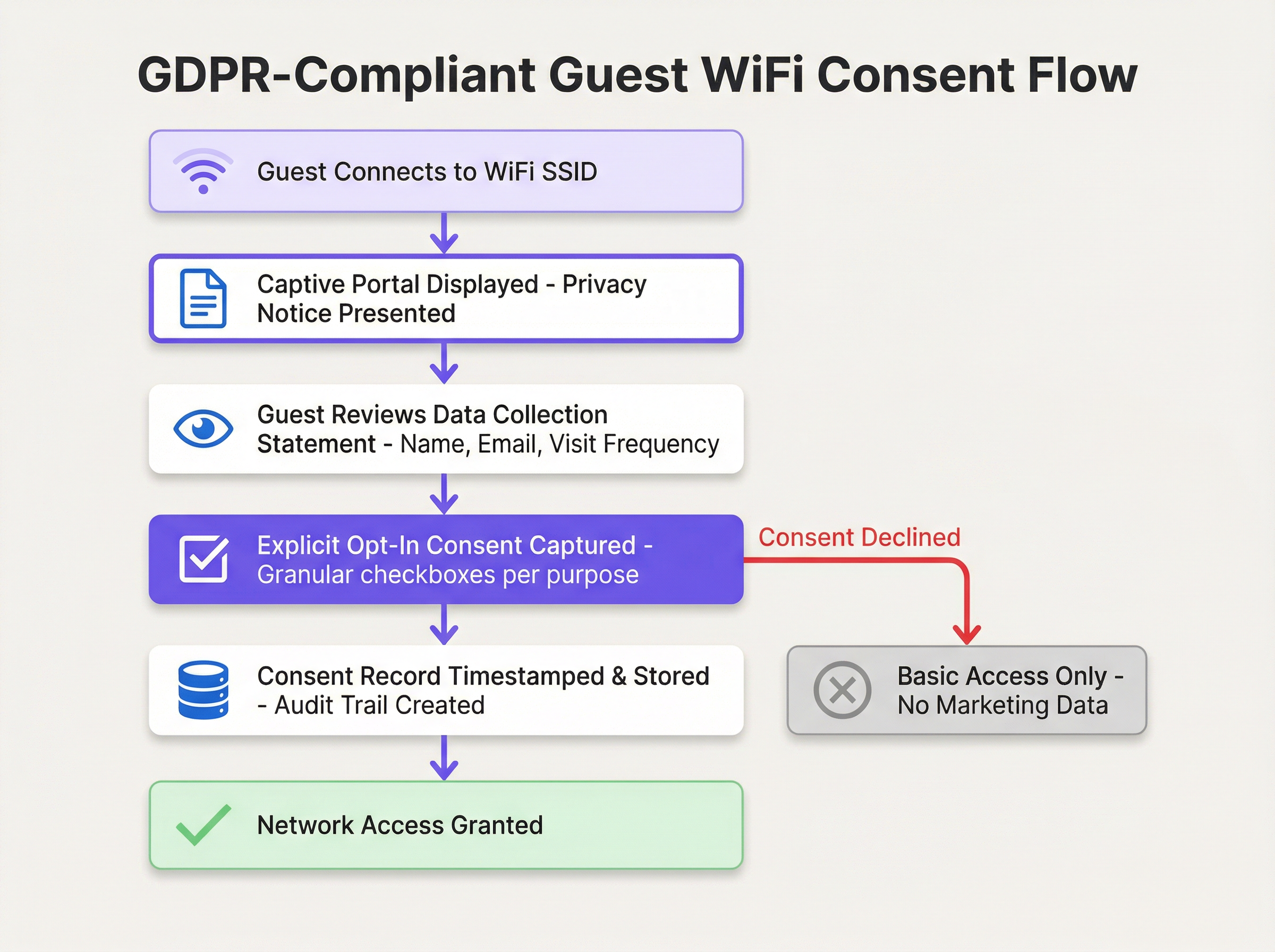
- Base de Rede Segura (WPA3/802.1X): Antes de qualquer recolha de dados, a própria rede deve ser segura. A utilização do WPA3 é o padrão atual da indústria, fornecendo uma proteção robusta contra interceções. Para ambientes empresariais, o IEEE 802.1X oferece controlo de acesso à rede baseado em portas, garantindo que apenas dispositivos autenticados e autorizados se podem ligar.
- O Captive Portal em Conformidade: Esta é a componente mais crítica voltada para o utilizador. Deve apresentar um aviso de privacidade 'just-in-time' antes de o utilizador introduzir qualquer informação, incluir um link para uma política de privacidade completa e acessível, utilizar caixas de verificação granulares não selecionadas para cada finalidade de processamento e funcionar sobre HTTPS para evitar ataques man-in-the-middle.
- Plataforma de Gestão de Consentimento (CMP): Nos bastidores, é necessária uma CMP robusta para registar cada ação de consentimento com uma pista de auditoria imutável, gerir o ciclo de vida do consentimento, incluindo a sua revogação, e integrar-se com um fluxo de trabalho de DSAR (Pedido de Acesso do Titular dos Dados) para facilitar a pesquisa, exportação ou eliminação fácil dos dados de um utilizador específico.
Guia de Implementação
A implementação de uma solução de WiFi para convidados em conformidade com o GDPR requer uma abordagem estruturada, passando da definição de políticas para a configuração técnica.
Fase 1: Definição de Políticas e Requisitos (Semanas 1-2)
Antes de implementar qualquer hardware ou software, a sua organização deve definir as suas políticas. Convoque um workshop de stakeholders com representantes das TI, Departamento Jurídico, Marketing e Operações para acordar o propósito do WiFi para convidados. Realize uma Avaliação de Minimização de Dados, documentando a justificação de negócio específica para cada ponto de dados solicitado. Defina e documente o período de retenção para cada categoria de dados, e selecione e documente formalmente a base legal para cada atividade de processamento.
Fase 2: Design da Solução Técnica e Seleção de Fornecedores (Semanas 3-4)
Com uma política clara em vigor, avalie a sua infraestrutura de rede atual quanto à capacidade de WPA3 e segmentação de VLAN. Avalie os fornecedores de Captive Portal e CMP com base em critérios que incluem design de portal personalizável, registos de auditoria de consentimento robustos e pesquisáveis, ferramentas de automatização de DSAR, regras automatizadas de retenção de dados e capacidades de integração com CRM.
Fase 3: Implementação e Testes (Semanas 5-6)
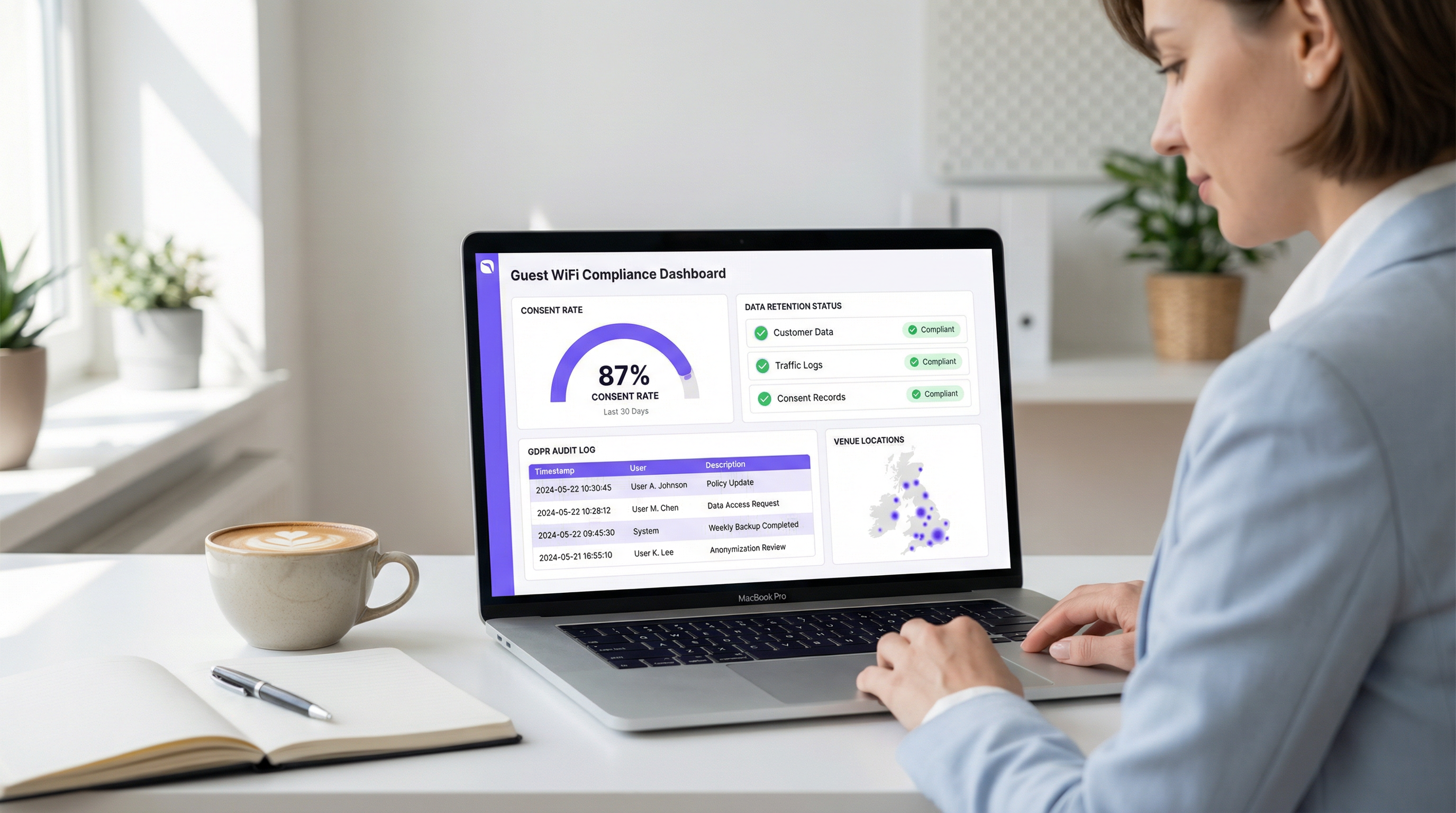
Implemente primeiro a solução num ambiente de staging. Configure o Captive Portal com o texto finalizado e caixas de consentimento não selecionadas, defina as regras de retenção de dados e implemente o controlo de acesso baseado em funções (RBAC). Realize testes de ponta a ponta de toda a jornada do utilizador, incluindo a aceitação do consentimento, recusa do consentimento, submissão de DSAR e eliminação automatizada de dados.
Fase 4: Lançamento em Produção e Formação de Pessoal (Semanas 7-8)
Lance a solução de forma faseada nos vários espaços. Dê formação ao helpdesk de TI e ao pessoal de atendimento ao público para responderem a questões básicas dos utilizadores e encaminharem questões específicas de privacidade para o Encarregado da Proteção de Dados. Certifique-se de que todas as configurações e processos estão devidamente documentados.
Melhores Práticas
Para além da implementação técnica, a adesão às melhores práticas padrão da indústria é crucial para manter a conformidade com o GDPR a longo prazo e construir confiança com os seus utilizadores.
Princípio do Menor Privilégio: Conceda acesso a dados pessoais numa base estrita de necessidade de conhecimento, utilizando o controlo de acesso baseado em funções (RBAC). As equipas de marketing não devem ter acesso aos registos de segurança da rede, e vice-versa.
Auditorias Regulares e Testes de Intrusão: Agende auditorias anuais que abranjam a revisão dos registos de consentimento, a verificação da política de retenção e os testes do processo de DSAR. Contrate terceiros para a realização de testes de intrusão ao Captive Portal e à infraestrutura WiFi.
Transparência para o Utilizador: Implemente um aviso de privacidade em camadas no Captive Portal, forneça um centro de preferências self-service para os utilizadores gerirem os seus dados e complemente os esforços digitais com sinalética clara no local do seu espaço.
Anonimização e Pseudonimização de Dados: Empregue técnicas de anonimização ou pseudonimização o mais cedo possível no ciclo de vida dos dados. Para efeitos de análise, armazene um hash unidirecional do endereço MAC em vez do identificador em bruto, e utilize identificadores pseudonimizados na sua base de dados de análise para reduzir o âmbito de conformidade.
Resolução de Problemas e Mitigação de Riscos
Mesmo com um sistema bem concebido, podem surgir problemas operacionais e riscos de conformidade. Identificar e planear proativamente estes cenários é a marca de um programa de governação de dados maduro.
| Modo de Falha | Impacto | Mitigação e Solução |
|---|---|---|
| Incompatibilidade no Registo de Consentimento | Elevado. A incapacidade de provar o consentimento pode levar a multas regulamentares. | Implemente uma CMP com um registo de auditoria imutável e com carimbo de data/hora. Remova imediatamente o utilizador das listas de marketing em caso de disputa. |
| Falha na Retenção de Dados | Médio a Elevado. Violação técnica da política, crítica se for recebido um DSAR de eliminação. | Implemente monitorização e alertas robustos para todas as tarefas de purga de dados. Acione a purga manualmente e realize uma análise pós-incidente (post-mortem). |
| Contorno do Captive Portal | Baixo a Médio. Risco de acesso não autorizado à rede. | Implemente regras rigorosas de firewall bloqueando todo o tráfego de dispositivos não autenticados, exceto DHCP e DNS para o portal. |
| Falha no Processo de DSAR | Elevado. A falha em responder no prazo de um mês viola o Artigo 15 do GDPR. | Crie um alias de e-mail de privacidade dedicado e monitorizado. Realize formação anual obrigatória para o pessoal sobre a identificação e o escalonamento de DSAR. |
Para uma mitigação proativa de riscos, realize uma Avaliação de Impacto sobre a Proteção de Dados (DPIA) antes de implementar ou modificar significativamente um sistema de WiFi para convidados. Efetue uma devida diligência (due diligence) rigorosa aos fornecedores, revendo as certificações de segurança (ISO 27001, SOC 2) e garantindo a existência de uma Adenda de Processamento de Dados robusta. Mantenha um plano de resposta a incidentes documentado que cubra o requisito de notificação de violação no prazo de 72 horas.
ROI e Impacto no Negócio
Uma solução de WiFi para convidados em conformidade com o GDPR não deve ser vista como um centro de custos. Quando implementada corretamente, é um facilitador estratégico que proporciona um ROI mensurável através da mitigação de riscos, do aumento da confiança dos clientes e de inteligência de negócio ética.
As multas do GDPR podem atingir os 20 milhões de euros ou 4% da faturação global anual. Uma plataforma em conformidade com um custo anual de 50.000 € representa uma fração desta potencial responsabilidade. Para além da mitigação de riscos, os dados anonimizados e agregados recolhidos com o consentimento do utilizador fornecem insights poderosos sobre o tráfego (footfall), tempos de permanência, frequência de visitas e padrões demográficos. Uma cadeia de retalho com uma faturação anual de 50 milhões de euros que evite uma multa de 2 milhões de euros e aumente a sua base de dados de marketing consentida em 10.000 utilizadores (com um valor médio por lead de 10 €) alcança um ROI convincente e multidimensional.
Ao enquadrar a discussão em torno da mitigação de riscos, confiança do cliente e tomada de decisões éticas baseadas em dados, os líderes de TI podem demonstrar que uma solução de WiFi para convidados em conformidade com o GDPR não é apenas uma necessidade legal, mas sim um poderoso motor para o crescimento do negócio.
Termos-Chave e Definições
GDPR (General Data Protection Regulation)
The EU's primary data protection law, which came into force on 25 May 2018 and was retained in UK law post-Brexit as the UK GDPR. It governs how organizations collect, process, store, and share personal data of individuals in the UK and EU. Non-compliance can result in fines of up to €20 million or 4% of annual global turnover.
IT teams encounter GDPR as the overarching legal framework governing every aspect of their guest WiFi data collection. It is the source of all consent, retention, and transparency requirements discussed in this guide.
Captive Portal
A web page presented to a user when they first connect to a guest WiFi network, before they are granted full internet access. It is the primary mechanism for presenting privacy notices, capturing consent, and collecting registration data (e.g., name, email). Under GDPR, the design of the captive portal is a critical compliance control.
Network architects and IT managers configure captive portals as part of the guest WiFi deployment. The portal's design — specifically the consent checkboxes and privacy notice — directly determines the organization's GDPR compliance posture.
Data Controller
The organization that determines the purposes and means of processing personal data. When a hotel, retailer, or venue operator deploys guest WiFi and decides what data to collect and why, they become the Data Controller and bear primary responsibility for GDPR compliance.
Venue operators are often surprised to learn they are the Data Controller for their guest WiFi, not their technology vendor. This distinction is critical because it means the legal obligations and potential fines fall on the venue operator, not the platform provider.
Data Processor
An organization that processes personal data on behalf of a Data Controller. A guest WiFi platform provider like Purple acts as a Data Processor. The relationship must be governed by a formal Data Processing Addendum (DPA) that defines the processor's obligations and restrictions.
IT managers must ensure that a DPA is in place with every technology vendor that handles personal data collected via the guest WiFi. Without a DPA, the organization is in breach of GDPR Article 28.
Consent Management Platform (CMP)
A software system that manages the collection, storage, and lifecycle of user consent. In a guest WiFi context, a CMP records every consent event with a timestamp, the specific purposes consented to, and the version of the privacy notice presented. It also manages consent withdrawal and integrates with DSAR workflows.
A CMP is the technical backbone of GDPR compliance for guest WiFi. IT managers should evaluate any guest WiFi platform on the robustness of its CMP capabilities, particularly the immutability and searchability of its consent audit log.
Data Subject Access Request (DSAR)
A formal request from an individual (the 'data subject') to an organization, asking for a copy of all personal data held about them, or requesting that their data be corrected or deleted. Under GDPR, organizations must respond to DSARs within one calendar month.
IT managers and DPOs must have a documented, tested process for handling DSARs. Guest WiFi platforms should provide tools to quickly search for and export or delete a specific user's data, reducing the operational burden of fulfilling these requests.
Data Minimisation
A core GDPR principle (Article 5(1)(c)) requiring that personal data collected must be 'adequate, relevant and limited to what is necessary in relation to the purposes for which they are processed.' In practice, this means only collecting the data you genuinely need for a specific, stated purpose.
Data minimisation is the most commonly violated principle in guest WiFi deployments. IT managers should challenge every data field on the captive portal with the question: 'What specific business purpose does this serve, and can we achieve that purpose without this data?'
Data Protection Impact Assessment (DPIA)
A formal process for identifying and minimizing the data protection risks of a project or system. Under GDPR Article 35, a DPIA is legally mandatory before undertaking any processing that is 'likely to result in a high risk' to individuals' rights and freedoms. This includes large-scale location tracking and systematic behavioural profiling.
IT managers and DPOs must conduct a DPIA before deploying guest WiFi systems that include footfall analytics, real-time location tracking, or marketing profiling. Failure to conduct a required DPIA is itself a GDPR violation.
Pseudonymisation
A data processing technique that replaces directly identifying information (e.g., a name or email address) with an artificial identifier, such that the data can no longer be attributed to a specific individual without the use of additional information kept separately. Unlike anonymisation, pseudonymisation is reversible.
IT architects use pseudonymisation in guest WiFi analytics databases to reduce the risk associated with a data breach. If the analytics database is compromised, the attacker cannot directly identify individuals. The 'key' linking the pseudonym to the real identity is stored separately with stronger access controls.
ICO (Information Commissioner's Office)
The UK's independent authority set up to uphold information rights in the public interest, promoting openness by public bodies and data privacy for individuals. The ICO is the primary supervisory authority for GDPR compliance in the UK. It has the power to issue fines, conduct audits, and publish enforcement actions.
UK-based venue operators must comply with UK GDPR as enforced by the ICO. IT managers should monitor ICO guidance and enforcement notices, as these provide practical interpretation of how the law applies to specific scenarios, including guest WiFi.
Estudos de Caso
A 250-room, four-star hotel group with 12 properties across the UK wants to deploy guest WiFi across all sites. Their primary goals are to provide a seamless connectivity experience for guests, build a consented marketing database for their loyalty programme, and gain footfall analytics to optimise lobby and restaurant layouts. Their current setup is a basic, unmanaged open WiFi network with no captive portal. How should they approach a GDPR-compliant deployment?
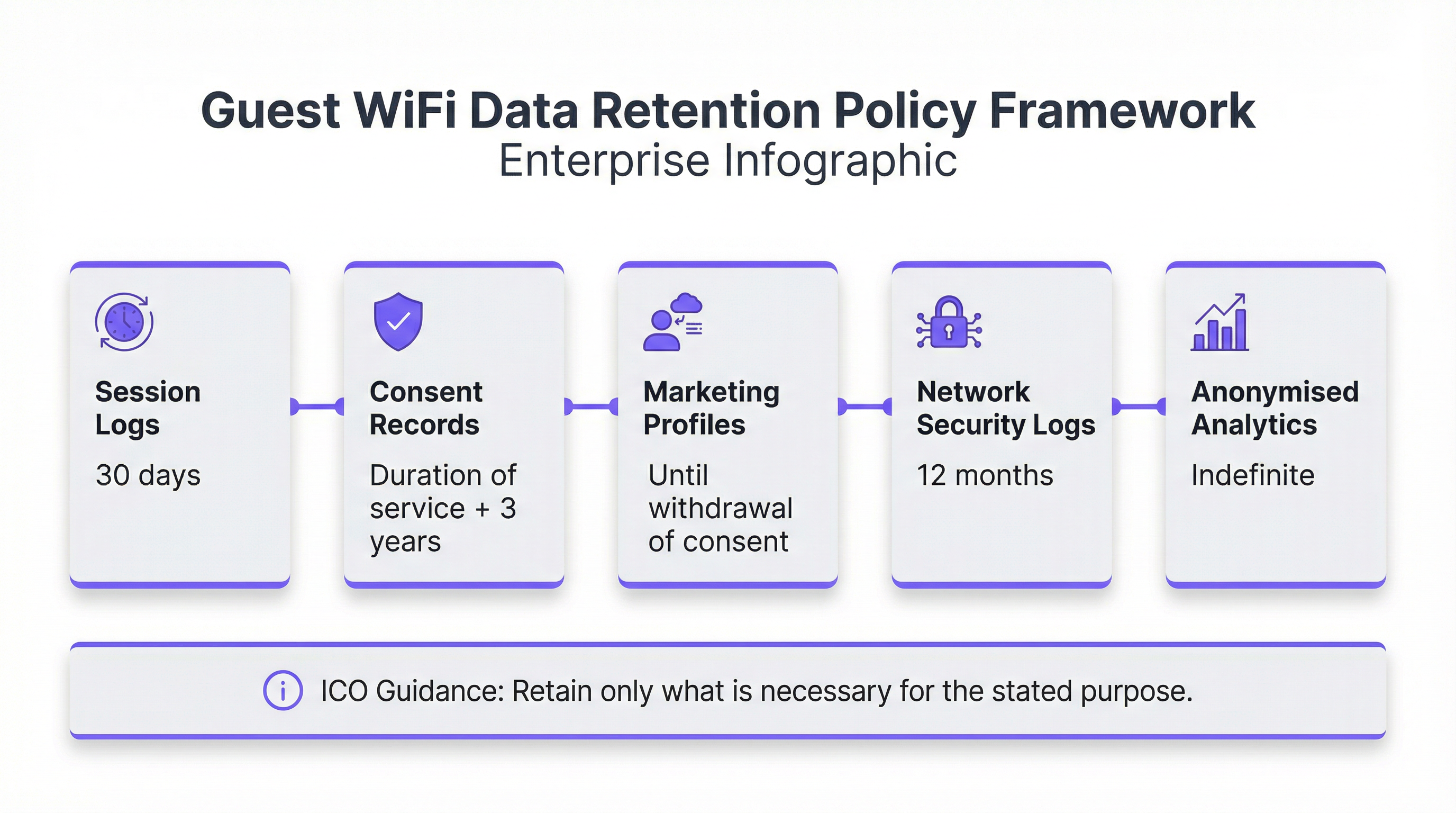
The deployment should follow a four-phase approach. In Phase 1 (Policy), the hotel group must convene a workshop with IT, Marketing, Legal, and the DPO. They need to define three distinct processing purposes: (1) providing network access, (2) marketing communications for the loyalty programme, and (3) footfall analytics. Each purpose requires a separate legal basis and consent mechanism. In Phase 2 (Design), they should select a managed guest WiFi platform such as Purple, which provides a customizable captive portal, a consent management platform, and integrated analytics. The captive portal should be designed with a clear, two-step flow: first, a mandatory acceptance of terms for network access (which can use Legitimate Interest for basic session data); second, two separate, optional, unticked checkboxes — one for 'Loyalty Programme Marketing' and one for 'Anonymous Footfall Analytics'. The privacy notice must be concise and clearly explain each purpose. In Phase 3 (Deployment), the solution should be staged at a single property first. The team must configure automated data retention rules: session logs purged after 30 days, marketing profiles retained until consent is withdrawn, and footfall analytics data anonymised at the point of collection and retained indefinitely. In Phase 4 (Rollout), the solution is deployed to all 12 properties with a phased rollout over 8 weeks. Front desk staff are trained to direct guests to the WiFi and to escalate any data queries to the DPO.
A national retail chain with 85 stores wants to use their guest WiFi to run footfall heatmaps and measure the effectiveness of in-store promotional displays. Their marketing team wants to use the WiFi to send push notifications to customers who are currently in-store. Their IT team is concerned about GDPR compliance, particularly around the use of MAC addresses for tracking. How should the IT manager advise the business?
The IT manager should advise the business that this use case is achievable but requires careful architectural decisions. First, regarding MAC address tracking: modern mobile devices (iOS 14+ and Android 10+) use MAC address randomization by default, which means that a MAC address is not a stable, persistent identifier for a specific device. However, it is still considered personal data when collected, as it can be combined with other data to identify an individual. The IT manager should recommend that the analytics platform anonymise the MAC address immediately upon collection (using a one-way hash), and that the analytics dashboard only ever display aggregated, anonymised data. This significantly reduces the GDPR risk. Second, regarding in-store push notifications: this is a high-risk processing activity that requires explicit, specific consent. The captive portal must include a specific, unticked checkbox that reads: 'I consent to receiving personalised offers and notifications while I am connected to the store WiFi.' The purpose must be clearly explained. Third, the IT manager should recommend conducting a DPIA before deploying the push notification feature, as it involves real-time location-based processing of personal data. The DPIA should assess the risk to user privacy and document the mitigations in place. A platform like Purple can support this use case with its consent management, analytics, and marketing automation capabilities, while providing the audit trail needed to demonstrate compliance.
Análise de Cenários
Q1. You are the IT Manager for a 50-store retail chain. Your Marketing Director wants to deploy guest WiFi and use it to send in-store push notifications to customers who have previously visited any of your stores. The notifications would be triggered when a known device (identified by MAC address) reconnects to any store's WiFi. Your DPO has flagged this as high-risk. What steps must you take before this feature can be deployed, and what technical safeguards are required?
💡 Dica:Consider the DPIA trigger checklist, the specific consent required for cross-store device tracking, and the technical challenges of MAC address randomization on modern devices.
Mostrar Abordagem Recomendada
Before deploying this feature, you must: (1) Conduct a mandatory Data Protection Impact Assessment (DPIA), as this involves systematic monitoring of individuals across multiple locations using device identifiers — a clear GDPR Article 35 trigger. The DPIA must document the risks and the mitigations. (2) Redesign the captive portal to include a specific, unticked consent checkbox that clearly explains cross-store device recognition and targeted notifications. The language must be explicit: 'I consent to [Brand] recognising my device across all stores and sending me personalised offers when I connect.' (3) Address the MAC randomization challenge: since modern iOS and Android devices randomize MAC addresses, you cannot reliably use raw MAC addresses for cross-store recognition. You must instead require users to authenticate via a persistent identifier such as an email address or social login, which then becomes the cross-store tracking key. (4) Implement a Data Processing Addendum with your push notification provider. (5) Provide a clear, accessible opt-out mechanism in every push notification and in a self-service preference center. Only after completing these steps and obtaining sign-off from the DPO should the feature be deployed.
Q2. Your organization has received a Data Subject Access Request from a former hotel guest who stayed 18 months ago. They are requesting a copy of all personal data you hold about them, including their WiFi session history. Your current guest WiFi platform stores session logs indefinitely. What are your immediate obligations, and what systemic changes should you make?
💡 Dica:Consider the one-month response deadline, the data minimisation principle, and the need for a documented retention policy.
Mostrar Abordagem Recomendada
Your immediate obligations are: (1) Acknowledge the DSAR in writing within 5 working days, confirming you have received it and will respond within one calendar month. (2) Search all systems — your guest WiFi CMP, CRM, and any email marketing platforms — for all personal data associated with this individual. (3) Compile and provide a copy of all data found, in a commonly used electronic format, within one calendar month of receipt. This includes session logs, consent records, and any marketing profile data. The systemic change required is urgent: storing session logs indefinitely is a clear violation of the GDPR data minimisation and storage limitation principles. You must immediately define and implement a data retention policy. Session logs should be purged after 30-90 days. You must configure automated retention rules in your guest WiFi platform to enforce this policy going forward. Additionally, you should implement a formal DSAR intake process — a dedicated privacy email alias, a trained point of contact, and a documented workflow — to ensure future requests are handled efficiently and within the statutory deadline.
Q3. A conference centre is deploying guest WiFi for a major three-day event with 5,000 attendees. The event organiser wants to use the WiFi analytics to provide sponsors with data on how many unique visitors attended each sponsor's exhibition stand. The data would be presented as a report showing stand visit counts and average dwell times per stand. Is this use case GDPR-compliant as described, and what conditions must be met for it to proceed?
💡 Dica:Consider the distinction between anonymised aggregate data and personal data, and the specific consent required for location-based analytics.
Mostrar Abordagem Recomendada
The use case as described is potentially compliant, but only under specific conditions. The key question is whether the data provided to sponsors is truly anonymised and aggregated, or whether it could be used to identify individuals. If the report shows only aggregate counts (e.g., 'Stand A received 342 unique device visits with an average dwell time of 4.2 minutes'), and if the underlying device-level data has been irreversibly anonymised before any analysis, then this data is no longer personal data and can be shared with sponsors without restriction. However, to get to this point, the following conditions must be met: (1) The captive portal for the event WiFi must include a specific, unticked consent checkbox for 'Anonymous footfall analytics to measure event attendance and stand popularity.' The purpose and the fact that aggregated data will be shared with event sponsors must be clearly disclosed. (2) The analytics platform must anonymise device identifiers (e.g., hash the MAC address) at the point of collection, before any analysis is performed. (3) The reports shared with sponsors must contain only aggregated data with no possibility of re-identification. If any stand had very few visitors, the data for that stand should be suppressed to prevent re-identification. (4) A DPIA should be conducted given the large scale of the data collection. If these conditions are met, the use case is compliant and represents a legitimate and valuable application of guest WiFi analytics.
Principais Conclusões
- ✓Guest WiFi networks collect four categories of personal data under GDPR: registration data, device and session data, location data, and usage data. Each requires a distinct legal basis and compliance approach.
- ✓Consent for marketing and analytics must be freely given, specific, informed, and unambiguous. This means separate, unticked checkboxes for each purpose on the captive portal — never bundled with the terms of service for network access.
- ✓A robust data retention policy is non-negotiable. Session logs should be purged after 30 days, consent records retained for 2 years post-last-interaction, and marketing profiles deleted upon consent withdrawal. Automate these rules in your CMP.
- ✓A Data Protection Impact Assessment (DPIA) is legally mandatory before deploying guest WiFi systems that involve large-scale location tracking, behavioural profiling, or processing data from vulnerable groups.
- ✓Your guest WiFi vendor is a Data Processor. A formal Data Processing Addendum (DPA) must be in place before any personal data is shared with them. Evaluate vendors on their security certifications (ISO 27001, SOC 2) and GDPR compliance documentation.
- ✓GDPR compliance for guest WiFi is not just a cost — it is a strategic enabler. A compliant platform mitigates fines of up to 4% of global turnover, builds customer trust, and provides ethically sourced business intelligence that drives operational and marketing ROI.
- ✓In the event of a personal data breach, the 72-hour notification clock starts the moment you become aware of it. Build this timeline into your incident response plan and ensure your team knows to notify before the investigation is complete.




