

हवाई अड्डों के लिए गेस्ट WiFi: रोमिंग, ट्रांज़िट और थ्रूपुट
यह तकनीकी संदर्भ मार्गदर्शिका वरिष्ठ IT पेशेवरों और नेटवर्क आर्किटेक्ट्स को उच्च-प्रदर्शन वाले हवाई अड्डे के गेस्ट WiFi को डिज़ाइन और तैनात करने के लिए कार्रवाई योग्य रणनीतियाँ प्रदान करती है। इसमें टर्मिनलों में निर्बाध रोमिंग, ज़ोन के अनुसार थ्रूपुट प्रावधान, रियायती किरायेदारों के लिए सुरक्षित विभाजन, और घर्षण-रहित कनेक्टिविटी के लिए Passpoint (Hotspot 2.0) का कार्यान्वयन शामिल है। वायरलेस नेटवर्क को एक रणनीतिक संपत्ति के रूप में मानकर, हवाई अड्डे के संचालक यात्रियों की संतुष्टि बढ़ा सकते हैं, अनुपालन सुनिश्चित कर सकते हैं और मापने योग्य गैर-एरोनॉटिकल राजस्व बढ़ा सकते हैं।
🎧 इस गाइड को सुनें
ट्रांसक्रिप्ट देखें

कार्यकारी सारांश
हवाई अड्डे के गेस्ट WiFi को डिज़ाइन करना एक मानक एंटरप्राइज़ परिनियोजन से बिल्कुल अलग है। प्रतिवर्ष लाखों अस्थायी उपयोगकर्ताओं, ज़ोन में अलग-अलग ठहरने के समय, और यात्रियों, एयरलाइन कर्मचारियों, खुदरा रियायती किरायेदारों और परिचालन प्रणालियों सहित एक जटिल बहु-हितधारक वातावरण का समर्थन करने की आवश्यकता के साथ — नेटवर्क आर्किटेक्चर मजबूत, स्केलेबल और कठोरता से खंडित होना चाहिए। यह मार्गदर्शिका बड़े पैमाने पर हवाई अड्डे के गेस्ट WiFi को तैनात करने के लिए तकनीकी आवश्यकताओं का विवरण देती है, जिसमें रोमिंग तंत्र, ट्रांज़िट संबंधी विचार और ज़ोन के अनुसार थ्रूपुट प्रावधान पर ध्यान केंद्रित किया गया है। हम यह पता लगाते हैं कि आधुनिक मानक जिनमें Passpoint (Hotspot 2.0), IEEE 802.11r, और WPA3 शामिल हैं, PCI DSS और GDPR अनुपालन के लिए आवश्यक सुरक्षा स्थिति प्रदान करते हुए उपयोगकर्ता अनुभव को कैसे सुव्यवस्थित कर सकते हैं। इन रणनीतियों को लागू करके, IT निदेशक अपने वायरलेस इंफ्रास्ट्रक्चर को एक उपयोगिता लागत केंद्र से एक रणनीतिक मंच में बदल सकते हैं जो यात्रियों की संतुष्टि बढ़ाता है, परिचालन दक्षता का समर्थन करता है, और WiFi Analytics के माध्यम से गैर-एरोनॉटिकल राजस्व बढ़ाता है।
तकनीकी गहन-विश्लेषण
हवाई अड्डे के WiFi की समस्या का क्षेत्र
हवाई अड्डे का WiFi तीन प्रतिस्पर्धी मांगों के चौराहे पर स्थित है: उच्च-घनत्व प्रदर्शन, निर्बाध गतिशीलता और बहु-किरायेदार सुरक्षा। एक प्रमुख अंतरराष्ट्रीय हब में चरम अवधि के दौरान 50,000 से 100,000 समवर्ती डिवाइस देखे जा सकते हैं, जो चेक-इन हॉल, सुरक्षा कतारों, खुदरा गलियारों, लाउंज और गेट होल्डिंग क्षेत्रों में वितरित होते हैं — प्रत्येक में मौलिक रूप से अलग-अलग ट्रैफिक प्रोफाइल और ठहरने के समय की विशेषताएं होती हैं। नेटवर्क को गेस्ट ट्रैफिक, एयरलाइन परिचालन प्रणालियों, खुदरा किरायेदार POS नेटवर्क और भवन प्रबंधन प्रणालियों के बीच सख्त तार्किक अलगाव बनाए रखते हुए यह सब संभालना होगा।
विरासत हवाई अड्डे के परिनियोजन में सबसे अधिक सामना की जाने वाली विफलता मोड एक सपाट, SSID-आधारित वास्तुकला है जिसे क्षमता के बजाय कवरेज के लिए डिज़ाइन किया गया था। जब यात्रियों की संख्या बढ़ी और प्रति व्यक्ति डिवाइस की संख्या बढ़ी — आज का औसत यात्री 3.5 कनेक्टेड डिवाइस रखता है — तो ये नेटवर्क संतृप्त हो गए, और the captive portal पुनः-प्रमाणीकरण चक्र यात्रियों की शिकायतों का एक लगातार स्रोत बन गया।
रोमिंग और निर्बाध पुनः-कनेक्ट
निर्बाध रोमिंग हवाई अड्डे के WiFi की परिभाषित तकनीकी चुनौती है। चेक-इन हॉल में आने वाला, सुरक्षा से गुजरने वाला, खुदरा गलियारे से गुजरने वाला, और एक सैटेलाइट टर्मिनल के लिए ट्रांज़िट ट्रेन में चढ़ने वाला यात्री अपनी कनेक्टिविटी को पूरे समय बनाए रखने की उम्मीद करता है। एक खराब वास्तुकला वाले नेटवर्क में, प्रत्येक ज़ोन सीमा एक पूर्ण पुनः-प्रमाणीकरण चक्र को ट्रिगर करती है, सक्रिय सत्रों को तोड़ती है और अनुभव को खराब करती है।
समाधान वास्तुकला दो पूरक मानकों पर निर्भर करती है जो मिलकर काम करते हैं।
Passpoint (Hotspot 2.0 / IEEE 802.11u) उपकरणों को एक मोबाइल नेटवर्क ऑपरेटर (MNO) या तीसरे पक्ष के पहचान प्रदाता द्वारा प्रदान किए गए क्रेडेंशियल का उपयोग करके नेटवर्क को स्वचालित रूप से खोजने और प्रमाणित करने में सक्षम बनाता है। SSID की सूची प्रस्तुत करने और मैन्युअल चयन की आवश्यकता के बजाय, Passpoint-सक्षम डिवाइस नेटवर्क की Generic Advertisement Service (GAS) और Interworking Service से यह निर्धारित करने के लिए क्वेरी करते हैं कि क्या कोई विश्वसनीय क्रेडेंशियल मौजूद है। यदि ऐसा होता है, तो डिवाइस 802.1X/EAP के माध्यम से चुपचाप प्रमाणित होता है, जिससे captive portal पूरी तरह से बायपास हो जाता है। यह वह तंत्र है जो OpenRoaming को आधार बनाता है — वैश्विक रोमिंग फेडरेशन जो यात्रियों को भाग लेने वाले प्रदाताओं से क्रेडेंशियल का उपयोग करके निर्बाध रूप से कनेक्ट करने की अनुमति देता है। Purple Connect लाइसेंस के तहत OpenRoaming के लिए एक मुफ्त पहचान प्रदाता के रूप में काम करता है, जिससे हवाई अड्डों को यात्रियों को एक विशिष्ट MNO संबंध रखने की आवश्यकता के बिना यह अनुभव प्रदान करने में सक्षम बनाया जाता है।
IEEE 802.11r (Fast BSS Transition) हैंडऑफ़ विलंबता समस्या का समाधान करता है। एक मानक 802.11 परिनियोजन में, एक्सेस पॉइंट के बीच जाने के लिए एक पूर्ण चार-तरफा EAPOL हैंडशेक की आवश्यकता होती है, जो 50-200ms की विलंबता का परिचय देता है — एक VoIP कॉल को गिराने या वीडियो स्ट्रीम को बाधित करने के लिए पर्याप्त। 802.11r Mobility Domain के माध्यम से Pairwise Master Key (PMK) को पड़ोसी APs में पूर्व-वितरित करता है, जिससे हैंडऑफ़ समय 50ms से कम हो जाता है। जब 802.11k (पड़ोसी रिपोर्ट) और 802.11v (BSS ट्रांज़िशन प्रबंधन) के साथ जोड़ा जाता है, तो क्लाइंट डिवाइस को कनेक्शन खराब होने से पहले सक्रिय रूप से इष्टतम AP पर निर्देशित किया जाता है, न कि कनेक्शन पहले ही ड्रॉप होने के बाद प्रतिक्रियात्मक रूप से।
टर्मिनलों के बीच ट्रांज़िट ट्रेनों या लोगों को ले जाने वाले हवाई अड्डों के लिए, रोमिंग डोमेन को पूरे परिसर में फैलाना चाहिए। इसके लिए एक केंद्रीकृत WLAN नियंत्रक वास्तुकला की आवश्यकता होती है — या तो ऑन-प्रिमाइसेस या क्लाउड-प्रबंधित — जो सभी टर्मिनलों में एक एकल गतिशीलता डोमेन बनाए रखता है और डिवाइस जिस भी AP से जुड़ा हो, उसकी परवाह किए बिना सुसंगत नीति लागू करता है।
ज़ोन के अनुसार थ्रूपुट प्रावधान
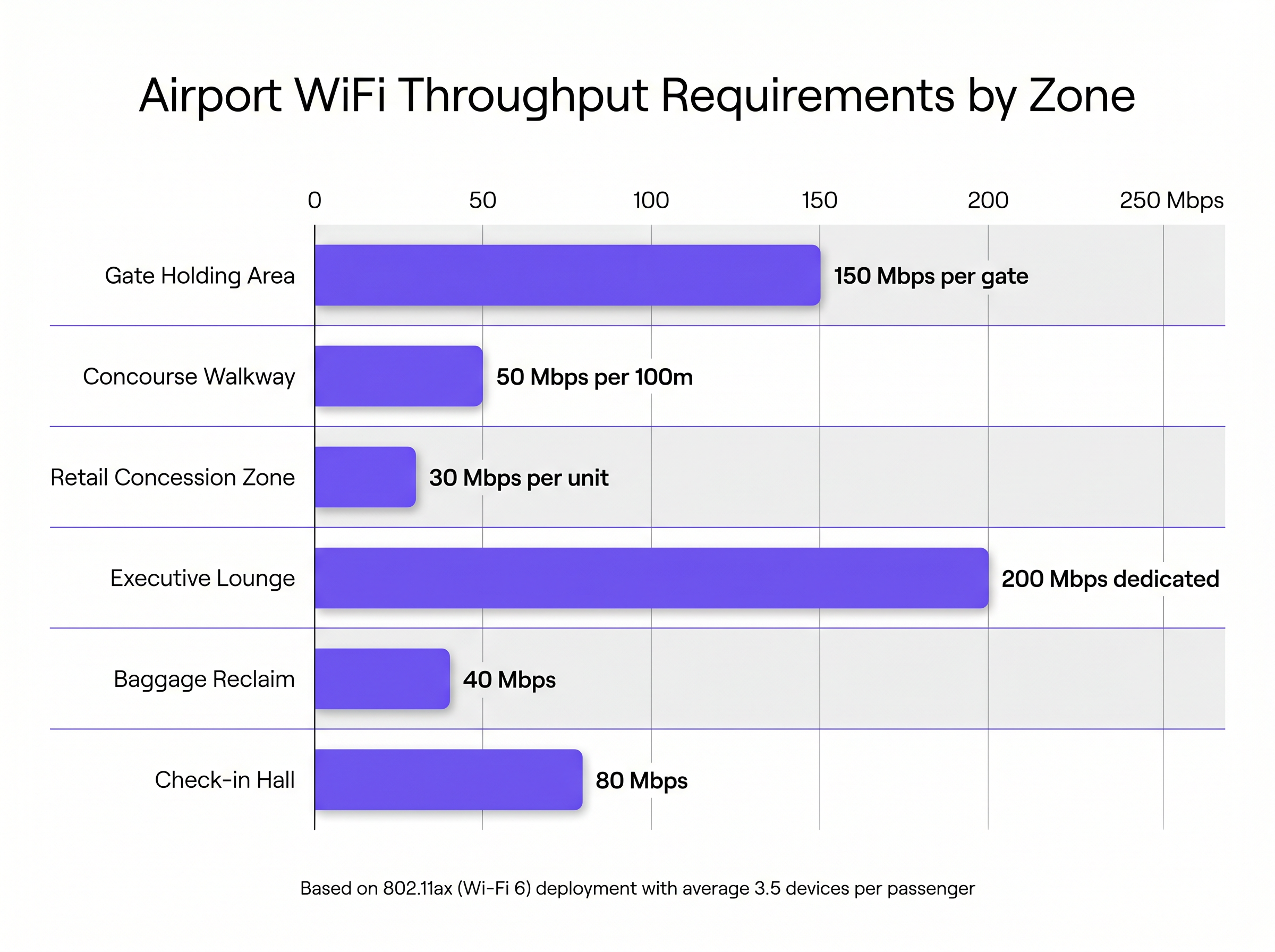
हवाई अड्डे के वातावरण समरूप नहीं होते हैं, और थ्रूपुट प्रावधान को प्रत्येक ज़ोन के विशिष्ट उपयोग प्रोफाइल को प्रतिबिंबित करना चाहिए। एक-आकार-सभी के लिए दृष्टिकोण अनिवार्य रूप से कम-मांग वाले क्षेत्रों में अत्यधिक प्रावधान और सबसे महत्वपूर्ण ज़ोन में गंभीर रूप से कम प्रावधान का परिणाम होता है।
| ज़ोन | पीक थ्रूपुट आवश्यकता | प्राथमिक ट्रैफिक प्रकार | अनुशंसित AP घनत्व |
|---|---|---|---|
| गेट होल्डिंग क्षेत्र | 150 Mbps प्रति गेट | वीडियो स्ट्रीमिंग, बड़े डाउनलोड | 1 AP प्रति 30m² |
| कॉनकोर्स वॉकवे | 50 Mbps प्रति 100m | बैकग्राउंड सिंक, मैसेजिंग | 1 AP प्रति 100m² |
| खुदरा रियायती क्षेत्र | 30 Mbps प्रति यूनिट + POS | POS लेनदेन, ग्राहक जुड़ाव | 1 AP प्रति 50m² |
| कार्यकारी लाउंज | 200 Mbps समर्पित | वीडियो कॉन्फ्रेंसिंग, एंटरप्राइज़ ऐप्स | 1 AP प्रति 20m² |
| बैगेज रिक्लेम | 40 Mbps | मैसेजिंग, उड़ान सूचनाएं | 1 AP प्रति 80m² |
| चेक-इन हॉल | 80 Mbps (बर्स्टी) | प्रारंभिक ऑनबोर्डिंग, संदेश"आयु | प्रति 60 वर्ग मीटर पर 1 AP |
गेट होल्डिंग क्षेत्र सबसे अधिक मांग वाले क्षेत्र हैं। यात्री आमतौर पर 45-90 मिनट तक रुकते हैं और प्रति-डिवाइस बैंडविड्थ की खपत सबसे अधिक होती है। इन घने वातावरणों में सह-चैनल हस्तक्षेप (co-channel interference) को प्रबंधित करने के लिए दिशात्मक एंटेना (directional antennas) के साथ 802.11ax (Wi-Fi 6) APs को तैनात करना — जो आसन्न गेट के बजाय बैठने की जगह को कवर करने के लिए उन्मुख हों — आवश्यक है। Wi-Fi 6 की OFDMA (ऑर्थोगोनल फ़्रीक्वेंसी डिवीज़न मल्टीपल एक्सेस) क्षमता एक ही AP को विभिन्न उप-चैनलों पर एक साथ कई क्लाइंट्स को सेवा देने की अनुमति देती है, जिससे 802.11ac की तुलना में स्पेक्ट्रल दक्षता (spectral efficiency) में नाटकीय रूप से सुधार होता है।
बुनियादी ढांचे के उन्नयन की योजना बना रहे हवाई अड्डों के लिए, Wi-Fi 6E — जो 6 GHz बैंड जोड़ता है — सबसे भीड़भाड़ वाले क्षेत्रों में क्षमता में उल्लेखनीय वृद्धि प्रदान करता है। 6 GHz बैंड वर्तमान में पुराने उपकरणों से मुक्त है, जिसका अर्थ है कि उस बैंड में संचालित सभी क्लाइंट Wi-Fi 6E सक्षम हैं और व्यापक चैनल चौड़ाई (160 MHz तक) का पूरा लाभ उठा सकते हैं।
नेटवर्क सेगमेंटेशन और रियायती किरायेदार वास्तुकला
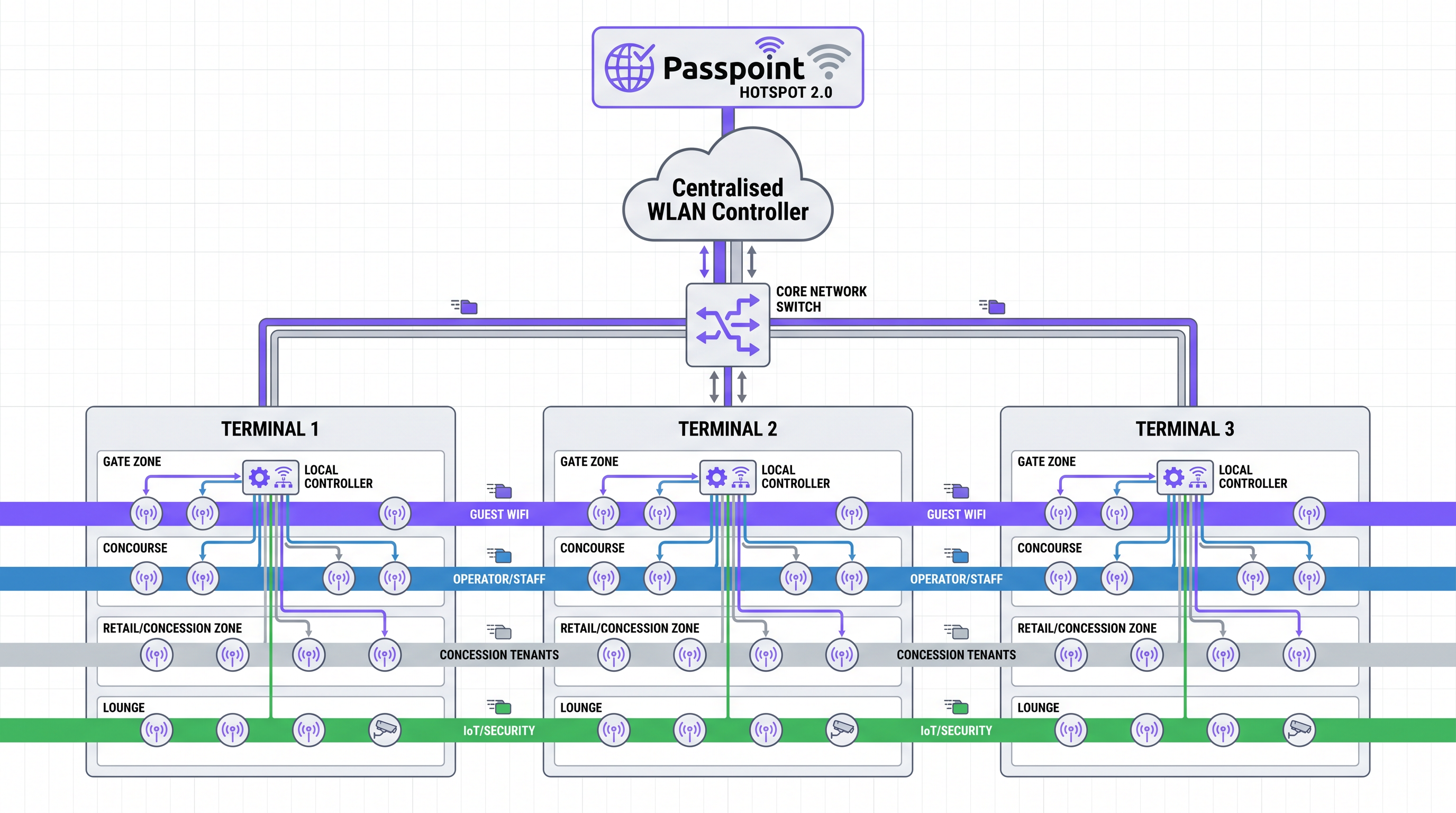
एक हवाई अड्डे की बहु-किरायेदार प्रकृति एक जटिल नेटवर्क सेगमेंटेशन आवश्यकता पैदा करती है। वास्तुकला को एक साथ समर्थन करना चाहिए:
- सार्वजनिक अतिथि WiFi यात्रियों के लिए, जिसमें Captive Portal ऑनबोर्डिंग और GDPR-अनुरूप डेटा कैप्चर शामिल है
- चेक-इन सिस्टम, बोर्डिंग गेट रीडर और ग्राउंड क्रू उपकरणों के लिए एयरलाइन परिचालन नेटवर्क
- PCI DSS-अनुरूप POS अलगाव के साथ खुदरा रियायती किरायेदार नेटवर्क
- सुरक्षा, भवन प्रबंधन और कर्मचारियों के लिए हवाई अड्डा प्राधिकरण परिचालन नेटवर्क
- CCTV, पर्यावरणीय सेंसर और वेफ़ाइंडिंग डिस्प्ले के लिए IoT और भवन प्रणालियाँ
इनमें से प्रत्येक ट्रैफ़िक क्लास को समर्पित VLANs के माध्यम से तार्किक रूप से अलग किया जाना चाहिए, जिसमें इंटर-VLAN रूटिंग को फ़ायरवॉल नीति द्वारा कड़ाई से नियंत्रित किया जाए। अतिथि WiFi VLAN को क्लाइंट अलगाव (client isolation) सक्षम करके कॉन्फ़िगर किया जाना चाहिए, जिससे सीधे डिवाइस-से-डिवाइस संचार को रोका जा सके और हमले की सतह (attack surface) कम हो सके।
खुदरा रियायती किरायेदारों के लिए, अनुशंसित वास्तुकला 802.1X/RADIUS के माध्यम से गतिशील VLAN असाइनमेंट है। प्रत्येक किरायेदार के उपकरण एक केंद्रीकृत RADIUS सर्वर के विरुद्ध प्रमाणित होते हैं, जो डिवाइस के क्रेडेंशियल्स के आधार पर उपयुक्त VLAN असाइनमेंट लौटाता है। यह हवाई अड्डे की IT टीम को एक ही नियंत्रण तल (control plane) से सभी किरायेदार नेटवर्क एक्सेस को प्रबंधित करने की अनुमति देता है, जिसमें प्रति-किरायेदार SSID प्रसार की आवश्यकता नहीं होती है — जो बीकन फ़्रेम (beacon frames) के साथ एयरटाइम की खपत करके RF प्रदर्शन को खराब करता है।
किरायेदार POS नेटवर्क के लिए PCI DSS अनुपालन के लिए निम्नलिखित नियंत्रणों का होना आवश्यक है: पैठ परीक्षण (penetration testing) द्वारा सत्यापित नेटवर्क सेगमेंटेशन, अनधिकृत APs का पता लगाने और उन्हें रोकने के लिए वायरलेस इंट्रूज़न प्रिवेंशन सिस्टम (WIPS), कार्डधारक डेटा का एन्क्रिप्टेड ट्रांसमिशन (न्यूनतम TLS 1.2), और नेटवर्क सेगमेंट का त्रैमासिक भेद्यता स्कैनिंग (vulnerability scanning)। केंद्रीकृत WLAN नियंत्रक WIPS क्षमता प्रदान करता है, जो मैन्युअल हस्तक्षेप के बिना अनधिकृत उपकरणों को स्वचालित रूप से वर्गीकृत और नियंत्रित करता है।
हवाई अड्डे के संदर्भ में Passpoint की भूमिका
Passpoint पर विशेष ध्यान देना चाहिए क्योंकि हवाई अड्डे के संदर्भ में इसका मूल्य प्रस्ताव (value proposition) साधारण ऑनबोर्डिंग सुविधा से कहीं अधिक है। एक हवाई अड्डा संचालक के लिए, Passpoint तीन रणनीतिक रूप से महत्वपूर्ण क्षमताओं को सक्षम बनाता है।
पहला, यह कैरियर ऑफलोड पार्टनरशिप को सक्षम बनाता है। MNOs हवाई अड्डों को Passpoint के माध्यम से सेलुलर डेटा ट्रैफ़िक को WiFi नेटवर्क पर ऑफलोड करने के लिए भुगतान करते हैं, जिससे बुनियादी ढांचे के निवेश से सीधा राजस्व प्रवाह (revenue stream) बनता है। यह उन क्षेत्रों में विशेष रूप से मूल्यवान है जहाँ सेलुलर पैठ (cellular penetration) खराब है, जैसे कि भूमिगत टर्मिनल या भारी परिरक्षित (shielded) इमारतें।
दूसरा, यह वापस आने वाले यात्रियों के लिए सहज पुनः-प्रमाणीकरण को सक्षम बनाता है। एक बार-बार यात्रा करने वाला यात्री जिसने अपनी पिछली यात्रा पर कनेक्ट किया था और एक Passpoint प्रोफ़ाइल स्वीकार की थी, वह हर बाद की यात्रा पर स्वचालित रूप से कनेक्ट हो जाएगा, जिसमें किसी पोर्टल इंटरैक्शन की आवश्यकता नहीं होगी। यह हवाई अड्डे के सबसे मूल्यवान यात्रियों के लिए अनुभव में नाटकीय रूप से सुधार करता है।
तीसरा, यह पहचान संघ (identity federation) के लिए एक मानक-आधारित नींव प्रदान करता है। जैसे-जैसे हवाई अड्डे वैश्विक OpenRoaming नेटवर्क में भाग लेते हैं, भागीदार स्थानों — होटल, सम्मेलन केंद्र, अन्य हवाई अड्डों — से आने वाले यात्री अपने मौजूदा क्रेडेंशियल्स का उपयोग करके स्वचालित रूप से कनेक्ट हो सकते हैं। यह वह दिशा है जिसमें उद्योग आगे बढ़ रहा है, और जो हवाई अड्डे आज Passpoint तैनात करते हैं, वे इस भविष्य की स्थिति के लिए खुद को तैयार कर रहे हैं।
कार्यान्वयन मार्गदर्शिका
एक मजबूत हवाई अड्डा WiFi नेटवर्क तैनात करने के लिए एक चरणबद्ध दृष्टिकोण की आवश्यकता होती है जो तकनीकी आवश्यकताओं को एक लाइव हवाई अड्डे के वातावरण की परिचालन बाधाओं के साथ संतुलित करता है। डाउनटाइम कोई विकल्प नहीं है; सभी बुनियादी ढांचे के काम को परिचालन अनुसूचियों के अनुसार योजनाबद्ध किया जाना चाहिए।
चरण 1 — मूल्यांकन और योजना (सप्ताह 1-6)
भविष्य कहनेवाला मॉडलिंग (Ekahau, AirMagnet) और सक्रिय माप दोनों का उपयोग करके एक व्यापक RF साइट सर्वेक्षण करें। भविष्य कहनेवाला सर्वेक्षण वास्तुशिल्प चित्रों के आधार पर इष्टतम AP प्लेसमेंट की पहचान करता है; सक्रिय सर्वेक्षण वास्तविक दुनिया की स्थितियों के विरुद्ध मॉडल को मान्य करता है। उच्च धातु सामग्री (संरचनात्मक इस्पात कार्य, खिड़कियों से दिखाई देने वाले विमान) और बड़े कांच के विभाजन वाले क्षेत्रों पर विशेष ध्यान दें, जो जटिल मल्टीपाथ वातावरण बनाते हैं। साथ ही, मौजूदा वायर्ड बुनियादी ढांचे का ऑडिट करें ताकि उन स्विचों की पहचान की जा सके जिन्हें उच्च-प्रदर्शन APs का समर्थन करने के लिए मल्टी-गीगाबिट ईथरनेट और PoE++ में अपग्रेड करने की आवश्यकता है।
चरण 2 — कोर इन्फ्रास्ट्रक्चर अपग्रेड (सप्ताह 7-16)
अनुमानित वायरलेस ट्रैफ़िक का समर्थन करने के लिए वायर्ड बैकबोन को अपग्रेड करें। इसमें उच्च-घनत्व वाले क्षेत्रों में AP स्थानों पर मल्टी-गीगाबिट ईथरनेट (2.5 या 5 Gbps) तैनात करना, यह सुनिश्चित करना कि कोर स्विचिंग फैब्रिक एकत्रित वायरलेस थ्रूपुट को संभाल सके, और पूर्ण AP एस्टेट के लिए पर्याप्त क्षमता वाले केंद्रीकृत WLAN नियंत्रक को तैनात करना शामिल है। कई टर्मिनलों वाले बड़े हवाई अड्डों के लिए, एक क्लाउड-प्रबंधित वास्तुकला प्रबंधन को सरल बनाती है और उच्च उपलब्धता के लिए आवश्यक भौगोलिक अतिरेक (geographic redundancy) प्रदान करती है।
चरण 3 — वायरलेस डितैनाती और सेगमेंटेशन (सप्ताह 17–28)
RF योजना के अनुसार Wi-Fi 6/6E APs तैनात करें, स्पेक्ट्रल दक्षता को अधिकतम करने के लिए OFDMA, MU-MIMO और BSS कलरिंग को कॉन्फ़िगर करें। VLAN सेगमेंटेशन आर्किटेक्चर लागू करें, डायनामिक VLAN असाइनमेंट के लिए RADIUS कॉन्फ़िगर करें और इंटर-VLAN एक्सेस नियंत्रणों को लागू करने के लिए फ़ायरवॉल नीतियां तैनात करें। WLAN कंट्रोलर पर WIPS सक्षम करें और दुष्ट AP रोकथाम नीतियों को कॉन्फ़िगर करें।
चरण 4 — प्रमाणीकरण और एनालिटिक्स एकीकरण (सप्ताह 29–36)
Captive Portal तैनात करें और एक Guest WiFi प्रबंधन प्लेटफ़ॉर्म के साथ एकीकृत करें। Passpoint प्रोफाइल कॉन्फ़िगर करें और यदि लागू हो तो OpenRoaming के साथ एकीकृत करें। निवास-समय डेटा, ज़ोन अधिभोग मेट्रिक्स और डिवाइस गणना कैप्चर करना शुरू करने के लिए एनालिटिक्स प्लेटफ़ॉर्म लागू करें। सहमति प्रबंधन, डेटा प्रतिधारण नीतियों और विषय एक्सेस अनुरोधों को संसाधित करने की क्षमता को लागू करके GDPR अनुपालन सुनिश्चित करें।
सर्वोत्तम अभ्यास
Wi-Fi 6/6E को बेसलाइन मानक के रूप में अपनाएं। आधुनिक हवाई अड्डे की तैनाती में 802.11ax की उच्च-घनत्व क्षमताएं वैकल्पिक नहीं हैं। OFDMA, MU-MIMO और टारगेट वेक टाइम (TWT) सामूहिक रूप से 802.11ac की तुलना में लोड के तहत प्रदर्शन में एक महत्वपूर्ण बदलाव लाते हैं। नई तैनाती के लिए, Wi-Fi 6E डिफ़ॉल्ट विनिर्देश होना चाहिए, जिसमें Wi-Fi 6 AP रीफ़्रेश कार्यक्रमों के लिए न्यूनतम स्वीकार्य मानक हो।
सभी नेटवर्क सेगमेंट में WPA3 लागू करें। WPA3-एंटरप्राइज़ (परिचालन नेटवर्क के लिए 192-बिट मोड का उपयोग करके) और WPA3-पर्सनल (SAE का उपयोग करके) WPA2 की तुलना में काफी मजबूत सुरक्षा प्रदान करते हैं। अतिथि नेटवर्क के लिए जहां प्रमाणीकरण की आवश्यकता नहीं है, एन्हांस्ड ओपन (OWE) अप्रमाणित डेटा एन्क्रिप्शन प्रदान करता है, जो यात्रियों को खुले नेटवर्क पर निष्क्रिय जासूसी से बचाता है — उपयोगकर्ता अनुभव पर कोई प्रभाव डाले बिना एक सार्थक सुरक्षा सुधार।
विफलता के लिए डिज़ाइन करें। एक लाइव हवाई अड्डे के वातावरण में, AP विफलताओं से कवरेज अंतराल नहीं बनना चाहिए। पर्याप्त ओवरलैप (15–20%) के साथ APs तैनात करें ताकि WLAN कंट्रोलर विफल इकाई की भरपाई के लिए पड़ोसी APs पर ट्रांसमिट पावर को स्वचालित रूप से बढ़ा सके। सुनिश्चित करें कि WLAN कंट्रोलर स्वयं स्वचालित फ़ेलओवर के साथ उच्च-उपलब्धता कॉन्फ़िगरेशन में तैनात है।
मल्टी-टर्मिनल वातावरण के लिए SD-WAN का लाभ उठाएं। WAN लिंक के माध्यम से जुड़े कई टर्मिनलों या वितरित सुविधाओं वाले हवाई अड्डों के लिए, SD-WAN एप्लिकेशन-जागरूक ट्रैफ़िक रूटिंग, बेहतर लचीलापन और केंद्रीकृत सुरक्षा नीति प्रवर्तन प्रदान करता है। परिचालन लाभों के विस्तृत विश्लेषण के लिए आधुनिक व्यवसायों के लिए मुख्य SD WAN लाभ देखें।
एनालिटिक्स को एक मुख्य डिलिवरेबल के रूप में मानें। एक अच्छी तरह से उपकरणित हवाई अड्डे के WiFi नेटवर्क द्वारा उत्पन्न डेटा — निवास समय, ज़ोन अधिभोग, बार-बार आने वाले आगंतुकों की दरें, डिवाइस जनसांख्यिकी — का महत्वपूर्ण परिचालन और वाणिज्यिक मूल्य है। पहले दिन से WiFi Analytics को एकीकृत करें, और टर्मिनल संचालन, खुदरा किरायेदार वार्ताओं और विपणन पहलों को सूचित करने के लिए इस डेटा का उपयोग करने के लिए स्पष्ट आंतरिक प्रक्रियाएं स्थापित करें।
समस्या निवारण और जोखिम शमन
को-चैनल इंटरफेरेंस (CCI)। उच्च-घनत्व तैनाती में खराब प्रदर्शन का सबसे आम कारण। सावधानीपूर्वक चैनल योजना (2.4 GHz बैंड में गैर-ओवरलैपिंग चैनलों का उपयोग करके, और 5 GHz और 6 GHz में व्यापक चैनल उपलब्धता का लाभ उठाकर), WLAN कंट्रोलर पर डायनामिक रेडियो मैनेजमेंट (DRM/RRM), और खुले-योजना वाले क्षेत्रों में दिशात्मक एंटेना के माध्यम से इसे कम करें। ट्रांसमिट पावर को अधिकतम करने के प्रलोभन से बचें; उच्च AP घनत्व के साथ कम पावर लगभग हमेशा हवाई अड्डे के वातावरण में उच्च-शक्ति, कम-घनत्व तैनाती से बेहतर प्रदर्शन करती है।
Captive Portal परित्याग। एक खराब डिज़ाइन किया गया Captive Portal एक महत्वपूर्ण परिचालन जोखिम है। मुख्य विफलता मोड में शामिल हैं: भीड़भाड़ वाले नेटवर्क पर लोड होने के लिए बहुत भारी पेज, Apple के Captive Network Assistant (CNA) या Android के नेटवर्क लॉगिन सुविधा के साथ असंगति, और अत्यधिक जटिल पंजीकरण फ़ॉर्म। पोर्टल पेज को 200KB से कम रखकर, CNA और Android समकक्षों के विरुद्ध परीक्षण करके, और आवश्यक फ़ील्ड की संख्या को कम करके इसे कम करें। प्रोफ़ाइल-आधारित प्रमाणीकरण लागू करें ताकि लौटने वाले उपयोगकर्ता पोर्टल को पूरी तरह से बायपास कर सकें।
दुष्ट एक्सेस पॉइंट। किरायेदारों, यात्रियों या दुर्भावनापूर्ण अभिनेताओं द्वारा तैनात अनधिकृत APs एक लगातार खतरा हैं। वे RF हस्तक्षेप के माध्यम से वैध नेटवर्क को बाधित कर सकते हैं और क्रेडेंशियल कैप्चर करके सुरक्षा जोखिम पैदा कर सकते हैं। WIPS — केंद्रीकृत WLAN कंट्रोलर की एक सुविधा के रूप में तैनात — दुष्ट उपकरणों की निरंतर निगरानी और स्वचालित रोकथाम प्रदान करता है। सुनिश्चित करें कि WIPS नीतियां दुष्ट APs का पता लगाने के बजाय उन्हें रोकने के लिए कॉन्फ़िगर की गई हैं।
GDPR और डेटा गोपनीयता अनुपालन। Captive Portal के माध्यम से यात्री डेटा कैप्चर करना GDPR (और अन्य न्यायालयों में समकक्ष कानून) के तहत दायित्व बनाता है। सुनिश्चित करें कि गोपनीयता सूचना स्पष्ट और सुलभ है, सहमति दानेदार और स्वतंत्र रूप से दी गई है, डेटा सुरक्षित रूप से और केवल बताए गए उद्देश्य के लिए संग्रहीत किया जाता है, और यात्रियों के लिए अपने डेटा विषय अधिकारों का प्रयोग करने के लिए तंत्र मौजूद हैं। तैनाती के बाद नहीं, डिज़ाइन चरण के दौरान अपने डेटा संरक्षण अधिकारी (DPO) को शामिल करें।
ROI और व्यावसायिक प्रभाव
एंटरप्राइज़-ग्रेड हवाई अड्डे के WiFi के लिए व्यावसायिक मामला यात्री संतुष्टि से कहीं आगे तक फैला हुआ है। एक अच्छी तरह से उपकरणित तैनाती कई आयामों में मापने योग्य रिटर्न प्रदान करती है।
यात्री अनुभव और ASQ स्कोर। एयरपोर्ट सर्विस क्वालिटी (ASQ) सर्वेक्षण लगातार WiFi गुणवत्ता को यात्री संतुष्टि के शीर्ष-पांच चालकों में से एक के रूप में पहचानते हैं। जो हवाई अड्डे सहज, उच्च-प्रदर्शन कनेक्टिविटी में निवेश करते हैं, वे अपनी ASQ रैंकिंग में मापने योग्य सुधार देखते हैं, जो सीधे एयरलाइन मार्ग निर्णयों और टर्मिनल रियायत अनुबंध वार्ताओं को प्रभावित करते हैं।
गैर-एरोनॉटिकल राजस्व। WiFi नेटवर्क खुदरा मीडिया मुद्रीकरण के लिए एक मंच प्रदान करता है — टर्मिनल में उनकी स्थिति और उनके निवास समय के आधार पर यात्रियों को लक्षित, स्थान-जागरूक विज्ञापन प्रदान करता है। खुदरा मीडिया नेटवर्क Retail में स्थल ऑपरेटरों के लिए महत्वपूर्ण राजस्व उत्पन्न करते हैं।खुदरा) और हॉस्पिटैलिटी क्षेत्रों में, हवाई अड्डे अपने WiFi इंफ्रास्ट्रक्चर की व्यावसायिक क्षमता को तेजी से पहचान रहे हैं।
कैरियर ऑफलोड राजस्व। MNOs के साथ Passpoint-सक्षम कैरियर ऑफलोड समझौते इंफ्रास्ट्रक्चर निवेश से सीधा राजस्व प्रवाह बनाते हैं। अर्थव्यवस्था बाजार के अनुसार भिन्न होती है, लेकिन अधिक यातायात वाले हवाई अड्डों में, कैरियर ऑफलोड समझौते स्वामित्व की कुल लागत समीकरण में महत्वपूर्ण योगदान दे सकते हैं।
परिचालन दक्षता। WiFi नेटवर्क से प्राप्त स्थान विश्लेषण टर्मिनल संचालन के डेटा-संचालित अनुकूलन को सक्षम बनाता है: सुरक्षा चौकियों पर कर्मचारियों का स्तर, चेक-इन पर कतार प्रबंधन, और खुदरा किरायेदार प्लेसमेंट निर्णय। इन परिचालन सुधारों का हवाई अड्डे की लागत आधार और प्रति यात्री राजस्व पर सीधा प्रभाव पड़ता है।
डेटा परिसंपत्ति मूल्य। captive portal के माध्यम से उचित सहमति के साथ प्राप्त प्रथम-पक्षीय डेटा सत्यापित यात्री प्रोफाइल का एक CRM डेटाबेस बनाता है। इस परिसंपत्ति का प्रत्यक्ष विपणन, लॉयल्टी कार्यक्रम एकीकरण, और एयरलाइंस तथा खुदरा किरायेदारों के साथ वाणिज्यिक साझेदारियों के लिए महत्वपूर्ण मूल्य है। परिवहन क्षेत्र के हवाई अड्डों के लिए, यह डेटा क्षमता तेजी से एक प्रतिस्पर्धी विभेदक बन रही है।
मुख्य शब्द और परिभाषाएं
Passpoint (Hotspot 2.0 / IEEE 802.11u)
A Wi-Fi Alliance certification programme that enables devices to automatically discover and authenticate to Wi-Fi networks using pre-provisioned credentials, without requiring user interaction with a captive portal. Authentication is performed via 802.1X/EAP, providing enterprise-grade security.
Essential for delivering a seamless, cellular-like roaming experience across large airport footprints and enabling carrier offload partnerships with MNOs.
IEEE 802.11r (Fast BSS Transition)
An amendment to the IEEE 802.11 standard that reduces the latency of access point handoffs by pre-distributing cryptographic keys (PMK) to neighbouring APs within a mobility domain, reducing handoff time from 200ms+ to under 50ms.
Critical for maintaining VoIP calls and active application sessions as passengers move between APs or terminals, particularly on transit trains.
OpenRoaming
A global Wi-Fi roaming federation operated by the Wireless Broadband Alliance (WBA) that enables automatic, secure connectivity across participating venues and networks using Passpoint credentials. Participants include MNOs, identity providers, and venue operators.
Allows passengers to connect automatically at participating airports using credentials from their home network or identity provider, with no manual interaction required.
OFDMA (Orthogonal Frequency Division Multiple Access)
A multi-user version of OFDM that subdivides a Wi-Fi channel into smaller sub-channels (Resource Units), allowing a single AP to simultaneously serve multiple clients on different sub-channels within a single transmission.
A key Wi-Fi 6 feature that significantly improves spectral efficiency in high-density environments like gate holding areas, where many clients are active simultaneously.
Dynamic VLAN Assignment
A network access control mechanism where the VLAN a device is placed into is determined dynamically by a RADIUS server at authentication time, based on the device's credentials, rather than being statically configured on the switch port or SSID.
The recommended approach for managing concession tenant network access, allowing centralised policy control without per-tenant SSID proliferation.
WIPS (Wireless Intrusion Prevention System)
A network security component that continuously monitors the radio spectrum for unauthorised access points and client devices, and can automatically take countermeasures (containment) to prevent them from operating.
Mandatory for PCI DSS compliance in environments with retail tenant POS systems, and essential for maintaining overall network security in a public venue.
BSS Colouring (IEEE 802.11ax)
A mechanism introduced in Wi-Fi 6 that assigns a colour identifier to each Basic Service Set (BSS), allowing APs to distinguish between overlapping transmissions from their own network and those from neighbouring networks, reducing unnecessary backoff and improving spectral reuse.
Particularly valuable in dense airport deployments where multiple APs are operating in close proximity, improving overall network throughput.
Dwell Time
The duration a passenger spends within a specific zone of the airport, measured from entry to exit. Dwell time varies significantly by zone: typically 45–90 minutes at gates, under 5 minutes in concourse walkways.
The primary input variable for throughput provisioning decisions. High dwell time zones require higher per-device bandwidth allocation and more robust AP density.
Enhanced Open (OWE / Opportunistic Wireless Encryption)
A Wi-Fi Alliance security protocol that provides data encryption for open (unauthenticated) Wi-Fi networks without requiring a password or user interaction. Each client session uses a unique encryption key.
The recommended security standard for public guest WiFi networks, protecting passengers from passive eavesdropping without adding friction to the connection process.
केस स्टडीज
A major international airport with three terminals connected by an automated people mover is experiencing significant passenger complaints. Users report that their WiFi connection drops every time they board the transit train between terminals, forcing them to re-authenticate via the captive portal on arrival. The existing network uses a legacy controller-based architecture with per-terminal WLAN controllers and no inter-controller roaming domain.
The root cause is the absence of a unified roaming domain spanning all three terminals. The remediation requires: (1) Migrating to a single centralised WLAN controller — either on-premises or cloud-managed — that manages all APs across all three terminals within a single mobility domain. (2) Enabling IEEE 802.11r (Fast BSS Transition) across all APs, ensuring the PMK is distributed to all APs within the mobility domain so handoffs complete in under 50ms. (3) Deploying Passpoint profiles to eliminate captive portal re-authentication for returning users. (4) Ensuring AP coverage is continuous along the transit train route, with overlapping cells (15–20%) to guarantee signal availability throughout the journey. (5) Enabling 802.11k and 802.11v to proactively guide client devices to the optimal AP as they move, rather than waiting for the connection to degrade before initiating a handoff.
An airport operator is planning a major retail concession expansion, adding 40 new food and beverage and retail units to a newly constructed pier. Each tenant requires WiFi for cloud-based POS systems, staff devices, and customer-facing digital signage. The airport IT team wants to use the existing wireless infrastructure being deployed for passenger guest WiFi, rather than deploying a separate network for tenants.
The shared infrastructure approach is viable and cost-effective, provided the segmentation architecture is correctly implemented. The recommended design uses dynamic VLAN assignment via 802.1X/RADIUS: (1) Each tenant is provisioned with a unique set of credentials in the RADIUS server. When a tenant device authenticates, the RADIUS server returns a VLAN assignment attribute, placing the device in the tenant's dedicated VLAN. (2) Each tenant VLAN is isolated from the guest WiFi VLAN and the airport operational network via firewall ACLs. Internet access is provided via a shared uplink, but inter-VLAN routing is blocked. (3) For PCI DSS compliance, the tenant VLANs are scoped as the Cardholder Data Environment (CDE). Firewall rules restrict inbound and outbound traffic to only what is required for POS operation. WIPS is enabled to detect and contain rogue APs within the tenant zones. (4) A dedicated SSID for tenant devices is configured with WPA3-Enterprise, ensuring all traffic is encrypted. The SSID is hidden to prevent passenger devices from attempting to connect. (5) The airport IT team retains centralised management of all tenant network access, with the ability to revoke or modify access for individual tenants without physical intervention.
परिदृश्य विश्लेषण
Q1. An airport IT director is reviewing complaints about poor WiFi performance in the international departure lounge. The lounge has 12 access points deployed across 1,200m², all using 802.11ac with omnidirectional antennas and maximum transmit power. Peak occupancy is 400 passengers. What is the most likely root cause of the performance issues, and what remediation steps would you recommend?
💡 संकेत:Consider the relationship between transmit power, cell size, and co-channel interference in a high-density environment.
अनुशंसित दृष्टिकोण दिखाएं
The most likely root cause is co-channel interference (CCI) caused by the combination of high transmit power and omnidirectional antennas. At maximum power, each AP's cell extends far beyond its intended coverage area, causing significant overlap with neighbouring APs on the same channel. This forces devices to defer transmission, reducing effective throughput. The remediation steps are: (1) Reduce transmit power on all APs to create tighter, more defined cells. (2) Replace omnidirectional antennas with directional antennas oriented toward the seating areas. (3) Enable Dynamic Radio Management (RRM) on the WLAN controller to automatically optimise channel and power assignments. (4) Upgrade APs to Wi-Fi 6 (802.11ax) to leverage OFDMA and BSS Colouring, which significantly improve performance under high-density conditions. (5) Consider increasing AP density (adding 4–6 additional APs) rather than increasing power on existing APs.
Q2. A retail concession tenant at an airport has requested permission to deploy their own wireless access point in their unit, citing poor signal from the airport's infrastructure. How should the IT team respond, and what is the correct technical resolution?
💡 संकेत:Consider both the security implications and the RF impact of an unauthorised AP deployment.
अनुशंसित दृष्टिकोण दिखाएं
The IT team must deny the request to deploy an unauthorised AP. An unmanaged AP introduces two critical risks: (1) Security risk — the AP would not be subject to the airport's security policies, WIPS monitoring, or PCI DSS controls, creating a potential attack vector. (2) RF interference — an unmanaged AP operating on an uncoordinated channel would interfere with the managed network, degrading performance for all users in the vicinity. The correct resolution is to investigate the root cause of the poor signal in the tenant's unit. This may require a targeted RF survey to identify coverage gaps or interference sources. The remediation should involve deploying an additional managed AP — or repositioning an existing one — to provide adequate coverage in the tenant's zone, with the tenant's devices assigned to their dedicated VLAN via dynamic VLAN assignment.
Q3. An airport is planning to deploy Passpoint for the first time. The IT director wants to understand what infrastructure changes are required and what the passenger experience will look like for both first-time and returning visitors.
💡 संकेत:Think through the end-to-end journey for both a new and a returning passenger, and the infrastructure components required to support each.
अनुशंसित दृष्टिकोण दिखाएं
Infrastructure requirements for Passpoint deployment include: (1) WLAN controller and APs that support 802.11u (GAS/ANQP) and 802.1X/EAP. (2) A RADIUS server configured to handle EAP authentication for Passpoint credentials. (3) An identity provider relationship — either with an MNO for carrier credentials or with a platform like Purple for OpenRoaming. (4) Passpoint profile provisioning capability, typically delivered via the captive portal or an MDM system. For a first-time visitor: they connect to the open guest SSID, are redirected to the captive portal, register and accept terms, and are then provisioned with a Passpoint profile on their device. They experience the portal once. For a returning visitor: their device detects the Passpoint network via 802.11u GAS queries, authenticates silently via 802.1X/EAP using the stored profile, and connects without any portal interaction. For a visitor with MNO credentials in an OpenRoaming-enabled network: their device connects automatically on first visit, with no portal interaction at all.
Q4. An airport operator is negotiating a new five-year WiFi infrastructure contract. The vendor is proposing a flat per-AP licensing model regardless of zone type. What counter-proposal should the IT director make, and what data should they use to support it?
💡 संकेत:Consider the significant variation in AP capability requirements and management complexity across different airport zones.
अनुशंसित दृष्टिकोण दिखाएं
The IT director should counter-propose a tiered licensing model that reflects the different capability requirements and management overhead of APs in different zones. High-density zones (gates, lounges) require Wi-Fi 6/6E APs with advanced features (OFDMA, MU-MIMO, WIPS), higher management overhead, and more frequent capacity reviews — these should command a higher per-AP cost. Low-density transit zones (walkways, baggage reclaim) can be served by lower-specification APs with simpler management requirements. Supporting data should include: the RF site survey results showing the density differential between zones, the throughput provisioning model demonstrating the capability gap between zone types, and a total cost of ownership analysis showing that a flat model either over-pays for low-density APs or under-provisions high-density zones. The director should also negotiate SLA terms that differentiate by zone criticality — gate zones should have a higher availability SLA than walkway zones.
मुख्य निष्कर्ष
- ✓Seamless roaming is the baseline expectation: deploy Passpoint (Hotspot 2.0) and IEEE 802.11r to eliminate re-authentication as passengers move between terminals and zones.
- ✓Provision throughput dynamically by zone: gate holding areas require 150 Mbps per gate; concourse walkways need only 50 Mbps per 100m. Design for density and dwell time, not square footage.
- ✓Strict VLAN segmentation is non-negotiable: retail concession tenants must be isolated from guest and operational traffic, with PCI DSS controls applied to all POS network segments.
- ✓Wi-Fi 6 (802.11ax) is the minimum viable standard for new airport deployments; Wi-Fi 6E should be the target specification for high-density zones.
- ✓Passpoint enables three strategic capabilities: carrier offload revenue, seamless re-authentication for frequent flyers, and participation in global OpenRoaming federations.
- ✓Treat the WiFi network as a revenue platform: location analytics, retail media monetisation, and first-party data capture can generate measurable non-aeronautical revenue.
- ✓GDPR and PCI DSS compliance must be designed in from the start — not retrofitted. Engage your DPO and security team during the architecture phase.




