

रिटेल WiFi नेटवर्क के लिए PCI DSS अनुपालन
यह तकनीकी संदर्भ मार्गदर्शिका PCI DSS v4.0 की उन आवश्यकताओं का विवरण देती है जो विशेष रूप से रिटेल WiFi नेटवर्क पर लागू होती हैं, जिसमें नेटवर्क सेगमेंटेशन आर्किटेक्चर, एन्क्रिप्शन मानक, प्रमाणीकरण नियंत्रण और ऑडिट ट्रेल आवश्यकताएं शामिल हैं। यह IT प्रबंधकों और नेटवर्क आर्किटेक्ट्स के लिए कार्रवाई योग्य कार्यान्वयन मार्गदर्शन प्रदान करती है, जिन्हें अलग-अलग गेस्ट WiFi और कॉर्पोरेट वायरलेस एक्सेस को सुरक्षित रूप से सपोर्ट करते हुए भुगतान डेटा को सुरक्षित करने की आवश्यकता है।
🎧 इस गाइड को सुनें
ट्रांसक्रिप्ट देखें

कार्यकारी सारांश
IT प्रबंधकों और नेटवर्क आर्किटेक्ट्स के लिए जो रिटेल , हॉस्पिटैलिटी , परिवहन , और सार्वजनिक क्षेत्र के स्थानों में काम करते हैं, वायरलेस नेटवर्क तैनात करना एक महत्वपूर्ण अनुपालन चुनौती प्रस्तुत करता है: मजबूत गेस्ट WiFi और परिचालन कनेक्टिविटी कैसे प्रदान करें, बिना अनजाने में कार्डधारक डेटा एन्वायरमेंट (CDE) के दायरे का विस्तार किए। PCI DSS v4.0 के तहत, CDE से जुड़ा कोई भी वायरलेस नेटवर्क, या भुगतान डेटा प्रसारित करने वाला, अनुपालन ऑडिट के पूर्ण दायरे में आता है — और गैर-अनुपालन के लिए दंड महत्वपूर्ण हैं।
यह मार्गदर्शिका भुगतान ट्रैफ़िक को अलग करने, मजबूत एन्क्रिप्शन मानकों (WPA3/AES-256) को लागू करने, 802.1X प्रमाणीकरण को कार्यान्वित करने और अनधिकृत वायरलेस उपकरणों की निरंतर निगरानी बनाए रखने के लिए तकनीकी आवश्यकताओं को रेखांकित करती है। कठोर तार्किक और भौतिक नेटवर्क सेगमेंटेशन को अपनाकर, रिटेल IT टीमें अपनी अनुपालन बोझ को काफी कम कर सकती हैं, जबकि पॉइंट-ऑफ-सेल (POS) सिस्टम और ग्राहक जुड़ाव प्लेटफॉर्म जैसे WiFi Analytics दोनों के लिए उच्च-प्रदर्शन कनेक्टिविटी बनाए रख सकती हैं। मुख्य सिद्धांत सीधा है: भुगतान ट्रैफ़िक को गेस्ट और कॉर्पोरेट ट्रैफ़िक से पूरी तरह अलग रखें, और उस अलगाव को सख्ती से सत्यापित करें।
तकनीकी गहन-विश्लेषण
PCI DSS v4.0 वायरलेस दायरा
PCI DSS v4.0 कई आवश्यकताओं में वायरलेस नेटवर्क को संबोधित करता है। सबसे सीधे प्रासंगिक हैं आवश्यकता 2 (सुरक्षित कॉन्फ़िगरेशन और डिफ़ॉल्ट क्रेडेंशियल), आवश्यकता 4 (पारगमन में एन्क्रिप्शन), आवश्यकता 6 (सुरक्षित सिस्टम और सॉफ्टवेयर), आवश्यकता 10 (ऑडिट लॉगिंग), और आवश्यकता 11 (सुरक्षा परीक्षण, जिसमें अनधिकृत वायरलेस पहचान शामिल है)। इन सभी का मूलभूत सिद्धांत यह है कि वायरलेस नेटवर्क स्वाभाविक रूप से अविश्वसनीय ट्रांसमिशन मीडिया हैं।
यदि किसी वायरलेस नेटवर्क का उपयोग कार्डधारक डेटा प्रसारित करने के लिए किया जाता है — उदाहरण के लिए, रिटेल शॉप फ्लोर पर मोबाइल POS टैबलेट — तो यह CDE का हिस्सा है। यदि कोई वायरलेस नेटवर्क, जैसे कि गेस्ट WiFi नेटवर्क, भुगतान नेटवर्क के समान भौतिक हार्डवेयर साझा करता है लेकिन CDE से तार्किक रूप से खंडित है, तो सेगमेंटेशन नियंत्रण स्वयं दायरे में आते हैं और उनका कठोरता से परीक्षण और दस्तावेजीकरण किया जाना चाहिए। यह अंतर महत्वपूर्ण है: एक ही एक्सेस पॉइंट इंफ्रास्ट्रक्चर पर गेस्ट नेटवर्क की मात्र उपस्थिति स्वचालित रूप से अनुपालन विफलता नहीं बनाती है, लेकिन यह यह साबित करने के लिए एक अनुपालन दायित्व बनाती है कि सेगमेंटेशन प्रभावी है।
कार्डधारक डेटा एन्वायरमेंट सीमा को समझना
किसी भी वायरलेस आर्किटेक्चर को डिजाइन करने से पहले, IT टीम को CDE सीमा को सटीक रूप से परिभाषित करना होगा। CDE में वे सभी सिस्टम शामिल हैं जो प्राइमरी अकाउंट नंबर (PAN), कार्डधारक के नाम, समाप्ति तिथियां, सेवा कोड और CVV2 मान और PIN ब्लॉक जैसे संवेदनशील प्रमाणीकरण डेटा को स्टोर, प्रोसेस या प्रसारित करते हैं। कोई भी सिस्टम जो CDE सिस्टम से जुड़ता है — भले ही वह स्वयं भुगतान डेटा को हैंडल न करता हो — उसे भी दायरे में माना जाता है, जब तक कि मजबूत सेगमेंटेशन नियंत्रण उसे अलग न कर दें।
एक विशिष्ट रिटेल वातावरण में, CDE में POS टर्मिनल और उनके संबंधित बैक-एंड सर्वर, भुगतान गेटवे कनेक्शन, और कोई भी वायरलेस नेटवर्क शामिल होता है जिसके माध्यम से भुगतान डेटा यात्रा करता है। गेस्ट WiFi नेटवर्क, कॉर्पोरेट स्टाफ नेटवर्क, और डिजिटल साइनेज या पर्यावरणीय सेंसर जैसे कोई भी IoT डिवाइस दायरे से बाहर हैं — लेकिन तभी जब वे ठीक से अलग-थलग हों।
नेटवर्क आर्किटेक्चर और सेगमेंटेशन
PCI DSS दायरे को नियंत्रित करने के लिए सबसे प्रभावी रणनीति मजबूत नेटवर्क सेगमेंटेशन है। लक्ष्य यह सुनिश्चित करना है कि सार्वजनिक या कॉर्पोरेट WiFi नेटवर्क के साथ कोई समझौता हमलावर को भुगतान नेटवर्क में प्रवेश करने का मार्ग प्रदान न कर सके।
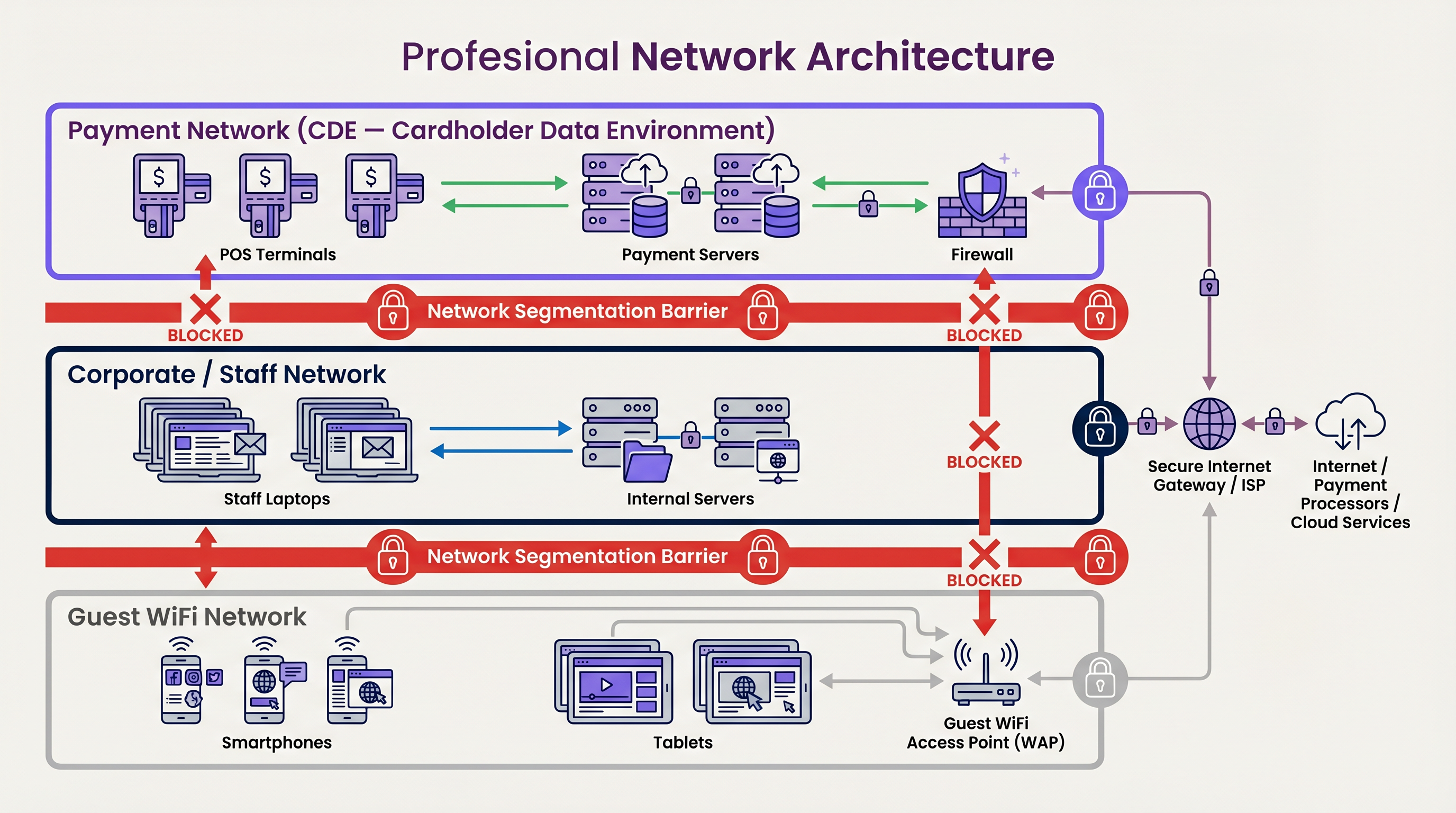
VLAN अलगाव एक मूलभूत नियंत्रण है। गेस्ट, कॉर्पोरेट और भुगतान ट्रैफ़िक को अलग-अलग VLANs पर रहना चाहिए, जिनके बीच कोई रूट करने योग्य पथ न हो। एक ठीक से कॉन्फ़िगर किए गए वातावरण में, गेस्ट VLAN के पास फ़ायरवॉल के माध्यम से इंटरनेट तक एक ही मार्ग होता है, और किसी भी आंतरिक सबनेट तक कोई मार्ग नहीं होता है। भुगतान VLAN के पास भुगतान गेटवे और आंतरिक भुगतान सर्वर तक एक कसकर नियंत्रित मार्ग होता है, जिसमें अन्य सभी ट्रैफ़िक को स्पष्ट रूप से अस्वीकार कर दिया जाता है।
फ़ायरवॉल नियम को सख्त प्रवेश और निकास नीतियों को लागू करना चाहिए। फ़ायरवॉल नियमसेट को डिफ़ॉल्ट-अस्वीकृति की स्थिति का पालन करना चाहिए: सभी ट्रैफ़िक को तब तक ब्लॉक किया जाता है जब तक कि स्पष्ट रूप से अनुमति न दी जाए। अनुमति प्राप्त ट्रैफ़िक प्रवाह को एक नेटवर्क आरेख में प्रलेखित किया जाना चाहिए और कम से कम सालाना समीक्षा की जानी चाहिए। कोई भी नियम जो CDE VLAN में ट्रैफ़िक की अनुमति देता है, उसे सुरक्षा टीम द्वारा उचित ठहराया, प्रलेखित और अनुमोदित किया जाना चाहिए।
समर्पित हार्डवेयर उच्च जोखिम वाले वातावरण के लिए एक वैकल्पिक लेकिन अनुशंसित नियंत्रण है। CDE के लिए समर्पित एक्सेस पॉइंट और स्विच का उपयोग VLAN हॉपिंग हमलों के सैद्धांतिक जोखिम को समाप्त करता है, जहां एक गलत कॉन्फ़िगर किया गया स्विच पोर्ट दो VLANs को ब्रिज कर सकता है। व्यवहार में, आधुनिक एंटरप्राइज़ स्विच पर डबल-टैगिंग हमलों के माध्यम से VLAN हॉपिंग दुर्लभ है, लेकिन जोखिम शून्य नहीं है। बहुत अधिक लेनदेन मात्रा को संसाधित करने वाले संगठनों के लिए, या उच्च खतरे वाले प्रोफाइल वाले क्षेत्रों में काम करने वाले लोगों के लिए, समर्पित हार्डवेयर आश्वासन की एक अतिरिक्त परत प्रदान करता है।
इंटर-VLAN रूटिंग सत्यापन किसी भी नेटवर्क परिवर्तन के बाद किया जाना चाहिए। एक साधारण परीक्षण — गेस्ट VLAN से CDE डिवाइस को पिंग करने का प्रयास — पूरी तरह से विफल होना चाहिए। पेनेट्रेशन टेस्टर अधिक परिष्कृत सत्यापन करेंगे, जिसमें VLAN हॉपिंग कमजोरियों का फायदा उठाने के प्रयास और किसी भी गलत कॉन्फ़िगर की गई एक्सेस कंट्रोल लिस्ट का परीक्षण शामिल है।
एन्क्रिप्शन और प्रमाणीकरण मानक
आवश्यकता 4.2.1 खुले, सार्वजनिक नेटवर्क पर कार्डधारक डेटा के प्रसारण के लिए मजबूत क्रिप्टोग्राफी अनिवार्य करती है। वायरलेस नेटवर्क को स्पष्ट रूप से वर्गीकृत किया गया है इस उद्देश्य के लिए खुले, सार्वजनिक नेटवर्क के रूप में।
WEP और WPA/WPA2-TKIP पूरी तरह से प्रतिबंधित हैं। इन प्रोटोकॉल में ज्ञात क्रिप्टोग्राफिक कमजोरियाँ हैं जो एक हमलावर को निष्क्रिय निगरानी क्षमता के साथ कुछ ही मिनटों में कैप्चर किए गए ट्रैफ़िक को डिक्रिप्ट करने की अनुमति देती हैं। इन प्रोटोकॉल का उपयोग करने वाले किसी भी SSID को तुरंत अपग्रेड किया जाना चाहिए।
WPA3-Enterprise भुगतान डेटा प्रसारित करने वाले SSIDs के लिए आवश्यक मानक है। WPA3-Enterprise डेटा एन्क्रिप्शन के लिए CCMP-256 (CBC-MAC के साथ काउंटर मोड में AES-256) का उपयोग करता है और 802.1X प्रमाणीकरण की आवश्यकता होती है। यह डिफ़ॉल्ट रूप से प्रोटेक्टेड मैनेजमेंट फ्रेम्स (PMF) भी प्रदान करता है, जो डीऑथेंटिकेशन हमलों को रोकता है — हमलावरों द्वारा क्लाइंट्स को फिर से कनेक्ट करने और प्रमाणीकरण हैंडशेक को कैप्चर करने के लिए उपयोग की जाने वाली एक सामान्य तकनीक।
IEEE 802.1X प्रमाणीकरण वह तंत्र है जो साझा प्री-शेयर्ड कीज़ को व्यक्तिगत डिवाइस और उपयोगकर्ता प्रमाणीकरण से बदलता है। 802.1X परिनियोजन में, एक्सेस पॉइंट एक प्रमाणीकरणकर्ता के रूप में कार्य करता है, प्रमाणीकरण अनुरोधों को एक RADIUS सर्वर पर अग्रेषित करता है। RADIUS सर्वर क्रेडेंशियल को मान्य करता है — जो एक उपयोगकर्ता नाम/पासवर्ड जोड़ी, एक क्लाइंट प्रमाणपत्र, या दोनों हो सकता है — और एक एक्सेस-एक्सेप्ट या एक्सेस-रिजेक्ट प्रतिक्रिया देता है। केवल प्रमाणित उपकरणों को नेटवर्क एक्सेस प्रदान किया जाता है।
EAP-TLS (एक्सटेंसिबल ऑथेंटिकेशन प्रोटोकॉल विद ट्रांसपोर्ट लेयर सिक्योरिटी) एंटरप्राइज़ वायरलेस प्रमाणीकरण के लिए स्वर्ण मानक है। इसके लिए क्लाइंट और RADIUS सर्वर दोनों को वैध X.509 प्रमाणपत्र प्रस्तुत करने की आवश्यकता होती है, जिससे आपसी प्रमाणीकरण प्रदान किया जाता है। यह एक दुर्भावनापूर्ण RADIUS सर्वर द्वारा क्लाइंट्स को एक दुर्भावनापूर्ण नेटवर्क से जोड़ने के जोखिम को समाप्त करता है। EAP-TLS को परिनियोजित करने के लिए क्लाइंट प्रमाणपत्र जारी करने और प्रबंधित करने के लिए एक पब्लिक की इन्फ्रास्ट्रक्चर (PKI) की आवश्यकता होती है, जो एक सार्थक परिचालन निवेश का प्रतिनिधित्व करता है लेकिन सबसे मजबूत उपलब्ध प्रमाणीकरण आश्वासन प्रदान करता है।
कार्यान्वयन मार्गदर्शिका
चरण 1: खोज और कार्यक्षेत्र परिभाषा
किसी भी नियंत्रण को लागू करने से पहले, IT टीम को वर्तमान वायरलेस फ़ुटप्रिंट का व्यापक रूप से मानचित्रण करना होगा। इसका मतलब है कि वर्तमान में संचालन में प्रत्येक एक्सेस पॉइंट, वायरलेस कंट्रोलर और SSID की पहचान करना। प्रत्येक SSID के लिए, यह निर्धारित करें कि उससे कनेक्ट होने वाला कोई भी डिवाइस भुगतान डेटा को संभालता है या नहीं। यह खोज चरण अक्सर अप्रत्याशित कार्यक्षेत्र आइटमों को प्रकट करता है — उदाहरण के लिए, एक लेगेसी SSID जिसे कभी भी निष्क्रिय नहीं किया गया था, या एक भुगतान टर्मिनल के लिए एक विक्रेता-प्रबंधित वायरलेस नेटवर्क जिसके बारे में आंतरिक IT टीम को जानकारी नहीं थी।
निष्कर्षों को एक नेटवर्क आरेख में दस्तावेज़ करें जो स्पष्ट रूप से CDE सीमा, सभी VLANs, सभी फ़ायरवॉल नियमों और सभी वायरलेस SSIDs को दर्शाता है। यह आरेख PCI DSS मूल्यांकन के लिए एक अनिवार्य डिलिवरेबल है।
चरण 2: सेगमेंटेशन कार्यान्वयन
प्रत्येक SSID को उसके समर्पित VLAN से मैप करने के लिए नेटवर्क स्विच और वायरलेस कंट्रोलर को कॉन्फ़िगर करें। डिफ़ॉल्ट-अस्वीकृति मुद्रा को लागू करने के लिए स्विच और फ़ायरवॉल स्तर पर एक्सेस कंट्रोल लिस्ट लागू करें। VLANs के बीच ट्रैफ़िक को रूट करने का प्रयास करके सेगमेंटेशन का परीक्षण करें — ऐसे सभी प्रयास विफल होने चाहिए।
आधुनिक SD-WAN आर्किटेक्चर को तैनात करने वाले संगठनों के लिए, सेगमेंटेशन सिद्धांत समान हैं, हालांकि कार्यान्वयन तंत्र भिन्न होता है। SD-WAN प्लेटफ़ॉर्म नीति-आधारित रूटिंग को लागू कर सकते हैं जो भुगतान ट्रैफ़िक को अतिथि ट्रैफ़िक से पूरी तरह से अलग, समर्पित, एन्क्रिप्टेड टनल पर रखता है। इस आर्किटेक्चर के बारे में अधिक जानकारी के लिए, देखें The Core SD WAN Benefits for Modern Businesses ।
चरण 3: एन्क्रिप्शन अपग्रेड
सभी CDE-फेसिंग SSIDs को WPA3-Enterprise में अपग्रेड करें। वायरलेस कंट्रोलर को कॉन्फ़िगर करें ताकि किसी भी क्लाइंट को कम एन्क्रिप्शन मानक पर बातचीत करने का प्रयास करने पर अस्वीकार कर दिया जाए। यदि भुगतान नेटवर्क पर लेगेसी डिवाइस WPA3 का समर्थन नहीं कर सकते हैं, तो समय-सीमित फ़ॉलबैक के रूप में AES (TKIP नहीं) के साथ WPA2-Enterprise का उपयोग करके एक अलग SSID तैनात करें, और लेगेसी डिवाइस को खत्म करने के लिए एक हार्डवेयर रीफ़्रेश टाइमलाइन स्थापित करें।
चरण 4: 802.1X और RADIUS परिनियोजन
एक RADIUS सर्वर तैनात करें — या तो ऑन-प्रिमाइसेस या क्लाउड-प्रबंधित सेवा के रूप में — और प्रमाणीकरण अनुरोधों को अग्रेषित करने के लिए वायरलेस कंट्रोलर को कॉन्फ़िगर करें। एक आंतरिक सर्टिफिकेट अथॉरिटी का उपयोग करके सभी भुगतान-नेटवर्क उपकरणों को क्लाइंट प्रमाणपत्र जारी करें। RADIUS सर्वर को वैध प्रमाणपत्र के बिना उपकरणों से प्रमाणीकरण प्रयासों को अस्वीकार करने के लिए कॉन्फ़िगर करें।
चरण 5: वायरलेस घुसपैठ का पता लगाना
वायरलेस कंट्रोलर पर WIDS/WIPS सक्षम करें। सिस्टम को इन पर अलर्ट करने के लिए कॉन्फ़िगर करें: आपके परिसर में अनधिकृत SSIDs का प्रसारण, आपके SSID नाम का उपयोग करने वाले लेकिन आपके BSSID का उपयोग न करने वाले डिवाइस (एक ईविल ट्विन हमले का एक सामान्य संकेतक), और आपके नेटवर्क से भौतिक रूप से जुड़े एक्सेस पॉइंट लेकिन कंट्रोलर इन्वेंट्री में पंजीकृत नहीं।
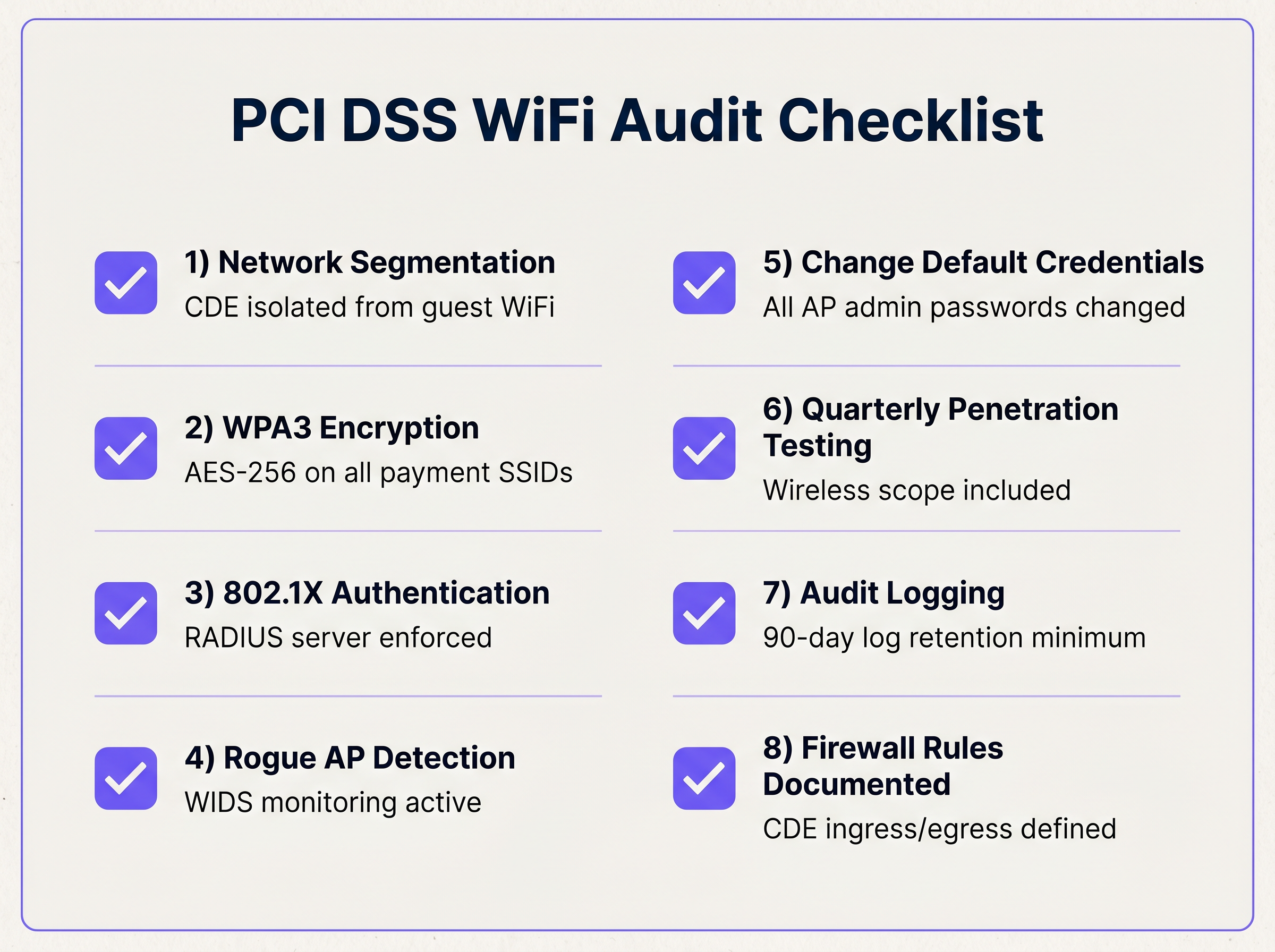
चरण 6: लॉगिंग और निगरानी
सभी वायरलेस कंट्रोलर लॉग, RADIUS प्रमाणीकरण लॉग और फ़ायरवॉल लॉग को एक केंद्रीकृत SIEM पर अग्रेषित करें। यह सत्यापित करें कि लॉग फ़ॉरवर्डिंग सही ढंग से काम कर रही है, यह जांच कर कि हाल की प्रमाणीकरण घटनाएँ अपेक्षित समय सीमा के भीतर SIEM में दिखाई देती हैं। प्रमाणीकरण विफलताओं, VLAN नीति उल्लंघनों और दुष्ट AP पहचान के लिए अलर्ट कॉन्फ़िगर करें।
सर्वोत्तम अभ्यास
डिफ़ॉल्ट क्रेडेंशियल बिना किसी अपवाद के बदलें। आवश्यकता 2.1.1 गैर-परक्राम्य है। प्रत्येक एक्सेस पॉइंट, वायरलेस कंट्रोलर, RADIUS सर्वर और नेटवर्क स्विच के फ़ैक्टरी-डिफ़ॉल्ट क्रेडेंशियल को परिनियोजन से पहले बदला जाना चाहिए। एक क्रेडेंशियल प्रबंधन प्रक्रिया बनाए रखें जो जटिलता आवश्यकताओं और नियमित रोटेशन को लागू करती है।
अप्रयुक्त प्रबंधन प्रोटोकॉल अक्षम करें। Telnet, HTTP और SNMPv1/v2 क्रेडेंशियल और डेटा को क्लियरटेक्स्ट में प्रसारित करते हैं। सभी नेटवर्क हार्डवेयर पर इन प्रोटोकॉल को अक्षम करें और प्रबंधन एक्सेस के लिए विशेष रूप से SSH, HTTPS और SNMPv3 का उपयोग करें।
वायर्ड स्विच पर पोर्ट सुरक्षा लागू करें। आवश्यकता 1.3.2 अनधिकृत उपकरणों को नेटवर्क से कनेक्ट होने से रोकने के लिए नियंत्रणों की आवश्यकता है। वायर्ड स्विच पोर्ट पर 802.1X को सक्षम करना यह सुनिश्चित करता है कि नेटवर्क जैक में प्लग किया गया एक दुष्ट एक्सेस पॉइंट प्रमाणीकरण के बिना नेटवर्क एक्सेस प्राप्त नहीं कर सकता है।
नियमित प्रवेश परीक्षण करें। PCI DSS आवश्यकता 11.4 वार्षिक पेनेट्रेशन टेस्टिंग अनिवार्य करती है जिसमें वायरलेस वातावरण शामिल हो। परीक्षण को यह सत्यापित करना होगा कि सेगमेंटेशन नियंत्रण प्रभावी हैं — न कि केवल कॉन्फ़िगर किए गए हैं। एक पेनेट्रेशन टेस्टर को गेस्ट VLAN से CDE में सेंध लगाने का सक्रिय रूप से प्रयास करना चाहिए और परिणामों का दस्तावेजीकरण करना चाहिए।
वायरलेस डिवाइस इन्वेंट्री बनाए रखें। सभी अधिकृत वायरलेस एक्सेस पॉइंट की अद्यतन इन्वेंट्री रखें, जिसमें उनके MAC पते, भौतिक स्थान और फर्मवेयर संस्करण शामिल हों। यह इन्वेंट्री अनधिकृत डिवाइसों की पहचान करने और ऑडिटरों को वायरलेस वातावरण पर नियंत्रण प्रदर्शित करने के लिए आवश्यक है।
समस्या निवारण और जोखिम न्यूनीकरण
सामान्य ऑडिट निष्कर्ष
VLAN गलत कॉन्फ़िगरेशन वायरलेस से संबंधित सबसे सामान्य निष्कर्ष है। एक स्विच पोर्ट कॉन्फ़िगरेशन में एक भी टाइपो — उदाहरण के लिए, एक ट्रंक पोर्ट को गलत नेटिव VLAN को असाइन करना — गेस्ट और CDE VLANs को ब्रिज कर सकता है, जिससे तुरंत पूरा सार्वजनिक नेटवर्क PCI दायरे में आ जाता है। इसे कॉन्फ़िगरेशन प्रबंधन टूल का उपयोग करके कम करें जो सभी स्विचों पर मानकीकृत टेम्पलेट लागू करते हैं, और प्रत्येक परिवर्तन के बाद स्वचालित कॉन्फ़िगरेशन ऑडिट चलाकर।
अनधिकृत एक्सेस पॉइंट एक लगातार जोखिम बने हुए हैं। कर्मचारी स्टॉक रूम या बैक ऑफिस में WiFi कवरेज सुधारने के लिए कॉर्पोरेट नेटवर्क जैक में उपभोक्ता-ग्रेड राउटर लगाकर सभी एंटरप्राइज़ सुरक्षा नियंत्रणों को बायपास कर सकते हैं। एक WIDS निरंतर पहचान प्रदान करता है, लेकिन मूल कारण — वे कर्मचारी जो सुरक्षा निहितार्थों को नहीं समझते हैं — को सुरक्षा जागरूकता प्रशिक्षण के माध्यम से संबोधित किया जाना चाहिए।
लेगेसी डिवाइस प्रतिधारण एक महत्वपूर्ण अनुपालन जोखिम है। एक लेगेसी बारकोड स्कैनर का समर्थन करने के लिए एक ही SSID पर WPA2-TKIP सक्षम रखना उस SSID पर प्रत्येक डिवाइस की सुरक्षा से समझौता करता है। लेगेसी हार्डवेयर को सेवानिवृत्त करने का व्यावसायिक मामला अनुपालन जोखिम के संदर्भ में बनाया जाना चाहिए: हार्डवेयर रीफ्रेश की लागत लगभग हमेशा PCI DSS निष्कर्ष की लागत से कम होती है।
अपर्याप्त लॉग प्रतिधारण को अक्सर ऑडिट में उद्धृत किया जाता है। कई संगठनों में लॉगिंग मौजूद है लेकिन उन्होंने यह सत्यापित नहीं किया है कि लॉग SIEM को अग्रेषित किए जा रहे हैं और आवश्यक अवधियों के लिए बनाए रखे जा रहे हैं। आवश्यकता 10.5.1 सक्रिय प्रतिधारण के न्यूनतम 90 दिन और कुल प्रतिधारण के 12 महीने अनिवार्य करती है। इस कॉन्फ़िगरेशन को स्पष्ट रूप से सत्यापित करें और 91 दिन पहले की घटनाओं के लिए SIEM से क्वेरी करके इसका परीक्षण करें।
पेनेट्रेशन टेस्ट के दायरे में वायरलेस को शामिल करने में विफलता एक सामान्य चूक है। पेनेट्रेशन टेस्टिंग अनुबंध अक्सर बाहरी और आंतरिक नेटवर्क टेस्टिंग को डिफ़ॉल्ट करते हैं, जिसमें वायरलेस एक वैकल्पिक ऐड-ऑन के रूप में होता है। सुनिश्चित करें कि वायरलेस वातावरण — VLAN सेगमेंटेशन के सत्यापन सहित — कार्य के दायरे में स्पष्ट रूप से शामिल है।
ROI और व्यावसायिक प्रभाव
PCI-अनुपालक वायरलेस आर्किटेक्चर को लागू करने के लिए एंटरप्राइज़-ग्रेड हार्डवेयर, RADIUS इन्फ्रास्ट्रक्चर, प्रमाणपत्र प्रबंधन के लिए PKI, और WIDS/WIPS लाइसेंसिंग में अग्रिम निवेश की आवश्यकता होती है। पचास स्थानों वाली एक मध्यम आकार की खुदरा श्रृंखला के लिए, यह निवेश काफी हो सकता है। हालांकि, गैर-अनुपालन की लागत के मुकाबले मापा जाने पर ROI गणना सीधी होती है।
एक भी PCI DSS अनुपालन उल्लंघन के परिणामस्वरूप कार्ड ब्रांडों से $5,000 से $100,000 प्रति माह तक का जुर्माना लग सकता है जब तक कि समस्या का समाधान नहीं हो जाता। एक असुरक्षित वायरलेस नेटवर्क से उत्पन्न होने वाले डेटा उल्लंघन में अतिरिक्त लागतें आती हैं: फोरेंसिक जांच, प्रभावित कार्डधारकों को अनिवार्य सूचना, संभावित मुकदमेबाजी, और प्रतिष्ठा को नुकसान जिससे उबरने में वर्षों लग सकते हैं। पोनेमोन इंस्टीट्यूट की वार्षिक डेटा उल्लंघन की लागत रिपोर्ट लगातार खुदरा डेटा उल्लंघन की औसत लागत को लाखों में रखती है।
जोखिम न्यूनीकरण से परे, एक ठीक से सेगमेंटेड वायरलेस आर्किटेक्चर व्यवसाय को अनुपालन जोखिम के बिना राजस्व-उत्पादक टूल तैनात करने में सक्षम बनाता है। एक सुरक्षित, पृथक Guest WiFi नेटवर्क मार्केटिंग टीम को ग्राहक जुड़ाव और एनालिटिक्स प्लेटफॉर्म का लाभ उठाने की अनुमति देता है — जिसमें HubSpot और Guest WiFi: लीड संवर्धन और विभाजन जैसे एकीकरण शामिल हैं — बिना किसी भुगतान डेटा के जोखिम के। Purple का Guest WiFi प्लेटफॉर्म पूरी तरह से नेटवर्क के गेस्ट-फेसिंग साइड पर संचालित होता है, जो भुगतान इन्फ्रास्ट्रक्चर से स्पष्ट रूप से अलग होता है। इसका मतलब है कि खुदरा विक्रेता फर्स्ट-पार्टी ग्राहक डेटा कैप्चर कर सकते हैं, लॉयल्टी कार्यक्रम चला सकते हैं, और व्यक्तिगत मार्केटिंग प्रदान कर सकते हैं — यह सब एक मजबूत, ऑडिट करने योग्य सुरक्षा स्थिति बनाए रखते हुए।
रोगी WiFi और क्लिनिकल डिवाइस नेटवर्क दोनों का प्रबंधन करने वाले स्वास्थ्य सेवा स्थलों के लिए, वही सेगमेंटेशन सिद्धांत लागू होते हैं, जैसा कि हमारे Healthcare उद्योग संसाधनों में खोजा गया है। परिचालन और सार्वजनिक नेटवर्क का स्पष्ट पृथक्करण एक सार्वभौमिक वास्तुशिल्प सिद्धांत है जो अनुपालन फ्रेमवर्क में लाभ देता है।
मुख्य शब्द और परिभाषाएं
Cardholder Data Environment (CDE)
The people, processes, and technology that store, process, or transmit cardholder data or sensitive authentication data, including any system connected to such systems.
IT teams must precisely define the CDE boundary before designing any wireless architecture. Everything inside the boundary is subject to the full set of PCI DSS controls.
Network Segmentation
The practice of isolating the CDE from the remainder of the corporate and public network using logical controls (VLANs, firewalls, ACLs) or physical controls (dedicated hardware).
Effective segmentation is the primary method for reducing the scope, cost, and complexity of a PCI DSS audit. Without it, the entire network is in scope.
WPA3-Enterprise
The latest Wi-Fi security protocol, providing AES-256 encryption via CCMP-256 and requiring 802.1X authentication backed by a RADIUS server. Also mandates Protected Management Frames (PMF) by default.
Mandatory for securing modern wireless payment networks. Replaces WPA2-Enterprise as the recommended standard under PCI DSS v4.0.
IEEE 802.1X
An IEEE standard for port-based network access control, providing an authentication mechanism to devices wishing to attach to a LAN or WLAN. Requires a supplicant (client), authenticator (AP or switch), and authentication server (RADIUS).
Replaces shared Pre-Shared Keys with individual user and device authentication, ensuring accountability and enabling granular access control on the payment network.
WIDS / WIPS
Wireless Intrusion Detection System / Wireless Intrusion Prevention System. Sensors that monitor the radio spectrum for unauthorized access points, rogue clients, and malicious wireless activity such as deauthentication attacks.
Required to satisfy PCI DSS Requirement 11.2.1 for detecting and responding to unauthorized wireless devices. Best practice is continuous monitoring rather than quarterly manual scans.
Rogue Access Point
An unauthorized wireless access point connected to the corporate network, either intentionally by an attacker or inadvertently by an employee, that bypasses enterprise security controls.
A primary vector for network compromise in retail environments. IT teams must have automated detection tools and a documented response procedure.
VLAN Hopping
An attack technique where a device on one VLAN gains unauthorized access to traffic on another VLAN, typically by exploiting misconfigured switch trunk ports or native VLAN settings.
A critical risk if the Guest WiFi VLAN is not properly isolated from the CDE VLAN. Mitigated by disabling DTP, setting explicit native VLANs, and using dedicated trunk ports.
RADIUS Server
Remote Authentication Dial-In User Service. A centralized authentication, authorization, and accounting (AAA) server that verifies credentials before granting network access, used as the backend for 802.1X authentication.
The required infrastructure for deploying 802.1X on the wireless payment network. Can be deployed on-premises or consumed as a cloud-managed service.
EAP-TLS
Extensible Authentication Protocol with Transport Layer Security. A mutual authentication method that uses X.509 certificates on both the client and the RADIUS server, providing the strongest available wireless authentication assurance.
The gold standard for enterprise wireless authentication on payment networks. Requires a PKI to issue and manage client certificates but eliminates the risk of credential theft or rogue RADIUS server attacks.
Protected Management Frames (PMF)
An IEEE 802.11w feature that encrypts and authenticates wireless management frames, preventing deauthentication and disassociation attacks.
Mandatory in WPA3. Should also be enabled on WPA2-Enterprise deployments to prevent attackers from forcing clients to reconnect and capturing authentication handshakes.
केस स्टडीज
A 200-room hotel needs to provide high-speed guest WiFi while also supporting mobile POS tablets for poolside drink orders. Currently, both use the same WPA2-PSK network. The IT architect has been asked to redesign this for PCI DSS v4.0 compliance without replacing the existing access point hardware.
Step 1: Audit the existing wireless controller to confirm it supports multiple SSIDs mapped to separate VLANs and WPA3-Enterprise. Step 2: Create two SSIDs: 'Hotel_Guest' mapped to VLAN 10 and 'Hotel_Ops' mapped to VLAN 20. Step 3: Configure the core firewall with an explicit deny rule blocking all traffic from VLAN 10 to VLAN 20. VLAN 10 receives only a default route to the internet. Step 4: Upgrade 'Hotel_Ops' to WPA3-Enterprise. Deploy a RADIUS server (cloud-managed or on-premises) and issue client certificates to each POS tablet via an internal CA. Step 5: Enable WIDS on the wireless controller to monitor for rogue APs. Step 6: Commission a penetration test to validate that a device on VLAN 10 cannot reach any device on VLAN 20. Document the test results as audit evidence.
A 50-store retail chain is deploying a new guest WiFi analytics platform to capture customer footfall data and support loyalty programme sign-ups. The IT security manager is concerned that deploying the platform will expand the PCI DSS scope. How should the architecture be designed to prevent this?
The guest WiFi analytics platform must be deployed entirely within the Guest VLAN, which has no route to the CDE. The platform's servers — whether cloud-hosted or on-premises — must not be co-located on any subnet that contains payment systems. The SSID used for guest access must be isolated from the Payment SSID at both the VLAN and firewall level. The captive portal and data collection components of the analytics platform should communicate only with the internet (for cloud-hosted platforms) or with a dedicated analytics server on a separate, non-CDE VLAN. A network diagram showing the data flows for both the guest analytics platform and the payment network must be reviewed by the QSA to confirm that the two environments do not intersect.
परिदृश्य विश्लेषण
Q1. A retail chain is deploying a new mobile POS system across 30 stores. The vendor recommends using a hidden SSID with WPA2-PSK for quick deployment across all locations. As the network architect, do you approve this design? Justify your decision.
💡 संकेत:Consider the security value of hidden SSIDs, the scalability of PSK key management, and the PCI DSS requirements for authentication on payment networks.
अनुशंसित दृष्टिकोण दिखाएं
No. This design must be rejected on two grounds. First, hidden SSIDs provide zero security benefit — they are trivially discoverable by any wireless packet analyser and create operational complexity without any compensating control. Second, and more critically, WPA2-PSK uses a single shared key across all devices. If one tablet is compromised, stolen, or if the key is shared inappropriately, the entire payment network is exposed. PCI DSS requires individual device authentication for payment networks. The design must be revised to use WPA3-Enterprise (or WPA2-Enterprise with AES as a fallback) with 802.1X authentication backed by a RADIUS server, with each device issued a unique client certificate.
Q2. During a PCI DSS assessment, the QSA notes that the guest WiFi and the payment network share the same physical access points. The QSA asks for evidence that the two networks are properly segmented. What evidence do you provide?
💡 संकेत:PCI DSS permits shared physical hardware. The question is about what evidence is required to demonstrate effective logical segmentation.
अनुशंसित दृष्टिकोण दिखाएं
Provide the following: (1) A network diagram showing the two SSIDs mapped to separate VLANs, the VLAN configuration on the switches, and the firewall rules denying traffic between the Guest VLAN and the CDE VLAN. (2) The wireless controller configuration showing SSID-to-VLAN mappings. (3) The firewall ruleset showing explicit deny rules for inter-VLAN traffic. (4) The results of the most recent penetration test, which should include a specific test case where the tester attempted to access CDE resources from the Guest VLAN and confirmed that all such attempts were blocked.
Q3. Your WIDS generates an alert for a rogue access point with a signal strength suggesting it is physically inside your store. Investigation reveals the MAC address is not in your authorised AP inventory. What are your immediate response steps, and what documentation is required?
💡 संकेत:Consider the incident response requirements under PCI DSS Requirement 12, and the difference between a rogue AP connected to your network versus a neighbouring network bleeding into your space.
अनुशंसित दृष्टिकोण दिखाएं
Immediate steps: (1) Use the WIDS triangulation data to physically locate the device. (2) Determine whether the device is physically connected to your network infrastructure by checking switch port MAC address tables. (3) If connected to your network, isolate the switch port immediately and preserve the device for forensic investigation. (4) If not connected to your network (e.g., a neighbouring business or a customer's personal hotspot), classify it as an external device in the WIDS to prevent future false positives. Documentation required: Log the alert timestamp, the investigation steps taken, the findings, and the remediation actions in the security incident log. This documentation is mandatory audit evidence under Requirement 12.10.
मुख्य निष्कर्ष
- ✓Any wireless network transmitting payment data, or connected to the Cardholder Data Environment, is fully in scope for PCI DSS v4.0 — define your CDE boundary precisely before designing your wireless architecture.
- ✓Robust VLAN segmentation and firewall rules are mandatory to isolate the payment network from guest and corporate WiFi — validate this segmentation with penetration testing, not just configuration review.
- ✓WEP, WPA-TKIP, and WPA2-PSK are prohibited on payment networks — deploy WPA3-Enterprise with 802.1X authentication and individual device certificates.
- ✓Continuous WIDS/WIPS monitoring is essential for detecting rogue access points — quarterly manual scans are the minimum requirement, not the recommended practice.
- ✓Change all default vendor credentials on every piece of network hardware before deployment — this is a non-negotiable PCI DSS requirement with no compensating controls.
- ✓Proper network segmentation enables safe deployment of guest analytics and marketing platforms like Purple WiFi without expanding PCI compliance scope.
- ✓Audit log retention must meet PCI DSS minimums: 90 days active, 12 months total — verify this configuration explicitly and test it regularly.




