
मेश नेटवर्क विरुद्ध ॲक्सेस पॉईंट्स: मोठ्या ठिकाणांसाठी कोणते चांगले आहे?
हे तांत्रिक मार्गदर्शक मोठ्या प्रमाणावरील ठिकाणांसाठी मेश नेटवर्क आणि पारंपारिक वायर्ड ॲक्सेस पॉईंट्स यांच्यातील निश्चित तुलना प्रदान करते, ज्यात आर्किटेक्चर, कार्यक्षमतेतील तडजोडी आणि डिप्लॉयमेंट रणनीती यांचा समावेश आहे. हे IT व्यवस्थापक, नेटवर्क आर्किटेक्ट आणि CTOs यांना हॉस्पिटॅलिटी, रिटेल, इव्हेंट्स आणि सार्वजनिक क्षेत्रातील वातावरणासाठी उच्च-कार्यक्षम, अनुरूप WiFi इन्फ्रास्ट्रक्चर्स डिझाइन करण्यासाठी कृतीयोग्य फ्रेमवर्क प्रदान करते. हे मार्गदर्शक Purple च्या हार्डवेअर-ॲग्नोस्टिक गेस्ट WiFi आणि ॲनालिटिक्स प्लॅटफॉर्मशी हे आर्किटेक्चरल निर्णय जोडते, ज्यामुळे योग्य इन्फ्रास्ट्रक्चर निवड कशी मोजता येण्याजोगे व्यावसायिक परिणाम देते हे दर्शविते.
हे मार्गदर्शक ऐका
पॉडकास्ट ट्रान्सक्रिप्ट पहा
कार्यकारी सारांश
मोठ्या ठिकाणांचे — स्टेडियम, Retail साखळ्या, Hospitality कॉम्प्लेक्स, Transport हब आणि कॉन्फरन्स सेंटर्स — व्यवस्थापन करणाऱ्या IT व्यवस्थापक आणि CTOs साठी, योग्य वायरलेस आर्किटेक्चर निवडणे हा एक उच्च-जोखीम असलेला भांडवली निर्णय आहे. मेश नेटवर्क विरुद्ध पारंपारिक वायर्ड ॲक्सेस पॉईंट्स (APs) डिप्लॉय करण्याच्या वादामुळे CapEx, ऑपरेशनल विश्वसनीयता आणि अंतिम वापरकर्त्याच्या अनुभवावर मूलभूतपणे परिणाम होतो.
पारंपारिक APs समर्पित इथरनेट बॅकहॉल्सद्वारे निश्चित कार्यक्षमता आणि अतुलनीय थ्रुपुट प्रदान करतात, तर मेश नेटवर्क अशा वातावरणात जलद डिप्लॉयमेंट क्षमता आणि लवचिकता प्रदान करतात जिथे स्ट्रक्चर्ड केबलिंग करणे खूप महाग किंवा शारीरिकदृष्ट्या अशक्य आहे. हे मार्गदर्शक दोन्ही आर्किटेक्चर्सच्या तांत्रिक वास्तविकतेचे विश्लेषण करते, ज्यामुळे तुम्हाला तुमच्या ठिकाणाच्या विशिष्ट घनता, लेटन्सी आणि अनुपालन आवश्यकतांशी तुमची हार्डवेअर रणनीती जुळवून घेण्यासाठी कृतीयोग्य फ्रेमवर्क मिळतात. महत्त्वाचे म्हणजे, योग्य इन्फ्रास्ट्रक्चर निवड हे देखील ठरवते की तुम्ही Guest WiFi आणि WiFi Analytics सारख्या प्लॅटफॉर्मचा वापर वापरकर्ता डेटा कॅप्चर करण्यासाठी आणि मोजता येण्याजोगे व्यावसायिक परिणाम मिळवण्यासाठी किती प्रभावीपणे करू शकता.
तांत्रिक सखोल विश्लेषण
पारंपारिक ॲक्सेस पॉईंट आर्किटेक्चर
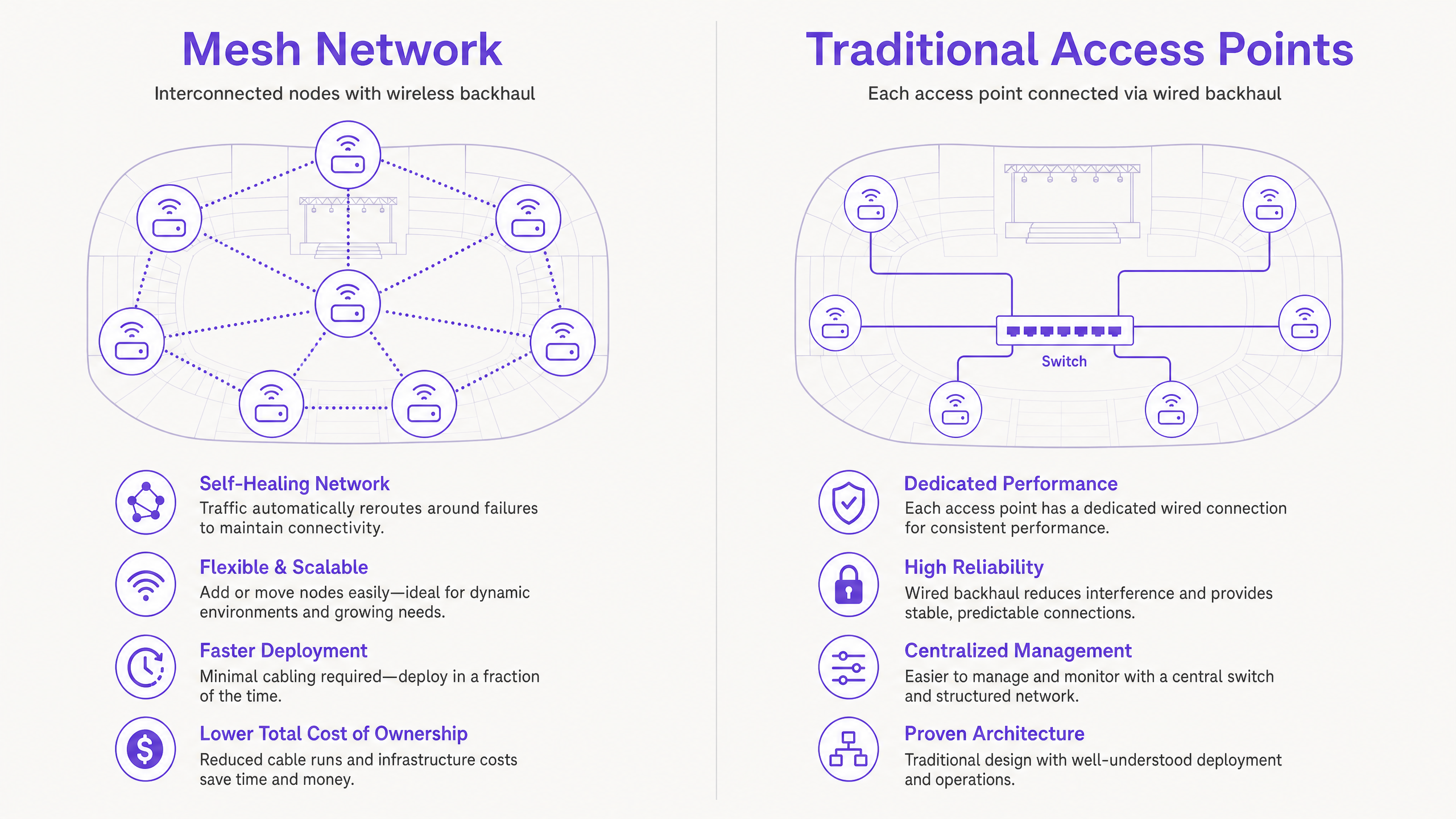
पारंपारिक डिप्लॉयमेंटमध्ये, प्रत्येक ॲक्सेस पॉईंट एज किंवा कोअर स्विचशी हार्डवायर्ड असतो, सामान्यतः Cat6 किंवा Cat6a केबलिंग वापरून 8P8C (RJ-45) कनेक्टरला जोडलेला असतो. हे वायर्ड बॅकहॉल सुनिश्चित करते की AP च्या रेडिओ फ्रिक्वेन्सी (RF) क्षमतेपैकी 100% क्लायंट डिव्हाइसेसना सेवा देण्यासाठी समर्पित आहे.
थ्रुपुट आणि लेटन्सी: बॅकहॉल ट्रॅफिक पूर्णपणे फिजिकल वायरद्वारे हाताळले जात असल्याने, पारंपारिक APs निश्चित, मल्टी-गिगाबिट थ्रुपुट प्रदान करतात. आधुनिक Wi-Fi 6 (IEEE 802.11ax) APs अनेक स्पॅशियल स्ट्रीम्सवर 9.6 Gbps पर्यंत एकत्रित थ्रुपुटला समर्थन देतात आणि Wi-Fi 7 (IEEE 802.11be) मल्टी-लिंक ऑपरेशन (MLO) सह याला आणखी पुढे नेते. हे आर्किटेक्चर उच्च-घनतेच्या वातावरणासाठी आवश्यक आहे जिथे सब-10ms लेटन्सी गंभीर आहे — पॉइंट-ऑफ-सेल (POS) सिस्टम, रिअल-टाइम ॲनालिटिक्स डॅशबोर्ड आणि VoWLAN डिप्लॉयमेंट सर्व यावर अवलंबून असतात.
पॉवर आणि इन्फ्रास्ट्रक्चर: या दृष्टिकोनासाठी मजबूत पॉवर ओव्हर इथरनेट (PoE) इन्फ्रास्ट्रक्चर आवश्यक आहे. पूर्ण रेडिओ चेन्स असलेले आधुनिक Wi-Fi 6 आणि Wi-Fi 7 APs पूर्ण क्षमतेने कार्य करण्यासाठी अनेकदा PoE+ (IEEE 802.3at, 30W) किंवा PoE++ (IEEE 802.3bt, 90W पर्यंत) आवश्यक असतात, ज्यामुळे कोणत्याही हार्डवेअर रिफ्रेशपूर्वी स्विच पोर्ट आणि पॉवर बजेटचे काळजीपूर्वक नियोजन करणे आवश्यक होते.
सुरक्षा स्थिती: वायर्ड बॅकहॉल्स स्वाभाविकपणे फिजिकल अटॅक सरफेस कमी करतात. IEEE 802.1X पोर्ट-आधारित प्रमाणीकरण आणि WPA3-एंटरप्राइझ एन्क्रिप्शनसह एकत्रित केल्यास, हे आर्किटेक्चर PCI DSS आणि GDPR अनुपालनासाठी सर्वात मजबूत बेसलाइन प्रदान करते.
मेश नेटवर्क आर्किटेक्चर
मेश नेटवर्क वायर्ड बॅकहॉलला वायरलेस लिंक्सने बदलतात. एक सामान्य एंटरप्राइझ डिप्लॉयमेंटमध्ये वायर्ड LAN शी जोडलेला एक रूट नोड असतो, जो ठिकाणाभोवती वितरित केलेल्या सॅटेलाइट नोड्सना वायरलेस पद्धतीने डेटा प्रसारित करतो.
हाफ-डुप्लेक्स दंड: Wi-Fi स्वाभाविकपणे हाफ-डुप्लेक्स आहे. एका मानक ड्युअल-बँड मेश सिस्टममध्ये, रेडिओने क्लायंट डिव्हाइसला सेवा देणे आणि साखळीतील पुढील नोडला ट्रॅफिक रिले करणे या दरम्यान पर्यायीपणे कार्य केले पाहिजे. प्रत्येक वायरलेस हॉप प्रभावीपणे उपलब्ध थ्रुपुट अर्धे करते आणि 1-5ms अतिरिक्त लेटन्सी जोडते. हजारो समवर्ती वापरकर्त्यांसह उच्च-घनतेच्या वातावरणात, ही लेटन्सी वेगाने वाढते आणि ऑपरेशनलदृष्ट्या महत्त्वपूर्ण बनते.
ट्राय-बँड शमन: एंटरप्राइझ-ग्रेड मेश सिस्टम्स समर्पित तिसऱ्या रेडिओचा — सामान्यतः 5GHz किंवा 6GHz (Wi-Fi 6E) स्पेक्ट्रममध्ये कार्यरत — केवळ बॅकहॉल ट्रॅफिकसाठी वापर करून हे कमी करतात. यामुळे बॅकहॉलला क्लायंट-फेसिंग रेडिओशी एअरटाइमसाठी स्पर्धा करण्यापासून प्रतिबंध होतो. यामुळे ग्राहक-श्रेणीच्या मेशपेक्षा कार्यक्षमतेत लक्षणीय सुधारणा होत असली तरी, ते अजूनही मौल्यवान RF स्पेक्ट्रम वापरते आणि दाट वातावरणात वायर्ड कनेक्शनच्या कच्च्या, निश्चित क्षमतेशी जुळू शकत नाही.
सेल्फ-हीलिंग टोपोलॉजी: मेशचा एक महत्त्वाचा लवचिकता फायदा म्हणजे त्याची सेल्फ-हीलिंग क्षमता. जर एखाद्या सॅटेलाइट नोडने त्याची प्राथमिक बॅकहॉल लिंक गमावली, तर ते आपोआप शेजारच्या नोडद्वारे ट्रॅफिक पुनर्निर्देशित करू शकते. हे डायनॅमिक किंवा तात्पुरत्या ठिकाणांच्या कॉन्फिगरेशनमध्ये विशेषतः मौल्यवान आहे जिथे शारीरिक व्यत्यय येण्याची शक्यता असते.
बाजू-बाजूने कार्यक्षमतेची तुलना
| गुणधर्म | पारंपारिक वायर्ड APs | एंटरप्राइझ मेश नेटवर्क |
|---|---|---|
| बॅकहॉल प्रकार | वायर्ड (Cat6/Cat6a) | वायरलेस (समर्पित रेडिओ) |
| प्रति AP थ्रुपुट | 9.6 Gbps पर्यंत (Wi-Fi 6) | प्रति हॉप ~50% ने कमी होते |
| लेटन्सी | 5ms पेक्षा कमी (निश्चित) | 5–20ms (परिवर्तनीय) |
| डिप्लॉयमेंट वेग | धीमा (केबलिंग आवश्यक) | जलद (फक्त पॉवर) |
| CapEx | उच्च (केबलिंग + स्विचेस) | कमी (किमान केबलिंग) |
| OpEx | कमी (उच्च विश्वसनीयता) | मध्यम (RF ट्यूनिंग) |
| उच्च-घनता उपयुक्तता | उत्कृष्ट | मर्यादित |
| लवचिकता / स्केलेबिलिटी | कमी (निश्चित केबल रन) | उच्च (नोडची जागा बदलणे) |
| PCI DSS / GDPR अनुपालन | सरळ | कॉन्फिगरेशनसह साध्य करण्यायोग्य |
अंमलबजावणी मार्गदर्शक
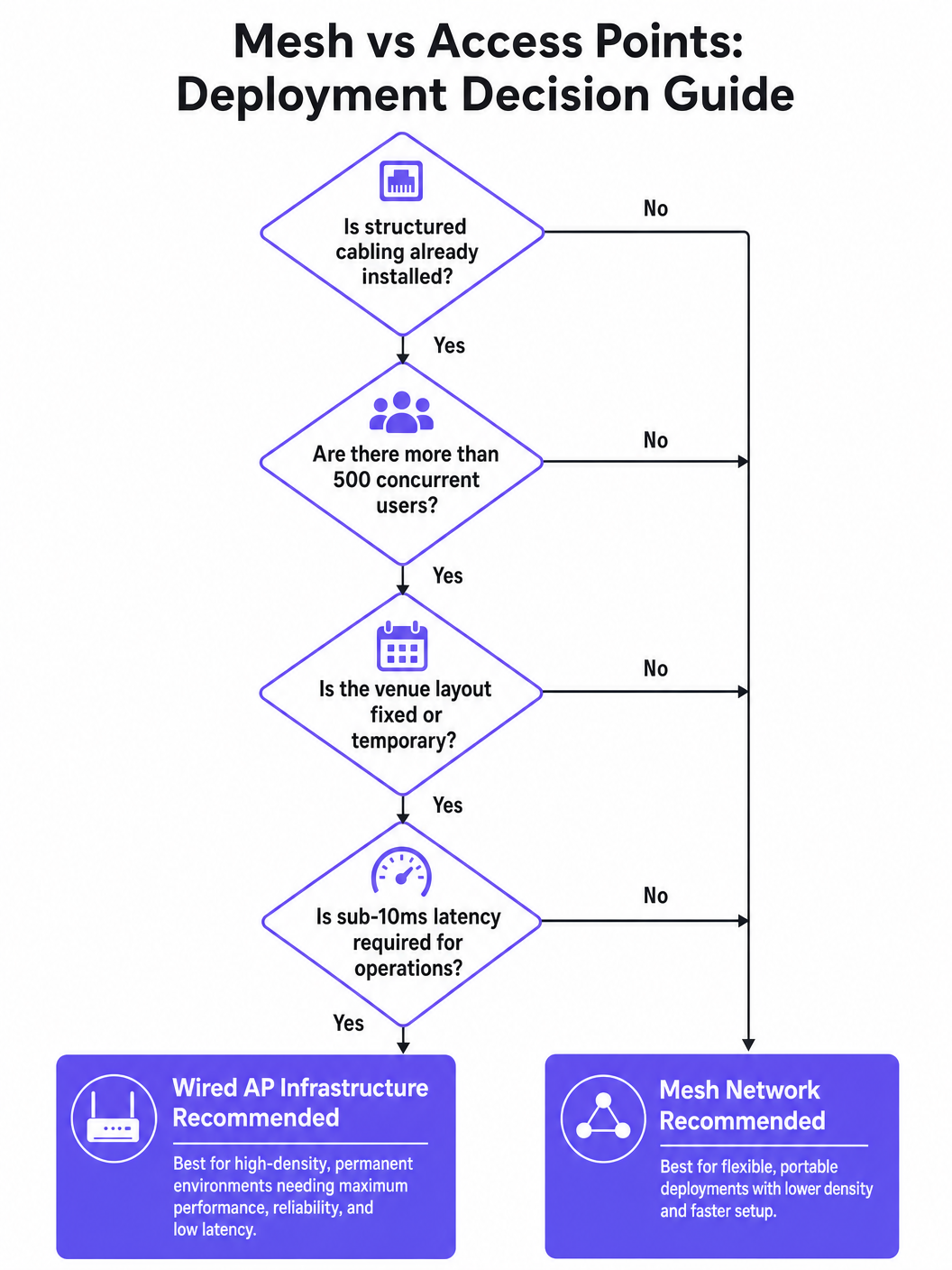
पायरी 1: RF प्रेडिक्टिव्ह सर्वेक्षण आणि घनता मॅपिंग
हार्डवेअर निवडण्यापूर्वी, Ekahau Pro किंवा iBwave सारख्या साधनांचा वापर करून प्रेडिक्टिव्ह RF साइट सर्वेक्षण करा. तुमच्या ठिकाणाचे विशिष्ट झोनमध्ये मॅपिंग करा:
- उच्च-घनता झोन: कॉन्फरन्स हॉल, स्टेडियममधील आसन व्यवस्था, हॉटेल लॉबी, रिटेल चेकआउट क्षेत्रे. यांना वायर्ड APs आवश्यक आहेत.
- मध्यम-घनता झोन: हॉटेल कॉरिडॉर, रिटेल फ्लोअर स्पेस, ऑफिस विंग्स. वायर्ड APs पसंत; मेश व्यवहार्य.
- वायर्ड करणे कठीण / तात्पुरते झोन: आउटडोअर पॅटिओस, ऐतिहासिक इमारतींचे विंग्स, तात्पुरत्या कार्यक्रमांची ठिकाणे. मेश हे व्यावहारिक आहे.योग्य निवड.
पायरी 2: आर्किटेक्चर निवड आणि हायब्रीड डिझाइन
बहुतेक मोठ्या ठिकाणांसाठी, हायब्रीड आर्किटेक्चर हा सर्वोत्तम पर्याय आहे: उच्च-घनतेच्या मुख्य भागात वायर्ड APs आणि परिघीय किंवा प्रतिबंधित क्षेत्रांमध्ये कव्हरेज वाढवणारे मेश नोड्स. हा दृष्टिकोन भांडवली कार्यक्षमता आणि कार्यप्रदर्शन यांच्यात संतुलन साधतो.
पायरी 3: बॅकहॉल इन्फ्रास्ट्रक्चरचे आकारमान
वायर्ड डिप्लॉयमेंटसाठी, तुमच्या एज स्विचमध्ये पुरेसे PoE बजेट असल्याची खात्री करा. 90W प्रति-पोर्ट बजेट आणि कोअरला 2.5GbE किंवा 10GbE अपलिंक असलेला 48-पोर्ट PoE++ स्विच हे आधुनिक Wi-Fi 6/7 डिप्लॉयमेंटसाठी शिफारस केलेले बेसलाइन आहे. मेशसाठी, सर्व सॅटेलाइट नोड्समधून एकत्रित ट्रॅफिक हाताळण्यासाठी रूट नोड्स मल्टी-गिगाबिट अपलिंक्सद्वारे जोडलेले असल्याची खात्री करा.
पायरी 4: सुरक्षा आणि अनुपालन कॉन्फिगरेशन
आर्किटेक्चर काहीही असो, खालील गोष्टी कॉन्फिगर करा:
- WPA3-Enterprise सर्व कॉर्पोरेट आणि ऑपरेशनल SSIDs वर.
- डिव्हाइस प्रमाणीकरणासाठी RADIUS सर्व्हरसह (उदा. FreeRADIUS, Cisco ISE, किंवा क्लाउड-होस्टेड समतुल्य) IEEE 802.1X.
- POS आणि बॅक-ऑफिस सिस्टममधून अतिथी ट्रॅफिक वेगळे करण्यासाठी VLAN segmentation. PCI DSS अनुपालनासाठी हे एक अनिवार्य नियंत्रण आहे.
- अनधिकृत APs शोधण्यासाठी आणि नियंत्रित करण्यासाठी Wireless Intrusion Prevention System (WIPS).
पायरी 5: प्लॅटफॉर्म एकत्रीकरण
हार्डवेअर लेयर हा पाया आहे, परंतु व्यवसायाचे मूल्य सॉफ्टवेअर लेयरवर अनलॉक होते. तुमच्या निवडलेल्या AP विक्रेत्याचे फर्मवेअर तुमच्या अतिथी WiFi आणि ॲनालिटिक्स प्लॅटफॉर्मसाठी आवश्यक असलेल्या API एकत्रीकरणांना समर्थन देते याची खात्री करा. Purple चे प्लॅटफॉर्म हार्डवेअर-अज्ञेयवादी आहे, जे Cisco Meraki, Aruba, Ruckus आणि Ubiquiti यासह प्रमुख विक्रेत्यांना समर्थन देते. यामुळे तुम्ही अतिथी डेटा कॅप्चर करू शकता, Captive Portal प्रवास चालवू शकता आणि तुमच्या अंतर्निहित हार्डवेअर निवडीची पर्वा न करता WiFi Analytics डॅशबोर्डला फीड करू शकता. व्यवस्थापन आर्किटेक्चर यावर कसा परिणाम करते हे सखोलपणे पाहण्यासाठी, Comparing Controller-Based vs. Cloud-Managed Access Points पहा.
सर्वोत्तम पद्धती
मेश हॉप्स तीनपर्यंत मर्यादित ठेवा. असे मेश नेटवर्क कधीही डिझाइन करू नका ज्याला सॅटेलाइट नोडपासून रूट नोडपर्यंत तीनपेक्षा जास्त वायरलेस हॉप्सची आवश्यकता असेल. तीन हॉप्सच्या पलीकडे, एंटरप्राइझ ॲप्लिकेशन्ससाठी विलंबता अस्वीकार्य होते आणि थ्रूपुट इतके कमी होते की वापरकर्त्याच्या अनुभवावर लक्षणीय परिणाम होतो.
कोणत्याही हार्डवेअर रिफ्रेशपूर्वी PoE बजेट ऑडिट करा. एज स्विच अपग्रेड न करता Wi-Fi 6 किंवा Wi-Fi 7 APs मध्ये अपग्रेड करणे ही एक सामान्य आणि महागडी चूक आहे. नवीन APs ना अनेकदा PoE++ (802.3bt) ची आवश्यकता असते, तर सध्याचे स्विच फक्त PoE+ (802.3at) ला समर्थन देऊ शकतात, ज्यामुळे लोडखाली APs रीबूट होतात.
सर्व SSIDs वर WPA3 चे मानकीकरण करा. WPA3 चे Simultaneous Authentication of Equals (SAE) हँडशेक WPA2 मध्ये असलेल्या KRACK आणि डिक्शनरी-अटॅक असुरक्षितता दूर करते. GDPR अंतर्गत पेमेंट डेटा किंवा संवेदनशील वैयक्तिक डेटा हाताळणाऱ्या ठिकाणांसाठी, ही एक गैर-वाटाघाटी करण्यायोग्य बेसलाइन आहे.
मेश बॅकहॉल लिंक्सना गंभीर पायाभूत सुविधा म्हणून माना. मेश डिप्लॉयमेंटमध्ये, नोड्समधील वायरलेस लिंक केबलइतकीच महत्त्वाची असते. बॅकहॉल लिंकची गुणवत्ता (RSSI, SNR, आणि MCS दर) सतत निरीक्षण करा. खराब झालेली बॅकहॉल लिंक डाउनस्ट्रीमशी कनेक्ट केलेल्या प्रत्येक क्लायंटची कार्यक्षमता शांतपणे कमी करेल.
विक्रेता वाटाघाटीसाठी हार्डवेअर अज्ञेयवादाचा लाभ घ्या. सॉफ्टवेअर व्यवस्थापन लेयर (Purple चे प्लॅटफॉर्म) हार्डवेअर लेयरपासून वेगळे करून, तुम्ही रिफ्रेश सायकलमध्ये हार्डवेअर विक्रेते बदलण्याची क्षमता कायम ठेवता. हा स्पर्धात्मक फायदा सामान्यतः 5 वर्षांच्या TCO कालावधीत हार्डवेअर खर्च 15-25% ने कमी करतो.
समस्यानिवारण आणि जोखीम कमी करणे
सामान्य अपयश पद्धती
लपलेल्या नोडची समस्या. मेश नेटवर्कमध्ये, जर दोन सॅटेलाइट नोड्स एकमेकांना 'ऐकू' शकत नसतील परंतु दोन्ही एकाच वेळी एकाच रूट नोडला प्रसारित करत असतील, तर पॅकेट टक्कर होतात, ज्यामुळे थ्रूपुट नष्ट होते. RF वातावरण जटिल असलेल्या ठिकाणी हे विशेषतः सामान्य आहे. शमन: काळजीपूर्वक RF ट्यूनिंग, ट्रान्समिट पॉवर लेव्हल्स समायोजित करणे आणि RTS/CTS (Request to Send/Clear to Send) यंत्रणा वापरणे.
PoE बजेटची समाप्ती. वर नमूद केल्याप्रमाणे, लेगसी PoE इन्फ्रास्ट्रक्चरवर नवीन उच्च-शक्तीचे APs डिप्लॉय केल्याने लोडखाली अधूनमधून रीबूट होतात. शमन: डिप्लॉयमेंटपूर्वी पूर्ण PoE बजेट ऑडिट करा. स्विचच्या एकूण PoE बजेटच्या तुलनेत सर्व कनेक्ट केलेल्या डिव्हाइसेसचा एकूण सर्वात वाईट-केस पॉवर ड्रॉ मोजा.
अनधिकृत AP हस्तक्षेप. त्याच एअरस्पेसमध्ये प्रसारित होणारी अनियंत्रित ग्राहक-श्रेणीची उपकरणे — विशेषतः अशा ठिकाणी जिथे प्रदर्शक किंवा भाडेकरू स्वतःची उपकरणे आणतात — मेश बॅकहॉल आणि क्लायंट ॲक्सेस दोन्हीची गुणवत्ता गंभीरपणे कमी करतील. शमन: सतत WIPS स्कॅनिंग लागू करा आणि अनधिकृत वायरलेस उपकरणांना प्रतिबंधित करणारी स्पष्ट धोरण अंमलात आणा.
डेड झोनमध्ये मेश नोडची स्थापना. एक सामान्य डिप्लॉयमेंट त्रुटी म्हणजे मेश सॅटेलाइट नोडला कव्हरेज डेड झोनमध्ये ठेवणे, जे दुरुस्त करण्यासाठी ते आहे. जर नोडला मजबूत बॅकहॉल सिग्नल मिळू शकत नसेल, तर ते चांगले क्लायंट कव्हरेज देऊ शकत नाही. शमन: सॅटेलाइट नोडला रूट नोड आणि डेड झोनच्या मध्यभागी ठेवा, जिथे बॅकहॉल सिग्नल मजबूत आहे, आणि डेड झोनपर्यंत पोहोचण्यासाठी सॅटेलाइटच्या क्लायंट-फेसिंग रेडिओवर अवलंबून रहा.
ROI आणि व्यवसायावर परिणाम
तुमच्या वायरलेस इन्फ्रास्ट्रक्चरच्या ROI चे मूल्यांकन करताना, हार्डवेअरच्या प्रारंभिक CapEx च्या पलीकडे पहा.
| खर्च श्रेणी | पारंपारिक वायर्ड APs | मेश नेटवर्क |
|---|---|---|
| हार्डवेअर CapEx | मध्यम | कमी |
| केबलिंग CapEx | उच्च ($150–$300/ड्रॉप) | किमान |
| स्थापना श्रम | उच्च | कमी |
| चालू RF ट्यूनिंग OpEx | कमी | मध्यम |
| हार्डवेअर जीवनचक्र | 5–7 वर्षे | 3–5 वर्षे |
| डाउनटाइम धोका | कमी | मध्यम |
300 APs डिप्लॉय करणाऱ्या 500 खोल्यांच्या हॉटेलसाठी, पारंपारिक डिप्लॉयमेंटसाठी फक्त केबलिंगचा खर्च £60,000–£90,000 पर्यंत पोहोचू शकतो. त्याच ठिकाणी मेश डिप्लॉयमेंटमुळे हा खर्च £10,000 च्या खाली येऊ शकतो, जो एक महत्त्वपूर्णमोठी कॅपेक्स बचत — जर कार्यक्षमतेतील तडजोड वापरासाठी स्वीकार्य असेल.
अखेरीस, पायाभूत सुविधा डेटासाठी एक माध्यम आहे. एक मजबूत, सु-डिझाइन केलेले नेटवर्क — वायर्ड असो, मेश असो किंवा हायब्रिड असो — ठिकाणांना कृतीयोग्य अतिथी विश्लेषणे मिळवण्यास, वैयक्तिकृत मार्केटिंग करण्यास आणि कार्यात्मक कार्यक्षमता सुधारण्यास सक्षम करते. Purple च्या Guest WiFi सारखे प्लॅटफॉर्म नेटवर्कला खर्च केंद्रातून महसूल-उत्पन्न करणाऱ्या मालमत्तेत रूपांतरित करतात. या डेटाचा लाभ घेण्यासाठी व्यावहारिक धोरणांसाठी, अतिथी समाधान कसे सुधारावे: अंतिम प्लेबुक पहा. अखंड, पासवर्डविना प्रमाणीकरणाकडे होणारी प्रगती हे मूल्य आणखी वाढवते, जसे 2026 मध्ये wi fi assistant पासवर्डविना प्रवेश कसा सक्षम करतो यात शोधले आहे.
सार्वजनिक क्षेत्रातील ठिकाणांसाठी आणि स्मार्ट सिटी उपयोजनांसाठी, नेटवर्क पायाभूत सुविधा डिजिटल समावेशक उपक्रमांमध्ये एक मूलभूत भूमिका बजावते, ही एक धोरणात्मक प्राथमिकता आहे जी Purple सक्रियपणे पुढे नेत आहे, जसे डिजिटल समावेशकता आणि स्मार्ट सिटी नवोपक्रम चालवण्यासाठी Purple ने इयान फॉक्स यांची सार्वजनिक क्षेत्राचे VP ग्रोथ म्हणून नियुक्ती केली यात दिसून येते.
ऑडिओ ब्रीफिंग
आमच्या वरिष्ठ सोल्युशन्स आर्किटेक्टला या 10 मिनिटांच्या तांत्रिक ब्रीफिंगमध्ये आर्किटेक्चरल बारकावे चर्चा करताना ऐका:
महत्वाच्या व्याख्या
Wireless Backhaul
The use of wireless communication to transmit data from an access point back to the core network, rather than using a physical Ethernet cable.
The defining characteristic of a mesh network. Saves cabling costs and enables flexible deployment but consumes RF spectrum and introduces latency.
Tri-Band Radio
An access point equipped with three separate radios — typically one 2.4GHz and two 5GHz or 6GHz radios — allowing one radio to be dedicated exclusively to wireless backhaul traffic.
Essential for enterprise mesh networks. Without a dedicated backhaul radio, client-facing throughput is severely degraded as the AP must share its radios between serving clients and relaying traffic.
Deterministic Performance
Network behaviour where latency and throughput are predictable and consistent, regardless of minor environmental changes or load fluctuations.
A key advantage of wired Access Points, critical for applications like Voice over WLAN (VoWLAN), real-time POS systems, and any latency-sensitive operational technology.
Root Node
The access point in a mesh network that has a physical wired connection to the LAN and acts as the gateway for all downstream wireless satellite nodes.
Proper placement and sizing of root nodes are critical to prevent bottlenecks. The root node's uplink capacity sets the ceiling for all downstream mesh traffic.
Power over Ethernet (PoE)
An IEEE standard (802.3af/at/bt) that allows Ethernet cables to transmit both data and electrical power simultaneously to connected devices such as access points.
A major planning consideration for wired AP deployments. IT teams must ensure their switches have sufficient PoE budgets (PoE+ at 30W or PoE++ at up to 90W) to support modern Wi-Fi 6/7 hardware.
IEEE 802.1X
An IEEE standard for port-based network access control, providing an authentication mechanism to devices attempting to connect to a LAN or WLAN via a RADIUS server.
Crucial for enterprise security and compliance. Ensures only authorised devices and users can access corporate network segments, a baseline requirement for PCI DSS and ISO 27001 compliance.
VLAN Segmentation
The practice of dividing a single physical network into multiple logical networks (VLANs) to isolate traffic between different user groups or systems.
Mandatory for PCI DSS compliance. Guest WiFi traffic must be completely isolated from payment terminals and back-office systems. Failure to segment correctly is one of the most common PCI audit failures.
Multi-Link Operation (MLO)
A key feature of Wi-Fi 7 (IEEE 802.11be) that allows a device to simultaneously transmit and receive data across multiple frequency bands (e.g., 2.4GHz, 5GHz, and 6GHz) at the same time.
Significantly increases throughput and reduces latency for supported client devices. Particularly relevant for high-density venue planning as Wi-Fi 7 infrastructure becomes more prevalent.
Wireless Intrusion Prevention System (WIPS)
A security system that monitors the wireless radio spectrum for the presence of unauthorised access points and takes automated countermeasures to contain them.
Essential for venues where exhibitors, tenants, or guests may bring their own wireless devices. Rogue APs are a significant source of both RF interference and security risk.
सोडवलेली उदाहरणे
A 400-room historic hotel needs to provide wall-to-wall WiFi. The main lobby and conference centre have drop ceilings, but the guest wings feature solid concrete walls where drilling new cable runs is prohibited by heritage preservation rules. The hotel also needs to capture guest data for its CRM and loyalty programme.
Deploy a hybrid architecture. Install traditional wired Wi-Fi 6 Access Points (e.g., Aruba AP-635 or Cisco Catalyst 9136) in the lobby and conference centre, where high density demands maximum throughput and drop ceilings allow for easy Cat6a routing. For the guest wings, deploy a tri-band enterprise mesh network with root nodes installed in the hallways at existing legacy Ethernet drops, and wireless satellite nodes placed in corridor alcoves to propagate signal without drilling. Configure a single SSID with 802.1X authentication across both wired and mesh APs, with a captive portal managed by Purple's Guest WiFi platform. VLAN 10 for guest traffic, VLAN 20 for management. Ensure the mesh nodes support the Purple API integration for analytics data capture.
A large outdoor music festival expects 20,000 attendees over a 3-day weekend across a 15-hectare greenfield site. The site has no existing infrastructure. POS vendors require sub-50ms latency for transaction processing. The event organiser also wants to offer branded guest WiFi with a splash page for sponsor activation.
Deploy a Point-to-Multipoint (PtMP) wireless backhaul from the production compound to light towers around the festival grounds using 5GHz or 60GHz directional radios. At each light tower, install a root mesh node connected to the PtMP radio via a short Cat6 run. Deploy 1–2 satellite mesh nodes per zone for area fill. Segment POS traffic onto a dedicated, hidden SSID (VLAN 30) with strict QoS priority (DSCP EF marking) over guest traffic. Deploy a separate branded guest SSID (VLAN 40) with a Purple captive portal for sponsor activation and guest data capture. Ensure all mesh nodes are powered via PoE from compact managed switches at each light tower, fed by the site's temporary power distribution.
सराव प्रश्न
Q1. Your team is deploying WiFi across a newly constructed 500,000 sq ft retail distribution centre. The facility features 40-foot ceilings and heavy metal racking. The primary use case is barcode scanners mounted on forklifts that require seamless roaming and sub-20ms latency to the inventory management server. Budget is not a constraint. Do you recommend a mesh network or traditional wired APs?
टीप: Consider the impact of heavy metal racking on RF propagation, the latency requirements of the barcode scanners, and the roaming behaviour of mobile devices on mesh vs wired networks.
नमुना उत्तर पहा
Traditional wired APs are the clear recommendation. The heavy metal racking will cause significant multipath interference and signal attenuation, which would severely degrade the wireless backhaul links of a mesh network. Furthermore, the strict sub-20ms latency requirement for the barcode scanners demands the deterministic performance of a wired backhaul. Use directional antennas mounted high in the aisles to direct the signal down between the racks. Implement 802.11r (Fast BSS Transition) and 802.11k/v (neighbour reports and BSS transition management) on all APs to ensure seamless roaming for the forklift-mounted scanners.
Q2. A boutique hotel is expanding by converting an adjacent 19th-century townhouse into 15 luxury suites. The building owner refuses to allow any new conduit or visible cabling in the hallways or rooms. You have one existing Ethernet drop in the basement from the main building. How do you provide high-speed guest WiFi across all 15 suites?
टीप: You need to provide coverage across multiple floors without running new cables from the basement. Consider the backhaul path from the basement to the upper floors.
नमुना उत्तर पहा
Deploy a tri-band enterprise mesh network. Connect the root node to the single Ethernet drop in the basement. Place satellite nodes strategically on each floor, positioned as close to vertical alignment above the root node as possible to establish a strong wireless backhaul through the floorboards. The tri-band system ensures the dedicated 6GHz backhaul radio does not interfere with the 5GHz client access radios, providing sufficient bandwidth for the luxury suites. Integrate with Purple's Guest WiFi platform to deliver a branded captive portal experience and capture guest data for the hotel's CRM.
Q3. You are upgrading a 60,000-capacity stadium's WiFi to support concurrent fan connectivity. The previous deployment used a mix of wired APs and mesh nodes, but fans consistently reported unusable speeds during halftime. A full rip-and-replace budget has been approved. What is the core architectural strategy and what was the likely cause of the halftime performance failure?
टीप: High density is the primary constraint. What happens to mesh backhaul capacity when thousands of clients simultaneously attempt to upload content?
नमुना उत्तर पहा
The halftime performance failure was almost certainly caused by the mesh nodes' wireless backhaul links being saturated by the sudden surge in concurrent client traffic — thousands of fans simultaneously uploading photos and videos to social media. The wireless backhaul, already consuming RF spectrum, was overwhelmed. The core strategy for the replacement must be a 100% traditional wired AP architecture utilising Wi-Fi 6 or Wi-Fi 7 access points with high-density directional antennas deployed under seats or in overhanging fascia positions. Every AP must have a dedicated multi-gigabit wired connection back to the core. Mesh nodes have no place in a 60,000-capacity stadium deployment.