
Mesh Network vs Access Points: quale è meglio per i grandi spazi?
Questa guida tecnica offre un confronto definitivo tra le reti mesh e i tradizionali access point cablati per spazi di grandi dimensioni, coprendo l'architettura, i compromessi in termini di prestazioni e la strategia di implementazione. Fornisce a IT manager, architetti di rete e CTO i framework operativi per progettare infrastrutture WiFi ad alte prestazioni e conformi alle normative per i settori hospitality, retail, eventi e settore pubblico. La guida associa inoltre queste decisioni architetturali alla piattaforma di guest WiFi e analytics di Purple, indipendente dall'hardware, dimostrando come la scelta della giusta infrastruttura influenzi direttamente i risultati di business.
Video overview
Ascolta questa guida
Visualizza trascrizione del podcast
Parte della nostra serie principale: Guida al Guest WiFi →
Executive Summary
Per i responsabili IT e i CTO che gestiscono grandi spazi - stadi, catene di Retail , complessi Hospitality , hub di Transport e centri congressi - la scelta della giusta architettura wireless è una decisione di investimento ad alto rischio. Il dibattito tra l'implementazione di una rete mesh rispetto ai tradizionali Access Point (AP) cablati influisce fondamentalmente sulle spese in conto capitale (CapEx), sull'affidabilità operativa e sull'esperienza dell'utente finale.
Mentre gli AP tradizionali offrono prestazioni deterministiche e una larghezza di banda impareggiabile tramite backhaul Ethernet dedicati, le reti mesh offrono funzionalità di implementazione rapida e flessibilità in ambienti in cui la posa di cablaggi strutturati è proibitiva in termini di costi o fisicamente impossibile. Questa guida analizza le realtà tecniche di entrambe le architetture, offrendo schemi operativi per aiutarvi ad allineare la vostra strategia hardware con i requisiti specifici di densità, latenza e conformità della vostra sede. In modo cruciale, la scelta della giusta infrastruttura determina anche l'efficacia con cui potrete sfruttare piattaforme come il Guest WiFi e i WiFi Analytics per catturare i dati degli utenti e generare risultati aziendali misurabili.
Approfondimento Tecnico
Architettura Access Point Tradizionale
In un'implementazione tradizionale, ogni access point è cablato direttamente a uno switch edge o core, in genere utilizzando cavi Cat6 o Cat6a terminati con connettori 8P8C (RJ-45). Questo backhaul cablato garantisce che il 100% della capacità di radiofrequenza (RF) dell'AP sia dedicata al servizio dei dispositivi client.
Larghezza di banda e latenza: Poiché il traffico di backhaul è gestito interamente dal cavo fisico, gli AP tradizionali forniscono una larghezza di banda deterministica e multi-gigabit. I moderni AP Wi-Fi 6 (IEEE 802.11ax) supportano fino a 9,6 Gbps di larghezza di banda aggregata su più flussi spaziali, e Wi-Fi 7 (IEEE 802.11be) spinge oltre questa soglia grazie alla tecnologia Multi-Link Operation (MLO). Questa architettura è essenziale per ambienti ad alta densità in cui una latenza inferiore a 10 ms è fondamentale - i sistemi di punto vendita (POS), le dashboard di analisi in tempo reale e le implementazioni VoWLAN dipendono tutti da essa.
Alimentazione e infrastruttura: Questo approccio richiede una robusta infrastruttura Power over Ethernet (PoE). I moderni AP Wi-Fi 6 e Wi-Fi 7 con catene radio complete richiedono spesso PoE+ (IEEE 802.3at, 30W) o PoE++ (IEEE 802.3bt, fino a 90W) per funzionare a piena capacità, richiedendo un'attenta pianificazione delle porte dello switch e del budget energetico prima di qualsiasi aggiornamento hardware.
Postura di sicurezza: I backhaul cablati riducono intrinsecamente la superficie di attacco fisica. Combinata con l'autenticazione basata su porta IEEE 802.1X e la crittografia WPA3-Enterprise, questa architettura offre la base più solida per la conformità PCI-DSS e GDPR.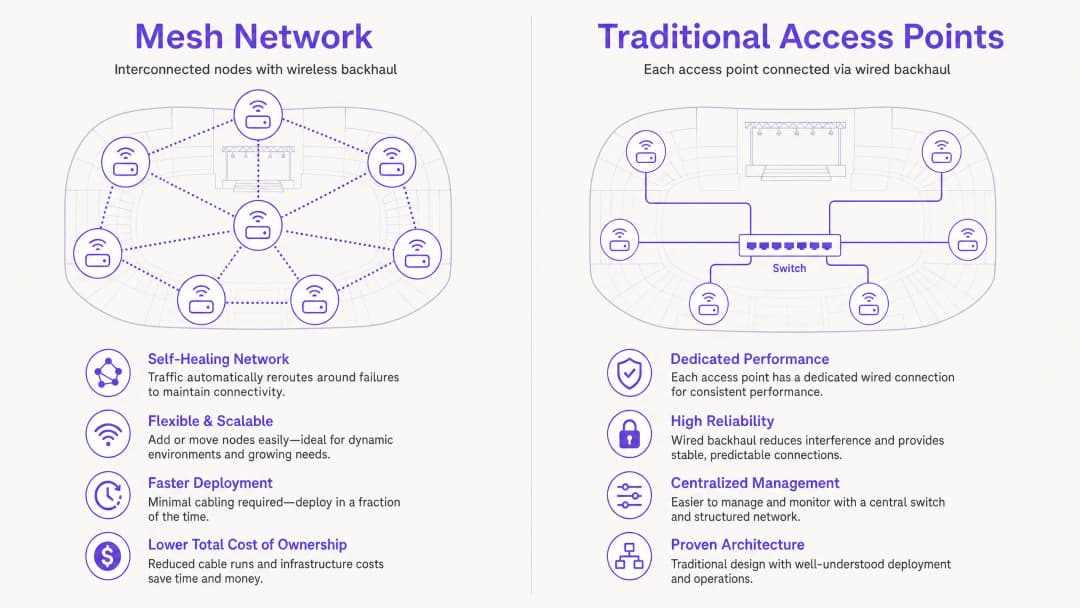
Architettura di rete Mesh
Le reti mesh sostituiscono il backhaul cablato con collegamenti wireless. Una tipica implementazione aziendale consiste in un nodo radice collegato alla LAN cablata, che trasmette in modalità wireless i dati ai nodi satelliti distribuiti in tutta la struttura.
La penalità del Half-Duplex: Il WiFi è intrinsecamente half-duplex. In un sistema mesh dual-band standard, la radio deve alternarsi tra il servizio al dispositivo client e il rilancio del traffico al nodo successivo della catena. Ogni hop wireless dimezza effettivamente il throughput disponibile e aggiunge 1 - 5 ms di latenza aggiuntiva. In un ambiente ad alta densità con migliaia di utenti simultanei, questa latenza si accumula rapidamente e diventa operativamente significativa.
Mitigazione Tri-Band: I sistemi mesh di livello aziendale mitigano questo problema utilizzando una terza radio dedicata - che opera tipicamente nello spettro a 5GHz o 6GHz (WiFi 6E) - esclusivamente per il traffico di backhaul. Ciò impedisce al backhaul di competere per il tempo di trasmissione con le radio rivolte ai client. Sebbene questo migliori significativamente le prestazioni rispetto al mesh di livello consumer, consuma comunque prezioso spettro RF e non può eguagliare la capacità grezza e deterministica di una connessione cablata in un ambiente denso.
Topologia autorigenerante: Un vantaggio fondamentale in termini di resilienza del mesh è la sua capacità di autorigenerazione. Se un nodo satellite perde il suo collegamento di backhaul primario, può reindirizzare automaticamente il traffico attraverso un nodo adiacente. Ciò è particolarmente utile in configurazioni di spazi dinamici o temporanei in cui è probabile che si verifichino interruzioni fisiche.
Confronto delle prestazioni affiancato
| Attributo | AP cablati tradizionali | Rete Mesh aziendale |
|---|---|---|
| Tipo di Backhaul | Cablato (Cat6/Cat6a) | Wireless (radio dedicata) |
| Throughput per AP | Fino a 9,6 Gbps (WiFi 6) | Ridotto di circa il 50% per hop |
| Latenza | Sotto i 5 ms (deterministica) | 5 - 20 ms (variabile) |
| Velocità di implementazione | Lenta (cablaggio richiesto) | Rapida (solo alimentazione) |
| CapEx | Elevato (cablaggio + switch) | Inferiore (cablaggio minimo) |
| OpEx | Basso (alta affidabilità) | Moderato (ottimizzazione RF) |
| Idoneità ad alta densità | Eccellente | Limitata |
| Flessibilità / Scalabilità | Bassa (tratte di cavo fisse) | Alta (riposizionamento dei nodi) |
| Conformità PCI-DSS / GDPR | Semplice | Raggiungibile con la configurazione |
Hai domande sulla tua configurazione specifica?
Il nostro team collabora con gestori di sedi, responsabili IT e ingegneri di rete in 80.000 sedi. Prenota una chiamata di 20 minuti e ti mostreremo come altri professionisti come te hanno risolto il problema.
Guida all'implementazione
Passaggio 1: Rilevamento predittivo RF e mappatura della densità
Prima di selezionare l'hardware, commissiona un rilevamento predittivo RF del sito utilizzando strumenti come Ekahau Pro o iBwave. Mappa la tua struttura in zone distinte:
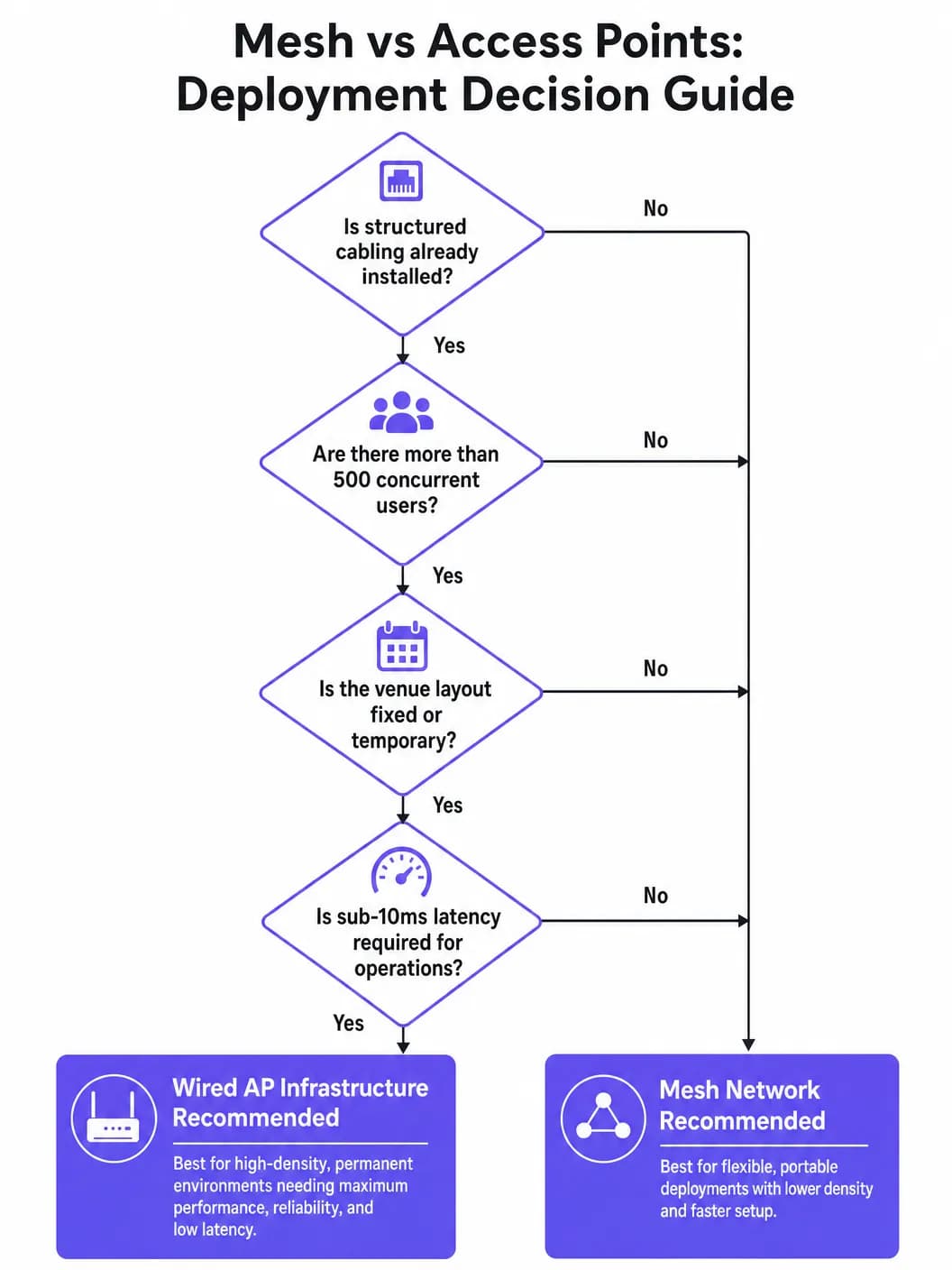
- Zone ad alta densità: Sale conferenze, tribune di stadi, hall di hotel, aree di cassa dei negozi. Queste richiedono AP cablati.
- Zone a media densità: Corridoi di hotel, spazi espositivi di negozi, ali di uffici. AP cablati preferibili; mesh praticabile.
- Zone difficili da cablare / temporanee: Patii esterni, ali di edifici storici, spazi per eventi temporanei. Il mesh è la scelta pratica.
Passaggio 2: Selezione dell'architettura e design ibrido
Per la maggior parte dei grandi spazi, un'architettura ibrida rappresenta il risultato ottimale: AP cablati nel nucleo ad alta densità e nodi mesh che estendono la copertura alle aree periferiche o vincolate. Questo approccio bilancia l'efficienza del capitale con le prestazioni.
Passaggio 3: Dimensionamento dell'infrastruttura di backhaul
Per le distribuzioni cablate, assicurati che i tuoi switch di bordo forniscano un budget PoE sufficiente. Uno switch PoE++ a 48 porte con un budget di 90 W per porta e un uplink a 2.5GbE o 10GbE verso il nucleo è la base consigliata per una moderna distribuzione Wi-Fi 6/7. Per il mesh, assicurati che i nodi radice siano connessi tramite uplink multi-gigabit per gestire il traffico aggregato da tutti i nodi satellite.
Passaggio 4: Configurazione di sicurezza e conformità
Indipendentemente dall'architettura, configura quanto segue:
- WPA3-Enterprise su tutti gli SSID aziendali e operativi.
- IEEE 802.1X con un server RADIUS (ad esempio, FreeRADIUS, Cisco ISE o un equivalente ospitato in cloud) per l'autenticazione dei dispositivi.
- Segmentazione VLAN per isolare il traffico degli ospiti dai sistemi POS e di back-office. Questo è un controllo obbligatorio per la conformità PCI-DSS.
- Wireless Intrusion Prevention System (WIPS) per rilevare e contenere AP non autorizzati.
Passaggio 5: Integrazione della piattaforma
Il livello hardware rappresenta la base, ma il valore aziendale si sblocca a livello software. Assicurati che il firmware del fornitore di AP scelto supporti le integrazioni API richieste dalla tua piattaforma di guest WiFi e analisi. La piattaforma di Purple è indipendente dall'hardware e supporta i principali fornitori, tra cui Cisco Meraki, Aruba, Ruckus e Ubiquiti. Ciò ti consente di acquisire i dati degli ospiti, gestire i percorsi del Captive Portal e alimentare i dashboard di WiFi Analytics indipendentemente dalla scelta dell'hardware sottostante. Per un'analisi più approfondita di come l'architettura di gestione influisca su questo aspetto, consulta Comparing Controller-Based vs. Cloud-Managed Access Points .
-
Best Practice
Limita i passaggi mesh a tre. Non progettare mai una rete mesh che richieda più di tre passaggi wireless da un nodo satellite al nodo radice. Oltre i tre passaggi, la latenza diventa inaccettabile per le applicazioni aziendali e il throughput si degrada a un punto tale da influire materialmente sull'esperienza utente.
Esegui un controllo del budget PoE prima di qualsiasi aggiornamento hardware. Aggiornare agli AP Wi-Fi 6 o Wi-Fi 7 senza aggiornare gli switch di bordo è un errore comune e costoso. I nuovi AP richiedono spesso PoE++ (802.3bt) mentre gli switch esistenti potrebbero supportare solo PoE+ (802.3at), causando il riavvio degli AP sotto carico. Standardizzare su WPA3 in tutti gli SSID. L'handshake Simultaneous Authentication of Equals (SAE) di WPA3 elimina le vulnerabilità KRACK e gli attacchi a dizionario presenti in WPA2. Per le strutture che gestiscono dati di pagamento o dati personali sensibili ai sensi del GDPR, questo è un requisito minimo non negoziabile.
Trattare i collegamenti di backhaul mesh come infrastruttura critica. In un'implementazione mesh, il collegamento wireless tra i nodi è importante tanto quanto un cavo. Monitora costantemente la qualità del collegamento di backhaul (RSSI, SNR e tasso MCS). Un collegamento di backhaul degradato ridurrà silenziosamente le prestazioni di ogni client connesso a valle.
Sfruttare l'agnosticismo hardware per la trattativa con i fornitori. Separando il livello di gestione software (la piattaforma di Purple) dal livello hardware, mantieni la possibilità di cambiare i fornitori di hardware durante i cicli di rinnovo. Questa leva competitiva riduce tipicamente i costi dell'hardware del 15 - 25% su un periodo TCO di 5 anni.
Risoluzione dei problemi e mitigazione dei rischi
Modalità di guasto comuni
Il problema del nodo nascosto. Nelle reti mesh, se due nodi satellite non si "sentono" a vicenda ma trasmettono entrambi allo stesso nodo radice contemporaneamente, si verificano collisioni di pacchetti che distruggono il throughput. Questo è particolarmente comune in ambienti con condizioni RF complesse. Mitigazione: Un'attenta sintonizzazione RF, la regolazione dei livelli di potenza di trasmissione e l'uso di meccanismi RTS/CTS (Request to Send/Clear to Send).
Esaurimento del budget PoE. Come indicato sopra, l'implementazione di nuovi AP ad alta potenza su infrastrutture PoE legacy causa riavvii intermittenti sotto carico. Mitigazione: Eseguire un audit completo del budget PoE prima dell'implementazione. Calcolare l'assorbimento di potenza totale nel peggiore dei casi di tutti i dispositivi connessi rispetto al budget PoE totale dello switch.
Interferenza da AP non autorizzati. I dispositivi consumer non gestiti che trasmettono nello stesso spazio aereo - in particolare nelle strutture in cui espositori o inquilini portano le proprie apparecchiature - degraderanno gravemente sia il backhaul mesh che l'accesso dei client. Mitigazione: Implementare la scansione WIPS continua e applicare una policy chiara che vieti i dispositivi wireless non autorizzati.
Posizionamento dei nodi mesh in zone d'ombra. Un errore di implementazione comune è posizionare un nodo satellite mesh nella zona d'ombra di copertura che si intende risolvere. Se il nodo non riesce a ricevere un segnale di backhaul forte, non può fornire una buona copertura per i client. Mitigazione: Posizionare il nodo satellite a metà strada tra il nodo radice e la zona d'ombra, dove il segnale di backhaul è forte, e fare affidamento sulle radio del satellite rivolte verso i client per raggiungere la zona d'ombra.
ROI e impatto aziendale
Quando si valuta il ROI della propria infrastruttura wireless, occorre guardare oltre il CapEx iniziale dell'hardware.
| Categoria di costo | AP cablati tradizionali | Rete mesh |
|---|---|---|
| CapEx hardware | Moderato | Inferiore |
| CapEx cablaggio | Alto ($150 - $300/punto rete) | Minimo |
| Manodopera per l'installazione | Alta | Bassa |
| OpEx di sintonizzazione RF continua | Bassa | Moderata |
| Ciclo di vita hardware | 5 - 7 anni | 3 - 5 anni |
| Rischio di inattività | Basso | Moderato |
Per un hotel di 500 camere che distribuisce 300 AP, il solo costo di cablaggio per un'installazione tradizionale può raggiungere i £60.000 - £90.000. Un'installazione mesh nella stessa struttura potrebbe ridurre questo costo a meno di £10.000, rappresentando un risparmio significativo in termini di CapEx - a condizione che il compromesso sulle prestazioni sia accettabile per il caso d'uso specifico.
In definitiva, l'infrastruttura è un mezzo per i dati. Una rete robusta e ben progettata - sia essa cablata, mesh o ibrida - consente alle strutture di raccogliere analytics utili sugli ospiti, guidare il marketing personalizzato e migliorare l'efficienza operativa. Piattaforme come il Guest WiFi di Purple trasformano la rete da centro di costo a risorsa in grado di generare ricavi. Per strategie pratiche su come sfruttare questi dati, consulta How To Improve Guest Satisfaction: The Ultimate Playbook . L'evoluzione verso un'autenticazione fluida e senza password aumenta ulteriormente questo valore, come analizzato in How a wi fi assistant Enables Passwordless Access in 2026 .
Per le strutture del settore pubblico e le installazioni di smart city, l'infrastruttura di rete svolge anche un ruolo fondamentale nelle iniziative di inclusione digitale, una priorità strategica che Purple sta guidando attivamente, come riflesso in Purple Appoints Iain Fox as VP Growth – Public Sector to Drive Digital Inclusion and Smart City Innovation .
Audio Briefing
Ascolta il nostro Senior Solutions Architect discutere le sfumature architetturali in questo briefing tecnico di 10 minuti:
Definizioni chiave
Backhaul wireless
L'uso della comunicazione wireless per trasmettere dati da un access point alla rete centrale, anziché utilizzare un cavo Ethernet fisico.
La caratteristica distintiva di una rete mesh. Consente di risparmiare sui costi di cablaggio e permette una distribuzione flessibile, ma consuma spettro RF e introduce latenza.
Tri-Band Radio
Un access point dotato di tre radio separate - in genere una a 2,4 GHz e due a 5 GHz o 6 GHz - che consente di dedicare una radio esclusivamente al traffico di backhaul wireless.
Essenziale per le reti mesh aziendali. Senza una radio di backhaul dedicata, la velocità di trasmissione verso i client risulta fortemente degradata, poiché l'AP deve condividere le proprie radio tra il servizio ai client e il rilancio del traffico.
Prestazioni Deterministiche
Comportamento di rete in cui la latenza e la velocità di trasmissione sono prevedibili e costanti, indipendentemente da lievi variazioni ambientali o fluttuazioni del carico.
Un vantaggio chiave degli Access Point cablati, fondamentale per applicazioni come Voice over WLAN (VoWLAN), sistemi POS in tempo reale e qualsiasi tecnologia operativa sensibile alla latenza.
Nodo Radice
L'access point in una rete mesh che dispone di una connessione cablata fisica alla LAN e funge da gateway per tutti i nodi satellite wireless a valle.
Il corretto posizionamento e dimensionamento dei nodi radice sono fondamentali per evitare colli di bottiglia. La capacità di uplink del nodo radice stabilisce il limite massimo per tutto il traffico mesh a valle.
Power over Ethernet (PoE)
Uno standard IEEE (802.3af/at/bt) che consente ai cavi Ethernet di trasmettere contemporaneamente sia dati che energia elettrica ai dispositivi collegati, come gli access point.
Un elemento di pianificazione fondamentale per le implementazioni di AP cablati. I team IT devono garantire che i propri switch dispongano di budget PoE sufficienti (PoE+ a 30W o PoE++ fino a 90W) per supportare il moderno hardware WiFi 6/7.
IEEE 802.1X
Uno standard IEEE per il controllo dell'accesso alla rete basato su porte, che fornisce un meccanismo di autenticazione ai dispositivi che tentano di connettersi a una LAN o WLAN tramite un server RADIUS.
Cruciale per la sicurezza aziendale e la conformità. Garantisce che solo i dispositivi e gli utenti autorizzati possano accedere ai segmenti della rete aziendale, un requisito di base per la conformità PCI-DSS e ISO 27001.
Segmentazione VLAN
La pratica di suddividere una singola rete fisica in più reti logiche (VLAN) per isolare il traffico tra diversi gruppi di utenti o sistemi.
Obbligatoria per la conformità PCI-DSS. Il traffico del WiFi per gli ospiti deve essere completamente isolato dai terminali di pagamento e dai sistemi di back-office. La mancata segmentazione corretta è uno dei motivi più comuni di fallimento degli audit PCI.
Multi-Link Operation (MLO)
Una funzionalità chiave del WiFi 7 (IEEE 802.11be) che consente a un dispositivo di trasmettere e ricevere dati contemporaneamente su più bande di frequenza (es. 2,4 GHz, 5 GHz e 6 GHz).
Aumenta significativamente la velocità di trasmissione e riduce la latenza per i dispositivi client supportati. Particolarmente rilevante per la pianificazione di sedi ad alta densità con la crescente diffusione delle infrastrutture WiFi 7.
Wireless Intrusion Prevention System (WIPS)
Un sistema di sicurezza che monitora lo spettro radio wireless per rilevare la presenza di access point non autorizzati e adotta contromisure automatizzate per contenerli.
Essenziale per i contesti in cui espositori, inquilini o ospiti possono portare i propri dispositivi wireless. Gli AP non autorizzati rappresentano una fonte significativa sia di interferenze RF che di rischi per la sicurezza.
Esempi pratici
Un hotel storico di 400 camere ha l'esigenza di fornire una copertura WiFi totale. La lobby principale e il centro congressi presentano controsoffitti, ma le ali dedicate alle camere degli ospiti sono caratterizzate da pareti in cemento pieno dove la perforazione per il passaggio di nuovi cavi è vietata dalle norme di tutela del patrimonio storico. L'hotel deve inoltre acquisire i dati degli ospiti per il proprio CRM e programma fedeltà.
Implementare un'architettura ibrida. Installare Access Points WiFi 6 cablati tradizionali (ad esempio, Aruba AP-635 o Cisco Catalyst 9136) nella lobby e nel centro congressi, dove l'elevata densità richiede il massimo throughput e i controsoffitti consentono un facile passaggio dei cavi Cat6a. Per le ali delle camere, implementare una rete mesh aziendale tri-band con nodi radice installati nei corridoi in corrispondenza delle prese Ethernet preesistenti e nodi satellite wireless posizionati nelle nicchie dei corridoi per propagare il segnale senza effettuare perforazioni. Configurare un unico SSID con autenticazione 802.1X sia sugli AP cablati sia su quelli mesh, con un Captive Portal gestito dalla piattaforma Guest WiFi di Purple. Configurare la VLAN 10 per il traffico ospiti e la VLAN 20 per la gestione. Assicurarsi che i nodi mesh supportino l'integrazione con le API di Purple per l'acquisizione dei dati analitici.
Un grande festival musicale all'aperto prevede l'afflusso di 20.000 partecipanti durante un fine settimana di 3 giorni su un'area verde di 15 ettari. Il sito è privo di infrastrutture preesistenti. I venditori POS richiedono una latenza inferiore a 50ms per l'elaborazione delle transazioni. L'organizzatore dell'evento desidera inoltre offrire un servizio Guest WiFi personalizzato con una splash page per l'attivazione degli sponsor.
Implementare un backhaul wireless Point-to-Multipoint (PtMP) dal centro di produzione alle torri faro dislocate nell'area del festival utilizzando radio direzionali a 5GHz o 60GHz. In corrispondenza di ciascuna torre faro, installare un nodo mesh radice connesso alla radio PtMP tramite un breve cavo Cat6. Distribuire da 1 a 2 nodi mesh satellite per zona per la copertura dell'area. Segmentare il traffico POS su un SSID dedicato e nascosto (VLAN 30) con una priorità QoS rigorosa (marcatura DSCP EF) rispetto al traffico ospiti. Distribuire un SSID guest separato e personalizzato (VLAN 40) con un Captive Portal di Purple per l'attivazione degli sponsor e l'acquisizione dei dati degli ospiti. Assicurarsi che tutti i nodi mesh siano alimentati tramite PoE da switch gestiti compatti situati su ciascuna torre faro, alimentati dalla rete di distribuzione elettrica temporanea del sito.
Domande di esercitazione
Q1. Il tuo team sta distribuendo il WiFi in un centro di distribuzione logistica di nuova costruzione di 46.000 metri quadrati. La struttura presenta soffitti alti 12 metri e scaffalature metalliche pesanti. Il caso d'uso principale riguarda i lettori di codici a barre montati sui carrelli elevatori, che richiedono un roaming continuo e una latenza inferiore a 20 ms verso il server di gestione dell'inventario. Il budget non è un vincolo. Raccomandi una rete mesh o AP cablati tradizionali?
Suggerimento: Considera l'impatto delle scaffalature metalliche pesanti sulla propagazione RF, i requisiti di latenza dei lettori di codici a barre e il comportamento di roaming dei dispositivi mobili sulle reti mesh rispetto a quelle cablate.
Visualizza risposta modello
Gli AP cablati tradizionali sono la raccomandazione più chiara. Le pesanti scaffalature metalliche causerebbero una significativa interferenza multipath e un'attenuazione del segnale, che degraderebbero gravemente i collegamenti di backhaul wireless di una rete mesh. Inoltre, il rigido requisito di latenza inferiore a 20 ms per gli scanner di codici a barre richiede le prestazioni deterministiche di un backhaul cablato. Utilizzare antenne direzionali montate in alto nei corridoi per dirigere il segnale verso il basso tra le scaffalature. Implementare 802.11r (Fast BSS Transition) e 802.11k/v (neighbour reports e BSS transition management) su tutti gli AP per garantire un roaming continuo per gli scanner montati sui carrelli elevatori.
Q2. Un boutique hotel si sta espandendo convertendo una residenza adiacente del XIX secolo in 15 suite di lusso. Il proprietario dell'edificio rifiuta di consentire l'installazione di nuove canaline o cablaggi visibili nei corridoi o nelle camere. È disponibile una sola presa Ethernet esistente nel seminterrato proveniente dall'edificio principale. Come fare per fornire WiFi per gli ospiti ad alta velocità in tutte le 15 suite?
Suggerimento: È necessario fornire copertura su più piani senza posare nuovi cavi dal seminterrato. Considerare il percorso di backhaul dal seminterrato ai piani superiori.
Visualizza risposta modello
Distribuire una rete mesh aziendale tri-band. Collegare il nodo radice all'unica presa Ethernet nel seminterrato. Posizionare i nodi satellite in modo strategico su ciascun piano, posizionandoli il più vicino possibile all'allineamento verticale sopra il nodo radice per stabilire un forte backhaul wireless attraverso i pavimenti. Il sistema tri-band garantisce che la radio di backhaul a 6GHz dedicata non interferisca con le radio di accesso client a 5GHz, fornendo una larghezza di banda sufficiente per le suite di lusso. Integrare con la piattaforma Guest WiFi di Purple per offrire un'esperienza di Captive Portal personalizzata e acquisire i dati degli ospiti per il CRM dell'hotel.
Q3. Si sta aggiornando il WiFi di uno stadio con una capacità di 60.000 persone per supportare la connettività simultanea dei tifosi. La distribuzione precedente utilizzava un mix di AP cablati e nodi mesh, ma i tifosi hanno costantemente segnalato velocità inutilizzabili durante l'intervallo. È stato approvato il budget per una sostituzione completa. Qual è la strategia architetturale principale e quale è stata la probabile causa del calo di prestazioni durante l'intervallo?
Suggerimento: L'alta densità è il vincolo principale. Cosa succede alla capacità del backhaul mesh quando migliaia di client tentano simultaneamente di caricare contenuti?
Visualizza risposta modello
Il calo di prestazioni durante l'intervallo è stato quasi certamente causato dalla saturazione dei collegamenti di backhaul wireless dei nodi mesh dovuta all'improvviso picco di traffico simultaneo dei client - migliaia di tifosi che caricavano contemporaneamente foto e video sui social media. Il backhaul wireless, che già consumava spettro RF, è stato sovraccaricato. La strategia principale per la sostituzione deve essere un'architettura ad AP cablati tradizionali al 100% che utilizzi access point WiFi 6 o WiFi 7 con antenne direzionali ad alta densità distribuite sotto i sedili o in posizioni sospese sulla fascia. Ogni AP deve avere una connessione cablata multi-gigabit dedicata che torna al core. I nodi mesh non hanno posto in una distribuzione all'interno di uno stadio da 60.000 persone.
Continua a leggere questa serie
Access Point vs. Router: una guida per il networking commerciale
Questa guida completa esplora le distinzioni tecniche tra access point e router, fornendo strategie di implementazione pratiche per ambienti commerciali. Offre ai responsabili IT e ai gestori di sedi le conoscenze necessarie per progettare reti wireless scalabili, sicure e ad alte prestazioni.
Progettazione di reti WiFi ad alta densità: best practice per stadi e arene
Questa guida di riferimento tecnico fornisce ai responsabili IT e agli architetti di rete strategie di architettura attuabili e indipendenti dai vendor per implementare reti WiFi ad alta densità in stadi e arene che ospitano 50.000 o più utenti simultanei. La guida tratta la fisica RF degli ambienti ad alta densità, il calcolo della densità degli access point, la pianificazione dei canali, i requisiti di backhaul e i vantaggi specifici di WiFi 6 e 6E. Casi di studio reali provenienti da importanti impianti sportivi dimostrano risultati misurabili, e la guida affronta direttamente il ROI operativo e commerciale offerto da una rete per stadi ben progettata.
Outdoor WiFi Deployment: Weatherproofing, PoE, and Mesh Options
Questa guida autorevole descrive in dettaglio le considerazioni ingegneristiche fondamentali per il deployment di WiFi all'aperto, concentrandosi sulla protezione dagli agenti atmosferici (classificazioni IP), sulle strategie Power over Ethernet (PoE) per tratte di cavo lunghe e sui compromessi architetturali tra mesh e backhaul cablato. Fornisce raccomandazioni pratiche per i leader IT per garantire una connettività resiliente e ad alte prestazioni in ambienti esterni ostili.
Hai domande sulla tua configurazione specifica?
Il nostro team collabora con gestori di sedi, responsabili IT e ingegneri di rete in 80.000 sedi. Prenota una chiamata di 20 minuti e ti mostreremo come altri professionisti come te hanno risolto il problema.