
Mesh Network vs Access Points: Which is Better for Large Venues?
This technical guide provides a definitive comparison between mesh networks and traditional wired access points for large-scale venues, covering architecture, performance trade-offs, and deployment strategy. It equips IT managers, network architects, and CTOs with actionable frameworks to design high-performance, compliant WiFi infrastructures for hospitality, retail, events, and public-sector environments. The guide also maps these architectural decisions to Purple's hardware-agnostic guest WiFi and analytics platform, demonstrating how the right infrastructure choice drives measurable business outcomes.
Video overview
Listen to this guide
View podcast transcript
Part of our core series: Guest WiFi Guide →
Executive Summary
For IT managers and CTOs overseeing large venues — stadiums, Retail chains, Hospitality complexes, Transport hubs, and conference centres — choosing the right wireless architecture is a high-stakes capital decision. The debate between deploying a mesh network versus traditional wired Access Points (APs) fundamentally impacts CapEx, operational reliability, and the end-user experience.
While traditional APs deliver deterministic performance and unmatched throughput via dedicated Ethernet backhauls, mesh networks provide rapid deployment capabilities and flexibility in environments where running structured cabling is cost-prohibitive or physically impossible. This guide breaks down the technical realities of both architectures, offering actionable frameworks to help you align your hardware strategy with your venue's specific density, latency, and compliance requirements. Critically, the right infrastructure choice also determines how effectively you can leverage platforms like Guest WiFi and WiFi Analytics to capture user data and drive measurable business outcomes.
Technical Deep-Dive
Traditional Access Point Architecture
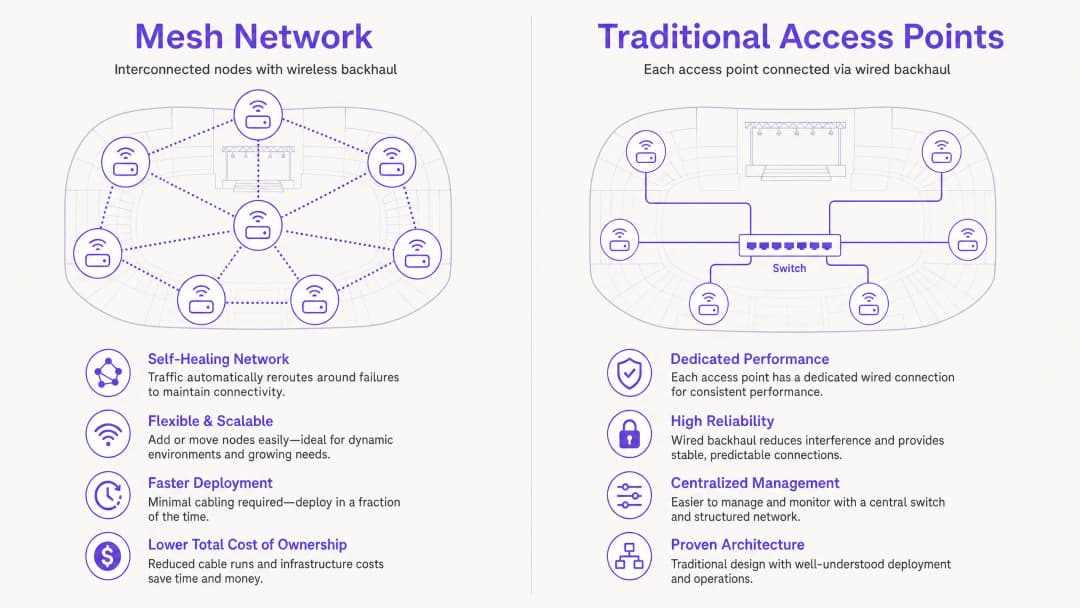
In a traditional deployment, every access point is hardwired back to an edge or core switch, typically using Cat6 or Cat6a cabling terminated to 8P8C (RJ-45) connectors. This wired backhaul ensures that 100% of the AP's radio frequency (RF) capacity is dedicated to serving client devices.
Throughput and Latency: Because backhaul traffic is handled entirely by the physical wire, traditional APs deliver deterministic, multi-gigabit throughput. Modern Wi-Fi 6 (IEEE 802.11ax) APs support up to 9.6 Gbps aggregate throughput across multiple spatial streams, and Wi-Fi 7 (IEEE 802.11be) pushes this further with Multi-Link Operation (MLO). This architecture is essential for high-density environments where sub-10ms latency is critical — point-of-sale (POS) systems, real-time analytics dashboards, and VoWLAN deployments all depend on it.
Power and Infrastructure: This approach requires robust Power over Ethernet (PoE) infrastructure. Modern Wi-Fi 6 and Wi-Fi 7 APs with full radio chains often require PoE+ (IEEE 802.3at, 30W) or PoE++ (IEEE 802.3bt, up to 90W) to function at full capacity, necessitating careful switch port and power budget planning before any hardware refresh.
Security Posture: Wired backhauls inherently reduce the physical attack surface. Combined with IEEE 802.1X port-based authentication and WPA3-Enterprise encryption, this architecture provides the strongest baseline for PCI DSS and GDPR compliance.
Mesh Network Architecture
Mesh networks replace the wired backhaul with wireless links. A typical enterprise deployment consists of a root node connected to the wired LAN, which wirelessly transmits data to satellite nodes distributed throughout the venue.
The Half-Duplex Penalty: Wi-Fi is inherently half-duplex. In a standard dual-band mesh system, the radio must alternate between serving the client device and relaying traffic to the next node in the chain. Every wireless hop effectively halves the available throughput and adds 1–5ms of additional latency. In a high-density environment with thousands of concurrent users, this latency stacks up rapidly and becomes operationally significant.
Tri-Band Mitigation: Enterprise-grade mesh systems mitigate this by utilising a dedicated third radio — typically operating in the 5GHz or 6GHz (Wi-Fi 6E) spectrum — exclusively for backhaul traffic. This prevents the backhaul from competing with client-facing radios for airtime. While this significantly improves performance over consumer-grade mesh, it still consumes valuable RF spectrum and cannot match the raw, deterministic capacity of a wired connection in a dense environment.
Self-Healing Topology: A key resilience advantage of mesh is its self-healing capability. If a satellite node loses its primary backhaul link, it can automatically reroute traffic through an adjacent node. This is particularly valuable in dynamic or temporary venue configurations where physical disruption is likely.
Side-by-Side Performance Comparison
| Attribute | Traditional Wired APs | Enterprise Mesh Network |
|---|---|---|
| Backhaul Type | Wired (Cat6/Cat6a) | Wireless (dedicated radio) |
| Throughput per AP | Up to 9.6 Gbps (Wi-Fi 6) | Reduced by ~50% per hop |
| Latency | Sub-5ms (deterministic) | 5–20ms (variable) |
| Deployment Speed | Slow (cabling required) | Fast (power only) |
| CapEx | High (cabling + switches) | Lower (minimal cabling) |
| OpEx | Low (high reliability) | Moderate (RF tuning) |
| High-Density Suitability | Excellent | Limited |
| Flexibility / Scalability | Low (fixed cable runs) | High (node repositioning) |
| PCI DSS / GDPR Compliance | Straightforward | Achievable with configuration |
Got questions about your specific setup?
Our team works with venue operators, IT managers, and network engineers across 80,000 venues. Book a 20-minute call and we will show you how others like you solved it.
Implementation Guide
Step 1: RF Predictive Survey and Density Mapping
Before selecting hardware, commission a predictive RF site survey using tools such as Ekahau Pro or iBwave. Map your venue into distinct zones:
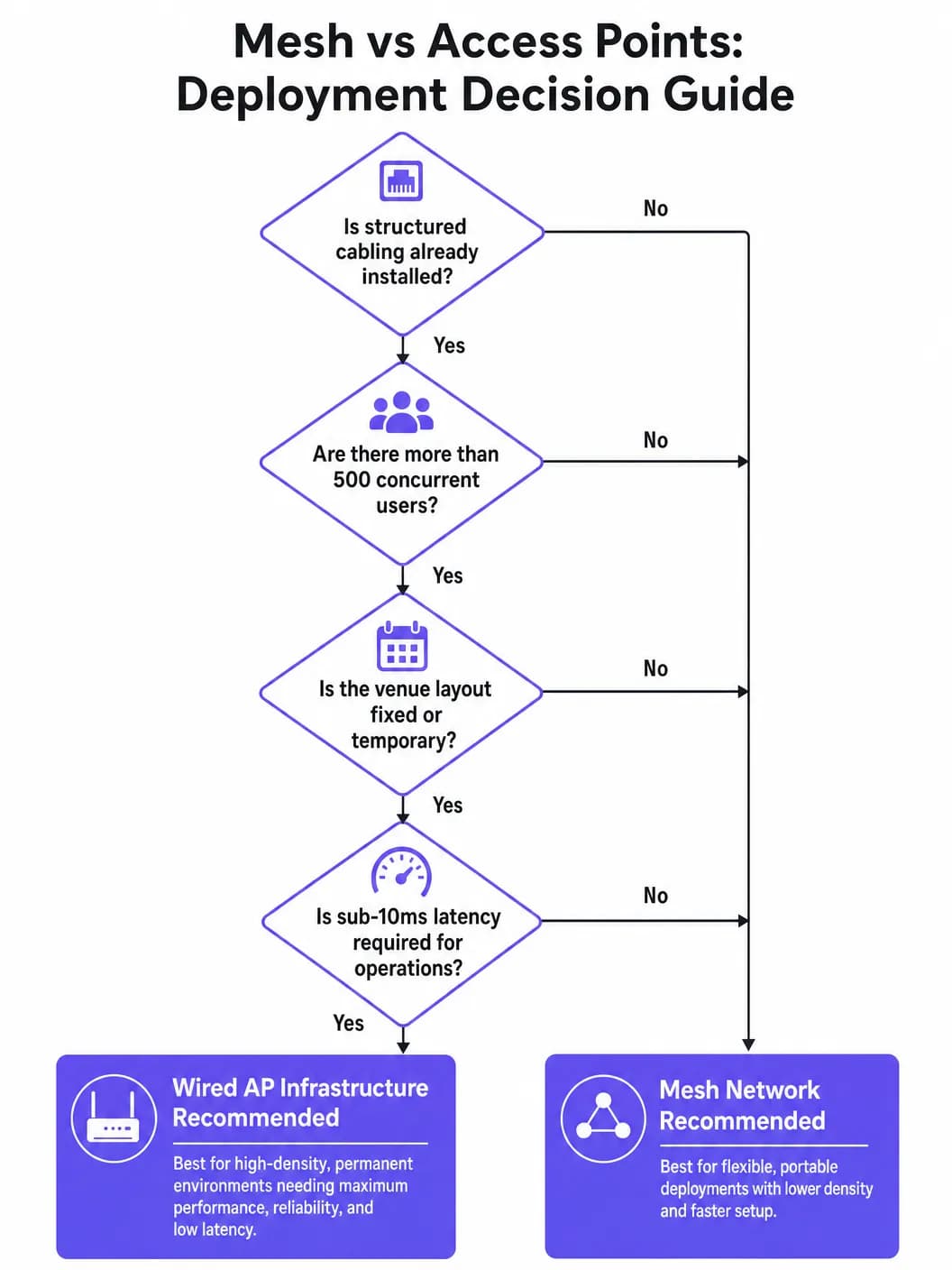
- High-Density Zones: Conference halls, stadium seating bowls, hotel lobbies, retail checkout areas. These require wired APs.
- Medium-Density Zones: Hotel corridors, retail floor space, office wings. Wired APs preferred; mesh viable.
- Hard-to-Wire / Temporary Zones: Outdoor patios, historic building wings, temporary event spaces. Mesh is the practical choice.
Step 2: Architecture Selection and Hybrid Design
For most large venues, a hybrid architecture is the optimal outcome: wired APs in the high-density core and mesh nodes extending coverage to peripheral or constrained areas. This approach balances capital efficiency with performance.
Step 3: Backhaul Infrastructure Sizing
For wired deployments, ensure your edge switches provide sufficient PoE budget. A 48-port PoE++ switch with a 90W per-port budget and a 2.5GbE or 10GbE uplink to the core is the recommended baseline for a modern Wi-Fi 6/7 deployment. For mesh, ensure root nodes are connected via multi-gigabit uplinks to handle the aggregated traffic from all satellite nodes.
Step 4: Security and Compliance Configuration
Regardless of architecture, configure the following:
- WPA3-Enterprise on all corporate and operational SSIDs.
- IEEE 802.1X with a RADIUS server (e.g., FreeRADIUS, Cisco ISE, or a cloud-hosted equivalent) for device authentication.
- VLAN segmentation to isolate guest traffic from POS and back-office systems. This is a mandatory control for PCI DSS compliance.
- Wireless Intrusion Prevention System (WIPS) to detect and contain rogue APs.
Step 5: Platform Integration
The hardware layer is the foundation, but the business value is unlocked at the software layer. Ensure your chosen AP vendor's firmware supports the API integrations required by your guest WiFi and analytics platform. Purple's platform is hardware-agnostic, supporting major vendors including Cisco Meraki, Aruba, Ruckus, and Ubiquiti. This enables you to capture guest data, run captive portal journeys, and feed WiFi Analytics dashboards regardless of your underlying hardware choice. For a deeper look at how management architecture affects this, see Comparing Controller-Based vs. Cloud-Managed Access Points.
Best Practices
Limit Mesh Hops to Three. Never design a mesh network that requires more than three wireless hops from a satellite node back to the root node. Beyond three hops, latency becomes unacceptable for enterprise applications and throughput degrades to a point where the user experience is materially impacted.
Conduct a PoE Budget Audit Before Any Hardware Refresh. Upgrading to Wi-Fi 6 or Wi-Fi 7 APs without upgrading the edge switches is a common and costly mistake. New APs often require PoE++ (802.3bt) while existing switches may only support PoE+ (802.3at), causing APs to reboot under load.
Standardise on WPA3 Across All SSIDs. WPA3's Simultaneous Authentication of Equals (SAE) handshake eliminates the KRACK and dictionary-attack vulnerabilities present in WPA2. For venues handling payment data or sensitive personal data under GDPR, this is a non-negotiable baseline.
Treat Mesh Backhaul Links as Critical Infrastructure. In a mesh deployment, the wireless link between nodes is as important as a cable. Monitor backhaul link quality (RSSI, SNR, and MCS rate) continuously. A degraded backhaul link will silently throttle the performance of every client connected downstream.
Leverage Hardware Agnosticism for Vendor Negotiation. By separating the software management layer (Purple's platform) from the hardware layer, you retain the ability to switch hardware vendors at refresh cycles. This competitive leverage typically reduces hardware costs by 15–25% over a 5-year TCO period.
Troubleshooting & Risk Mitigation
Common Failure Modes
The Hidden Node Problem. In mesh networks, if two satellite nodes cannot 'hear' each other but are both transmitting to the same root node simultaneously, packet collisions occur, destroying throughput. This is particularly common in venues with complex RF environments. Mitigation: Careful RF tuning, adjusting transmit power levels, and using RTS/CTS (Request to Send/Clear to Send) mechanisms.
PoE Budget Exhaustion. As noted above, deploying new high-power APs on legacy PoE infrastructure causes intermittent reboots under load. Mitigation: Conduct a full PoE budget audit prior to deployment. Calculate the total worst-case power draw of all connected devices against the switch's total PoE budget.
Rogue AP Interference. Unmanaged consumer-grade devices broadcasting in the same airspace — particularly in venues where exhibitors or tenants bring their own equipment — will severely degrade both mesh backhaul and client access. Mitigation: Implement continuous WIPS scanning and enforce a clear policy prohibiting unauthorised wireless devices.
Mesh Node Placement in Dead Zones. A common deployment error is placing a mesh satellite node in the coverage dead zone it is intended to fix. If the node cannot receive a strong backhaul signal, it cannot provide good client coverage. Mitigation: Place the satellite node halfway between the root node and the dead zone, where backhaul signal is strong, and rely on the satellite's client-facing radios to reach the dead zone.
ROI & Business Impact
When evaluating the ROI of your wireless infrastructure, look beyond the initial CapEx of the hardware.
| Cost Category | Traditional Wired APs | Mesh Network |
|---|---|---|
| Hardware CapEx | Moderate | Lower |
| Cabling CapEx | High ($150–$300/drop) | Minimal |
| Installation Labour | High | Low |
| Ongoing RF Tuning OpEx | Low | Moderate |
| Hardware Lifecycle | 5–7 years | 3–5 years |
| Downtime Risk | Low | Moderate |
For a 500-room hotel deploying 300 APs, the cabling cost alone for a traditional deployment can reach £60,000–£90,000. A mesh deployment in the same venue could reduce this to under £10,000, representing a significant CapEx saving — provided the performance trade-off is acceptable for the use case.
Ultimately, the infrastructure is a vehicle for data. A robust, well-designed network — whether wired, mesh, or hybrid — enables venues to capture actionable guest analytics, drive personalised marketing, and improve operational efficiency. Platforms like Purple's Guest WiFi transform the network from a cost centre into a revenue-generating asset. For practical strategies on leveraging this data, see How To Improve Guest Satisfaction: The Ultimate Playbook. The evolution towards seamless, passwordless authentication further enhances this value, as explored in How a wi fi assistant Enables Passwordless Access in 2026.
For public-sector venues and smart city deployments, the network infrastructure also plays a foundational role in digital inclusion initiatives, a strategic priority that Purple is actively driving, as reflected in Purple Appoints Iain Fox as VP Growth – Public Sector to Drive Digital Inclusion and Smart City Innovation.
Audio Briefing
Listen to our Senior Solutions Architect discuss the architectural nuances in this 10-minute technical briefing:
Key Definitions
Wireless Backhaul
The use of wireless communication to transmit data from an access point back to the core network, rather than using a physical Ethernet cable.
The defining characteristic of a mesh network. Saves cabling costs and enables flexible deployment but consumes RF spectrum and introduces latency.
Tri-Band Radio
An access point equipped with three separate radios - typically one 2.4GHz and two 5GHz or 6GHz radios - allowing one radio to be dedicated exclusively to wireless backhaul traffic.
Essential for enterprise mesh networks. Without a dedicated backhaul radio, client-facing throughput is severely degraded as the AP must share its radios between serving clients and relaying traffic.
Deterministic Performance
Network behaviour where latency and throughput are predictable and consistent, regardless of minor environmental changes or load fluctuations.
A key advantage of wired Access Points, critical for applications like Voice over WLAN (VoWLAN), real-time POS systems, and any latency-sensitive operational technology.
Root Node
The access point in a mesh network that has a physical wired connection to the LAN and acts as the gateway for all downstream wireless satellite nodes.
Proper placement and sizing of root nodes are critical to prevent bottlenecks. The root node's uplink capacity sets the ceiling for all downstream mesh traffic.
Power over Ethernet (PoE)
An IEEE standard (802.3af/at/bt) that allows Ethernet cables to transmit both data and electrical power simultaneously to connected devices such as access points.
A major planning consideration for wired AP deployments. IT teams must ensure their switches have sufficient PoE budgets (PoE+ at 30W or PoE++ at up to 90W) to support modern WiFi 6/7 hardware.
IEEE 802.1X
An IEEE standard for port-based network access control, providing an authentication mechanism to devices attempting to connect to a LAN or WLAN via a RADIUS server.
Crucial for enterprise security and compliance. Ensures only authorised devices and users can access corporate network segments, a baseline requirement for PCI DSS and ISO 27001 compliance.
VLAN Segmentation
The practice of dividing a single physical network into multiple logical networks (VLANs) to isolate traffic between different user groups or systems.
Mandatory for PCI DSS compliance. Guest WiFi traffic must be completely isolated from payment terminals and back-office systems. Failure to segment correctly is one of the most common PCI audit failures.
Multi-Link Operation (MLO)
A key feature of WiFi 7 (IEEE 802.11be) that allows a device to simultaneously transmit and receive data across multiple frequency bands (e.g., 2.4GHz, 5GHz, and 6GHz) at the same time.
Significantly increases throughput and reduces latency for supported client devices. Particularly relevant for high-density venue planning as WiFi 7 infrastructure becomes more prevalent.
Wireless Intrusion Prevention System (WIPS)
A security system that monitors the wireless radio spectrum for the presence of unauthorised access points and takes automated countermeasures to contain them.
Essential for venues where exhibitors, tenants, or guests may bring their own wireless devices. Rogue APs are a significant source of both RF interference and security risk.
Worked Examples
A 400-room historic hotel needs to provide wall-to-wall WiFi. The main lobby and conference centre have drop ceilings, but the guest wings feature solid concrete walls where drilling new cable runs is prohibited by heritage preservation rules. The hotel also needs to capture guest data for its CRM and loyalty programme.
Deploy a hybrid architecture. Install traditional wired WiFi 6 Access Points (e.g., Aruba AP-635 or Cisco Catalyst 9136) in the lobby and conference centre, where high density demands maximum throughput and drop ceilings allow for easy Cat6a routing. For the guest wings, deploy a tri-band enterprise mesh network with root nodes installed in the hallways at existing legacy Ethernet drops, and wireless satellite nodes placed in corridor alcoves to propagate signal without drilling. Configure a single SSID with 802.1X authentication across both wired and mesh APs, with a captive portal managed by Purple's Guest WiFi platform. VLAN 10 for guest traffic, VLAN 20 for management. Ensure the mesh nodes support the Purple API integration for analytics data capture.
A large outdoor music festival expects 20,000 attendees over a 3-day weekend across a 15-hectare greenfield site. The site has no existing infrastructure. POS vendors require sub-50ms latency for transaction processing. The event organiser also wants to offer branded guest WiFi with a splash page for sponsor activation.
Deploy a Point-to-Multipoint (PtMP) wireless backhaul from the production compound to light towers around the festival grounds using 5GHz or 60GHz directional radios. At each light tower, install a root mesh node connected to the PtMP radio via a short Cat6 run. Deploy 1–2 satellite mesh nodes per zone for area fill. Segment POS traffic onto a dedicated, hidden SSID (VLAN 30) with strict QoS priority (DSCP EF marking) over guest traffic. Deploy a separate branded guest SSID (VLAN 40) with a Purple captive portal for sponsor activation and guest data capture. Ensure all mesh nodes are powered via PoE from compact managed switches at each light tower, fed by the site's temporary power distribution.
Practice Questions
Q1. Your team is deploying WiFi across a newly constructed 500,000 sq ft retail distribution centre. The facility features 40-foot ceilings and heavy metal racking. The primary use case is barcode scanners mounted on forklifts that require seamless roaming and sub-20ms latency to the inventory management server. Budget is not a constraint. Do you recommend a mesh network or traditional wired APs?
Hint: Consider the impact of heavy metal racking on RF propagation, the latency requirements of the barcode scanners, and the roaming behaviour of mobile devices on mesh vs wired networks.
View model answer
Traditional wired APs are the clear recommendation. The heavy metal racking will cause significant multipath interference and signal attenuation, which would severely degrade the wireless backhaul links of a mesh network. Furthermore, the strict sub-20ms latency requirement for the barcode scanners demands the deterministic performance of a wired backhaul. Use directional antennas mounted high in the aisles to direct the signal down between the racks. Implement 802.11r (Fast BSS Transition) and 802.11k/v (neighbour reports and BSS transition management) on all APs to ensure seamless roaming for the forklift-mounted scanners.
Q2. A boutique hotel is expanding by converting an adjacent 19th-century townhouse into 15 luxury suites. The building owner refuses to allow any new conduit or visible cabling in the hallways or rooms. You have one existing Ethernet drop in the basement from the main building. How do you provide high-speed guest WiFi across all 15 suites?
Hint: You need to provide coverage across multiple floors without running new cables from the basement. Consider the backhaul path from the basement to the upper floors.
View model answer
Deploy a tri-band enterprise mesh network. Connect the root node to the single Ethernet drop in the basement. Place satellite nodes strategically on each floor, positioned as close to vertical alignment above the root node as possible to establish a strong wireless backhaul through the floorboards. The tri-band system ensures the dedicated 6GHz backhaul radio does not interfere with the 5GHz client access radios, providing sufficient bandwidth for the luxury suites. Integrate with Purple's Guest WiFi platform to deliver a branded captive portal experience and capture guest data for the hotel's CRM.
Q3. You are upgrading a 60,000-capacity stadium's WiFi to support concurrent fan connectivity. The previous deployment used a mix of wired APs and mesh nodes, but fans consistently reported unusable speeds during halftime. A full rip-and-replace budget has been approved. What is the core architectural strategy and what was the likely cause of the halftime performance failure?
Hint: High density is the primary constraint. What happens to mesh backhaul capacity when thousands of clients simultaneously attempt to upload content?
View model answer
The halftime performance failure was almost certainly caused by the mesh nodes' wireless backhaul links being saturated by the sudden surge in concurrent client traffic - thousands of fans simultaneously uploading photos and videos to social media. The wireless backhaul, already consuming RF spectrum, was overwhelmed. The core strategy for the replacement must be a 100% traditional wired AP architecture utilising WiFi 6 or WiFi 7 access points with high-density directional antennas deployed under seats or in overhanging fascia positions. Every AP must have a dedicated multi-gigabit wired connection back to the core. Mesh nodes have no place in a 60,000-capacity stadium deployment.
Continue reading in this series
What is a WLC (Wireless LAN Controller) and Do You Still Need One?
This comprehensive guide explores the evolution of Wireless LAN Controllers (WLCs) and provides a technical framework for determining the right architecture in 2026. It covers traditional hardware, cloud-managed, and controller-less models, detailing their impact on compliance, scalability, and guest experience.
The Best Wi-Fi Access Points for Enterprise and Homelabs
This technical guide evaluates the best enterprise Wi-Fi access points for 2025-2026, covering Wi-Fi 6E and Wi-Fi 7 hardware from Cisco, HPE Aruba, Ruckus, Juniper Mist, and Ubiquiti across high-density hospitality, retail, and public venue deployments. It provides actionable architecture strategies, vendor comparisons, security frameworks, and ROI metrics for IT leaders building next-generation wireless networks. Purple's hardware-agnostic guest WiFi and analytics platform is mapped throughout as the intelligence layer that transforms network infrastructure into a first-party data asset.
Cisco Meraki vs. Aruba: A Technical Comparison for Guest WiFi
An authoritative technical comparison of Cisco Meraki and HPE Aruba for enterprise guest WiFi deployments. This guide provides actionable insights for IT managers and architects on architecture, authentication, network segmentation, and hardware-agnostic analytics integration.
Got questions about your specific setup?
Our team works with venue operators, IT managers, and network engineers across 80,000 venues. Book a 20-minute call and we will show you how others like you solved it.